

FprEN 15732
(Main)Lightweight fill and thermal insulation products for civil engineering applications (CEA) - Expanded clay lightweight aggregate products (LWA)
General Information
- Abstract
This document specifies the assessment of characteristics for loose-fill expanded clay lightweight aggregate products (hereafter as: expanded clay LWA) intended to be used for application in civil engineering works.
This document covers the use of expanded clay LWA as:
- lightweight fill and insulation materials in embankments for roads, railways and other trafficked areas;
- lightweight backfill for structures.
This document specifies procedures for assessment and verification of constancy of performance (AVCP) of characteristics of the expanded clay LWA.
This document does not cover the expanded clay LWA:
- which are intended to be used as thermal insulation in- and under buildings (already covered in EN 14063-1:2004).
- Status
- Not Published
- Publication Date
- 22-Nov-2020
- Withdrawal Date
- 23-May-2021
- Technical Committee
- CEN/TC 88 - Thermal insulating materials and products
- Drafting Committee
- CEN/TC 88/WG 20 - Project development of WI 00088165.
- Current Stage
- 5098 - Decision to abandon - Formal Approval
- Start Date
- 14-Jun-2023
- Completion Date
- 30-Sep-2026

Overview
FprEN 15732 is a European standard developed by CEN that specifies the assessment of expanded clay lightweight aggregate (LWA) products used in civil engineering applications (CEA). These lightweight fill and thermal insulation materials are designed primarily for embankments in roads, railways, other trafficked areas, and backfill for structures. The standard outlines detailed procedures for evaluating product characteristics, testing, marking, and labelling while ensuring constancy of performance.
This standard excludes the use of expanded clay LWA as thermal insulation in or under buildings, which is covered separately by EN 14063-1. It provides essential requirements and test methods to support quality control in manufacturing and confirm product suitability for civil engineering use.
Key Topics
Scope and Application
Specifies loose-fill expanded clay LWAs for civil engineering applications like lightweight fill in embankments and backfill for structures, excluding thermal insulation in buildings.Product Characteristics Assessment
Defines testing and verification procedures to assess crucial product properties including:- Loose bulk density (EN 1097-3)
- Particle size distribution (EN 933-1)
- Reaction to fire (EN 13501-1)
- Durability against aging, chemicals, and biological attack
- Thermal resistance and conductivity (EN 14063-1)
- Mechanical properties such as compressive strength, compressibility, shear strength, cyclic loading resistance, and creep
Testing and Sampling Procedures
Includes detailed sampling methods (EN 932 series) and standardized laboratory tests for bulk density, water content, water absorption, mechanical resistance, and shear properties. Test annexes explain triaxial tests, cyclic compressive loading, and compressive creep.Durability and Stability
Assesses product stability under long-term load, resistance to dynamic loads and chemical/biological degradation, ensuring long-lasting performance in civil engineering structures.Conformity and Marking
Establishes factory production control requirements and specifies product marking and labelling to ensure traceability and compliance with performance declarations.
Applications
Expanded clay lightweight aggregate products as covered by FprEN 15732 are widely used in civil engineering projects requiring lightweight fill or thermal insulation properties, including:
Road and Railway Embankments
Providing stable, lightweight fill material that reduces load on underlying soils and improves insulation.Lightweight Backfill Materials
Used around retaining walls, foundations, and buried structures to minimize soil pressure and improve drainage.Thermal Insulation in Civil Infrastructure
Serving as thermal insulation layers in embankments and ground structures, enhancing energy efficiency and frost protection.
The standard supports civil engineers, contractors, and manufacturers by providing reliable methods to characterize expanded clay LWA products, ensuring that specified properties meet project requirements for strength, thermal performance, and durability.
Related Standards
EN 14063-1 - Thermal insulation materials and products: Specifications for expanded clay LWA used inside or under buildings (excluded from this document).
EN 13055-1 and EN 13055-2 - Lightweight aggregates used in concrete, mortar, bituminous mixtures, and unbound applications.
EN 932 series - Sampling and reduction methods for aggregates.
EN 1097 series - Tests for mechanical and physical properties of aggregates, including density, water content, and absorption.
EN 13501-1 - Fire classification of construction products (reaction to fire).
EN 13172 - Evaluation of conformity for thermal insulation products.
EN 12524 - Hygrothermal properties of building materials (for thermal capacity values).
EN 13286 series - Test methods for unbound and hydraulically bound mixtures; relevant for cyclic load and triaxial tests.
Applying FprEN 15732 in conjunction with these complementary standards ensures comprehensive quality control and performance assessment of expanded clay lightweight aggregates used in civil engineering, promoting safety, efficiency, and sustainability in infrastructure construction.
Relations
- Effective Date
- 21-Mar-2018
Get Certified
Connect with accredited certification bodies for this standard

DIBt (Deutsches Institut für Bautechnik)
German Institute for Building Technology.
DIN CERTCO
DIN Group product certification.

Aboma Certification B.V.
Specialized in construction, metal, and transport sectors.
Sponsored listings
Frequently Asked Questions
FprEN 15732 is a draft published by the European Committee for Standardization (CEN). Its full title is "Lightweight fill and thermal insulation products for civil engineering applications (CEA) - Expanded clay lightweight aggregate products (LWA)". This standard covers: This document specifies the assessment of characteristics for loose-fill expanded clay lightweight aggregate products (hereafter as: expanded clay LWA) intended to be used for application in civil engineering works. This document covers the use of expanded clay LWA as: - lightweight fill and insulation materials in embankments for roads, railways and other trafficked areas; - lightweight backfill for structures. This document specifies procedures for assessment and verification of constancy of performance (AVCP) of characteristics of the expanded clay LWA. This document does not cover the expanded clay LWA: - which are intended to be used as thermal insulation in- and under buildings (already covered in EN 14063-1:2004).
This document specifies the assessment of characteristics for loose-fill expanded clay lightweight aggregate products (hereafter as: expanded clay LWA) intended to be used for application in civil engineering works. This document covers the use of expanded clay LWA as: - lightweight fill and insulation materials in embankments for roads, railways and other trafficked areas; - lightweight backfill for structures. This document specifies procedures for assessment and verification of constancy of performance (AVCP) of characteristics of the expanded clay LWA. This document does not cover the expanded clay LWA: - which are intended to be used as thermal insulation in- and under buildings (already covered in EN 14063-1:2004).
FprEN 15732 is classified under the following ICS (International Classification for Standards) categories: 91.100.60 - Thermal and sound insulating materials. The ICS classification helps identify the subject area and facilitates finding related standards.
FprEN 15732 has the following relationships with other standards: It is inter standard links to EN 15732:2012. Understanding these relationships helps ensure you are using the most current and applicable version of the standard.
FprEN 15732 is associated with the following European legislation: EU Directives/Regulations: 305/2011, 89/106/EEC; Standardization Mandates: M/103, M/138. When a standard is cited in the Official Journal of the European Union, products manufactured in conformity with it benefit from a presumption of conformity with the essential requirements of the corresponding EU directive or regulation.
FprEN 15732 is available in PDF format for immediate download after purchase. The document can be added to your cart and obtained through the secure checkout process. Digital delivery ensures instant access to the complete standard document.
Standards Content (Sample)
SLOVENSKI STANDARD
01-februar-2008
Toplotnoizolacijski in lahki polnilni proizvodi za inženirske objekte - Proizvodi iz
ekspandiranega glinenega agregatnega proizvoda (LWA)
Light weight fill and thermal insulation products for civil engineering applications (CEA) -
Expanded clay lightweight aggregate products (LWA)
Leichte Schütt- und Wärmedämmstoffe für bautechnische Anwendungen (CEA) -
Produkte aus Blähton-Leichtzuschlagstoffen (LWA)
Ta slovenski standard je istoveten z: prEN 15732
ICS:
91.100.60
2003-01.Slovenski inštitut za standardizacijo. Razmnoževanje celote ali delov tega standarda ni dovoljeno.
EUROPEAN STANDARD
DRAFT
prEN 15732
NORME EUROPÉENNE
EUROPÄISCHE NORM
October 2007
ICS 91.100.60
English Version
Light weight fill and thermal insulation products for civil
engineering applications (CEA) - Expanded clay lightweight
aggregate products (LWA)
Leichte Schütt- und Wärmedämmstoffe für bautechnische
Anwendungen (CEA) - Produkte aus Blähton-
Leichtzuschlagstoffen (LWA)
This draft European Standard is submitted to CEN members for enquiry. It has been drawn up by the Technical Committee CEN/TC 88.
If this draft becomes a European Standard, CEN members are bound to comply with the CEN/CENELEC Internal Regulations which
stipulate the conditions for giving this European Standard the status of a national standard without any alteration.
This draft European Standard was established by CEN in three official versions (English, French, German). A version in any other language
made by translation under the responsibility of a CEN member into its own language and notified to the CEN Management Centre has the
same status as the official versions.
CEN members are the national standards bodies of Austria, Belgium, Bulgaria, Cyprus, Czech Republic, Denmark, Estonia, Finland,
France, Germany, Greece, Hungary, Iceland, Ireland, Italy, Latvia, Lithuania, Luxembourg, Malta, Netherlands, Norway, Poland, Portugal,
Romania, Slovakia, Slovenia, Spain, Sweden, Switzerland and United Kingdom.
Recipients of this draft are invited to submit, with their comments, notification of any relevant patent rights of which they are aware and to
provide supporting documentation.
Warning : This document is not a European Standard. It is distributed for review and comments. It is subject to change without notice and
shall not be referred to as a European Standard.
EUROPEAN COMMITTEE FOR STANDARDIZATION
COMITÉ EUROPÉEN DE NORMALISATION
EUROPÄISCHES KOMITEE FÜR NORMUNG
Management Centre: rue de Stassart, 36 B-1050 Brussels
© 2007 CEN All rights of exploitation in any form and by any means reserved Ref. No. prEN 15732:2007: E
worldwide for CEN national Members.
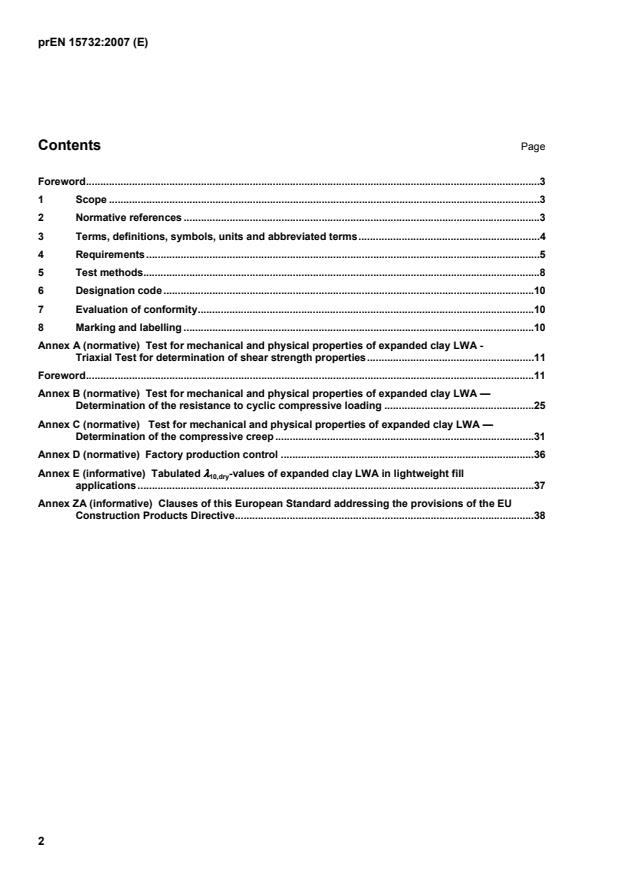
prEN 15732:2007 (E)
Contents Page
Foreword.3
1 Scope .3
2 Normative references .3
3 Terms, definitions, symbols, units and abbreviated terms.4
4 Requirements.5
5 Test methods.8
6 Designation code.10
7 Evaluation of conformity.10
8 Marking and labelling .10
Annex A (normative) Test for mechanical and physical properties of expanded clay LWA -
Triaxial Test for determination of shear strength properties.11
Foreword.11
Annex B (normative) Test for mechanical and physical properties of expanded clay LWA —
Determination of the resistance to cyclic compressive loading .25
Annex C (normative) Test for mechanical and physical properties of expanded clay LWA —
Determination of the compressive creep .31
Annex D (normative) Factory production control .36
Annex E (informative) Tabulated λλ -values of expanded clay LWA in lightweight fill
λλ
10,dry
applications .37
Annex ZA (informative) Clauses of this European Standard addressing the provisions of the EU
Construction Products Directive.38
prEN 15732:2007 (E)
Foreword
This document (prEN 15732:2007) has been prepared by Technical Committee CEN/TC 88 “Thermal
insulating materials and products”, the secretariat of which is held by DIN.
This document is currently submitted to the CEN Enquiry.
This document has been prepared under a mandate given to CEN by the European Commission and the
European Free Trade Association, and supports essential requirements of EU Directive(s). This document has
been progressed to CEN Enquiry even though a confirmation from the Commission that it can be considered as a
candidate harmonized standard is outstanding. An answer is being expected before the formal vote procedure. An
amendment to the answer to mandate M/103 is finalized.
For relationship with EC Directive(s), see informative Annex ZA which is an integral part of this document.
1 Scope
This standard describes the product characteristics and includes procedures for testing, marking and labelling.
This European Standard specifies the requirements for loose-fill expanded clay lightweight aggregate
(expanded clay LWA) products for Civil Engineering Applications excluding the use as thermal insulation in
and under buildings which are covered by European Standard EN 14063-1. The standard covers the use of
expanded clay LWA as lightweight fill and insulation materials in embankments for roads, railways and other
trafficked areas and as lightweight backfill for structures.
This standard does not specify the required level of a given property to be achieved by a product to
demonstrate fitness for purpose in a particular application. The levels required for a given application are to be
found in regulations or non-conflicting standards.
2 Normative references
The following referenced documents are indispensable for the application of this document. For dated
references, only the edition cited applies. For undated references, the latest edition of the referenced
document (including any amendments) applies.
EN 932-1, Test for general properties of aggregates - Part 1: Methods for sampling
EN 932-2, Test for general properties of aggregates - Part 2: Methods for reducing laboratory samples
EN 933-1, Test for geometrical properties of aggregates - Part 1: Determination of particle size distribution -
Sieving method
EN 1097-3, Test for mechanical and physical properties of aggregates - Part 3: Determination of loose bulk
density and voids
EN 1097-5, Test for mechanical and physical properties of aggregates - Part 5: Determination of water content
by drying in a ventilated oven
EN 1097-6, Test for mechanical and physical properties of aggregates - Part 6: Determination of particle
density and water absorption
EN ISO 10456, Thermal insulation building materials and products – Determination of declared and design
values (ISO 10456:1999)
prEN 15732:2007 (E)
EN 12524, Building materials and products – Hygrothermal properties – Tabulated design values
EN 13055-1, Lightweight aggregates – Part 1: Lightweight aggregates for concrete, mortar and grout
EN 13055-2, Lightweight aggregates – Part 2: Lightweight aggregates for bituminous mixtures and surface
treatments and for unbound and bound applications.
EN 13172, Thermal Insulation products - Evaluation of conformity
EN 13286-4, Unbound and hydraulically bound mixtures - Part 4: Test methods for laboratory reference
density and water content - Vibrating hammer.
EN 13286-5, Unbound and hydraulically bound mixtures - Part 5: Test methods for laboratory reference
density and water content - Vibrating table.
EN 13286-7, Unbound and hydraulically bound mixtures - Part 7: Cyclic load triaxial test for unbound mixtures
EN 13501-1, Fire classification of construction products and building elements – Part 1: Classification using
test data from reaction to fire test
EN 13820, Thermal insulation materials for building applications - Determination of organic content
EN 14063-1, Thermal insulation materials and products – In-situ formed expanded clay lightweight aggregate
products (LWA) – Part 1: Specification for the loose-fill products before installation
prEN ISO 9229, Thermal insulation – Definitions of terms (ISO/DIS 9229:2005)
3 Terms, definitions, symbols, units and abbreviated terms
3.1 Terms and definitions
For the purposes of this document, the following terms and definitions apply. Other terms used for insulation
products are given in prEN ISO 9229.
3.1.1
expanded clay lightweight aggregate
Insulation material or product composed of lightweight granular material having a cellular structure formed by
expanding clay minerals by heat.
3.1.2
compressibility
Deformation at a certain load of a vibrated specimen, given as a load-deformation curve
3.1.3
compressive strength, CS(10)
The load where the deformation of a vibrated specimen is 10%
3.1.4
stiffness modulus
The stiffness modulus is given as the tangent to the load-deformation curve and shall be related to the level of
deformation.
3.1.5
compressive creep (CC)
Compressive creep is the deformation at a constant load in a specified time.
prEN 15732:2007 (E)
3.1.6
compaction
Mechanical compression (e.g. by vibrator) of the installed insulation layer, expressed as a percentage of the
initial untreated layer thickness.
3.1.7
level
Given value, which is the upper or lower limit of a requirement. The level is given by the declared value of the
characteristic concerned.
3.1.8
class
Combination of two levels of the same property, between which the performance shall fall, where the levels
are given by the declared value of the characteristic concerned.
3.2 Symbols, units and abbreviated terms
Symbols and units used in this standard:
LD is the symbol of the declared level for loose bulk density
PS is the symbol of the declared level for aggregate size (mm)
CS(10) is the symbol of the declared level for compressive strength at 10 % deformation
CC is the symbol of the declared level for compressive creep
Abbreviated terms used in this standard:
LWA is Lightweight Aggregate
ITT is Initial Type Test
CEA is Civil Engineering Applications
4 Requirements
4.1 General
Product properties shall be assessed in accordance with Clause 5. To conform with this standard, products
shall meet the requirements of 4.2 and the requirements of 4.3 as appropriate.
Sampling of expanded clay LWA shall be performed according to EN 932-1 and splitting of samples according
to EN 932-2.
One test result on a product property is the average of the measured values on the number of test specimens
given in Table 1.
4.2 For all applications
4.2.1 Loose bulk density
Loose bulk density shall be declared and determined in accordance with EN 1097-3. The dry loose bulk
3 3
density shall be declared by the manufacturer with steps of 5 kg/m up to a density of 400 kg/m and thereafter
with steps of 10 kg/m . It shall be in the range of ±15% of the manufacturers declared value with a maximum of
3 3
± 100 kg /m .The value shall be expressed in kg/m .
NOTE The value of the density used for design purposes will be influenced by compaction and water content
prEN 15732:2007 (E)
4.2.2 Particle size distribution
4.2.2.1 General
Particle size distribution shall be measured in accordance with EN 933-1, without washing, and shall be
declared in % by mass.
4.2.2.2 Aggregate size
The pair of sieve sizes between which the main proportion of the particles lies shall designate the size and
any undersize or oversize shall comply with clauses 4.2.2.3 and 4.2.2.4.
The sieve sizes in mm shall be selected from the specifications in EN 13055-2.
NOTE Normally the aggregate size for expanded clay LWA products will be in the range 0 mm - 32 mm.
4.2.2.3 Undersize
The content of undersize material shall not exceed 15% by mass.
4.2.2.4 Oversize
The content of oversize material shall not exceed 10% by mass.
4.2.3 Reaction to fire
Reaction to fire classification (Euroclasses) shall be determined in accordance with EN 13501-1.
NOTE Expanded clay LWA described in clause 3.1.1 of the standard is classified, without testing, as a class A1
product in accordance with Commission Decision 96/603/EC as amended by decision 2000/605/EC as it is demonstrated
that the product has an organic content less than 1 %, determined by EN 13820.
4.2.4 Durability characteristics
4.2.4.1 General
The appropriate durability characteristics have been considered and are covered in 4.2.4.2 to 4.2.4.6.
Note: The product is a clay mineral product burnt to clinkers in a stable structure.
4.2.4.2 Durability of reaction to fire against ageing/degradation
The reaction to fire performance of expanded clay LWA does not change with time.
4.2.4.3 Durability of thermal resistance against ageing/degradation
The thermal conductivity (4.3.3) of the product does not change with time.
4.2.4.4 Durability of compressive strength against ageing/degradation
The compressive strength of expanded clay does not change with time.
4.2.4.5 Durability of resistance to dynamic loads against ageing/degradation
The resistance to dynamic loads does not change with time.
4.2.4.6 Durability against chemicals and biological attack
The expanded clay LWA is a ceramic material and is durable against chemicals and biological attack.
prEN 15732:2007 (E)
4.3 For specific applications
4.3.1 General
If there is no requirement for a property, described in 4.3.2 – 4.3.16, for a product in use, then the property
need not to be determined and declared by the manufacturer.
4.3.2 Thermal resistance and thermal conductivity
The thermal conductivity and thermal resistance shall be determined in accordance with EN 14063-1.
For light weight fill applications without thermal insulation requirements it is permitted to declare tabulated
thermal values in accordance with annex E.
4.3.3 Specific heat capacity
A typical value of 1000 J/kgK can be used for the specific heat capacity of expanded clay LWA, in accordance
with EN 12524.
4.3.4 Particle density
The particle density of the grains shall be determined in accordance with EN 1097-6, Annex C. It shall be in
the range of ± 15% with a maximum of ± 150 kg/m of the declared value.
4.3.5 Water content
The water content shall be determined in accordance with EN 1097-5.
4.3.6 Water absorption
The water absorption shall be determined in accordance with EN 1097-6, Annex C. Water absorption test
should be performed also with an immersion time of 28 days.
4.3.7 Compressibility and compressive strength
The compressibility, in terms of load-deformation curve, stiffness modulus, and the compressive strength
CS(10) shall be determined in accordance with EN 13055-2, Annex A. The stiffness modulus shall be given as
the tangent to the load-deformation curve and related to the level of deformation.
NOTE The compressive strength at 10% deformation is not a design value, it is used as a reference value for
material characterisation only. For characterisation of material properties the stiffness modulus and the load at a
deformation level at maximum 2% is more relevant.
4.3.8 Compressive creep
The compressive creep, in terms of deformation in % of the height of a vibrated sample, shall be determined
in accordance with Annex C. The load shall be applied in load steps corresponding to stress levels of 50kPa
from 50 kPa and upwards.
4.3.9 Shear strength – static loading
The shear strength properties shall be determined in accordance with Annex A. The method using the
pressure cell, annex A6, shall be used as reference test method.
4.3.10 Cyclic compression
The cyclic compression shall be determined in accordance with Annex B. The cyclic load shall be applied in
load steps corresponding to stress levels of 50kPa from 50 kPa and upwards. The results shall be given as
deformation in % related to the stress level.
prEN 15732:2007 (E)
4.3.11 Shear strength – cyclic loading
The resilient modulus (elastic stiffness) and resistance to permanent deformations shall be determined by
cyclic triaxial tests. Cyclic triaxial testing shall be performed in accordance with EN 13286-7. The multistage
loading procedure (low stress level) shall be followed.
NOTE The development of permanent deformations is highly dependent on the stress history. This should be taken
into consideration when the results from the test are used.
4.3.12 Water permeability
The property is not measured because the open structure of the final product itself offers no substantial
resistance to the free movement of water.
-3
NOTE Based on experience; the typical graded expanded clay LWA has a measured permeability greater than 10
m/s.
4.3.13 Water vapour transmission
The property is not measured because the open structure of the final product itself offers no substantial
resistance to the free movement of water vapour.
Note According to EN 12524 a typical water vapour diffusion resistance factor is 2.
4.3.14 Chemical content
The chemical content of the expanded clay LWA shall be determined in accordance with EN 13055-2.
4.3.15 Freezing and thawing resistance
The freezing and thawing resistance of expanded clay LWA shall be determined in accordance with EN
13055-2 Annex B.
4.3.16 Release of dangerous substances
NOTE See Annex ZA.1.
4.4 Other requirements
4.4.1 Crushing resistance
The crushing resistance shall be measured in accordance with EN 13055-1 Annex A. Each vibration time shall
2 2
be 30 seconds and the result shall be expressed in N/mm , and in levels with steps of 0,05 N/mm up to 1,0
2 2
N/mm and thereafter with steps of 0,1 N/mm .
NOTE The crushing resistance is not a design value, it is used for quality documentation and factory production
control only.
5 Test methods
5.1 Sampling
Sampling shall be carried out according to the procedures given in EN 932-1.
5.2 Conditioning
If not otherwise prescribed in the test method, the test specimens shall be dried to constant mass at (110 +/-
5) ºC according to EN 1097-5.
prEN 15732:2007 (E)
5.3 Testing
5.3.1 General
Table 1 gives the dimensions of the test specimens, the minimum number of measurements required to get one test
result and any specific conditions, which are necessary.
5.3.2 Thermal conductivity
Thermal conductivity shall be determined in accordance with EN 14063-1.
Table 1 —Test methods, test specimens and specific conditions
Clause
No. Title Test method Minimum number of Specific
test specimens to conditions
get one test result
4.2.1 Loose bulk density EN 1097-3 3
4.2.2 Particle size distribution EN-933-1 1
4.2.3 Reaction to fire EN 13820 See Annex ZA, reaction to fire class A1
without testing
(organic content)
4.3.2 Thermal conductivity In accordance with 14063-1
4.3.4 Particle density EN 1097-6, Annex C 2
4.3.5 Water content EN 1097-5 3 Not applicable for
ITT
4.3.6 Water absorption EN 1097-6, Annex C 2
4.3.7 Compressibility and compressive Compressibility and 3
strength compressive strength
(EN13055-2, Annex A)
4.3.8 Compressive creep Annex C 3
4.3.9 Shear strength –static loading Annex A 4
4.3.10 Cyclic compression Annex B 2
4.3.11 Shear strength –cyclic loading EN 13286-7 3
4.3.14 Chemical content EN 13055-2 1
4.3.15 Freezing and thawing resistance EN 13055-2, 3
Annex B
4.4.1 Crushing resistance EN 13055-1, Annex A 3
prEN 15732:2007 (E)
6 Designation code
A designation code for the product shall be given by the manufacturer. The following shall be included except
when there is no requirement for a property described in 4.3:
Abbreviated term
– Expanded clay LWA Exp. clay LWA
– This EN standard number
prEN 15732
– Loose bulk density
LD “i”
– Particle size PS “i”
The designation code according to this standard for an expanded clay lightweight aggregate product is
illustrated by the following example:
Exp. clay LWA prEN 15732 – LD250 – PS(8-20)
7 Evaluation of conformity
The manufacturer or the authorised representative established in the EEA shall be responsible for the
conformity of his product with the requirements of this document. The evaluation of conformity shall be carried
out in accordance with EN 13172 and shall be based on initial type testing (ITT), factory production control
(FPC) by the manufacturer, including product assessment and tests of samples taken from the factory.
ITT shall be carried out in accordance with EN 13172 for all characteristics declared, as listed in Table 1.
FPC shall be made for the characteristics listed in Annex D.
If a manufacturer decides to group his products it shall be done in accordance with EN 13172.
The minimum frequencies of tests in the factory production control shall be in accordance with Annex D, Table
D.1. When indirect testing is used, the correlation to direct testing shall be established in accordance with
EN 13172.
The manufacturer or the authorized representative shall make available, in response to a request, a certificate
or declaration of conformity as appropriate.
NOTE For the EC certificate and declaration of conformity, as appropriate, see ZA.2.2.
8 Marking and labelling
Products conforming with this standard shall be clearly marked on the label on the packaging or on an
accompanying document, with the following information:
– product name or other identifying characteristic;
– name or identifying mark and address of the manufacturer or his authorised representative;
– date of delivery, manufacturing plant and/or traceability code;
– reaction to fire class
– designation code as given in clause 6;
– quantity of material, in m .
NOTE For CE marking and labelling see Annex ZA.3.
prEN 15732:2007 (E)
Annex A
(normative)
Test for mechanical and physical properties of expanded clay LWA -
Triaxial Test for determination of shear strength properties
Foreword
This draft of static triaxial test for expanded clay LWA is based on the Draft European Standard, which
specifies a procedure for determining the behaviour of unbound mixtures of natural and artificial aggregates
used in road structures.
A.1 Scope
This test description specifies a triaxial test method for determination of strength and deformation properties of
expanded clay LWA and similar products. In a triaxial test an axial deviator stress and a static confining cell
pressure are imposed on a cylindrical specimen of the material. The test procedure shall simulate relevant
conditions and stress states for these materials, for example as found in layers beneath the surface of a
pavement section or structure.
This method is applicable to specimens prepared by compaction in the laboratory, where various compaction
methods may be used to obtain the wanted porosity. This method applies to mixtures, in which all particles
have a maximum size of 1/5 of the specimen diameter.
The test methods provide stress paths and tables and plots of stress versus strain. The test results are used
to interpret the strength properties (friction angle φ and cohesion c) of the expanded clay LWA aggregate
under a variety of test conditions, such as different moisture and stress states. The properties determined with
this procedure can be used with classical procedures of limit state soil mechanic to establish the stability or
bearing capacity of the structure.
The resilient properties (Young's modulus and Poisson ratio) determined with this procedure can accordingly
be used with currently established linear elastic layered system theories to calculate the structural responses
of pavement structures.
The development of relationships to aid in interpreting and evaluating test results is left to the engineering or
office requesting the test.
prEN 15732:2007 (E)
A.2 Definitions, symbols and abbreviations
For the purposes of this test description the following definitions and symbols in Table A.1 apply.
Table A1 — Symbols and definitions
Symbol Definition Explanation and equations Unit
Normal stress kPa
σ
σ Total axial stress, major principal kPa
stress in active compression tests
Total radial stress, minor and i.e. the applied confining pressure in kPa
σ
intermediate principal stress in active the triaxial chamber or the vacuum
compression tests inside the specimen when no triaxial
chamber is used
Deviatoric stress i.e. difference between total axial and kPa
σ
d
total radial stress in compression test
P Mean normal stress kPa
p = (σ + 2 * σ )/3
1 3
Linear strain %
ε ∆h / H , H = the total height or the
0 0
gage length
r
Resilient or recovered axial strain %
ε
p
Permanent axial strain %
ε
r
Resilient or recovered radial strain %
ε
p
Permanent radial strain %
ε
r r r r
Resilient or recovered volumetric strain %
ε ε = ε + 2 * ε
v v 1 3
p p p p
Permanent volumetric strain %
ε ε = ε + 2 * ε
v v 1 3
r r r r
Resilient or recovered shear strain %
ε ε = 2 * (ε - ε )/3
q q 1 3
p p p p
Permanent shear strain %
ε ε = 2 * (ε - ε )/3
q q 1 3
Change in linear strain %
dε
dt Change in time s
E Resilient modulus kPa
Poisson ratio -
ν
Friction angle
φ
Cohesion kN/m
χ
Dry density kg/m
ρ
d
Maximum dry density kg/m
ρ
dmax
A.3 Test principle
The triaxial test is used to determine the strength properties (friction angle φ and cohesion c) of expanded clay
LWA. In static triaxial tests a monotonic axial deviator stress and a static confining cell pressure are imposed
on a cylindrical unbound specimen of the material to simulate the average stress range in an unbound layer or
structure. For the determination of these properties, no pre-conditioning phase is needed. The specimen has
to be tested at known density and moisture condition.
This test provides a means of evaluating the properties of expanded clay LWA materials, under a variety of
test conditions, such as different moisture and stress states, that realistically simulate the conditions that exist
in pavements or structures.
It is not possible to study the permanent behaviour of material with this test procedure.
prEN 15732:2007 (E)
NOTE The resilient properties provide the basic constitutive relationship between stresses and resilient strains of
flexible pavement construction materials for use in structural analysis of multilayer pavement systems.
NOTE There are certain limitations inherent in using triaxial tests to simulate the stress and strain conditions of the
unbound mixture in the field when a wheel moves over the surface of a pavement.
NOTE Non-uniform stress conditions within the test specimen are imposed by the specimen end plates.
NOTE It has been shown that different methods of reconstituting specimens to the same density may result in
significantly different deformation properties. Hence the preparation method is important.
A.4 Apparatus
A.4.1 Triaxial apparatus
A.4.2 Triaxial test with cell
The pressure chamber capable for testing of expanded clay LWA are similar to most standard triaxial cells,
except that they are somewhat larger to facilitate larger samples and the internally mounted load and
deformation measuring equipment. The cells should allow for additional outlets for the electrical leads from the
measuring devices. An example of a triaxial test apparatus and the corresponding terminology is given in
Figure A1.
Air, water or silicon oil may be used as the chamber fluid. Water is suitable only if the electrical cables and
connections of the instrumentation are fully sealed.
A.4.3 Triaxial test without cell
For large specimens, the chamber pressure may alternatively be replaced using a partial vacuum applied
inside the specimen. In this case, the triaxial equipment is only composed of a top, a base and a bottom plate.
A.4.4 Top and bottom plates
The alignment of top and bottom plate of the chamber is critical to avoid any non-linear state of stress in the
specimen. These plates must have a sufficient number of electrical connections for instrumentation purposes.
A.4.5 Loading device
The external loading device may be any device capable of providing varying monotonic loads up to the failure
load of the specimen. These devices range from simple mechanical motor driven devices to closed-loop
electro-hydraulic or electro-pneumatic systems. The loading is done under strain control, and the rate of
straining must be adjustable within a range of 0.1 %/min to 10 %/min. The axial strain rate is defined as the
ratio between the axial strain and the corresponding time increment (dε /dt). When the press is set to advance
at a certain strain rate, the actual rate should not deviate more than ±10 % from the required value. The
movement of the press shall be smooth without fluctuations and vibrations.
For specimen sizes up to 150 mm in diameter, the loading device should be capable of providing axial loads
up to 20-25 kN. For 300 mm specimens, the load needed may reach 100 kN.
A.4.6 Load measuring equipment
The load is measured with an electronic load cell or similar between the specimen top cap and the loading
piston inside the cell, if a cell is used. The device for measurement of the piston load shall be sufficiently
accurate to permit the load to be known within ± 3 %.
Internal load cells shall be insensitive to horizontal forces, eccentricities in axial load and uninfluenced by the
magnitude of the total cell pressure.
prEN 15732:2007 (E)
A.4.7 Confining pressure and vacuum-control device
A system is needed to pressurise the pressure cell and specimen to the specified test pressures. The
confining pressure regulator shall be capable of applying and controlling cell pressures constant within ± 2%.
The vacuum-control device shall be capable of applying and controlling partial vacuums to within ± 2%.
Pressures below 25 kPa shall be kept constant within an accuracy of ± 0.5 kPa.
A.4.8 Pressure transducers
The chamber pressure, the partial vacuum or underpressure and possible pore pressures shall be monitored
by electronic pressure transducers with suitable sensitivity and accuracy. The pressure must be measured
with the accuracy of ± 2 %.
A.4.9 Displacement transducers
Specimen deformations are measured with four to six displacement transducers: 2-3 for the axial and 2-3 for
the radial deformation.
A.4.9.1 Axial transducers
The axial displacement of the specimen is usually determined by the distance the piston travels during the test.
This distance shall be measured with accuracy better than ± 0.02 % of the initial specimen height. Possible
false displacement due to changes in cell pressure shall be accounted for.
NOTE Axial transducers are fixed axially to the centre part of the specimen and the lateral ones on Perspex or
aluminium rings.
prEN 15732:2007 (E)
A.4.9.2 Lateral transducers
The lateral displacement transducers measure either the distance between the specimen surface to the ring or
the opening of a hinged ring during the loading. This distance shall be measured with accuracy better than ±
0.02 % of the initial specimen diameter. The fixing method must allow relatively large deformations to occur
during compression both in axial and radial direction without leading to errors in the measured deformation.
Key
1 Load frame 7 Radial displacement transducer (LVDT)
2 Pneumatic jack 8 Drainage tubes
3 Presssure sensor 9 Axial displacement transducer (LVDT)
4 Triaxial cell 10 Air (max. 10 bar)
5 Load transducer 11 Data acquisition and computer unit
6 Rubber membrane 12 Specimen
Figure A.1 — Triaxial apparatus with possibility of both constant and variable confining pressure.
A.4.10 Other electronic equipment
It is necessary to have suitable signal excitation, conditioning and data acquisition equipment for simultaneous
recording of axial load, cell pressure and axial and radial deformations.
A.4.11 Calibration
In order to minimise errors in the stress and strain, the system should be calibrated periodically.
rd
NOTE A new calibration may be carried out every 3 month or after 100 tests, depending on what comes first. In
addition, the transducers should be checked if they are loaded up to or beyond their maximum capacity.
prEN 15732:2007 (E)
A.4.12 Top cap and pedestal
The specimen top cap and pedestal shall be designed to provide drainage from both ends of the specimen.
They shall be constructed of a rigid, non-corrosive, impermeable material, and each shall, except for the
drainage provision, have a circular plane surface in contact with the porous discs of circular cross section.
The diameter of the top cap and pedestal shall be equal to or larger than the initial diameter of the specimen.
The specimen base shall be connected to the triaxial compression chamber or load frame (if no chamber is
used) to prevent lateral motion or tilting. The top cap and the pedestal, and the connection between the top
cap and the piston, shall be designed so that their deformations are negligible compared to the deformations
of the soil specimen.
The top cap shall be designed so that the eccentricity of the loading, relative to the vertical axis of the
specimen, does not exceed 1 % of the diameter of the specimen, D. The cylindrical surfaces of the pedestal
and top cap, that form the contact and sealing surfaces for the membrane, shall be smooth and free of
scratches.
A.4.13 Porous discs
The specimen shall be separated from the top cap and pedestal by rigid porous discs, having a diameter
equal to or slightly smaller than the diameter of the specimen. The discs shall have plane and smooth
surfaces, and their compressibility shall be negligible compared to the compressibility of the specimen.
The discs shall be regularly checked for clogging by passing pressurised air or water through them. If the
discs are clogged, new discs should be used to ensure effective drainage of the specimen.
Both the top cap and the pedestal should have two drainage connections so that the filter discs can be flushed
with water after mounting of the specimen.
A.4.13.1 Semi-permeable filters or filter papers (optional)
These filters/filter papers are used to perform constant moisture tests in which the moisture/suction regime is
controlled. Water - proof and air permeable filters (paper) are placed between the specimen and the top cap
and pedestal. The diameter of the filters shall be equal to that of the specimen and the mass by unit area
2 2
should be between 50 g/m and 80 g/m . If semi-permeable filters are not used they must be replaced with
filter paper discs.
A.4.13.2 Rubber membrane
The specimen shall be confined by a rubber membrane which shall prevent the cell fluid from penetrating into
the specimen.
To offer minimum restraint to the specimen, the unstretched membrane diameter shall be the same or slightly
smaller than the diameter of the specimen.
It is recommended to use membranes with the following properties:
- The membrane thickness shall not exceed 1 % of the diameter of the specimen.
- The unstretched diameter should be between 95% and 100 % of the specimen diameter.
- The elastic modulus (in tension) should not exceed 1600 kPa.
- The membrane shall be sealed to the specimen cap and base with suitable sized rubber O-rings or by
other means that will provide a positive seal.
NOTE Each membrane should be checked for leakage before being used, for example by subjecting it to a small air
pressure on the inside and look for air bubbles when immersing in water.
NOTE Equations are given for correction of the axial and radial stresses due to the effect of the rubber membrane.
Rubber membranes giving a correction according to these formulas of more than 10 % at failure shall not be used.
prEN 15732:2007 (E)
A.4.13.3 Measurement of specimen size
Devices used to determine the height and diameter of the specimen shall measure the respective dimensions
to an accuracy of 0.1 % of the total dimensions, and shall be designed so that their use will not disturb the
specimen.
NOTE Circumferential measuring tapes are recommended over callipers for measuring the diameter. The height can
preferably be measured by a dial gauge mounted on a stand.
Key
1 Hydraulic actuator 7 Valve
2 Axial displacement transducer (top platten) 8 Vacuum supply
3 Specimen, 300 mm x 600 mm 9 Waveform generator
4 Axial displacement transducer 10 Control system
5 Radial displacement transducer of wheels" 11 Load transducer
6 Data acquisition system
Figure A.2 — Example of triaxial test apparatus using partial vacuum as confining pressure
prEN 15732:2007 (E)
A.4.13.4 Balance
The device used for weighing the specimen shall determine the mass of the specimen to an accuracy of 0.1 %
or better.
A.4.13.5 Testing environment
The consolidation and shearing parts of the test shall be performed in an environment in which the
temperature fluctuations are less than ±4 °C and where there is no direct sunlight.
A.4.13.6 Miscellaneous devices
Steel straightedge, water content cups, membrane and O-ring expander.
A.5 Triaxial tests with constant confining pressure - use of triaxial cell
A.5.1 Test principle
In this procedure, a triaxial pressure cell is utilised for application of the confining pressure. The cell pressure
is kept constant during the test, and may easily reach 100 kPa.
The axial load is increased monotonically until failure takes place in the specimen, and the test usually
continues until 10 % axial strain level is reached.
This method applies in principle to all unbound mixtures in which the specimen diameter is at least five times
maximum particle size and height from 1.85 to 2.25 times the diameter.
A.5.2 Number of test specimens
In the procedures recommended herein, at least four specimens are tested for each selected water content
and dry density.
A.5.3 Procedures for compaction of laboratory test specimens
Compact the specimen by a vibration process in one layer according to EN 13286-5.
A representative sample of material is selected according to EN 932-1 or similar guidelines for expanded clay
LWA - specific test methods. The required mass of the sample should approximately be 1.5 - 2.5 kg of
expanded clay LWA for a specimen with a diameter close to 150 mm and a height about twice the diameter.
Generally, the mean particle size (d ) of the material is considered. The water content used in the test should
be equal to the average service water content in the natural condition. In cases where the material is
immersed all or part of the time the test should be carried out with moist or saturated specimens, preferably
also with measurement of the pore pressure in an undrained test.
The dry density (ρ ) should correspond to 95 % of the maximum dry density (ρ ) if no other value is given.
d dmax
Alternatively the design or in situ density value should be used.
After mixing the material with water, the sample shall be placed in a plastic bag and stored in an environment
with at least 85 % relative humidity for at least 24 hours. A complete sealing of the sample may be obtained by
wrapping the sample using two or more impermeable plastic bags.
A.5.4 Compaction using vibrations
Compaction using vibrations, such as a vibrating table, is applicable for moisture contents and densities close
to that of maximum dry density ρ .
dmax
prEN 15732:2007 (E)
A.5.4.1 Other means of compaction
The specimen can also be compacted with a vibration hammer or manually by stamping the specimen in
layers into the mould. These methods are better suited for compaction of specimens reaching very high
densities, in which the grains tend to crush and the material gradation changes.
A.5.4.2 Storage of specimens before testing
In general it is recommended to store the specimens for a while before testing, using the following
recommended procedure:
Put a cap on each end of the specimen and complete with adhesive tape;
Put the specimen in an upright position in a storage room at a temperature of 20 °C ± 3 °C.
It is recommended a minimum storage time of 1 day and a maximum of 3 days before testing.
If the specimen does not include fine particles and the suction is not significant, one can reduce the storage
period to hours.
A.5.5 Test Procedure
A.5.5.1 Specimen compaction and installation
The compaction and preparation for testing should generally contain the following steps:
Place the triaxial cell base assembly on the platform of the loading frame.
Place a semi-permeable porous disc (optional) or filter paper disc between each porous stone and the
specimen.
Fix the rubber membrane into the base plate and mount the mould on the base plate.
Stretch the membrane smoothly inside the mould and fix it at the upper end. Apply a small vacuum between
the membrane and mould in order to fix the membrane on the inner wall of the mould. A sheet of filter paper
between the membrane and the mould is helpful if the specimen is saturated as it will speed up consolidation
in fine-grained materials.
Carefully pour the material into the mould and compact as described above.
Place the top plate (sample cap) on the specimen, fold up the membrane and seal it to the top plate.
Apply a small 5-10 kPa partial vacuum into the specimen via the drainage system to support the specimen
during removal of the mould and the transducer installation.
Check the system for any leakage by monitoring the vacuum pressure.
Remove the mould and measure the height and diameter of the specimen. Install the necessary axial and
radial displacement transducers.
Mount the upper part of the triaxial chamber and apply a small cell pressure (5-10 kPa). Remove the vacuum
pressure. The drainage system shall now be open to the atmosphere during the test.
Adjust the axial loading piston and force transducer.
Move, if necessary, the triaxial cell on the loading frame and zero all the transducers.
A.5.5.2 Mounting of displacement transducers
The following procedures for mounting of displacement tra
...