

EN 16637-3:2023
(Main)Construction products: Assessment of release of dangerous substances - Part 3: Horizontal up-flow percolation test
- Abstract
(1) This document specifies an up-flow percolation test (PT) which is applicable to determine the leaching behaviour of inorganic and non-volatile organic substances from granular construction products. The test is not suitable for substances that are volatile under ambient conditions. The construction products are subjected to percolation with water as a function of liquid to solid ratio under specified percolation conditions. The method is a once-through column leaching test.
(2) This up-flow percolation test is performed under specified test conditions for construction products and does not necessarily produce results that mimic specific intended use conditions. This test method produces eluates, which can subsequently be characterized by physical, chemical and ecotoxicological methods according to existing standard methods. The results of eluate analysis are presented as a function of the liquid/solid ratio. The test results enable the distinction between different leaching behaviour.
NOTE 1 Volatile organic substances include the low molecular weight substances in mixtures such as mineral oil.
NOTE 2 It is not always possible to adjust test conditions simultaneously for inorganic and organic substances. Test conditions can also vary between different groups of organic substances. Test conditions for organic substances are generally more stringent than those for inorganic substances. The test conditions are generally described in a way that they fit testing organic substances and are also applicable to inorganic substances depending on the set-up.
NOTE 3 For ecotoxicity testing, eluates representing the release of both inorganic and organic substances are needed. In this document, ecotoxicological testing is meant to include also genotoxicological testing.
NOTE 4 Construction products with a low hydraulic conductivity that can cause detrimental pressure build-up are not supposed to be subjected to this test.
NOTE 5 This procedure is generally not applicable to products that are easily biologically degradable and products reacting with the leachant, leading, for example, to excessive gas emission or excessive heat release, impermeable hydraulically bound products or products that swell in contact with water.
(3) In this document the same test conditions as for prEN 17516 (CEN/TC 444/WG 1) are applied in order to allow full comparability of testing construction products and waste derived construction products to avoid double testing. The prEN 17516 test results are eligible in the context of testing construction products as well.
NOTE 6 If a leaching test according to prEN 17516 has been performed, additional prEN 16637 3 testing does not need to be carried out.
- Status
- Published
- Publication Date
- 31-Oct-2023
- Withdrawal Date
- 09-May-2022
- Current Stage
- 6060 - Definitive text made available (DAV) - Publishing
- Start Date
- 01-Nov-2023
- Due Date
- 17-Dec-2021
- Completion Date
- 01-Nov-2023
Overview
EN 16637-3:2023 - "Construction products: Assessment of release of dangerous substances - Part 3: Horizontal up-flow percolation test" (CEN) defines a standardized up-flow percolation (PT) method to determine the leaching behaviour of inorganic and non‑volatile organic substances from granular construction products. The method is a once‑through column leaching test that produces eluates for follow‑up chemical, physical and ecotoxicological analyses presented as a function of the liquid/solid (L/S) ratio.
Key topics and technical requirements
- Scope: Applicable to granular construction materials; not suitable for volatile substances or products with very low hydraulic conductivity that would cause excessive pressure.
- Test principle: Horizontal column packed with test material; water percolates upward under controlled flow, temperature and L/S conditions; eluates collected at specified intervals.
- Eluate analysis: Eluates characterized by standard physical, chemical and ecotoxicological/genotoxicological methods. Results reported as concentrations and mass‑related releases vs L/S.
- Sample handling: Detailed procedures for sample preparation, drying, sieving, subsampling and particle size reduction.
- Column procedures: Requirements for pre‑treatment, packing, equilibration, flow‑rate calculation, saturation and eluate collection.
- Quality control: Blank tests, documentation, and reporting rules; validation data on repeatability and reproducibility are included.
- Limitations: Not applicable to easily biodegradable materials, products reacting with leachant (excessive gas/heat), impermeable hydraulically bound products, or products that swell on wetting.
- Comparability: Test conditions aligned with prEN 17516 to allow testing of waste‑derived construction products and avoid duplicate testing.
Applications and users
Practical uses of EN 16637-3:
- Demonstrating compliance for CE marking, regulatory submissions and national notified regulations concerning release of dangerous substances.
- Type testing (TT) and factory production control (FPC) of granular construction materials (e.g., aggregates, recycled materials, blended products).
- Generating eluates for ecotoxicity/genotoxicity assessments and environmental risk evaluations (soil, surface water, groundwater). Who will use it:
- Accredited laboratories performing leaching tests
- Manufacturers and product certification bodies
- Regulators, environmental consultants and CEN Technical Product Committees
Related standards
- EN 16637-1: Guidance for selection and interpretation of leaching tests
- EN 16637-2: Horizontal dynamic surface leaching test
- prEN 17516: Aligned percolation test conditions for waste‑derived construction products
Keywords: EN 16637-3, horizontal up-flow percolation test, leaching behaviour, construction products, percolation test, eluate, liquid/solid ratio, CEN, ecotoxicity testing.
Relations
- Effective Date
- 19-Jan-2023
- Effective Date
- 28-Jan-2026
- Effective Date
- 28-Jan-2026
- Refers
EN 16687:2023 - Construction products: Assessment of release of dangerous substances - Terminology - Effective Date
- 28-Jan-2026
- Effective Date
- 28-Jan-2026
- Effective Date
- 28-Jan-2026
- Effective Date
- 28-Jan-2026
- Effective Date
- 28-Jan-2026
- Effective Date
- 28-Jan-2026
- Effective Date
- 28-Jan-2026
- Effective Date
- 28-Jan-2026
- Effective Date
- 28-Jan-2026
- Effective Date
- 28-Jan-2026
- Effective Date
- 28-Jan-2026
- Effective Date
- 28-Jan-2026
Get Certified
Connect with accredited certification bodies for this standard

DIBt (Deutsches Institut für Bautechnik)
German Institute for Building Technology.
DIN CERTCO
DIN Group product certification.

Aboma Certification B.V.
Specialized in construction, metal, and transport sectors.
Sponsored listings
Frequently Asked Questions
EN 16637-3:2023 is a standard published by the European Committee for Standardization (CEN). Its full title is "Construction products: Assessment of release of dangerous substances - Part 3: Horizontal up-flow percolation test". This standard covers: (1) This document specifies an up-flow percolation test (PT) which is applicable to determine the leaching behaviour of inorganic and non-volatile organic substances from granular construction products. The test is not suitable for substances that are volatile under ambient conditions. The construction products are subjected to percolation with water as a function of liquid to solid ratio under specified percolation conditions. The method is a once-through column leaching test. (2) This up-flow percolation test is performed under specified test conditions for construction products and does not necessarily produce results that mimic specific intended use conditions. This test method produces eluates, which can subsequently be characterized by physical, chemical and ecotoxicological methods according to existing standard methods. The results of eluate analysis are presented as a function of the liquid/solid ratio. The test results enable the distinction between different leaching behaviour. NOTE 1 Volatile organic substances include the low molecular weight substances in mixtures such as mineral oil. NOTE 2 It is not always possible to adjust test conditions simultaneously for inorganic and organic substances. Test conditions can also vary between different groups of organic substances. Test conditions for organic substances are generally more stringent than those for inorganic substances. The test conditions are generally described in a way that they fit testing organic substances and are also applicable to inorganic substances depending on the set-up. NOTE 3 For ecotoxicity testing, eluates representing the release of both inorganic and organic substances are needed. In this document, ecotoxicological testing is meant to include also genotoxicological testing. NOTE 4 Construction products with a low hydraulic conductivity that can cause detrimental pressure build-up are not supposed to be subjected to this test. NOTE 5 This procedure is generally not applicable to products that are easily biologically degradable and products reacting with the leachant, leading, for example, to excessive gas emission or excessive heat release, impermeable hydraulically bound products or products that swell in contact with water. (3) In this document the same test conditions as for prEN 17516 (CEN/TC 444/WG 1) are applied in order to allow full comparability of testing construction products and waste derived construction products to avoid double testing. The prEN 17516 test results are eligible in the context of testing construction products as well. NOTE 6 If a leaching test according to prEN 17516 has been performed, additional prEN 16637 3 testing does not need to be carried out.
(1) This document specifies an up-flow percolation test (PT) which is applicable to determine the leaching behaviour of inorganic and non-volatile organic substances from granular construction products. The test is not suitable for substances that are volatile under ambient conditions. The construction products are subjected to percolation with water as a function of liquid to solid ratio under specified percolation conditions. The method is a once-through column leaching test. (2) This up-flow percolation test is performed under specified test conditions for construction products and does not necessarily produce results that mimic specific intended use conditions. This test method produces eluates, which can subsequently be characterized by physical, chemical and ecotoxicological methods according to existing standard methods. The results of eluate analysis are presented as a function of the liquid/solid ratio. The test results enable the distinction between different leaching behaviour. NOTE 1 Volatile organic substances include the low molecular weight substances in mixtures such as mineral oil. NOTE 2 It is not always possible to adjust test conditions simultaneously for inorganic and organic substances. Test conditions can also vary between different groups of organic substances. Test conditions for organic substances are generally more stringent than those for inorganic substances. The test conditions are generally described in a way that they fit testing organic substances and are also applicable to inorganic substances depending on the set-up. NOTE 3 For ecotoxicity testing, eluates representing the release of both inorganic and organic substances are needed. In this document, ecotoxicological testing is meant to include also genotoxicological testing. NOTE 4 Construction products with a low hydraulic conductivity that can cause detrimental pressure build-up are not supposed to be subjected to this test. NOTE 5 This procedure is generally not applicable to products that are easily biologically degradable and products reacting with the leachant, leading, for example, to excessive gas emission or excessive heat release, impermeable hydraulically bound products or products that swell in contact with water. (3) In this document the same test conditions as for prEN 17516 (CEN/TC 444/WG 1) are applied in order to allow full comparability of testing construction products and waste derived construction products to avoid double testing. The prEN 17516 test results are eligible in the context of testing construction products as well. NOTE 6 If a leaching test according to prEN 17516 has been performed, additional prEN 16637 3 testing does not need to be carried out.
EN 16637-3:2023 is classified under the following ICS (International Classification for Standards) categories: 91.100.01 - Construction materials in general. The ICS classification helps identify the subject area and facilitates finding related standards.
EN 16637-3:2023 has the following relationships with other standards: It is inter standard links to CEN/TS 16637-3:2016, EN 17195:2023, EN ISO 11465:2025, EN 16687:2023, EN ISO 5667-3:2024, EN 933-1:2012, EN 17845:2023, CEN/TS 17200:2018+AC:2018, CEN/TS 17197:2018, CEN/TS 17200:2018, EN 17197:2023, EN 17200:2023, CEN/TS 17197:2018+AC:2018, EN 17516:2023, CEN/TS 17332:2019. Understanding these relationships helps ensure you are using the most current and applicable version of the standard.
EN 16637-3:2023 is associated with the following European legislation: EU Directives/Regulations: 305/2011; Standardization Mandates: M/366. When a standard is cited in the Official Journal of the European Union, products manufactured in conformity with it benefit from a presumption of conformity with the essential requirements of the corresponding EU directive or regulation.
EN 16637-3:2023 is available in PDF format for immediate download after purchase. The document can be added to your cart and obtained through the secure checkout process. Digital delivery ensures instant access to the complete standard document.
Standards Content (Sample)
SLOVENSKI STANDARD
01-april-2024
Nadomešča:
SIST-TS CEN/TS 16637-3:2017
Gradbeni proizvodi - Ocenjevanje sproščanja nevarnih snovi - 3. del: Horizontani
preskus precejanja v koloni s tokom navzgor
Construction products - Assessment of release of dangerous substances - Part 3:
Horizontal up-flow percolation test
Bauprodukte - Bewertung der Freisetzung von gefährlichen Stoffen - Teil 3: Horizontale
Perkolationsprüfung im Aufwärtsstrom
Produits de construction - Évaluation du relargage de substances dangereuses - Partie 3
: Essai horizontal de percolation à écoulement ascendant
Ta slovenski standard je istoveten z: EN 16637-3:2023
ICS:
13.020.99 Drugi standardi v zvezi z Other standards related to
varstvom okolja environmental protection
91.100.01 Gradbeni materiali na Construction materials in
splošno general
2003-01.Slovenski inštitut za standardizacijo. Razmnoževanje celote ali delov tega standarda ni dovoljeno.
EN 16637-3
EUROPEAN STANDARD
NORME EUROPÉENNE
September 2023
EUROPÄISCHE NORM
ICS 91.100.01 Supersedes CEN/TS 16637-3:2016
English Version
Construction products: Assessment of release of
dangerous substances - Part 3: Horizontal up-flow
percolation test
Produits de construction - Évaluation du relargage de Bauprodukte - Bewertung der Freisetzung von
substances dangereuses - Partie 3 : Essai horizontal de gefährlichen Stoffen - Teil 3: Horizontale
percolation à écoulement ascendant Perkolationsprüfung im Aufwärtsstrom
This European Standard was approved by CEN on 30 July 2023.
CEN members are bound to comply with the CEN/CENELEC Internal Regulations which stipulate the conditions for giving this
European Standard the status of a national standard without any alteration. Up-to-date lists and bibliographical references
concerning such national standards may be obtained on application to the CEN-CENELEC Management Centre or to any CEN
member.
This European Standard exists in three official versions (English, French, German). A version in any other language made by
translation under the responsibility of a CEN member into its own language and notified to the CEN-CENELEC Management
Centre has the same status as the official versions.
CEN members are the national standards bodies of Austria, Belgium, Bulgaria, Croatia, Cyprus, Czech Republic, Denmark, Estonia,
Finland, France, Germany, Greece, Hungary, Iceland, Ireland, Italy, Latvia, Lithuania, Luxembourg, Malta, Netherlands, Norway,
Poland, Portugal, Republic of North Macedonia, Romania, Serbia, Slovakia, Slovenia, Spain, Sweden, Switzerland, Türkiye and
United Kingdom.
EUROPEAN COMMITTEE FOR STANDARDIZATION
COMITÉ EUROPÉEN DE NORMALISATION
EUROPÄISCHES KOMITEE FÜR NORMUNG
CEN-CENELEC Management Centre: Rue de la Science 23, B-1040 Brussels
© 2023 CEN All rights of exploitation in any form and by any means reserved Ref. No. EN 16637-3:2023 E
worldwide for CEN national Members.
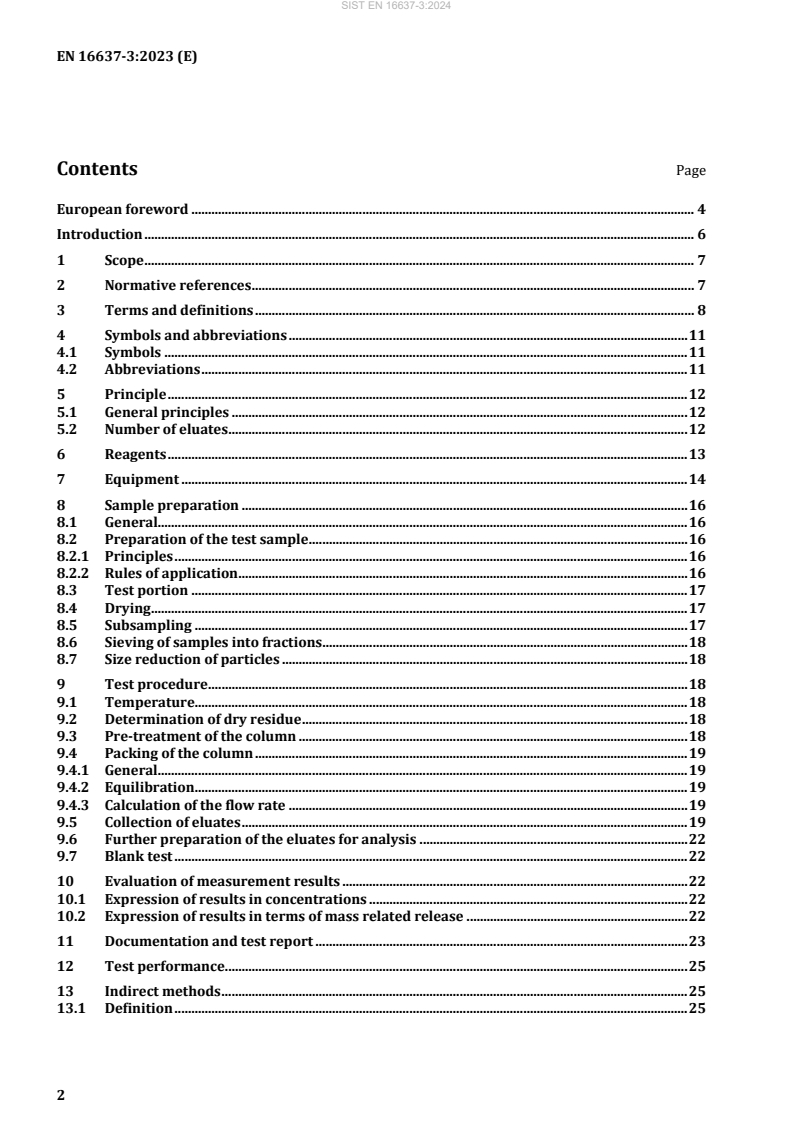
Contents Page
European foreword . 4
Introduction . 6
1 Scope . 7
2 Normative references . 7
3 Terms and definitions . 8
4 Symbols and abbreviations . 11
4.1 Symbols . 11
4.2 Abbreviations . 11
5 Principle . 12
5.1 General principles . 12
5.2 Number of eluates . 12
6 Reagents . 13
7 Equipment . 14
8 Sample preparation . 16
8.1 General. 16
8.2 Preparation of the test sample . 16
8.2.1 Principles . 16
8.2.2 Rules of application . 16
8.3 Test portion . 17
8.4 Drying . 17
8.5 Subsampling . 17
8.6 Sieving of samples into fractions . 18
8.7 Size reduction of particles . 18
9 Test procedure . 18
9.1 Temperature. 18
9.2 Determination of dry residue . 18
9.3 Pre-treatment of the column . 18
9.4 Packing of the column . 19
9.4.1 General. 19
9.4.2 Equilibration. 19
9.4.3 Calculation of the flow rate . 19
9.5 Collection of eluates . 19
9.6 Further preparation of the eluates for analysis . 22
9.7 Blank test . 22
10 Evaluation of measurement results . 22
10.1 Expression of results in concentrations . 22
10.2 Expression of results in terms of mass related release . 22
11 Documentation and test report . 23
12 Test performance . 25
13 Indirect methods . 25
13.1 Definition . 25
13.2 Provisions . 25
13.3 Examples of indirect methods. 25
Annex A (informative) Examples of sample preparation procedures . 26
Annex B (informative) Illustration of the column and accompanying equipment . 29
Annex C (informative) Procedures for packing and saturation of the column . 30
Annex D (informative) Assessment of release mechanism(s) . 33
Annex E (informative) Summary of cumulative results for L/S = 2 and L/S = 10 . 53
Bibliography . 69
European foreword
This document (EN 16637-3:2023) has been prepared by Technical Committee CEN/TC 351
“Construction products: Assessment of release of dangerous substances”, the secretariat of which is held
by NEN.
This European Standard shall be given the status of a national standard, either by publication of an
identical text or by endorsement, at the latest by May 2024 and conflicting national standards shall be
withdrawn at the latest by May 2024.
Attention is drawn to the possibility that some of the elements of this document may be the subject of
patent rights. CEN shall not be held responsible for identifying any or all such patent rights.
This document supersedes CEN/TS 16637-3:2016.
The main changes compared to the previous edition are as follows:
— transfer of technical specification into a European Standard;
— addition of validation data from interlaboratory validation on repeatability and reproducibility (see
Clause 12 and Annex E);
— addition of requirements on the number of eluates (see 5.2);
— alignment of the test conditions with the test conditions which are specified in EN 17516;
— updating of normative and informative cross-references.
This document has been prepared under a standardization request addressed to CEN by the European
Commission. The Standing Committee of the EFTA States subsequently approves these requests for its
Member States.
This document was elaborated on the basis of CEN/TS 14405 [1].
This document specifies an up-flow percolation test to determine the leaching behaviour of granular
construction products under standardized percolation conditions.
EN 16637, Construction products: Assessment of release of dangerous substances, consists of the following
parts:
— Part 1: Guidance for the determination of leaching tests and additional testing steps;
— Part 2: Horizontal dynamic surface leaching test;
— Part 3: Horizontal up-flow percolation test.
EN 16637-1 deals with the determination and use of test methods for leaching of construction products
taking specific situations into account. EN 16637-2 specifies a dynamic surface leaching test for
determination of surface dependent release of substances from monolithic or plate-like or sheet-like
construction products or granular construction products with low hydraulic conductivity under
standardized conditions.
Background information on characterization of leaching behaviour of construction products can be found
in Technical Reports provided by CEN/TC 351 (i.e. CEN/TR 16098 [2], CEN/TR 16496 [3]).
Any feedback and questions on this document should be directed to the users’ national standards body.
A complete listing of these bodies can be found on the CEN website.
According to the CEN-CENELEC Internal Regulations, the national standards organizations of the
following countries are bound to implement this European Standard: Austria, Belgium, Bulgaria, Croatia,
Cyprus, Czech Republic, Denmark, Estonia, Finland, France, Germany, Greece, Hungary, Iceland, Ireland,
Italy, Latvia, Lithuania, Luxembourg, Malta, Netherlands, Norway, Poland, Portugal, Republic of North
Macedonia, Romania, Serbia, Slovakia, Slovenia, Spain, Sweden, Switzerland, Türkiye and the United
Kingdom.
Introduction
The European Standards EN 16637-1, EN 16637-2 and EN 16637-3 are developed to assess the release
of regulated dangerous substances (RDS) from construction products into soil, surface water and
groundwater in the framework of Mandate M/366. The horizontal test methods developed under the
Mandate M/366 are intended to be used to show compliance with notified regulations. The tests cover
the release of substances from construction products and in particular, those that are regulated in
notified regulations in one or more EU Member States.
EN 16637-1 specifies how the CEN Technical Product Committees and EOTA experts should determine
the appropriate leaching test for the determination of the release of RDS from a construction product into
soil, surface water and groundwater. EN 16637-1 gives background information for CEN Technical
Product Committees on the following aspects:
a) description of the intended conditions of use of the construction product (e.g. above ground exposed
to the precipitation, or shielded from direct infiltration, in surface or groundwater) with respect to
the release of RDS into soil, surface water and groundwater;
b) identification of main release mechanisms, and the appropriate leaching test for a given construction
product.
EN 16637-2 specifies a horizontal test to assess surface dependent release from monolithic, plate-like or
sheet-like construction products (tank test).
EN 16637-3 specifies a horizontal test to assess release from granular construction products.
The test methods can be used for both steps in the hierarchy (type testing (TT) and factory production
control (FPC)) and form the reference tests for the intended uses and conditions specified in EN 16637-1.
In this hierarchy of testing conditionally “indirect tests” can be used, but are not specified.
The release of substances upon contact with water results in a potential risk to the environment during
the intended use of construction products. The intent of these tests is to identify the leaching behaviour
of construction products and thereby allow assessments of the release of RDS from such products to soil,
surface water and groundwater under intended conditions of use in relation to CE marking and
assessment and verification of constancy of performance.
This document does not address impact assessment. However, since the test methods described in the
document may be used in the context of impact assessments and regulation based on impact assessments,
some guidance on this issue is provided in EN 16637-1:2023, Annex A (informative).
In addition to existing validation results, in 2011 CEN/TC 351 began an extensive research program on
robustness validation of the existing tank leaching and percolation tests. This was carried out by a
consortium of European experts on 20 construction products to unify differences from the protocols of
the different CEN Members and to check the influence of testing conditions on the test result (e.g.
temperature, flow rate, renewal scheme). The results ([4], [22]) of the research program confirmed the
robustness of the horizontal tests known from former works. Conclusions from the program have been
implemented into the Technical Specifications for the test methods. The performance of the leaching tests
regarding repeatability and reproducibility was deduced from a second validation step and respective
data ([5], [6]) are included in EN 16637-2 and in this document.
1 Scope
This document specifies an up-flow percolation test (PT) which is applicable to determine the leaching
behaviour of inorganic and non-volatile organic substances from granular construction products. The test
is not suitable for substances that are volatile under ambient conditions. The construction products are
subjected to percolation with water as a function of liquid to solid ratio under specified percolation
conditions. The method is a once-through column leaching test.
NOTE 1 Volatile organic substances include the low molecular weight substances in mixtures such as mineral oil.
This up-flow percolation test is performed under specified test conditions for construction products and
does not necessarily produce results that mimic specific intended use conditions. This test method
produces eluates, which can subsequently be characterized by physical, chemical and ecotoxicological
methods according to existing standard methods. The results of eluate analysis are presented as a
function of the liquid/solid ratio. The test results enable the distinction between different leaching
behaviour.
NOTE 2 It is not always possible to adjust test conditions simultaneously for inorganic and organic substances.
Test conditions can also vary between different groups of organic substances. Test conditions for organic
substances are generally more stringent than those for inorganic substances. The test conditions are generally
described in a way that they fit testing organic substances and are also applicable to inorganic substances depending
on the set-up.
NOTE 3 For ecotoxicity testing, eluates representing the release of both inorganic and organic substances are
needed. In this document, ecotoxicological testing is meant to include also genotoxicological testing.
NOTE 4 Construction products with a low hydraulic conductivity that can cause detrimental pressure build-up
are not supposed to be subjected to this test.
NOTE 5 This procedure is generally not applicable to products that are easily biologically degradable and
products reacting with the leachant, leading, for example, to excessive gas emission or excessive heat release,
impermeable hydraulically bound products or products that swell in contact with water.
In this document the same test conditions as for EN 17516 (CEN/TC 444/WG 1) are applied in order to
allow full comparability of testing construction products and waste derived construction products to
avoid double testing. The EN 17516 test results are eligible in the context of testing construction products
as well.
NOTE 6 If a leaching test according to EN 17516 has been performed, additional EN 16637-3 testing does not
need to be carried out.
2 Normative references
The following documents are referred to in the text in such a way that some or all of their content
constitutes requirements of this document. For dated references, only the edition cited applies. For
undated references, the latest edition of the referenced document (including any amendments) applies.
EN 933-1, Tests for geometrical properties of aggregates — Part 1: Determination of particle size
distribution — Sieving method
EN 15934, Sludge, treated biowaste, soil and waste — Calculation of dry matter fraction after
determination of dry residue or water content
EN 16637-1, Construction products: Assessment of release of dangerous substances — Part 1: Guidance for
the determination of leaching tests and additional testing steps (under development)
EN 16687:2023, Construction products: Assessment of release of dangerous substances — Terminology
EN 17195, Construction products: Assessment of release of dangerous substances — Analysis of inorganic
substances in eluates
EN ISO 5667-3, Water quality — Sampling — Part 3: Preservation and handling of water samples
(ISO 5667-3)
3 Terms and definitions
For the purposes of this document, the terms and definitions in EN 16687:2023 and the following apply.
ISO and IEC maintain terminology databases for use in standardization at the following addresses:
— IEC Electropedia: available at https://www.electropedia.org/
— ISO Online browsing platform: available at https://www.iso.org/obp/
3.1
eluate
solution obtained from a leaching test
[SOURCE: EN 16687:2023, 3.3.2.8, modified — Note 1 to entry deleted]
3.2
granular product
product composed of solid particles with a particle size smaller than a specified size or grading
Note 1 to entry: Granular products are usually tested by a percolation test.
[SOURCE: EN 16687:2023, 3.1.2.1]
3.3
laboratory sample
sample or sub-sample(s) sent to or received by the laboratory
Note 1 to entry: When the laboratory sample is further prepared by subdividing, cutting, sawing, coring, drying,
grinding, mixing, curing or by combinations of these operations, the result is the test sample. When no preparation
of the laboratory sample is required, the laboratory sample is the test sample. A test portion is removed from the
test sample for the performance of the test/analysis.
Note 2 to entry: The laboratory sample is the final sample from the point of view of sample collection but it is the
initial sample from the point of view of the laboratory.
[SOURCE: EN 16687:2023, 3.2.2.1]
3.4
leachant
liquid that is brought into contact with the test portion in the leaching procedure
Note 1 to entry: Usually demineralized water is used as leachant for laboratory leaching tests.
[SOURCE: EN 16687:2023, 3.3.2.7]
3.5
leaching behaviour
release and change with time in release from a solid product in contact with a leachant as a function of
major release controlling factors
Note 1 to entry: Such factors are diffusion, pH, L/S-ratio or time.
[SOURCE: EN 16687:2023, 3.3.2.10]
3.6
liquid to solid ratio
L/S
ratio between the total volume of liquid (L) percolated through the solid product and of solid product (S)
packed into the column
Note 1 to entry: L/S is expressed in l/kg dry matter.
[SOURCE: EN 16687:2023, 3.3.2.14]
3.7
local equilibrium
LE
situation where chemical equilibrium exists between a substance in solution and the same substance in
the solid phase at any point in the column
Note 1 to entry: Even when local equilibrium exists at all points along the column the equilibrium concentrations
may be different at different points.
[SOURCE: EN 16687:2023, 3.3.2.15]
3.8
percolation test
PT
column test
release test method to determine the release of substances from a granular construction product packed
in a column with a leachant percolating through it
[SOURCE: EN 16687:2023, 3.3.2.5]
3.9
release
emission
liberation of chemical substances (e.g. non-volatile organic compounds, heavy metals, salts) from a
construction product into soil, surface water or groundwater into the leachant of a test facility
Note 1 to entry: Release to soil, surface and groundwater may be expressed in terms of area related release (tank
leaching test, e.g. mg/m ) or in terms of mass related release (percolation test, e.g. mg/kg).
Note 2 to entry: The terms “emission” and “release” have fundamentally the same meaning. However, it is often a
tradition to use the term “emission” when describing liberation of chemical substances or radiation into air and to
use the term “release” when describing the liberation of chemical substances into soil or water.
[SOURCE: EN 16687:2023, 3.3.2.16]
3.10
release mechanism
physical-chemical processes that control the release of substances from a solid construction product into
a leachant
Note 1 to entry: In case of granular products the main release mechanisms are washout and solubility control.
Diffusion and additional factors like pH or DOC also have influence on the mechanism of the release.
Note 2 to entry: The release mechanism for every substance can be determined using the results of the release test
(tank leaching test, percolation test). Determination of the release mechanism is relevant for modelling of the source
term and so for determination of the effects on soil and water over a time period.
[SOURCE: EN 16687:2023, 3.3.2.18, modified — notes edited to refer to percolation only]
3.11
sample
portion of material selected from a larger quantity of material
Note 1 to entry: The manner of selection of the sample should be prescribed in a sampling plan.
Note 2 to entry: The term “sample” is often accompanied by a prefix (e.g. laboratory sample, test sample) specifying
the type of sample and/or the specific step in the sampling process to which the obtained material relates.
[SOURCE: EN 16687:2023, 3.2.1.5]
3.12
sampling plan
predetermined procedure for the selection, withdrawal, on-site pre-treatment — if necessary,
preservation and transportation of samples to be removed from a population
[SOURCE: EN 16687:2023, 3.2.1.6]
3.13
test portion
analytical portion
amount of the test sample taken for testing/analysis purposes, usually of known dimension, mass or
volume
[SOURCE: EN 16687:2023, 3.2.2.3, modified — Examples deleted]
3.14
test sample
analytical sample
sample, prepared from the laboratory sample, from which test portions are removed for testing or for
analysis
[SOURCE: EN 16687:2023, 3.2.2.2]
3.15
limit of quantification
LOQ
lowest value of an analyte (determinant) that can be determined with an acceptable level of accuracy and
precision, generally determined as three times the limit of detection of the method
[SOURCE: EN 16687:2023, 3.3.1.14]
4 Symbols and abbreviations
4.1 Symbols
For the purposes of this document, the following symbols apply.
c concentration of the substance concerned in the eluate fraction i, in µg/l
i
D sieve diameter, in mm
max
NOTE Common sizes are 31,5 mm, 45 mm or 63 mm.
d inner diameter of the column, in mm
i
d density of the construction product, expressed in kilograms per cubic metre (kg/m )
p
E released quantity of a substance per quantity of sample for analysis in eluate fraction i, in
i
mg/kg dry matter
h height or layer thickness of the construction, in m
k constant that represents the speed of the release of a certain substance
c
k number of eluates collected in the test
e
m dry mass of the test portion, in g
d
m mass of the undried test portion, in g
r
m mass of the (moist) test portion in the column, in g
W
S sieve diameter for test sample preparation (crushing) to reduce the amount of oversized
cs
product to fit the inner column diameter, in mm
t execution time of the test, in days
measured cumulative release of a substance for cumulative L/S ratio n including fraction
Un
i = 1 to n, in mg/kg dry matter
V volume of the eluate fraction i, in l
i
V linear velocity of the leachant through the empty column, in mm per day
L
w dry residue of the construction product, in %
dr
Φ leachant flow rate, in ml per hour
4.2 Abbreviations
For the purposes of this document, the following abbreviations apply.
DL detection limit
DOC dissolved organic carbon
EC electrical conductivity
EOTA European organization for technical assessment
ETA European technical assessment
ETFE ethylene tetrafluoroethylene
FEP fluorinated ethylene propylene
FPC factory production control
GLHC test method for granular products with low hydraulic conductivity
HDPE high-density polyethylene
hEN harmonized European Standard
PAH polycyclic aromatic hydrocarbon
PCTFE polychlorotrifluoroethylene
PT percolation test
PTFE polytetrafluorethylene
RDS regulated dangerous substances
TPH total petroleum hydrocarbons
TT type testing
5 Principle
5.1 General principles
The percolation test described in this document starts with the representative laboratory sample. The
methodology for the collection of a representative laboratory sample is part of the respective product
standard.
This document describes a method to determine the release of substances from a construction product,
with or without size reduction to a maximum particle size, packed in a column with a leachant percolating
through it. Pre-equilibration is applied to approach (local) equilibrium at the start. The column size is
related to the amount of eluate needed for subsequent analysis and testing and the size of the largest
particles in the test portion. A continuous vertical up-flow is used, so that the column is water saturated.
The test conditions, including the flow rate of the leachant, enable a conclusion to be drawn from the
results as to which substances are rapidly being washed out and which substances are released under
the influence of interaction with the matrix. The method is a once-through column leaching test. It is
assumed that conditions approach local equilibrium between construction product and leachant (for
inorganic substances) in the test.
NOTE The results obtained under local equilibrium (LE) can be up-scaled and used in the modelling of in-use
conditions for various scenarios.
The eluate is collected in fractions that are characterized physically and chemically and possibly
ecotoxicologically according to existing standards. The results of the test are expressed as a function of
the L/S ratio, in terms of mg of the substances released cumulatively per kg of product or of mg of
substance determined per litre of eluate.
The procedure described in this document is based on the more stringent test requirements for
determining the release of organic substances and/or for subsequent ecotoxicological testing. If only the
release of inorganic substances is to be measured, requirements on equipment (e.g. column and tubing
material, centrifugation) are specified in the relevant clauses for some steps of the procedure.
5.2 Number of eluates
By reference the percolation test requires the analysis of seven eluates to determine the release of
dangerous substances for a L/S ratio up to 10. These results are needed for characterization of the
construction product and allow the determination of the release mechanism according to Annex D.
For specific scenarios, other than characterization, it may be beneficial to combine eluates or adopt other
testing schemes based on the one of this document. Examples of such scenarios are:
a) Release at a specific L/S ratio. If it is sufficient to know the cumulative release at a predetermined
L/S ratio, for instance L/S = 2, the test can be stopped after the collection of the fifth eluate fraction.
b) Long-term monitoring. In the case scenario descriptions require much higher values of the L/S ratio
than L/S = 10 (e.g. construction products functioning as unbound drains), additional fractions may
be collected until the relevant range of L/S ratio has been covered. Additionally, for specific
monitoring scenarios or research tasks, a closer sampling frequency may be applied in a certain
range of L/S ratios.
c) Factory production control. In the case of FPC it is checked whether the product conforms to the
previously determined characteristics (type testing). Different test methods may be used:
— In the case of testing in accordance with the standard it is sufficient to check the release for the
specified L/S ratio and to collect and combine successive eluates in proportion to the volumes,
e.g. L/S (0 to 2) l/kg dry matter or L/S (0 to10) l/kg dry matter.
— Following an alternative testing procedure (indirect test method), the release at for instance
L/S (0 to 0,5) l/kg dry matter or L/S (0 to 1) l/kg dry matter, may be extrapolated to predict the
release after L/S (0 to 10) l/kg dry matter or another appropriate L/S ratio. Also, other leaching
tests may be used. Further guidance on the use of indirect test methods is given in Clause 13.
As long as the adapted test scheme is based on the one of this document and the test is performed
according to this document, the cumulative release at a specified L/S ratio is equal to the cumulative
release based on the reference test performance. The release mechanisms specified in Annex D of this
document cannot be determined if less than seven eluates are analysed.
6 Reagents
6.1 General
Use only reagents of recognized analytical grade, unless otherwise specified.
6.2 Leachant
Use as a leachant demineralized water or deionized water or water of equivalent purity with
a conductivity < 0,5 mS/m or better.
When the release of biodegradable organic compounds is studied, the eluate might be stabilized with a
preservative in order to avoid biodegradation.
For ecotoxicological tests, preservatives are not allowed.
6.3 Rinsing solutions
Use as rinsing solution nitric acid, c(HNO ) = 0,1 mol/l and an organic solvent (e.g. acetone). Make sure
that the quality grade of the nitric acid is appropriate for analysis of trace elements.
7 Equipment
7.1 General
Check the materials and equipment specified in 7.2 to 7.17 before use for proper operation and absence
of interfering substances that may affect the result of the test.
The equipment specified under 7.6, 7.7, 7.8, 7.14 and 7.15 shall be calibrated.
7.2 Column
Column made of plastics or glass for inorganic substances and glass or stainless steel for organic
substances with an inner diameter d larger than 50 mm and a length that can accommodate a filling
i
height of 300 mm ± 50 mm. In top and bottom of the column a filter plate, glass beads or a thin layer of
quartz sand with a particle size range of 1,0 mm to 2,5 mm is applied to ensure proper water flow over
the total width of the column.
Filter plates, quartz sand (SiO -content at least 98 % by mass) or glass beads can be washed but where
heated to remove any adsorbed organic contaminants they shall not be heated to red-heat. They shall
also be low in substances (i.e. determinants) which could lead to increased levels in procedural blanks.
NOTE 1 In some cases, it is useful to place a pre-filter at least in the bottom section to prevent the material from
leaving the column, through the water inlet duct.
A drawing of the column and accompanying equipment is given in Annex B.
Glass of high quality is usually considered adequate for both metals and organic contaminants,
particularly, since the pH range usually covered in product testing does not reach the conditions where
glass itself is attacked. For ecotoxicity testing, eluates with both metals and organic contaminants are
needed, which emphasizes the need to generate integrated eluates.
NOTE 2 Usually borosilicate glass is appropriate, unless boron has to be analysed. Sodium glass can change the
pH of the eluate.
In case of organic substances to be analysed, it shall be checked that the material does not interfere
significantly with the substances to be measured.
7.3 Packing equipment, Rammer with a weight of 125 g in the case of a column with a diameter of
50 mm up to 500 g for a column with a diameter of ≥ 100 mm. Intermediate weights to be linearly
interpolated by surface area.
NOTE The limited contact of the rammer is considered not to affect the test results.
7.4 Membrane for off-line filtration of eluates to be analysed for inorganic substances, with a pore size
of 0,45 µm (e.g. cellulose acetate, PTFE).
Membranes shall be of inert material and not absorb or adsorb compounds of interest. Filters shall not
be used for eluates to be analysed for organic substances.
7.5 Volumetric pump, with an adjustable capacity to be suitable to allow for the flow rate specified
according to 9.4.3.
7.6 Laboratory balance, with an accuracy of at least 0,1 g.
7.7 pH meter, with an accuracy of at least 0,05 pH units.
7.8 Electrical conductivity meter, with an accuracy of at least 0,1 mS/m.
7.9 Tubing material, inert and adapted to the substances to be analysed. In case organic substances
are to be analysed, stainless steel or glass and FEP can be used in contact with the eluate. In case inorganic
substances are analysed PE, PP, PTFE, ETFE, FEP or similar tubing materials can be used.
NOTE Examples of appropriate tubing material are given in EN ISO 5667-3.
7.10 Eluate bottles
For eluate collection and preservation of eluate samples, use high quality glass bottles with an
appropriate volume and with screw cap with PTFE, ETFE or PTFE inlay (in accordance with
EN ISO 5667-3). If only inorganic contaminants are to be analysed, alternative bottle materials can be
selected, e.g. PE or PP.
NOTE Usually borosilicate glass is appropriate, unless boron has to be analysed. Sodium glass can change the
pH of the eluate.
7.11 Crushing equipment
Jaw crusher or a cutting device. The crushing device shall be cleaned thoroughly to avoid cross
contamination from previous use.
NOTE Due to crushing, contamination of the sample can occur to an extent which affects the leaching of some
constituents of concern e.g. cobalt and tungsten from tungsten carbide equipment or chromium, nickel and
molybdenum from stainless steel equipment.
7.12 Sieving equipment (dry sieving), e.g. with sieves 4 mm, 11,2 mm and 22,4 mm nominal screen
size.
7.13 Sample splitting equipment
For sub-sampling of laboratory samples, e.g. riffle divider or dividing cross for coning and quartering
(optional).
7.14 Redox potential meter (optional)
7.15 Turbidity meter, as specified in ISO 7027-1 [29].
7.16 Centrifuge
Use a centrifuge operating at 20 000 g to 30 000 g using centrifuge tubes of FEP or tubes of an alternative
material, which is inert with regard to both inorganic and organic substances and suitable to high speed
centrifugation.
Alternatively, if a high-speed centrifuge is not available, a centrifuge operating at 2 000 g to 2 500 g using
glass bottles may be used in combination with increased centrifugation time. Cooling shall be applied to
maintain the desired temperature.
7.17 Filtration
Vacuum filtration device 30 kPa to 70 kPa or pressure filtration device (≤0,5 MPa).
8 Sample preparation
8.1 General
Sample preparation shall consist of preparation of the test sample from the laboratory sample, preparing
a test portion and determining the dry residue of the test sample.
Sampling shall be performed in accordance with the procedures described in the respective product
standard considering guidance given in EN 16637-1 in order to obtain a representative laboratory
sample.
NOTE As usual in an accreditation procedure, the testing laboratory reports on sampling only when it performs
sampling itself to produce laboratory sample.
8.2 Preparation of the test sample
8.2.1 Principles
A laboratory sample shall be received whose minimum amount depends on the maximum particle size of
the granular product, the column diameter chosen and the number of tests to be carried out. The
laboratory sample shall be stored in closed packages and kept under conditions which prevent any
alterations of the construction product.
The laboratory selects the appropriate column (7.2) and determines the sieve diameter S for the test
cs
sample (see Table 1).
Crushing of the product shall be applied no more than absolutely necessary in order to minimize the effect
on the product properties, i.e. crushing is only needed in case of an oversized fraction larger than S (see
cs
Table 1) or to fill a lack of fines less than 4 mm.
For granular construction products at least 45 % by mass of the test sample shall have a particle
size < 4 mm. If the grading of the laboratory sample already contains 100 % by mass particles < S (see
cs
Table 1) and an amount of particles of at least 45 % by mass < 4 mm no further crushing or sieving is
allowed.
The choice of column width depends on the maximum particle size of the product to be tested (S ).
cs
NOTE The choice of column width can also depend on equipment available in the laboratory, the mass of the
laboratory sample or the amount of eluate required for chemical analysis or ecotoxicological testing.
No part of the laboratory sample shall be discarded during the sample preparation.
8.2.2 Rules of application
The following stepwise procedure to prepare the test sample shall be applied to fulfil the principles
specified in 8.2.1:
a) If the laboratory sample of the product already contains 100 % by mass of particles < S (see Table 1)
cs
and an amount of particles of at least 45 % by mass < 4 mm no further crushing or sieving is allowed
(see Annex A for an example).
b) If the laboratory sample contains an oversized fraction larger than S gently crush this fraction to
cs
obtain a test sample with all particles ≤ S (result: test sample with a maximum particle size to fit the
cs
chosen column size).
c) Crusher jaws should be adjusted to avoid large amounts of particles < 4 mm.
d) Depending on the number and size of the test portions, the further procedure may be carried out on
a representative subsample (see EN 932-1).
e) Check by sieving on a 4 mm sieve whether test sample contains an amount of particles < 4 mm larger
than 45 % by mass. If this condition is fulfilled the test sample is ready to take test portions for the
percolation test.
f) If the test sample does not contain an amount of at least 45 % by mass passing the 4 mm sieve after
step d), gently crush a sufficient and representative portion of 4/S mm (see Annex A for an example)
cs
to an extent that after crushing the completely prepared (recombined) grading contains an amount
of particles < 4 mm between 45 % by mass and 55 % by mass. If this condition is fulfilled, the test
sample is ready to take test portions for the percolation test.
Table 1 — Column size and corresponding sieve diameter S
cs
Inner column diameter Sieve diameter for test sample preparati
...