

EN 12899-1:2007
(Main)Fixed, vertical road traffic signs - Part 1: Fixed signs
- Abstract
This Part 1 of EN 12899 specifies requirements for complete sign assemblies (including supports), signs (sign plates with sign faces), sign plates (without sign faces) and for other major components (retroreflective sheeting, supports and luminaires).
The main intended use of fixed signs is for the instruction and guidance of road users on public and private land.
Matters not covered by this standard:
a) sign gantry and cantilever structures;
b) signs with discontinuous messages, e.g. using light emitting diodes (LED), or fibre optics;
c) variable message signs;
d) signs used for temporary purposes;
e) foundations;
f) tests for extremely low temperatures.
- Status
- Published
- Publication Date
- 06-Nov-2007
- Withdrawal Date
- 30-Aug-2009
- Technical Committee
- CEN/TC 226 - Road equipment
- Drafting Committee
- CEN/TC 226/WG 3 - Vertical signs
- Current Stage
- 9092 - Decision on results of review/2YR ENQ - revise - Review Enquiry
- Start Date
- 04-Jan-2024
- Completion Date
- 21-Oct-2026
- Directive
- 305/2011 - Regulation (eu) No 305/2011 of the European Parliament and of the Council of 9 march 2011 laying down harmonised conditions for the marketing of construction products and repealing council directive 89/106/eecOJ Ref: C, C 259 OJ Date: 08-Aug-2014
89/106/EEC - Construction productsOJ Ref: C, C 321 OJ Date: 16-Dec-2008

Overview
EN 12899-1:2007 is the CEN European standard for fixed, vertical road traffic signs - Part 1: Fixed signs. It specifies performance, testing and marking requirements for complete sign assemblies (including supports), sign plates, sign faces, and major components such as retroreflective sheeting, supports and luminaires. Approved in 2007 (superseding the 2001 edition), the standard is intended primarily for road authorities and private landowners who install permanent traffic signs.
Key exclusions are clearly stated: gantry/cantilever structures, LED or fibre‑optic/discontinuous message signs, variable message signs, temporary signs, foundations and extreme low‑temperature tests.
Key topics and requirements
- Scope of application: Requirements apply to complete sign assemblies, sign plates (with or without sign faces) and related components used for instruction and guidance of road users on public and private land.
- Retroreflective materials: Defines optical performance for glass‑bead sign face materials (chromaticity, luminance factor, and minimum coefficients of retroreflection RA). Microprismatic materials are addressed by relevant ETA/CE marking routes.
- Structural performance: Static and dynamic load tests, wind loading (reference to EN 1991‑1‑4/Eurocode for wind actions), deflection limits, and vehicle impact considerations to ensure safety in use.
- Supports and corrosion: Requirements for support components, tops, base compartments, base plates and corrosion resistance.
- Illumination: Criteria for externally illuminated and transilluminated signs, plus luminaires and photometric data (references to EN 13032‑1 and EN 13201‑3).
- Testing & conformity: Test methods, factory production control (see EN 12899‑4), initial type testing (EN 12899‑5) and provisions for CE marking and the EU Construction Products Directive (informative Annex ZA).
- Marking and product information: Required labelling, production identification codes and documentation to ensure traceability.
Practical applications and users
EN 12899-1:2007 is used for:
- Specifying and procuring permanent road signs that meet safety and visibility requirements
- Type approval, conformity assessment and CE marking of sign products
- Design and selection of sign face materials (retroreflective sheeting) and luminaires
- Testing and certification by manufacturers, testing laboratories and conformity bodies
Typical users:
- Road authorities and highway agencies
- Traffic sign manufacturers and suppliers
- Specifiers, installers and asset managers
- Certification and testing laboratories
Related standards
- EN 12899‑2 to EN 12899‑5 (other parts of the series)
- EN 1991‑1‑4 (Eurocode - wind actions)
- EN 12767 (passive safety of support structures)
- EN 13032‑1, EN 13201‑3 (lighting and photometry)
- EN 12899‑4 (factory production control) and EN 12899‑5 (initial type testing)
Keywords: EN 12899-1:2007, fixed vertical road traffic signs, retroreflective sheeting, sign assemblies, CEN standard, road sign standards, CE marking, structural performance.
Relations
- Effective Date
- 22-Dec-2008
- Effective Date
- 17-Sep-2026
- Effective Date
- 25-Aug-2026
- Effective Date
- 25-Mar-2026
- Effective Date
- 09-Feb-2026
- Effective Date
- 28-Jan-2026
- Refers
EN 12665:2002 - Light and lighting - Basic terms and criteria for specifying lighting requirements - Effective Date
- 28-Jan-2026
- Effective Date
- 28-Jan-2026
- Effective Date
- 28-Jan-2026
- Effective Date
- 28-Jan-2026
- Effective Date
- 28-Jan-2026
- Effective Date
- 28-Jan-2026
- Effective Date
- 28-Jan-2026
- Effective Date
- 28-Jan-2026
- Effective Date
- 28-Jan-2026
Get Certified
Connect with accredited certification bodies for this standard

Zavod za gradbeništvo Slovenije (ZAG) - Inšpekcija
ZAG inspection body for construction products, structures, and materials.
Sponsored listings
Frequently Asked Questions
EN 12899-1:2007 is a standard published by the European Committee for Standardization (CEN). Its full title is "Fixed, vertical road traffic signs - Part 1: Fixed signs". This standard covers: This Part 1 of EN 12899 specifies requirements for complete sign assemblies (including supports), signs (sign plates with sign faces), sign plates (without sign faces) and for other major components (retroreflective sheeting, supports and luminaires). The main intended use of fixed signs is for the instruction and guidance of road users on public and private land. Matters not covered by this standard: a) sign gantry and cantilever structures; b) signs with discontinuous messages, e.g. using light emitting diodes (LED), or fibre optics; c) variable message signs; d) signs used for temporary purposes; e) foundations; f) tests for extremely low temperatures.
This Part 1 of EN 12899 specifies requirements for complete sign assemblies (including supports), signs (sign plates with sign faces), sign plates (without sign faces) and for other major components (retroreflective sheeting, supports and luminaires). The main intended use of fixed signs is for the instruction and guidance of road users on public and private land. Matters not covered by this standard: a) sign gantry and cantilever structures; b) signs with discontinuous messages, e.g. using light emitting diodes (LED), or fibre optics; c) variable message signs; d) signs used for temporary purposes; e) foundations; f) tests for extremely low temperatures.
EN 12899-1:2007 is classified under the following ICS (International Classification for Standards) categories: 93.080.30 - Road equipment and installations. The ICS classification helps identify the subject area and facilitates finding related standards.
EN 12899-1:2007 has the following relationships with other standards: It is inter standard links to EN 12899-1:2001, EN ISO 9001:2026, ISO 4:1997, EN 1991-1-4:2026, EN 60529:1991, EN 1011-3:2018, EN 12665:2002, EN ISO 9001:2015, EN 12767:2019+A1:2024, EN 13032-1:2004+A1:2012, EN 1011-2:2001/A1:2003, EN 1011-1:2009, EN 1011-4:2000/A1:2003, EN 1011-2:2001, EN ISO 1461:2022. Understanding these relationships helps ensure you are using the most current and applicable version of the standard.
EN 12899-1:2007 is associated with the following European legislation: EU Directives/Regulations: 305/2011, 89/106/EEC; Standardization Mandates: M/111. When a standard is cited in the Official Journal of the European Union, products manufactured in conformity with it benefit from a presumption of conformity with the essential requirements of the corresponding EU directive or regulation.
EN 12899-1:2007 is available in PDF format for immediate download after purchase. The document can be added to your cart and obtained through the secure checkout process. Digital delivery ensures instant access to the complete standard document.
Standards Content (Sample)
2003-01.Slovenski inštitut za standardizacijo. Razmnoževanje celote ali delov tega standarda ni dovoljeno.Fixed, vertical road traffic signs - Part 1: Fixed signsStalna vertikalna cestna signalizacija - 1. del: Stalni prometni znakiSignaux fixes de signalisation routière verticale - Partie 1 : Panneaux fixesOrtsfeste, vertikale Straßenverkehrszeichen - Teil 1: Ortsfeste VerkehrszeichenTa slovenski standard je istoveten z:EN 12899-1:2007SIST EN 12899-1:2008en,fr,de93.080.30ICS:SIST EN 12899-1:20021DGRPHãþDSLOVENSKI
STANDARDSIST EN 12899-1:200801-marec-2008
EUROPEAN STANDARDNORME EUROPÉENNEEUROPÄISCHE NORMEN 12899-1November 2007ICS 93.080.30Supersedes EN 12899-1:2001
English VersionFixed, vertical road traffic signs - Part 1: Fixed signsSignaux fixes de signalisation routière verticale - Partie 1 :Panneaux fixesOrtsfeste, vertikale Straßenverkehrszeichen - Teil 1:VerkehrszeichenThis European Standard was approved by CEN on 4 February 2007.CEN members are bound to comply with the CEN/CENELEC Internal Regulations which stipulate the conditions for giving this EuropeanStandard the status of a national standard without any alteration. Up-to-date lists and bibliographical references concerning such nationalstandards may be obtained on application to the CEN Management Centre or to any CEN member.This European Standard exists in three official versions (English, French, German). A version in any other language made by translationunder the responsibility of a CEN member into its own language and notified to the CEN Management Centre has the same status as theofficial versions.CEN members are the national standards bodies of Austria, Belgium, Bulgaria, Cyprus, Czech Republic, Denmark, Estonia, Finland,France, Germany, Greece, Hungary, Iceland, Ireland, Italy, Latvia, Lithuania, Luxembourg, Malta, Netherlands, Norway, Poland, Portugal,Romania, Slovakia, Slovenia, Spain, Sweden, Switzerland and United Kingdom.EUROPEAN COMMITTEE FOR STANDARDIZATIONCOMITÉ EUROPÉEN DE NORMALISATIONEUROPÄISCHES KOMITEE FÜR NORMUNGManagement Centre: rue de Stassart, 36
B-1050 Brussels© 2007 CENAll rights of exploitation in any form and by any means reservedworldwide for CEN national Members.Ref. No. EN 12899-1:2007: E
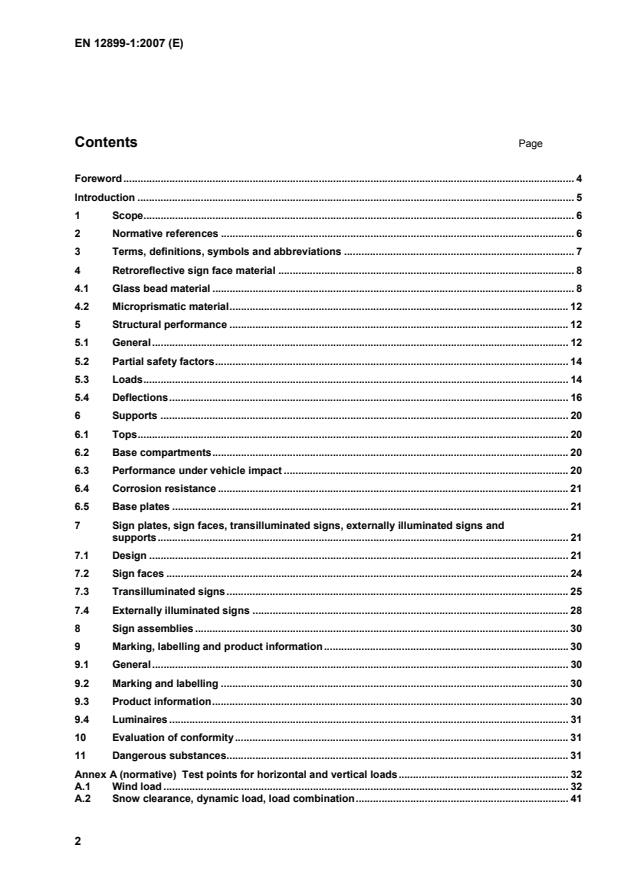
Test points for horizontal and vertical loads.32 A.1 Wind load.32 A.2 Snow clearance, dynamic load, load combination.41
Clauses of this European Standard addressing the provisions of the EU Construction Products Directive.44 ZA.1 Scope and relevant characteristics.44 ZA.2 Procedure for attestation of conformity of fixed vertical road traffic signs.51 ZA.3
CE marking and labelling.52
This European Standard has been prepared under a Mandate given to CEN by the European Commission and the European Free Trade Association and supports essential requirements of EU Directives.
For relationships with EU Directives, see informative Annex ZA, which is an integral part of this standard. This European Standard consists of the following Parts under the general title:
Fixed, vertical road traffic signs — Part 1: (This part) Fixed signs Part 2: Transilluminated traffic bollards (TTB) Part 3: Delineator posts and retroreflectors Part 4: Factory production control Part 5: Initial type testing It is based on performance requirements and test methods published in CEN, CENELEC, CIE (International Commission on Illumination) and ISO documents together with standards of the CEN member organizations. According to the CEN/CENELEC Internal Regulations, the national standards organizations of the following countries are bound to implement this European Standard: Austria, Belgium, Bulgaria, Cyprus, Czech Republic, Denmark, Estonia, Finland, France, Germany, Greece, Hungary, Iceland, Ireland, Italy, Latvia, Lithuania, Luxembourg, Malta, Netherlands, Norway, Poland, Portugal, Romania, Slovakia, Slovenia, Spain, Sweden, Switzerland and United Kingdom.
It can also be used by private developers who wish to use signs on their own land similar to those used on public highways. This European Standard: can be used to implement type approval and certification testing; derives from performance requirements and test methods published in CEN, CENELEC, CIE and ISO documents together with standards of the CEN member organizations; does not require the replacement of existing signs; covers performance requirements and test methods; defines performance limits and a range of performance classes. Colorimetric and retroreflective properties, as well as the luminance and illuminance, are specified; The retroreflective requirements and tests in respect of materials based on glass bead technology are specified in this standard. The performance of retroreflective materials using microprismatic technology is specified in the relevant ETA which enables CE marking of such material. Wind actions can be specified by the use of either values in this standard or by the methods specified in EN 1991-1-4. Structural requirements for signs complete with sign supports include performance under static and dynamic loading. Provision is made for safety in use, including vehicle impact.
2 Normative references The following referenced documents are indispensable for the application of this document. For dated references, only the edition cited applies. For undated references, the latest edition of the referenced document (including any amendments) applies. EN 1011, Welding - Recommendations for welding of metallic materials EN 1991-1-4, Eurocode 1: Actions on structures - Part 1-4: General actions - Wind actions EN 1993-1-1, Eurocode 3: Design of steel structures — Part 1-1: General rules and rules for buildings
EN 1995-1-1, Eurocode 5: Design of timber structures - Part 1-1: General - Common rules and rules for buildings EN 1999-1-1, Eurocode 9: Design of aluminium structures — Part 1-1: General rules – General rules and rules for buildings EN 10240, Internal and/or external protective coatings for steel tubes - Specification for hot dip galvanized coatings applied in automatic plants EN 12665:2002, Light and lighting – Basic terms and criteria for specifying lighting requirements EN 12767, Passive safety of support structures for road equipment - Requirements and test methods EN 12899-4, Fixed vertical road traffic signs – Part 4: Factory production control EN 12899-5, Fixed vertical road traffic signs – Part 5: Initial type testing EN 13032-1, Light and lighting - Measurement and presentation of photometric data of lamps and luminaires – Part 1: Measurement and file format EN 13201-3, Road lighting – Part 3: Calculation of performance
EN ISO 9001, - Quality management systems
- Requirements (ISO 9001:2000)
ISO 4:1997, Information and documentation — Rules for the abbreviation of title words and titles of publications CIE 15, Colorimetry CIE 54.2, Retroreflection – Definition and measurement CIE 74:1988, Road signs 3 Terms, definitions, symbols and abbreviations For the purposes of this document, the symbols and abbreviations given in ISO 4:1997 apply. The photometric terms and definitions given in EN 12665:2002 and the sign descriptions given in CIE 74:1988 also apply, together with the following. 3.1 sign assembly complete assembly including the sign plate, sign face material and supports 3.2 sign sign plate with the sign face material applied 3.3 sign plate fabrication comprising the substrate, reinforcing members and fixings 3.4 protective edge fabrication intended to reinforce the edge of the sign and to reduce the severity of personal injury in the event of bodily impact with the sign edge 3.5 substrate material used to support the sign face material 3.6 sign face material material or materials applied to the substrate to produce the finished surface of the fixed sign
Tests shall be carried out at a temperature of (23 ± 3) °C and a relative humidity of (50 ± 5) % unless otherwise specified. 4.1.1.2 Test samples Tests shall be conducted on finished products, or on prepared samples representative of finished products and suitable for the test equipment. Test samples and test panels shall be conditioned in accordance with EN ISO 139 and shall be identified on the back. 4.1.1.3 Daylight chromaticity and luminance factor When tested in accordance with the relevant procedure specified in CIE 15, using CIE standard daylight illuminant D65 and the standard CIE 45/0 viewing conditions, the chromaticity and the luminance factor β shall conform to Table 1 or Table 2 as appropriate.
Table 1 — Daylight chromaticity and luminance factors. Class CR1
Colour 1 2 3 4 Luminance factor
β
x y x y x y x y Table 3 Table 4 White
0,355 0,355 0,305 0,305 0,285 0,325 0,335 0,375 ≥0,35 ≥0,27 Yellow
see Table 3 0,522 0,477 0,470 0,440 0,427 0,483 0,465 0,534 ≥0,27
Yellow see Table 4 0,545 0,454 0,487 0,423 0,427 0,483 0,465 0,534
≥0,16 Orange 0,610 0,390 0,535 0,375 0,506 0,404 0,570 0,429 ≥0,17 ≥0,14 Red 0,735 0,265 0,674 0,236 0,569 0,341 0,655 0,345 ≥0,05 ≥0,03 Blue 0,078 0,171 0,150 0,220 0,210 0,160 0,137 0,038 ≥0,01 ≥0,01 Green 0,007 0,703 0,248 0,409 0,177 0,362 0,026 0,399 ≥0,04 ≥0,03 Dark green 0,313 0,682 0,313 0,453 0,248 0,409 0,127 0,557 0,01 ≤ ß ≤ 0,07 Brown 0,455 0,397 0,523 0,429 0,479 0,373 0,558 0,394 0,03 ≤ ß ≤ 0,09 Grey 0,350 0,360 0,300 0,310 0,285 0,325 0,335 0,375 0,12 ≤ ß ≤ 0,18
Table 2 — Daylight chromaticity and luminance factors. Class CR2 1 2 3 4 Luminance factor
ββββ Colour x y x y x y x y Table 3 Table 4 White
0,305 0,315 0,335 0,345 0,325 0,355 0,295 0,325 ≥0,35 ≥0,27 Yellow
see Table 3 0,494 0,505 0,470 0,480 0,493 0,457 0,522 0,477 ≥0,27
Yellow see Table 4 0,494 0,505 0,470 0,480 0,513 0,437 0,545 0,454
≥0,16 Red 0,735 0,265 0,700 0,250 0,610 0,340 0,660 0,340 ≥0,05 ≥0,03 Blue
see Table 3 0,130 0,086 0,160 0,086 0,160 0,120 0,130 0,120 ≥0,01
Blue
see Table 4 0,130 0,090 0,160 0,090 0,160 0,140 0,130 0,140
≥0,01 Green see Table 3 0,110 0,415 0,150 0,415 0,150 0,455 0,110 0,455 ≥0,04
Green see Table 4 0,110 0,415 0,170 0,415 0,170 0,500 0,110 0,500
≥0,03 Dark green 0,190 0,580 0,190 0,520 0,230 0,580 0,230 0,520 0,01 ≤ β ≤ 0,07 Brown 0,455 0,397 0,523 0,429 0,479 0,373 0,558 0,394 0,03 ≤ β ≤ 0,09 Grey 0,305 0,315 0,335 0,345 0,325 0,355 0,295 0,325 0,12 ≤ β ≤ 0,18
+30° 30 22 6 3,5 1,7 0,3 10 18
+40° 10 7 2 1,5 0,5 # 2,2 6 20' +5° 50 35 10 7 2 0,6 20 30
+30° 24 16 4 3 1 0,2 8 14,4
+40° 9 6 1,8 1,2 # # 2,2 5,4 2° +5° 5 3 1 0,5 # # 1,2 3
+30° 2,5 1,5 0,5 0,3 # # 0,5 1,5
+40° 1,5 1,0 0,5 0,2 # # # 0,9 #
Indicates "Value greater than zero but not significant or applicable".
+30° 150 100 25 25 15 11 8,5 60 75
+40° 110 70 15 12 6 8 5,0 29 55 20' +5° 180 120 25 21 14 14 8 65 90
+30° 100 70 14 12 11 8 5 40 50
+40° 95 60 13 11 5 7 3 20 47 2° +5° 5 3 1 0,5 0,5 0,2 0,2 1,5 2,5
+30° 2,5 1,5 0,4 0,3 0,3 # # 1 1,2
+40° 1,5 1,0 0,3 0,2 0,2 # # # 0,7 #
Indicates "Value greater than zero but not significant or applicable".
4.1.1.5 Durability
4.1.1.5.1 Resistance to weathering After weathering in accordance with 4.1.1.5.2 or 4.1.1.5.3, the following requirements shall apply. The chromaticity and luminance factor of materials using glass beads technology shall conform to the requirements of 4.1.1.3 as appropriate. When tested at an observation angle (α) of 20' and entrance angles (β1 = 5° and 30°, with
β2 = 0°) the coefficient of retroreflection shall be not less than 80 % of the values required in 4.1.1.4 as appropriate.
4.1.1.5.2 Accelerated natural weathering Samples of material shall be exposed, inclined at an angle of 45° to the horizontal and facing the equator, in accordance with EN ISO 877:1996, Method A for three years. 4.1.1.5.3 Accelerated artificial weathering
The manufacturer may use accelerated artificial weathering to predict durability but testing shall be commenced by accelerated natural weathering not later than the start of the accelerated artificial weathering. The result of accelerated natural weathering shall take precedence over the result of accelerated artificial weathering. The apparatus shall be either an air-cooled or water-cooled Xenon arc weathering device capable of exposing samples in accordance with EN ISO 4892-2. Preparation of test specimens shall be in accordance with the general guideline given in EN ISO 4892-2. The samples shall be exposed in accordance with EN ISO 4892-2 using the parameters given in Table 5, for a period of 2000 h.
— over 300 nm to 400 nm range
— over 300 nm
to 800 nm range
60 550
60 630 NOTE 1 Water used for specimen spray should contain no more than 1 ppm silica. Higher levels of silica can produce spotting on samples and variability in results. Water of the required purity can be obtained by distillation or by a combination of deionization and reverse osmosis. NOTE 2 Whilst irradiance levels should be set at the above levels, variations in filter ages and transmissivity, and in calibration variations, will generally mean that irradiance error will be in the order of ± 10 %.
4.1.2 Impact resistance When tested in accordance with EN ISO 6272, using a mass of 450 g with a contact radius of 50 mm dropped from a height of 220 mm, there shall be no cracking or, for sign face sheeting material, delamination from any substrate, outside a circle of 6 mm radius with the point of impact as the centre. The test sign shall be supported as it would be when installed, or the test sample shall be supported over an open area of 100 mm x 100 mm.
4.2 Microprismatic material The performance of retroreflective materials using microprismatic technology can be found in the relevant European Technical Approval (ETA). The manufacturer shall obtain the performance specifications from the purchaser. NOTE The testing procedure for retroreflective materials using microprismatic technology can be found in the relevant European Technical Approval (ETA). 5 Structural performance
5.1 General Steel constructions and steel mounting elements shall conform to EN 1993-1-1. Aluminium constructions shall conform to EN 1999-1-1. Timber constructions shall conform to EN 1995-1-1. Welded fabrications shall conform to EN 1011, as appropriate. Other materials are acceptable but if they are used they shall enable conformity to this standard.
either
(a) for supports of constant cross-section:
— maximum bending moment Mu (kNm); — stiffness for bending EI (kNm2); — maximum moment for torsion Tu (kNm); — stiffness for torsion GIt (kN⋅m2); NOTE 1 EI = modulus of elasticity x moment of inertia.
NOTE 2 GIt = shear modulus x torsion constant. For a non-constant cross-section, equivalent values shall be given related to the actual length of the support.
or (b)
the type and grade of material and all the dimensions;
or (c)
verification of conformity to a purchaser’s prescriptive specification for materials and dimensions. Information to be provided in case (a) may be obtained by calculation in accordance with 5.4.3 or by physical testing in accordance with 5.4.4. The criterion for the maximum bending moment Mu and the maximum moment for torsion Tu shall be as 5.4.4.4. The declared maximum bending moment shall be given at the designed ground level. If the weakest point is other than at ground level the equivalent value at ground level shall be given. Any other relevant information shall be given as part of the manufacturer’s supporting data, e.g. details and strength of fixings integral to the supports. NOTE 3 Case (b) can be adequate for supports of simple construction, for instance comprising a standard metal tube of any standard cross-sectional shape.
The safety factors for materials shall be in accordance with Table 7. Table 7 — Partial material factors γm Material γm Steel 1,05 Aluminium 1,15 Timber 1,35 Fibre reinforced polymer 1,50 Plastics 1,80
To obtain the overall safety factor, multiply the figures from Table 6 and Table 7. 5.3 Loads 5.3.1 Wind actions 5.3.1.1 General The wind pressure may be either calculated by the method in 5.3.1.2 or taken from Table 8. In either case the wind load shall be multiplied by the shape factor. The shape factor for flat signs is 1.20. In both cases the wind pressure shall be applied as a uniformly distributed load over the area of the sign plate and act at the centre of pressure of the sign plate in order to calculate the bending moments in the supports and sign plate. The eccentricity value shall be declared in the requirements and in the evaluation report of the product.
NOTE This is often taken as zero however purchasers can require different values as they affect the bending moment applied to the post. 5.3.1.2 Calculation of wind pressure Wind actions shall be calculated in accordance with EN 1991-1-4. The calculations shall identify whether they are based on a 25 year or a 50 year reference wind speed. The reference wind speed shall be appropriate to the sign location taken from the location data.
The wind pressure for calculating the structural integrity of the sign plate, fixings and supports shall be in accordance with Table 8.
Table 8 — Wind pressure
Class Wind pressure kN.m-2 WL0 No performance determined WL1 0,40 WL2 0,60 WL3 0,80 WL4 0.90 WL5 1,00 WL6 1,20 WL7 1,40 WL8 1,50 WL9 1,60
NOTE 1 Wind speeds in mountainous, coastal and estuarial regions can be as much as 40 % above speeds in other areas. Purchasers should consider specifying a higher class of wind load or reference wind speed for these locations. NOTE 2 The wind pressures in Table 8 do not include safety factors and shape factors. 5.3.2 Dynamic pressure from snow clearance The dynamic pressure from snow clearance, from Table 9, shall be applied to the areas indicated in Annex A. This load is not simultaneous with wind load and point load.
Table 9 — Dynamic snow pressure Class Dynamic snow pressure kN⋅m-2 DSL0 No performance determined DSL1 1,5 DSL2 2,5 DSL3 3,0 DSL4 4,0
5.3.3 Point loads The point load, from Table 10, shall be placed as indicated in Annex A. This load is not applied simultaneously with the wind load and snow load. The acceptance criterion shall be as given in 5.4.2.
5.3.4 Dead loads Dead loads shall be the combined weight of the individual components of the finished sign such as substrate, sign housing, protective edge, stiffeners, luminaires, supports, fixings etc. The acceptance criterion shall be as given in 5.4.2. 5.4 Deflections 5.4.1 Temporary deflections The wind load for calculating the temporary deflection shall be based on the wind loads multiplied by 0,56, and no partial action and material factors are applied. NOTE 1 The factor of 0,56 is derived from the 50 year wind speed reduction to one year wind speeds. Temporary deflections from wind actions only shall be calculated in accordance with 5.4.3 or tested in accordance with 5.4.4. The temporary deflection of the sign plate, specified from Table 11, shall be determined at the point where the deflection is greatest (see Figures A.1 to A.7). The maximum temporary deflection of the supports relative to the foundations shall conform to the deflection class(es) chosen from Tables 11 and 12. Table 11 — Maximum temporary deflection – Bending Class Bending mm⋅m-1 TDB0 No performance determined TDB1 2 TDB2 5 TDB3 10 TDB4 25 TDB5 50 TDB6 100
NOTE 2 Table 12 only applies to a single sign support subjected to torsion from an asymmetrical load, position or shape of the sign. 5.4.2 Permanent deflections Permanent deflections shall be assessed using the following loads: 25 year or 50 year wind load, dynamic snow load, point load and dead load. The partial action and material factors are applied. When the structural performance is evaluated by means of a physical test, the maximum permanent deflection shall not exceed 20 % of the temporary deflection using the same load. NOTE This takes into account the slack in the fixings and other non-elastic phenomena. When the structural performance is evaluated by calculation, the material stresses shall not exceed the elastic limit. 5.4.3 Calculations for the verification of physical performance The construction shall be designed in such a way that the deformation shall stay in the elastic region when applying the specified (25 year or 50 year) wind load, point load or dynamic load from snow clearance. Calculations shall be in accordance with, and fulfil the requirements of, EN 1993-1-1, EN 1995-1-1 or EN 1999-1-1 as appropriate.
The relevant safety factors in 5.2 and shape factors for the individual member shall be applied when calculating the loading.
When calculating temporary deflections, only shape factors for the individual member shall be applied.
5.4.4.1 Apparatus and materials
•
A rigid test structure, on which to clamp or mount a support, sign plate or complete assembly in the horizontal plane. The deflection of the structure shall not exceed Tables 11 and/or 12 for the declared class.
• Means of fixing the test item, so that it cannot rotate or deflect during the test at the point or points at which it is fixed. The test item shall be mounted with sufficient clear space beneath to permit foreseeable deflections. • Means of applying a load, equivalent to the specified horizontal and vertical loads. • Means of measuring deflections. 5.4.4.2 Procedure for the sign plate
The following procedure shall be used: • Fix the sign plate to the test structure using the same fixings as are to be used in service, at as many points as in its intended use. Take into account the number and location of supports and fixings that would be applied in the intended use of the sign. To simulate symmetric mounting on a single vertical support, ensure the fixings are in the vertical centre line of the sign.
• Apply the specified load; • Release the load; • Zero the deflection measuring equipment; • Apply the charge; • Maintain the load for 5 min; • Measure and record the deflection at the following location: the extremities of the horizontal side for triangles; the extremities of the horizontal axis for other sign shapes; the mid-point between each pair of fixings on the horizontal axis (where more than one support is intended). • Release the load; • Immediately measure and record the permanent deflection at the same location; • When relevant, re-mount the same test sign plate so that it can be loaded on the reverse face and repeat the above procedure. NOTE 1 Loading on the reverse face will apply only in the case of wind loading and horizontal point loads. NOTE 2 The expressions "vertical axis”, "horizontal side" and "horizontal axis" used, apply as if the sign was in its normal upright position.
Lead shot is recommended as it is more stable when being placed in position. NOTE 4 The loads specified for wind loads are different for temporary and permanent deflections (see 5.4.1 and 5.4.2). 5.4.4.3 Procedure for the support where the loads are known To determine the deflection of the support follow the procedure below. • Apply the specified load (wind, dynamic snow or point) measuring the deflection at the top of the support.
• Release the load.
• Zero the measuring device. • Apply the charge. • Maintain the load for 5 min. • Measure the deflection at the top of the support while the load is applied. • Release the load. • Measure the permanent deflection. To determine the torsional deflection of the support: • Mount or clamp the support securely so that it cannot rotate or deflect at the base and restrain its top so that it is free to rotate, but otherwise remains fixed.
Repeat the procedure, measuring the rotation at the top of the support. NOTE The loads specified for wind loads are different for temporary and permanent deflections (see 5.4.1 and 5.4.2). 5.4.4.4 Procedure for supports where the loads are unknown To determine the maximum bending moment of the support, mount or clamp the support securely so that it cannot rotate or deflect at the base and follow the procedure below. • Apply loads to the top of the support in small increments, while measuring the deflection at the top of the support. • Increase the load until the first numerical deflection in the relevant table is exceeded (see Table 11 for deflection due to bending, and Table 12 for rotation due to torsion). • Release the load.
• Zero the measuring device. • Apply loads in small increments, until the first numerical deflection in the table is reached. • Maintain the load for 5 min. • Measure the deflection and record the deflection and the load. • Release the load.
Repeat the procedure, measuring the rotation at the top of the support in degrees. The maximum moment for torsion Tu (kN⋅m) is calculated from the highest load which does not cause a permanent deflection greater than 20 % of the temporary deflection multiplied by the distance of the centre of the support. GIt is calculated from the load, the location of the load and the torsional deflection observed in the test. 5.4.4.5 Procedure for fixings • Mount the complete sign assembly vertically and apply the vertical point load. • Determine whether the sign plate slides on the support. • Clamp the support and apply the horizontal point load. • Determine whether the sign plate rotates on the support. 6 Supports 6.1 Tops Hollow section supports shall if required be sealed at the top to prevent ingress of water.
Sealing may take the form of a separate cap to be fitted during construction or installation of the assembly. 6.2 Base compartments Where electrical apparatus is to be housed in a support, the support shall be fitted with a base compartment with an IP rating of IP3x or as specified by the purchaser. 6.3 Performance under vehicle impact The performance of the support under vehicle impact shall be declared to conform to a performance class from EN 12767.
If the support does not conform to a performance class it shall be declared to be class 0 under EN 12767.
The dimensions and the signs faces shall be in accordance to the purchaser's requirements. 7.1.4 Corner radii Unless otherwise specified in the purchaser’s requirements, the corner radii shall be not less than 10 mm. 7.1.5 Piercing When sign substrates are stiffened with additional reinforcing members, these shall be fixed to the sign substrate in accordance with Table 13. Table 13 — Piercing of sign face Class Requirements P1 The sign face shall be pierced only at intervals of not less than 150 mm in any direction, except when required for the purpose of securing the sign substrate to the supporting structure P2 The sign face shall not be pierced, except when required for the purpose of securing the sign substrate to the supporting structure P3 The sign face shall not be pierced for any reason
7.1.7 Corrosion resistance The classes of surface protection against corrosion shall be in accordance with Table 15. Table 15 — Surface protection Class Requirements SP0 Surface protection not provided SP1 Protective coatings provided SP2 Inherent surface protection provided
Hot dip galvanizing shall conform to EN ISO 1461 or EN 10240.
Any part of an aluminium support which is to be placed underground shall have a protective coating applied in accordance with the instructions and recommendations of the manufacturer of the surface coating.
The manufacturer shall apply surface coating in accordance with the instructions and recommendations of the manufacturer of the surface coating.
Timber components shall be treated for preservation in accordance with the instructions and recommendations of the manufacturer of the preservation material.
7.1.8 Protection from foreign objects and water The minimum levels of protection of transilluminated sign housings, luminaires and luminaire housings against penetration by dust and water, specified in EN 60529, shall be level 2 for solid particles and level 3 for water.
NOTE This does not exclude the possibility of a purchaser specifying a higher level of protection. 7.1.9 Light sources and circuits Lit signs may have either a single light source or multiple light sources.
Multiple light source circuits shall be arranged so that in the event of one circuit failure, the sign will remain evenly illuminated.
7.1.10 Colour rendering of light sources Light sources installed in transilluminated signs, or in luminaires for external illumination of road signs, shall be of types with a general colour rendering index Ra, as defined in EN 12665, of a minimum value of 60. NOTE Improved performance can be obtained with light sources with a colour rendering index of 80. 7.1.11 Transilluminated sign housings Sign housings for transilluminated signs shall be designed to ensure reliable transfer of all static and dynamic forces to the fixing and mounting structures.
The walls of the housing shall be designed to satisfy the static requirements.
Corners shall be rounded.
The design shall ensure that rainwater does not run off the housing and down the sign face. 7.1.12 External lighting units Luminaires for the external illumination of signs shall be of the enclosed type.
The structural design shall include the whole structure consisting of housing, support and fixings.
The luminaire shall incorporate light source, control equipment, reflector and cover or lens. Luminaires for the external illumination of signs shall be mounted so that they do not hide any part of the sign face from the view of drivers and do not lead to surface reflections in the sign face material as seen in normal viewing directions.
NOTE Surface reflections are normally avoided when directions of illumination form angles to the normal of the sign face greater than 30°.
This can be obtained by mounting the luminaires below the road sign, above it or at the sides.
Each of these mounting arrangements have advantages and disadvantages, e.g. reduced free height below the luminaires and possibly light shining in the eyes of drivers travelling in the opposite direction.
This latter problem can be reduced by an extension of the sign plate. 7.1.13 Electrical
Mounting devices shall have cable entries to accommodate cable connection equipment. NOTE The Low Voltage and EMC Directives apply to electrical components.
Means shall be provided to correct the power factor in accordance with national electricity supply requirements. The nominal life of light sources shall be declared by the manufacturer.
...