

EN 12836:2002
(Main)Surface active agents - Determination of the water number of alkoxylated products
- Abstract
This European Standard specifies the determination of the water number of ethoxylated products up to about 70 % ethylene oxide. EO/PO block polymers with water numbers higher than about 23 become hard to interpret.
NOTE The values obtained by this method are not completely identical with the water number obtained in dioxane, in particular water numbers higher than 23.
- Status
- Published
- Publication Date
- 19-Mar-2002
- Withdrawal Date
- 29-Sep-2002
- Technical Committee
- CEN/TC 276 - Surface active agents
- Drafting Committee
- CEN/TC 276/WG 2 - Methods of test
- Current Stage
- 9093 - Decision to confirm - Review Enquiry
- Start Date
- 31-Oct-2024
- Completion Date
- 14-Oct-2026

Overview
EN 12836:2002 is a European Standard developed by CEN that specifies the method for determining the water number of alkoxylated surface active agents, particularly ethoxylated products containing up to about 70% ethylene oxide. The water number is a key parameter that reflects the hydrophilic-lipophilic balance (HLB) of nonionic surfactants and is critical for characterizing their performance in formulations.
This standard replaces earlier versions and ensures harmonized, accurate, and reproducible testing across European laboratories for quality control and product development in the surfactants industry. It focuses on the titrimetric determination of the volume of water causing persistent turbidity in a solvent mixture containing the alkoxylated product.
Key Topics
Water Number Definition
The water number is defined as the milliliters of water needed to induce persistent turbidity in a clear solution of the alkoxylated product dissolved in a specific solvent mixture at 25 ± 1 °C.Scope and Limitations
Applicable mainly to ethoxylated products up to ~70% ethylene oxide content.
For EO/PO block polymers with water numbers higher than about 23, the determination becomes difficult to interpret. This standard notes that water numbers determined by this method differ slightly from those obtained using dioxane alone, especially above 23.Method Principle
A known sample is dissolved in a dioxane/toluene solvent mixture (97% dioxane, 3% toluene) or triethylene glycol dimethyl ether/toluene, then water is slowly added under controlled temperature (25 °C) until turbidity persists for two minutes.Apparatus and Procedure
The process uses laboratory apparatus such as conical flasks, thermostated baths, semi-microburettes, double-walled beakers, magnetic stirrers, and analytical balances to ensure precise measurements.
The test is performed twice to report the mean water number with results rounded to 0.1 ml.Precision and Accuracy
Repeatability and reproducibility limits are established through interlaboratory ring tests, ensuring consistency in results between operators and laboratories.
Typical repeatability coefficient of variation is around 1%, while reproducibility can reach up to approximately 7%.Reporting
The test report must include sample identification, method details, solvent type (dioxane or triethylene glycol dimethyl ether), test results, date, and any deviations or noteworthy incidents during testing.
Applications
EN 12836:2002 provides critical data for industries and laboratories dealing with surface active agents where an understanding of hydrophilic-lipophilic balance is essential, such as:
Detergents and Cleaning Products
Optimizing surfactant formulations for effective emulsification and solubilization.Cosmetics and Personal Care
Designing stable emulsions and enhancing product performance in creams, lotions, and shampoos.Pharmaceuticals
Formulating drug delivery systems with controlled surface activity.Industrial Surfactants and Lubricants
Evaluating nonionic surfactants for use in emulsions, dispersions, or lubricant additives.Research and Development
Assessing new alkoxylated surfactants and polymers to tailor their water affinity and balance for specific applications.
Related Standards
- EN ISO 3696 – Water for analytical laboratory use – Specifies the purity grade of water necessary for testing.
- EN ISO 4320 – Non-ionic surface active agents – Determination of cloud point index – Relates to properties influencing surfactant solubility.
- ISO 5725-2 – Accuracy of measurement methods – Provides guidelines on repeatability and reproducibility assessments applicable to EN 12836 procedures.
Using this standard and related documents collectively supports robust surfactant characterization under consistent and internationally accepted conditions.
Keywords: EN 12836, water number, alkoxylated products, ethoxylated surfactants, surface active agents, hydrophilic-lipophilic balance, HLB, nonionic surfactants, surfactant testing, CEN standards, analytical method, solvent mixture, repeatability, reproducibility.
Relations
- Replaces
ENV 12836:1999 - Surface active agents - Determination of the water number of alkoxylated products - Effective Date
- 22-Dec-2008
- Effective Date
- 28-Jan-2026
- Effective Date
- 28-Jan-2026
Get Certified
Connect with accredited certification bodies for this standard

ECOCERT
Organic and sustainability certification.

Eurofins Food Testing Global
Global leader in food, environment, and pharmaceutical product testing.

Intertek Bangladesh
Intertek certification and testing services in Bangladesh.
Sponsored listings
Frequently Asked Questions
EN 12836:2002 is a standard published by the European Committee for Standardization (CEN). Its full title is "Surface active agents - Determination of the water number of alkoxylated products". This standard covers: This European Standard specifies the determination of the water number of ethoxylated products up to about 70 % ethylene oxide. EO/PO block polymers with water numbers higher than about 23 become hard to interpret. NOTE The values obtained by this method are not completely identical with the water number obtained in dioxane, in particular water numbers higher than 23.
This European Standard specifies the determination of the water number of ethoxylated products up to about 70 % ethylene oxide. EO/PO block polymers with water numbers higher than about 23 become hard to interpret. NOTE The values obtained by this method are not completely identical with the water number obtained in dioxane, in particular water numbers higher than 23.
EN 12836:2002 is classified under the following ICS (International Classification for Standards) categories: 71.100.40 - Surface active agents. The ICS classification helps identify the subject area and facilitates finding related standards.
EN 12836:2002 has the following relationships with other standards: It is inter standard links to ENV 12836:1999, EN ISO 3696:1995, EN ISO 4320:1997. Understanding these relationships helps ensure you are using the most current and applicable version of the standard.
EN 12836:2002 is available in PDF format for immediate download after purchase. The document can be added to your cart and obtained through the secure checkout process. Digital delivery ensures instant access to the complete standard document.
Standards Content (Sample)
2003-01.Slovenski inštitut za standardizacijo. Razmnoževanje celote ali delov tega standarda ni dovoljeno.Grenzflächenaktive Stoffe - Bestimmung der Wasserzahl von alkoxylierten ProduktenAgents de surface - Détermination du nombre d'eau dans les produits alkoxylésSurface active agents - Determination of the water number of alkoxylated products71.100.40Površinsko aktivna sredstvaSurface active agentsICS:Ta slovenski standard je istoveten z:EN 12836:2002SIST EN 12836:2002en01-september-2002SIST EN 12836:2002SLOVENSKI
STANDARDSIST ENV 12836:20011DGRPHãþD
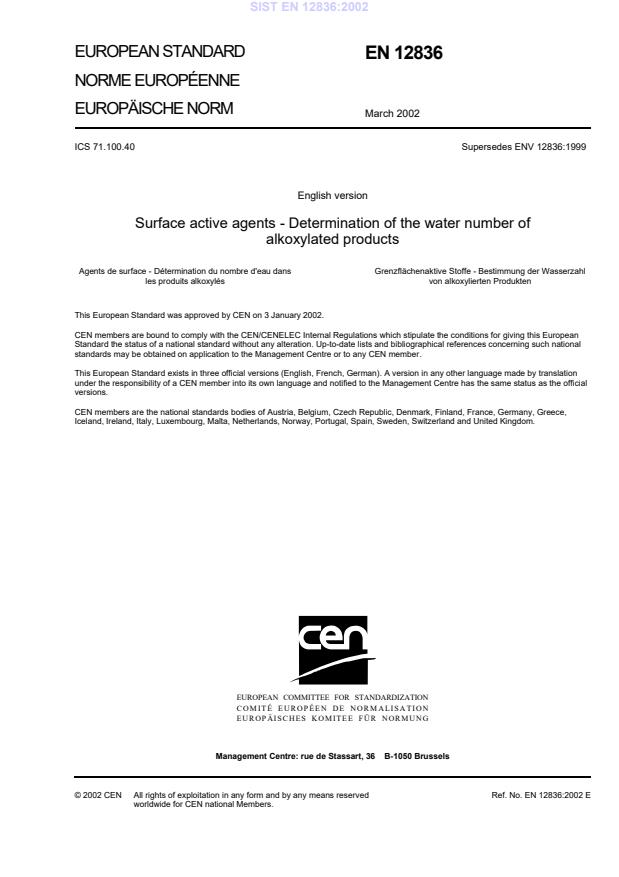
EUROPEAN STANDARDNORME EUROPÉENNEEUROPÄISCHE NORMEN 12836March 2002ICS 71.100.40Supersedes ENV 12836:1999English versionSurface active agents - Determination of the water number ofalkoxylated productsAgents de surface - Détermination du nombre d'eau dansles produits alkoxylésGrenzflächenaktive Stoffe - Bestimmung der Wasserzahlvon alkoxylierten ProduktenThis European Standard was approved by CEN on 3 January 2002.CEN members are bound to comply with the CEN/CENELEC Internal Regulations which stipulate the conditions for giving this EuropeanStandard the status of a national standard without any alteration. Up-to-date lists and bibliographical references concerning such nationalstandards may be obtained on application to the Management Centre or to any CEN member.This European Standard exists in three official versions (English, French, German). A version in any other language made by translationunder the responsibility of a CEN member into its own language and notified to the Management Centre has the same status as the officialversions.CEN members are the national standards bodies of Austria, Belgium, Czech Republic, Denmark, Finland, France, Germany, Greece,Iceland, Ireland, Italy, Luxembourg, Malta, Netherlands, Norway, Portugal, Spain, Sweden, Switzerland and United Kingdom.EUROPEAN COMMITTEE FOR STANDARDIZATIONCOMITÉ EUROPÉEN DE NORMALISATIONEUROPÄISCHES KOMITEE FÜR NORMUNGManagement Centre: rue de Stassart, 36
B-1050 Brussels© 2002 CENAll rights of exploitation in any form and by any means reservedworldwide for CEN national Members.Ref. No. EN 12836:2002 ESIST EN 12836:2002
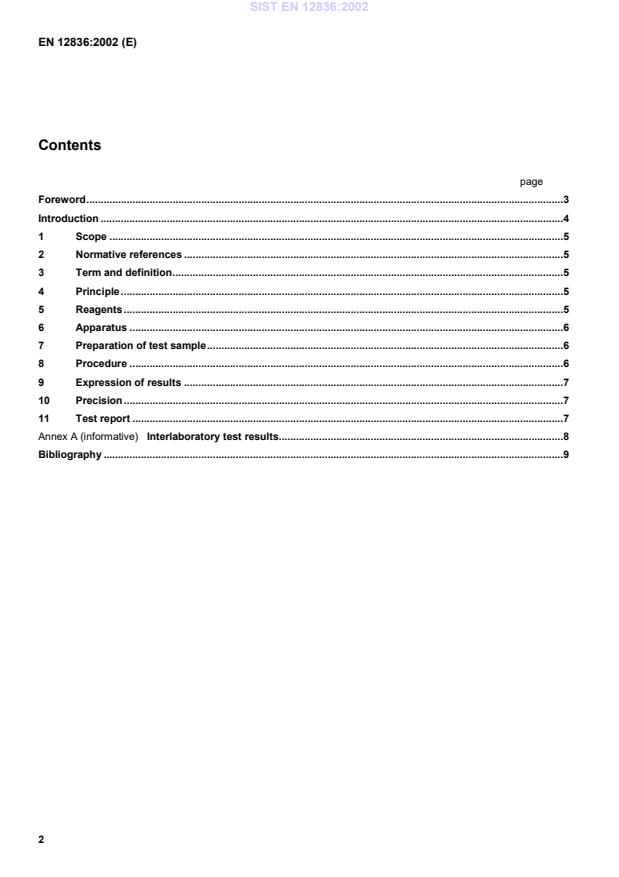
Interlaboratory test results.8Bibliography.9SIST EN 12836:2002
[1] and W.C. Griffin [2] proposed the so-called water number as aneasy-to-measure criterion for the hydrophilic-lipophilic-balance (HLB) value of surface active agents and oils. Themethod described was based on a dioxane/benzene mixture. In the following test method noxious benzene hasbeen replaced by toluene. The water number is not altered by this change.It is also possible to replace dioxane with triethylene glycol dimethyl ether. This, however, results in a change in theabsolute numerical value of the water number, especially for high molecular mass nonionics (for example ethyleneoxide/propylene oxide (EO/PO) block polymers).SIST EN 12836:2002
...