

EN 1364-3:2014
(Main)Fire resistance tests for non-loadbearing elements - Part 3: Curtain walling - Full configuration (complete assembly)
- Abstract
This European Standard specifies a method for determining the fire resistance of curtain walling full configuration.
This European Standard is used in conjunction with EN 1363 1.
NOTE Annex B gives further information on the test method.
The test method is applicable to curtain walling type B (for definition see 3.4). The test is not appropriate for testing curtain walling type A (for definition see 3.3).
The fire resistance of curtain walling may be determined under internal or external exposure conditions. In the latter case the external fire exposure curve given in EN 1363 2 may be used, subject to deviating national regulations.
Tests on individual parts of a curtain walling (e.g. perimeter seal, infill panel or fixing of the framing system (anchoring) used to attach the curtain walling to the floor element) or systems with fire resistance requirements only to the spandrel area may be performed using EN 1364 4. For vertical linear gap seals, this part of the standard applies.
This European Standard does not cover double skin façades, over-cladding systems and ventilated façade systems on external walls. It does not deal with the reaction to fire behaviour of curtain walling.
This standard is intended to be read in conjunction with EN 1363 1 and EN 1363 2.
- Status
- Published
- Publication Date
- 28-Jan-2014
- Withdrawal Date
- 30-Jul-2014
- Technical Committee
- CEN/TC 127 - Fire safety in buildings
- Drafting Committee
- CEN/TC 127/WG 1 - Structural and separating elements
- Current Stage
- 9092 - Decision on results of review/2YR ENQ - revise - Review Enquiry
- Start Date
- 17-Feb-2020
- Completion Date
- 07-Oct-2026



Overview
EN 1364-3:2014 - Fire resistance tests for non-loadbearing elements - Part 3: Curtain walling (full configuration) - is a CEN European Standard that specifies a test method for determining the fire resistance of curtain walling full configuration (complete assembly). It is intended to be read and used in conjunction with EN 1363‑1 (general fire resistance test procedures) and, for external exposure, EN 1363‑2 (external fire exposure curves). Annex B provides informative explanatory notes on the test method.
This standard applies to curtain walling type B (see clause references in the standard) and is not appropriate for curtain walling type A. It covers both internal and external fire exposure conditions (external exposure may use the EN 1363‑2 curve, subject to national regulations) and includes provisions for vertical linear gap seals.
Key topics and requirements
The standard defines technical requirements and test procedures for full‑scale curtain wall fire resistance testing, including:
- Test specimen design and construction: requirements for full configuration (complete assembly), standard and non‑standard constructions, restraint and surface conditions, and perimeter seals.
- Test conditions and apparatus: furnace setup, exposure curves (internal/external), supporting floor arrangements and simulated wall constructions.
- Instrumentation and measurement: thermocouples, pressure and deflection measurement, radiation assessment and conditioning of specimens before test.
- Test procedure and performance criteria: criteria for pass/fail under specified exposure, and required content of the test report.
- Field of direct application: rules for applying test results to real installations (width/height/span limits, framing systems, infill panels, perimeter seals, anchoring and installation angles).
- Scope limitations: the standard does not cover double‑skin façades, over‑cladding systems, ventilated façade systems, or reaction‑to‑fire behavior of materials.
Annex A addresses unitised construction application rules; Annex B gives explanatory notes to assist interpretation.
Applications and users
EN 1364‑3 is used by:
- Façade and curtain wall manufacturers to demonstrate fire resistance of complete curtain wall assemblies.
- Independent fire test laboratories for conducting standardized full‑scale tests.
- Façade engineers, architects and specifiers to select compliant systems and interpret test applicability to project designs.
- Building control authorities, certification bodies and consultants for regulatory compliance, product certification and performance verification.
- Installers and contractors to understand installation constraints that affect fire performance (anchoring, perimeter seals, pressure plates).
Typical use cases: certifying curtain wall systems for multi‑storey buildings, validating infill panels and perimeter seals within a complete assembly, and assessing external fire exposure performance.
Related standards
- EN 1363‑1 - General fire resistance test procedures
- EN 1363‑2 - External fire exposure curves (for external testing)
- EN 1364‑4 - Tests on individual parts / spandrel area / vertical linear gap seals
Keywords: EN 1364-3, curtain walling fire resistance, full configuration test, curtain wall fire testing, CEN standard, non-loadbearing elements.
Relations
- Effective Date
- 08-Jun-2022
- Effective Date
- 28-Jan-2026
- Effective Date
- 28-Jan-2026
- Effective Date
- 28-Jan-2026
- Effective Date
- 28-Jan-2026
- Effective Date
- 28-Jan-2026
- Effective Date
- 28-Jan-2026
- Effective Date
- 28-Jan-2026
- Effective Date
- 28-Jan-2026
- Effective Date
- 28-Jan-2026
- Effective Date
- 28-Jan-2026
- Effective Date
- 28-Jan-2026
- Effective Date
- 28-Jan-2026
- Effective Date
- 28-Jan-2026
- Effective Date
- 28-Jan-2026
Get Certified
Connect with accredited certification bodies for this standard

DIBt (Deutsches Institut für Bautechnik)
German Institute for Building Technology.
DIN CERTCO
DIN Group product certification.

Kiwa BDA Testing
Building and construction product certification.
Sponsored listings
Frequently Asked Questions
EN 1364-3:2014 is a standard published by the European Committee for Standardization (CEN). Its full title is "Fire resistance tests for non-loadbearing elements - Part 3: Curtain walling - Full configuration (complete assembly)". This standard covers: This European Standard specifies a method for determining the fire resistance of curtain walling full configuration. This European Standard is used in conjunction with EN 1363 1. NOTE Annex B gives further information on the test method. The test method is applicable to curtain walling type B (for definition see 3.4). The test is not appropriate for testing curtain walling type A (for definition see 3.3). The fire resistance of curtain walling may be determined under internal or external exposure conditions. In the latter case the external fire exposure curve given in EN 1363 2 may be used, subject to deviating national regulations. Tests on individual parts of a curtain walling (e.g. perimeter seal, infill panel or fixing of the framing system (anchoring) used to attach the curtain walling to the floor element) or systems with fire resistance requirements only to the spandrel area may be performed using EN 1364 4. For vertical linear gap seals, this part of the standard applies. This European Standard does not cover double skin façades, over-cladding systems and ventilated façade systems on external walls. It does not deal with the reaction to fire behaviour of curtain walling. This standard is intended to be read in conjunction with EN 1363 1 and EN 1363 2.
This European Standard specifies a method for determining the fire resistance of curtain walling full configuration. This European Standard is used in conjunction with EN 1363 1. NOTE Annex B gives further information on the test method. The test method is applicable to curtain walling type B (for definition see 3.4). The test is not appropriate for testing curtain walling type A (for definition see 3.3). The fire resistance of curtain walling may be determined under internal or external exposure conditions. In the latter case the external fire exposure curve given in EN 1363 2 may be used, subject to deviating national regulations. Tests on individual parts of a curtain walling (e.g. perimeter seal, infill panel or fixing of the framing system (anchoring) used to attach the curtain walling to the floor element) or systems with fire resistance requirements only to the spandrel area may be performed using EN 1364 4. For vertical linear gap seals, this part of the standard applies. This European Standard does not cover double skin façades, over-cladding systems and ventilated façade systems on external walls. It does not deal with the reaction to fire behaviour of curtain walling. This standard is intended to be read in conjunction with EN 1363 1 and EN 1363 2.
EN 1364-3:2014 is classified under the following ICS (International Classification for Standards) categories: 13.220.50 - Fire-resistance of building materials and elements; 91.060.10 - Walls. Partitions. Facades. The ICS classification helps identify the subject area and facilitates finding related standards.
EN 1364-3:2014 has the following relationships with other standards: It is inter standard links to EN 1364-3:2006, EN 1363-1:2020, EN 1363-2:1999, EN 13501-2:2023, EN ISO 13943:2023, EN 13119:2016, EN 13830:2015+A1:2020, EN 13501-1:2018, EN 378-3:2008+A1:2012, EN 378-3:2016, EN 15254-6:2014, EN 13501-2:2016, EN 357:2004, EN 378-3:2016+A1:2020, EN 15998:2020. Understanding these relationships helps ensure you are using the most current and applicable version of the standard.
EN 1364-3:2014 is associated with the following European legislation: EU Directives/Regulations: 305/2011, 89/106/EEC; Standardization Mandates: M/117. When a standard is cited in the Official Journal of the European Union, products manufactured in conformity with it benefit from a presumption of conformity with the essential requirements of the corresponding EU directive or regulation.
EN 1364-3:2014 is available in PDF format for immediate download after purchase. The document can be added to your cart and obtained through the secure checkout process. Digital delivery ensures instant access to the complete standard document.
Standards Content (Sample)
2003-01.Slovenski inštitut za standardizacijo. Razmnoževanje celote ali delov tega standarda ni dovoljeno.Preskusi požarne odpornosti nenosilnih elementov - 3. del: Obešene fasade - Celotna fasadaFeuerwiderstandsprüfungen für nichttragende Bauteile - Teil 3: Vorhangfassaden - GesamtausführungEssais de résistance au feu des éléments non-porteurs dans les bâtiments - Partie 3: Murs rideauxFire resistance tests for non-loadbearing elements - Part 3: Curtain walling - Full configuration (complete assembly)91.060.10Stene. Predelne stene. FasadeWalls. Partitions. Facades13.220.50Požarna odpornost gradbenih materialov in elementovFire-resistance of building materials and elementsICS:Ta slovenski standard je istoveten z:EN 1364-3:2014SIST EN 1364-3:2014en,fr,de01-marec-2014SIST EN 1364-3:2014SLOVENSKI
STANDARDSIST EN 1364-3:20071DGRPHãþD
EUROPEAN STANDARD NORME EUROPÉENNE EUROPÄISCHE NORM
EN 1364-3
January 2014 ICS 13.220.50; 91.060.10 Supersedes EN 1364-3:2006English Version
Fire resistance tests for non-loadbearing elements - Part 3: Curtain walling - Full configuration (complete assembly)
Essais de résistance au feu des éléments non-porteurs dans les bâtiments - Partie 3: Murs rideaux - Configuration en grandeur réelle (assemblage complet)
Feuerwiderstandsprüfungen für nichttragende Bauteile - Teil 3: Vorhangfassaden - Gesamtausführung This European Standard was approved by CEN on 9 November 2013.
CEN members are bound to comply with the CEN/CENELEC Internal Regulations which stipulate the conditions for giving this European Standard the status of a national standard without any alteration. Up-to-date lists and bibliographical references concerning such national standards may be obtained on application to the CEN-CENELEC Management Centre or to any CEN member.
This European Standard exists in three official versions (English, French, German). A version in any other language made by translation under the responsibility of a CEN member into its own language and notified to the CEN-CENELEC Management Centre has the same status as the official versions.
CEN members are the national standards bodies of Austria, Belgium, Bulgaria, Croatia, Cyprus, Czech Republic, Denmark, Estonia, Finland, Former Yugoslav Republic of Macedonia, France, Germany, Greece, Hungary, Iceland, Ireland, Italy, Latvia, Lithuania, Luxembourg, Malta, Netherlands, Norway, Poland, Portugal, Romania, Slovakia, Slovenia, Spain, Sweden, Switzerland, Turkey and United Kingdom.
EUROPEAN COMMITTEE FOR STANDARDIZATION
COMITÉ EUROPÉEN DE NORMALISATION EUROPÄISCHES KOMITEE FÜR NORMUNG
CEN-CENELEC Management Centre:
Avenue Marnix 17,
B-1000 Brussels © 2014 CEN All rights of exploitation in any form and by any means reserved worldwide for CEN national Members. Ref. No. EN 1364-3:2014 ESIST EN 1364-3:2014
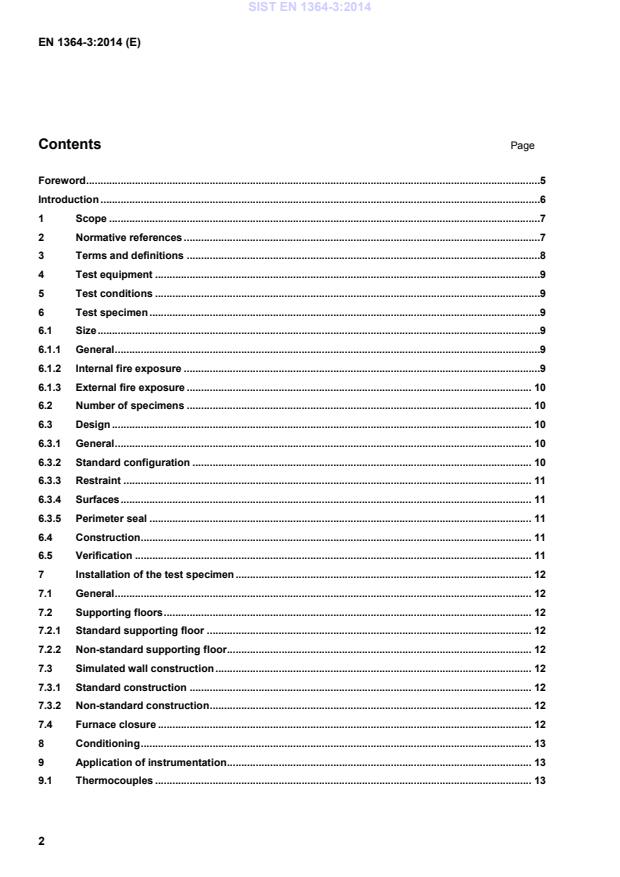
2 Contents Page Foreword .5 Introduction .6 1 Scope .7 2 Normative references .7 3 Terms and definitions .8 4 Test equipment .9 5 Test conditions .9 6 Test specimen .9 6.1 Size .9 6.1.1 General .9 6.1.2 Internal fire exposure .9 6.1.3 External fire exposure . 10 6.2 Number of specimens . 10 6.3 Design . 10 6.3.1 General . 10 6.3.2 Standard configuration . 10 6.3.3 Restraint . 11 6.3.4 Surfaces . 11 6.3.5 Perimeter seal . 11 6.4 Construction . 11 6.5 Verification . 11 7 Installation of the test specimen . 12 7.1 General . 12 7.2 Supporting floors . 12 7.2.1 Standard supporting floor . 12 7.2.2 Non-standard supporting floor . 12 7.3 Simulated wall construction . 12 7.3.1 Standard construction . 12 7.3.2 Non-standard construction . 12 7.4 Furnace closure . 12 8 Conditioning . 13 9 Application of instrumentation . 13 9.1 Thermocouples . 13 SIST EN 1364-3:2014
4 13.5.5 Fixing of the perimeter seal . 31 13.5.6 Covering . 31 13.6 Supporting floor . 31 13.7 Walls abutting the curtain walling. 32 Annex A (normative)
Field of direct application of test results for unitised construction . 55 A.1 General . 55 A.2 Rules for the complete construction . 55 A.2.1 Width of the curtain walling . 55 A.2.2 Height of the curtain wall . 55 A.2.3 Span length . 55 A.3 Infill panels . 55 A.3.1 Opaque (non-translucent/non-transparent) infill panels . 55 A.3.2 Sandwich panels . 55 A.3.3 Translucent or transparent infill panels . 55 Annex B (informative)
Explanatory notes . 56 B.1 Notes to Clause 1 “Scope” . 56 B.1.1 Test principles and requirements . 56 B.1.2 Fire from the outside of the building be.g. bf bt and bf bo t icc . 56 B.2 Notes to Clause 3 “Terms and definitions” . 56 B.3 Notes to Clause 5 “Test conditions” . 57 B.4 Notes to Clause 6 “Test specimen” . 57 B.5 Notes to 7.2.1 “Standard supporting floor” . 57 B.6 Notes to Clause 9 “Application of instrumentation” . 57 B.6.1 Thermocouples . 57 B.6.2 Deflection measurement . 57 B.7 Notes to Clause 13 “Field of direct application of test results” . 58 B.7.1 Overrun time . 58 B.7.2 Width of the curtain walling . 58 B.7.3 Installation angle (vertical/sloped) . 58 B.7.4 Horizontally faceted curtain walling . 58 B.7.5 Height of the curtain walling / span length . 58 B.7.6 Framing system . 58 B.7.7 Infill panels / spandrel panels . 59 B.7.8 Perimeter seal . 59 Bibliography . 63
6 Introduction CAUTION The attention of all persons concerned with managing and carrying out this fire resistance test is drawn to the fact that fire testing may be hazardous and that there is a possibility that toxic and/or harmful smoke and gases may be evolved during the test. Mechanical and operational hazards may also arise during the construction of the test elements or structures, during their testing and during the disposal of test residues. An assessment of all potential hazards and risks to health should be made and safety precautions should be identified and provided. Written safety instructions should be issued. Appropriate training should be given to relevant personnel. Laboratory personnel should ensure that they follow written safety instructions at all times. SIST EN 1364-3:2014
1 Scope This European Standard specifies a method for determining the fire resistance of curtain walling – full configuration. This European Standard is used in conjunction with EN 1363-1. NOTE Annex B gives further information on the test method. The test method is applicable to curtain walling type B (for definition see 3.4). The test is not appropriate for testing curtain walling type A (for definition see 3.3). The fire resistance of curtain walling may be determined under internal or external exposure conditions. In the latter case the external fire exposure curve given in EN 1363-2 may be used, subject to deviating national regulations. Tests on individual parts of a curtain walling (e.g. perimeter seal, infill panel or fixing of the framing system (anchoring) used to attach the curtain walling to the floor element) or systems with fire resistance requirements only to the spandrel area may be performed using EN 1364-4. For vertical linear gap seals, this part of the standard applies. This European Standard does not cover double skin façades, over-cladding systems and ventilated façade systems on external walls. It does not deal with the reaction to fire behaviour of curtain walling. This standard is intended to be read in conjunction with EN 1363-1 and EN 1363-2. 2 Normative references The following documents, in whole or in part, are normatively referenced in this document and are indispensable for its application. For dated references, only the edition cited applies. For undated references, the latest edition of the referenced document (including any amendments) applies. EN 1363-1, Fire resistance tests - Part 1: General Requirements EN 1363-2, Fire resistance tests - Part 2: Alternative and additional procedures EN 13119, Curtain walling - Terminology EN 13501-1, Fire classification of construction products and building elements — Part 1: Classification using data from reaction to fire tests EN 13501-2, Fire classification of construction products and building elements — Part 2: Classification using data from fire resistance tests, excluding ventilation services EN 13830, Curtain walling - Product standard EN ISO 13943, Fire safety - Vocabulary (ISO 13943) SIST EN 1364-3:2014
8 3 Terms and definitions For the purposes of this document, the terms and definitions given in EN 1363-1, EN 13119, EN 13830,
EN ISO 13943 and the following apply. 3.1 anchoring see fixing of the framing system 3.2 associated wall construction form of construction required to close the vertical side of the furnace (not part of the test specimen) 3.3 curtain walling type A curtain walling without fire resistant glazing outside the spandrel area – fire resistant only in the spandrel area 3.4 curtain walling type B curtain walling with fire resistant glazing outside the spandrel area - fully fire resistant curtain walling 3.5 fire-resistant glazing glazing system consisting of one or more transparent or translucent panes with a suitable method of mounting, with e.g. frames, seals and fixing materials, capable of satisfying the appropriate fire resistance criteria 3.6 fire resistant translucent or transparent infill panel glass product, monolithic, laminated or insulating glass unit, manufactured by a particular manufacturer and intended to be used as infill panel in curtain walling, which is CE marked based on a classification according to EN 13501-2 in minimum one glazed construction Note 1 to entry: The term “insulating” when used with “insulating glass unit” according to EN 1279–1, should not be confused with the term “insulation” used in classification standard EN 13501–2. 3.7 fixing of the framing system system used to attach the curtain wall to the loadbearing floor. It contains the brackets but not the anchor or other devices used to fix the brackets to the floor 3.8 glazing materials all materials used to glaze the fire resistant translucent or transparent infill panel into its frame 3.9 horizontally faceted curtain walling curtain walling with an angle between horizontally adjacent infill panels at the common mullion (see Figure 1) 3.10 insulating glass unit (IGU) glass product according to EN 1279–1 3.11 perimeter seal see EN 13119 SIST EN 1364-3:2014
10 b) the test specimen to extend 150 mm below the upper surface of the lower supporting floor with the bottom edge unsupported. If an assessment of a vertical linear gap is required, the test specimen shall then be of sufficient width to allow a minimum of 500 mm of the test specimen to extend beyond the outside of the simulated wall. 6.1.3 External fire exposure The test specimen shall be of sufficient height to allow the test specimen to extend minimum 150 mm below the upper surface of the lower supporting floor with the bottom edge unsupported in case the specimen is installed in front of the furnace (see Figure 3). 6.2 Number of specimens Separate tests are necessary for internal and external exposure conditions. Depending on the construction of the curtain walling and the intended field of application additional tests with faceted specimens may be necessary. 6.3 Design 6.3.1 General The test specimen for internal exposure shall include the curtain walling, the perimeter seal and, if required, the vertical linear gap seal. The test specimen for external exposure only includes the curtain walling. The supporting floors, the perimeter seal and the vertical linear gap seal may be omitted. The test specimen or test construction, if appropriate, shall be: a) either fully representative of the construction intended for use in practice, including fixing of the framing system, expansion joints, perimeter seals, vertical linear gap seals, any surface finishes and fittings which are essential and may influence its behaviour in the test, or b) a standard configuration as defined in 6.3.2. 6.3.2 Standard configuration A straight test specimen shall comprise a section of the curtain walling comprising minimum two mullions and two transoms or two vertical joints between panels in case of systems without a frame or mullions, fully exposed to the fire, see Figure 4. One of the mullions and transoms may be interrupted to allow the inclusion of T-connections. Figure 5 shows an example for the standard configuration of a test specimen including a vertical linear gap seal. Figure 6 shows an example for the standard configuration of a specimen including horizontal and vertical T-connections. Figure 7 shows details of the connection geometry between mullions and associated wall and simulated wall / vertical linear gap seal. A faceted specimen shall comprise minimum four sections of the curtain walling forming minimum one corner of 90 degrees and two angles of 135 degrees, all sections with a minimum width of 500 mm, minimum three sections with a width of minimum 1000 mm, see Figures 8A to 8D. Two such specimens may be combined to a specimen forming two corners of 90 degrees and two angles of 135 degrees, see Figures 8E and 8F for examples. The sequence of the segments of the combined specimens may be different to that shown in Figure 8E and 8F except that the 500 mm wide section shall always be on one end. SIST EN 1364-3:2014
12 7 Installation of the test specimen 7.1 General For internal exposure the test construction shall include the test specimen and in addition two supporting floors and two associated walls. In case a vertical linear gap seal is included in the test specimen a simulated wall is used instead of one associated wall. The test specimen shall be fitted to the supporting floors by means of the fixing of the framing system that is used in practice, see 7.2. For external exposure a supporting frame which supports the specimen and is designed to allow the specimen to be supported and located adjacent to the furnace in case an installation in front of the furnace is used. For standard configurations see Figure 9. In case a test specimen according to Figures 9B or 9C is intended to be used it shall comply with the following: a) the test specimen shall be rigidly fixed only on top (hanging curtain walling) or at bottom (standing curtain walling); b) the fixing on the opposite side as well as the adjacent furnace closure shall allow thermal extension of the specimen as in practice; NOTE A gap of 50 to 100 mm is considered sufficient to allow thermal extension as in practice. 7.2 Supporting floors 7.2.1 Standard supporting floor The standard supporting floor shall have a minimum thickness of 150 mm and minimum width of 500 mm for straight specimens. For faceted specimens the minimum width shall be 200 mm (see Figure 13). The floor shall be made of reinforced concrete or made of reinforced aerated concrete and shall be restrained at three sides. 7.2.2 Non-standard supporting floor Any floor construction as in practise may be used. The results of the test are limited to that floor construction only (no field of direct application concerning floor constructions). 7.3 Simulated wall construction 7.3.1 Standard construction The construction details of standard wall constructions shall be in accordance with EN 1363-1. The method of sealing the vertical linear gap between the test specimen and the simulated wall construction shall be recorded in the test report. 7.3.2 Non-standard construction Any wall construction as in practise may be used. The result of the test is limited to that construction only (no field of direct application). 7.4 Furnace closure The furnace closure shall be done with a mineral wool packing of class A1 according to EN 13501-1 to allow the specimen to move to a similar extent as in practice. SIST EN 1364-3:2014
14 9.1.2.3.2 Surface 1 For the determination of maximum temperature rise, additional thermocouples shall be applied to Surface 1 as follows and given in Figure 15 for straight specimens and Figure 12 for faceted specimens: — Thermocouple 1A - 20 mm below the upper edge of the visible spandrel panel area at mid width of the panel; — Thermocouple 1B - on a mullion 20 mm below the upper edge of the visible spandrel panel area; — Thermocouple 1C - at the junction of a mullion and a transom; — Thermocouple 1D – at mid height of the edge panel with the maximum height and/or largest area, 150 mm in from the outer panel edge in case of installation according to Figure 9B and 9C or minimum 150 mm in from the inner surface of the furnace wall in case of installation according to Figure 9A; — Thermocouple 1F - at mid way between two mullions, where possible, at a transom or a horizontal joint between infill panel / infill panel or infill panel / spandrel panel (in the positive pressure zone); — Thermocouple 1G - at mid way between two transoms, where possible, on a mullion or a vertical joint between infill panel / infill panel (in the positive pressure zone) for each type of infill panel; — Thermocouple 1H - at mid-height of the panel with the largest area, 20 mm from the mullion for each type of infill panel and spandrel panel. If the largest panel is not the tallest panel, then another thermocouple shall be placed at mid-height of the tallest panel, 20 mm from the mullion or the joint between panel / panel; — Thermocouple 1I – at mid-width of the panel with the largest area, 20 mm from the transom at the top edge of the panel for each type of infill panel and spandrel panel. If the largest panel is not the widest panel, then another thermocouple shall be placed at mid-width of the widest panel, 20 mm from the transom or the joint between panel / panel at the top edge of the panel. Thermocouples 1I are used when the upper transom of the panel is located in the heated area. If this is not the case, thermocouples 2K are used; — Thermocouple 1J – in the top corners of the panel with the largest area and additionally in the top corners of the highest placed panel, if this is not the same panel, for each type of infill panel and spandrel panel, 20 mm from the mullion and the transom. Thermocouples 1J are used when the upper transom of the panel is located in the heated area. If this is not the case, thermocouples 2K are used; — Thermocouple 1K – in the bottom corners of the highest placed non-glazed panel, if there is no upper transom in the heated area, for each type of panel, 20 mm from the mullion and the transom. 9.1.2.3.3 Surfaces 2 and 6 For the determination of maximum temperature rise, additional thermocouples shall be applied as follows and as given in Figures 4 to 6 for straight specimens and Figure 13 for faceted specimens: — Thermocouple 2A - 20 mm below the soffit of the upper supporting floor at mid width of a spandrel panel (Surface 2); — Thermocouple 2B - 20 mm below the soffit of the upper supporting floor in line with a mullion (Surface 2); — Thermocouple 2C - at the junction of a mullion and a transom (Surface 2); — Thermocouple 2F - at mid way between two mullions, where possible, at a transom or a horizontal joint between infill panel / infill panel or infill panel / spandrel panel (in the positive pressure zone) (Surface 2); SIST EN 1364-3:2014
16 — Thermocouples on Surface 4 are only required if a vertical linear gap seal is part of the test specimen. 9.1.2.3.5 Perimeter Seal For the determination of the maximum temperature rise, thermocouples shall be applied to the perimeter seal as follows (see Figures 4 to 6): — Thermocouple HV - at the top surface of the seal, centrally between the mullions and centrally across the perimeter seal; — Thermocouple HW - at the top surface of the seal 20 mm from a mullion centrally across the perimeter seal; — Thermocouple HV1 - at the top surface of the seal
...