


EN 1364-1:2015
(Main)Fire resistance tests for non-loadbearing elements - Part 1: Walls
Fire resistance tests for non-loadbearing elements - Part 1: Walls
This European standard specifies a method for determining the fire resistance of non-loadbearing walls.
This European Standard is used in conjunction with EN 1363-1.
It is applicable to partitions (non-loadbearing walls) with and without glazing, non-loadbearing walls consisting almost wholly of glazing (glazed non-loadbearing walls) and other non-loadbearing internal and external non-loadbearing walls with and without glazing.
The fire resistance of external non-loadbearing walls can be determined under internal or external exposure conditions. In the latter case the external fire exposure curve given in EN 1363-2 is used.
It is not applicable to:
a) curtain walls (external non-loadbearing walls suspended in front of the floor slab), unless explicitly permitted under EN 1364-3 or EN 1364-4 which shall contain details of the methodology to be used.
b) non-loadbearing walls containing door assemblies which shall be tested to EN 1634-1.
Specific requirements relating to the testing of glazing are given in Annex A.
Specific requirements relating to the testing of non-loadbearing external and internal walls designed to span horizontally between two independently proven fire resisting vertical structural elements are given in annex B.
Feuerwiderstandsprüfungen für nichttragende Bauteile - Teil 1: Wände
Diese Europäische Norm legt ein Verfahren zur Bestimmung der Feuerwiderstandsdauer von nichttragenden Wänden fest.
Diese Europäische Norm gilt in Verbindung mit EN 1363-1.
Sie gilt für nichttragende Innenwände (Trennwände) mit und ohne Verglasung, nahezu vollständig aus Verglasung bestehende nichttragende Wände (nichttragende Glaswände), sowie sonstige nichttragende Innen- und Außenwände mit und ohne Verglasung.
Die Feuerwiderstandsdauer von nichttragenden Außenwänden kann durch Beflammung von innen oder von außen bestimmt werden. Im letzteren Fall wird die in EN 1363-2 aufgeführte Außenbrandkurve angewendet.
Die Norm gilt nicht für:
a) Vorhangfassaden (nichttragende Außenwände, die vor Decken abgehängt werden), sofern dies nicht ausdrücklich nach EN 1364-3 oder EN 1364-4, welche Einzelheiten zur anzuwendenden Vorgehensweise enthalten, zulässig ist.
b) nichttragende Wände mit Türen, die nach EN 1634-1 geprüft werden.
Besondere Anforderungen an die Prüfung von verglasten Bauteilen oder nichttragenden Wänden mit Verglasung sind in Anhang A aufgeführt.
Besondere Anforderungen an die Prüfung nichttragender Außen- und Innenwände, die dafür vorgesehen sind, horizontal gespannt zwischen zwei vertikalen tragenden Bauteilen angeordnet zu sein, für die unabhängig der Feuerwiderstand nachgewiesen wurde, sind in Anhang B aufgeführt.
Essais de résistance au feu des éléments non porteurs - Partie 1 : Murs
La présente Norme européenne spécifie une méthode pour déterminer la résistance au feu des murs non porteurs.
La présente Norme européenne est utilisée conjointement avec l’EN 1363-1.
Elle est applicable aux cloisons (murs non porteurs), avec et sans vitrage, aux murs non porteurs constitués presque entièrement de vitrage (murs non porteurs vitrés) et aux autres murs intérieurs et extérieurs non porteurs, avec ou sans vitrage.
La résistance au feu des murs extérieurs non porteurs peut être déterminée dans des conditions d’exposition à l’intérieur ou à l’extérieur. Dans ce dernier cas, on utilise la courbe d’exposition au feu extérieur donnée dans l’EN 1363-2.
Elle ne s’applique pas :
a) aux façades rideaux (murs extérieurs non porteurs suspendus devant la dalle de plancher), sauf si cela est explicitement autorisé par l’EN 1364-3 ou l’EN 1364-4, qui doit contenir des détails sur la méthodologie à suivre ;
b) aux murs non porteurs comportant des blocs-portes qui doivent être soumis à l’essai conformément à l’EN 1364-1.
Les prescriptions spécifiques se rapportant aux essais effectués sur les vitrages sont données dans l’Annexe A.
Les prescriptions spécifiques se rapportant aux essais effectués sur les murs extérieurs et intérieurs non porteurs conçus pour s’étendre horizontalement entre deux éléments structurels verticaux résistant au feu soumis à l’essai indépendamment sont données dans l’Annexe B.
Preskusi požarne odpornosti nenosilnih elementov - 1. del: Stene
Ta evropski standard določa metodo za ugotavljanje požarne odpornosti nenosilnih sten.
Ta evropski standard se uporablja v povezavi s standardom EN 1363-1.
Uporablja se za predelne stene (nenosilne stene) z in brez zasteklitve, nenosilne stene, ki so skoraj povsem zastekljene (zastekljene nenosilne stene) in druge nenosilne notranje in zunanje stene z zasteklitvijo in brez nje.
Požarno odpornost zunanjih nenosilnih zidov je mogoče določiti za notranje in zunanje pogoje izpostavljenosti. Pri zunanjih pogojih je uporabljena krivulja izpostavljenosti ognju iz standarda EN 1363-2.
Ne velja za:
a) fasade (zunanje nenosilne zidove, obešene pred talno ploščo), razen če je to izrecno dovoljeno s standardom EN 1364-3 ali EN 1364-4, ki mora vsebovati podrobnosti uporabljene metodologije.
b) nenosilne zidove z vrati, ki jih je treba preskusiti v skladu z EN 1634-1.
Posebne zahteve v povezavi s preskušanjem zasteklitve so določene v dodatku A.
Posebne zahteve v povezavi s preskušanjem zunanjih in notranjih nenosilnih zidov, ki so zasnovani za vodoraven razpon med dvema neodvisno dokazano požarno odpornima navpičnima strukturnima elementoma, so določene v dodatku B.
General Information
- Status
- Published
- Publication Date
- 07-Jul-2015
- Withdrawal Date
- 30-Jan-2016
- Technical Committee
- CEN/TC 127 - Fire safety in buildings
- Drafting Committee
- CEN/TC 127/WG 1 - Structural and separating elements
- Current Stage
- 9092 - Decision on results of review/2YR ENQ - revise - Review Enquiry
- Start Date
- 15-Jul-2021
- Completion Date
- 14-Apr-2025
Relations
- Effective Date
- 23-Apr-2014
- Effective Date
- 18-Jan-2023
Overview
EN 1364-1:2015 - published by CEN - specifies a standardized method for determining the fire resistance of non-loadbearing walls (partitions), including walls with glazing and walls made almost wholly of glazing. The standard is intended to measure the ability of a representative wall specimen to resist fire spread from one face to the other. EN 1364-1:2015 is used in conjunction with EN 1363-1 (general fire resistance test conditions) and, for external exposure, may reference the external fire curve in EN 1363-2.
Key Topics
- Scope and applicability
- Tests for internal and external non-loadbearing walls, partitions, glazed and partly glazed walls.
- Not applicable to curtain walls (unless addressed in EN 1364-3/4) or to walls containing door assemblies (tested under EN 1634-1).
- Test specimen requirements
- Dimensions, number of specimens and representative construction details (joints, restraint, framing and glazing).
- Special provisions for glazed assemblies (Annex A) and for horizontally spanning walls between independent vertical elements (Annex B).
- Test equipment and instrumentation
- Furnace thermocouples, unexposed-face thermocouples, deflection and radiation measurements, pressure and impact monitoring as required.
- Locations and number of measuring points defined; additional thermocouples and deflection measurements for larger or glazed constructions.
- Test procedure and conditions
- Conditioning, installation, exposure regimes (including external exposure using EN 1363-2 when applicable) and test progression rules.
- Performance criteria and reporting
- Criteria for integrity, insulation and mechanical performance during the test and detailed test report requirements.
- Field of direct application
- Rules for extending test results to other dimensions, supporting constructions and configurations, with specific provisions for glazed elements.
Applications
EN 1364-1:2015 is used by:
- Test laboratories conducting standardized fire resistance tests.
- Manufacturers of partitions, glazed wall systems and façade components needing certified fire ratings.
- Fire safety engineers, architects, specifiers and building authorities for product selection, compliance assessment and design verification.
- Contractors and façade installers referencing tested configurations for on-site compliance and acceptance.
Practical uses include certifying partition systems for fire compartments, specifying glazed partition fire performance, and establishing allowable field-of-application limits for tested wall assemblies.
Related standards
- EN 1363-1 - General Fire Resistance Tests (required companion)
- EN 1363-2 - External Exposure Fire Curve
- EN 1364 (Parts 2–5) - Ceilings, curtain walling, air transfer grilles
- EN 1364-3 / EN 1364-4 - Curtain wall specific rules
- EN 1634-1 - Fire resistance of door assemblies
Keywords: EN 1364-1:2015, fire resistance tests, non-loadbearing walls, glazed partitions, EN 1363-1, EN 1363-2, fire test methods, CEN.



Frequently Asked Questions
EN 1364-1:2015 is a standard published by the European Committee for Standardization (CEN). Its full title is "Fire resistance tests for non-loadbearing elements - Part 1: Walls". This standard covers: This European standard specifies a method for determining the fire resistance of non-loadbearing walls. This European Standard is used in conjunction with EN 1363-1. It is applicable to partitions (non-loadbearing walls) with and without glazing, non-loadbearing walls consisting almost wholly of glazing (glazed non-loadbearing walls) and other non-loadbearing internal and external non-loadbearing walls with and without glazing. The fire resistance of external non-loadbearing walls can be determined under internal or external exposure conditions. In the latter case the external fire exposure curve given in EN 1363-2 is used. It is not applicable to: a) curtain walls (external non-loadbearing walls suspended in front of the floor slab), unless explicitly permitted under EN 1364-3 or EN 1364-4 which shall contain details of the methodology to be used. b) non-loadbearing walls containing door assemblies which shall be tested to EN 1634-1. Specific requirements relating to the testing of glazing are given in Annex A. Specific requirements relating to the testing of non-loadbearing external and internal walls designed to span horizontally between two independently proven fire resisting vertical structural elements are given in annex B.
This European standard specifies a method for determining the fire resistance of non-loadbearing walls. This European Standard is used in conjunction with EN 1363-1. It is applicable to partitions (non-loadbearing walls) with and without glazing, non-loadbearing walls consisting almost wholly of glazing (glazed non-loadbearing walls) and other non-loadbearing internal and external non-loadbearing walls with and without glazing. The fire resistance of external non-loadbearing walls can be determined under internal or external exposure conditions. In the latter case the external fire exposure curve given in EN 1363-2 is used. It is not applicable to: a) curtain walls (external non-loadbearing walls suspended in front of the floor slab), unless explicitly permitted under EN 1364-3 or EN 1364-4 which shall contain details of the methodology to be used. b) non-loadbearing walls containing door assemblies which shall be tested to EN 1634-1. Specific requirements relating to the testing of glazing are given in Annex A. Specific requirements relating to the testing of non-loadbearing external and internal walls designed to span horizontally between two independently proven fire resisting vertical structural elements are given in annex B.
EN 1364-1:2015 is classified under the following ICS (International Classification for Standards) categories: 13.220.50 - Fire-resistance of building materials and elements; 91.060.10 - Walls. Partitions. Facades. The ICS classification helps identify the subject area and facilitates finding related standards.
EN 1364-1:2015 has the following relationships with other standards: It is inter standard links to EN 1364-1:1999, prEN 1364-1. Understanding these relationships helps ensure you are using the most current and applicable version of the standard.
EN 1364-1:2015 is associated with the following European legislation: EU Directives/Regulations: 305/2011; Standardization Mandates: M/117. When a standard is cited in the Official Journal of the European Union, products manufactured in conformity with it benefit from a presumption of conformity with the essential requirements of the corresponding EU directive or regulation.
You can purchase EN 1364-1:2015 directly from iTeh Standards. The document is available in PDF format and is delivered instantly after payment. Add the standard to your cart and complete the secure checkout process. iTeh Standards is an authorized distributor of CEN standards.
Standards Content (Sample)
2003-01.Slovenski inštitut za standardizacijo. Razmnoževanje celote ali delov tega standarda ni dovoljeno.Preskusi požarne odpornosti nenosilnih elementov - 1. del: SteneFeuerwiderstandsprüfungen für nichttragende Bauteile - Teil 1: WändeEssais de résistance au feu des éléments non porteurs - Partie 1 : MursFire resistance tests for non-loadbearing elements - Part 1: Walls91.060.10Stene. Predelne stene. FasadeWalls. Partitions. Facades13.220.50Požarna odpornost gradbenih materialov in elementovFire-resistance of building materials and elementsICS:Ta slovenski standard je istoveten z:EN 1364-1:2015SIST EN 1364-1:2015en,fr,de01-september-2015SIST EN 1364-1:2015SLOVENSKI
STANDARDSIST EN 1364-1:19991DGRPHãþD
EUROPEAN STANDARD NORME EUROPÉENNE EUROPÄISCHE NORM
EN 1364-1
July 2015 ICS 13.220.50; 91.060.10 Supersedes EN 1364-1:1999English Version
Fire resistance tests for non-loadbearing elements - Part 1: Walls
Essais de résistance au feu des éléments non porteurs - Partie 1 : Murs
Feuerwiderstandsprüfungen für nichttragende Bauteile - Teil 1: Wände This European Standard was approved by CEN on 30 April 2015.
CEN members are bound to comply with the CEN/CENELEC Internal Regulations which stipulate the conditions for giving this European Standard the status of a national standard without any alteration. Up-to-date lists and bibliographical references concerning such national standards may be obtained on application to the CEN-CENELEC Management Centre or to any CEN member.
This European Standard exists in three official versions (English, French, German). A version in any other language made by translation under the responsibility of a CEN member into its own language and notified to the CEN-CENELEC Management Centre has the same status as the official versions.
CEN members are the national standards bodies of Austria, Belgium, Bulgaria, Croatia, Cyprus, Czech Republic, Denmark, Estonia, Finland, Former Yugoslav Republic of Macedonia, France, Germany, Greece, Hungary, Iceland, Ireland, Italy, Latvia, Lithuania, Luxembourg, Malta, Netherlands, Norway, Poland, Portugal, Romania, Slovakia, Slovenia, Spain, Sweden, Switzerland, Turkey and United Kingdom.
EUROPEAN COMMITTEE FOR STANDARDIZATION
COMITÉ EUROPÉEN DE NORMALISATION EUROPÄISCHES KOMITEE FÜR NORMUNG
CEN-CENELEC Management Centre:
Avenue Marnix 17,
B-1000 Brussels © 2015 CEN All rights of exploitation in any form and by any means reserved worldwide for CEN national Members. Ref. No. EN 1364-1:2015 ESIST EN 1364-1:2015
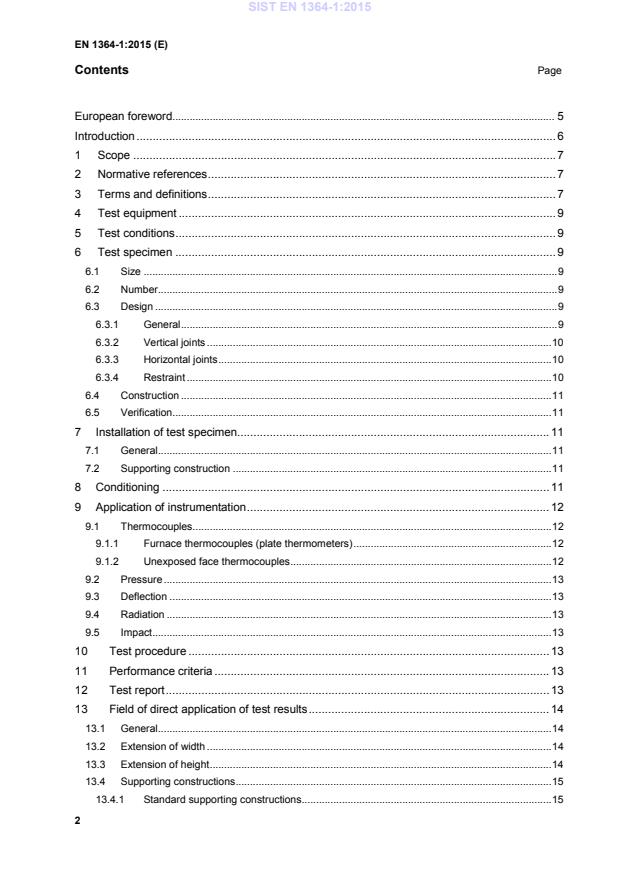
European foreword. 5 Introduction . 6 1 Scope . 7 2 Normative references . 7 3 Terms and definitions . 7 4 Test equipment . 9 5 Test conditions . 9 6 Test specimen . 9 6.1 Size . 9 6.2 Number . 9 6.3 Design . 9 6.3.1 General . 9 6.3.2 Vertical joints . 10 6.3.3 Horizontal joints . 10 6.3.4 Restraint . 10 6.4 Construction . 11 6.5 Verification . 11 7 Installation of test specimen. 11 7.1 General . 11 7.2 Supporting construction . 11 8 Conditioning . 11 9 Application of instrumentation . 12 9.1 Thermocouples. 12 9.1.1 Furnace thermocouples (plate thermometers) . 12 9.1.2 Unexposed face thermocouples . 12 9.2 Pressure . 13 9.3 Deflection . 13 9.4 Radiation . 13 9.5 Impact . 13 10 Test procedure . 13 11 Performance criteria . 13 12 Test report . 13 13 Field of direct application of test results . 14 13.1 General . 14 13.2 Extension of width . 14 13.3 Extension of height . 14 13.4 Supporting constructions . 15 13.4.1 Standard supporting constructions. 15 SIST EN 1364-1:2015
Specific requirements for testing glazed elements or non-loadbearing walls incorporating glazing . 36 A.1 General . 36 A.2 Test specimen design . 36 A.3 Test specimen instrumentation . 37 A.3.1 General . 37 A.3.2 Average temperature rise . 37 A.3.2.1 Fully glazed test specimen . 37 A.3.2.2 Partly glazed test specimen . 37 A.3.3 Maximum temperature rise . 37 A.3.4 Radiation measurement . 38 A.3.5 Deflection measurement . 38 A.4 Field of direct application of test results . 38 A.4.1 General . 38 A.4.2 Field of direct application rules not requiring overrun time. 38 A.4.2.1 Glazed element . 38 A.4.2.1.1 Installation angle . 38 A.4.2.1.2 Height of the glazed element . 39 A.4.2.1.3 Width of the glazed element . 39 A.4.2.2 Glazing system (see Figure 16) . 39 A.4.2.2.1 Linear dimensions . 39 A.4.2.2.2 Aspect ratio . 39 A.4.2.2.3 Glazing beads . 40 A.4.2.3 Framing system (see Figure 16) . 40 A.4.2.4 Supporting constructions . 40 A.4.2.4.1 General . 40 A.4.2.4.2 Standard supporting constructions . 40 A.4.2.4.3 Non-standard supporting construction . 41 A.4.3 Field of direct application rules requiring overrun time . 41 A.4.3.1 General . 41 A.4.3.2 Dimensions of the glazed element . 41 A.4.3.2.1 Height . 41 A.4.3.2.2 Width . 41 A.4.3.3 Dimensions and area of individual rectangular glass panes . 42 A.4.3.4 Aspect ratio . 42 A.4.3.5 Area of individual circular, triangular and four side non-rectangular glass panes . 42 Annex B (normative)
Specific requirements for testing non-loadbearing external and internal walls designed to span horizontally between two independently proven fire resisting vertical structural elements . 43 SIST EN 1364-1:2015
EN 1363-1, Fire resistance tests - Part 1: General Requirements EN 1363-2, Fire resistance tests - Part 2: Alternative and additional procedures EN ISO 13943, Fire safety - Vocabulary (ISO 13943) 3 Terms and definitions For the purposes of this document, the terms and definitions given in EN 1363-1 and EN ISO 13943, together with the following, apply: 3.1 non-loadbearing wall (partition) wall designed not to be subject to any load other than its self-weight 3.2 internal non-loadbearing wall (partition) wall, with or without glazing, which provides fire separation Note 1 to entry It may be exposed separately to a fire from either side. 3.3 external non-loadbearing wall wall forming the external envelope of a building Note 1 to entry It may be exposed separately to an internal or an external fire. SIST EN 1364-1:2015
Test specimens can incorporate both horizontal and vertical joints in the same test. If large dimension boards or panels e.g. 3 m high are used in practice, then this will necessitate two tests for a 3 m x 3 m furnace: one test to evaluate the effect of joints and another to evaluate the full height board or panel. An alternative is to use a 4 m high (or more) furnace in which both the full height board or panel together with the joints at the specified locations can be incorporated in one test. 6.3.4 Restraint The edges shall be restrained as in practice. When the width of the element in practice is larger than the front opening of the furnace, one vertical edge shall be left unrestrained and there shall be a gap of 25 mm to 50 mm between the free edge of the test specimen and the test frame. This gap shall be packed with a resilient non-combustible material, e.g. mineral fibre, to provide a seal without restricting freedom of movement. SIST EN 1364-1:2015
prevent as far as possible the leakage of hot gases from the furnace into the test specimen; b)
prevent as far as possible the leakage of gasses out of the test specimen; c)
have as minimal effect as possible on the deformations of the test specimen; d)
have as minimal effect as possible on the insulation rating of the test specimen. 6.4 Construction The test specimen shall be constructed as described in EN 1363-1. 6.5 Verification Verification of the test specimen shall be carried out as described in EN 1363-1. 7 Installation of test specimen 7.1 General The test specimen shall be installed in the test frame and, if used, the supporting construction, as in practice. The whole area of the test construction shall be exposed to the heating conditions. 7.2 Supporting construction If the size of the test specimen is smaller than the opening in the test frame then it shall be installed in the test frame using one of the following approaches: a) Where the height of the test specimen is smaller than the height of the test frame opening, then a plinth shall be provided to reduce the opening to the required height. The plinth shall possess sufficient stability for the test specimen and shall be selected from one of the rigid standard supporting constructions in EN 1363-1. b) Where the width of the test specimen is smaller, a standard supporting construction shall be provided on the vertical sides of the opening selected from either the rigid or flexible standard supporting constructions given in EN 1363-1. NOTE If the test specimen is mounted in a non-standard supporting construction, then the result will only be valid for non-loadbearing walls mounted in the construction as tested. 8 Conditioning The test construction shall be conditioned in accordance with EN 1363-1. SIST EN 1364-1:2015
at the top of the specimen at mid-width. b)
at the top of the specimen in line with a stud/mullion. c)
at the junction of a stud and a rail, or at the junction of horizontal and vertical joints in a non-loadbearing wall system. d)
at mid height of the fixed edge. e)
at mid height of the free edge, 150 mm in from the edge of test specimen. SIST EN 1364-1:2015
at mid width, where possible, adjacent to a horizontal joint (positive pressure zone). g)
at mid height, where possible, adjacent to a vertical joint (positive pressure zone). Thermocouples for evaluating insulation shall not be positioned closer than 100 mm from any discrete area that is not being evaluated for insulation. If electrical installation boxes, such as socket boxes are tested, the arrangement of the thermocouples is given in Figures 10 and 11. 9.2 Pressure Pressure measuring devices shall be located in accordance with EN 1363-1. 9.3 Deflection Appropriate instrumentation shall be provided to determine a history of all significant deflection (i.e. greater than 5 mm) of the test specimen during the test. One (1) deflection measurement shall be made at the centre of the test specimen. For a test specimen with a width larger than 3 meter, additional measurements shall be made at mid-height at ¼ and ¾ of the width of the specimen. For a test specimen with a height larger than 3 meter, additional measurements shall be made at mid-width at ¼ and ¾ of the height. See Figures 2, 4, 6, 9 and 12. The interval of measurement shall be adequate to present a history of movement during the test. Guidance on the application of deflection measurement is given in EN 1363-1. NOTE
Measurement of deflection is a mandatory requirement although there are no performance criteria associated with it. The deflection of the test specimen may be important in determining the direct field of application and may also be important in determining the extended field of application of the test result. 9.4 Radiation If radiation is to be measured, heat flux meter shall be positioned as described in EN 1363-2. 9.5 Impact If performance under the impact test is required, this shall be carried out as described in EN 1363-2. 10 Test procedure The test shall be carried out using the equipment and procedures in accordance with EN 1363-1 and if appropriate EN 1363-2. 11 Performance criteria The criteria by which the performance of the test specimen is judged are given in EN 1363-1. However, failure under all criteria shall be disregarded within 150 mm of the free edge, unless in practice the free edge is unrestrained. 12 Test report In addition to the items required by EN 1363-1, a reference that the test was carried out in accordance with EN 1364-1 shall also be included in the test report. SIST EN 1364-1:2015
increase in the number of vertical joints, of the type tested; i) the use of installations such as electrical sockets, switches, etc. when tested as illustrated in Figures 9, 10 and 11 with the installations not more than 500 mm from the top edge; j) horizontal and/or vertical joints, of the type tested. For framing systems or systems with visible profiles on the unexposed side, intended to be used for EI classification, no increase in width and depth is allowed in case no temperature measurements on the unexposed side of the profiles were made during the test. The field of direct application for glazed elements or non-loadbearing walls incorporating glazing is given in Annex A. The field of direct application for non-loadbearing external and internal walls designed to span horizontally between two independently proven fire resisting vertical structural elements is given in Annex B. 13.2 Extension of width For test specimens tested without a supporting construction, the width of an identical construction may be increased if the specimen was tested at a minimum of nominally 3 m wide with one vertical edge without restraint. For test specimens tested with a supporting construction, the width of an identical construction may be increased if the specimen was tested at a minimum of nominally 2,8 m wide with one vertical edge without restraint. In case of EW classification, an increase in width of an identical construction is only allowed when the average unexposed surface temperature of any discrete area of the test specimen remains below 300 °C or the measured radiation remains below 6 kW/m2. In any other case, no increase in width is allowed. 13.3 Extension of height The height of the construction may be increased by 1,0 m under the following conditions: SIST EN 1364-1:2015
minimum tested height is 3 m when tested without a supporting construction or 2,8 m when tested with a supporting construction b)
the maximum deflection of the test specimen was not in excess of 100 mm (see 9.3) c)
the expansion allowances are increased pro-rata In case of EW classification, an increase in height of an identical construction is only allowed when the average unexposed surface temperature of any discrete area of the test specimen remains below 300 °C or the measured radiation remains below 6 kW/m2. In any other case, no increase in height is allowed. 13.4 Supporting constructions The following rules for the field of application apply. 13.4.1 Standard supporting constructions a) For specimens tested in the test frame without any supporting construction, the result is applicable to high density rigid supporting constructions with at least the same fire resistance as the test specimen. b) For specimens tested with any standard supporting construction as defined in EN 1363-1, the result is applicable to any other supporting construction of the same type (flexible or rigid) that has the same or a greater classified fire resistance (thicker, denser, more layers of boards, as appropriate) than the one used in the test and the same horizontal and/or vertical orientation, i.e.: • only vertical if the specimen was tested with the standard supporting construction fixed along the vertical edge (see Figure 17, b1); • only horizontal if the specimen was tested with the standard supporting construction fixed along the horizontal edge (see Figure 17, b2); • both if the specimen was tested with the standard supporting construction fixed along both the horizontal and the vertical edge (see Figure 17, b3). 13.4.2 Non-standard supporting constructions The result of a test on a non-loadbearing wall tested in a non-standard supporting construction is only applicable to that construction. SIST EN 1364-1:2015
Key 1 full size panel/board 2 free edge 3
vertical / horizontal joint Figure 1 Position of free edge and joints (see 6.3.2 and 6.3.3 and A.2) SIST EN 1364-1:2015
Key positions for thermocouples for average temperature rise positions for thermocouples for maximum temperature rise
(letters refer to thermocouples denoted by letter in 9.1.2.3) x positions for deflection measurement 1 fixed edge 2 free edge 3 test frame A, B, C, D and E see Figure 3 Figure 2 Example of unexposed thermocouple positions and deflection measurement positions for masonry walls SIST EN 1364-1:2015
Key
positions for thermocouples for maximum temperature rise
(letters refer to thermocouples denoted by letter in 9.1.2.3)
For overall location of thermocouples see Figure 2 Figure 3 Example of unexposed thermocouple positions for masonry walls SIST EN 1364-1:2015
Key positions for thermocouples for average temperature rise positions for thermocouples for maximum temperature rise
(letters refer to thermocouples denoted by letter in 9.1.2.3) x positions for deflection
measurements 1 fixed edge 2 free edge 3 test frame
A, B, C, D and
E
see Figure 5 Figure 4 - Example of unexposed thermocouple positions and deflection measurement positions for walls made of prefabricated panels
Key
positions for thermocouples for maximum temperature rise
(letters refer to thermocouples denoted by letter in 9.1.2.3)
for overall location of thermocouples see Figure 4 Figure 5 - Example of unexposed thermocouple positions for walls made of prefabricated panels
positions for thermocouples for average temperature rise positions for thermocouples for maximum temperature rise
(letters refer to thermocouples denoted by letters in 9.1.2.3) x positions for deflection measurements 1 fixed edge 2 free edge 3 test frame
A, B, D, E, F and G see Figures 7 and 8 Figure 6 - Example of unexposed thermocouple positions and deflection measurement positions for hollow panel walls with metal or timber framework
Key
positions for thermocouples for maximum temperature rise
(letters refer to thermocouples denoted by letter in 9.1.2.3)
for overall location of thermocouples see Figure 6 Figure 7 - Example of unexposed thermocouple positions for hollow walls with metal framework
Key
positions of thermocouples for maximum temperature rise
letters refer to thermocouples denoted by letter in 9.1.2.3)
for overall location of thermocouples see Figure 6 Figure 8 - Example of unexposed thermocouple positions for walls with timber framework
Key positions for thermocouples for average temperature rise positions for thermocouples for maximum temperature rise
(letters refer to thermocouples denoted by letter in 9.1.2.3) x positions for deflection measurements 1 fixed edge 2 free edge 3 test frame
A, B, C, D, E, F and G see Figures 10 and 11 Figure 9 - Example of unexposed thermocouple positions and deflection measurement positions for hollow panel walls with metal or timber framework incorporating horizontal joints and electrical installations
Key positions of thermocouples for maximum temperature rise
(letters refer to thermocouples denoted by letter in 9.1.2.3) 1 electrical installation
for overall location of thermocouples see Figure 9 Figure 10 - Example of unexposed thermocouple positions for hollow panel walls with metal framework incorporating horizontal joints and electrical installations
Key positions of thermocouples for maximum temperature rise
(letters refer to thermocouples denoted by letter in 9.1.2.3) 1 electrical installation
for overall location of t
...
Die Norm EN 1364-1:2015 legt eine präzise Methode zur Bestimmung der Feuerwiderstandsfähigkeit von nicht tragenden Wänden fest und bildet somit einen wichtigen Bestandteil der Brandschutzstandards in Europa. Sie ist insbesondere relevant für Partitionen, die entweder mit oder ohne Verglasung auftreten, sowie für nicht tragende Wände, die überwiegend aus Verglasung bestehen. Die umfassende Abdeckung der verschiedenen Typen von nicht tragenden Wänden, sowohl innen als auch außen, macht die Norm vielseitig einsetzbar. Die Stärke dieser Norm liegt in ihrer klaren Definition der Prüfmethoden und ihrem Anwendungsbereich, der sowohl interne als auch externe Expositionsbedingungen berücksichtigt. So wird beispielsweise die Feuerexpositionskurve für Außenwände gemäß EN 1363-2 verwendet, um realistische Bedingungen zu simulieren. Das ermöglicht eine fundierte Bewertung der Feuerwiderstandsfähigkeit unter unterschiedlichen Umständen und trägt zur Sicherheit von Gebäuden bei. Hinzu kommen spezifische Anforderungen für das Testen von Verglasungen und für nicht tragende Wände, die horizontal zwischen zwei unabhängig geprüften vertikalen Brandwiderstandselementen überspannen. Diese zusätzlichen Anleitungen, enthalten in den Anhängen A und B, erweitern den praktischen Nutzen und die Anwendbarkeit der Norm und unterstützen Fachleute dabei, die Anforderungen an die Brandsicherheit in verschiedenen Gebäudekonfigurationen zu erfüllen. Die normativen Ausschlüsse, wie die Regelungen zu Vorhangfassaden und nicht tragenden Wänden mit Türanlagen, stellen sicher, dass die Testergebnisse nur für die entsprechenden Wandtypen gelten. Dadurch wird die Präzision und Zuverlässigkeit der Testergebnisse gewährleistet. Insgesamt bietet die EN 1364-1:2015 eine solide Grundlage für die Beurteilung der Feuerwiderstandsfähigkeit von nicht tragenden Wänden und zeigt sich als unverzichtbares Dokument für Architekten, Ingenieure und Prüfinstitutionen im Bereich des Brandschutzes.
SIST EN 1364-1:2015 표준은 비하중-bearing 요소의 내화 시험을 위한 중요한 가이드라인을 제공합니다. 이 표준의 범위는 비하중-bearing 벽의 내화성능을 결정하는 방법을 명확히 명시하고 있으며, 이는 특히 비하중-bearing 벽의 안전성을 평가하는 데 필수적입니다. 본 표준은 EN 1363-1과 함께 사용되며, 유리 여부에 관계없이 다양한 유형의 비하중-bearing 파티션을 포함합니다. 이러한 표준의 강점 중 하나는 비하중-bearing 외벽의 내화성을 내부 및 외부 노출 조건 하에 모두 평가할 수 있다는 점입니다. 이는 건물의 특정 건축 환경에 따라 내화성능을 보다 정확히 검토할 수 있도록 돕습니다. 외부 화재 노출 곡선은 EN 1363-2에서 제공되는 정보를 기반으로 하며, 이를 통해 실질적인 화재 환경에서 비하중-bearing 벽의 성능을 명확히 분석할 수 있습니다. 또한, 표준은 커튼 월과 같은 특정 비하중-bearing 구조물에 대한 명확한 적용 제외를 규정하고 있으며, 이는 해당 구조가 별도의 규정을 따르도록 돕습니다. 예를 들어, EN 1634-1에 따라 테스트되는 도어 어셈블리를 포함하는 비하중-bearing 벽은 이 표준의 적용 범위에서 제외됩니다. 이러한 명확한 규정은 사용자에게 필요한 정보를 제공합니다. 부록 A에서는 유리에 대한 시험의 특정 요구사항을 제시하고 있으며, 부록 B는 두 개의 독립적으로 인증된 내화 수직 구조 요소 사이에 수평으로 span을 형성하는 비하중-bearing 외부 및 내부 벽의 시험 요구사항을 구체적으로 설명합니다. 이러한 세부 사항은 각각의 비하중-bearing 벽의 안전성과 성능을 보장하는 데 매우 중요합니다. 결론적으로, SIST EN 1364-1:2015 표준은 비하중-bearing 벽의 내화성능 평가를 위한 포괄적이고 체계적인 지침을 제공하여, 건축 설계와 안전성 평가에서 중요한 역할을 수행합니다.
The EN 1364-1:2015 standard titled "Fire resistance tests for non-loadbearing elements - Part 1: Walls" provides a comprehensive framework for evaluating the fire resistance of non-loadbearing walls. The standard specifically addresses various wall configurations, including those with glazing, and accounts for both internal and external non-loadbearing walls, showcasing its extensive applicability in real-world scenarios. One of the strengths of EN 1364-1:2015 is its methodical approach to fire resistance testing. By clearly defining the testing methodology for different types of partitions, including glazed and non-glazed non-loadbearing walls, it ensures that fire safety assessments are conducted consistently and reliably. The standard's incorporation of specific requirements in Annex A for glazing tests and in Annex B for horizontally spanning walls underlines its attention to detail, which is crucial for designers and engineers seeking to meet high safety standards. Furthermore, the relevance of this standard is underscored by its alignment with EN 1363-1, promoting cohesion in fire safety testing protocols across Europe. This connection facilitates a clearer understanding of fire resistance requirements, helping stakeholders comply with both national and international safety regulations. While EN 1364-1:2015 effectively sets the groundwork for assessing fire resistance, it also delineates the boundaries of its application. By explicitly stating what is not covered, such as curtain walls and non-loadbearing walls containing door assemblies (which are addressed in EN 1634-1), the standard helps to prevent misinterpretation and ensures clear application of fire safety tests. In summary, EN 1364-1:2015 stands out as a vital standard within the fire safety domain, providing clarity, breadth of application, and a stringent framework for assessing the fire resistance of non-loadbearing walls. Its structure and specifications are pivotal for enhancing fire safety across various building practices in Europe.
La norme SIST EN 1364-1:2015 est une référence fondamentale pour les tests de résistance au feu des éléments non porteurs, spécifiquement dédiée aux murs. Cette norme européenne précise une méthode rigoureuse pour déterminer la résistance au feu des cloisons non porteuses, ce qui en fait un outil indispensable pour les professionnels du bâtiment et de la sécurité incendie. Le champ d'application de cette norme est particulièrement étendu, englobant les cloisons, qu'elles soient avec ou sans vitrage, ainsi que les murs non porteurs composés presque entièrement de vitrage. Cela implique que la norme est pertinente pour une variété de structures internes et externes, garantissant ainsi une large applicabilité à divers projets de construction. En outre, elle stipule que la résistance au feu des murs non porteurs externes peut être évaluée selon des conditions d'exposition internes ou externes, utilisant la courbe d'exposition au feu externe indiquée dans la norme EN 1363-2. Un des points forts de cette norme est qu’elle intègre des exigences spécifiques pour les tests de vitrage, énoncées dans l’Annexe A, ce qui garantit que ce type de construction soit également examiné en détail pour sa performance en cas d'incendie. De plus, l'Annexe B fournit des exigences claires pour les murs non porteurs conçus pour s'étendre horizontalement entre deux éléments structuraux verticaux, testés pour leur résistance au feu. Cela montre un souci de détail et de précision qui renforce la crédibilité de la norme. Cependant, il est important de noter que la norme ne s'applique pas à certains types de constructions spécifiques, telles que les murs-rideaux et les murs contenant des ensembles de portes, qui doivent suivre les directives de la norme EN 1634-1. Ce cadre d'exclusion est essentiel pour clarifier l'usage de la norme et éviter les ambiguïtés lors de l'évaluation de la conformité des éléments non porteurs. Dans l'ensemble, la norme SIST EN 1364-1:2015 est un document essentiel qui joue un rôle crucial dans le développement de bâtiments sûrs, en standardisant les méthodes d’essai et en définissant clairement le champ d’application. Sa rigueur et sa spécificité en font un outil pertinent pour toute évaluation de la résistance au feu, promouvant des pratiques de construction sécurisées et conformes aux exigences réglementaires en matière de sécurité incendie.
SIST EN 1364-1:2015は、非荷重支持壁の耐火性能を評価するための欧州標準であり、非常に重要な役割を果たします。この標準は、非荷重支持壁に関連する様々な要素、特にグレージングの有無にかかわらず、内部および外部の非荷重支持壁の耐火性能を評価する方法を明確に規定しています。そのため、火災安全性を確保するために非常に有用です。 この標準の大きな強みは、非荷重支持壁が持つ多様性に対応できるという点です。文書では、パーティションやグレージングされた非荷重支持壁、さらには他の内部および外部の非荷重支持壁に関しても詳細な基準を設けており、各種環境下での耐火性能試験が可能であることが強調されています。これにより、建物の設計者や施工業者は、安全で適切な材料および構造を選択する際の強力な指針を得ることができます。 さらに、EN 1364-1:2015は、内部および外部の火災曝露条件に基づいて耐火性能を評価するアプローチを採用しており、特に外部の耐火性試験に関する基準が明確に示されています。この点は、建物全体の火災リスクを低減する上で非常に重要です。 また、カーテンウォールやドアアセンブリを含む非荷重支持壁に関しては、明確に適用除外が設定されていますが、これにより他の標準(例えば、EN 1634-1)との整合性が保たれており、各種試験の方法論に関して一貫したアプローチが確立されています。これにより、異なる材料や設計要素が同じ基準で評価されることが確保されています。 附属文書AおよびBでは、グレージングおよび特定の壁の試験に関する詳細な要件が定められており、より専門的な知見を提供しています。このように、SIST EN 1364-1:2015は、建物の耐火性能を確保するための基準として非常に有効であり、建築業界全体にとって重要なツールです。
Questions, Comments and Discussion
Ask us and Technical Secretary will try to provide an answer. You can facilitate discussion about the standard in here.
Loading comments...