


EN 1364-4:2014
(Main)Fire resistance tests for non-loadbearing elements - Part 4: Curtain walling - Part configuration
Fire resistance tests for non-loadbearing elements - Part 4: Curtain walling - Part configuration
This European Standard specifies a method for determining the fire resistance of parts of curtain walling and of the perimeter seal. It examines the fire resistance to internal and external fire exposure of:
- the spandrel panel, i.e. downstand, upstand or a combination thereof, or
- the perimeter seal, or
- the fixing of the framing system (anchoring) used to attach the curtain walling to the floor element, or
- combinations thereof.
Results from tests according to this standard form the basis for classification of curtain walling type A (see 3.3 for definition).
For curtain walling type B (see 3.4 for definition) results may be used to determine fire resistance of parts of a curtain walling to increase the field of application when previously tested to EN 1364 3. For intended classification EW and for corner/faceted specimens EN 1364 3 should be used.
This European Standard does not cover double skin façades, over-cladding systems and ventilated façade systems on external walls. It does not deal with the reaction to fire behaviour of curtain walling.
This standard is intended to be read in conjunction with EN 1363 1 and EN 1363 2 as well as EN 1364 3 for curtain walling type B.
NOTE Annex A gives informative guidance on the principles of testing parts of curtain walling and the test method.
Feuerwiderstandsprüfungen für nichttragende Bauteile - Teil 4: Vorhangfassaden - Teilausführung
Diese Europäische Norm legt ein Verfahren zur Bestimmung der Feuerwiderstandsdauer von Teilen der Vorhangfassade und der Rand-Dichtung fest. Sie untersucht den Feuerwiderstand der folgenden Elemente bei Brandbeanspruchung von innen und von außen:
- Brüstungspaneel, d. h. Schürze, aufgeständerte Brüstung oder eine Kombination daraus;
- Rand-Dichtung;
- Befestigung des Rahmensystems (Verankerung) zur Anbringung der Vorhangfassade am Decken-element;
- Kombinationen dieser Elemente.
Die Ergebnisse der Prüfungen nach dieser Norm bilden die Grundlage für die Klassifizierung von Vorhang-fassaden vom Typ A (siehe 3.3 für die Definition).
Für Vorhangfassaden vom Typ B (siehe 3.4 für die Definition) dürfen die Ergebnisse zur Bestimmung des Feuerwiderstands von Teilen der Vorhangfassade angewendet werden, um den Anwendungsbereich zu erweitern, sofern bereits Prüfungen nach EN 1364 3 durchgeführt wurden. Bei vorgesehener Klassifi-zierung EW sowie bei Probekörpern mit Ecken/facettierten Probekörpern sollte EN 1364 3 angewendet werden.
Die vorliegende Europäische Norm deckt keine Doppelfassaden, Fassadenbekleidungssysteme und hinterlüftete Fassadensysteme an Außenwänden ab. Sie behandelt nicht das Brandverhalten von Vorhang-fassaden.
Diese Norm ist dafür vorgesehen, zusammen mit EN 1363 1 und EN 1363 2 sowie - für Vorhangfassaden vom Typ B - mit EN 1364 3 angewendet zu werden.
ANMERKUNG Anhang A enthält informative Hinweise zu den Grundsätzen der Prüfung von Teilen von Vorhang-fassaden und zum Prüfverfahren.
Essais de résistance au feu des éléments non-porteurs - Partie 4: Murs rideaux - Configuration partielle
La présente Norme européenne spécifie une méthode permettant de déterminer la résistance au feu de
parties de façade rideau et de l'étanchéité périphérique. Elle étudie la résistance au feu à l'exposition interne
et externe :
⎯ du panneau d'allège, c'est-à-dire panneau d’allège suspendu, en appui ou combinaison des deux ;
ou
⎯ de l'étanchéité périphérique ; ou
⎯ des fixations du système d'ossature (ancrage) utilisées pour attacher la façade rideau à l'élément de
plancher, ci-après désignées en tant que « fixation » ; ou
⎯ de combinaisons de ceux-ci.
Les résultats des essais réalisés conformément à la présente norme servent de base au classement d'une
façade rideau de type A (voir définition en 3.2).
Pour une façade rideau de type B (voir définition en 3.3), les résultats peuvent être utilisés pour déterminer la
résistance au feu de parties de la façade rideau afin d'étendre le domaine d'application, lorsqu'elle a été
préalablement soumise à essai conformément à l'EN 1364-3. Lorsqu'un classement EW est prévu et pour les
éléments d'essai à angles/facettes, l'EN 1364-3 doit être utilisée.
La présente Norme européenne ne couvre pas les façades double peau, les systèmes de bardage et les
systèmes de façades ventilées sur des murs extérieurs. Elle ne traite pas du comportement au feu des
façades rideaux.
La présente norme est destinée à être lue conjointement à l'EN 1363-1 et à l'EN 1363-2 ainsi qu'à l'EN 1364-3
pour une façade rideau de type B.
NOTE L'Annexe A informative donne des lignes directrices concernant les principes et la méthode d'essai de parties
de façade rideau.
Preskusi požarne odpornosti nenosilnih elementov - 4. del: Obešene fasade - Delna fasada
General Information
- Status
- Published
- Publication Date
- 04-Feb-2014
- Withdrawal Date
- 30-Aug-2014
- Technical Committee
- CEN/TC 127 - Fire safety in buildings
- Drafting Committee
- CEN/TC 127/WG 1 - Structural and separating elements
- Current Stage
- 9092 - Decision on results of review/2YR ENQ - revise - Review Enquiry
- Start Date
- 17-Feb-2020
- Completion Date
- 14-Apr-2025
- Directive
- 89/106/EEC - Construction products
Relations
- Effective Date
- 16-Apr-2011
- Effective Date
- 11-Sep-2024
Overview
EN 1364-4:2014 (CEN) specifies a standardized method for determining the fire resistance of parts of curtain walling and the perimeter seal. The standard covers fire exposure from both the inside and the outside for components such as the spandrel panel (downstand/upstand), the perimeter seal, and the fixing/anchoring of the framing system, or combinations of these. Results support classification of curtain walling type A (non-fire-resistant glazing outside the spandrel) and can extend the field of application for type B when combined with EN 1364-3. EN 1364-4:2014 excludes double-skin façades, over-cladding and ventilated façades and does not address reaction-to-fire behavior.
Key Topics
- Scope and object under test: spandrel panels, perimeter seals, frame fixings and combinations.
- Test equipment & furnace configuration: requirements for furnace setup and supporting floor to replicate part-configuration exposures.
- Specimen design and installation: size, number of specimens, restraint, surface treatment and perimeter detailing.
- Conditioning and instrumentation: thermocouples on exposed and unexposed faces, pressure and radiation measurement as required.
- Test procedure & performance criteria: timing, failure criteria and reporting requirements to support classification.
- Field of direct application: rules that govern how test results can be extrapolated to other curtain wall configurations (type A and B).
- Annexes: informative guidance (Annex A) on testing principles and normative annexes for standard configurations and radiation calculations.
Applications
EN 1364-4:2014 is used to:
- Provide fire resistance data for parts of curtain wall systems to support product certification and regulatory compliance.
- Inform design decisions around spandrel construction, perimeter seals and anchoring details to achieve fire compartmentation.
- Support testing laboratories in performing repeatable and comparable curtain wall fire tests.
- Help façade manufacturers and façade engineers to demonstrate performance for building approvals and third‑party certification.
Who uses it:
- Façade and curtain wall manufacturers
- Independent fire test laboratories
- Fire safety engineers and consultants
- Architects and façade designers
- Building control authorities and certification bodies
Related Standards
- EN 1363-1 - Fire resistance tests - General requirements
- EN 1363-2 - Alternative and additional procedures
- EN 1364-3 - Curtain walling - Full configuration (complete assembly)
- EN 13830 - Curtain walling - Product standard
- EN 13119 - Curtain walling terminology
- EN 13501-2 - Fire classification from fire resistance tests
- EN ISO 13943 - Fire safety vocabulary
By following EN 1364-4:2014, stakeholders achieve consistent, comparable test results for partial curtain wall configurations that inform safe façade design and regulatory compliance.



Frequently Asked Questions
EN 1364-4:2014 is a standard published by the European Committee for Standardization (CEN). Its full title is "Fire resistance tests for non-loadbearing elements - Part 4: Curtain walling - Part configuration". This standard covers: This European Standard specifies a method for determining the fire resistance of parts of curtain walling and of the perimeter seal. It examines the fire resistance to internal and external fire exposure of: - the spandrel panel, i.e. downstand, upstand or a combination thereof, or - the perimeter seal, or - the fixing of the framing system (anchoring) used to attach the curtain walling to the floor element, or - combinations thereof. Results from tests according to this standard form the basis for classification of curtain walling type A (see 3.3 for definition). For curtain walling type B (see 3.4 for definition) results may be used to determine fire resistance of parts of a curtain walling to increase the field of application when previously tested to EN 1364 3. For intended classification EW and for corner/faceted specimens EN 1364 3 should be used. This European Standard does not cover double skin façades, over-cladding systems and ventilated façade systems on external walls. It does not deal with the reaction to fire behaviour of curtain walling. This standard is intended to be read in conjunction with EN 1363 1 and EN 1363 2 as well as EN 1364 3 for curtain walling type B. NOTE Annex A gives informative guidance on the principles of testing parts of curtain walling and the test method.
This European Standard specifies a method for determining the fire resistance of parts of curtain walling and of the perimeter seal. It examines the fire resistance to internal and external fire exposure of: - the spandrel panel, i.e. downstand, upstand or a combination thereof, or - the perimeter seal, or - the fixing of the framing system (anchoring) used to attach the curtain walling to the floor element, or - combinations thereof. Results from tests according to this standard form the basis for classification of curtain walling type A (see 3.3 for definition). For curtain walling type B (see 3.4 for definition) results may be used to determine fire resistance of parts of a curtain walling to increase the field of application when previously tested to EN 1364 3. For intended classification EW and for corner/faceted specimens EN 1364 3 should be used. This European Standard does not cover double skin façades, over-cladding systems and ventilated façade systems on external walls. It does not deal with the reaction to fire behaviour of curtain walling. This standard is intended to be read in conjunction with EN 1363 1 and EN 1363 2 as well as EN 1364 3 for curtain walling type B. NOTE Annex A gives informative guidance on the principles of testing parts of curtain walling and the test method.
EN 1364-4:2014 is classified under the following ICS (International Classification for Standards) categories: 13.220.50 - Fire-resistance of building materials and elements; 91.060.10 - Walls. Partitions. Facades. The ICS classification helps identify the subject area and facilitates finding related standards.
EN 1364-4:2014 has the following relationships with other standards: It is inter standard links to EN 1364-4:2007, prEN 1364-4. Understanding these relationships helps ensure you are using the most current and applicable version of the standard.
EN 1364-4:2014 is associated with the following European legislation: EU Directives/Regulations: 305/2011, 89/106/EEC; Standardization Mandates: M/117. When a standard is cited in the Official Journal of the European Union, products manufactured in conformity with it benefit from a presumption of conformity with the essential requirements of the corresponding EU directive or regulation.
You can purchase EN 1364-4:2014 directly from iTeh Standards. The document is available in PDF format and is delivered instantly after payment. Add the standard to your cart and complete the secure checkout process. iTeh Standards is an authorized distributor of CEN standards.
Standards Content (Sample)
2003-01.Slovenski inštitut za standardizacijo. Razmnoževanje celote ali delov tega standarda ni dovoljeno.Preskusi požarne odpornosti nenosilnih elementov - 4. del: Obešene fasade - Delna fasadaFeuerwiderstandsprüfungen für nichttragende Bauteile - Teil 4: Vorhangfassaden - TeilausführungEssais de résistance au feu des éléments non-porteurs - Partie 4: Façades rideaux - Configuration partielleFire resistance tests for non-loadbearing elements - Part 4: Curtain walling - Part configuration91.060.10Stene. Predelne stene. FasadeWalls. Partitions. Facades13.220.50Požarna odpornost gradbenih materialov in elementovFire-resistance of building materials and elementsICS:Ta slovenski standard je istoveten z:EN 1364-4:2014SIST EN 1364-4:2014en,fr,de01-april-2014SIST EN 1364-4:2014SLOVENSKI
STANDARDSIST EN 1364-4:20071DGRPHãþD
EUROPEAN STANDARD NORME EUROPÉENNE EUROPÄISCHE NORM
EN 1364-4
February 2014 ICS 13.220.50; 91.060.10 Supersedes EN 1364-4:2007English Version
Fire resistance tests for non-loadbearing elements - Part 4: Curtain walling - Part configuration
Essais de résistance au feu des éléments non-porteurs - Partie 4: Façades rideaux - Configuration partielle
Feuerwiderstandsprüfungen für nichttragende Bauteile - Teil 4: Vorhangfassaden - Teilausführung This European Standard was approved by CEN on 9 November 2013.
CEN members are bound to comply with the CEN/CENELEC Internal Regulations which stipulate the conditions for giving this European Standard the status of a national standard without any alteration. Up-to-date lists and bibliographical references concerning such national standards may be obtained on application to the CEN-CENELEC Management Centre or to any CEN member.
This European Standard exists in three official versions (English, French, German). A version in any other language made by translation under the responsibility of a CEN member into its own language and notified to the CEN-CENELEC Management Centre has the same status as the official versions.
CEN members are the national standards bodies of Austria, Belgium, Bulgaria, Croatia, Cyprus, Czech Republic, Denmark, Estonia, Finland, Former Yugoslav Republic of Macedonia, France, Germany, Greece, Hungary, Iceland, Ireland, Italy, Latvia, Lithuania, Luxembourg, Malta, Netherlands, Norway, Poland, Portugal, Romania, Slovakia, Slovenia, Spain, Sweden, Switzerland, Turkey and United Kingdom.
EUROPEAN COMMITTEE FOR STANDARDIZATION
COMITÉ EUROPÉEN DE NORMALISATION EUROPÄISCHES KOMITEE FÜR NORMUNG
CEN-CENELEC Management Centre:
Avenue Marnix 17,
B-1000 Brussels © 2014 CEN All rights of exploitation in any form and by any means reserved worldwide for CEN national Members. Ref. No. EN 1364-4:2014 ESIST EN 1364-4:2014
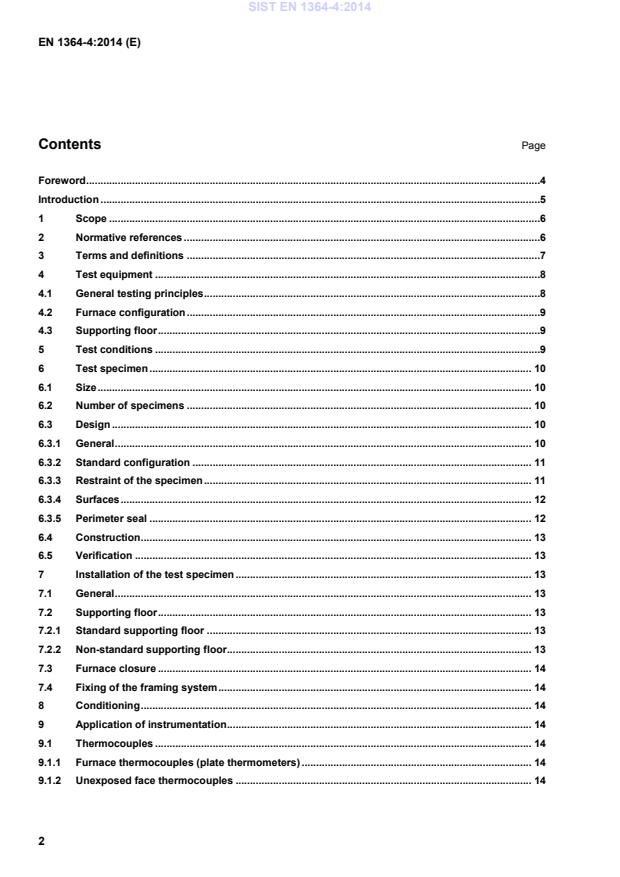
Guidance on testing curtain walling – part configuration . 44 A.1 Standard configuration . 44 A.1.1 General . 44 A.1.2 Supporting floor . 44 A.1.3 Parts of a curtain walling . 44 A.1.4 Specimen selection . 45 A.2 Test principles and requirements . 45 A.3 Fire from the inside . 47 A.3.1 General . 47 A.3.2 Curtain walling type A . 47 A.3.3 Curtain walling type B . 47 A.3.4 Perimeter seal . 48 A.3.5 Fixing of the framing system. 48 A.4 Fire from the outside . 48 Annex B (normative)
Standard configurations . 51 Annex C (normative)
Radiation calculation . 56 Annex D (normative)
Field of direct application of test results for unitised construction . 59 D.1 Rules for curtain walling type A . 59 D.1.1 General . 59 D.1.2 Exposure conditions . 59 D.1.3 Rules for the complete construction . 59 D.1.4 Spandrel panels . 59 D.2 Rules for curtain walling type B . 59 Bibliography . 60
1 Scope This European Standard specifies a method for determining the fire resistance of parts of curtain walling and of the perimeter seal. It examines the fire resistance to internal and external fire exposure of: — the spandrel panel, i.e. downstand, upstand or a combination thereof, or — the perimeter seal, or — the fixing of the framing system (anchoring) used to attach the curtain walling to the floor element, or — combinations thereof. Results from tests according to this standard form the basis for classification of curtain walling type A (see 3.3 for definition). For curtain walling type B (see 3.4 for definition) results may be used to determine fire resistance of parts of a curtain walling to increase the field of application when previously tested to EN 1364-3. For intended classification EW and for corner/faceted specimens EN 1364-3 should be used. This European Standard does not cover double skin façades, over-cladding systems and ventilated façade systems on external walls. It does not deal with the reaction to fire behaviour of curtain walling. This standard is intended to be read in conjunction with EN 1363-1 and EN 1363-2 as well as EN 1364-3 for curtain walling type B. NOTE Annex A gives informative guidance on the principles of testing parts of curtain walling and the test method. 2 Normative references The following documents, in whole or in part, are normatively referenced in this document and are indispensable for its application. For dated references, only the edition cited applies. For undated references, the latest edition of the referenced document (including any amendments) applies. EN 1363-1, Fire resistance tests - Part 1: General Requirements EN 1363-2, Fire resistance tests - Part 2: Alternative and additional procedures EN 1364-3, Fire resistance tests for non-loadbearing elements - Part 3: Curtain walling - Full configuration (complete assembly) EN 13119, Curtain walling - Terminology EN 13501-1, Fire classification of construction products and building elements — Part 1: Classification using data from reaction to fire tests EN 13501-2, Fire classification of construction products and building elements — Part 2: Classification using data from fire resistance tests, excluding ventilation services EN 13830, Curtain walling - Product standard EN ISO 13943, Fire safety - Vocabulary (ISO 13943) SIST EN 1364-4:2014
EN ISO 13943 and the following apply. 3.1 anchoring see fixing of the framing system 3.2 associated wall construction form of construction required to close the vertical side of the furnace (not part of the test specimen) 3.3 curtain walling type A curtain walling without fire resistant glazing outside the spandrel area – fire resistant only in the spandrel area 3.4 curtain walling type B curtain walling with fire resistant glazing outside the spandrel area - fully fire resistant curtain walling 3.5 downstand special type of spandrel panel, hanging down from or located in front of the floor Note 1 to entry: See Figure A.2. 3.6 fire-resistant glazing glazing system consisting of one or more transparent or translucent panes with a suitable method of mounting, with e.g. frames, seals and fixing materials, capable of satisfying the appropriate fire resistance criteria 3.7 fire resistant translucent or transparent spandrel panel glass product, monolithic, laminated or insulating glass unit, manufactured by a particular manufacturer and intended to be used as spandrel panel in curtain walling, which is CE marked based on a classification according to EN 13501-2 in minimum one glazed construction Note 1 to entry: The term “insulating” when used with “insulating glass unit” according to EN 1279–1, should not be confused with the term “insulation” used in classification standard EN 13501–2. 3.8 fixing of the framing system system used to attach the curtain wall to the loadbearing floor. It contains the brackets but not the anchor or other devices used to fix the brackets to the floor 3.9 glazing materials all materials used to glaze the fire resistant translucent or transparent spandrel panel into its frame 3.10 horizontally faceted curtain walling curtain walling with an angle between horizontally adjacent infill panels at the common mullion (see Figure 1) 3.11 insulating glass unit (IGU) glass product according to EN 1279–1 SIST EN 1364-4:2014
...
SIST EN 1364-4:2014 표준은 비하중-bearing 요소에 대한 방화 저항 테스트에 대해 규정하고 있으며, 특히 커튼 월(Curtain walling) 시스템의 부품 및 주위 밀봉의 방화 저항을 평가하기 위한 방법을 명확히 제시합니다. 이 표준의 범위는 방화 저항성을 평가할 수 있는 구체적인 요소들을 포괄합니다. 예를 들어, 스팬드렐 패널, 주위 밀봉 및 프레임 시스템의 고정 방법(앵커링)이 포함됩니다. 이 표준의 강점은 내부 및 외부 화재 노출에 대한 커튼 월링의 각 구성 요소의 방화 저항을 명확하게 시험할 수 있는 접근 방식을 제공한다는 것입니다. EN 1364-4:2014의 테스트 결과는 커튼 월링 유형 A의 분류 기준으로 사용되며, 이러한 명확한 기준은 건축물의 안전성을 높이는 데 기여합니다. 또한, 커튼 월링 유형 B에 대해서도 이 표준의 결과를 활용하여 방화 저항성을 증가시키는 방식으로 적절한 적용 범위를 확대할 수 있습니다. 해당 표준은 EN 1363-1 및 EN 1363-2, EN 1364-3과 함께 읽혀져야 하며, 커튼 월링 유형 B에 대한 가장 정확하고 신뢰할 수 있는 정보를 제공합니다. 또한, 부록 A에서는 커튼 월링 부품 시험의 원칙 및 시험 방법에 대한 유용한 지침을 제공하여 사용자가 보다 효과적인 테스트를 수행할 수 있도록 돕습니다. 하지만, 주의할 점은 이 표준이 이중 외장 형태의 파사드, 오버클래딩 시스템, 외부 벽의 환기형 파사드 시스템에 대해서는 다루지 않으며, 커튼 월링의 화재 반응 행동에 대해서도 명시하지 않기 때문에 한계가 존재합니다. 이러한 한계에도 불구하고, SIST EN 1364-4:2014 표준은 건축 설계 및 방화 안전 분야에서 매우 중요한 문서로, 커튼 월링 시스템의 안전성을 확인하는 데 중요한 역할을 합니다.
標準EN 1364-4:2014は、非荷重支持要素に対する防火試験の一環として、カーテンウォールの部品及び周囲シールの防火性能を評価するための方法を定めています。この欧州標準は、内外部の火災に対する耐火性を検証し、具体的にはスパンドレルパネルや周囲シール、またそれを床要素に取り付けるためのフレームシステム(アンカー)の固定方法に関する試験を対象としています。 この標準の強みは、スパンドレルパネルやフレーム接続要素の防火性能を明確に定義し、具体的な評価基準を提示している点です。試験結果は、カーテンウォールの分類に重要な役割を果たし、型式Aのカーテンウォールについては、結果がそのまま分類の基礎になります。また、型式Bのカーテンウォールに関しても、EN 1364-3での過去の試験結果を活用することで、適用範囲を広げることができる規定も設けられています。 この標準は、カーテンウォール標準の一環として、EN 1363-1およびEN 1363-2並びにEN 1364-3と併せて読むことを推奨しており、より包括的な理解を促進します。これにより、設計や建設における防火性能の評価が一層具体化され、実務に役立つ情報を提供することが可能になります。 なお、この標準はダブルスキンファサードやオーバークラッディングシステム、換気ファサードシステムについては適用外であり、カーテンウォールの火災反応挙動には触れていないため、対象範囲を明確に理解しておくことが重要です。附属書Aでは、カーテンウォール部品の試験原則及び試験方法に関する有益なガイダンスが提供されています。このように、EN 1364-4:2014は確固たる基準を提供しており、実際の建設現場での安全性向上に寄与する重要な文書であると言えるでしょう。
The standard EN 1364-4:2014 provides a comprehensive method for assessing the fire resistance of various components of curtain walling, focusing on parts of the system such as spandrel panels and perimeter seals. Its scope is clearly defined, addressing both internal and external fire exposure, which is crucial for ensuring that non-loadbearing elements maintain safety during fire incidents. One of the strengths of this standard is its detailed classification framework, allowing for precise categorization of curtain walling into type A and type B, thereby facilitating a clearer understanding of their fire resistance capabilities. This classification not only aids manufacturers and designers in compliance but also enhances safety measures within the built environment. Additionally, the standard emphasizes the importance of testing conditions, recommending that it be read in conjunction with EN 1363-1 and EN 1363-2, as well as EN 1364-3 for curtain walling type B. This integration of related standards underscores the interconnected nature of fire safety assessments and enhances the reliability of results obtained through EN 1364-4, ensuring that all aspects of fire resistance in curtain walling are robustly evaluated. Although it does not encompass certain systems such as double skin façades or ventilated façade systems, the focus on curtain walling offers targeted guidance where it is most needed, ensuring high relevance in modern construction practices. Furthermore, Annex A provides informative guidance on test principles, contributing to a clearer understanding of the methodology involved. Overall, EN 1364-4:2014 stands as a critical document within fire safety standards, facilitating the effective evaluation of fire resistance in non-loadbearing elements and contributing to the overall safety framework in building design and construction. Its strengths in classification and thorough procedural guidelines make it an indispensable resource for professionals in the field.
Questions, Comments and Discussion
Ask us and Technical Secretary will try to provide an answer. You can facilitate discussion about the standard in here.
Loading comments...