

EN 13084-1:2025
(Main)Free-standing chimneys - Part 1: General requirements
General Information
- Abstract
This document deals with the general requirements and the basic performance criteria for the design and construction of all types of structurally independent chimneys including their liners.
This document also applies to chimneys connected to buildings when at least one of the following criteria is met:
- the distance between the lateral guides is more than 4 m;
- the free-standing height above the uppermost structural support attachment is more than 3 m;
- the free-standing height above the uppermost structural support attachment for chimneys with rectangular cross section is more than five times the smallest external dimension.
Structurally independent chimneys take into account in their design: operational conditions and other actions to verify mechanical resistance and stability and safety in use. Detailed requirements relating to specialized designs are given in the standards for concrete chimneys, steel chimneys and their liners, as well as masts construction with satellite components.
In other parts of the EN 13084 series, rules will be given where system chimney products in accordance with EN 1443 (and the relating product standards) are used in structurally independent chimneys.
This document does not cover the design and construction of connecting flue pipes.
- Status
- Published
- Publication Date
- 07-Jan-2025
- Technical Committee
- CEN/TC 297 - Free-standing industrial chimneys
- Drafting Committee
- CEN/TC 297 - Free-standing industrial chimneys
- Current Stage
- 6060 - Definitive text made available (DAV) - Publishing
- Start Date
- 08-Jan-2025
- Due Date
- 30-Dec-2024
- Completion Date
- 08-Jan-2025

Overview
EN 13084-1:2025 - Free-standing chimneys: Part 1 - General requirements (CEN) defines the general requirements and basic performance criteria for the design and construction of all types of structurally independent (free‑standing) chimneys, including their liners. It also clarifies when chimneys connected to buildings are treated as free‑standing (e.g., lateral guide spacing > 4 m, free‑standing height above the last support > 3 m, or rectangular chimneys with free‑standing height > 5× the smallest external dimension). The standard supersedes EN 13084‑1:2007 and complements detailed parts for specific materials and components.
Key topics and technical requirements
- Scope and applicability: criteria that determine when a chimney is treated as structurally independent; exclusion of connecting flue pipes.
- Materials and liners: general material requirements and references to dedicated parts of the EN 13084 series for concrete, steel and brick liners.
- Flue gas considerations: design parameters, heat‑flow and gas‑flow calculations (normative Annex A) and guidance for combined flue gases of differing temperatures (informative Annex B).
- Environmental aspects: pollutant dispersion, noise, temperature effects, fire safety and gas tightness.
- Structural design & performance: mechanical resistance, stability, actions (permanent, variable, accidental), imperfections, foundation design and liner interaction.
- Thermal, flow and pressure calculations: methods for determining flue gas temperatures, densities, velocities and available draft.
- Site activities & lifetime management: requirements for construction site activities, monitoring, inspection, maintenance, cleaning, repair and remedial works plus reporting.
- Accessories & safety systems: access systems, lightning protection, aircraft warning systems and additional protective coatings.
- Instrumentation: guidance on sensors and monitoring needed for lifetime management.
Practical applications
EN 13084‑1:2025 is used to:
- Guide structural design checks for mechanical resistance, stability and safety in use of tall chimneys.
- Provide a framework for thermal and gas‑flow calculations needed to size liners and ensure adequate draft.
- Inform specification of materials, protective systems, access and safety accessories during construction and maintenance.
- Support development of inspection, monitoring and lifetime management plans for industrial and utility chimneys.
Who uses this standard
- Structural and mechanical engineers designing chimneys and liners
- Chimney manufacturers and fabricators (concrete, steel, brick)
- Plant owners, operators and maintenance teams
- Construction contractors and installers
- Regulatory authorities, certification bodies and safety assessors
Related standards
- EN 13084 series (Parts 2, 4–9) - concrete, liners, steel components, masts, lifetime management
- EN 1443 - System chimney products
- Relevant Eurocodes: EN 1990, EN 1991 (including wind actions EN 1991‑1‑4), EN 1998‑6 (chimneys & earthquake design)
Keywords: EN 13084‑1:2025, free‑standing chimneys, structurally independent chimneys, chimney design, chimney liners, CEN, flue gas calculations, chimney construction, lifetime management.
Relations
- Effective Date
- 18-Jan-2023
- Refers
EN 1991-1-4:2005 - Eurocode 1: Actions on structures - Part 1-4: General actions - Wind actions - Effective Date
- 28-Jan-2026
- Effective Date
- 28-Jan-2026
- Effective Date
- 28-Jan-2026
- Effective Date
- 28-Jan-2026
- Referred By
EN 1991-1-5:2003 - Eurocode 1: Actions on structures - Part 1-5: General actions - Thermal actions - Effective Date
- 28-Jan-2026
- Effective Date
- 28-Jan-2026
- Effective Date
- 28-Jan-2026
- Effective Date
- 28-Jan-2026
- Effective Date
- 28-Jan-2026
- Effective Date
- 28-Jan-2026
- Effective Date
- 28-Jan-2026
- Effective Date
- 28-Jan-2026
- Referred By
EN 14471:2005 - Chimneys - System chimneys with plastic flue liners - Requirements and test methods - Effective Date
- 28-Jan-2026
- Effective Date
- 28-Jan-2026
Get Certified
Connect with accredited certification bodies for this standard

DIBt (Deutsches Institut für Bautechnik)
German Institute for Building Technology.
DIN CERTCO
DIN Group product certification.

Aboma Certification B.V.
Specialized in construction, metal, and transport sectors.
Sponsored listings
Frequently Asked Questions
EN 13084-1:2025 is a standard published by the European Committee for Standardization (CEN). Its full title is "Free-standing chimneys - Part 1: General requirements". This standard covers: This document deals with the general requirements and the basic performance criteria for the design and construction of all types of structurally independent chimneys including their liners. This document also applies to chimneys connected to buildings when at least one of the following criteria is met: - the distance between the lateral guides is more than 4 m; - the free-standing height above the uppermost structural support attachment is more than 3 m; - the free-standing height above the uppermost structural support attachment for chimneys with rectangular cross section is more than five times the smallest external dimension. Structurally independent chimneys take into account in their design: operational conditions and other actions to verify mechanical resistance and stability and safety in use. Detailed requirements relating to specialized designs are given in the standards for concrete chimneys, steel chimneys and their liners, as well as masts construction with satellite components. In other parts of the EN 13084 series, rules will be given where system chimney products in accordance with EN 1443 (and the relating product standards) are used in structurally independent chimneys. This document does not cover the design and construction of connecting flue pipes.
This document deals with the general requirements and the basic performance criteria for the design and construction of all types of structurally independent chimneys including their liners. This document also applies to chimneys connected to buildings when at least one of the following criteria is met: - the distance between the lateral guides is more than 4 m; - the free-standing height above the uppermost structural support attachment is more than 3 m; - the free-standing height above the uppermost structural support attachment for chimneys with rectangular cross section is more than five times the smallest external dimension. Structurally independent chimneys take into account in their design: operational conditions and other actions to verify mechanical resistance and stability and safety in use. Detailed requirements relating to specialized designs are given in the standards for concrete chimneys, steel chimneys and their liners, as well as masts construction with satellite components. In other parts of the EN 13084 series, rules will be given where system chimney products in accordance with EN 1443 (and the relating product standards) are used in structurally independent chimneys. This document does not cover the design and construction of connecting flue pipes.
EN 13084-1:2025 is classified under the following ICS (International Classification for Standards) categories: 91.060.40 - Chimneys, shafts, ducts. The ICS classification helps identify the subject area and facilitates finding related standards.
EN 13084-1:2025 has the following relationships with other standards: It is inter standard links to EN 13084-1:2007, EN 1991-1-4:2005, EN 1991-1-1:2025, EN 1998-4:2025, EN 13084-6:2025, EN 1991-1-5:2003, EN 1366-13:2019, EN 15287-2:2008, EN 15287-2:2023, EN 13084-8:2005, EN 1993-3-2:2006, EN 15287-1:2007+A1:2010, EN 13084-9:2022, EN 14471:2005, EN 15287-1:2023. Understanding these relationships helps ensure you are using the most current and applicable version of the standard.
EN 13084-1:2025 is associated with the following European legislation: EU Directives/Regulations: 305/2011; Standardization Mandates: M/105. When a standard is cited in the Official Journal of the European Union, products manufactured in conformity with it benefit from a presumption of conformity with the essential requirements of the corresponding EU directive or regulation.
EN 13084-1:2025 is available in PDF format for immediate download after purchase. The document can be added to your cart and obtained through the secure checkout process. Digital delivery ensures instant access to the complete standard document.
Standards Content (Sample)
SLOVENSKI STANDARD
01-marec-2025
Prostostoječi dimniki - 1. del: Splošne zahteve
Free-standing chimneys - Part 1: General requirements
Freistehende Schornsteine - Teil 1: Allgemeine Anforderungen
Cheminées autoportantes - Partie 1 : Exigences générales
Ta slovenski standard je istoveten z: EN 13084-1:2025
ICS:
91.060.40 Dimniki, jaški, kanali Chimneys, shafts, ducts
2003-01.Slovenski inštitut za standardizacijo. Razmnoževanje celote ali delov tega standarda ni dovoljeno.
EN 13084-1
EUROPEAN STANDARD
NORME EUROPÉENNE
January 2025
EUROPÄISCHE NORM
ICS 91.060.40 Supersedes EN 13084-1:2007
English Version
Free-standing chimneys - Part 1: General requirements
Cheminées autoportantes - Partie 1 : Exigences Freistehende Schornsteine - Teil 1: Allgemeine
générales Anforderungen
This European Standard was approved by CEN on 25 November 2024.
CEN members are bound to comply with the CEN/CENELEC Internal Regulations which stipulate the conditions for giving this
European Standard the status of a national standard without any alteration. Up-to-date lists and bibliographical references
concerning such national standards may be obtained on application to the CEN-CENELEC Management Centre or to any CEN
member.
This European Standard exists in three official versions (English, French, German). A version in any other language made by
translation under the responsibility of a CEN member into its own language and notified to the CEN-CENELEC Management
Centre has the same status as the official versions.
CEN members are the national standards bodies of Austria, Belgium, Bulgaria, Croatia, Cyprus, Czech Republic, Denmark, Estonia,
Finland, France, Germany, Greece, Hungary, Iceland, Ireland, Italy, Latvia, Lithuania, Luxembourg, Malta, Netherlands, Norway,
Poland, Portugal, Republic of North Macedonia, Romania, Serbia, Slovakia, Slovenia, Spain, Sweden, Switzerland, Türkiye and
United Kingdom.
EUROPEAN COMMITTEE FOR STANDARDIZATION
COMITÉ EUROPÉEN DE NORMALISATION
EUROPÄISCHES KOMITEE FÜR NORMUNG
CEN-CENELEC Management Centre: Rue de la Science 23, B-1040 Brussels
© 2025 CEN All rights of exploitation in any form and by any means reserved Ref. No. EN 13084-1:2024 E
worldwide for CEN national Members.
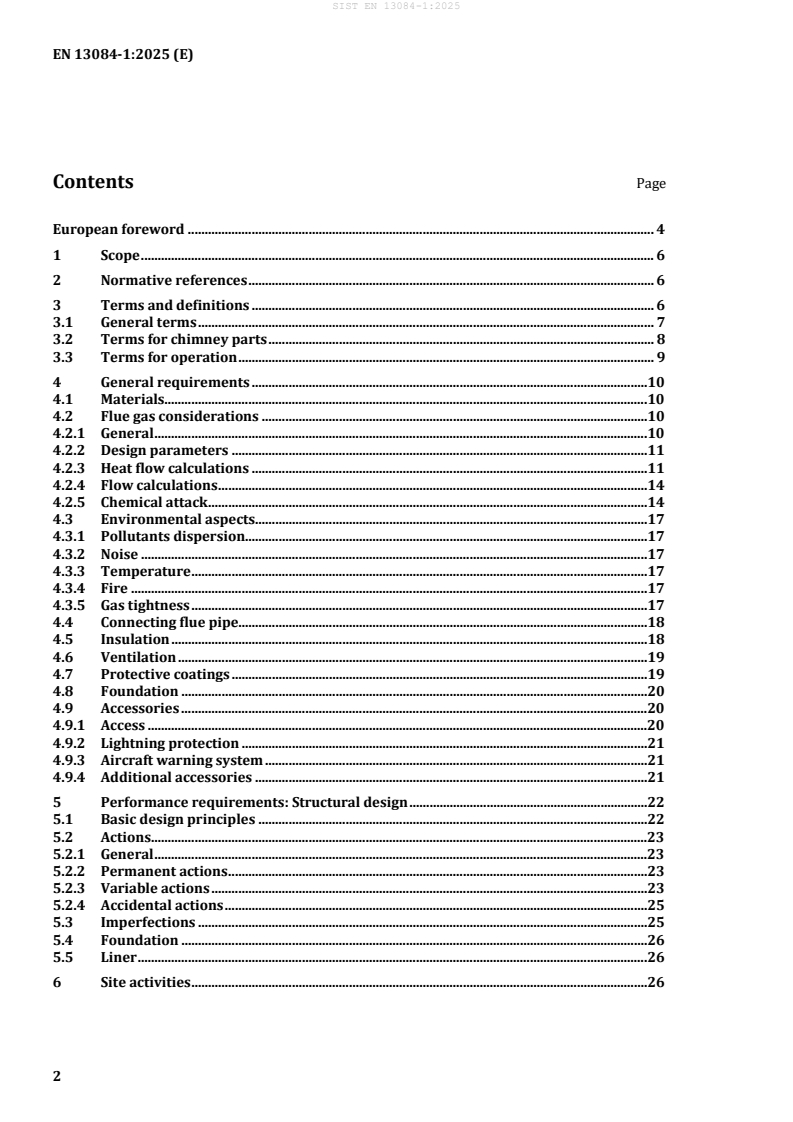
Contents Page
European foreword . 4
1 Scope . 6
2 Normative references . 6
3 Terms and definitions . 6
3.1 General terms . 7
3.2 Terms for chimney parts . 8
3.3 Terms for operation . 9
4 General requirements .10
4.1 Materials.10
4.2 Flue gas considerations .10
4.2.1 General .10
4.2.2 Design parameters .11
4.2.3 Heat flow calculations .11
4.2.4 Flow calculations .14
4.2.5 Chemical attack .14
4.3 Environmental aspects .17
4.3.1 Pollutants dispersion.17
4.3.2 Noise .17
4.3.3 Temperature .17
4.3.4 Fire .17
4.3.5 Gas tightness .17
4.4 Connecting flue pipe.18
4.5 Insulation .18
4.6 Ventilation .19
4.7 Protective coatings .19
4.8 Foundation .20
4.9 Accessories .20
4.9.1 Access .20
4.9.2 Lightning protection .21
4.9.3 Aircraft warning system .21
4.9.4 Additional accessories .21
5 Performance requirements: Structural design .22
5.1 Basic design principles .22
5.2 Actions.23
5.2.1 General .23
5.2.2 Permanent actions .23
5.2.3 Variable actions .23
5.2.4 Accidental actions .25
5.3 Imperfections .25
5.4 Foundation .26
5.5 Liner .26
6 Site activities .26
7 Lifetime management, monitoring, inspection, maintenance, cleaning, repair and
remedial work including the reporting; operations and actions required . 26
8 Instrumentation . 26
Annex A (normative) Gas flow calculation . 28
A.1 Principal features of the method of calculation . 28
A.2 Parameters related to construction type . 28
A.2.1 Roughness . 28
A.2.2 Thermal resistance . 28
A.3 Basic values for the calculation . 29
A.3.1 Air temperature . 29
A.3.2 Outside air pressure . 29
A.3.3 Flue gas . 29
A.3.4 Gas constant . 30
A.3.5 Density of outside air . 31
A.3.6 Specific heat capacity . 31
A.3.7 Correction factor for temperature . 31
A.3.8 Flow safety coefficient . 32
A.4 Determination of temperatures . 32
A.4.1 Flue gas temperatures . 32
A.4.2 Coefficient of cooling . 32
A.4.3 Heat transmission coefficient . 33
A.4.4 Internal heat transfer coefficient . 33
A.5 Density of flue gas . 35
A.6 Flue gas velocity . 35
A.7 Pressure at entry of flue gas into chimney . 35
A.7.1 Calculation of pressure . 35
A.7.2 Theoretical draught available due to chimney effect . 36
A.7.3 Pressure resistance of the flue gas carrying tube . 36
A.7.4 Flue friction coefficient . 36
A.7.5 Individual resistance coefficient . 37
A.7.6 Change in pressure due to change of velocity . 37
A.7.7 Pressure caused by sudden interruption of the flue gas stream (Implosion) . 37
A.8 Minimum velocity . 38
Annex B (informative) Calculation method for combined flue gases with different
temperatures. 43
Bibliography . 46
European foreword
This document (EN 13084-1:2025) has been prepared by Technical Committee CEN/TC 297 “Free-
standing industrial chimneys”, the secretariat of which is held by AFNOR.
This document supersedes EN 13084-1:2007.
This European Standard shall be given the status of a national standard, either by publication of an
identical text or by endorsement, at the latest by July 2025, and conflicting national standards shall be
withdrawn at the latest by July 2025.
Attention is drawn to the possibility that some of the elements of this document may be the subject of
patent rights. CEN shall not be held responsible for identifying any or all such patent rights.
In comparison with its previous edition EN 13084-1:2007, the current edition EN 13084-1:2024
includes the following:
— reorganization of terms and definitions;
— addition of the paragraph on connecting flue pipe;
— additional information on access systems;
— new informative Annex B “Calculation method for combined flue gases with different temperatures”.
This document is part 1 of a series of standards as listed below:
— EN 13084-1, Free-standing chimneys — Part 1: General requirements
— EN 13084-2, Free-standing chimneys — Part 2: Concrete chimneys
— EN 13084-4, Free-standing chimneys — Part 4: Brick liners — Design and execution
— EN 13084-5, Free-standing chimneys — Part 5: Material for brick liners — Product specifications
— EN 13084-6, Free-standing chimneys — Part 6: Steel liners – Design and execution
— EN 13084-7, Free-standing chimneys — Part 7: Product specifications of cylindrical steel fabrications
for use in single wall steel chimneys and steel liners
— EN 13084-8, Free-standing chimneys — Part 8: Design and execution of mast construction with
satellite components
— EN 13084-9, Free-standing chimneys — Part 9: Lifetime management — Monitoring, inspection,
maintenance, remedial and reporting; operations and actions required
Additionally applies:
— EN 1993-3-2:2006, Eurocode 3 — Design of steel structures — Part 3-2: Towers, masts and
chimneys — Chimneys
Any feedback and questions on this document should be directed to the users’ national standards body.
A complete listing of these bodies can be found on the CEN website.
According to the CEN-CENELEC Internal Regulations, the national standards organisations of the
following countries are bound to implement this European Standard: Austria, Belgium, Bulgaria, Croatia,
Cyprus, Czech Republic, Denmark, Estonia, Finland, France, Germany, Greece, Hungary, Iceland, Ireland,
Italy, Latvia, Lithuania, Luxembourg, Malta, Netherlands, Norway, Poland, Portugal, Republic of North
Macedonia, Romania, Serbia, Slovakia, Slovenia, Spain, Sweden, Switzerland, Türkiye and the United
Kingdom.
1 Scope
This document deals with the general requirements and the basic performance criteria for the design
and construction of all types of structurally independent chimneys including their liners.
This document also applies to chimneys connected to buildings when at least one of the following criteria
is met:
— the distance between the lateral guides is more than 4 m;
— the free-standing height above the uppermost structural support attachment is more than 3 m;
— the free-standing height above the uppermost structural support attachment for chimneys with
rectangular cross section is more than five times the smallest external dimension.
Structurally independent chimneys take into account in their design: operational conditions and other
actions to verify mechanical resistance and stability and safety in use. Detailed requirements relating to
specialized designs are given in the standards for concrete chimneys, steel chimneys and their liners, as
well as masts construction with satellite components.
In other parts of the EN 13084 series, rules will be given where system chimney products in accordance
with EN 1443 (and the relating product standards) are used in structurally independent chimneys.
This document does not cover the design and construction of connecting flue pipes.
2 Normative references
The following documents are referred to in the text in such a way that some or all of their content
constitutes requirements of this document. For dated references, only the edition cited applies. For
undated references, the latest edition of the referenced document (including any amendments) applies.
EN 1990, Eurocode — Basis of structural and geotechnical design
EN 1991-1-1, Eurocode 1: Actions on structures — Part 1-1: General actions — Densities, self-weight,
imposed loads for buildings
EN 1991-1-4:2005, Eurocode 1: Actions on structures — Part 1-4: General actions — Wind actions
EN 1998-6, Eurocode 8: Design of structures for earthquake resistance — Part 6: Towers, masts and
chimneys
3 Terms and definitions
For the purposes of this document, the following terms and definitions apply.
ISO and IEC maintain terminological databases for use in standardization at the following addresses:
— ISO Online browsing platform: available at https://www.iso.org/obp/
— IEC Electropedia: available at https://www.electropedia.org/
3.1 General terms
3.1.1
chimney
vertical structure used to carry off air or combustion products to the outside up to a height from the
ground defined to ensure dispersion of the pollutants in order to avoid, prevent or reduce harmful effects
on human health and the environment
3.1.2
structurally independent chimney
free-standing chimney
chimney designed and manufactured in order to be self-supporting and resist other operational
conditions like wind, oscillations, vibrations, etc
Note 1 to entry: A chimney may also be considered as structurally independent, if it is guyed or laterally supported
or if it stands on another structure.
3.1.3
guyed chimney
chimney, the stability of which is ensured by guy ropes
3.1.4
concrete chimney
chimney, the windshield of which is made of concrete
3.1.5
steel chimney
chimney, the windshield of which is made of steel
3.1.6
masonry chimney
chimney the windshield of which is made of masonry
3.1.7
single-wall chimney
chimney whose structural shell also conducts the flue gases and can be fitted with thermal insulation
and/or internal lining
3.1.8
double-wall chimney
chimney consisting of an outer structural shell and one inner liner which carries the flue gases
3.1.9
multi-flue chimney
group of two or more chimneys structurally interconnected or a group of two or more liners within a
structural shell
3.1.10
effective chimney height
vertical distance between the inlet (centre axis) and the chimney outlet level
3.1.11
involved party
party involved in the process of executing the project, including designers, specifiers, manufacturers,
installers, customers, end-users and contractors
3.2 Terms for chimney parts
3.2.1
windshield
structural shell designed for load bearing purposes and to protect the flue from wind actions
Note 1 to entry: It may also function as a flue.
3.2.2
structural shell
main load-bearing steel structure of the shell structure, excluding any flanges
3.2.3
mast
structural construction designed and manufactured to be self-supportive and/or free standing and
support the attached satellite components
3.2.4
lining system
total system, if any, which separates the flue gases from the windshield
Note 1 to entry: This comprises a liner and its supports, the space between liner and windshield and insulation,
where existing.
3.2.5
liner
structural element (membrane) of the lining system, contained within the structural shell
3.2.6
lateral guide
component of a chimney or connecting flue pipe/duct used to fix it to a structural element (building,
mast, wind shield…) in order to withstand lateral loads (wind load for instance)
3.2.7
accessible space
space between windshield and liner that is designed for entry by personnel
3.2.8
connecting flue pipe/duct
component or components connecting the appliance outlet to the chimney
3.2.9
cladding
additional non-structural outer wall around a chimney and/or liner for protection against heat transfer
and/or weathering, and/or for decorative purposes
3.2.10
coating
paint or other surface treatment to protect the outer surface of a liner or chimney against atmospheric
corrosivity and/or plume downwash
3.2.11
insulation
material and/or air gap between the flue liner and the outer wall, designed to increase the thermal
resistance of the chimney, reduce condensates and improve buoyancy
3.2.12
spoiler
device attached to the surface of a chimney with the objective of reducing cross wind response
3.2.13
protective cap
cap at the top of the chimney which covers the space between windshield and liner
3.2.14
climbing socket
threaded socket inserted in the concrete windshield to enable climbing dogs to be attached to the surface
3.3 Terms for operation
3.3.1
inlet
location where gases come into the chimney
3.3.2
outlet
top of the chimney, where the flue gases are released to the atmosphere
3.3.3
flue gas
gaseous products of combustion or other processes, including air, which can comprise of solids or liquids
3.3.4
gas tightness
ability of the liner to prevent smoke/exhaust gases from escaping out of the liner into the chimney or the
outside atmosphere under the outlet level
3.3.5
positive pressure
pressure inside the liner which is greater than the pressure outside the liner
3.3.6
negative pressure
pressure inside the liner which is lower than the pressure outside the liner
3.3.7
flow resistance
pressure loss in a flue or in a combustion circuit opposed to the flow of the flue gas and/or combustion
air in motion at a given temperature and velocity
3.3.8
individual resistance coefficient
dimensionless quantity that defines the flow resistance of an incident or an equipment on the flue
3.3.9
thermal resistance
resistance to heat transfer from the inside to the outside of the chimney
3.3.10
thermal shock resistance
ability of the chimney and/or liner to withstand sudden changes in temperature either during heating or
cooling
3.3.11
intransient heat flow
flow of heat, where the temperature of each point does not change with time
3.3.12
transient heat flow
flow of heat, where the temperature changes with time
3.3.13
mean roughness
average of the surface roughness of the liner or the component
3.3.14
down draught
negative pressure on the lee-side of the chimney top, which can cause the flue gases to be drawn down
3.3.15
gas flow
mass or volume of gas through the liner per unit of time
4 General requirements
4.1 Materials
Materials shall conform to the appropriate CEN or ISO standards. Where no such standards exist, other
materials may be used if their properties are well defined and their suitability has been proven. This
proof shall take account of the mechanical, thermal and chemical loads.
For concrete and steel chimneys as well as for liners see EN 13084-2, EN 13084-4, EN 13084-5,
EN 13084-6, EN 13084-7, EN 13084-8 and EN 1993-3-2:2006.
4.2 Flue gas considerations
4.2.1 General
Thermal and flow calculations shall be carried out to ensure that the flue gases will be conveyed from
the combustion appliance to atmosphere taking into account the effects of the flue gases on the
environment and the safety in use. However, the effect of the flue gases concerning the pollution with
gaseous and particle components is not the subject matter of this document.
4.2.2 Design parameters
The following design parameters based on information given at design stage shall take into account the
various operating conditions during normal and defined abnormal operations. These also apply to the
assessment of chemical attack on those structural elements which are in contact with flue gases.
a) nature of chimney operation, whether continuous, intermittent or occasional;
b) planned frequency of shut-downs for internal inspection and maintenance;
c) composition of the flue gases and concentrations of chemicals in the flue gases deleterious for the
chimney;
d) concentration of dust and particularly of abrasive dust in the flue gas;
e) mass flow of each flue gas stream;
f) flue gas temperature at entry of each flue gas duct into chimney;
g) range of maximum acid dew point temperatures of the flue gases;
h) admissible or required pressure at entry of flue gas ducts into chimney;
i) altitude of the site and any special local topographic features (e.g. nearby hills, cliffs);
j) maximum, average and minimum outside temperature;
k) maximum, average and minimum atmospheric pressure;
l) maximum, average and minimum humidity of the ambient air;
m) relevant design parameters used for appliances (for example boiler) to which the chimney is
connected.
4.2.3 Heat flow calculations
Temperatures in the flue gas carrying tube, in thermal insulating layers and in the windshield shall be
determined. The drop in the temperature of the flue gases as they pass up to the outlet shall be calculated.
The calculation shall be carried out in accordance with Annex A or with EN 13384-1 provided that in
both cases the implosion and minimum velocity are respected.
Values for thermal conductivity and the heat transfer coefficient may be taken from Table 1 and Table 2
respectively. Values for materials not included in these tables or values differing from these, may be
taken if their source is referenced.
Table 1 — Indicative thermal conductivity values for building materials
Thermal
a
Density Temperature
b
conductivity
Material Description ρ T
λ
kg/m °C
W/(m⋅K)
Concrete 2 400 2,1
1 000 0,47
1 200 0,59
1 400 0,72
Lightweight concrete
1 600 0,87
1 800 0,99
2 000 1,20
1 800 0,81
Brickwork 2 000 0,96
2 200 1,00
Acid resistant
1,2
brickwork
200 0,18
800 400 0,19
600 0,21
Brickwork of
diatomaceous clay
200 0,09
c
500 400 0,10
600 0,11
20 0,05
Cellular glass 130 200 0,09
300 0,12
50 0,038
100 0,045
150 0,053
200 0,064
Mineral wool
250 0,076
resistant up to 750°C
300 0,090
400 0,122
500 0,168
600 0,230
Thermal
a
Density Temperature
b
conductivity
Material Description ρ T
λ
kg/m °C
W/(m⋅K)
50 0,039
100 0,046
150 0,053
200 0,061
125 250 0,070
300 0,080
400 0,105
500 0,140
600 0,180
Structural steel and
weather resistant 7 850 60
structural steel
X5CrNi18–10 (1.4301) 7 900 15
X2CrNi 18–9 (1.4307) 7 900 15
X2CrNiMoN 22–5-3 7 800 14
X2CrTiNb 18 (1.4509) 7 700 25
X6CrNiTi18–10 (1.4541) 7 900 15
X6CrNiMoTi17–12–2
Stainless steel 7 980 15
(1.4571)
X2CrNiMo17–12–2
7 980 15
(1.4404)
X2CrNiMo18–14–3
7 980 15
(1.4435)
X1NiCrMoCu25–20–5
8 050 13
(1.4539)
a
The temperature T is the average temperature of material. It can be considered that T = (Temperature of
internal wall + Temperature of external wall) /2.
b
The given values are indicative values that could be used as preliminary design. After selection of the material,
the guaranteed properties specified into the declaration of performance of the material shall be used
c
Shall only be used as insulation.
NOTE Where no value for density and temperature is given, the thermal conductivity λ can be assumed as
independent of these values.
a
Table 2 — Heat transfer coefficients
Heat transfer
coefficient
Zone
α
W/(m⋅K)
b
Inner surface of the liner 8+w
In case of accessible space between windshield and liner: 8
— outer surface of the liner
— inner surface of the windshield
In case of non-accessible space between windshield and liner: 20
— outer surface of the liner:
— temperature > 80 °C;
— temperature ≤ 80 °C;
— inner surface of the windshield
c
Outer surface of the windshield 24
a
These values are approximate values which lead to sufficiently accurate results for flue gas carrying tubes
with an interior diameter of more than 1 m.
b
w is the mean flue gas velocity in m/s. A detailed calculation of α is given in Annex A.
c 2
For verification of the suitability of the materials as regards temperature a value α = 6 W/(m⋅K) shall be
taken.
4.2.4 Flow calculations
Flow calculations shall include calculations of pressure conditions inside the flue gas carrying tube and
of flow velocity. They shall take into account the density of the flue gases and of the ambient air as well
as energy losses, such as directional losses, losses due to friction and due to the joints.
If flue gas can permeate through the liner, for example in a brickwork liner, no positive pressure is
allowed during normal operation conditions.
NOTE The start up pressure is not a normal operating condition in accordance with this document.
The calculation shall be carried out in accordance with Annex A. In the case of chimneys with a height of
less than 20 m, the calculation may be carried out in accordance with EN 13384-1, provided that the
conditions given in that standard apply.
4.2.5 Chemical attack
Chemical attack of the structural elements in contact with flue gases can occur by condensation of
different flue gases to acid, for example sulphuric or hydrochloric acid polluted by chlorides or fluorides.
Depending on the nature and period of time of the attack the chemical effect is graded into:
1) low;
2) medium;
3) high;
4) very high.
The chemical attack of flue gases containing SO is graded according to Table 3 depending on the period
during which the temperature of the liner wall falls below the acid dew point. Periods during which the
installation is out of service are to be disregarded when determining the operating hours.
Table 3 applies to flue gases containing 50 mg/m of SO . In the case of other values of SO concentration,
3 3
the operating hours given in Table 3 vary in inverse proportion to the SO content. If the SO content is
3 3
not known, a 2 % conversion of SO into SO may be assumed unless other values can be proven.
2 3
For other flue gases, the level of chemical attack shall be determined by other methods.
The temperature of the acid dew point of flue gases containing water vapour (H O) and sulphur trioxide
(SO ) can be taken from Figure 1.
Figure 1 — Temperature of the acid dew point, T , of flue gases containing water vapour (H O)
ADP 2
and sulphur trioxide (SO )
Table 3 — Chemical attack due to flue gases containing 50 mg/m of SO
a
Operating hours per year
Degree of Liner face in contact with flue Parts of the chimney protected by
chemical attack gas the liner
T > 150 °C T ≤ 150 °C T > 150 °C T ≤ 150 °C
ADP ADP ADP ADP
Low < 10 < 30 < 50 < 150
Medium 10 to 50 30 to 150 50 to 250 150 to 750
b
High 50 to 1 000 150 to 3 000 250 to 5 000 750 to 15 000
b
Very high > 1 000 > 3 000 > 5 000 > 15 000
a
Operating hours per year during which the temperature of the attacked component is below the acid dew
point of the flue gases which are in contact with that component.
b
Only for interpolation purposes (see 4.2.5, paragraph 3), however, in no case more than 8 760 h (1 year).
The presence of chlorides or fluorides in the flue gas condensate can radically increase corrosion rates.
Estimation of the corrosion rate in these circumstances depends upon a number of complex factors and
would require the advice of a corrosion expert in each individual case.
In the absence of such advice:
— the degree of chemical attack can be considered as “low”, if the temperature of chimney components
in contact with flue gas is below acid dew point for periods of less than 25 h per year and the
3 3
concentrations of HCl ≤ 30 mg/m and HF ≤ 5 mg/m ;
— the degree of chemical attack shall be considered as “very high”, regardless of temperature and
exposure time, if halogen concentrations at 20 °C and 1 bar pressure exceed the following limits:
— hydrogen fluoride: 300 mg/m ;
— elementary chlorine: 1 300 mg/m ;
— hydrogen chloride: 1 300 mg/m .
Condensing flue gas conditions occurring longer than 10 h per year downstream of a flue gas
desulphurization system shall be classified as causing “very high” chemical attack.
While a chimney can generally be at a temperature above acid dew point, care shall be taken to prevent
small areas being subjected to local cooling and therefore being at risk of localized acid corrosion. Local
cooling can be due to:
— air leaks;
— fin cooling of flanges, spoilers or other attachments;
— support points;
— down draught effects at the top of the chimney.
Chemical attack can also occur if, for example, dry flue gases become moist at the chimney top as a result
of atmospheric influences and affect the inside or outside of the chimney or if the flue gases passing up
towards the top or during start-up of the installation cool down to such an extent that condensation
occurs.
4.3 Environmental aspects
4.3.1 Pollutants dispersion
The dispersion of pollutants is mainly influenced by the environment of the chimney, including
surrounding obstacles (natural or artificial such as buildings), the presence of other pollutant sources in
the vicinity and the typology of the terrain, as well as by the exhaust gas characteristics and the geometry
of the chimney mouth.
The height of the chimney amongst other parameters is defined in agreement with local regulation in
such a way as the height of the release point is high enough to ensure the dispersion of the pollutants
into the atmosphere in order to safeguard human health and the environment.
4.3.2 Noise
The noise at the outlet of the chimney shall not exceed permissible noise levels.
The noise produced by the chimney (regenerated noise power level created by any obstacle), Lw ,
regen
in dB, is calculated from Formula (1):
Lw = 10 + 60 log(w) + 30 log (ζ) + 10 log(A) (1)
regen
where
w is the velocity of the flue gas, in m/s;
ζ is the pressure drop factor for the obstacle;
A is the surface of the obstacle (m ).
NOTE The noise at the outlet of chimney is the total regenerated noise adding the noise introduced at the inlet
of the chimney (provided by engines, boilers, turbines, fans, etc.).
If the total noise calculated at the outlet of chimney is too high, chimney should be equipped by a silencer.
4.3.3 Temperature
The temperature of the outer surfaces of chimney areas that can be contacted by people, should not
exceed 70 °C for bare uncoated steel, and 80 °C for coated steel and other materials, a risk assessment at
installation stage shall be completed.
If this requirement is not met in a risk assessment; a protective device can be installed to prevent
unintentional contact with the chimney wall.
The maximum temperature of adjacent combustible materials shall not exceed 85 °C when related to an
ambient temperature of 20 °C. The distance between the outer surface of the chimney and the
combustible material shall be chosen accordingly.
For the air temperature within an accessible space between windshield and liner, see EN 13084-9.
4.3.4 Fire
The risk of fire inside a chimney shall be taken into account.
The load-bearing components shall not fail due to the effects of fire. Heat transfer to other parts nearby
the chimney shall be considered.
4.3.5 Gas tightness
For metal liners, please refer to EN 13084-6. For other materials, covered in the present standard, only
negative pressure is allowed.
4.4 Connecting flue pipe
The Connecting Flue Pipe (CFP) is the “passage pipe for exhaust gasses”. The CFP begins either at the
appliance producing the gases or, if present, at the last conditioning procedure of the gases. It ends at the
windshield of the chimney.
The CFP shall be designed to meet the operational requirements of the plant. A suitable connection of
the CFP to the chimney liner is particularly decisive for the trouble-free exhaust gas transport from the
generation to the outlet at the chimney head.
In addition, Annex A contains specifications for determining the flue gas draft which can be used in
consideration of the CFP.
If no other standard is applicable, it is generally accepted to work according to the performance
characteristics of the EN 13084 series.
The performance criteria of the CFP specifically:
— the CFP pressure rating will be defined as required by the appliance operating conditions
requirements e.g. N1 or P1 or H1;
— the CFP temperature rating will also be defined as required by the appliance operating conditions
e.g. T80 to T600;
— CFP clearance distance to combustible will be as required by the surrounding building fabric and the
type of fuel being burned e.g. G50 or O50.
The loads from the CFP on the windshield and liner shall be considered when a load-bearing connection
is made between the CFP and the chimney. In detail:
— vertical load and, if applicable, bending moments from dead weight of the CFP;
— horizontal load perpendicular to the axis CFP and bending moments from wind on CFP;
— horizontal expansion load in the axis of the CFP due to temperature differences, if free deformation
in longitudinal direction (e.g. by expansion joints) is not possible;
— deflection loads and or accommodation (Slip Joints), as a consequence of the calculated defection
(or allowed deflection of a CE marked modular chimney section) of the chimney at the level of
connection to the CFP.
4.5 Insulation
A valid insulation system has the following purpose:
a) it reduces the thermal gradient and, therefore, the thermal stress in the liner material;
b) it reduces the heat loss of the flue gases as they flow upwards, within the flue gas carrying tube. This
has the following advantages:
— it reduces the temperature drop of the flue gases as they progress up the chimney. This is
important in the case of flue gases whose entry temperatures are close to acid dew point, where
cooling could result in acid deposition or smutting;
— it increases the available thermal lift;
c) it reduces the thermal gradient and thermal stress in the windshield.
In selecting the insulation system, the following characteristics shall be taken into account:
d) its structural stability, long term. It is important that the insulation material does not sag, exposing
uninsulated surfaces;
e) its thermal conductivity;
f) its performance and integrity at the temperatures it will be subjected to in service;
g) the acid resistance and moisture absorption of the insulating material and its supports. This is
important in brickwork liners, as limited quantities of flue gas can permeate through the liner,
condensing as they pass to the cool side of the insulation;
h) its accessibility.
The thermal insulating material shall be incombustible.
4.6 Ventilation
It can be useful to provide a ventilated air space between liner and windshield. The purposes of this air
space are:
— to help eliminate flue gases which can have leaked through the liner due to diffusion or to positive
pressure conditions;
— to reduce the partial vapour pressure of the sulphur oxides of any flue gas that can have leaked
through the liner, thereby reducing its acid dew point and minimizing deposition of acid on
vulnerable surfaces;
— to allow access for maintenance and inspection into an air space large enough for this purpose.
The ventilation shall be operative at all times. Where an accessible space is provided, its efficacy shall be
verified by thermal and flow calculations.
NOTE The methodology given in EN 13384-1 can be used.
A clear path shall be provided for vertical passage of the air through the total or sectional height of the
air space. This requires provision of adequately sized openings through corbels or slabs supporting
sectional liners or in the windshield respectively.
4.7 Protective coatings
Generally, chimneys shall be protected against corrosion. Coatings can be a means of protection. A
distinction shall be made between attack by the flue gases and attack by environmental conditions.
Attack by the flue gases happens at:
— the interior surface of the flue gas carrying tube;
— the exterior surface of the chimney and the access facilities such as ladders, platforms and their
fixings exposed to the flue gas trail;
— all exterior surfaces exposed to the flue gases of adjoining chimneys.
Bearing the intended use in mind, protective coatings shall be chemically and thermally resistant,
impermeable to liquids and adequately resistant to diffusion and to ageing.
4.8 Foundation
The foundation shall be protected against thermal and chemical effects. If condensation is to be expected,
the upper surface of the foundation shall be sloped and provided with a coating which is acid-resistant
and impervious to liquids.
It can be useful to provide a space between the liner and the foundation and to design it in such a way
that this space can be entered and ventilated.
4.9 Accessories
4.9.1 Access
All chimneys sh
...