

CEN/TR 17491:2020
(Main)Automotive fuels - Information on aniline, N-methyl aniline, N-ethyl aniline, N,N di-methyl aniline and secondary-butyl acetate when used as blending components in unleaded petrol
- Abstract
This document is intended to inform about the potential technical consequences on engine parts and fuel systems when some types of chemical compounds are used as blending components in unleaded petrol. This document is not meant to intentionally limit market fuel development.
The chemical compounds addressed, specifically, in this document are:
- sec-butyl acetate (SBA) (CAS 105-46-4),
- aniline (CAS 62-53-3),
- N-methyl aniline (NMA) (CAS 100-61-8),
- N-ethyl aniline (NEA) (CAS 103-69-5), and
- N,N di-methyl aniline (DMA) (CAS 121-69-7).
Other chemical compounds are not addressed in this document, however, attention is drawn to EN 228, which requires that unleaded petrol be free from any adulterant or contaminant that can render the fuel unacceptable for use.
NOTE 1 This document does not address environmental and/or health related issues. These aspects are beyond the scope of CEN/TC 19 activities.
NOTE 2 For the purposes of this document, the term "% (V/V)" is used to represent the volume fraction, φ.
- Status
- Published
- Publication Date
- 14-Apr-2020
- Technical Committee
- CEN/TC 19 - Petroleum products, lubricants and related products
- Drafting Committee
- CEN/TC 19/WG 21 - Specification for unleaded petrol
- Current Stage
- 6060 - Definitive text made available (DAV) - Publishing
- Start Date
- 15-Apr-2020
- Due Date
- 01-Apr-2021
- Completion Date
- 15-Apr-2020



Overview
CEN/TR 17491:2020 is a technical report developed by the European Committee for Standardization (CEN) that provides comprehensive information on the use of specific chemical compounds as blending components in unleaded petrol. The standard focuses on the potential technical impacts these substances might have on engine parts and fuel systems, especially highlighting concerns related to durability and performance. The compounds covered include:
- sec-butyl acetate (SBA)
- aniline
- N-methyl aniline (NMA)
- N-ethyl aniline (NEA)
- N,N di-methyl aniline (DMA)
This document does not restrict fuel market development but instead aims to inform fuel producers, automotive manufacturers, and regulators about possible issues associated with these additives.
Key Topics
Chemical Blending Components in Unleaded Petrol
The report emphasizes the importance of understanding the implications of using certain amine derivatives and esters as octane enhancers in petrol blends. While these chemicals can significantly improve the octane rating, they also pose risks:
- SBA (sec-butyl acetate) reacts strongly with acids and oxidants, causing swelling in rubber-based engine materials and promoting deposit formation.
- Aniline and its derivatives (NMA, NEA, DMA) enhance octane but can lead to lubrication oil degradation, increased engine deposits, and swelling of sealing components when present at high concentrations.
Technical Consequences on Engines
Accelerated engine tests and field observations highlight the following issues:
- Increased engine oil fouling and reduced oil durability.
- Formation of black sludge deposits on critical engine components such as pistons and valves.
- Rubber swelling affecting fuel system seals leading to potential leaks or malfunction.
- Variability in effects depending on concentration and the specific chemical used.
Regulatory and Specification Context
The report underscores that, according to European fuel standard EN 228:2012+A1:2017, unleaded petrol must be free from adulterants or contaminants that render it unfit for use. Although EN 228 does not specifically ban these chemical compounds, fuel blenders are responsible for ensuring blends comply with this requirement.
Applications
- Fuel formulation optimization: Fuel producers can use the insights in CEN/TR 17491:2020 to evaluate the trade-offs between enhancing fuel octane and the risk of damaging engine components.
- Engine design and testing: Automotive manufacturers can better understand compatibility issues and durability concerns related to these blending chemicals.
- Quality control and compliance: Regulators and fuel quality control laboratories can reference this report for guidance on identifying and regulating blending agents to prevent engine damage.
- Market surveillance: The standard aids in identifying potentially harmful fuel blends, especially in regions where such additives are more commonly used.
Related Standards
EN 228:2012+A1:2017 - Automotive fuels - Unleaded petrol - Requirements and test methods
This European standard details general requirements for unleaded petrol, including purity and contaminant limits, and sets the baseline for fuel quality relevant to CEN/TR 17491:2020.GOST 32515 - Motor unleaded petrols - Determination of N-methylaniline
A test method referenced for detecting N-methyl aniline levels in petrol, relevant for monitoring compliance with regional fuel regulations.Technical Regulation CU TR 013/2011
Provides regulatory context regarding fuels in the Eurasian Economic Union, including permissible levels for NMA and other blending components.
Keywords: unleaded petrol, fuel additives, sec-butyl acetate, aniline, N-methyl aniline, N-ethyl aniline, N,N di-methyl aniline, engine fouling, octane enhancer, fuel blending components, EN 228, fuel quality, automotive fuels, CEN standards, fuel system compatibility, oil degradation.
Relations
- Effective Date
- 28-Jan-2026
Get Certified
Connect with accredited certification bodies for this standard

Element Materials Technology
Materials testing and product certification.

ABS Group Brazil
ABS Group certification services in Brazil.

ABS Quality Evaluations Inc.
American Bureau of Shipping quality certification.
Sponsored listings
Frequently Asked Questions
CEN/TR 17491:2020 is a technical report published by the European Committee for Standardization (CEN). Its full title is "Automotive fuels - Information on aniline, N-methyl aniline, N-ethyl aniline, N,N di-methyl aniline and secondary-butyl acetate when used as blending components in unleaded petrol". This standard covers: This document is intended to inform about the potential technical consequences on engine parts and fuel systems when some types of chemical compounds are used as blending components in unleaded petrol. This document is not meant to intentionally limit market fuel development. The chemical compounds addressed, specifically, in this document are: - sec-butyl acetate (SBA) (CAS 105-46-4), - aniline (CAS 62-53-3), - N-methyl aniline (NMA) (CAS 100-61-8), - N-ethyl aniline (NEA) (CAS 103-69-5), and - N,N di-methyl aniline (DMA) (CAS 121-69-7). Other chemical compounds are not addressed in this document, however, attention is drawn to EN 228, which requires that unleaded petrol be free from any adulterant or contaminant that can render the fuel unacceptable for use. NOTE 1 This document does not address environmental and/or health related issues. These aspects are beyond the scope of CEN/TC 19 activities. NOTE 2 For the purposes of this document, the term "% (V/V)" is used to represent the volume fraction, φ.
This document is intended to inform about the potential technical consequences on engine parts and fuel systems when some types of chemical compounds are used as blending components in unleaded petrol. This document is not meant to intentionally limit market fuel development. The chemical compounds addressed, specifically, in this document are: - sec-butyl acetate (SBA) (CAS 105-46-4), - aniline (CAS 62-53-3), - N-methyl aniline (NMA) (CAS 100-61-8), - N-ethyl aniline (NEA) (CAS 103-69-5), and - N,N di-methyl aniline (DMA) (CAS 121-69-7). Other chemical compounds are not addressed in this document, however, attention is drawn to EN 228, which requires that unleaded petrol be free from any adulterant or contaminant that can render the fuel unacceptable for use. NOTE 1 This document does not address environmental and/or health related issues. These aspects are beyond the scope of CEN/TC 19 activities. NOTE 2 For the purposes of this document, the term "% (V/V)" is used to represent the volume fraction, φ.
CEN/TR 17491:2020 is classified under the following ICS (International Classification for Standards) categories: 75.160.20 - Liquid fuels. The ICS classification helps identify the subject area and facilitates finding related standards.
CEN/TR 17491:2020 has the following relationships with other standards: It is inter standard links to EN 228:2012+A1:2017. Understanding these relationships helps ensure you are using the most current and applicable version of the standard.
CEN/TR 17491:2020 is available in PDF format for immediate download after purchase. The document can be added to your cart and obtained through the secure checkout process. Digital delivery ensures instant access to the complete standard document.
Standards Content (Sample)
SLOVENSKI STANDARD
01-junij-2020
Goriva za motorna vozila - Informacije o anilinu, N-metil anilinu, N-etil anilinu, N,N-
dimetil anilinu in sekundarnem butil acetatu, če se uporabljajo kot mešalne
komponente v neosvinčenem bencinu
Automotive fuels - Information on aniline, N-methyl aniline, N-ethyl aniline, N,N di-methyl
aniline and secondary-butyl acetate when used as blending components in unleaded
petrol
Kraftstoffe - Leitfaden zum Mischen von Benzin - Informationen zu Anilin, Anilinderivaten
und sekundärem Butylacetat
Ta slovenski standard je istoveten z: CEN/TR 17491:2020
ICS:
75.160.20 Tekoča goriva Liquid fuels
2003-01.Slovenski inštitut za standardizacijo. Razmnoževanje celote ali delov tega standarda ni dovoljeno.
CEN/TR 17491
TECHNICAL REPORT
RAPPORT TECHNIQUE
April 2020
TECHNISCHER BERICHT
ICS 75.160.20
English Version
Automotive fuels - Information on aniline, N-methyl
aniline, N-ethyl aniline, N,N di-methyl aniline and
secondary-butyl acetate when used as blending
components in unleaded petrol
Kraftstoffe - Leitfaden zum Mischen von Benzin -
Informationen zu Anilin, Anilinderivaten und
sekundärem Butylacetat
This Technical Report was approved by CEN on 6 April 2020. It has been drawn up by the Technical Committee CEN/TC 19.
CEN members are the national standards bodies of Austria, Belgium, Bulgaria, Croatia, Cyprus, Czech Republic, Denmark, Estonia,
Finland, France, Germany, Greece, Hungary, Iceland, Ireland, Italy, Latvia, Lithuania, Luxembourg, Malta, Netherlands, Norway,
Poland, Portugal, Republic of North Macedonia, Romania, Serbia, Slovakia, Slovenia, Spain, Sweden, Switzerland, Turkey and
United Kingdom.
EUROPEAN COMMITTEE FOR STANDARDIZATION
COMITÉ EUROPÉEN DE NORMALISATION
EUROPÄISCHES KOMITEE FÜR NORMUNG
CEN-CENELEC Management Centre: Rue de la Science 23, B-1040 Brussels
© 2020 CEN All rights of exploitation in any form and by any means reserved Ref. No. CEN/TR 17491:2020 E
worldwide for CEN national Members.
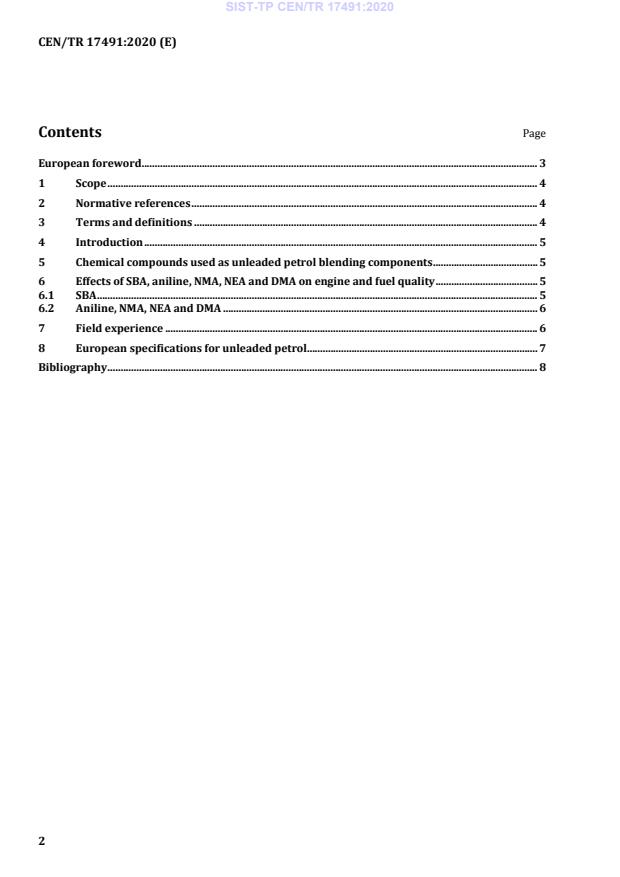
Contents Page
European foreword . 3
1 Scope . 4
2 Normative references . 4
3 Terms and definitions . 4
4 Introduction . 5
5 Chemical compounds used as unleaded petrol blending components . 5
6 Effects of SBA, aniline, NMA, NEA and DMA on engine and fuel quality . 5
6.1 SBA . 5
6.2 Aniline, NMA, NEA and DMA . 6
7 Field experience . 6
8 European specifications for unleaded petrol . 7
Bibliography . 8
European foreword
This document (CEN/TR 17491:2020) has been prepared by Technical Committee CEN/TC 19 “Gaseous
and liquid fuels, lubricants and related products of petroleum, synthetic and biological origin”, the
secretariat of which is held by NEN.
Attention is drawn to the possibility that some of the elements of this document may be the subject of
patent rights. CEN shall not be held responsible for identifying any or all such patent rights.
1 Scope
This document is intended to inform about the potential technical consequences on engine parts and
fuel systems when some types of chemical compounds are used as blending components in unleaded
petrol. This document is not meant to intentionally limit market fuel development.
The chemical compounds addressed, specifically, in this document are:
— sec-butyl acetate (SBA) (CAS 105-46-4),
— aniline (CAS 62-53-3),
— N-methyl aniline (NMA) (CAS 100-61-8),
— N-ethyl aniline (NEA) (CAS 103-69-5), and
— N,N di-methyl aniline (DMA) (CAS 121-69-7).
Other chemical compounds are not addressed in this document, however, attention is drawn to EN 228,
which requires that unleaded petrol be free from any adulterant or contaminant that can render the fuel
unacceptable for use.
NOTE 1 This document does not address environmental and/or health related issues. These aspects are
beyond the scope of CEN/TC 19 activities.
NOTE 2 For the purposes of this document, the term “% (V/V)” is used to represent the volume fraction, φ.
2 Normative references
The following documents are referred to in the text in such a way that some or all of their content
constitutes requirements of this document. For dated references, only the edition cited applies. For
undated references, the latest edition of the referenced document (including any amendments) applies.
EN 228:2012+A1:2017, Automotive fuels - Unleaded petrol - Requirements and test methods
3 Terms and definitions
For the purposes of this document, the following terms and definitions apply.
ISO and IEC maintain terminological databases for use in standardization at the following addresses:
• IEC Electropedia: available at http://www.electropedia.org/
• ISO Online browsing platform: available at https://www.iso.org/obp/ui
3.1
accelerated test
test performed under controlled conditions aimed at reflecting in an engine but in a shorter time frame
Note 1 to entry For example, the effects observed on the lubricant over the oil drain interval.
4 Introduction
Over the recent
...