

EN 1629:2011
(Main)Pedestrian doorsets, windows, curtain walling, grilles and shutters - Burglar resistance - Test method for the determination of resistance under dynamic loading
- Abstract
This European Standard specifies a test method for the determination of resistance to dynamic loading in order to assess the burglar resistant properties of pedestrian doorsets, windows, curtain walling, grilles and shutters. It is applicable to the following means of opening: Turning, tilting, folding, turn-tilting, top or bottom hung, sliding (horizontally and vertically) and rolling as well as fixed constructions.
There are two aspects to the burglar resistance performance of construction products, their normal resistance to forced operation and their ability to remain fixed to the building. Due to the limitation of reproducing the fixing methods and building construction in a laboratory environment this aspect is not fully covered by the standard. This is particularly true with products built into a building. The performance of the fixed part of the product is evaluated using a standard sub frame. It is the manufacturer´s responsibility to ensure that guidance on the fixing of the product is contained in the mounting instructions and that this guidance is suitable for the burglar resistance class claimed for the product. As with the other referenced standards this specification uses a standard sub frame and the product is mounted according to the manufacturer´s instructions. The fixing method to be considered is detailed in Annex A of EN 1627:2011. This test method does not evaluate the performance of the fixing to the building.
This European Standard does not apply to doors, gates and barriers, intended for installation in areas in the reach of persons, and for which the main intended uses are giving safe access for goods and vehicles accompanied or driven by persons in industrial, commercial or residential premises, as covered by EN 13241-1.
- Status
- Withdrawn
- Publication Date
- 10-May-2011
- Withdrawal Date
- 06-Oct-2026
- Technical Committee
- CEN/TC 33 - Doors, windows, shutters and building hardware
- Drafting Committee
- CEN/TC 33 - Doors, windows, shutters and building hardware
- Current Stage
- 9960 - Withdrawal effective - Withdrawal
- Start Date
- 23-Dec-2015
- Completion Date
- 07-Oct-2026

Relations
- Effective Date
- 14-May-2011
- Effective Date
- 19-Jan-2023
- Effective Date
- 28-Jan-2026
- Effective Date
- 28-Jan-2026
- Refers
EN 1906:2010 - Building hardware - Lever handles and knob furniture - Requirements and test methods - Effective Date
- 28-Jan-2026
- Effective Date
- 28-Jan-2026
- Effective Date
- 28-Jan-2026
- Effective Date
- 28-Jan-2026
- Effective Date
- 28-Jan-2026
- Effective Date
- 28-Jan-2026
- Effective Date
- 21-May-2014
- Effective Date
- 06-May-2015
Get Certified
Connect with accredited certification bodies for this standard

DIBt (Deutsches Institut für Bautechnik)
German Institute for Building Technology.
DIN CERTCO
DIN Group product certification.

Kiwa BDA Testing
Building and construction product certification.
Sponsored listings
Frequently Asked Questions
EN 1629:2011 is a standard published by the European Committee for Standardization (CEN). Its full title is "Pedestrian doorsets, windows, curtain walling, grilles and shutters - Burglar resistance - Test method for the determination of resistance under dynamic loading". This standard covers: This European Standard specifies a test method for the determination of resistance to dynamic loading in order to assess the burglar resistant properties of pedestrian doorsets, windows, curtain walling, grilles and shutters. It is applicable to the following means of opening: Turning, tilting, folding, turn-tilting, top or bottom hung, sliding (horizontally and vertically) and rolling as well as fixed constructions. There are two aspects to the burglar resistance performance of construction products, their normal resistance to forced operation and their ability to remain fixed to the building. Due to the limitation of reproducing the fixing methods and building construction in a laboratory environment this aspect is not fully covered by the standard. This is particularly true with products built into a building. The performance of the fixed part of the product is evaluated using a standard sub frame. It is the manufacturer´s responsibility to ensure that guidance on the fixing of the product is contained in the mounting instructions and that this guidance is suitable for the burglar resistance class claimed for the product. As with the other referenced standards this specification uses a standard sub frame and the product is mounted according to the manufacturer´s instructions. The fixing method to be considered is detailed in Annex A of EN 1627:2011. This test method does not evaluate the performance of the fixing to the building. This European Standard does not apply to doors, gates and barriers, intended for installation in areas in the reach of persons, and for which the main intended uses are giving safe access for goods and vehicles accompanied or driven by persons in industrial, commercial or residential premises, as covered by EN 13241-1.
This European Standard specifies a test method for the determination of resistance to dynamic loading in order to assess the burglar resistant properties of pedestrian doorsets, windows, curtain walling, grilles and shutters. It is applicable to the following means of opening: Turning, tilting, folding, turn-tilting, top or bottom hung, sliding (horizontally and vertically) and rolling as well as fixed constructions. There are two aspects to the burglar resistance performance of construction products, their normal resistance to forced operation and their ability to remain fixed to the building. Due to the limitation of reproducing the fixing methods and building construction in a laboratory environment this aspect is not fully covered by the standard. This is particularly true with products built into a building. The performance of the fixed part of the product is evaluated using a standard sub frame. It is the manufacturer´s responsibility to ensure that guidance on the fixing of the product is contained in the mounting instructions and that this guidance is suitable for the burglar resistance class claimed for the product. As with the other referenced standards this specification uses a standard sub frame and the product is mounted according to the manufacturer´s instructions. The fixing method to be considered is detailed in Annex A of EN 1627:2011. This test method does not evaluate the performance of the fixing to the building. This European Standard does not apply to doors, gates and barriers, intended for installation in areas in the reach of persons, and for which the main intended uses are giving safe access for goods and vehicles accompanied or driven by persons in industrial, commercial or residential premises, as covered by EN 13241-1.
EN 1629:2011 is classified under the following ICS (International Classification for Standards) categories: 13.310 - Protection against crime; 91.060.50 - Doors and windows. The ICS classification helps identify the subject area and facilitates finding related standards.
EN 1629:2011 has the following relationships with other standards: It is inter standard links to ENV 1629:1999, EN 1629:2011+A1:2015, EN 12209:2003, EN 12600:2002, EN 1906:2010, EN 1630:2011, EN 1303:2005, EN 356:1999, EN 1627:2011, EN 1628:2011, EN 1629:2011/FprA1, EN 1629:2021. Understanding these relationships helps ensure you are using the most current and applicable version of the standard.
EN 1629:2011 is associated with the following European legislation: EU Directives/Regulations: 305/2011, 89/106/EEC. When a standard is cited in the Official Journal of the European Union, products manufactured in conformity with it benefit from a presumption of conformity with the essential requirements of the corresponding EU directive or regulation.
EN 1629:2011 is available in PDF format for immediate download after purchase. The document can be added to your cart and obtained through the secure checkout process. Digital delivery ensures instant access to the complete standard document.
Standards Content (Sample)
2003-01.Slovenski inštitut za standardizacijo. Razmnoževanje celote ali delov tega standarda ni dovoljeno.Einbruchhemmende Bauprodukte (nicht für Betonferteiligte) - Prüfverfahren für die Ermittlung der Widerstandsfähigkeit unter dynamischer BelastungProduits de construction résistants à l'effraction (sauf éléments en béton préfabriqué) - Méthode d'essai pour la détermination de la résistance à la charge dynamiquePedestrian doorsets, windows, curtain walling, grilles and shutters - Burglar resistance - Test method for the determination of resistance under dynamic loading91.060.50Vrata in oknaDoors and windows13.310Varstvo pred kriminalomProtection against crimeICS:Ta slovenski standard je istoveten z:EN 1629:2011SIST EN 1629:2012en,fr,de01-januar-2012SIST EN 1629:2012SLOVENSKI
STANDARDSIST ENV 1629:20001DGRPHãþD
EUROPEAN STANDARD NORME EUROPÉENNE EUROPÄISCHE NORM
EN 1629
May 2011 ICS 13.310; 91.060.50 Supersedes ENV 1629:1999English Version
Pedestrian doorsets, windows, curtain walling, grilles and shutters - Burglar resistance - Test method for the determination of resistance under dynamic loading
Blocs-portes pour piétons, fenêtres, façades rideaux, grilles et fermetures - Résistance à l'effraction - Méthode d'essai pour la détermination de la résistance à la charge dynamique
Türen, Fenster, Vorhangfassaden, Gitterelemente und Abschlüsse - Einbruchhemmung - Prüfverfahren für die Ermittlung der Widerstandsfähigkeit unter dynamischer Belastung This European Standard was approved by CEN on 2 December 2010.
CEN members are bound to comply with the CEN/CENELEC Internal Regulations which stipulate the conditions for giving this European Standard the status of a national standard without any alteration. Up-to-date lists and bibliographical references concerning such national standards may be obtained on application to the CEN-CENELEC Management Centre or to any CEN member.
This European Standard exists in three official versions (English, French, German). A version in any other language made by translation under the responsibility of a CEN member into its own language and notified to the CEN-CENELEC Management Centre has the same status as the official versions.
CEN members are the national standards bodies of Austria, Belgium, Bulgaria, Croatia, Cyprus, Czech Republic, Denmark, Estonia, Finland, France, Germany, Greece, Hungary, Iceland, Ireland, Italy, Latvia, Lithuania, Luxembourg, Malta, Netherlands, Norway, Poland, Portugal, Romania, Slovakia, Slovenia, Spain, Sweden, Switzerland and United Kingdom.
EUROPEAN COMMITTEE FOR STANDARDIZATION
COMITÉ EUROPÉEN DE NORMALISATION EUROPÄISCHES KOMITEE FÜR NORMUNG
Management Centre:
Avenue Marnix 17,
B-1000 Brussels © 2011 CEN All rights of exploitation in any form and by any means reserved worldwide for CEN national Members. Ref. No. EN 1629:2011: ESIST EN 1629:2012
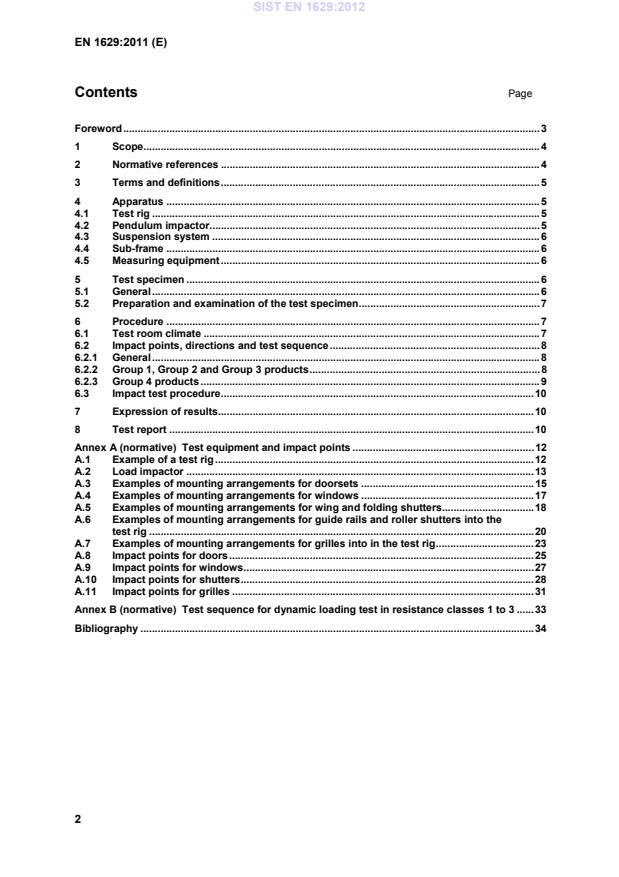
Test equipment and impact points . 12A.1Example of a test rig . 12A.2Load impactor . 13A.3Examples of mounting arrangements for doorsets . 15A.4Examples of mounting arrangements for windows . 17A.5Examples of mounting arrangements for wing and folding shutters . 18A.6Examples of mounting arrangements for guide rails and roller shutters into the test rig . 20A.7Examples of mounting arrangements for grilles into in the test rig . 23A.8Impact points for doors . 25A.9Impact points for windows . 27A.10Impact points for shutters . 28A.11Impact points for grilles . 31Annex B (normative)
Test sequence for dynamic loading test in resistance classes 1 to 3 . 33Bibliography . 34 SIST EN 1629:2012
1)
Tyre 3.50-R8 4PR manufactured by Vredestein can be used for the pendulum test. It can be obtained from Vredestein BV, Ingenieur Schiffstraat 370, NL – 7547 RD Enschede, Nederland or Vredestein GmbH, August-Horch-Strasse 7, D – 56070 Koblenz, Deutschland. Tyre 3.50-R8 4PR is the trade name o
...