

EN 16503:2014
(Main)Water quality - Guidance standard on assessing the hydromorphological features of transitional and coastal waters
- Abstract
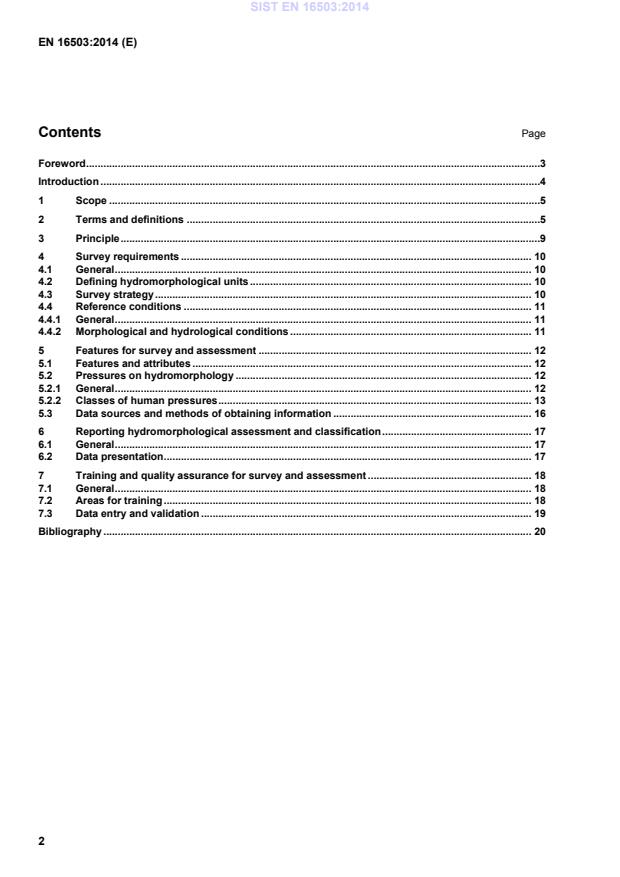
This European Standard gives guidelines for characterizing the hydromorphology of transitional or coastal (TraC) waters, but does not prescribe detailed methods of assessment. The main aim of this document is to improve the comparability of hydromorphological survey methods, data processing, and the interpretation and presentation of results.
This European Standard:
a) lists essential features and processes of TraC waters that should be characterized as part of a hydromorphological survey and used for determining hydromorphological condition;
b) gives guidance on strategies for collecting and presenting hydromorphological data depending on the resources available and the anticipated use of the assessment;
c) describes how to generate data sets appropriate for monitoring and reporting on the condition of Natura 2000 sites designated under the Habitats Directive and the Birds Directive;
d) provides guidance on data quality assurance.
This European Standard does not deal with biological assessments in TraC waters such as the presence or absence of individual species or community composition, nor does it attempt to link specific hydromorphological features with their associated biological communities. However, it is relevant where plants or other organisms form significant structural elements of the habitat (e.g. saltmarshes, biogenic reefs).
- Status
- Published
- Publication Date
- 26-Aug-2014
- Withdrawal Date
- 27-Feb-2015
- Technical Committee
- CEN/TC 230 - Water analysis
- Drafting Committee
- CEN/TC 230/WG 2 - Biological methods
- Current Stage
- 9060 - Closure of 2 Year Review Enquiry - Review Enquiry
- Start Date
- 02-Sep-2025
- Completion Date
- 02-Sep-2025



Overview
EN 16503:2014 - published by CEN - is a guidance standard for assessing the hydromorphological features of transitional and coastal (TraC) waters. It sets out a common framework (not prescriptive methods) to improve comparability of hydromorphological surveys, data processing, interpretation and presentation of results. The standard supports monitoring and reporting obligations under the Water Framework Directive (WFD), the Marine Strategy Framework Directive (MSFD) and Natura 2000 site assessments under the Habitats and Birds Directives.
Key topics
- Scope and purpose: Guidance for characterizing hydromorphology in estuaries, lagoons, bays and coastal waters; explicitly does not cover biological community assessments, except where organisms form structural habitat elements (e.g. saltmarsh, biogenic reefs).
- Essential features to record: physical structure and processes such as substrate type, bathymetry/topography, bedform patterns, tidal regime, stratification, sediment dynamics, coastal cell and shoreline physiography, intertidal/subtidal zones, saltmarshes and biogenic reefs.
- Survey strategy: Advice on defining hydromorphological units, tailoring survey intensity to objectives and resources, and combining measurements, models and expert judgement.
- Reference conditions: Guidance on identifying and using reference (near-natural) conditions for comparative assessment and classification of hydromorphological condition.
- Pressures and impacts: Classification of human pressures (e.g. coastal engineering, land reclamation, navigation, hydrological alterations) affecting TraC hydromorphology.
- Data management and reporting: Recommendations for data sources, data presentation, harmonized reporting formats to support monitoring and policy needs.
- Training and quality assurance: Guidance on staff training, data entry, validation and QA to ensure reliable, comparable hydromorphological data.
Applications and users
Who uses EN 16503:2014:
- Environmental and conservation agencies responsible for WFD/MSFD reporting
- Field survey teams and coastal monitoring practitioners
- Environmental consultants conducting EIA, restoration planning or coastal management studies
- Research institutions modelling sediment dynamics and hydrodynamics
- Natura 2000 site managers preparing condition assessments
Practical uses:
- Designing cost-effective hydromorphological surveys
- Generating comparable datasets for national or EU reporting
- Informing habitat conservation, coastal restoration and erosion management
- Supporting impact assessment and permitting decisions
Related standards and policy links
- Links to WFD (2000/60/EC), MSFD and Habitats/Birds Directives for monitoring and reporting context
- Cross-references within the document to other CEN/ISO standards used for specific terms and measurements (e.g. bathymetry, tidal parameters)
EN 16503:2014 is a practical framework for consistent, quality-assured hydromorphological assessment of transitional and coastal waters, enabling comparable monitoring and evidence-based coastal management.
Relations
- Effective Date
- 28-Jan-2026
- Effective Date
- 28-Jan-2026
- Effective Date
- 28-Jan-2026
- Effective Date
- 28-Jan-2026
- Effective Date
- 28-Jan-2026
Get Certified
Connect with accredited certification bodies for this standard

CIS Institut d.o.o.
Personal Protective Equipment (PPE) certification body. Notified Body NB-2890 for EU Regulation 2016/425 PPE.

Kiwa BDA Testing
Building and construction product certification.
Kmetijski inštitut Slovenije
Agricultural Institute of Slovenia. Soil testing, plant health, agricultural product analysis.
Sponsored listings
Frequently Asked Questions
EN 16503:2014 is a standard published by the European Committee for Standardization (CEN). Its full title is "Water quality - Guidance standard on assessing the hydromorphological features of transitional and coastal waters". This standard covers: This European Standard gives guidelines for characterizing the hydromorphology of transitional or coastal (TraC) waters, but does not prescribe detailed methods of assessment. The main aim of this document is to improve the comparability of hydromorphological survey methods, data processing, and the interpretation and presentation of results. This European Standard: a) lists essential features and processes of TraC waters that should be characterized as part of a hydromorphological survey and used for determining hydromorphological condition; b) gives guidance on strategies for collecting and presenting hydromorphological data depending on the resources available and the anticipated use of the assessment; c) describes how to generate data sets appropriate for monitoring and reporting on the condition of Natura 2000 sites designated under the Habitats Directive and the Birds Directive; d) provides guidance on data quality assurance. This European Standard does not deal with biological assessments in TraC waters such as the presence or absence of individual species or community composition, nor does it attempt to link specific hydromorphological features with their associated biological communities. However, it is relevant where plants or other organisms form significant structural elements of the habitat (e.g. saltmarshes, biogenic reefs).
This European Standard gives guidelines for characterizing the hydromorphology of transitional or coastal (TraC) waters, but does not prescribe detailed methods of assessment. The main aim of this document is to improve the comparability of hydromorphological survey methods, data processing, and the interpretation and presentation of results. This European Standard: a) lists essential features and processes of TraC waters that should be characterized as part of a hydromorphological survey and used for determining hydromorphological condition; b) gives guidance on strategies for collecting and presenting hydromorphological data depending on the resources available and the anticipated use of the assessment; c) describes how to generate data sets appropriate for monitoring and reporting on the condition of Natura 2000 sites designated under the Habitats Directive and the Birds Directive; d) provides guidance on data quality assurance. This European Standard does not deal with biological assessments in TraC waters such as the presence or absence of individual species or community composition, nor does it attempt to link specific hydromorphological features with their associated biological communities. However, it is relevant where plants or other organisms form significant structural elements of the habitat (e.g. saltmarshes, biogenic reefs).
EN 16503:2014 is classified under the following ICS (International Classification for Standards) categories: 13.060.70 - Examination of biological properties of water. The ICS classification helps identify the subject area and facilitates finding related standards.
EN 16503:2014 has the following relationships with other standards: It is inter standard links to EN ISO 12215-6:2008, EN ISO 12215-6:2018, EN ISO 25197:2018, EN ISO 25197:2012, EN ISO 12215-7:2020. Understanding these relationships helps ensure you are using the most current and applicable version of the standard.
EN 16503:2014 is associated with the following European legislation: EU Directives/Regulations: 2000/60/EC. When a standard is cited in the Official Journal of the European Union, products manufactured in conformity with it benefit from a presumption of conformity with the essential requirements of the corresponding EU directive or regulation.
EN 16503:2014 is available in PDF format for immediate download after purchase. The document can be added to your cart and obtained through the secure checkout process. Digital delivery ensures instant access to the complete standard document.
Standards Content (Sample)
2003-01.Slovenski inštitut za standardizacijo. Razmnoževanje celote ali delov tega standarda ni dovoljeno.Wasserbeschaffenheit - Anleitung zur Beurteilung der hydromorphologischen Merkmale der Übergangs- und KüstengewässerQualité de l'eau - Norme guide pour l'évaluation des caractéristiques hydromorphologiques des eaux de transition et des eaux côtièresWater quality - Guidance standard on assessing the hydromorphological features of transitional and coastal waters13.060.70Preiskava bioloških lastnosti vodeExamination of biological properties of water13.060.10Voda iz naravnih virovWater of natural resourcesICS:Ta slovenski standard je istoveten z:EN 16503:2014SIST EN 16503:2014en,fr,de01-november-2014SIST EN 16503:2014SLOVENSKI
STANDARD
EUROPEAN STANDARD NORME EUROPÉENNE EUROPÄISCHE NORM
EN 16503
August 2014 ICS 13.060.70 English Version
Water quality - Guidance standard on assessing the hydromorphological features of transitional and coastal waters
Qualité de l'eau - Norme guide pour l'évaluation des caractéristiques hydromorphologiques des eaux de transition et des eaux côtières
Wasserbeschaffenheit - Anleitung zur Beurteilung der hydromorphologischen Merkmale der Übergangs- und Küstengewässer This European Standard was approved by CEN on 11 July 2014.
CEN members are bound to comply with the CEN/CENELEC Internal Regulations which stipulate the conditions for giving this European Standard the status of a national standard without any alteration. Up-to-date lists and bibliographical references concerning such national standards may be obtained on application to the CEN-CENELEC Management Centre or to any CEN member.
This European Standard exists in three official versions (English, French, German). A version in any other language made by translation under the responsibility of a CEN member into its own language and notified to the CEN-CENELEC Management Centre has the same status as the official versions.
CEN members are the national standards bodies of Austria, Belgium, Bulgaria, Croatia, Cyprus, Czech Republic, Denmark, Estonia, Finland, Former Yugoslav Republic of Macedonia, France, Germany, Greece, Hungary, Iceland, Ireland, Italy, Latvia, Lithuania, Luxembourg, Malta, Netherlands, Norway, Poland, Portugal, Romania, Slovakia, Slovenia, Spain, Sweden, Switzerland, Turkey and United Kingdom.
EUROPEAN COMMITTEE FOR STANDARDIZATION
COMITÉ EUROPÉEN DE NORMALISATION EUROPÄISCHES KOMITEE FÜR NORMUNG
CEN-CENELEC Management Centre:
Avenue Marnix 17,
B-1000 Brussels © 2014 CEN All rights of exploitation in any form and by any means reserved worldwide for CEN national Members. Ref. No. EN 16503:2014 ESIST EN 16503:2014
As classified in accordance with Annex V of the EC Water Framework Directive (2000/60/EC). [SOURCE: EN 16039:2011, 3.15] 2.11 fetch fetch length distance of open water over which the wind can blow and generate wind-driven waves [SOURCE: EN 16039:2011, 3.19, modified — “fetch length” was added as synonym] 2.12 fjord long narrow and glacially eroded inlet with steep sides, created in a valley often with a shallow entrance at the mouth SIST EN 16503:2014
...