

prEN 14178-2
(Main)Glass in building - Basic alkaline earth silicate glass products - Part 2: Product standard
- Abstract
This European standard covers the evaluation of conformity and the factory production control of basic alkaline earth silicate glass for use in buildings.
For glass products with electrical wiring or connections for, e.g. alarm or heating purposes, other directives, e.g. Low Voltage Directive, may apply.
- Status
- Not Published
- Publication Date
- 10-Feb-2019
- Technical Committee
- CEN/TC 129 - Glass in building
- Drafting Committee
- CEN/TC 129/WG 1 - Basic glass products
- Current Stage
- 4098 - Decision to abandon - Enquiry
- Start Date
- 23-Jan-2020
- Completion Date
- 14-Oct-2026

Overview
The prEN 14178-2:2017 is a European standard developed by CEN Technical Committee CEN/TC 129 “Glass in building”. It specifies the product standards for basic alkaline earth silicate glass products used in building construction. This standard covers the evaluation of conformity and factory production control (FPC) processes required to ensure consistent quality and performance of these glass products.
The standard supersedes the earlier version EN 14178-2:2004 and aligns with the EU Construction Products Regulation (CPR) No. 305/2011 along with relevant amendment regulations. It plays a crucial role in certifying that alkaline earth silicate glass products meet essential legislative and technical requirements before entering the market.
Key Topics
Scope and Application
Defines the evaluation of conformity and factory production control specifically for basic alkaline earth silicate glass products intended for buildings. It excludes glass with electrical components, which fall under other directives such as the Low Voltage Directive.Product Description and Families
Manufacturers are responsible for preparing a detailed product description, which outlines relevant parameters such as production process, glass structure, and reference standards-mainly prEN 14178-1 and prEN 14178-2.Essential Characteristics and Performance
The standard identifies essential characteristics such as mechanical resistance, durability, and spectrophotometric properties like solar factor (g). These must be declared within the product’s Declaration of Performance (DoP).Factory Production Control (FPC)
A documented internal control system is mandated to monitor production quality continuously. FPC includes type testing, inspection plans, initial factory audits, and ongoing surveillance to detect non-compliances.Testing and Assessment Methods
Includes guidelines for type testing, sampling, spectrophotometric and energy performance measurements, and related tolerances. This ensures glass products meet declared performance levels and classifications.Marking and Labelling
Guidance on product marking supports traceability and identification, reinforcing compliance with regulatory and safety requirements.Relationship with EU Regulations
The standard connects to the Construction Products Regulation and includes an informative annex detailing the Assessment and Verification of Constancy of Performance (AVCP) system.
Applications
The prEN 14178-2 standard is essential for manufacturers, suppliers, and quality controllers of basic alkaline earth silicate glass products used in various building applications such as:
Building Facades and Cladding
Ensures glass used on exterior surfaces complies with safety, durability, and energy performance criteria.Window and Door Glazing
Supports assessment of mechanical resistance and thermal properties for energy-efficient and secure window systems.Partition Walls and Interior Design Elements
Facilitates conformity evaluation for interior glass panels in commercial and residential buildings.Fire Safety and Security Glazing
Coordination with other standards associated with fire classification, bullet resistance, and explosion-proof glazing ensures integration of alkaline earth silicate glass in specialized applications.Sustainable Building Design
The inclusion of solar factor measurements supports energy-efficient architectural design by quantifying solar heat gain.
Related Standards
prEN 14178-2 complements and references several critical standards in the field of building glass:
- prEN 14178-1:2017 – Part 1: Float Glass specification for alkaline earth silicate glass products.
- EN 410 – Determination of luminous and solar characteristics of glass glazing.
- EN 673 – Calculation of thermal transmittance (U value) of glazing.
- EN 12600 – Impact test methods for flat glass.
- EN 356 and EN 1063 – Security glazing against manual and bullet attack.
- EN 13501 series – Fire classification of construction products and building elements.
- prEN 16612:2017 – Determination of lateral load resistance of glass panes by calculation.
- ISO 9385 – Glass hardness testing.
Keywords: alkaline earth silicate glass, glass in building, product standard, factory production control, Construction Products Regulation, conformity assessment, building glazing, spectrophotometric characteristics, solar factor, glass performance, European standard, CEN prEN 14178-2.
Relations
- Effective Date
- 19-Jan-2023
Frequently Asked Questions
prEN 14178-2 is a draft published by the European Committee for Standardization (CEN). Its full title is "Glass in building - Basic alkaline earth silicate glass products - Part 2: Product standard". This standard covers: This European standard covers the evaluation of conformity and the factory production control of basic alkaline earth silicate glass for use in buildings. For glass products with electrical wiring or connections for, e.g. alarm or heating purposes, other directives, e.g. Low Voltage Directive, may apply.
This European standard covers the evaluation of conformity and the factory production control of basic alkaline earth silicate glass for use in buildings. For glass products with electrical wiring or connections for, e.g. alarm or heating purposes, other directives, e.g. Low Voltage Directive, may apply.
prEN 14178-2 is classified under the following ICS (International Classification for Standards) categories: 81.040.20 - Glass in building. The ICS classification helps identify the subject area and facilitates finding related standards.
prEN 14178-2 has the following relationships with other standards: It is inter standard links to EN 14178-2:2004. Understanding these relationships helps ensure you are using the most current and applicable version of the standard.
prEN 14178-2 is associated with the following European legislation: EU Directives/Regulations: 305/2011; Standardization Mandates: M/135. When a standard is cited in the Official Journal of the European Union, products manufactured in conformity with it benefit from a presumption of conformity with the essential requirements of the corresponding EU directive or regulation.
prEN 14178-2 is available in PDF format for immediate download after purchase. The document can be added to your cart and obtained through the secure checkout process. Digital delivery ensures instant access to the complete standard document.
Standards Content (Sample)
SLOVENSKI STANDARD
01-september-2017
Steklo v gradbeništvu - Osnovni izdelki iz zemljoalkalijskega silikatnega stekla - 2.
del: Standard za proizvod
Glass in building - Basic alkaline earth silicate glass products - Part 2: Product standard
Glas im Bauwesen - Basiserzeugnisse aus Erdalkali-Silicatglas - Teil 2: Produktnorm
Verre dans la construction - Verre de silicate alcalino-terreux de base - Partie 2 : Norme
de produit
Ta slovenski standard je istoveten z: prEN 14178-2
ICS:
81.040.20 Steklo v gradbeništvu Glass in building
2003-01.Slovenski inštitut za standardizacijo. Razmnoževanje celote ali delov tega standarda ni dovoljeno.
DRAFT
EUROPEAN STANDARD
NORME EUROPÉENNE
EUROPÄISCHE NORM
July 2017
ICS 81.040.20 Will supersede EN 14178-2:2004
English Version
Glass in building - Basic alkaline earth silicate glass
products - Part 2: Product standard
Verre dans la construction - Verre de silicate alcalino- Glas im Bauwesen - Basiserzeugnisse aus Erdalkali-
terreux de base - Partie 2 : Norme de produit Silicatglas - Teil 2: Produktnorm
This draft European Standard is submitted to CEN members for enquiry. It has been drawn up by the Technical Committee
CEN/TC 129.
If this draft becomes a European Standard, CEN members are bound to comply with the CEN/CENELEC Internal Regulations
which stipulate the conditions for giving this European Standard the status of a national standard without any alteration.
This draft European Standard was established by CEN in three official versions (English, French, German). A version in any other
language made by translation under the responsibility of a CEN member into its own language and notified to the CEN-CENELEC
Management Centre has the same status as the official versions.
CEN members are the national standards bodies of Austria, Belgium, Bulgaria, Croatia, Cyprus, Czech Republic, Denmark, Estonia,
Finland, Former Yugoslav Republic of Macedonia, France, Germany, Greece, Hungary, Iceland, Ireland, Italy, Latvia, Lithuania,
Luxembourg, Malta, Netherlands, Norway, Poland, Portugal, Romania, Serbia, Slovakia, Slovenia, Spain, Sweden, Switzerland,
Turkey and United Kingdom.
Recipients of this draft are invited to submit, with their comments, notification of any relevant patent rights of which they are
aware and to provide supporting documentation.
Warning : This document is not a European Standard. It is distributed for review and comments. It is subject to change without
notice and shall not be referred to as a European Standard.
EUROPEAN COMMITTEE FOR STANDARDIZATION
COMITÉ EUROPÉEN DE NORMALISATION
EUROPÄISCHES KOMITEE FÜR NORMUNG
CEN-CENELEC Management Centre: Avenue Marnix 17, B-1000 Brussels
© 2017 CEN All rights of exploitation in any form and by any means reserved Ref. No. prEN 14178-2:2017 E
worldwide for CEN national Members.
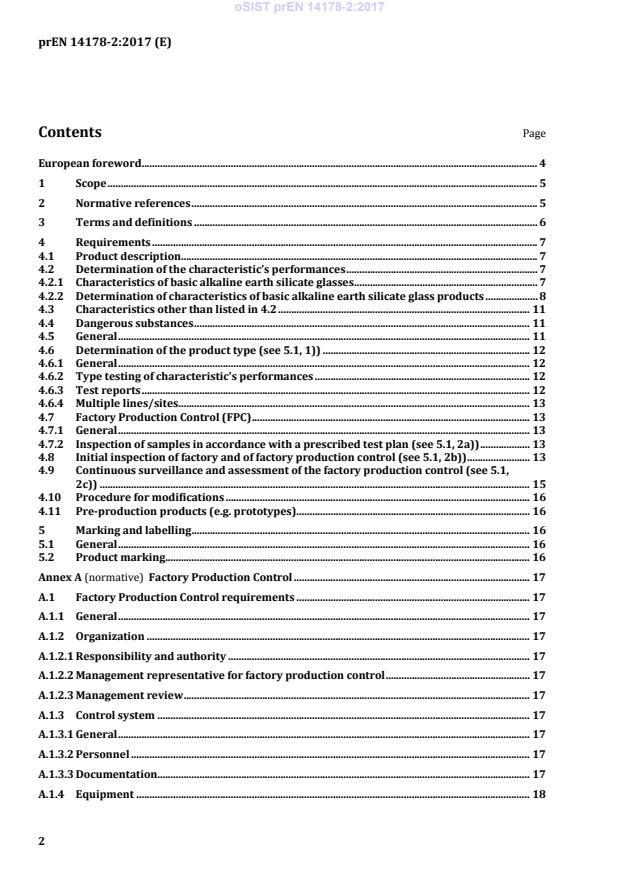
Contents Page
European foreword . 4
1 Scope . 5
2 Normative references . 5
3 Terms and definitions . 6
4 Requirements . 7
4.1 Product description . 7
4.2 Determination of the characteristic’s performances . 7
4.2.1 Characteristics of basic alkaline earth silicate glasses . 7
4.2.2 Determination of characteristics of basic alkaline earth silicate glass products . 8
4.3 Characteristics other than listed in 4.2 . 11
4.4 Dangerous substances . 11
4.5 General . 11
4.6 Determination of the product type (see 5.1, 1)) . 12
4.6.1 General . 12
4.6.2 Type testing of characteristic's performances . 12
4.6.3 Test reports . 12
4.6.4 Multiple lines/sites . 13
4.7 Factory Production Control (FPC) . 13
4.7.1 General . 13
4.7.2 Inspection of samples in accordance with a prescribed test plan (see 5.1, 2a)) . 13
4.8 Initial inspection of factory and of factory production control (see 5.1, 2b)) . 13
4.9 Continuous surveillance and assessment of the factory production control (see 5.1,
2c)) . 15
4.10 Procedure for modifications . 16
4.11 Pre-production products (e.g. prototypes) . 16
5 Marking and labelling . 16
5.1 General . 16
5.2 Product marking. 16
Annex A (normative) Factory Production Control . 17
A.1 Factory Production Control requirements . 17
A.1.1 General . 17
A.1.2 Organization . 17
A.1.2.1 Responsibility and authority . 17
A.1.2.2 Management representative for factory production control . 17
A.1.2.3 Management review . 17
A.1.3 Control system . 17
A.1.3.1 General . 17
A.1.3.2 Personnel . 17
A.1.3.3 Documentation . 17
A.1.4 Equipment . 18
A.1.4.1 Testing . 18
A.1.4.2 Manufacturing. 18
A.1.5 Inspection and testing . 18
A.1.6 Non-complying materials / products . 18
A.2 Inspection and testing tables of basic alkaline earth silicate glass production. 18
A.2.1 Information on Table A.1 . 18
A.2.2 Use of proxy testing. 19
Annex B (normative) Type testing of spectrophotometric and energy characteristics . 23
B.1 Sampling . 23
B.2 Measurement of spectrophotometric characteristics . 23
B.3 Tolerances on spectrophotometric characteristics . 23
Annex C (informative) Provisions for voluntary involvement of third party(ies) . 25
C.1 General . 25
C.2 Voluntary tasks for third parties . 25
C.3 Marking and labelling . 25
Annex ZA (informative) Relationship of this European Standard with Regulation (EU)
No.305/2011 . 26
ZA.1 Scope and relevant characteristics . 26
ZA.2 System of Assessment and Verification of Constancy of Performance (AVCP) . 27
ZA.3 Assignment of AVCP tasks . 28
Bibliography . 31
European foreword
This document (prEN 14178-2:2017) has been prepared by Technical Committee CEN/TC 129 “Glass in
building”, the secretariat of which is held by NBN.
This document is currently submitted to the CEN Enquiry.
This document will supersede EN 14178-2:2004.
This document has been prepared under a mandate given to CEN by the European Commission and the
European Free Trade Association, and supports basic work requirements of EU Regulation and
essential requirements of EU Directive(s).
For relationship with EU Regulation/Directive(s), see informative Annex ZA which is an integral part of
this document.
This European standard differs from EN 14178-2:2004 as follows:
a) the standard has been revised to fulfil the requirements of the Regulation (EU) No 305/2011
(Construction Product Regulation), modified by Regulations (EU) No 157/2014, (EU) No 568/2014
and (EU) No 574/2014;
b) the solar factor, g, is listed within the spectrophotometric characteristics to be declared in the
Declaration of Performances (DoP);
c) the durability/conformity assessment is listed within the characteristics to be declared in the DoP;
d) the mechanical resistance shall be given in the DoP by the characteristic bending strength.
This part of the European standard does not stand alone; it is a part of one document:
— prEN 14178-1: Glass in building — Basic alkaline earth silicate glass products — Part 1: Float glass;
— prEN 14178-2: Glass in building — Basic alkaline earth silicate glass products — Part 2: Product
standard.
This document contains other aspects of importance for trade.
1 Scope
This European standard covers the evaluation of conformity and the factory production control of basic
alkaline earth silicate glass for use in buildings.
For glass products with electrical wiring or connections for, e.g. alarm or heating purposes, other
directives, e.g. Low Voltage Directive, may apply.
2 Normative references
The following documents, in whole or in part, are normatively referenced in this document and are
indispensable for its application. For dated references, only the edition cited applies. For undated
references, the latest edition of the referenced document (including any amendments) applies.
EN 356, Glass in building — Security glazing — Testing and classification of resistance against manual
attack
EN 410, Glass in building — Determination of luminous and solar characteristics of glazing
EN 673, Glass in building — Determination of thermal transmittance (U value) — Calculation method
EN 1063, Glass in building — Security glazing — Testing and classification of resistance against bullet
attack
EN 12600, Glass in building — Pendulum test — Impact test method and classification for flat glass
EN 12758, Glass in building — Glazing and airborne sound insulation — Product descriptions and
determination of properties
EN 13501-1, Fire classification of construction products and building elements — Part 1: Classification
using data from reaction to fire tests
EN 13501-2, Fire classification of construction products and building elements — Part 2: Classification
using data from fire resistance tests, excluding ventilation services
EN 13501-5, Fire classification of construction products and building elements — Part 5: Classification
using data from external fire exposure to roofs tests
EN 13541, Glass in building — Security glazing — Testing and classification of resistance against
explosion pressure
prEN 14178-1:2017, Glass in building — Basic alkaline earth silicate glass products — Part 1: Float glass
EN 15998, Glass in building — Safety in case of fire, fire resistance — Glass testing methodology for the
purpose of classification
prEN 16612:2017, Glass in building — Determination of the lateral load resistance of glass panes by
calculation
ISO 9385, Glass and glass-ceramics — Knoop hardness test
3 Terms and definitions
For the purposes of this document, the terms and definitions given in prEN 14178-1:2017 and the
following apply.
3.1
factory production control
FPC
documented, permanent and internal control of production in a factory, in accordance with this
standard
Note 1 to entry: See also Annex A.
3.2
product-type
set of representative performance levels or classes of a construction product, in relation to its essential
characteristics, produced using a given combination of raw materials or other elements in a specific
production process
3.3
essential characteristic
characteristic of the construction product which relate to the basic requirements for construction
works
Note 1 to entry: Basic requirements for construction work are given in the regulation (EU) No 305/2011,
Annex I.
3.4
performance of a construction product
performance related to the relevant essential characteristics, expressed by level or class, or in a
description
3.5
level
result of the assessment of the performance of a construction product in relation to its essential
characteristics, expressed as a numerical value
3.6
class
range of levels, delimited by a minimum and a maximum value, of performance of a construction
product
3.7
type testing
TT
determination of the performance of a product (characteristic, durability), on the basis of either actual
tests or other procedures (such as conventional, standardised, tabulated or generally accepted values,
standardised or recognised calculation methods, test reports when made available, …), in accordance
with this European standard and that demonstrates compliance with this European standard
3.8
test report
document that covers the results of tests undertaken on a representative sample of the product from
production or on a prototype design of the product
3.9
product description
document that details the relevant parameters, e.g. process conditions, structure, etc., for defining a
product that complies with the standard and that includes specific reference(s) to characteristics that
are modified by the production process
3.10
product family
group of products determined by the manufacturer, which is made with similar components and
processes and which is tested for FPC using the same test method
3.11
significant change
variation in performance beyond the permitted tolerance for the characteristic
4 Requirements
4.1 Product description
For conformity purposes the basic alkaline earth silicate glass products manufacturer is responsible for
the preparation and maintenance of the product description. This description shall describe the product
and/or product families.
Disclosure of the product description shall be at the discretion of the basic alkaline earth silicate glass
products manufacturer or his agent except in the case of regulatory requirements.
The product description shall contain at least the following:
— a reference to prEN 14178-1:2017 and prEN 14178-2:2017 and all other standards with which the
manufacturer claims compliance;
— a description of the product family(ies);
— the spectrophotometric properties of the basic alkaline earth silicate glass products.
The definition of product families shall be consistent with the product description.
4.2 Determination of the characteristic’s performances
4.2.1 Characteristics of basic alkaline earth silicate glasses
Basic alkaline earth silicate glass products are made in accordance to prEN 14178-1:2017. For the
characteristics listed in Table 1, the values given in prEN 14178-1:2017, 5.1 and 5.2 shall be used.
Table 1 — Information on the characteristics of basic alkaline earth silicate glass
Characteristic Symbol Unit
Density ρ kg/m
Hardness (Knoop hardness in accordance with ISO 9385) HK Dimensionless
0,1/20
Young's modulus E GPa
Poisson's ratio μ Dimensionless
Characteristic bending strength f MPa
g,k
Resistance against temperature changes and temperature K
diff i l
Specific heat capacity c J/(kg∙K)
−1
Coefficient of linear expansion α K
Thermal conductivity λ W/(m∙K)
Mean refractive index to visible radiation η Dimensionless
4.2.2 Determination of characteristics of basic alkaline earth silicate glass products
4.2.2.1 General
If the basic alkaline earth silicate glass manufacturer wishes to claim that any performance
characteristic is independent of the production equipment used, then the factory production control
system shall be in accordance with this document including his specific process control conditions.
4.2.2.2 Safety in the case of fire - Resistance to fire
Fire resistance shall be determined and classified in accordance with EN 13501-2.
EN 15998 specifies the testing methodology to be used for glass products that are claiming fire
resistance.
4.2.2.3 Safety in the case of fire - Reaction to fire
Reaction to fire shall be determined and classified in accordance with EN 13501-1.
Basic alkaline earth silicate glass products are products/materials that do not require to be tested for
reaction to fire (e.g. Products/materials of Classes A1 according to Commission Decision 96/603/EC, as
amended 2000/605/EC).
4.2.2.4 Safety in the case of fire - External fire performance (for roof coverings only)
Where the manufacturer wishes to declare external fire performance (e.g. when subject to regulatory
requirements), the product shall be tested in accordance with EN 13501-5.
4.2.2.5 Safety in use - Bullet resistance: shatter properties and resistance to attack
Bullet resistance shall be determined and classified in accordance with EN 1063.
4.2.2.6 Safety in use - Explosion resistance: impact behaviour and resistance to impact
Explosion resistance shall be determined and classified in accordance with EN 13541.
4.2.2.7 Safety in use - Burglar resistance: shatter properties and resistance to attack
Burglar resistance shall be determined and classified in accordance with EN 356.
4.2.2.8 Safety in use - Pendulum body impact resistance: shatter properties (safe breakability)
and resistance to impact
Pendulum body impact resistance shall be determined and classified in accordance with EN 12600.
4.2.2.9 Safety in use - Mechanical resistance: Resistance against sudden temperature changes
and temperature differentials
The resistance against sudden temperature changes and temperature differentials is a generally
accepted value that is given in prEN 14178-1:2017 and shall be ensured by compliance with this
standard.
4.2.2.10 Safety in use - Mechanical resistance: Resistance against wind, snow, permanent load
and/or imposed loads of the glass unit
The mechanical resistance of basic alkaline earth silicate glass is a characteristic value that shall be
ensured by compliance with this document.
The value to be declared is the characteristic bending strength, as defined in prEN 14178-1:2017, 5.2.
As long as prEN 16612 is not applicable for the glass design with respect to the concerned construction
or building site, then the current method of determining mechanical resistance in the country of
destination shall be applied.
4.2.2.11 Protection against noise - Direct airborne sound reduction
The sound reduction indexes shall be determined in accordance with EN 12758.
The values to be declared shall be rounded down to the nearest whole number.
4.2.2.12 Energy conservation and heat retention - Thermal properties
The thermal transmittance value (U-value) shall be determined in accordance with the following
procedure:
a) the emissivity shall be taken equal to 0,837, as given in prEN 14178-1:2017;
b) the U-value shall be determined by calculation in accordance with EN 673, with the normal
emissivity as defined above and the nominal thickness of the glass panes.
4.2.2.13 Energy conservation and heat retention - Radiation properties: Light transmittance and
reflectance
The light transmittance and light reflectance shall be determined either:
a) in accordance with the following procedure:
1) The light transmittance and light reflectance of one sample of basic borosilicate glass product
shall be determined in accordance with EN 410 and Annex B. The exact thickness of the glass
shall be measured.
2) The light transmittance and the light reflectance of any other thickness shall be calculated
according to EN 410.
3) The tool used to calculate the light transmittance and the light reflectance shall be validated.
b) or measured following EN 410 and Annex B.
The tolerances on the calculated light transmittance and light reflectance are given in Annex B.
4.2.2.14 Energy conservation and heat retention - Radiation properties: Solar energy
characteristics
The solar direct transmittance, the solar direct reflectance and the total solar energy transmittance
(solar factor or g-value) shall be determined either:
a) in accordance with the following procedure:
1) The solar direct transmittance and solar direct reflectance of one sample of basic borosilicate
glass product shall be determined in accordance with EN 410 and Annex B. The exact thickness
of the glass shall be measured.
2) The solar direct transmittance, the solar direct reflectance and the total solar energy
transmittance (solar factor or g-value) of any other thickness shall be calculated according to
EN 410.
3) The tool used to calculate the solar direct transmittance, the solar direct reflectance and the
total solar energy transmittance (solar factor or g-value) shall be validated.
b) or measured following EN 410 and Annex B.
The tolerances on the calculated solar energy characteristics are given in Annex B.
4.2.2.15 Durability / conformity with the definition of basic alkaline earth silicate glass products
Products shall conform to the definition, to the manufacturer product description and fulfil the
requirements of basic alkaline earth silicate glass products as defined in prEN 14178-1:2017.
The type testing concerns the product aspects as listed in Table 2.
Table 2 — Product aspects to be checked if product belongs to the group basic alkaline earth
silicate glass products
Number of
Product aspect Requirement
samples
Chemical composition prEN 14178–1:2017, 4.1 1
Thickness prEN 14178–1:2017, 6.2 1
Light transmittance (distinction clear glass from tinted prEN 14178–1:2017, 5.3 1
glass)
When products conform to the definition of basic alkaline earth silicate glass, the other characteristics’
performances in 4.2 are ensured during an economically reasonable working life.
The durability / conformity of basic alkaline earth silicate glass products, including their characteristics,
is ensured by the following:
— compliance with this standard;
— compliance with instructions from the glass product manufacturer or supplier.
The manufacturer shall supply specific installation instructions or make reference to appropriate
technical specifications.
NOTE The durability of glass products depends also on:
— building and construction movements due to various actions;
— building and construction vibrations due to various actions;
— deflection and racking of the glass support due to various actions;
— glass support design (e.g. drainage of infiltrated water in the rebate, prevention of direct contact
between glass support members and glass);
— accuracy of glass support and glass support member dimensions;
— quality of the assembling of glass support members up to a glass support;
— quality of installation of the glass support into or onto the buildings or constructions;
— glass support expansion due to adsorbed moisture from the air or other sources;
— the quality of installation of the glass product into or onto its support.
4.3 Characteristics other than listed in 4.2
Optical and visual characteristics as well as dimensional tolerances shall comply with
prEN 14178-1:2017.
4.4 Dangerous substances
National regulations on dangerous substances may require verification and declaration on release, and
sometimes content, when construction products covered by this standard are placed on those markets.
In the absence of European harmonized test methods, verification and declaration on release/content
should be done taking into account national provisions in the place of use.
NOTE An informative database covering European and national provisions on dangerous substances is
available at the Construction website on EUROPA accessed through: http://ec.europa.eu/growth/tools-
databases/cp-ds/
5 Assessment and verification of constancy of performance – AVCP
5.1 General
The compliance of basic alkaline earth silicate glass products with the requirements of this standard
and with the performances declared by the manufacturer in the declaration of performances shall be
demonstrated by:
1) determination of the product type;
2) factory production control by the manufacturer, including product assessment.
This shall include the following:
a) inspection of samples taken at the factory in accordance with a prescribed test plan;
b) initial inspection of the factory and of factory production control;
c) continuous surveillance and assessment of the factory production control.
The manufacturer shall always retain the overall control and shall have the necessary means to take
responsibility for the conformity of the product with its declared performance(s).
NOTE The assignment of tasks to the notified body(ies) and the manufacturer is shown in Tables ZA.3.1 to
ZA.3.3.
5.2 Determination of the product type (see 5.1, 1))
5.2.1 General
All performances related to characteristics included in this standard shall be determined when the
manufacturer intends to declare the respective performances. In addition, instead of performing any
actual testing, type testing may make use of:
— generally accepted and/or conventional and/or standardized values, in the Clause 2 referenced
standards, or in publications that are referred to in these standards;
— standardized calculation methods and recognized calculation methods in the Clause 2 referenced
standards, or in publications that are referred to in these standards;
— assessment previously performed in accordance with the provisions of this standard (i.e. historic
data), may be taken into account provided that they were made to the same or a more rigorous test
method, under the same AVCP system (see note 1) on the same product or products of similar
design, construction and functionality, such that the results are applicable to the product in
question;
— assessments previously performed with the previous version of prEN 14178-2 remains valid;
— durability / conformity may be assessed indirectly by controlling the production processes
according to this document.
NOTE 1 AVCP systems were called Attestation of Conformity (AoC) systems under the EU Construction
Products Directive (89/106/EEC).
Products CE marked in accordance with appropriate harmonized European specifications may be
presumed to have the performances stated with the CE marking.
NOTE 2 The assignment of tasks to the notified body(ies) and the manufacturer is shown in Tables ZA.3.1 to
ZA.3.3.
When actual testing is required then the type testing (TT) shall be undertaken on a sample
representative of the product taken from direct production or a prototype, any plant and/ or line.
For the purposes of assessment, the manufacturer's products may be grouped into families, where it is
considered that the results for one or more characteristics from any one product wi
...