

EN 17074:2026
(Main)Glass in building - Environmental product declarations - Product category rules complementary to EN 15804 for flat glass and channel shaped glass products
- Abstract
This document provides complementary product category rules (c-PCR) for Type III environmental product declarations (EPD) for flat glass and channel shaped glass products for use in buildings and construction works. It describes stages of product’s life cycle considered in the EPD and the processes included in life cycle stages.
- Status
- Not Published
- Publication Date
- 27-Oct-2026
- Technical Committee
- CEN/TC 129 - Glass in building
- Drafting Committee
- CEN/TC 129/WG 20 - Health, Hygiene, Environment and Substainibility
- Current Stage
- 6055 - CEN Ratification completed (DOR) - Publishing
- Start Date
- 24-Aug-2026
- Due Date
- 24-Nov-2025
- Completion Date
- 24-Aug-2026

EN 17074:2026 is a CEN standard for environmental product declarations (EPD) of flat glass and channel shaped glass products used in buildings and construction works. It gives complementary product category rules (c-PCR) to EN 15804 so that EPDs for these glass products use the same life-cycle structure, data choices, and reporting logic.
What does EN 17074:2026 specify?
EN 17074:2026 specifies complementary product category rules for Type III EPD for flat glass and channel shaped glass products in building and construction applications. It tells EPD authors which life-cycle stages to include, how to treat cullet, how to choose data, and what to report in the EPD.
The document is organized into nine clauses covering scope, normative references, terms, abbreviations, general aspects, product category rules for life cycle assessment (LCA), EPD content, project report, and verification and validity. It also includes eight annexes that provide service-life guidance, waste and formula support, impact categories, data quality schemes, manufacturing process descriptions, cullet rules, and product specifications.
| Annex | What it covers |
|---|---|
| Annex A | Requirements and guidance on the reference service life |
| Annex B | Waste |
| Annex C | Impact categories, indicators, methodologies, and characterization factors |
| Annex D | End-of-life formulae |
| Annex E | Data quality assessment schemes for generic and specific data |
| Annex F | Manufacturing process of basic glass products |
| Annex G | Application rules for cullet |
| Annex H | Glass product specifications |
What are the key requirements of EN 17074:2026?
EN 17074:2026 sets the rules that make EPDs for glass products comparable and usable in practice. The most important points are the declared unit, the reference service life, the system boundaries across the life cycle, and the special treatment of cullet.
Product unit and reference service life
For each glass product covered by clause 6.1, EN 17074:2026 uses 1 m² as both the functional unit and the declared unit. In practice, that means EPDs are built around area, while thickness and configuration are handled in the reference flow.
The standard says nominal thickness is used in calculations. It also gives reference densities for glass and common interlayer materials, so transport, disposal, and mass-based calculations can be handled consistently when product sheets do not provide justified values. The reference service life is 30 years unless a product standard or the manufacturer states a different value for specific conditions.
System boundaries across the life cycle
EN 17074:2026 distinguishes basic glass from processed glass. For basic glass, module A1 covers raw material extraction and processing, and module A3 covers glass manufacturing. For processed glass, A1 covers incoming materials such as basic glass or intermediate glass product, and A3 covers the processing step such as insulating glass unit production.
The standard excludes human activity flows such as lighting, heating, cleaning, administration, and employee transport, as well as factory construction and internal factory transport systems. That matters because EPDs should focus on the product system, not on overhead items that are considered negligible in this context.
The construction stage follows EN 15804, with transport to site declared in A4. Module A5 does not include ancillary installation elements in this standard, because those depend on the building and system design. In use, module B1 may be neglected for installed glass products, while cleaning is the main routine operation to consider. Operational energy and water use are generally not applicable, except for specific products such as switchable or heatable glass.
Cullet rules and module D
A major part of EN 17074:2026 is the distinction between furnace process cullet, pre-consumer cullet, and post-consumer cullet. The standard ties these terms to different life-cycle treatments and different LCA allocations.
Furnace process cullet is treated as an internal flow in normal operation. If there is a net imbalance, that net flow is treated as pre-consumer cullet for LCA purposes. Pre-consumer cullet is handled as a co-product, while post-consumer cullet is treated as a secondary material.
This distinction matters because module D only counts the net flow of post-consumer cullet crossing the system boundary. Pre-consumer cullet and furnace process cullet are not counted in module D. The standard also gives the logic for reuse, recycling, recovery, backfilling, and landfilling at end of life.
Data selection, allocation, and quality
EN 17074:2026 gives priority to manufacturer-specific or manufacturer-average data, especially for glass manufacturing and processing in module A3. Where supplier data are available, they should be used for upstream materials with the highest influence on results. Generic data may be used in A1 when verified supplier data are not available.
The standard also sets allocation rules. Where co-products exist, allocation should be physical when possible and economic in other cases. For pre-consumer cullet from glass processing, the standard points to economic allocation with negligible impact assigned to the cullet factor. That is important because it prevents double counting and keeps recycled-content accounting consistent.
EPD content and additional information
Clause 7 lists the EPD content that must be declared, including the standard reference, geographical scope, product characteristics, declared or functional unit, reference service life, cut-off criteria if used, and the source of primary data. The document also requires environmental indicators from LCA, scenario information, and additional information on release of dangerous substances to indoor air, soil, and water during use.
For glass products, technical and functional performance data are also part of the additional information. For painted, filmed, mirror, and other organic-component products, emissions to indoor air according to EN 17416 are relevant in practice.
What terms does EN 17074:2026 define?
- End-of-waste-status - the status at which a product is no longer waste.
- Furnace process cullet - cullet generated in the glass furnace process and suitable for reintroduction with only crushing and/or standard magnetic or metallic separation.
- Pre-consumer cullet - cullet from industrial operations after glass leaves the melting furnace but before finished-product status.
- Post-consumer cullet - glass waste from finished products before, during, or after consumer use.
- Secondary material - in this standard, only post-consumer cullet is treated as secondary material for LCA.
- Basic glass product - monolithic transparent, translucent, clear, or tinted glass supplied in rectangular flat panes or channel shaped form.
- Processed glass product - a basic glass product that has been further transformed into an intermediate or finished product.
- Finished glass product - a product ready to be installed in a building or construction work.
Who uses EN 17074:2026?
EN 17074:2026 is used by glass manufacturers, EPD program operators, LCA practitioners, environmental consultants, and third-party verifiers working on construction-product EPDs. It is also relevant to quality managers, technical teams, and buyers who need to compare glass products on the same declared area and life-cycle basis.
In practice, it supports EPD preparation, data collection from manufacturing sites, allocation of cullet and co-products, scenario building for transport and end of life, and verification of published EPDs. It is aimed at products used in buildings and construction works, including basic glass, coated glass, laminated glass, insulating glass units, mirrors, painted glass, and related processed products.
What changed in EN 17074:2026 from the previous edition?
EN 17074:2026 supersedes EN 17074:2019. The foreword states these main technical changes:
- clearer definitions of cullet types and renamed terms;
- removal of product stages A'1, A'2, and A'3;
- introduction of the declared unit;
- inclusion of a reference to EN 17416:2021;
- clearer guidance for module D;
- clearer application rules for different cullet types;
- introduction of allocation rules for co-products and for reuse, recycling, and recovery;
- clarification of product information in the EPD;
- exclusion of glass blocks from the scope of this version.
Which standards are used with EN 17074:2026?
EN 17074:2026 cites EN 572-1 as a normative reference for basic soda lime silicate glass definitions and general physical and mechanical properties. It cites EN 15804:2012+A2:2019+AC:2021 as the core PCR for construction product EPD, and EN 17416:2021 for measuring emissions into indoor air from glass products.
Annex H points to the product standards used to describe glass products and their technical details in EPDs, including EN 572-2 to EN 572-7, EN 1036-1, EN 1096-1, EN 1279-1, EN 1748-1-1, EN 1748-2-1, EN 1863-1, EN 12150-1, EN 12337-1, EN 13024-1, EN 14178-1, EN 14179-1, EN 14321-1, EN 15681-1, EN 15682-1, EN 15683-1, EN 15755-1, EN 16477-1, EN 45557:2020, and EN ISO 12543-1, EN ISO 12543-2, EN ISO 12543-3.
What does the EN 17074:2026 document contain?
EN 17074:2026 contains the LCA rules, reporting rules, and verification basis needed to write a glass-product EPD. It includes clauses on unit definition, service life, system boundaries, cut-off rules, data selection, allocation, inventory analysis, impact assessment, EPD content, project reporting, and validity.
The annexes add practical support. Annex A explains the 30-year reference service life, Annex C lists impact categories and indicators, Annex D gives end-of-life formulae, Annex E provides data-quality schemes, Annex F describes float and rolled glass manufacture with a process figure, and Annex G gives cullet allocation and boundary rules with supporting system-boundary figures. Table 1 defines cullet delimitation, and Table 2 gives the default end-of-life management pathways used when reliable local data are not available.
Relations
- Effective Date
- 04-Oct-2023
Get Certified
Connect with accredited certification bodies for this standard

BSI Group
BSI (British Standards Institution) is the business standards company that helps organizations make excellence a habit.

Bureau Veritas
Bureau Veritas is a world leader in laboratory testing, inspection and certification services.

DNV
DNV is an independent assurance and risk management provider.
Sponsored listings
Frequently Asked Questions
EN 17074:2026 is a draft published by the European Committee for Standardization (CEN). Its full title is "Glass in building - Environmental product declarations - Product category rules complementary to EN 15804 for flat glass and channel shaped glass products". This standard covers: This document provides complementary product category rules (c-PCR) for Type III environmental product declarations (EPD) for flat glass and channel shaped glass products for use in buildings and construction works. It describes stages of product’s life cycle considered in the EPD and the processes included in life cycle stages.
This document provides complementary product category rules (c-PCR) for Type III environmental product declarations (EPD) for flat glass and channel shaped glass products for use in buildings and construction works. It describes stages of product’s life cycle considered in the EPD and the processes included in life cycle stages.
EN 17074:2026 is classified under the following ICS (International Classification for Standards) categories: 13.020.50 - Ecolabelling; 81.040.20 - Glass in building. The ICS classification helps identify the subject area and facilitates finding related standards.
EN 17074:2026 has the following relationships with other standards: It is inter standard links to EN 17074:2019. Understanding these relationships helps ensure you are using the most current and applicable version of the standard.
EN 17074:2026 is available in PDF format for immediate download after purchase. The document can be added to your cart and obtained through the secure checkout process. Digital delivery ensures instant access to the complete standard document.
Standards Content (Sample)
SLOVENSKI STANDARD
oSIST prEN 17074:2025
01-julij-2025
Trajnost gradbenih del - Okoljske deklaracije za proizvode - Pravila za kategorije
proizvodov iz ravnega in profiliranega stekla
Sustainability of construction works - Environmental product declarations - Product
Category Rules for flat glass and channel shaped glass products
Nachhaltigkeit von Bauwerken - Umweltproduktdeklarationen - Produktkategorieregeln
für Flachglas und rinnenförmige Glasprodukte
Verre dans la construction - Déclarations environnementales de produits - Règles de
catégories de produits complémentaires à la norme EN 15804 pour les produits en verre
plat et en verre profilé
Ta slovenski standard je istoveten z: prEN 17074
ICS:
13.020.50 Označevanje z ekološko Ecolabelling
nalepko
81.040.20 Steklo v gradbeništvu Glass in building
oSIST prEN 17074:2025 en,fr,de
2003-01.Slovenski inštitut za standardizacijo. Razmnoževanje celote ali delov tega standarda ni dovoljeno.
oSIST prEN 17074:2025
oSIST prEN 17074:2025
DRAFT
EUROPEAN STANDARD
prEN 17074
NORME EUROPÉENNE
EUROPÄISCHE NORM
May 2025
ICS 13.020.50; 81.040.20 Will supersede EN 17074:2019
English Version
Sustainability of construction works - Environmental
product declarations - Product Category Rules for flat glass
and channel shaped glass products
Verre dans la construction - Déclarations Nachhaltigkeit von Bauwerken -
environnementales de produits - Règles de catégories Umweltproduktdeklarationen -
de produits complémentaires à la norme EN 15804 Produktkategorieregeln für Flachglas und
pour les produits en verre plat et en verre profilé rinnenförmige Glasprodukte
This draft European Standard is submitted to CEN members for enquiry. It has been drawn up by the Technical Committee
CEN/TC 129.
If this draft becomes a European Standard, CEN members are bound to comply with the CEN/CENELEC Internal Regulations
which stipulate the conditions for giving this European Standard the status of a national standard without any alteration.
This draft European Standard was established by CEN in three official versions (English, French, German). A version in any other
language made by translation under the responsibility of a CEN member into its own language and notified to the CEN-CENELEC
Management Centre has the same status as the official versions.
CEN members are the national standards bodies of Austria, Belgium, Bulgaria, Croatia, Cyprus, Czech Republic, Denmark, Estonia,
Finland, France, Germany, Greece, Hungary, Iceland, Ireland, Italy, Latvia, Lithuania, Luxembourg, Malta, Netherlands, Norway,
Poland, Portugal, Republic of North Macedonia, Romania, Serbia, Slovakia, Slovenia, Spain, Sweden, Switzerland, Türkiye and
United Kingdom.
Recipients of this draft are invited to submit, with their comments, notification of any relevant patent rights of which they are
aware and to provide supporting documentation.
Warning : This document is not a European Standard. It is distributed for review and comments. It is subject to change without
notice and shall not be referred to as a European Standard.
EUROPEAN COMMITTEE FOR STANDARDIZATION
COMITÉ EUROPÉEN DE NORMALISATION
EUROPÄISCHES KOMITEE FÜR NORMUNG
CEN-CENELEC Management Centre: Rue de la Science 23, B-1040 Brussels
© 2025 CEN All rights of exploitation in any form and by any means reserved Ref. No. prEN 17074:2025 E
worldwide for CEN national Members.
oSIST prEN 17074:2025
prEN 17074:2025 (E)
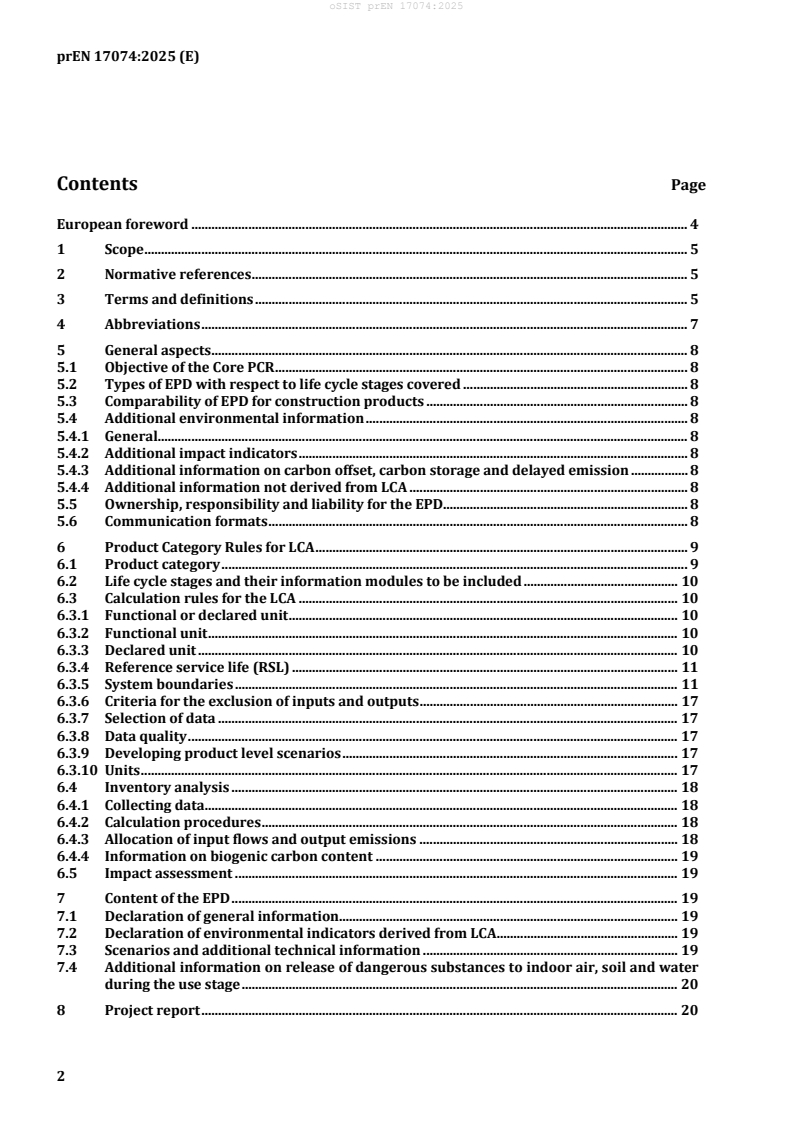
Contents Page
European foreword . 4
1 Scope . 5
2 Normative references . 5
3 Terms and definitions . 5
4 Abbreviations . 7
5 General aspects . 8
5.1 Objective of the Core PCR . 8
5.2 Types of EPD with respect to life cycle stages covered . 8
5.3 Comparability of EPD for construction products . 8
5.4 Additional environmental information . 8
5.4.1 General. 8
5.4.2 Additional impact indicators . 8
5.4.3 Additional information on carbon offset, carbon storage and delayed emission . 8
5.4.4 Additional information not derived from LCA . 8
5.5 Ownership, responsibility and liability for the EPD. 8
5.6 Communication formats . 8
6 Product Category Rules for LCA . 9
6.1 Product category . 9
6.2 Life cycle stages and their information modules to be included . 10
6.3 Calculation rules for the LCA . 10
6.3.1 Functional or declared unit . 10
6.3.2 Functional unit . 10
6.3.3 Declared unit . 10
6.3.4 Reference service life (RSL) . 11
6.3.5 System boundaries . 11
6.3.6 Criteria for the exclusion of inputs and outputs . 17
6.3.7 Selection of data . 17
6.3.8 Data quality . 17
6.3.9 Developing product level scenarios . 17
6.3.10 Units . 17
6.4 Inventory analysis . 18
6.4.1 Collecting data . 18
6.4.2 Calculation procedures . 18
6.4.3 Allocation of input flows and output emissions . 18
6.4.4 Information on biogenic carbon content . 19
6.5 Impact assessment . 19
7 Content of the EPD . 19
7.1 Declaration of general information. 19
7.2 Declaration of environmental indicators derived from LCA . 19
7.3 Scenarios and additional technical information . 19
7.4 Additional information on release of dangerous substances to indoor air, soil and water
during the use stage . 20
8 Project report . 20
oSIST prEN 17074:2025
prEN 17074:2025 (E)
9 Verification and validity of an EPD. 20
Annex A (normative) Requirements and guidance on the reference service life . 21
Annex B (informative) Waste . 22
Annex C (normative) Impact categories and related indicators, methodologies and
characterization factors (CF) . 23
Annex D (informative) End of life formulae . 24
Annex E (informative) Schemes to be applied for data quality assessment of generic and specific
data . 25
Annex F (informative) Manufacturing process of basic glass products . 26
F.1 Manufacturing process of float glass . 26
F.2 Manufacturing process of rolled glass . 27
Annex G (normative) Application rules for cullet . 28
G.1 Reminder of the allocation procedures according to EN 15804 . 28
G.2 Rules applicable to different cullet types in EPD . 28
G.2.1 Furnace process cullet . 28
G.2.2 Pre-consumer cullet . 29
G.2.3 Post-consumer cullet . 31
Annex H (informative) Glass product specifications . 32
Bibliography . 34
oSIST prEN 17074:2025
prEN 17074:2025 (E)
European foreword
This document (prEN 17074:2025) has been prepared by Technical Committee CEN/TC 129 “Glass in
building”, the secretariat of which is held by NBN.
This document is currently submitted to the CEN Enquiry.
This document will supersede EN 17074:2019.
prEN 17074:2025 is fully consistent with EN 15804:2012+A2:2019+AC:2021 and includes the following
significant technical changes with respect to EN 17074:2019:
— clearer definitions of different cullet types and modification of their names;
— removal of product stages A’1, A’2 and A’3;
— introduction of declared unit;
— inclusion of the reference to EN 17416:2021;
— clearer guideline for module D;
— clearer application rules for different cullet types;
— introduction of allocation rules (co-product allocation and allocation procedure for reuse, recycling
and recovery);
— clarification of the product information in the EPD;
— exclusion of glass blocks from the scope of this version of the standard.
oSIST prEN 17074:2025
prEN 17074:2025 (E)
1 Scope
This document provides complementary product category rules (c-PCR) for Type III environmental
product declarations (EPD) for flat glass and channel shaped glass products for use in buildings and
construction works. It describes stages of product’s life cycle considered in the EPD and the processes
included in life cycle stages.
For glass products covered by a European standard, the description, physical properties and useful
technical details that can be relevant for EPD are described in Annex H.
2 Normative references
The following documents are referred to in the text in such a way that some or all of their content
constitutes requirements of this document. For dated references, only the edition cited applies. For
undated references, the latest edition of the referenced document (including any amendments) applies.
EN 572-1, Glass in building — Basic soda lime silicate glass products — Part 1: Definitions and general
physical and mechanical properties
EN 15804:2012+A2:2019+AC:2021, Sustainability of construction works — Environmental product
declarations — Core rules for the product category of construction products
EN 17416:2021, Glass in building — Assessment of release of dangerous substances — Determination of
emissions into indoor air from glass products
3 Terms and definitions
For the purposes of this document, the terms and definitions given in EN 15804:2012+A2:2019+AC:2021
and the following apply.
ISO and IEC maintain terminology databases for use in standardization at the following addresses:
— ISO Online browsing platform: available at https://www.iso.org/obp/
— IEC Electropedia: available at https://www.electropedia.org/
3.1
end-of-waste-status
status of a product that is no longer a waste
Note 1 to entry: Conditions of end-of-waste status are described in the Article 6 of the consolidated version of
Directive 2008/98/EC from 18.02.2024.
3.2
furnace process cullet
cullet generated by a glass melting furnace for quality rejects or other reason (edge rejects, geometrical
losses, etc.) during production period or during non-production period (culleting, colour transition,
furnace draining), through any furnace exit (forming exit, furnace drain-out during production or at
furnace emptying), capable of being re-introduced in a glass melting furnace on the same or another
manufacturing site with no other treatment than crushing and/or standard magnetic/metallic separation
Note 1 to entry: The term “furnace process cullet” is used here in context of a “cullet produced by the glass furnace
process”, therefore glass furnace producing the cullet and glass furnace receiving the cullet for melting may belong
to two different manufacturing sites.
Note 2 to entry: Limits between different cullet types are specified in Table 1.
oSIST prEN 17074:2025
prEN 17074:2025 (E)
Note 3 to entry: This excludes other furnaces e.g. tempering and bending furnaces.
Note 4 to entry: In EN 17074:2019, the furnace process cullet was called internal cullet.
3.3
pre-consumer cullet
co-product resulting from industrial operations starting with stacking of glass after their exit from glass
melting furnace and ending at the stage where product achieves finished-product status
Note 1 to entry: An example of pre-consumer cullet is the glass cullet constituted by off cuts of glass processing
(manufacturing of mirror, coated glass, insulating glass unit, laminated glass, etc.).
Note 2 to entry: Cullet collected from glass processing on the same manufacturing site as the glass melting furnace
is pre-consumer cullet.
Note 3 to entry: Pre-consumer cullet is considered as co-product and not as secondary material in the context of
Life Cycle Assessment according to EN 15804 (see Annex G).
Note 4 to entry: Limits between different cullet types are specified in Table 1.
Note 5 to entry: In EN 17074:2019, the pre-consumer cullet was called external pre-consumer cullet.
Note 6 to entry: Cullet coming from online cutting of cut-size glass after cutting of the ribbon may be considered as
pre-consumer cullet provided that the calculation of the quantity takes into account cutting yield and quality losses.
3.4
post-consumer cullet
glass waste originated from finished products before, during or after their use at the consumer market
Note 1 to entry: This includes returns or breakages of finished products from transport or distribution chain
(adapted from EN ISO 14021:2016).
Note 2 to entry: Post-consumer cullet is considered as secondary material in the context of Life Cycle Assessment
according to EN 15804 (see Annex G).
Note 3 to entry: Limits between different cullet types are specified in Table 1.
Note 4 to entry: In EN 17074:2019, the poste-consumer cullet was called external post-consumer cullet.
3.5
secondary material
as in EN 15804
Note 1 to entry: Only post-consumer cullet is considered as secondary material in the context of Life Cycle
Assessment according to EN 15804. Pre-consumer cullet is considered as co-product and furnace process cullet is
an internal flow (see Annex G).
3.6
basic glass product
basic glass
monolithic, transparent, translucent, clear or tinted glass, wired or not, supplied in rectangular flat panes
or channel shaped, in stock sizes, for either final use in buildings or further processing
Note 1 to entry: Basic glass products can be of the following types:
oSIST prEN 17074:2025
prEN 17074:2025 (E)
— basic soda lime silicate glass products (EN 572-1, EN 572-2, EN 572-3, EN 572-4, EN 572-5, EN 572-6
and EN 572-7);
— special basic products - borosilicate glasses (EN 1748-1-1);
— special basic products - glass ceramics (EN 1748-2-1);
— basic alkaline earth silicate glass products (EN 14178-1);
— basic alumino silicate glass products (EN 15681-1);
— online coated glass (EN 1096-1).
3.7
intermediate glass product
product that has left a manufacturing line other than the glass melting furnace to be further processed in
one or more other manufacturing line(s) in order to become finished product
Note 1 to entry: Examples of intermediate glass product are offline coated glass, laminated glass, acid-etched glass,
painted glass, mirrors, etc.
3.8
finished glass product
product that is ready to be installed in a building or construction work
3.9
processed glass product
processed glass
one or more basic glass products further processed into an intermediate or a finished glass product
Note 1 to entry: Processed glass products can be of the following types:
— prestressed glass including enamelled glass;
— curved monolithic glass;
— laminated glass: laminated (safety) glass, building integrated laminated photovoltaic glass (BIPV) and
curved laminated glass;
— glass with modified surface e.g. offline coated glass, acid etched glass, mirrors;
— insulating glass: insulating glass unit (IGU) vacuum insulating glass (VIG) and curved IGU.
3.10
glass product
glass
any glass product according to 3.6 or 3.9
4 Abbreviations
As in EN 15804.
oSIST prEN 17074:2025
prEN 17074:2025 (E)
5 General aspects
5.1 Objective of the Core PCR
As in EN 15804.
5.2 Types of EPD with respect to life cycle stages covered
Shall be according to EN 15804.
5.3 Comparability of EPD for construction products
Shall be according to EN 15804. In addition:
Only glass products of the same type should be compared.
NOTE Comparison of two distinct products e.g. single glass units with triple glass units or annealed float with
a pre-stressed float could generate misleading conclusions.
5.4 Additional environmental information
5.4.1 General
Shall be according to EN 15804.
5.4.2 Additional impact indicators
Shall be according to EN 15804.
5.4.3 Additional information on carbon offset, carbon storage and delayed emission
Shall be according to EN 15804.
5.4.4 Additional information not derived from LCA
Shall be according to EN 15804. In addition:
Two following categories shall be addressed for glass products:
— Technical and functional performance data generally listed in Declaration of Performance, EU
Declaration of Conformity or a technical datasheet applicable to the product;
— In case of painted glass, filmed glass, mirrors, as well as other glass products containing organic
components, the emissions to indoor air according to EN 17416:2021.
EN 15804:2012+A2:2019+AC:2021 does not include any assessment of potential environmental benefits
from the product’s use in the building, (e.g. from energy savings due to a better insulation or solar gains
in the building when glass products are in use).
Therefore, they shall not be included in the calculations of the results presented in the EPD. However,
environment benefits from energy savings and losses in the use stage may be presented as ‘additional
information’ in the EPD. When calculating the environmental benefits during the use phase of glass
products, the methodology applied shall be documented (see Annex G).
5.5 Ownership, responsibility and liability for the EPD
Shall be according to EN 15804.
5.6 Communication formats
Shall be according to EN 15804.
oSIST prEN 17074:2025
prEN 17074:2025 (E)
6 Product Category Rules for LCA
6.1 Product category
Glass products are used in a variety of construction applications generally to provide a transparent,
impermeable barrier, which may have additional insulating, solar control, security, noise reduction or
decorative properties.
These c-PCR are applicable to the production of glass products for use in buildings such as:
— Float glass according to EN 572-2;
— Polished wired glass according to EN 572-3;
— Drawn sheet glass according to EN 572-4;
— Patterned glass according to EN 572-5;
— Wired patterned glass according to EN 572-6;
— Wired or unwired channel-shaped according to EN 572-7;
— Borosilicate glass according to EN 1748-1-1;
— Glass ceramics according to EN 1748-2-1;
— Alkaline earth silicate glass according to EN 14178-1;
— Alumina silicate according to EN 15681-1;
— Heat strengthened soda lime silicate glass according to EN 1863-1;
— Thermally toughened soda lime silicate safety glass according to EN 12150-1;
— Heat soaked thermally toughened soda lime silicate safety glass according to EN 14179-1;
— Chemically strengthened soda lime silicate glass according to EN 12337-1;
— Thermally toughened borosilicate safety glass according to EN 13024-1;
— Thermally toughened alkaline earth silicate safety glass according to EN 14321-1;
— Heat soaked thermally toughened alkaline earth silicate safety glass according to EN 15682-1;
— Thermally toughened soda lime silicate channel shaped safety glass according to EN 15683-1;
— Laminated glass and laminated safety glass according to EN ISO 12543-1, EN ISO 12543-2 and
EN ISO 12543-3;
— Insulating glass unit according to EN 1279-1;
— Coated glass according to EN 1096-1;
— Mirror form silvered coated glass for interior use according to EN 1036-1;
— Painted glass according to EN 16477-1;
oSIST prEN 17074:2025
prEN 17074:2025 (E)
— Adhesive back polymeric filmed glass according to EN 15755-1;
— Surface worked glass (e.g. sand blasted, acid etched);
— Any combination of the above.
NOTE 1 The above list of products is not exhaustive. The c-PCR can also apply to other glass products not listed
above.
NOTE 2 These c-PCR are applicable to the whole glass product including all components, not only the glass
element. For example, they would include the sealant in an insulating glass unit.
6.2 Life cycle stages and their information modules to be included
Shall be according to EN 15804.
6.3 Calculation rules for the LCA
6.3.1 Functional or declared unit
Shall be according to EN 15804.
6.3.2 Functional unit
Shall be according to EN 15804. In addition:
For each glass product listed in 6.1, the functional unit shall be one square metre (1 m ).
The reference flow shall be defined as regards the thickness and further configuration of the glass
products. Nominal thickness shall be used in calculations.
For transport and disposal, it may be convenient to convert thickness and square metres into mass.
Unless justified with manufacturer's technical product sheets, following material densities shall be used:
— Glass: 2 500 kg/m , according to EN 572-1;
— Interlayer in laminated glass, according to EN 17940:
— PVB: 1070 kg/m ;
— EVA: 950 kg/m ;
— Ionomer: 970 kg/m .
For other materials, e.g. butyl, polysulfide, polyurethan, silicone, spacers, desiccant, inserts, the data
provided by producers may be used.
6.3.3 Declared unit
Shall be according to EN 15804. In addition:
For each glass product listed in 6.1, the declared unit shall be one square metre (1 m ).
The reference flow shall be defined as regards the thickness and further configuration of the glass
products. Nominal thickness shall be used in calculations.
For transport and disposal, it may be convenient to convert thickness and square metres into mass.
Unless justified with manufacturer's technical product sheets, following material densities shall be used:
— Glass: 2 500 kg/m , according to EN 572-1;
oSIST prEN 17074:2025
prEN 17074:2025 (E)
— Interlayer in laminated glass, according to EN 17940:
— PVB: 1 070 kg/m ;
— EVA: 950 kg/m ;
— Ionomer: 970 kg/m .
For other materials, e.g. butyl, polysulfide, polyurethan, silicone, spacers, desiccant, inserts, the data
provided by producers may be used.
6.3.4 Reference service life (RSL)
Shall be according to EN 15804. In addition:
As a reference, a reference service life of 30 years (see Annex A) shall be used, unless otherwise indicated
in product standard or specified by the manufacturer for specific conditions of use.
6.3.5 System boundaries
Shall be according to EN 15804. In addition:
— In case of EPD of basic glass, module A1 includes the extraction and processing of mineral raw
materials and module A3 contains the glass manufacturing process.
— In case of EPD of processed glass, module A1 comprises the production of incoming materials,
including basic glass or intermediate glass product used as input to manufacture the processed glass,
and module A3 comprises the glass processing (IGU production, for example).
Flows related to human activities such as lighting, heating, cleaning of workshops, administration and
employee transport are excluded from the system boundaries.
Production facilities and their construction, machines and transportation systems inside the factories are
also excluded since the related flows are assumed to be negligible, compared to the production of glass
products when the comparison is done at the timescale of the reference service life of plants, machines
or transportation systems inside the factory.
6.3.5.1 General
Shall be according to EN 15804. In addition:
Where the object of the study is the average production of glass in a region, the number of sites,
companies and the representativeness of the regional production shall be specified in the project
(background) report. The primary data (i.e. gate-to-gate manufacturer’s average or specific data) shall be
provided in aggregate form.
6.3.5.2 Product stage
Shall be according to EN 15804. In addition:
A non-exhaustive list of the main raw materials used in the manufacture of glass products is shown below.
They shall be taken into account in the LCA studies:
— sand (silicon dioxide);
— soda ash (sodium carbonate);
— dolomite (calcium magnesium carbonate);
— limestone (calcium carbonate);
oSIST prEN 17074:2025
prEN 17074:2025 (E)
— salt cake (sodium sulphate);
— feldspar/nepheline;
— slag;
— carbon (anthracite, coal);
— scrubber reaction by-products (collected by electrostatic precipitator or bag-house);
— gypsum (calcium sulphate);
— cullet (pre-consumer cullet, post-consumer cullet and net flow of furnace process cullet).
The principal gases and energy resources used in the production process are shown below and shall be
included in the LCA:
— electricity;
— hydrogen;
— nitrogen;
— natural gas;
— fuel oil;
— oxygen;
— argon, krypton and other gas types used for filling the cavity of insulated glass units.
For any other auxiliary or additional raw materials (e.g. raw materials for glass colouring) or energy
resources representing less than 1 % of the total energy and mass flow and for which the information are
not accessible, cut-off rules apply (see cut-off rules in 6.3.6).
All incoming materials used for glass processing shall follow the same rules as raw materials and energy
supply for glass manufacturing.
— In case of EPD of basic glass, transport of raw material to the glass furnace shall be declared in the
module A2.
— In case of EPD of processed glass, transport of basic glass to the processor(s) shall be declared in the
module A2. However, in such case, the transport of raw material to the glass furnace, as well as the
glass furnace process, shall be declared in the module A1.
Different transport modes can be applied: road, rail, sea or river. Use of weighted average transportation
distances is recommended.
In case of road transport, the default scenario is ‘return of empty lorries’. Other transport conditions may
be considered if they are justified.
6.3.5.2.1 Glass cullet
Cullet may originate from the glass manufacturing process (furnace process cullet), from the use of glass
in the downstream production process (pre-consumer cullet) and as the result of recycling at the end of
the service life of the final product (post-consumer cullet). A clear distinction shall be made between
these different cullet types.
oSIST prEN 17074:2025
prEN 17074:2025 (E)
Limits between the different cullet types are specified in Table 1.
Table 1 — Cullet types delimitation
Furnace
Pre-consumer cullet Post-consumer cullet
process cullet
Storage -
Transport Transport
Production of intermediate
Storage
glass product when
Distribution network
relevant
Transport Transport
Basic glass
production
Storage
Installation
Distribution network
Transport Use
Production of finished
Deconstruction
glass product
c
Storage End-of-life
a
The cullet delimitation follows criteria for pre-consumer cullet given in EN ISO 14021:2016. Glass that has
been stacked after the furnace before initial quality rejection is furnace process cullet.
b
The cullet delimitation follows criteria for pre-consumer and post-consumer cullet given in
EN ISO 14021:2016 and EN 45557:2020.
c
To avoid the additional cost of a separate stock and recycling treatment of the cullet coming from
overstock, obsolete inventories and finished products that have not been placed on the market, this cullet is
sometimes put together with the cullet collected from used glass products. In such a situation, there is
generally no possibility to distinguish the flows and this cullet may be counted as post-consumer cullet for
practical reasons.
d
Cut-to-size glass product is not always a finished product. Some manufacturers produce cut-to-size glass
that is further processed by other manufacturer(s). When it is not a finished product as defined in 3.8, it is to
be considered an intermediate product (see 3.7) and its overstock, obsolete inventories and breakages would
represent a pre-consumer cullet.
6.3.5.2.2 Furnace process cullet
Furnace process cullet (see 3.2) circulates in closed loop during the manufacturing of glass. In case the
amount entering and leaving the product system is not balanced, the net flow of furnace process cullet
shall be considered as pre-consumer cullet for the purpose of Life Cycle Assessment (see Annex G).
6.3.5.2.3 Pre-consumer cullet
Pre-consumer cullet (see 3.3) shall be considered as co-product for the purpose of Life Cycle Assessment
(see Annex G).
6.3.5.2.4 Post-consumer cullet
Post-consumer cullet (see 3.4) shall be considered as secondary material for the purpose of Life Cycle
Assessment (see Annex G).
Limit between furnace process cullet and
pre-consumer cullet:
a b
Stacking of the basic glass
Limit between pre-consumer cullet and
post-consumer cullet:
b c d
Finished product
oSIST prEN 17074:2025
prEN 17074:2025 (E)
6.3.5.2.5 Basic glass manufacturing (A3)
Basic glass is mainly produced via the float process (float glass). It can also be produced via the rolled
process (channel shaped glass, patterned and wired glass).
The raw materials are fed into the furnace and are melted, resulting in molten glass, which is fed via a
distribution canal onto the surface of an enclosed bath of molten tin (float glass) or leaves the furnace
between rollers which may be used to give a printed relief to its surface (rolled or patterned glass).
During the basic glass manufacturing, direct CO emissions occur due to the chemical reaction of
carbonated materials (soda ash, dolomite, limestone…) and carbon-containing energy sources (natural
gas).
See Annex F.
6.3.5.2.6 Waste from basic glass manufacturing
Any waste material requiring off-site processing up to the end-of-waste status (see 3.1) or disposed in
landfill shall be included in the waste listing for the process.
Transport to waste processing plant where end-of-waste status is reached shall be declared in the module
A3.
6.3.5.2.7 Water for basic glass manufacturing
Water is used to cool parts of the furnace and equipment used in the furnace during the production of
glass. The amount of water used in the glass production process shall be considered.
6.3.5.2.8 Glass delivery
Different transport modes can be applied: road, rail, sea or river. Use of weighted average transportation
distances is recommended.
Finished glass products are delivered in the final size, configuration and ‘ready to install’. No waste other
than packaging waste is generated.
The impacts of packing glass products for onward distribution either to the final customer or to the next
production process (glass processing) shall be included, taking account of the cut-off criterion if it is
justified (see cut-off rules in 6.3.6).
NOTE In Europe, flat glass can be dispatched on returnable steel racks (stillages) using float liner vehicles,
which require no additional packaging or can be dispatched in plastic wrapped on stillages or packed in wooden
cases.
6.3.5.2.9 Glass processing
Basic glass products are usually further transformed into processed glass products. The latter can take
place in the same site (with no transportation required) or in a different site.
Different technologies and materials are applied and are specific to each of the glass products listed in
6.1. Additional processing (coating, laminating, prestressing, etc.) imparts specific and critical properties
to the glass products.
All the losses included in the glass processing steps shall be taken into account in the calculation (e.g.
cutting losses, breakage, quality defects).
6.3.5.2.10 Waste from glass processing
Any waste material requiring off-site processing up to the end-of-waste status (see 3.1) or disposed in
landfill shall be included in the waste listing for the process.
oSIST prEN 17074:2025
prEN 17074:2025 (E)
Transport to waste processing plant where end-of-waste status is reached shall be declared in the module
A3.
6.3.5.2.11 Water for glass processing
The amount of water used in the glass processing processes shall be considered.
6.3.5.3 Construction stage
As in EN 15804. In addition:
Transport to building site directly or through distribution circuit should be declared in the module A4.
In module A5 the ancillary elements to install the glass product in the building are not taken into account,
because there are many different considerations related to the installation in the building (depending on
the type of building, frame materials, etc.). Thus, the ancillary elements will be considered in the scenarios
established under the EPD of the window/ façade systems.
Storage of glass products does not generate any environmental impact.
6.3.5.4 Use stage
6.3.5.4.1 General
Shall be according to EN 15804.
6.3.5.4.2 B1-B5 Use stage information modules related to the building fabric
Shall be according to EN 15804. In addition:
The use of glass products installed in the building generates no environmental impacts and therefore
module B1 may be neglected.
Generally, the only maintenance operation for glass products is cleaning. As a reference, it can be
considered the use of 0,2 l of cleaning solution (0,2 l of water with 0,01 l of detergent) per square metre
of glass per year. This stage shall include the production of the detergent, water consumption and the
treatment of the wastewater generated by this phase.
The process, material, transport, waste and end-of-life processes of any waste shall be taken into account.
When installed in the building, glass products do not require repair, replacement or refurbishment
activities during their reference service lifetime (30 years, see 6.3.4) to maintain and/or recover the
required functional or technical performance.
6.3.5.4.3 B6-B7 use stage information modules related to the operation of buildings
Shall be according to EN 15804. In addition:
Except for specific glass products requiring energy for their activation ex. switchable glass, heatable glass,
operational energy use is not applicable. Operational water use is not applicable, since glass products do
not consume water for their usage.
6.3.5.5 End-of-life stage
Shall be according to EN 15804. In addition:
End-of-life stage starts at the point when the glass product is replaced, dismantled or deconstructed from
the building.
Alternative scenarios can be foreseen at the end-of-life stage of building products depending on whether
or not glass can be recovered.
Depending on the scenario, the glass can follow different routes.
oSIST prEN 17074:2025
prEN 17074:2025 (E)
In ideal case, glass products are separated and treated to be reused, remanufactured, recycled in closed-
loop recycling (i.e. in flat glass or channel shaped glass furnaces) or recycled in open-loop recycling
(downcycling in other glass furnaces, e.g. for container glass or glass wool).
Otherwise, it will be crushed together with other building materials for backfilling operations or it will
be landfilled.
End-of-life scenarios and routes can vary according to national and regional legislation, deconstruction
schemes and requirements, collection and sorting schemes in place and end-of-life treatments available.
End-of-life route and scenarios shall be described in the studies.
To establish end-of-life scenarios, the best is to use national statistics for given glass type. In case of non-
availability of reliable data for relevant product type and relevant location, management pathways
specified in the Table 2 shall be the default option for end of waste operations [7].
Table 2 — Management pathways for end-of-waste operations
Management pathway Fraction [%]
Preparing for reuse (REU) 0
Recycling in closed loop or
downcycling in open loop (REC)
Recovery / Backfilling (RBB) 24
Landfilling (LAN) 70
NOTE 1 Some glass products cannot be recycled.
NOTE 2 Some glass cullet need separate collection and preparation for recycling.
Transportation of end-of-life glass products from the building site to the ‘end-of-life destination’ (e.g.
glass recycling company site in case glass is recycled), according to the end-of-life scenario applicable
(C2) shall be taken into account. All the process steps necessary for the product to reach the end-of-waste
status shall be taken into account in module C. For cullet, the end-of-waste status are defined in the
Annex G.
For transportation modes and distances, as well as for environmental impacts from transport, see 6.3.5.2.
6.3.5.6 Benefits and loads beyond the product system boundary in module D
Module D declares the potential benefits and loads beyond the system boundary resulting from
secondary materials leaving or entering the product system.
In the context of glass products, benefits and loads resulting from the provision or consumption of post-
consumer cullet are the main specificities to be assessed. The net flow of post-consumer cullet to be
considered in module D corresponds to the quantity leaving the system minus the quantity entering the
system over the product life cycle.
Pre-consumer cullet and furnace process cullet are not taken into account in the assessment of module D
as they are respectively allocated as co-product and internal flow of the product system.
The environmental benefits and loads resulting from post-consumer cullet crossing the system boundary
shall include three different components:
— the virgin raw materials saving: This saving depends on the production under study. As an example,
the use of 1 kg of cullet replaces approximately 1,2 kg of virgin raw materials [2];
oSIST prEN 17074:2025
prEN 17074:2025 (E)
— the CO direct emissions avoided thanks to the use of cullet instead of carbonated raw materials:
These avoided emissions shall be calculated according to the amount of virgin raw materials saved;
— the energy saving: This saving shall be calculated based on the fact that the use of cullet allows to
reduce the energy consumptions of the furnace. As an example, each 10 % increase in cullet usage
results in an energy saving of 2 % to 3 % in the melting process [2].
In the case of reuse of glass product, Module D shall be calculated considering the impact of the average
standard glass production decreased by the impact of the recovery process after end-of-waste status
including e.g. cleaning, sorting, cutting and reassessing of the reused glass, if relevant.
The end-of-waste status of a reused glass product may occur after the potential disassembly of this glass
pane, e.g. from an IGU.
NOTE The reuse of glass products is technically feasible although not very common.
6.3.6 Criteria for the exclusion of inputs and outputs
Shall be according to EN 15804. In a
...