

CEN/CLC/TR 17603-31-07:2021
(Main)Space Engineering - Thermal design handbook - Part 7: Insulations
General Information
- Abstract
There are 3 main categories of insulators used in spacecrafts:
1. foams: organic and inorganic;
2. fibrous insulations: for internal and external insulation and for high temperature environments
3. multilayer insulations (MLI): layers of radiation reflecting shields.
Properties, thermal behaviour and application areas of the insulation materials used in spacecrafts are detailed in this Part 7.
The Thermal design handbook is published in 16 Parts
TR 17603-31-01 Part 1
Thermal design handbook – Part 1: View factors
TR 17603-31-01 Part 2
Thermal design handbook – Part 2: Holes, Grooves and Cavities
TR 17603-31-01 Part 3
Thermal design handbook – Part 3: Spacecraft Surface Temperature
TR 17603-31-01 Part 4
Thermal design handbook – Part 4: Conductive Heat Transfer
TR 17603-31-01 Part 5
Thermal design handbook – Part 5: Structural Materials: Metallic and Composite
TR 17603-31-01 Part 6
Thermal design handbook – Part 6: Thermal Control Surfaces
TR 17603-31-01 Part 7
Thermal design handbook – Part 7: Insulations
TR 17603-31-01 Part 8
Thermal design handbook – Part 8: Heat Pipes
TR 17603-31-01 Part 9
Thermal design handbook – Part 9: Radiators
TR 17603-31-01 Part 10
Thermal design handbook – Part 10: Phase – Change Capacitors
TR 17603-31-01 Part 11
Thermal design handbook – Part 11: Electrical Heating
TR 17603-31-01 Part 12
Thermal design handbook – Part 12: Louvers
TR 17603-31-01 Part 13
Thermal design handbook – Part 13: Fluid Loops
TR 17603-31-01 Part 14
Thermal design handbook – Part 14: Cryogenic Cooling
TR 17603-31-01 Part 15
Thermal design handbook – Part 15: Existing Satellites
TR 17603-31-01 Part 16
Thermal design handbook – Part 16: Thermal Protection System
- Status
- Published
- Publication Date
- 03-Aug-2021
- Technical Committee
- CEN/CLC/TC 5 - Space
- Drafting Committee
- CEN/CLC/TC 5/WG 6 - Upstream standards
- Current Stage
- 6060 - Definitive text made available (DAV) - Publishing
- Start Date
- 04-Aug-2021
- Due Date
- 14-Jul-2022
- Completion Date
- 04-Aug-2021



Overview
CEN/CLC/TR 17603-31-07:2021 - Space Engineering: Thermal design handbook - Part 7: Insulations is the CEN/CENELEC Technical Report (adopted as a Slovenian standard) that compiles guidance, measured data and practical information on insulation materials used in spacecraft thermal control. Part 7 focuses on three main insulation categories used on spacecraft: foams (organic and inorganic), fibrous insulations (bulk, blankets, felts, papers) and multilayer insulations (MLI - stacks of radiation-reflecting shields). The report forms one volume of a 16‑part Thermal Design Handbook series that supports spacecraft thermal design, analysis and material selection.
Key topics and technical content
The report provides comprehensive, application‑oriented coverage of insulation materials and their thermal behaviour including:
Material classes and properties
- Inorganic (ceramic) and organic foams: thermal conductivity, mechanical behaviour, thermal expansion and density relationships.
- Fibrous insulations: bulk, blankets, felts and paper forms with conductivity, compressive behavior, permeability and acoustic properties.
- MLI components: radiation shields (aluminium, gold, silver coatings), polymer films, spacer materials and composite layups.
Thermal performance and heat transfer
- Measurement and modelling of conduction, radiation and gas‑film contributions.
- One‑dimensional and lateral heat transfer through MLI and the effect of singularities (joints, stitches, patches).
- Behaviour under varying mean temperature, thickness and ambient pressure (including evacuation effects).
Practical engineering data
- Empirical graphs, tables and datasets for commercial products (thermal conductivity vs. temperature, strength vs. temperature, specific heat).
- Emittance and absorptance of foils/films; coating thickness measurement techniques.
- Spacer types, failure modes, effects of mechanical damage and interstitial gas pressure on MLI performance.
Manufacture, testing and reliability
- Guidance on common failure modes, evacuation procedures, self‑pumping MLIs, and cost considerations for MLI systems.
Applications and users
This Technical Report is intended for anyone involved in spacecraft thermal control and materials selection:
- Thermal engineers designing insulation systems for satellites, launch vehicles and payloads.
- Systems and materials engineers selecting foams, fibrous insulations or MLI for internal/external use and high‑temperature areas.
- Procurement teams and suppliers needing standardized property data for commercial insulation products.
- Test labs and researchers conducting thermal characterization and validating thermal models.
Practical uses include insulation selection, MLI layout and spacer choice, thermal modeling inputs, test planning (emittance/absorptance measurements), and failure‑mode risk assessment.
Related standards
Part 7 is one of 16 parts in the Thermal design handbook series (TR 17603‑31‑01 to Part 16) covering view factors, conductive heat transfer, thermal control surfaces, heat pipes, radiators, cryogenics, thermal protection systems and more - providing a coordinated set of references for spacecraft thermal design.
Get Certified
Connect with accredited certification bodies for this standard

BUREAU VERITAS Certification Germany
Bureau Veritas certification in Germany.

Element Materials Technology
Materials testing and product certification.

AQMS Ltd.
AQMS provides ISO certification to SMEs across the UK.
Sponsored listings
Frequently Asked Questions
CEN/CLC/TR 17603-31-07:2021 is a technical report published by the European Committee for Standardization (CEN). Its full title is "Space Engineering - Thermal design handbook - Part 7: Insulations". This standard covers: There are 3 main categories of insulators used in spacecrafts: 1. foams: organic and inorganic; 2. fibrous insulations: for internal and external insulation and for high temperature environments 3. multilayer insulations (MLI): layers of radiation reflecting shields. Properties, thermal behaviour and application areas of the insulation materials used in spacecrafts are detailed in this Part 7. The Thermal design handbook is published in 16 Parts TR 17603-31-01 Part 1 Thermal design handbook – Part 1: View factors TR 17603-31-01 Part 2 Thermal design handbook – Part 2: Holes, Grooves and Cavities TR 17603-31-01 Part 3 Thermal design handbook – Part 3: Spacecraft Surface Temperature TR 17603-31-01 Part 4 Thermal design handbook – Part 4: Conductive Heat Transfer TR 17603-31-01 Part 5 Thermal design handbook – Part 5: Structural Materials: Metallic and Composite TR 17603-31-01 Part 6 Thermal design handbook – Part 6: Thermal Control Surfaces TR 17603-31-01 Part 7 Thermal design handbook – Part 7: Insulations TR 17603-31-01 Part 8 Thermal design handbook – Part 8: Heat Pipes TR 17603-31-01 Part 9 Thermal design handbook – Part 9: Radiators TR 17603-31-01 Part 10 Thermal design handbook – Part 10: Phase – Change Capacitors TR 17603-31-01 Part 11 Thermal design handbook – Part 11: Electrical Heating TR 17603-31-01 Part 12 Thermal design handbook – Part 12: Louvers TR 17603-31-01 Part 13 Thermal design handbook – Part 13: Fluid Loops TR 17603-31-01 Part 14 Thermal design handbook – Part 14: Cryogenic Cooling TR 17603-31-01 Part 15 Thermal design handbook – Part 15: Existing Satellites TR 17603-31-01 Part 16 Thermal design handbook – Part 16: Thermal Protection System
There are 3 main categories of insulators used in spacecrafts: 1. foams: organic and inorganic; 2. fibrous insulations: for internal and external insulation and for high temperature environments 3. multilayer insulations (MLI): layers of radiation reflecting shields. Properties, thermal behaviour and application areas of the insulation materials used in spacecrafts are detailed in this Part 7. The Thermal design handbook is published in 16 Parts TR 17603-31-01 Part 1 Thermal design handbook – Part 1: View factors TR 17603-31-01 Part 2 Thermal design handbook – Part 2: Holes, Grooves and Cavities TR 17603-31-01 Part 3 Thermal design handbook – Part 3: Spacecraft Surface Temperature TR 17603-31-01 Part 4 Thermal design handbook – Part 4: Conductive Heat Transfer TR 17603-31-01 Part 5 Thermal design handbook – Part 5: Structural Materials: Metallic and Composite TR 17603-31-01 Part 6 Thermal design handbook – Part 6: Thermal Control Surfaces TR 17603-31-01 Part 7 Thermal design handbook – Part 7: Insulations TR 17603-31-01 Part 8 Thermal design handbook – Part 8: Heat Pipes TR 17603-31-01 Part 9 Thermal design handbook – Part 9: Radiators TR 17603-31-01 Part 10 Thermal design handbook – Part 10: Phase – Change Capacitors TR 17603-31-01 Part 11 Thermal design handbook – Part 11: Electrical Heating TR 17603-31-01 Part 12 Thermal design handbook – Part 12: Louvers TR 17603-31-01 Part 13 Thermal design handbook – Part 13: Fluid Loops TR 17603-31-01 Part 14 Thermal design handbook – Part 14: Cryogenic Cooling TR 17603-31-01 Part 15 Thermal design handbook – Part 15: Existing Satellites TR 17603-31-01 Part 16 Thermal design handbook – Part 16: Thermal Protection System
CEN/CLC/TR 17603-31-07:2021 is classified under the following ICS (International Classification for Standards) categories: 49.140 - Space systems and operations. The ICS classification helps identify the subject area and facilitates finding related standards.
CEN/CLC/TR 17603-31-07:2021 is associated with the following European legislation: Standardization Mandates: M/496. When a standard is cited in the Official Journal of the European Union, products manufactured in conformity with it benefit from a presumption of conformity with the essential requirements of the corresponding EU directive or regulation.
CEN/CLC/TR 17603-31-07:2021 is available in PDF format for immediate download after purchase. The document can be added to your cart and obtained through the secure checkout process. Digital delivery ensures instant access to the complete standard document.
Standards Content (Sample)
SLOVENSKI STANDARD
01-oktober-2021
Vesoljska tehnika - Priročnik o toplotni zasnovi - 7. del: Izolacija
Space Engineering - Thermal design handbook - Part 7: Insulations
Raumfahrttechnik - Handbuch für thermisches Design - Teil 7: Isolationen
Ingénierie spatiale - Manuel de conception thermique - Partie 7: Isolations
Ta slovenski standard je istoveten z: CEN/CLC/TR 17603-31-07:2021
ICS:
49.140 Vesoljski sistemi in operacije Space systems and
operations
2003-01.Slovenski inštitut za standardizacijo. Razmnoževanje celote ali delov tega standarda ni dovoljeno.
TECHNICAL REPORT
CEN/CLC/TR 17603-31-
RAPPORT TECHNIQUE
TECHNISCHER BERICHT
August 2021
ICS 49.140
English version
Space Engineering - Thermal design handbook - Part 7:
Insulations
Ingénierie spatiale - Manuel de conception thermique - Raumfahrttechnik - Handbuch für thermisches Design -
Partie 7 : Isolations Teil 7: Isolationen
This Technical Report was approved by CEN on 21 June 2021. It has been drawn up by the Technical Committee CEN/CLC/JTC 5.
CEN and CENELEC members are the national standards bodies and national electrotechnical committees of Austria, Belgium,
Bulgaria, Croatia, Cyprus, Czech Republic, Denmark, Estonia, Finland, France, Germany, Greece, Hungary, Iceland, Ireland, Italy,
Latvia, Lithuania, Luxembourg, Malta, Netherlands, Norway, Poland, Portugal, Republic of North Macedonia, Romania, Serbia,
Slovakia, Slovenia, Spain, Sweden, Switzerland, Turkey and United Kingdom.
CEN-CENELEC Management Centre:
Rue de la Science 23, B-1040 Brussels
© 2021 CEN/CENELEC All rights of exploitation in any form and by any means Ref. No. CEN/CLC/TR 17603-31-07:2021 E
reserved worldwide for CEN national Members and for
CENELEC Members.
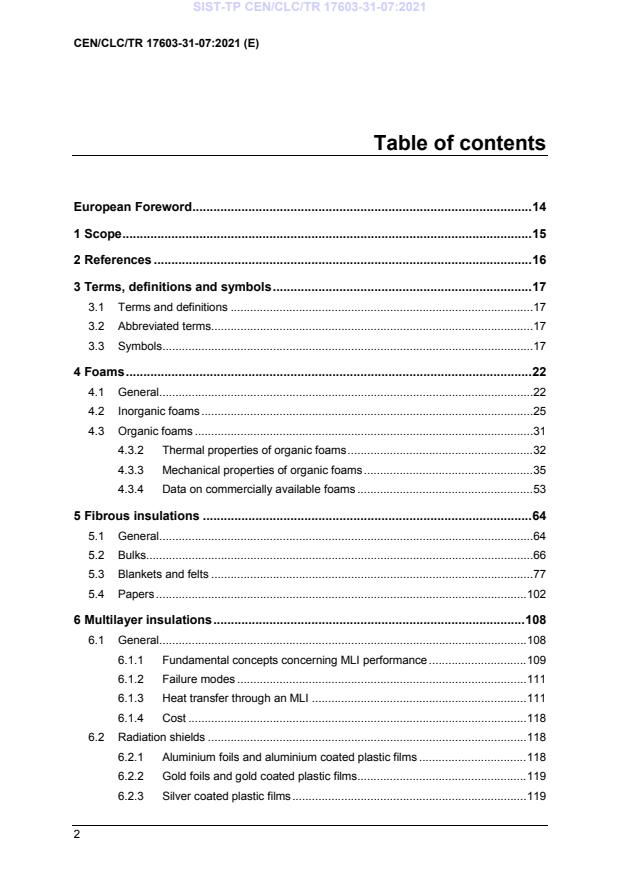
Table of contents
European Foreword . 14
1 Scope . 15
2 References . 16
3 Terms, definitions and symbols . 17
3.1 Terms and definitions . 17
3.2 Abbreviated terms. 17
3.3 Symbols . 17
4 Foams . 22
4.1 General . 22
4.2 Inorganic foams . 25
4.3 Organic foams . 31
4.3.2 Thermal properties of organic foams . 32
4.3.3 Mechanical properties of organic foams . 35
4.3.4 Data on commercially available foams . 53
5 Fibrous insulations . 64
5.1 General . 64
5.2 Bulks. 66
5.3 Blankets and felts . 77
5.4 Papers . 102
6 Multilayer insulations . 108
6.1 General . 108
6.1.1 Fundamental concepts concerning MLI performance . 109
6.1.2 Failure modes . 111
6.1.3 Heat transfer through an MLI . 111
6.1.4 Cost . 118
6.2 Radiation shields . 118
6.2.1 Aluminium foils and aluminium coated plastic films . 118
6.2.2 Gold foils and gold coated plastic films . 119
6.2.3 Silver coated plastic films . 119
6.2.4 Operating temperature ranges . 119
6.2.5 Normally used plastic films . 120
6.3 Emittance of metallic foils . 120
6.4 Emittance of metallized films . 135
6.5 Absorptance of metallic foils . 148
6.6 Radiation shields. miscellaneous properties . 165
6.7 Radiation shields. measurement of the coating thickness . 180
6.8 Spacers . 183
6.8.1 Multiple-resistance spacers . 184
6.8.2 Point-contact spacers . 184
6.8.3 Superfloc . 184
6.8.4 Single-component MLI . 185
6.8.5 Composite spacers . 185
6.8.6 One-dimensional heat flow through an mli with absorbing and
scattering spacers . 187
6.9 Spacers. miscellaneous properties . 189
6.10 Complete systems . 208
6.11 Normal heat transfer . 209
6.12 Lateral heat transfer . 251
6.13 Effect of singularities . 257
6.13.1 Joints . 257
6.13.2 Stitches and patches . 269
6.14 Effect of evacuating holes . 272
6.15 Effect of mechanical damage . 276
6.16 Effect of inner gas pressure . 277
6.17 Evacuation . 285
6.17.1 Interstitial pressure during rapid evacuation . 285
6.17.2 Interstitial pressure in outgas controlled situations . 292
6.17.3 Self-pumping multilayer insulations . 301
Bibliography . 319
Figures
Figure 4-1: Resin thermal conductivity . 23
Figure 4-2 : Gas thermal conductivity . 23
Figure 4-3: Radiation thermal conductivity . 24
Figure 4-4: Thermal conductivity, k, of several ceramic foams as a function of
arithmetic mean temperature, T . . 26
m
Figure 4-5: Linear thermal expansion, ∆L/L, of several ceramic foams as a function of
temperature, T. 27
Figure 4-6: Temperature evolution of the hot and cold faces of several pieces of Zircon
foam. Solid line: T , hot face. Dashed line: T , cold face. . 28
H C
Figure 4-7: Thermal conductivity k, of polyurethane foams vs. arithmetic mean
temperature, T . . 32
m
Figure 4-8: Thermal conductivity, k, of cryopumped polystyrene foams. . 33
Figure 4-9: Thermal conductivity, k, vs. arithmetic mean temperature, T , of a
m
polyurethane foam in the proximity of the condensation temperature of the
filling gas. . 34
Figure 4-10: Linear thermal expansion, ∆L/L, of several organic foams as a function of
temperature, T. 35
Figure 4-11: Ultimate tensile strength, of several foams as a function of temperature, T. . 36
Figure 4-12: Ultimate shear strength, τ , of several foams as a function of temperature,
ult
T. 37
Figure 4-13: Tensile stress, σ, vs. strain, δ, for several polyurethane foams at 76, 195
and 300 K. . 46
Figure 4-14: Modulus of Elasticity-tensile-E, as a function of density, ρ, for several
organic foams. 46
Figure 4-15: Ultimate tensile strength, σ , as a function of density, ρ, for several
ult
organic foams. 47
Figure 4-16: Compressive stress, s, vs, strain, d, for several organic foams at 76, 195
and 300 K. . 47
Figure 4-17: Modulus of Elasticity-tensile-E, as a function of density, ρ, for several
organic foams. 48
Figure 4-18: Proportional limit-compressive-σ, as a function of density, ρ, for several
organic foams. 49
Figure 4-19: Ultimate tensile strength, σ , and Modulus of Elasticity-tensile-E, as
ult
functions of temperature, T. 50
Figure 4-20: Ultimate compressive strength, σ , and Modulus of Elasticity-
ult
compressive-E, as functions of temperature, T. 51
Figure 4-21: Ultimate compressive strength, σ , as a function of temperature, T. . 52
ult
Figure 4-22: Ultimate block shear strength, τ , and Modulus of Elasticity-shear block-E,
ult
as functions of temperature, T. . 53
Figure 4-23: Strain, δ, vs. compressive stress, σ, of Fiberfill Structural Foams. . 62
Figure 4-24: Dielectric constant, ε , and dissipation factor, D, vs. frequency, f. Stycast
r
1090. . 62
Figure 5-1: Thermal conductivity, k, vs. mean temperature, T , for several fibrous
m
insulations. From Glasser et al. (1967) [23]. . 65
Figure 5-2: Thermal conductivity, k, of B & W Kaowool bulk vs. mean temperature, Tm. . 74
Figure 5-3: Thermal conductivity, k, of Carborundum Fiberfrax bulk and washed fibers
vs. mean temperature, Tm. . 74
Figure 5-4: Temperature differential, T −T , vs. mean temperature of the hot face, T , . 75
H C H
Figure 5-5: Temperature differential, TH−TC, vs. mean temperature of the hot face, TH, . 75
Figure 5-6: Temperature differential, T −T , vs. mean temperature of the hot face, T , . 76
H C H
Figure 5-7: Temperature differential, T −T , vs. mean temperature of the hot face, T
H C H
for different values of the insulation thickness, t. Fiberfrax washed fiber, ρ =
−3
96 kg.m . . 76
Figure 5-8: Sound absorption coefficient, α, as a function of frequency, f, for B & W
−2
Kaowool blanket 2,54x10 m thick. . 86
Figure 5-9: Sound absorption coefficient, α, as a function of frequency, f, for the
following Fiberfrax products:. 86
Figure 5-10: Air permeability across B & W Kaowool blankets . 87
Figure 5-11: Air permeability across Carborundum Fiberfrax blankets . 88
Figure 5-12: Thermal conductivity, k, of B & Kaowool blankets vs. mean temperature,
T . . 88
m
Figure 5-13: Thermal conductivity, k, of Fiberfrax blankets vs. mean temperature, T . . 89
m
Figure 5-14: Temperature differential, T −T , vs. temperature of the hot face T for
H C H
different values of the blanket thickness, t. Fiberfrax Lo-Con Blanket & felt,
−3
ρ = 64 kg.m . . 89
Figure 5-15: Temperature differential, T −T , vs. temperature of the hot face, T , . 90
H C H
Figure 5-16: Sound absorption coefficient, α, as a function of frequency, f, for J-M
Microlite Standard and Silicone Binder. . 91
Figure 5-17: Calculated specific heat, c, as a function of temperature, T, for J.M Dyna-
Quartz . 91
Figure 5-18: Thermal conductivity, k, of J-M Micro-Quartz felt vs. mean temperature,
Tm. . 93
Figure 5-19: Thermal conductivity, k, of J-M Dyna-Quartz vs. mean temperature, T . . 93
m
Figure 5-20: Thermal conductivity, k, of J-M Microlite "AA" and "B" vs. mean
temperature, T . . 94
m
Figure 5-21: Compressive stress, σ, vs. compressive strain, δ, for J-M Dyna-Quartz. . 94
Figure 5-22: Linear Shrinkage, LS, and Total Weight Loss, TWL, of J-M Micro-Quartz
Felt as a function of temperature, T. . 95
Figure 5-23: Calculated specific heat, c, as a function of temperature, T, for several J-M
insulations. . 96
Figure 5-24: Thermal conductivity, k, of J-M Min-K 1301 vs. mean temperature, T .
m
−3
Numbers on curves indicate the density in kg.m . . 97
Figure 5-25: Influence of ambient pressure on the variation of thermal conductivity, k, of
J-M Min-K 1301 vs. mean temperature, T , for several filling gases. . 97
m
Figure 5-26: Thermal conductivity, k, of J-M Min-K 1301 vs. mean temperature, T , for
m
different values of thickness, t. . 98
Figure 5-27: Thermal conductivity, k, of J-M Min-K 2000 vs. mean temperature, T . . 98
m
Figure 5-28: Influence of ambient pressure on the variation of thermal conductivity, k, of
J-M Min-K 2000 vs. mean temperature, T , for several filling gases. . 99
m
Figure 5-29: Thermal conductivity, k, of J-M Min-K 2000 vs. mean temperature, T , for
m
different values of thickness, t. . 99
Figure 5-30: Thermal conductivity, k, of J-M unbounded B-Fiber batt vs. mean
temperature, T . . 100
m
Figure 5-31: Thermal conductivity, k, of J-M Micro-Fibers felt Type "E" vs. mean
temperature, T . . 100
m
Figure 5-32: Compressive stress, σ, vs. compressive strain, δ, for J-M Min-K 1301.
−3
Numbers on curves indicate the density in kg.m . . 101
Figure 5-33: Compressive stress, σ, vs. compressive strain, δ, for J-M Min-K 2000. . 101
Figure 5-34: Thermal conductivity, k, of B & W Kaowool, Carborundum Fiberfrax 970
paper, and Fiberfrax Hi-Fi 660 paper vs. mean temperature, T . . 106
m
Figure 5-35: Temperature differential, T −T , vs. temperature of the hot face, T , for
H C H
different values of the paper thickness, t. Fiberfrax 970 paper, ρ = 160
−3
kg.m . 106
Figure 5-36: Temperature differential, T −T , vs. temperature of the hot face, T , for
H C H
different values of the paper thickness, t. Fiberfrax Hi-Fi 660 paper. . 107
Figure 5-37: Thermal reflectance, ρ, of Fiberfrax 970-J paper vs. mean temperature,
T . . 107
m
Figure 6-1: Effective thermal conductivity, k , of multilayer insulations as compared
eff
with other insulation materials. From Glaser et al. (1967) [23]. . 109
Figure 6-2: Effective thermal conductivity, keff, of several multilayer insulation systems
as a function of the characteristic temperature, T. Calculated by the
compiler. . 116
Figure 6-3: Summary of data concerning hemispherical total emittance, ε, of Aluminium
foils and thin sheets as a function of temperature, T. 121
Figure 6-4: Summary of data concerning hemispherical total emittance, ε, of Copper as
a function of temperature, T. . 122
Figure 6-5: Hemispherical total emittance, ε, of Copper as a function of temperature, T. . 123
Figure 6-6: Hemispherical total emittance, ε, of Copper as a function of temperature, T. . 124
Figure 6-7: Hemispherical total emittance, ε, of Gold vs. temperature, T. . 125
Figure 6-8: Hemispherical total emittance, ε, of Molybdenum vs. temperature, T. . 126
Figure 6-9: Hemispherical total emittance, ε, of Nickel vs. temperature, T. . 128
Figure 6-10: Hemispherical total emittance, ε, of oxidized Nickel as a function of
temperature, T. 129
Figure 6-11: Normal total emittance, ε', of Nickel as a function of temperature, T. . 130
Figure 6-12: Normal total emittance, ε', of Inconel as a function of temperature, T. . 131
Figure 6-13: Normal total emittance, ε', of Inconel X as a function of temperature, T. . 132
Figure 6-14: Hemispherical total emittance, ε, of Platinum as a function of temperature,
T. 133
Figure 6-15: Hemispherical total emittance, ε, of Silver as a function of temperature, T. . 134
Figure 6-16: Hemispherical total emittance, ε, of Aluminized Mylar as a function of
coating thickness, t . . 136
c
Figure 6-17: Hemispherical total emittance, ε, of Copper on Mylar as a function of
coating thickness, t . . 137
c
Figure 6-18: Hemispherical total emittance, ε, of Goldized Mylar as a function of
coating thickness, t . . 138
c
Figure 6-19: Hemispherical total emittance, ε, of Gold on Double Aluminized Mylar as a
function of Gold thickness, t . . 139
c
Figure 6-20: Hemispherical total emittance, ε, of Silvered Mylar as a function of coating
thickness, t . . 140
c
Figure 6-21: Hemispherical total emittance, ε, of Silvered Mylar overcoated with Silicon
Monoxide as a function of Silver thickness, t . . 141
c
Figure 6-22: Hemispherical total emittance, ε, of Aluminized Kapton as a function of
temperature, T. 143
Figure 6-23: Hemispherical total emittance, ε, of Aluminized Kapton as a function of
coating thickness, t , for T = 300 K. . 144
c
Figure 6-24: Hemispherical total emittance, ε, of Aluminized Kapton as a function of
coating thickness, t , for T = 400 K. . 145
c
Figure 6-25: Hemispherical total emittance, ε, of Silgle-Goldized Kapton as a function
of temperature, T. . 146
Figure 6-26: Hemispherical total emittance, ε, of Silgle-Silvered Kapton as a function of
temperature, T. 147
Figure 6-27: Normal spectral absorptance, α' , of Aluminium as a function of
λ
wavelength, λ. . 148
Figure 6-28: Normal solar absorptance, α , of Aluminium as a function of temperature,
s
T. 149
Figure 6-29: Normal spectral absorptance, α' , of Copper as a function of wavelength λ. . 150
λ
Figure 6-30: Normal solar absorptance, α , of Copper as a function of temperature T. . 151
s
Figure 6-31: Normal spectral absorptance, α' , of Gold as a function of wavelengthλ . . 152
λ
Figure 6-32: Normal solar absorptance, α , of Gold as a function of temperature T. . 153
s
Figure 6-33: Normal spectral absorptance, α' , of Molybdenum as a function of
λ
wavelength λ. . 154
Figure 6-34: Normal solar absorptance, αs, of Molybdenum as a function of
temperature T . 155
Figure 6-35: Normal spectral absorptance, α' , of Nickel as a function of wavelength λ . 156
λ
Figure 6-36: Normal solar absorptance, α , of Nickel as a function of temperature, T. . 158
s
Figure 6-37: Normal spectral absorptance, α' , of Incoel as a function of wavelength λ. . 159
λ
Figure 6-38: Normal solar absorptance, α , of Incoel as a function of the temperature,
s
T, to which samples had been previously heated. . 160
Figure 6-39: Normal spectral absorptance, α' , of Platinum as a function of
λ
wavelengthλ. . 161
Figure 6-40: Normal solar absorptance, α , of Platinum as a function of temperature, T. . 162
s
Figure 6-41: Normal spectral absorptance, α' , of Silver as a function of wavelength, λ. . 163
λ
Figure 6-42: Normal solar absorptance, α , of Silver as a function of temperature, T. . 164
s
Figure 6-43: Linear thermal expansion, ∆L/L, of two nominally identical specimens of
−6
6,35x10 m thick Mylar Double-Goldized as a function of temperature, T. . 172
−6 −6
Figure 6-44: Linear thermal expansion, ∆L/L of 6,35x10 - 7,62x10 m thick Kapton
Double-Goldized, with Dacron Flocking, as a function of temperature, T . 173
Figure 6-45: Coating thickness, t , given by several methods, compared with that gives
c
by the electrical resistance method, t . . 181
cΩ
Figure 6-46: Thickness, t , of metallic coatings as a function of film electrical
cΩ
resistance, R. Calculated by the compiler. . 183
Figure 6-47: Apparent emittance, ε , of a gray V-Groove as a function of surface
a
emittance, ε, illustrating the effect of embossing or crinkling on the optical
properties of the shield. Calculated by the compiler. . 186
Figure 6-48: Effective thermal conductivity, k , of several fibrous spacers as a function
eff
of mean temperature, T. . 199
Figure 6-49: Effective thermal conductivity, k , of Fiber-glass batting as a function of
eff
Nitrogen gas pressure, p. . 200
Figure 6-50: Effective thermal conductivity, k , of Dexiglas as a function of warm-
eff
boundary temperature, T . . 201
H
, of Tissuglas as a function of warm-
Figure 6-51: Effective thermal conductivity, keff
boundary temperature, T . . 202
H
Figure 6-52: Effective thermal conductivity, k , of Refrasil as a function of warm-
eff
boundary temperature, T . . 203
H
Figure 6-53: Effective thermal conductivity, k , of several spacer materials as a
eff
function of bulk density, ρ. . 204
Figure 6-54: Specific Heat, c, of several spacer materials as a function of temperature,
T. 205
, and product of apparent density and
Figure 6-55: Effective thermal conductivity, keff
effective thermal conductivity, ρk , vs. the number of radiation shields per
eff
unit thickness, N/t. . 211
Figure 6-56: Compressive mechanical load, P, on the multilayer insulation vs. the
number of radiation shields per unit thickness, N/t. . 212
Figure 6-57: Effective thermal conductivity, k , and product of apparent density and
eff
effective thermal conductivity, ρk , vs. the number of radiation shields per
eff
unit thickness, N/t. . 215
Figure 6-58: Effective thermal conductivity, k , as a function of the characteristic
eff
temperature, T. 216
Figure 6-59: Heat flux, Q/A, across a single-aluminized Mylar, crinkled, MLI on different
substrate plates, as a function of the number of radiation shields, N. T =
-3 -1
195 K, p = 2 x 10 Pa. N/t = 1100 ± 200 m . . 217
Figure 6-60: Effective thermal conductivity, k , of a single-aluminized Mylar, crinkled,
eff
MLI on two different substrate plates, as a function of the number of
radiation shields, N. . 218
Figure 6-61: Heat flux, Q/A, across a single-aluminized Mylar, crinkled, MLI on different
substrate plates, as a function of the pressure, p. T = 195 K. Layer density,
-1
N/t = 1100 ± 200 m in any case. . 219
Figure 6-62: Effective thermal conductivity, k , and product of apparent density and
eff
effective thermal conductivity, ρk , vs. the number of radiation shields per
eff
unit thickness, N/t. . 220
Figure 6-63: Effective thermal conductivity, k , as a function of the characteristic
eff
temperature, T. 221
Figure 6-64: Effective thermal conductivity, k , and product of apparent density and
eff
effective thermal conductivity, ρk , vs. the number of radiation shields per
eff
unit thickness, N/t. . 222
Figure 6-65: Compressive mechanical load, P, on the multilayer insulation vs. the
number of radiation shields per unit thickness, N/t. . 223
Figure 6-66: Effective thermal conductivity, k , and product of apparent density and
eff
effective thermal conductivity, ρk , vs. number of radiation shields per unit
eff
thickness, N/t. . 224
Figure 6-67: Compressive mechanical load, P, on the multilayer insulation vs. the
number of radiation shields per unit thickness, N/t. . 225
Figure 6-68: Effective thermal conductivity, k , as a function of the characteristic
eff
temperature, T. 225
Figure 6-69: Effective thermal conductivity, k , and product of apparent density and
eff
effective thermal conductivity, ρk , vs. the number of radiation shields per
eff
unit thickness, N/t. Arrows in curves indicate whether the system is being
loaded or unloaded. . 228
Figure 6-70: Compressive mechanical load, P, on the multilayer insulation vs. the
number of radiation shields per unit thickness, N/t. . 229
Figure 6-71: Effective thermal conductivity, k , as a function of the characteristic
eff
temperature, T. 229
Figure 6-72: Effective thermal conductivity, k , and product of apparent density and
eff
effective thermal conductivity, ρk , vs. the number of radiation shields per
eff
unit thickness, N/t. . 231
Figure 6-73: Compressive mechanical load, P, on the multilayer insulation vs. the
number of radiation shields per unit thickness, N/t. . 232
Figure 6-74: Effective thermal conductivity, k , and product of apparent density and
eff
effective thermal conductivity, ρk , vs. the number of radiation shields per
eff
unit thickness, N/t. . 234
Figure 6-75: Effective thermal conductivity, k , and product of apparent density and
eff
effective thermal conductivity, ρkeff, vs. the number of radiation shields per
unit thickness, N/t. Complete loading-unloading history of system ( ). . 235
Figure 6-76: Compressive mechanical load, P, on the multilayer insulation vs. the
number of radiation shields per unit thickness, N/t. . 236
Figure 6-77: Compressive mechanical load, P, on the multilayer insulation vs. the
number of radiation shields per unit thickness, N/t. Complete loading-
unloading history of system ( ). . 236
Figure 6-78: Effective thermal conductivity, k , and product of apparent density and
eff
effective thermal conductivity, ρk , vs. the number of radiation shields per
eff
unit thickness, N/t. . 239
Figure 6-79: Effective thermal conductivity, keff, as a function of the characteristic
temperature, T. 240
Figure 6-80: Effective thermal conductivity, k , and product of apparent density and
eff
effective thermal conductivity, ρk , vs. the number of radiation shields per
eff
unit thickness, N/t. . 243
Figure 6-81: Effective thermal conductivity, k , as a function of the characteristic
eff
temperature, T. 244
Figure 6-82: Effective thermal conductivity, k , and product of apparent density and
eff
effective thermal conductivity, ρk , vs. the number of radiation shields per
eff
unit thickness, N/t. . 245
Figure 6-83: Compressive mechanical load, P, on the multilayer insulation vs. the
number of radiation shields per unit thickness, N/t. . 246
Figure 6-84: Effective thermal conductivity, k , and product of apparent density and
eff
effective thermal conductivity, ρk , vs. the number of radiation shields per
eff
unit thickness, N/t. . 247
Figure 6-85: Compressive mechanical load, P, on the multilayer insulation vs. the
number of radiation shields per unit thickness, N/t. . 248
Figure 6-86: Effective thermal conductivity, k , and product of apparent density and
eff
effective thermal conductivity, ρk , vs. the number of radiation shields per
eff
unit thickness, N/t. . 249
Figure 6-87: Compressive mechanical load, P, on the multilayer insulation vs. the
number of radiation shields per unit thickness, N/t. . 250
Figure 6-88: Effective thermal conductivity, k , as a function of the characteristic
eff
temperature, T. 250
Figure 6-89: Lateral effective thermal conductivity, k , as a function of characteristic
eff
temperature, T. 252
Figure 6-90: Lateral effective thermal conductivity, keff, as a function of characteristic
temperature, T. 253
Figure 6-91: Lateral effective thermal conductivity, k , as a function of characteristic
eff
temperature, T. 255
Figure 6-92: Lateral effective thermal conductivity, k , as a function of characteristic
eff
temperature, T. 256
Figure 6-93: Effective emittance, ∆ε , vs. overlap, l . 267
eff
Figure 6-94: Length, L*, vs. overlap, l, of alternate layers. . 267
Figure 6-95: Length, L*, vs. underlap, l. . 268
Figure 6-96: Length, L*, vs. k . Edge rejection. 268
eff
Figure 6-97: Heat loss, ∆Q, due to stitching vs. the length of Stitch, L. . 270
Figure 6-98: Heat loss, ∆Q, due to stitch patching vs. the number of patch layers, N.
Undisturbed system and test method as in Figure 6-97. . 271
Figure 6-99: Effect of perforations on the effective thermal conductivity of a multilayer
−6
insulation formed by 24 Radiation Shields 6,35x10 m thick Mylar Double-
−4
Aluminized, and 23 Spacers 7,11x10 m thick Polyurethane Foam. . 272
Figure 6-100: Effect of perforations on the effective thermal conductivity of a multilayer
−6
insulation formed by 10 Radiation Shields 6,35x10 m thick by 0,279 m
−5
diameter Mylar Double-Aluminized, and 22 Spacers 2,54x10 m thick by
0,305 m diameter Glass Fabric. . 273
Figure 6-101: Effect of percentage of perforations, τ, on the heat flux through a
multilayer insulation. . 274
Figure 6-102: Effect of Meteoroid-Bumper debris damage on the effective thermal
conductivity, k , and product of apparent density and effective thermal
eff
conductivity, ρk . . 276
eff
Figure 6-103: Effective thermal conductivity, k , as a function of gas pressure, p. . 278
eff
Figure 6-104: Effective thermal conductivity, k , as a function of gas pressure, p. . 280
eff
Figure 6-105: Effective thermal conductivity, k , as a function of gas pressure, p. . 281
eff
Figure 6-106: Effective thermal conductivity, keff, as a function of gas pressure, p. . 283
Figure 6-107: Effective thermal conductivity, k , as a function of gas pressure, p. . 284
eff
Figure 6-108: Permeability, κ, of several multilayer insulation configurations as a
function of the layer density, N/t. . 287
Figure 6-109: Pressure differential, p(0,t)−p (t). Vs. time, t. . 290
o
Figure 6-110: Knudsen Diffusion Coefficient, D , as a function of gas molecular mass,
K
M. From Coston (1967) [13], p. 4,3-31. . 292
Figure 6-111: Outgassing rate, Q, as a function of pumping time, t, for Mylar Double-
Aluminized. Effect of preconditioning. From Glassford (1970) [24]. . 293
Figure 6-112: Outgassing rate, Q, as a function of pumping time, t, for Mylar Double-
Aluminized. Effect of prepumping. From Glassford (1970) [24]. . 294
Figure 6-113: Outgassing rate, Q, as a function of pumping time, t, for Mylar Double-
Aluminized, as received. Effect of test temperature. . 295
Figure 6-114: Outgassing rate, Q, as a function of pumping time, t, for several shielding
materials, as received. . 297
Figure 6-115: Outgassing rate, Q, as a function of pumping time, t, for several spacing
materials. . 298
Figure 6-116: Outgassing rate, Q, as a function of pumping time, t, for an MLI system
and for its components. No preconditioning. From Glassford (1970) [24]. . 299
Figure 6-117: Main characteristics of the different self-evacuated MLIs and
experimental methods used to obtain the results summarized in Table 6-25. . 303
Figure 6-118: Model for a guarded two-dimensional MLI. (a) Geometry. (b) Boundary
conditions for the calculations. . 317
Figure 6-119: Ratio of lateral to total heat transfer rate, Q /(Q +Q ), in an anisotropic
x x y
two-dimensional continuous medium subject to the boundary conditions
indicated in Figure 6-118: . 318
Tables
Table 4-1: Relevant Properties of Ceramic Foams . 25
Table 4-2: Properties of Ceramic Foams . 29
Table 4-3: Characterization of Foams Whose Properties Will Be Given Later . 38
Table 4-4: Average Tensile Data of Polyurethane and Polystyrene Foams . 39
Table 4-5: Average Tensile Data of Polyurethane and Polystyrene Foams at T = 76 K
T: Transverse; L: Longitudinal . 40
Table 4-6: Average Tensile Data of Polyurethane and Polystyrene Foams at T = 195 K
T: Transverse; L: Longitudinal .
...