

prEN ISO 25379-1
(Main)In vitro diagnostic Next Generation Sequencing (NGS) workflows -- Part 1: Part 1: Human DNA examination (ISO/DIS 25379-1:2026)
- Abstract
This document specifies requirements and gives recommendations for next generation sequencing (NGS) workflows. This document covers the pre-examination processes, human DNA (somatic and germline) isolation, sequencing library preparation, sequencing, sequence analysis and reporting of the examination of sequences for diagnostic purposes from isolated DNA from, e.g. formalin-fixed and paraffin embedded tissues, fresh frozen tissues, fine needle aspirates (FNA), whole blood, circulating tumour cells (CTCs), exosomes and other extracellular vesicles, circulating cell free DNA from plasma, and DNA from saliva. NOTE 1 Typical applications include, but are not limited to, NGS for oncology, pharmacogenomics and clinical genetics; approaches include panels (e.g. disease panels, exome panels, target gene panels and in silico panels), exome and whole genome sequencing, as well as certain epigenetics and certain single-cell analyses. This document is addressing in vitro diagnostic examinations including laboratory developed tests and is applicable to medical laboratories, molecular pathology laboratories and molecular genetic laboratories, in vitro diagnostic developers and manufacturers, biobanks as well as institutions and organizations performing biomedical research or sequencing services. This document is not applicable for in situ sequencing, DNA-mediated protein sequencing, forensic sequencing, sequencing of pathogens or microorganisms and microbiome analysis. NOTE 2 International, national or regional regulations or requirements or multiples of them can also apply to specific topics covered in this document.
- Status
- Not Published
- Publication Date
- 05-Mar-2028
- Technical Committee
- CEN/TC 140 - In vitro diagnostic medical devices
- Drafting Committee
- CEN/TC 140/WG 3 - Quality management in the medical laboratory
- Current Stage
- 4020 - Submission to enquiry - Enquiry
- Start Date
- 17-Sep-2026
- Due Date
- 02-May-2026
- Completion Date
- 02-May-2026
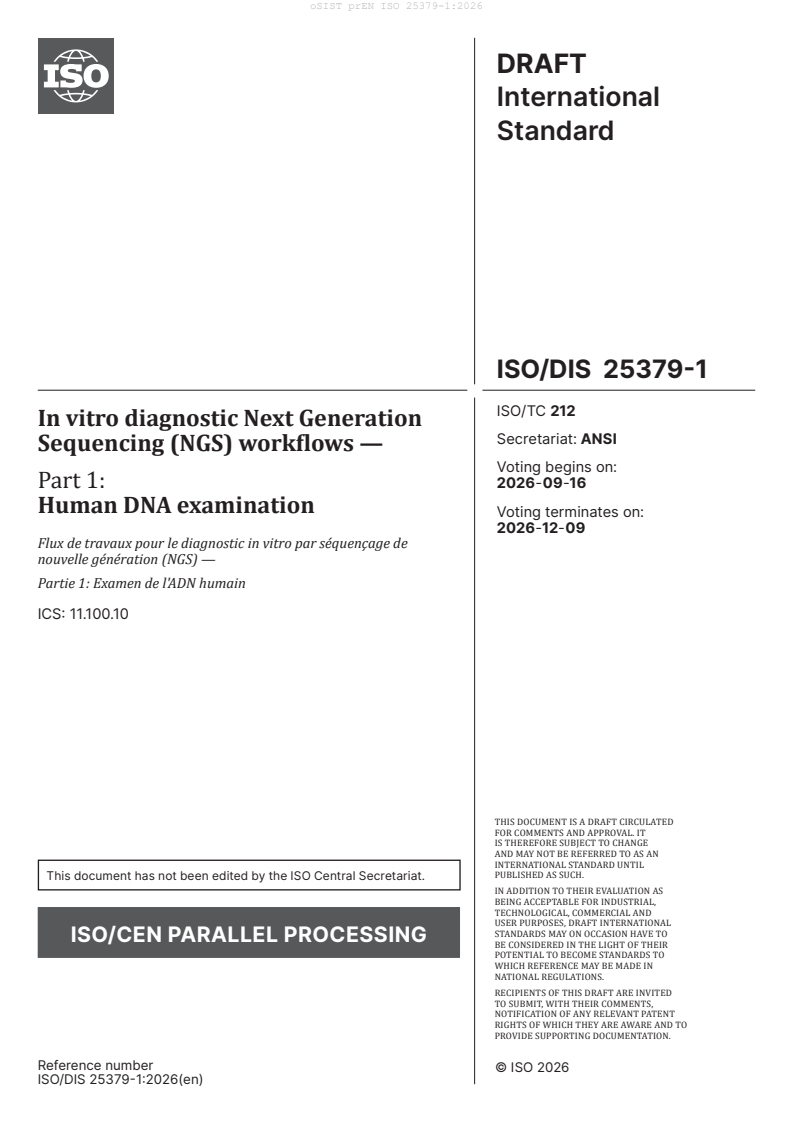
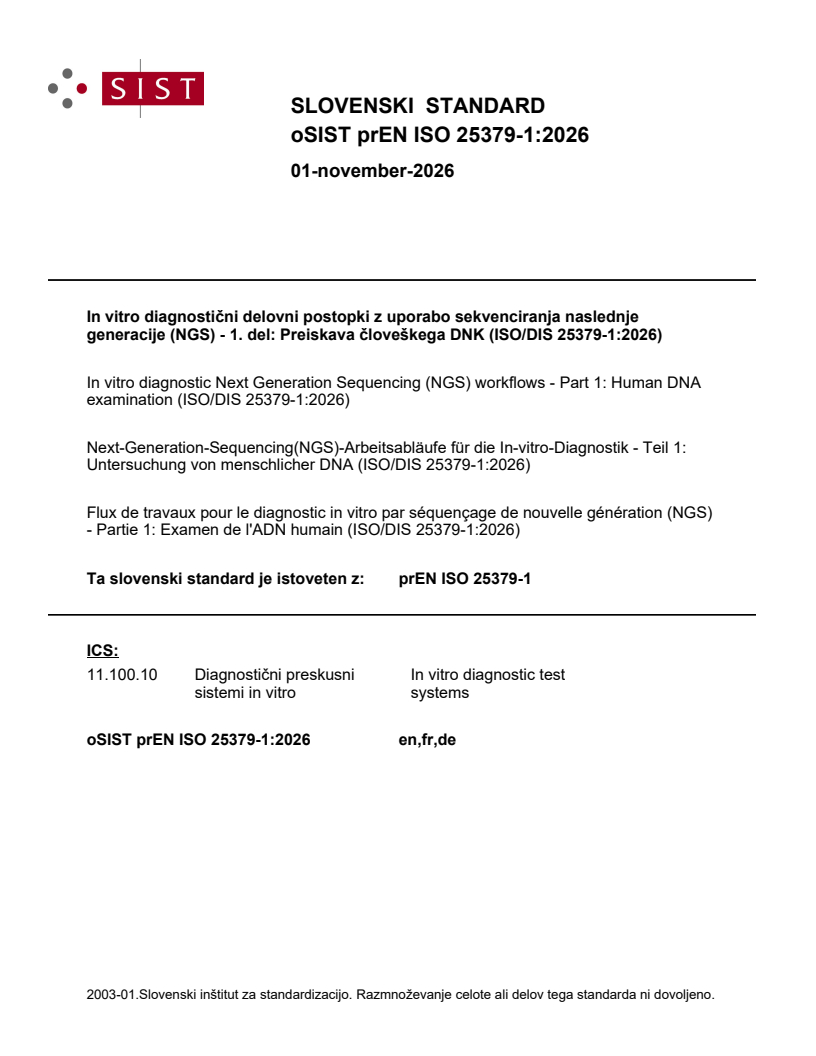


prEN ISO 25379-1 is a draft CEN/ISO document for in vitro diagnostic Next Generation Sequencing (NGS) workflows, Part 1 for human DNA examination. It specifies requirements and recommendations for the full workflow used to examine isolated human DNA for diagnostic purposes, from specimen handling and DNA isolation through sequencing, sequence analysis, and reporting.
What does prEN ISO 25379-1 specify?
prEN ISO 25379-1 specifies the workflow for NGS-based examination of human DNA in in vitro diagnostics and biomedical research. It covers pre-examination processes, human DNA isolation, sequencing library preparation, sequencing, sequence analysis, and reporting.
The scope includes DNA from FFPE tissue, fresh frozen tissue, FNA, whole blood, CTCs, exosomes and other EVs, circulating cell free DNA from plasma, and saliva. Typical uses include oncology, pharmacogenomics, and clinical genetics, with approaches such as disease panels, exome sequencing, whole genome sequencing, certain epigenetic analyses, and certain single-cell analyses.
The document applies to medical laboratories, molecular pathology laboratories, molecular genetic laboratories, IVD developers and manufacturers, biobanks, and organizations providing biomedical research or sequencing services. It excludes in situ sequencing, DNA-mediated protein sequencing, forensic sequencing, sequencing of pathogens or microorganisms, and microbiome analysis.
| Annex | What it covers |
|---|---|
| Annex A | In vitro diagnostic NGS workflow for single-cell analyses |
| Annex B | NGS workflow scheme for the examination of DNA |
What are the key requirements of prEN ISO 25379-1?
prEN ISO 25379-1 sets out a complete quality-managed approach to developing, verifying, validating, implementing, and reporting an NGS examination. In practice, it asks the laboratory or manufacturer to control the whole chain, not just the sequencing step.
Quality management and examination design
Clause 4 requires a suitable quality management system. For medical laboratories, ISO 15189 or an equivalent framework is to be followed; IVD manufacturers should follow ISO 13485. This matters because the document treats NGS as a controlled diagnostic process, not just a laboratory method.
Clause 4 also requires scientific validity to be proven and documented, and the intended use, customer and stakeholder needs, and design input specifications to be defined and documented. That means the examination has to be designed for a clear clinical purpose before development starts.
Development, verification, and validation
Clause 4 requires development of the examination according to the intended use, the design inputs, and the workflow requirements in Clauses 5 and 6. It also points to risk assessment, Design of Experiments (DoE), and guard band studies as useful tools. In practice, this helps the developer identify which parameters most affect performance and what tolerances are acceptable.
Clause 4 requires both verification and validation plans. The workflow, including pre-examination, examination, and post-examination steps, must be verified and validated as a whole. For laboratories, this means the published procedure is not enough - it must also work in their own setting.
Technical performance characteristics
Clause 4 requires the examination manufacturer to determine technical performance characteristics on the selected sequencing platform. These include analytical accuracy, analytical sensitivity or positive percentage agreement (PPA) when no reference method is available, analytical specificity or negative percentage agreement (NPA), positive predictive value (PPV), precision, limits of detection (LOD) and where applicable limit of detection for platforms (LODP), reportable range, reference range, interferences, base-quality metrics, clinical performance characteristics, and performance for each reported variant class.
This matters because an NGS workflow can be strong for one target type and weak for another. The document therefore expects performance to be characterized for the actual claims made in the report.
Pre-examination processes and DNA quality
Clause 5 requires the relevant pre-examination processes to be included for all specimen sources used in routine diagnostics. It also requires quality-control-relevant information to be collected during pre-examination, and DNA quality to be evaluated before sequencing.
The document recognizes that DNA quality depends on specimen type and processing history. For long-read DNA sequencing, the quality evaluation must be able to assess fragment length. That is important because degraded DNA can reduce coverage, affect variant calling, and limit what can be reported reliably.
Library preparation, sequencing, and bioinformatics
Clause 6 covers sequencing library preparation, sequencing equipment requirements, sequencing quality control, data analysis, and QC. The library preparation steps include fragmentation, end repair, base modifications, adaptor ligation, barcoding/indexing, size selection, amplification, purification, and library quantification/qualification.
The examination/bioinformatics pipeline must be fit for the intended purpose and follow ISO 20397-2 for sequencing data analysis and QC. This is important because the analytical result depends on both the wet-lab steps and the software pipeline used to process the reads.
Reporting, implementation, and quality assurance
Clauses 7 to 10 require accurate and unambiguous reporting, routine implementation into the laboratory quality system, result interpretation by qualified personnel, and ongoing quality assurance. Reports must include the information needed for interpretation, and qualitative results should be expressed as “Detected” or “Not detected” rather than “Positive” or “Negative”.
The document also requires each run to be monitored with controls, contamination to be controlled, safety procedures to be in place, and ongoing performance to be documented. In practice, this means an NGS workflow must stay controlled after validation, not just at the initial approval stage.
What terms does prEN ISO 25379-1 define?
prEN ISO 25379-1 defines the terms used to describe NGS workflow design, performance, and reporting.
- In vitro diagnostic NGS workflow - all activities needed to generate the NGS examination result, including pre-examination, examination, and post-examination processes.
- Pre-examination processes - the steps from the request and patient preparation through specimen collection, transport, storage, and isolation of the analyte.
- Sequencing library - DNA, cDNA, or RNA prepared for NGS in a specific size range with adaptors suited to the sequencing platform.
- Sequencing library preparation - the procedures used to prepare DNA or RNA fragments with tags and primer-binding regions for NGS.
- Bioinformatics pipeline - the set of bioinformatics tools that process NGS data.
- Validation - confirmation, through objective evidence, that requirements for a specific intended use have been fulfilled.
- Verification - confirmation, through objective evidence, that specified requirements have been fulfilled.
- Reference range - reportable sequence variations that the examination can detect and that are considered benign or non-pathogenic.
Who uses prEN ISO 25379-1?
prEN ISO 25379-1 is used by medical laboratories, molecular pathology laboratories, and molecular genetic laboratories that develop, verify, or run NGS tests on human DNA. It is also relevant for IVD developers and manufacturers, biobanks, and organizations that provide biomedical research or sequencing services.
In practice, it supports laboratory directors, quality managers, pathologists, molecular biologists, and bioinformaticians who need to design workflows, control quality, validate methods, interpret results, and write reports. It is also useful for buyers and assessors who need to check whether a workflow covers the right specimen types, performance claims, and reporting content.
Which standards are used with prEN ISO 25379-1?
| Standard(s) | What they contribute |
|---|---|
| ISO 15189:2022 | Core requirements for medical laboratory quality and competence, plus key definitions used in Clause 3 |
| ISO 13485 | Quality management system requirements for IVD manufacturers |
| ISO/IEC 17020:2012 and ISO/IEC 17025:2017 | Equivalent competence frameworks for inspection bodies and testing/calibration laboratories |
| ISO 20397-1:2022 | Requirements for nucleic acid and library preparation in massively parallel sequencing |
| ISO 20397-2 | Quality evaluation of sequencing data and sequencing-data QC requirements |
| ISO 7552-2, ISO 18702, ISO 18704, ISO 4307, ISO 20166-3, ISO 20184-3, ISO 20186-2, ISO 20186-3 | Pre-examination processes for CTCs, EVs, body fluids, saliva, FFPE tissue, frozen tissue, venous whole blood, and plasma ccfDNA |
What does the prEN ISO 25379-1 document contain?
prEN ISO 25379-1 contains requirements and recommendations for the full human-DNA NGS workflow, organized from general requirements through pre-examination, examination, reporting, implementation, and quality assurance. It gives detailed coverage of DNA isolation from several specimen types, library preparation steps, sequencing platform and equipment considerations, and data-analysis requirements.
The document also contains an annex for single-cell analyses, where cell capture, enrichment, amplification, and bias control need special attention. Annex B provides a workflow scheme for DNA examination, with optional steps and a reversed processing order shown in the figure.
For reporting, the document specifies report attributes and report content, including specimen identification, examination identification, results, interpretation, limitations, review and authorization, and report traceability. For routine use, it also covers cross-contamination control, run monitoring with controls, staff competence, and ongoing quality assurance, including interlaboratory comparison.
Relations
- Effective Date
- 19-Feb-2025
Get Certified
Connect with accredited certification bodies for this standard

BSI Group
BSI (British Standards Institution) is the business standards company that helps organizations make excellence a habit.

TÜV Rheinland
TÜV Rheinland is a leading international provider of technical services.

TÜV SÜD
TÜV SÜD is a trusted partner of choice for safety, security and sustainability solutions.
Sponsored listings
Frequently Asked Questions
prEN ISO 25379-1 is a draft published by the European Committee for Standardization (CEN). Its full title is "In vitro diagnostic Next Generation Sequencing (NGS) workflows -- Part 1: Part 1: Human DNA examination (ISO/DIS 25379-1:2026)". This standard covers: This document specifies requirements and gives recommendations for next generation sequencing (NGS) workflows. This document covers the pre-examination processes, human DNA (somatic and germline) isolation, sequencing library preparation, sequencing, sequence analysis and reporting of the examination of sequences for diagnostic purposes from isolated DNA from, e.g. formalin-fixed and paraffin embedded tissues, fresh frozen tissues, fine needle aspirates (FNA), whole blood, circulating tumour cells (CTCs), exosomes and other extracellular vesicles, circulating cell free DNA from plasma, and DNA from saliva. NOTE 1 Typical applications include, but are not limited to, NGS for oncology, pharmacogenomics and clinical genetics; approaches include panels (e.g. disease panels, exome panels, target gene panels and in silico panels), exome and whole genome sequencing, as well as certain epigenetics and certain single-cell analyses. This document is addressing in vitro diagnostic examinations including laboratory developed tests and is applicable to medical laboratories, molecular pathology laboratories and molecular genetic laboratories, in vitro diagnostic developers and manufacturers, biobanks as well as institutions and organizations performing biomedical research or sequencing services. This document is not applicable for in situ sequencing, DNA-mediated protein sequencing, forensic sequencing, sequencing of pathogens or microorganisms and microbiome analysis. NOTE 2 International, national or regional regulations or requirements or multiples of them can also apply to specific topics covered in this document.
This document specifies requirements and gives recommendations for next generation sequencing (NGS) workflows. This document covers the pre-examination processes, human DNA (somatic and germline) isolation, sequencing library preparation, sequencing, sequence analysis and reporting of the examination of sequences for diagnostic purposes from isolated DNA from, e.g. formalin-fixed and paraffin embedded tissues, fresh frozen tissues, fine needle aspirates (FNA), whole blood, circulating tumour cells (CTCs), exosomes and other extracellular vesicles, circulating cell free DNA from plasma, and DNA from saliva. NOTE 1 Typical applications include, but are not limited to, NGS for oncology, pharmacogenomics and clinical genetics; approaches include panels (e.g. disease panels, exome panels, target gene panels and in silico panels), exome and whole genome sequencing, as well as certain epigenetics and certain single-cell analyses. This document is addressing in vitro diagnostic examinations including laboratory developed tests and is applicable to medical laboratories, molecular pathology laboratories and molecular genetic laboratories, in vitro diagnostic developers and manufacturers, biobanks as well as institutions and organizations performing biomedical research or sequencing services. This document is not applicable for in situ sequencing, DNA-mediated protein sequencing, forensic sequencing, sequencing of pathogens or microorganisms and microbiome analysis. NOTE 2 International, national or regional regulations or requirements or multiples of them can also apply to specific topics covered in this document.
prEN ISO 25379-1 is classified under the following ICS (International Classification for Standards) categories: 11.100.10 - In vitro diagnostic test systems. The ICS classification helps identify the subject area and facilitates finding related standards.
prEN ISO 25379-1 has the following relationships with other standards: It is inter standard links to CEN/TS 17981-1:2023. Understanding these relationships helps ensure you are using the most current and applicable version of the standard.
prEN ISO 25379-1 is available in PDF format for immediate download after purchase. The document can be added to your cart and obtained through the secure checkout process. Digital delivery ensures instant access to the complete standard document.
Standards Content (Sample)
Contents
- Introduction
- 1 Scope
- 2 Normative references
- 3 Terms and definitions
- 3.1 aliquot
- 3.2 amplicon
- 3.3 analyte
- 3.4 analytical accuracy
- 3.5 analytical sensitivity
- 3.6 analytical specificity
- 3.7 bioinformatics pipeline
- 3.8 biomarker
- 3.9 circulating cell free DNA
- 3.10 cell free DNA
- 3.11 clinical accuracy
- 3.12 clinical performance
- 3.13 clinical sensitivity
- 3.14 clinical specificity
- 3.15 clinical utility
- 3.16 clinical validity
- 3.17 closed system
- 3.18 Design of Experiments
- 3.19 diagnosis
- 3.20 deoxyribonucleic acid
- 3.21 DNA sequencing
- 3.22 epigenetics
- 3.23 examination
- 3.24 examination manufacturer
- 3.25 examination performance
- 3.26 extracellular vesicle
- 3.27 fine needle aspirate
- 3.28 formalin
- 3.29 guard band
- 3.30 in vitro diagnostic NGS workflow
- 3.31 intended use
- 3.32 intermediate precision
- 3.33 intermediate precision condition of measurement
- 3.34 laboratory developed examination
- 3.35 limit of detection
- 3.36 limit of detection for platforms
- 3.37 long-read sequencing
- 3.38 massively parallel sequencing
- 3.39 measurand
- 3.40 measurement
- 3.41 measurement procedure
- 3.42 methylome
- 3.43 next generation sequencing
- 3.44 no template control
- 3.45 panel
- 3.46 performance characteristic
- 3.47 performance specification
- 3.48 pharmacogenomics
- 3.49 post-examination processes
- 3.50 pre-examination processes
- 3.51 proficiency testing
- 3.52 protein
- 3.53 reference material
- 3.54 reference method
- 3.55 reference range
- 3.56 repeatability
- 3.57 repeatability condition of measurement
- 3.58 reportable range
- 3.59 reproducibility
- 3.60 reproducibility condition of measurement
- 3.61 ribonucleic acid
- 3.62 sample
- 3.63 scientific validity
- 3.64 sequencing library
- 3.65 sequencing library preparation
- 3.66 short-read sequencing
- 3.67 specimen
- 3.68 validation
- 3.69 venous whole blood
- 3.70 verification
- 3.71 workflow
- 4 General requirements
- 4.1 General
- 4.2 Examination design
- 4.3 Examination development
- 4.4 Examination performance verification and validation
Introduction
Molecular in vitro diagnostics has enabled significant progress in medicine. Further progress is expected by new technologies analysing profiles of nucleic acids, proteins, and metabolites in human tissues and body fluids. Next Generation Sequencing (NGS) takes a prominent place in the series of molecular techniques used for diagnostics. It facilitates sequence analysis of nucleic acids that can result in precise information for diagnosis and progression of diseases.
The NGS technique, however, has a very complex workflow that contains many steps. The target nucleic acids can originate from different sources (e.g. tissues, blood, and body fluids). The profiles of the isolated DNA or methylated DNA can change during specimen collection, transport, storage and processing (e.g. formalin fixation), making the outcome from diagnostics or research unreliable or even impossible because the subsequent analytical assay will not determine the situation in the patient, but an artificial profile generated during the pre-examination process. The available material can be small, the cells in a tissue can be dispersed heterogeneously (e.g. ratio of tumour to normal), the target nucleic acids can be circulating in blood or body fluids free of cells or in circulating cells (e.g. circulating tumour cells (CTCs)). For a successful and reliable sequencing result, a suitable strategy needs to be chosen for every case depending on the available material and disease conditions. Therefore, the NGS workflow can differ from case to case, and the NGS workflow steps need to be carefully considered and chosen to get a sound and reliable result to determine the best available treatment for the patient. In addition, sequencing platforms can differ in their technique (e.g. detection of a change in a current or fluorescence) and approach (e.g. panels, short-read sequencing, longread sequencing) for sequence assessment. The bioinformatics analysis can differ in approach and ability to detect non-conformities and unreliable sequencing results. To enable such capabilities, NGS metadata needs to be collected during all workflow steps from the patient to the reporting. In addition, controls and added controls need to be analysed properly. In this way, non-conformities or detected unreliabilities can be reported to the patient and the treating physician. The reporting of diagnostic NGS results can differ in clarity and depth, which can lead to different interpretations. Standardization of the entire NGS workflow from specimen collection to the reporting of the results to the patient and the treating physician is needed for the development of reliable NGS examinations. This document draws upon previous work to standardize the steps for NGS examinations from tissues, blood and body fluids in what is referred to as the pre-examination phase (sample collection), the examination phase (library preparation, sequencing), and the post-examination phase (analysis and reporting). In this document, the following verbal forms are used:
- “shall” indicates a requirement;
- “should” indicates a recommendation;
- “may” indicates a permission;
- “can” indicates a possibility or a capability.
oSIST prEN ISO 25379-1:2026
oSIST prEN ISO 25379-1:2026 DRAFT International Standard ISO/DIS 25379-1:2026(en) In vitro diagnostic Next Generation Sequencing (NGS) workflows — Part 1:
Human DNA examination
1 Scope
This document specifies requirements and gives recommendations for next generation sequencing (NGS) workflows for in vitro diagnostics and biomedical research. This document covers the pre-examination processes including human DNA (somatic and germline) isolation, sequencing library preparation, sequencing, sequence analysis and reporting of the examined sequences for diagnostic purposes from isolated DNA from, e.g. formalin-fixed and paraffin embedded tissues, fresh frozen tissues, fine needle aspirates (FNA), whole blood, circulating tumour cells (CTCs), exosomes and other extracellular vesicles, circulating cell free DNA from plasma, and DNA from saliva.
NOTE 1 Typical applications include, but are not limited to, NGS for oncology, pharmacogenomics and clinical genetics; approaches include panels (e.g. disease panels, exome panels, target gene panels and in silico panels), exome and whole genome sequencing, as well as certain epigenetic and certain single-cell analyses. This document addresses in vitro diagnostic examinations including laboratory developed examinations and is applicable to medical laboratories, molecular pathology laboratories and molecular genetic laboratories, in vitro diagnostic developers and manufacturers, biobanks and institutions and organizations performing biomedical research or sequencing services.
This document is not applicable for in situ sequencing, DNA-mediated protein sequencing, forensic sequencing, sequencing of pathogens or microorganisms and microbiome analysis. NOTE 2 International, national or regional regulations or requirements or multiples of them can also apply to specific topics covered in this document.
2 Normative references
The following documents are referred to in the text in such a way that some or all of their content constitutes requirements of this document. For dated references, only the edition cited applies. For undated references, the latest edition of the referenced document (including any amendments) applies. ISO 7552-2, Molecular in vitro diagnostic examinations — Specifications for pre-examination processes for circulating tumor cells (CTCs) in venous whole blood — Part 2: Isolated DNA ISO 18702, Molecular in vitro diagnostic examinations — Specifications for pre-examination processes for exosomes and other extracellular vesicles in venous whole blood — DNA, RNA and proteins ISO 18704, Molecular in vitro diagnostic examinations — Requirements and recommendations for preexamination processes for urine and other body fluids — Isolated cell-free DNA ISO 4307, Molecular in vitro diagnostic examinations — Specifications for pre-examination processes for saliva - Isolated human DNA ISO 13485, Medical devices — Quality management systems — Requirements for regulatory purposes ISO 15189:2022, Medical laboratories — Requirements for quality and competence
oSIST prEN ISO 25379-1:2026 ISO/DIS 25379-1:2026(en) ISO/IEC 17020:2012, Conformity assessment — Requirements for the operation of various types of bodies performing inspection ISO/IEC 17025:2017, General requirements for the competence of testing and calibration laboratories ISO 20166-3, Molecular in vitro diagnostic examinations — Specifications for pre-examination processes for formalin-fixed and paraffin-embedded (FFPE) tissue — Part 3: Isolated DNA ISO 20184-3, Molecular in vitro diagnostic examinations — Specifications for pre-examination processes for frozen tissue — Part 3: Isolated DNA ISO 20186-2, Molecular in vitro diagnostic examinations — Specifications for pre-examination processes for venous whole blood — Part 2: Isolated genomic DNA ISO 20186-3, Molecular in vitro diagnostic examinations — Specifications for pre-examination processes for venous whole blood — Part 3: Isolated circulating cell free DNA from plasma ISO 20397-1:2022, Biotechnology — Massively parallel sequencing — Part 1: Nucleic acid and library preparation ISO 20397-2, Biotechnology — Massively parallel sequencing — Part 2: Quality evaluation of sequencing data
3 Terms and definitions
For the purposes of this document, the terms and definitions given in ISO 15189 and the following apply. ISO and IEC maintain terminology databases for use in standardization at the following addresses:
- ISO Online browsing platform: available at https:// www .iso .org/ obp
- IEC Electropedia: available at https:// www .electropedia .org/
3.1 aliquot
portion of a larger amount of homogenous material, assumed to be taken with negligible sampling error Note 1 to entry: The term is usually applied to fluids. Tissues are heterogeneous and therefore cannot be aliquoted. [1][2][3] Note 2 to entry: The definition is derived from .
[SOURCE: ISO 20184-3:2021, 3.1, modified ─ Note 2 to entry was added.]
3.2 amplicon
specific DNA fragment produced by a DNA-amplification technology, such as the polymerase chain reaction (PCR) [SOURCE: ISO 13495:2013, 3.3.1]
3.3 analyte
component represented in the name of a measurable quantity Note 1 to entry: The term “analyte”, or the name of a substance or compound, is not to be confused with the term “measurand”, because analytes are not quantities.
EXAMPLE Amount of substance of glucose in plasma is a measurand (3.39), while glucose is the analyte. [SOURCE: ISO 17511:2021, 3.1, modified — Note 1 and example were added]
oSIST prEN ISO 25379-1:2026 ISO/DIS 25379-1:2026(en)
3.4 analytical accuracy
closeness of the agreement between the result of an examination (3.23) and a true property value Note 1 to entry: For NGS-based examinations, accuracy represents the degree of concordance (or agreement) of results between a sequence obtained from the examination and the same sequence determined by a valid comparator method, or between a reference sample run on an NGS-based examination and the high confidence sequence of the reference. [SOURCE: ISO/IEC Guide 99:2007, 2.13, modified – Original notes were deleted, Note 1 to entry was added; "analytical accuracy" replaces all old terms, "a measured quantity value" was replaced by "the result of an examination" and "quantity value of a measurand" was replaced by "property value".]
3.5 analytical sensitivity
sensitivity of a measurement procedure quotient of the change in a measurement (3.40) indication and the corresponding change in a value of a quantity being measured Note 1 to entry: The sensitivity of a measurement procedure (3.41) can depend on the value of the quantity being measured.
Note 2 to entry: The change considered in the value of the quantity being measured only becomes useful when large compared with the resolution.
Note 3 to entry: The analytical sensitivity of a measuring system is the slope of the calibration curve. Note 4 to entry: Analytical sensitivity is often confused with positive percentage agreement (PPA), because similar calculations are used for both the analytical sensitivity and the PPA. However, the term PPA instead of analytical sensitivity is only used, if a reference method is not available or not used. The PPA represents merely an estimation of the analytical sensitivity. PPA is applicable only to measurements of quantities that have the nature of a count. [SOURCE: ISO/IEC Guide 99:2007, 4.12, modified — terms changed from "sensitivity of a measuring system /sensitivity" changed to "analytical sensitivity/sensitivity of a measurement procedure"; "an indication of a measuring system" replaced by "a measurement indication", "measuring system" replaced by "measurement procedure" in Note 1; new Note 3 and Note 4 were added.]
3.6 analytical specificity
selectivity of a measurement procedure capability of a measuring system, using a specified measurement procedure (3.41), to provide measurement (3.40) results for one or more measurands (3.39) which do not depend on each other nor on any other quantity in the system undergoing measurement Note 1 to entry: Lack of analytical specificity is called analytical interference (see ISO 18113-1:2022, 3.2.2). Note 2 to entry: Specificity of a measurement procedure (3.41) should not be confused with diagnostic specificity (3.14) (see ISO 18113-1:2022, 3.2.18).
Note 3 to entry: ISO/IEC Guide 99:2007 uses the term selectivity for this concept instead of specificity. Note 4 to entry: Adapted from ISO/IEC Guide 99:2007, 4.13.
Note 5 to entry: Selectivity as used in metrology is a concept close to specificity as it is sometimes used in chemistry. “Specificity” of measurements has some risk of ambiguity with “clinical/diagnostic specificity”. Note 6 to entry: Analytical specificity is often confused with negative percentage agreement (NPA), because the same calculations are used for both the analytical specificity and the NPA. However, the term NPA instead of analytical specificity is only used, if a reference method (3.54) is not available or is not used. The NPA represents merely an estimation of the analytical specificity.
[SOURCE: ISO 18113-1:2022, 3.2.5, modified — Note 2 was deleted and Note 5 and 67 were added.]
oSIST prEN ISO 25379-1:2026 ISO/DIS 25379-1:2026(en)
3.7 bioinformatics pipeline
suite of different bioinformatics tools that process the next generation sequencing (3.43) data
3.8 biomarker
molecular marker detectable and/or quantifiable molecule or group of molecules used to indicate a biological condition, state, identity or characteristic or an organism [SOURCE: ISO 16577:2022, 3.4.28]
3.9 circulating cell free DNA
ccfDNA extracellular human DNA present in blood and plasma Note 1 to entry: ccfDNA includes DNA present in vesicles such as exosomes. [SOURCE: EN ISO 20186-3:2019, 3.5]
3.10 cell free DNA
cfDNA extracellular human DNA present in body liquids such as urine and plasma Note 1 to entry: cfDNA can include DNA present in vesicles such as exosomes. [SOURCE: ISO/DIS 18704, 3.8]
3.11 clinical accuracy
diagnostic accuracy extent of agreement between the outcome of the examination (3.23) and the target clinical condition
3.12 clinical performance
ability of an examination (3.23) to yield results that are correlated with a particular clinical condition, physiological or pathological state in accordance with the target population and intended use(r) Note 1 to entry: Although sometimes referred to as diagnostic performance or clinical validity (3.16); clinical performance is the harmonized term endorsed by the Global Harmonization Task Force (GHTF) and its successor, the International Medical Devices Regulators Forum (IMDRF).
Note 2 to entry: Evaluation of clinical performance often relies on the outcome of other types of clinical examinations (3.23) to define “true positive or true negative” results.
3.13 clinical sensitivity
diagnostic sensitivity ability of an in vitro diagnostic examination (3.23) procedure to have positive results associated with a particular disease or condition Note 1 to entry: Also defined as percent positivity in samples where the target marker is known to be present. Note 2 to entry: Diagnostic sensitivity is expressed as a percentage (number fraction multiplied by 100), calculated as 100 × the number of true positive values (TP) divided by the sum of the number of true positive values (TP) plus the number of false negative values (FP), or 100 × TP/(TP + FN). This calculation is based on a study design where only one sample is taken from each subject.
Note 3 to entry: The target condition is defined by criteria independent of the examination procedure under consideration.
oSIST prEN ISO 25379-1:2026 ISO/DIS 25379-1:2026(en) Note 4 to entry: Clinical sensitivity is often confused with positive percentage agreement (PPA), because the same calculations are used for both the clinical sensitivity and the PPA. However, the term PPA instead of clinical sensitivity is only used, if a reference method is not available or is not used. The PPA represents merely an estimation of the clinical sensitivity.
[SOURCE: ISO 18113-1:2022, 3.2.17, modified — The term "clinical sensitivity" was added; second sentence in Note 1 was deleted; Note 4 was added.]
3.14 clinical specificity
diagnostic specificity ability of an in vitro diagnostic examination (3.23) procedure to have negative results associated with an absence of particular disease or condition Note 1 to entry: Also defined as percent negativity in samples where the target marker is known to be absent. For information regarding description of the diagnostic performance characteristics of an IVD medical device, see Reference [4].
Note 2 to entry: Clinical specificity is expressed as a percentage (number fraction multiplied by 100), calculated as 100 × the number of true negative values (TN) divided by the sum of the number of true negative plus the number of false positive values (FP), or 100 × TN/(TN + FP). This calculation is based on a study design where only one sample is taken from each subject.
Note 3 to entry: The target condition is defined by criteria independent of the examination (3.23) procedure under consideration.
Note 4 to entry: Clinical specificity is often confused with negative percentage agreement (NPA), because the same calculations are used for both the clinical specificity and the NPA. However, the term NPA instead of clinical specificity is only used, if a reference method (3.54) is not available or is not used. The NPA represents merely an estimation of the clinical specificity.
[SOURCE: ISO 18113-1:2022, 3.2.18, modified — The term "clinical specificity" was added; Note 4 was added.]
3.15 clinical utility
ability of a screening or diagnostic examination (3.23) to prevent or ameliorate adverse health outcomes such as mortality, morbidity, or disability through the adoption of efficacious treatments conditioned on examination results [5][6] Note 1 to entry: Clinical utility can be part of scientific validity and clinical performance (3.12) . [6] [SOURCE: ]
3.16 clinical validity
predictive value of an examination (3.23) for a given clinical outcome Note 1 to entry: Clinical validity is primarily determined by the clinical sensitivity (3.13) and clinical specificity (3.14) with which an examination identifies individuals with a defined clinical condition within a given population. The clinical validity (3.16) of a genetic examination is the likelihood that, e.g. cancer will develop in someone with a positive examination result.
3.17 closed system
non-modifiable system (by the user) provided by the vendor including all necessary components for the examination (3.23) Note 1 to entry: Necessary components are hardware, software, procedures and reagents.
oSIST prEN ISO 25379-1:2026 ISO/DIS 25379-1:2026(en)
3.18 Design of Experiments
DoE <NGS> structured, statistical approach for planning sequencing runs and experimental conditions in order to systematically evaluate the effects of key variables (e.g. library preparation methods, input nucleic acid quantity, sequencing depth, and indexing strategies) on sequencing quality, coverage, and downstream data interpretation
3.19 diagnosis
identification of a disease from its signs and symptoms, where the diagnostic process can involve examinations (3.23) and tests for classification of an individual's condition into separate and distinct categories or subclasses that allow medical decisions about treatment and prognosis to be made
3.20 deoxyribonucleic acid
DNA polymer of deoxyribonucleotides occurring in a double-stranded (dsDNA) or single-stranded (ssDNA) form
3.21 DNA sequencing
determining the order of nucleotide bases (e.g. adenine, guanine, cytosine and thymine) in a molecule of DNA (3.20) Note 1 to entry: Sequence is generally described from the 5’ end. [SOURCE: ISO 17822:2020, 3.19, modified — Added e.g.]
3.22 epigenetics
study of changes of genome usage without alterations in the underlying DNA sequence [7] [SOURCE: ]
3.23 examination
analytical test set of operations having the objective of determining the numerical value or characteristics of a property Note 1 to entry: An examination can be the total of a number of activities, observations or measurements required to determine a value or characteristic.
...