

prEN 17771
(Main)Organic and organo-mineral fertilizers - Determination of the nitrogen content
- Abstract
This document specifies a method for the determination of the total nitrogen content and the content of ammoniacal, nitric, ureic and organic nitrogen in organic and organo-mineral fertilizers.
This document is applicable to fertilizing product blends, where the blend is a mix of at least two of the following components: fertilizers, liming materials, soil improvers, biostimulants and where the following category organic fertilizers, organo-mineral fertilizers is the highest % in the blend by mass or volume, or in the case of liquid form by dry mass. If the organic fertilizer or the organo-mineral fertilizer is not the highest % in the blend, the European Standard for the highest % of the blend applies. In case a fertilizing product blend is composed of components in equal quantity, the user decides which standard to apply.
This document is applicable to products that at least contain a total nitrogen content of 1 % by mass. In case of fertilizing product blends, it is unattainable to ascertain the origin of the measured nitrogen with respect to the specific component.
NOTE Variations in analytical methods for fertilizing product blends can lead to differing results as some components or matrix interactions can affect the outcome. Validation procedures have shown that developed standard methods are robust and reliable across diverse product compositions, but possible interferences and unexpected results when analysing fertilizing product blends are possible.
- Status
- Not Published
- Publication Date
- 08-Aug-2027
- Technical Committee
- CEN/TC 260 - Fertilizers and liming materials
- Drafting Committee
- CEN/TC 260/WG 8 - Organic and organo-mineral fertilizers
- Current Stage
- 4020 - Submission to enquiry - Enquiry
- Start Date
- 13-Aug-2026
- Due Date
- 26-Apr-2026
- Completion Date
- 13-Aug-2026

prEN 17771 is a CEN draft European Standard for organic and organo-mineral fertilizers. It specifies a laboratory method for determining total nitrogen and the ammoniacal, nitric, ureic and organic nitrogen fractions, for laboratories, quality teams and conformity assessment work on covered fertilizers and fertilizing product blends.
What does prEN 17771 specify?
prEN 17771 specifies one analytical method for nitrogen determination in organic and organo-mineral fertilizers, including the calculation of the different nitrogen fractions from four analytical pathways. It also defines how the method applies to certain fertilizing product blends and how results are reported.
The document applies to blends made from at least two of these components: fertilizers, liming materials, soil improvers and biostimulants, when the organic fertilizer or organo-mineral fertilizer category is the highest share in the blend. If another component is the highest share, the standard for that highest-share component applies; if quantities are equal, the user chooses the applicable standard.
The method applies to products with at least 1 % total nitrogen by mass. Sampling is handled outside the method, and sample preparation follows EN 1482-2:2024.
The document is organized into Clauses 1 to 12, covering scope, references, terms, principle, reagents, apparatus, sampling and sample preparation, procedure, calculation, verification, precision and test report, plus Annex A and Annex ZA.
| Annex | What it covers |
|---|---|
| Annex A | Results of the interlaboratory study and precision data |
| Annex ZA | Link between this European Standard and Regulation (EU) 2019/1009 |
What are the key requirements of prEN 17771?
prEN 17771 is built around four analytical pathways based on the Kjeldahl principle. In practice, the laboratory does not measure all nitrogen fractions directly in one step - it combines pathway results to calculate the nitrogen forms needed for reporting and compliance.
Analytical pathways and sample limits
- Clause 4 defines four pathways: total nitrogen, total nitrogen except nitric nitrogen, ammoniacal nitrogen, and ureic plus ammoniacal nitrogen. This structure matters because each fraction is obtained by a different chemical treatment.
- Clause 8.2 limits the test portion to a sample containing no more than 40 mg nitrogen, or 650 mg organic matter for the reduction steps. This keeps the digestion and distillation within the method's validated working range.
- Pathway 1 uses reduced iron and stannous chloride to reduce nitric nitrogen before Kjeldahl digestion. That makes total nitrogen available for products where nitrate must be included.
- Pathway 2 uses ferrous sulfate and sulfuric acid digestion to measure total nitrogen except nitric nitrogen. The nitric fraction is then obtained by difference from pathway 1.
- Pathway 3 uses mild distillation after magnesium oxide to determine ammoniacal nitrogen. This is the route for nitrogen already present as ammonia or ammonium.
- Pathway 4 uses urease pretreatment followed by mild distillation to measure ureic plus ammoniacal nitrogen. This is what allows ureic nitrogen to be calculated from the pathway 4 and pathway 3 results.
- Clause 8 also requires careful distillation conditions, an acid receiver, an endpoint by colour change or potentiometric reading, and a blank test for each pathway. These steps reduce ammonia loss and make the measured volume usable for calculation.
Calculation, verification and reporting
- Clause 9.1 converts the titration results into nitrogen mass fractions and then derives total, nitric, ammoniacal, ureic and organic nitrogen. For a user, this means the final report is not just one number - it is a set of linked fractions.
- Clause 9.2 calculates the maximum ammonium nitrate content from the minority of ammoniacal or nitric nitrogen. This is relevant when the product must be checked against composition limits.
- Clause 10 requires regular performance checks with mixed nitrogen standards made from potassium thiocyanate, potassium nitrate, ammonium sulfate, urea and bovine serum albumin. In practice, the lab should use these checks to confirm that all relevant nitrogen forms are being recovered correctly, especially for products with complexing agents, chelating agents or nutrient polymers.
- Clause 11 and Annex A define repeatability and reproducibility from an interlaboratory study. Buyers and quality managers use this to judge how much difference to expect between results from the same lab and from different labs.
- Clause 12 requires the test report to identify the sample, state the method and year, give results in g N/kg or % N, and record sampling dates, completion date, optional details, incidents and unusual features. This is the information needed for audit trails and product dossiers.
What terms does prEN 17771 define?
The terms and definitions in EN 12944-1:1999 and EN 12944-2:1999 apply to prEN 17771.
- Kjeldahl principle - the method family used here, in which selected nitrogen compounds are converted to ammonia and then measured by distillation and titration.
- Total nitrogen - the overall nitrogen amount obtained by pathway 1.
- Ammoniacal nitrogen - the nitrogen fraction measured by pathway 3 after mild distillation.
- Nitric nitrogen - nitrate nitrogen, calculated from the difference between pathway 1 and pathway 2.
- Ureic nitrogen - the nitrogen associated with urea, calculated from pathway 4 minus pathway 3.
- Organic nitrogen - the nitrogen remaining after the mineral fractions are subtracted from total nitrogen.
- Fertilizing product blend - a mix of at least two listed component types where the organic or organo-mineral category is the highest share, or where the user selects the applicable standard if shares are equal.
Who uses prEN 17771?
prEN 17771 is used by laboratories that test fertilizers for composition and compliance, especially when they need to report nitrogen fractions rather than only total nitrogen. It is also used by fertilizer manufacturers, formulators and quality managers who check product declarations, batch consistency and release data.
The method is relevant to conformity assessment work tied to organic fertilizers, organo-mineral fertilizers and qualifying fertilizing product blends. It also supports regulatory testing linked to Regulation (EU) 2019/1009.
What changed in prEN 17771 from the previous edition?
prEN 17771 will supersede CEN/TS 17771:2022. The draft states these changes: the Technical Specification has been adopted as a European Standard with Annex ZA added, the scope has been updated with clarification for fertilizing product blends, the normative references and bibliography have been revised, Annex A has been added, and Annex ZA has been added.
Which standards are used with prEN 17771?
| Standard | What it contributes |
|---|---|
| EN 1482-2:2024 | Sample preparation for fertilizers, liming materials and inhibitors |
| EN 1482-1 | General sampling provisions, named as a recommended sampling method |
| EN 1482-3 | Sampling of static heaps, named as a recommended sampling method |
| EN 12944-1:1999 | General fertilizer and liming-material vocabulary |
| EN 12944-2:1999 | Vocabulary terms relating to fertilizers |
| ISO 5725-2 | Calculation approach for repeatability and reproducibility in the precision study |
Annex ZA also ties the method to Regulation (EU) 2019/1009 for EU fertilising products.
What does the prEN 17771 document contain?
prEN 17771 contains the method principle, reagent lists and preparation instructions, apparatus requirements, sampling and sample-preparation guidance, and step-by-step procedures for digestion, mild distillation, distillation and titration. It also gives the calculation formulas for each nitrogen fraction and for maximum ammonium nitrate content.
The document includes a verification section for ongoing control of the apparatus and a precision section based on an interlaboratory study. Annex A presents the study materials and statistical results in tables, while Annex ZA provides the regulatory mapping for conformity work.
Relations
- Revises
CEN/TS 17771:2022 - Organic and organo-mineral fertilizers - Determination of the nitrogen content - Effective Date
- 11-Jun-2025
Get Certified
Connect with accredited certification bodies for this standard

Control Union Certifications
Global certification for agriculture and sustainability.

ECOCERT
Organic and sustainability certification.

FSC International
Forest Stewardship Council certification.
Sponsored listings
Frequently Asked Questions
prEN 17771 is a draft published by the European Committee for Standardization (CEN). Its full title is "Organic and organo-mineral fertilizers - Determination of the nitrogen content". This standard covers: This document specifies a method for the determination of the total nitrogen content and the content of ammoniacal, nitric, ureic and organic nitrogen in organic and organo-mineral fertilizers. This document is applicable to fertilizing product blends, where the blend is a mix of at least two of the following components: fertilizers, liming materials, soil improvers, biostimulants and where the following category organic fertilizers, organo-mineral fertilizers is the highest % in the blend by mass or volume, or in the case of liquid form by dry mass. If the organic fertilizer or the organo-mineral fertilizer is not the highest % in the blend, the European Standard for the highest % of the blend applies. In case a fertilizing product blend is composed of components in equal quantity, the user decides which standard to apply. This document is applicable to products that at least contain a total nitrogen content of 1 % by mass. In case of fertilizing product blends, it is unattainable to ascertain the origin of the measured nitrogen with respect to the specific component. NOTE Variations in analytical methods for fertilizing product blends can lead to differing results as some components or matrix interactions can affect the outcome. Validation procedures have shown that developed standard methods are robust and reliable across diverse product compositions, but possible interferences and unexpected results when analysing fertilizing product blends are possible.
This document specifies a method for the determination of the total nitrogen content and the content of ammoniacal, nitric, ureic and organic nitrogen in organic and organo-mineral fertilizers. This document is applicable to fertilizing product blends, where the blend is a mix of at least two of the following components: fertilizers, liming materials, soil improvers, biostimulants and where the following category organic fertilizers, organo-mineral fertilizers is the highest % in the blend by mass or volume, or in the case of liquid form by dry mass. If the organic fertilizer or the organo-mineral fertilizer is not the highest % in the blend, the European Standard for the highest % of the blend applies. In case a fertilizing product blend is composed of components in equal quantity, the user decides which standard to apply. This document is applicable to products that at least contain a total nitrogen content of 1 % by mass. In case of fertilizing product blends, it is unattainable to ascertain the origin of the measured nitrogen with respect to the specific component. NOTE Variations in analytical methods for fertilizing product blends can lead to differing results as some components or matrix interactions can affect the outcome. Validation procedures have shown that developed standard methods are robust and reliable across diverse product compositions, but possible interferences and unexpected results when analysing fertilizing product blends are possible.
prEN 17771 is classified under the following ICS (International Classification for Standards) categories: 65.080 - Fertilizers. The ICS classification helps identify the subject area and facilitates finding related standards.
prEN 17771 has the following relationships with other standards: It is inter standard links to CEN/TS 17771:2022. Understanding these relationships helps ensure you are using the most current and applicable version of the standard.
prEN 17771 is associated with the following European legislation: EU Directives/Regulations: 2019/1009; Standardization Mandates: M/564, M/564 Amd 1, M/564 Amd 2. When a standard is cited in the Official Journal of the European Union, products manufactured in conformity with it benefit from a presumption of conformity with the essential requirements of the corresponding EU directive or regulation.
prEN 17771 is available in PDF format for immediate download after purchase. The document can be added to your cart and obtained through the secure checkout process. Digital delivery ensures instant access to the complete standard document.
Standards Content (Sample)
SLOVENSKI STANDARD
01-september-2026
Organska in organsko-mineralna gnojila - Določanje dušika
Organic and organo-mineral fertilizers - Determination of the nitrogen content
Organische und organisch-mineralische Düngemittel - Bestimmung des
Stickstoffgehaltes
Ta slovenski standard je istoveten z: prEN 17771
ICS:
65.080 Gnojila Fertilizers
2003-01.Slovenski inštitut za standardizacijo. Razmnoževanje celote ali delov tega standarda ni dovoljeno.
DRAFT
EUROPEAN STANDARD
NORME EUROPÉENNE
EUROPÄISCHE NORM
August 2026
ICS 65.080 Will supersede CEN/TS 17771:2022
English Version
Organic and organo-mineral fertilizers - Determination of
the nitrogen content
Organische und organisch-mineralische Düngemittel -
Bestimmung des Stickstoffgehaltes
This draft European Standard is submitted to CEN members for enquiry. It has been drawn up by the Technical Committee
CEN/TC 260.
If this draft becomes a European Standard, CEN members are bound to comply with the CEN/CENELEC Internal Regulations
which stipulate the conditions for giving this European Standard the status of a national standard without any alteration.
This draft European Standard was established by CEN in three official versions (English, French, German). A version in any other
language made by translation under the responsibility of a CEN member into its own language and notified to the CEN-CENELEC
Management Centre has the same status as the official versions.
CEN members are the national standards bodies of Austria, Belgium, Bulgaria, Croatia, Cyprus, Czech Republic, Denmark, Estonia,
Finland, France, Germany, Greece, Hungary, Iceland, Ireland, Italy, Latvia, Lithuania, Luxembourg, Malta, Netherlands, Norway,
Poland, Portugal, Republic of North Macedonia, Romania, Serbia, Slovakia, Slovenia, Spain, Sweden, Switzerland, Türkiye and
United Kingdom.
Recipients of this draft are invited to submit, with their comments, notification of any relevant patent rights of which they are
aware and to provide supporting documentation.
Warning : This document is not a European Standard. It is distributed for review and comments. It is subject to change without
notice and shall not be referred to as a European Standard.
EUROPEAN COMMITTEE FOR STANDARDIZATION
COMITÉ EUROPÉEN DE NORMALISATION
EUROPÄISCHES KOMITEE FÜR NORMUNG
CEN-CENELEC Management Centre: Rue de la Science 23, B-1040 Brussels
© 2026 CEN All rights of exploitation in any form and by any means reserved Ref. No. prEN 17771:2026 E
worldwide for CEN national Members.
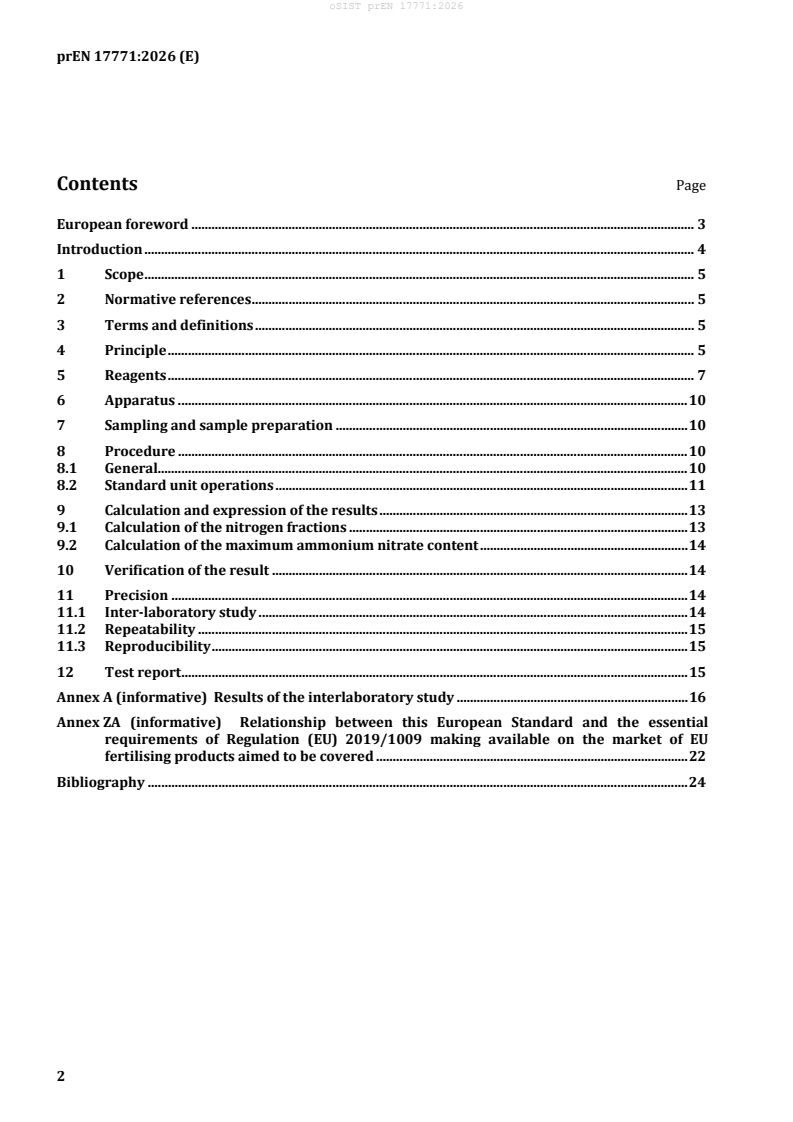
Contents Page
European foreword . 3
Introduction . 4
1 Scope . 5
2 Normative references . 5
3 Terms and definitions . 5
4 Principle . 5
5 Reagents . 7
6 Apparatus . 10
7 Sampling and sample preparation . 10
8 Procedure . 10
8.1 General. 10
8.2 Standard unit operations . 11
9 Calculation and expression of the results . 13
9.1 Calculation of the nitrogen fractions . 13
9.2 Calculation of the maximum ammonium nitrate content . 14
10 Verification of the result . 14
11 Precision . 14
11.1 Inter-laboratory study . 14
11.2 Repeatability . 15
11.3 Reproducibility . 15
12 Test report . 15
Annex A (informative) Results of the interlaboratory study . 16
Annex ZA (informative) Relationship between this European Standard and the essential
requirements of Regulation (EU) 2019/1009 making available on the market of EU
fertilising products aimed to be covered . 22
Bibliography . 24
European foreword
This document (prEN 17771:2026) has been prepared by Technical Committee CEN/TC 260 “Fertilizers
and liming materials”, the secretariat of which is held by DIN.
This document is currently submitted to the CEN Enquiry.
This document will supersede CEN/TS 17771:2022.
CEN/TS 17771:2022:
— The CEN Technical Specification has been adopted as a European Standard including the addition of
Annex ZA;
— Scope (Clause 1) updated including a clarification on fertilizing product blends;
— Normative references and Bibliography revised;
— Annex A (Results of the interlaboratory study) added;
— Annex ZA added.
This document has been prepared under a Standardization Request addressed to CEN by the European
Commission. The Standing Committee of the EFTA States subsequently approves these requests for its
Member States.
For the relationship with EU Legislation, see informative Annex ZA, which is an integral part of this
document.
Introduction
Regulation (EU) 2019/1009 [1] lays down the rules on the making available on the market of EU
fertilizing products and the specific safety and quality requirements for the defined product function
categories (PFCs). Organic and organo-mineral fertilizers have been classified as PFC 1(A) and PFC 1(B).
This document defines test methods for the determination of the nitrogen content to be used for organic
and organo-mineral fertilizers in order to measure the compliance with the related requirement in
Regulation (EU) 2019/1009 [1].
The inter-laboratory study reflects the final statistical characteristics of the method for the determination
of the specific forms of nitrogen present in the sample.
1 Scope
This document specifies a method for the determination of the total nitrogen content and the content of
ammoniacal, nitric, ureic and organic nitrogen in organic and organo-mineral fertilizers.
This document is applicable to fertilizing product blends, where the blend is a mix of at least two of the
following components: fertilizers, liming materials, soil improvers, biostimulants and where the
following category organic fertilizers, organo-mineral fertilizers is the highest % in the blend by mass or
volume, or in the case of liquid form by dry mass. If the organic fertilizer or the organo-mineral fertilizer
is not the highest % in the blend, the European Standard for the highest % of the blend applies. In case a
fertilizing product blend is composed of components in equal quantity, the user decides which standard
to apply.
This document is applicable to products that at least contain a total nitrogen content of 1 % by mass. In
case of fertilizing product blends, it is unattainable to ascertain the origin of the measured nitrogen with
respect to the specific component.
NOTE Variations in analytical methods for fertilizing product blends can lead to differing results as some
components or matrix interactions can affect the outcome. Validation procedures have shown that developed
standard methods are robust and reliable across diverse product compositions, but possible interferences and
unexpected results when analysing fertilizing product blends are possible.
2 Normative references
The following documents are referred to in the text in such a way that some or all of their content
constitutes requirements of this document. For dated references, only the edition cited applies. For
undated references, the latest edition of the referenced document (including any amendments) applies.
EN 1482-2:2024, Fertilizers, liming materials and inhibitors - Sampling and sample preparation - Part 2:
General sample preparation provisions
EN 12944-1:1999, Fertilizers and liming materials — Vocabulary — Part 1: General terms
EN 12944-2:1999, Fertilizers and liming materials — Vocabulary — Part 2: Terms relating to fertilizers
3 Terms and definitions
For the purposes of this document, the terms and definitions given in EN 12944-1:1999 and
EN 12944-2:1999 apply.
ISO and IEC maintain terminological databases for use in standardization at the following addresses:
— ISO Online browsing platform: available at https://www.iso.org/obp
— IEC Electropedia: available at https://www.electropedia.org/
4 Principle
The fertilizer sample shall be analysed according to four different analytical pathways to quantify the
different forms of nitrogen in the sample. The nitrogen content determined by the four analytical
pathways is representative for:
a) total nitrogen content;
As impacted by EN 12944-1:1999/AC:2000.
As impacted by EN 12944-2:1999/AC:2000.
b) total nitrogen content with exception of nitric nitrogen;
c) ammoniacal nitrogen content;
d) ammoniacal nitrogen and ureic nitrogen content.
The analysis results that are obtained by the determination of nitrogen according to these four pathways
shall be used to calculate the content of ammoniacal, nitric, ureic, and organic nitrogen in the sample
(see 9.1).
All four analytical pathways are based on or derived from the Kjeldahl principle. First, a pretreatment
and/or digestion shall be performed to convert the nitrogen of a certain fraction of nitrogenous
compounds to ammonia. Next, the ammoniacal nitrogen shall be distilled into a known volume and
concentration of hydrochloric acid. Finally, the ammoniacal nitrogen shall be quantified by titration of
excess amount of acid in the receiving flask with sodium hydroxide.
The procedures that shall be performed for the pretreatment, digestion and distillation depend on the
analytical pathway, as schematically shown in Figure 1.
When performing analytical pathway 1, the total nitrogen content shall be determined by a reduction
with the aid of reduced iron and stannous chloride to convert nitric nitrogen to ammonia, followed by
Kjeldahl digestion of the sample. Subsequently, the ammonia shall be distilled after addition of sodium
hydroxide.
NOTE For the determination of the total nitrogen content, the Dumas method can also be applied if it is proven
to be as accurate and precise as the Kjeldahl method.
When performing analytical pathway 2, the total nitrogen with the exception of nitric nitrogen shall be
determined by a Kjeldahl digestion with ferrous sulfate. Then, the ammonia shall be distilled after
addition of sodium hydroxide.
When performing analytical pathway 3, the ammoniacal nitrogen content shall be determined by a mild
distillation after addition of magnesium oxide.
Performing pathway 4, the ureic and ammoniacal nitrogen content shall be determined by a pretreatment
with urease. Subsequently, the ammonia shall be distilled by a mild distillation after addition of
magnesium oxide.
Figure 1 — The four analytical pathways for the determination of the different nitrogen
fractions
5 Reagents
The following reagents shall be used. All reagents should be of recognized analytical grade.
5.1 Water, with a specific conductivity not higher than 0,2 mS/m at 25 °C, free from the elements to be
determined.
5.2 Reduced iron.
Iron powder reduced by hydrogen.
5.3 Standard iodine solution (I substance concentration, c = 0,05 mol/l).
2,
5.4 Stannous chloride solution (SnCl , c = 0,532 mol/l)
For the preparation of the stannous chloride solution, the following tasks shall be performed:
— Weigh 120 g of stannous chloride dihydrate and transfer it into a 1 l volumetric flask;
— Add 400 ml concentrated hydrochloric acid (mass concentration at 20 °C, ρ = 1,18 g/ml) to the
flask;
— Bring to volume with water and shake the flask until all stannous chloride is dissolved.
The solution shall be clear and prepared immediately before use.
It is essential to check the reducing power of stannous chloride dihydrate. In order to check the reducing
power, the following steps shall be performed:
— Weigh 0,5 g of stannous chloride dihydrate and transfer it into a 50 ml volumetric flask;
— Add 2 ml concentrated hydrochloric acid (ρ = 1,18 g/ml) to the flask;
— Bring to volume with water and shake the flask until all stannous chloride is dissolved;
— Transfer the content of the volumetric flask into a glass beaker;
— Weigh 5 g of Rochelle salt (potassium sodium tartrate) and transfer into the glass beaker;
— Add sufficient quantity of sodium bicarbonate for the solution to be alkaline to litmus paper.
Titrate this solution with an iodine solution (I ) (5.3) in the presence of a starch solution as an indicator.
1 ml of the iodine solution corresponds to 0,011 28 g of stannous chloride dihydrate. At least 80 % of the
total tin present in the solution thus prepared shall be in bivalent form.
Therefore, at least 35 ml of the iodine solution should be required for the titration.
5.5 Defoaming agent
Octyl alcohol shall be used as defoaming agent, or any other non-nitrogen containing agent.
5.6 Ferrous sulfate
Crystalline ferrous sulfate heptahydrate (FeSO ·7 H O).
4 2
5.7 Sulfuric acid (c = 18 mol/l)
Concentrated sulfuric acid (H SO ), ρ = 1,84 g/ml.
2 4 20
5.8 Hydrochloric acid solution (c = 6 mol/l)
For the preparation of this hydrochloric acid solution gradually add one volume of concentrated
hydrochloric acid (ρ = 1,18 g/ml) to one volume of water.
5.9 Hydrochloric acid solution (c = 0,1 mol/l)
For the preparation of this hydrochloric acid solution, the following tasks shall be performed:
— Fill a 1 l volumetric flask about three-quarters with water;
— Add 8,5 ml of concentrated hydrochloric acid (ρ = 1,18 g/ml);
— Bring to a volume of 1 l.
5.10 Sodium hydroxide solution (c = 7,5 mol/l)
For the preparation of the sodium hydroxide solution of about 30 % (mass concentration), the following
tasks shall be performed:
— Fill a 1 l flask about three-quarters with water.
— Weigh 300 g sodium hydroxide and gradually add it to the flask.
— Stir the solution until all sodium hydroxide is dissolved.
— Bring to a volume of 1 l.
5.11 Sodium hydroxide solution (c = 0,1 mol/l)
Certified standard solution of sodium hydroxide 0,1 mol/l.
5.12 Phosphate buffer (c = 0,15 mol/l, pH 6,8)
— Weigh 12,60 g NaH PO and transfer into a 1 l volumetric flask;
2 4
— Weigh 6,38 g Na HPO ·2 H O and transfer into the 1 l volumetric flask;
2 4 2
— Bring to volume with water and shake until all sodium phosphate is dissolved;
— Adjust the pH to 6,8 by adding hydrochloric acid solution (5.9) or sodium hydroxide (5.11).
5.13 Urease solution
For the preparation of the urease solution the following tasks shall be performed:
— Suspend 5 g of active urease, with an activity of at least 5 U/mg in 1 l of phosphate buffer pH 6,8
(5.12).
— Adjust the pH to 6,8 by adding hydrochloric acid (5.9) or sodium hydroxide solution (5.11).
5.14 Catalyst
A mixture of: (a) 10 g of potassium sulfate (K SO ) and 0,3 g of copper oxide (CuO) or (b) 10 g of
2 4
potassium sulfate and 1 g of copper sulfate pentahydrate (CuSO ·5H O) shall be used as catalyst for the
4 2
digestion, possibly in the form of tablets containing similar amount of the chemicals mentioned.
5.15 Indicator solutions
The following tasks shall be performed to prepare the indicator solutions:
5.15.1 Indicator solution I
— Weigh 1 g of methyl red and transfer it into a 1 l volumetric flask;
— Add 0,5 ml of sodium hydroxide solution 7,5 mol/l (5.10);
— Bring to volume with water and shake the flask until all methyl red is dissolved.
5.15.2 Indicator solution II
— Weigh 1 g of methylene blue and transfer into a 1 l volumetric flask;
— Bring to volume with water and shake the flask until all methylene blue is dissolved.
5.15.3 Combined indicator solution
— Mix one volume of indicator solution I (5.15.1) with two volumes of indicator solution II (5.15.2).
The combined pH indicator (5.15.3) changes colour from violet to green between pH 4,4 and pH 6,2 and
is grey at the equivalence point (pH 5,2). A quantity of 0,5 ml (10 drops) of this indicator solution should
be used.
5.15.4 Methyl red indicator solution
— Weigh 1 g of methyl red and transfer it into a 1 l volumetric flask;
— Add 0,5 l of ethanol;
— Bring to volume with water and shake the flask until all methyl red is dissolved;
— Filter the solution if necessary.
This pH indicator changes colour from red to yellow between pH 4,4 and pH 6,2 and may be used instead
of that described in 5.15.3. A quantity of four or five drops of this indicator solution should be used.
5.15.5 Phenolphthalein solution
— Weigh 1 g phenolphthalein and transfer it into a 100 ml volumetric flask;
— Add 50 ml of ethanol;
— Bring to volume with water and shake the flask until all phenolphthalein is dissolved.
This pH indicator changes from colourless to pink between pH 8,3 and pH 10,0.
5.16 Magnesium oxide
5.17 Indicator paper
5.18 Potassium thiocyanate
5.19 Potassium nitrate.
5.20 Ammonium sulfate
5.21 Urea
5.22 Bovine serum albumin
Lyophilized, crystalized bovine serum albumin.
6 Apparatus
Disposable equipment is acceptable in the same way as reusable glassware if the specifications are
similar. Ordinary laboratory equipment, and:
6.1 Analytical balance, capable of reading to the nearest 0,001 g or better.
6.2 Common laboratory glass ware, e.g. volumetric flasks.
6.3 Boiling chips.
6.4 pH-meter, with glass electrode.
6.5 Automated apparatuses.
In order to facilitate automatization, commercially available automated apparatuses can be used if equal
reaction conditions (e.g. reagents, temperature) are attained. Furthermore, the operations shall comply
with the necessary safety precautions, including the precautions that are required for the avoidance of
ammonia loss. If automated equipment is used then it shall be proven to be as accurate and precise as the
method here described.
7 Sampling and sample preparation
Sampling is not part of the method specified in this document. Recommended sampling methods are
given in EN 1482-1 [5] and/or EN 1482-3 [6]. It is important that the laboratory receives a sample that is
representative of the product under consideration and the given analysis, respectively. The sample
should not have been damaged or changed during transport or storage.
Sample preparation shall be carried out in accordance with EN 1482-2:2024.
Nitrogen might be lost due to ammonia volatilization throughout the procedure, depending mainly on pH
and temperature. When needed appropriate precautions shall be taken.
8 Procedure
8.1 General
The fertilizer sample shall be analysed according to four different analytical pathways to quantify the
different forms of nitrogen that are present in the sample. Table 1 shows the standard unit operations
that shall be carried out to obtain the results for the four analytical pathways. The results of the four
analytical pathways shall be used to determine total nitrogen content and the contribution of the
individual nitrogen fractions.
Table 1 — Unit operations
Pathway Pretreatment Digestion Distillation Titration
1 8.2 a) 8.2 e) 8.2 f) 8.2 g)
(Method A: Distillation)
2 8.2 b) 8.2 e) 8.2 f) 8.2 g)
(Method A: Distillation)
3 8.2 c) - 8.2 f) 8.2 g)
(Method B: Mild distillation)
4 8.2 d) - 8.2 f) 8.2 g)
(Method B: Mild distillation)
Be sure to take into account the safety of the fertilizing product to avoid harm due to explosions, caking,
foaming, bumping, toxic gases, toxic compounds for people.
8.2 Standard unit operations
The following tasks shall be performed:
a) Pretreatment for the determination of total nitrogen by reduction of nitric nitrogen to
ammoniacal nitrogen
— Weigh to the nearest 0,001 g an amount of the sample not exceeding 40 mg of nitrogen or a maximum
of 650 mg organic matter;
— Transfer the sample into a Kjeldahl tube e.g. 250 ml;
— Add 0,5 g of reduced iron (5.2) and 40 ml of stannous chloride solution (5.4);
— Shake the flask and leave it to stand for 0,5 h. During this half hour, stir a few times. If necessary, add
a few drops of defoaming agent (5.5);
— Proceed with the digestion described in 8.2 e).
b) Pretreatment for the determination of total nitrogen with exception of nitric nitrogen
— Weigh to the nearest 0,001 g an amount of the sample not exceeding 40 mg of nitrogen or a maximum
of 650 mg organic matter;
— Mix the sample in a Kjeldahl tube e.g. 250 ml with 50 ml water;
— Add 5 g of ferrous sulfate (5.6) and 5 ml of sulfuric acid (5.7);
— Proceed with the digestion described in 8.2 e).
c) Pretreatment for the determination of ammoniacal nitrogen content
— Weigh to the nearest 0,001 g an amount of the sample containing a maximum of 40 mg of ammoniacal
nitrogen;
— Mix the sample in a distillation flask with water;
— Directly after proceed with the mild version of the distillation described in 8.2 f).
If the distillation cannot be carried out immediately afterwards, add 5 ml of hydrochloric acid solution
(5.8).
d) Pretreatment using the urease method
— Weigh to the nearest 0,001 g an amount of the sample containing a
...