

prEN 438-2
(Main)High-pressure decorative laminates (HPL) - Sheets based on thermosetting resins (usually called laminates) - Part 2: Determination of properties
- Abstract
This document specifies the methods of test for determination of the properties of high-pressure decorative laminates as defined in Clause 3. These methods are primarily intended for testing the sheets specified in EN 438-3, EN 438-4, EN 438-5, EN 438-6, EN 438-8, and EN 438-9.
The precision of the test methods, specified in this document, is not known because inter-laboratory data are not yet available. When inter-laboratory data will be obtained, precision statements will be added to the test method at the following revision. For those test methods having an end point determination based on subjective judgement, it is not meaningful to make a statement of precision.
- Status
- Not Published
- Publication Date
- 23-Apr-2028
- Technical Committee
- CEN/TC 249 - Plastics
- Current Stage
- 4020 - Submission to enquiry - Enquiry
- Start Date
- 24-Sep-2026
- Due Date
- 05-Jan-2027
- Completion Date
- 24-Sep-2026

prEN 438-2 is a draft European Standard from CEN for high-pressure decorative laminates (HPL) made on thermosetting resins. It specifies test methods for determining the properties of HPL sheets, mainly for the sheet products covered by EN 438-3, EN 438-4, EN 438-5, EN 438-6, EN 438-8, and EN 438-9. It is written for laboratories, manufacturers, quality teams and buyers who need the same procedures to compare laminate performance.
What does prEN 438-2 specify?
prEN 438-2 specifies the methods of test used to determine properties of HPL sheets as defined in Clause 3. The document is primarily aimed at testing the sheet types identified in the other parts of the EN 438 series that are named in the scope.
The standard is organized as a test-method document. Clauses 4 to 34 cover appearance, dimensions, durability, environmental resistance, mechanical resistance, surface damage, weathering, formability and blistering. It also includes two informative annexes.
| Annex | What it covers |
|---|---|
| A | Surface finish and colour influence on surface evaluations |
| B | Calibration and maintenance of abrasion equipment |
prEN 438-2 also notes that the precision of the test methods is not yet known because inter-laboratory data are not available. For methods where the end point depends on subjective judgement, a precision statement is not meaningful.
What are the key requirements of prEN 438-2?
Basic appearance and dimensions
Clause 4 requires inspection of the laminate surface under standardized lighting and viewing conditions. In practice, this means the decorative face is checked for blemishes such as smudges, scratches, foreign particles and other visible defects, and cut-to-size panels are also checked at the edges. This matters because visual acceptance often depends on whether a laminate is suitable for finished use without extra processing.
Clauses 5 to 9 cover thickness, length and width, edge straightness, edge squareness and flatness. These are simple measurement checks, but they matter because out-of-tolerance dimensions can cause fitting problems, visible installation defects and disputes over delivered quality. Clause 9 also allows pre-conditioning in disputed cases so that flatness is assessed in a controlled state.
Wear, abrasion and impact
Clause 10 measures resistance to surface wear and uses an abrasion tester with loaded wheels and abrasive paper. The result is the initial wear-point (IP), recorded as revolutions until defined wear-through is reached. Clause 11 adapts the same method for flooring grade laminates, with different inspection intervals and reporting of the average IP from three specimens.
Clauses 20, 21 and 22 cover resistance to impact. Clause 20 uses a small-diameter ball impact tester and reports the maximum spring force that produces no visible damage. Clauses 21 and 22 use a large-diameter falling steel ball and report the maximum drop height without visible cracking or an excessive imprint. Clause 22 is the flooring grade variant and uses dry process fibreboard and a foam underlayer. In practice, these methods help users judge whether a surface can tolerate knocks during service and installation.
Clause 25 measures resistance to scratching with a diamond point under increasing loads. The test ends when a continuous scratch appears, and the result is expressed as a rating linked to the highest acceptable load. Clause 30 measures microscratch resistance with a Martindale tester and either gloss measurement or visual classification. Together, these methods separate surfaces that only resist general wear from those that also resist fine visible damage.
Moisture, heat and environmental resistance
Clauses 12 to 15 cover water and moisture exposure. Clause 12 measures resistance to immersion in boiling water by mass, thickness and appearance change. Clause 13 checks substrate protection against water vapour after a cut groove exposes the first sub-layer, while Clause 14 checks resistance to water vapour on the decorative face. Clause 15 covers wet conditions for exterior grade laminates by immersion in water at elevated temperature. These tests matter because moisture damage often starts at cut edges, damaged areas and vulnerable substrates.
Clauses 16 to 19 cover dry heat, wet heat, dimensional stability at elevated temperature and climatic shock. Clause 16 is aimed at kitchen use with hot utensils, Clause 18 adds moisture to that heat exposure, and Clause 17 measures dimensional change under high and low humidity at elevated temperature. Clause 19 subjects exterior grade laminates to repeated hot, cold, wet and dry cycling and then checks both appearance and flexural properties. These methods help predict how the laminate will behave in real service when temperature and humidity change quickly.
Clauses 27 to 29 cover light fastness, UV light and artificial weathering. Clause 27 uses xenon arc exposure and a grey scale comparison with an unexposed control. Clause 28 uses fluorescent UV lamps for exterior grade laminates, and Clause 29 combines xenon arc light with rain to simulate outdoor weathering. For buyers and specifiers, these tests are the main evidence for colour stability and weather resistance claims.
Forming, cracking and blistering
Clause 23 checks resistance to cracking under stress for laminates up to 2 mm thick. A drilled hole specimen is clamped, heated and then inspected for cracking, with results given on a rating scale from no evidence of cracking to complete breakage. Clause 24 does a related check for crazing on compact laminates after dry heat exposure.
Clauses 31 and 32 cover formability, using Method A and Method B. Both involve heating a specimen and forming it to a specified radius, then checking for failure on the bend line. Clauses 33 and 34 are companion blistering tests for post-forming-type HPL, also split into Method A and Method B, and they record the time to reach the indicator temperature and the time to blistering. These methods matter when the laminate must be bent or shaped during manufacture or installation.
What terms does prEN 438-2 define?
- High-pressure decorative laminates (HPL) are sheet materials based on thermosetting resins that this standard tests.
- Rub is one revolution of the two outer drives of the Martindale tester.
- Cycle is one complete set of translational movements tracing a Lissajous figure and comprising 16 rubs.
- Lissajous figure is the movement path produced by the Martindale tester as the figure narrows through changing ellipses.
- IP is the abrasion end point used in the wear and abrasion tests and is recorded as the number of revolutions.
- Machine direction is the direction of the fibrous sheet material used to make the laminate.
- Cross-machine direction is the direction at right angles to the machine direction.
Who uses prEN 438-2?
prEN 438-2 is used by test laboratories that measure laminate performance under controlled conditions. It is also used by laminate manufacturers and quality teams for factory production control, type testing and complaint investigation.
Buyers, specifiers and product managers use it to compare sheets from different suppliers against the same test methods. It is particularly relevant for applications that need defined behavior in flooring, kitchen, interior fitment and exterior grade use.
Certification bodies and third-party assessors use it when they need repeatable test evidence for conformity decisions. In practice, the standard helps separate appearance checks from performance checks so the right test is matched to the right product claim.
What changed in prEN 438-2 from the previous edition?
prEN 438-2 will supersede EN 438-2:2016+A1:2018.
Which standards are used with prEN 438-2?
| Reference | What it contributes |
|---|---|
| EN 438-1 | Introduction and general information for the HPL series, plus shared terms and definitions |
| EN 438-3, EN 438-4, EN 438-5, EN 438-6, EN 438-8, EN 438-9 | The laminate sheet products that are primarily tested with this part |
| EN 204 | Adhesive classification used in the flooring-grade impact test |
| EN 312 | Particleboard specification used for bonded test specimens |
| EN 316 | Wood fibre board definition and classification used in the flooring-grade impact test |
| EN ISO 178 | Flexural properties used after climatic shock exposure |
| EN ISO 291 | Standard atmospheres for conditioning and testing |
| EN ISO 2813 | Gloss measurement used in visual assessment contexts |
| EN ISO 3668 | Visual colour comparison used in appearance-related assessment |
| EN ISO 4892-1 | General guidance for laboratory light exposure methods |
| EN ISO 4892-2:2013 | Xenon-arc exposure method used for light fastness and weathering |
| EN ISO 4892-3 | Fluorescent UV exposure method used for UV resistance |
| ISO 105-A02 | Grey scale grading used for contrast after light and weathering exposure |
What does the prEN 438-2 document contain?
prEN 438-2 contains test procedures with specified apparatus, specimen preparation, conditioning and reporting requirements. Many clauses include figures for test rigs, tables for rating scales, and detailed procedures for visual examination and result expression.
The document also includes calculation steps where results are expressed as means, percentage changes, cumulative dimensional change, load thresholds, drop heights or exposure doses. Annex A explains why surface finish and colour affect visible damage, while Annex B gives guidance on calibration and maintenance for abrasion equipment. That makes the document useful both for running tests and for interpreting results consistently across laboratories.
Relations
- Effective Date
- 25-Feb-2026
Get Certified
Connect with accredited certification bodies for this standard

DIN CERTCO
DIN Group product certification.

Smithers Quality Assessments
US management systems and product certification.
Sponsored listings
Frequently Asked Questions
prEN 438-2 is a draft published by the European Committee for Standardization (CEN). Its full title is "High-pressure decorative laminates (HPL) - Sheets based on thermosetting resins (usually called laminates) - Part 2: Determination of properties". This standard covers: This document specifies the methods of test for determination of the properties of high-pressure decorative laminates as defined in Clause 3. These methods are primarily intended for testing the sheets specified in EN 438-3, EN 438-4, EN 438-5, EN 438-6, EN 438-8, and EN 438-9. The precision of the test methods, specified in this document, is not known because inter-laboratory data are not yet available. When inter-laboratory data will be obtained, precision statements will be added to the test method at the following revision. For those test methods having an end point determination based on subjective judgement, it is not meaningful to make a statement of precision.
This document specifies the methods of test for determination of the properties of high-pressure decorative laminates as defined in Clause 3. These methods are primarily intended for testing the sheets specified in EN 438-3, EN 438-4, EN 438-5, EN 438-6, EN 438-8, and EN 438-9. The precision of the test methods, specified in this document, is not known because inter-laboratory data are not yet available. When inter-laboratory data will be obtained, precision statements will be added to the test method at the following revision. For those test methods having an end point determination based on subjective judgement, it is not meaningful to make a statement of precision.
prEN 438-2 is classified under the following ICS (International Classification for Standards) categories: 83.140.20 - Laminated sheets. The ICS classification helps identify the subject area and facilitates finding related standards.
prEN 438-2 has the following relationships with other standards: It is inter standard links to EN 438-2:2016+A1:2018. Understanding these relationships helps ensure you are using the most current and applicable version of the standard.
prEN 438-2 is available in PDF format for immediate download after purchase. The document can be added to your cart and obtained through the secure checkout process. Digital delivery ensures instant access to the complete standard document.
Standards Content (Sample)
SLOVENSKI STANDARD
01-november-2026
Dekorativni visokotlačni laminati (HPL) - Plošče na osnovi duromernih smol - 2.
del: Ugotavljanje lastnosti
High-pressure decorative laminates (HPL) - Sheets based on thermosetting resins
(usually called laminates) - Part 2: Determination of properties
Dekorative Hochdruck-Schichtpressstoffplatten (HPL) - Platten auf Basis härtbarer Harze
(Schichtpressstoffe) - Teil 2: Bestimmung der Eigenschaften
Stratifiés décoratifs haute pression (HPL) - Plaques à base de résines
thermodurcissables (communément appelées stratifiés) - Partie 2 : Détermination des
propriétés
Ta slovenski standard je istoveten z: prEN 438-2
ICS:
83.140.20 Laminatne plošče Laminated sheets
2003-01.Slovenski inštitut za standardizacijo. Razmnoževanje celote ali delov tega standarda ni dovoljeno.
DRAFT
EUROPEAN STANDARD
NORME EUROPÉENNE
EUROPÄISCHE NORM
September 2026
ICS 83.140.20 Will supersede EN 438-2:2016+A1:2018
English Version
High-pressure decorative laminates (HPL) - Sheets based
on thermosetting resins (usually called laminates) - Part 2:
Determination of properties
Stratifiés décoratifs haute pression (HPL) - Plaques à Dekorative Hochdruck-Schichtpressstoffplatten (HPL)
base de résines thermodurcissables (communément - Platten auf Basis härtbarer Harze (Schichtpressstoffe)
appelées stratifiés) - Partie 2 : Détermination des - Teil 2: Bestimmung der Eigenschaften
propriétés
This draft European Standard is submitted to CEN members for enquiry. It has been drawn up by the Technical Committee
CEN/TC 249.
If this draft becomes a European Standard, CEN members are bound to comply with the CEN/CENELEC Internal Regulations
which stipulate the conditions for giving this European Standard the status of a national standard without any alteration.
This draft European Standard was established by CEN in three official versions (English, French, German). A version in any other
language made by translation under the responsibility of a CEN member into its own language and notified to the CEN-CENELEC
Management Centre has the same status as the official versions.
CEN members are the national standards bodies of Austria, Belgium, Bulgaria, Croatia, Cyprus, Czech Republic, Denmark, Estonia,
Finland, France, Germany, Greece, Hungary, Iceland, Ireland, Italy, Latvia, Lithuania, Luxembourg, Malta, Netherlands, Norway,
Poland, Portugal, Republic of North Macedonia, Romania, Serbia, Slovakia, Slovenia, Spain, Sweden, Switzerland, Türkiye and
United Kingdom.
Recipients of this draft are invited to submit, with their comments, notification of any relevant patent rights of which they are
aware and to provide supporting documentation.
Warning : This document is not a European Standard. It is distributed for review and comments. It is subject to change without
notice and shall not be referred to as a European Standard.
EUROPEAN COMMITTEE FOR STANDARDIZATION
COMITÉ EUROPÉEN DE NORMALISATION
EUROPÄISCHES KOMITEE FÜR NORMUNG
CEN-CENELEC Management Centre: Rue de la Science 23, B-1040 Brussels
© 2026 CEN All rights of exploitation in any form and by any means reserved Ref. No. prEN 438-2:2026 E
worldwide for CEN national Members.
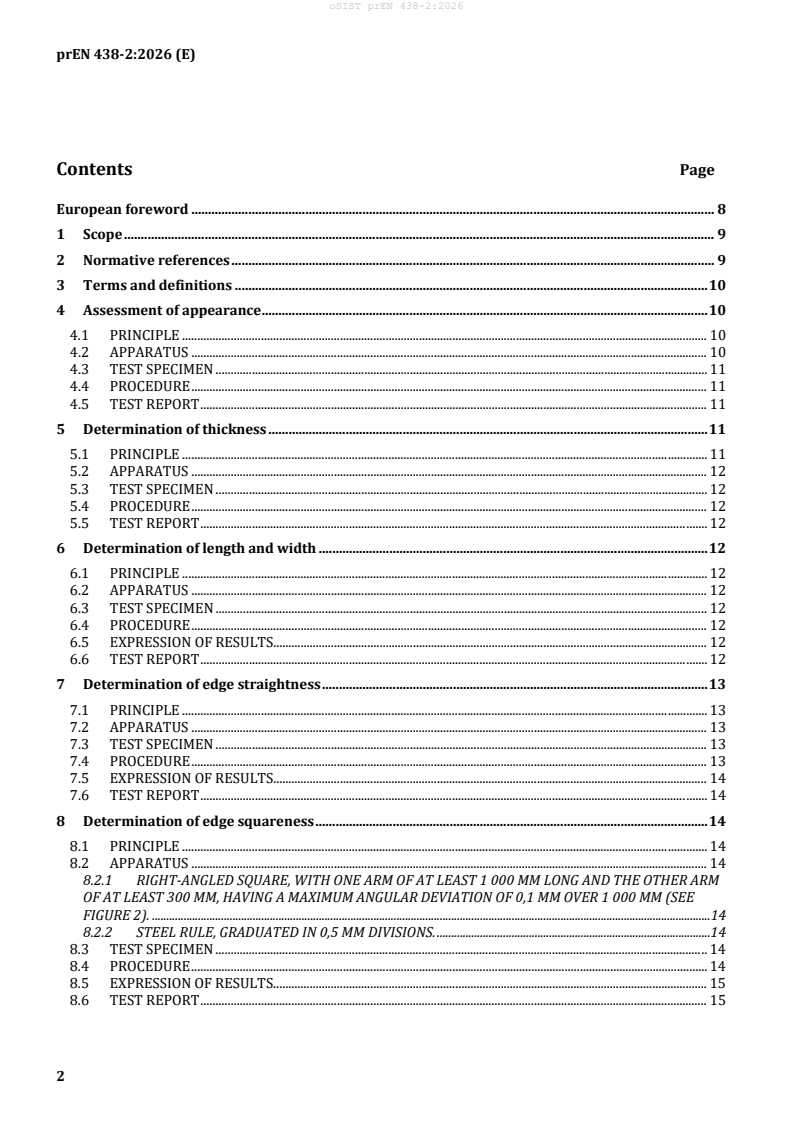
Contents Page
European foreword . 8
1 Scope . 9
2 Normative references . 9
3 Terms and definitions . 10
4 Assessment of appearance . 10
4.1 PRINCIPLE . 10
4.2 APPARATUS . 10
4.3 TEST SPECIMEN . 11
4.4 PROCEDURE . 11
4.5 TEST REPORT . 11
5 Determination of thickness . 11
5.1 PRINCIPLE . 11
5.2 APPARATUS . 12
5.3 TEST SPECIMEN . 12
5.4 PROCEDURE . 12
5.5 TEST REPORT . 12
6 Determination of length and width . 12
6.1 PRINCIPLE . 12
6.2 APPARATUS . 12
6.3 TEST SPECIMEN . 12
6.4 PROCEDURE . 12
6.5 EXPRESSION OF RESULTS. 12
6.6 TEST REPORT . 12
7 Determination of edge straightness . 13
7.1 PRINCIPLE . 13
7.2 APPARATUS . 13
7.3 TEST SPECIMEN . 13
7.4 PROCEDURE . 13
7.5 EXPRESSION OF RESULTS. 14
7.6 TEST REPORT . 14
8 Determination of edge squareness . 14
8.1 PRINCIPLE . 14
8.2 APPARATUS . 14
8.2.1 RIGHT-ANGLED SQUARE, WITH ONE ARM OF AT LEAST 1 000 MM LONG AND THE OTHER ARM
OF AT LEAST 300 MM, HAVING A MAXIMUM ANGULAR DEVIATION OF 0,1 MM OVER 1 000 MM (SEE
FIGURE 2). .14
8.2.2 STEEL RULE, GRADUATED IN 0,5 MM DIVISIONS. .14
8.3 TEST SPECIMEN . 14
8.4 PROCEDURE . 14
8.5 EXPRESSION OF RESULTS. 15
8.6 TEST REPORT . 15
9 Determination of flatness .15
9.1 PRINCIPLE . 15
9.2 APPARATUS . 15
9.3 TEST SPECIMENS . 16
9.4 PROCEDURE . 16
9.5 EXPRESSION OF RESULTS . 16
9.6 TEST REPORT . 16
10 Resistance to surface wear.16
10.1 PRINCIPLE . 16
10.2 MATERIALS . 17
10.3 APPARATUS . 18
10.4 TEST SPECIMENS . 20
10.5 PREPARATION OF SPECIMENS AND ABRASIVE PAPER . 20
10.6 PROCEDURE . 20
10.6.1 PREPARATION OF ABRASIVE WHEELS . 20
10.6.2 CALIBRATION OF ABRASIVE PAPER . 20
10.6.3 ABRASION OF SPECIMEN . 20
10.7 EXPRESSION OF RESULTS . 21
10.8 TEST REPORT . 22
11 Resistance to abrasion (flooring grade laminates) .22
12 Resistance to immersion in boiling water .22
12.1 PRINCIPLE . 22
12.2 APPARATUS . 22
12.3 TEST SPECIMENS . 23
12.4 PROCEDURE . 23
12.5 EXPRESSION OF RESULTS . 23
12.5.1 CALCULATION . 23
12.5.2 SURFACE RATING SCALE . 24
12.5.3 EDGE RATING SCALE . 24
12.6 TEST REPORT . 25
13 Substrate protection against water vapour .25
13.1 PRINCIPLE . 25
13.2 APPARATUS . 25
13.3 TEST SPECIMENS . 25
13.4 PROCEDURE . 25
13.5 EXPRESSION OF RESULTS . 26
13.6 TEST REPORT . 26
14 Resistance to water vapour .27
14.1 PRINCIPLE . 27
14.2 APPARATUS . 27
14.3 TEST SPECIMEN . 27
14.4 PROCEDURE . 27
14.5 EXPRESSION OF RESULTS . 27
14.6 TEST REPORT . 28
15 Resistance to wet conditions (exterior grade laminates) .29
15.1 PRINCIPLE . 29
15.2 APPARATUS . 29
15.3 TEST SPECIMENS . 29
15.4 PROCEDURE . 29
15.5 EXPRESSION OF RESULTS . 30
15.5.1 CALCULATION .30
15.5.2 VISUAL EXAMINATION .30
15.6 TEST REPORT . 30
16 Resistance to dry heat . 31
16.1 PRINCIPLE . 31
16.2 APPARATUS AND MATERIALS . 31
16.3 TEST SPECIMEN . 33
16.4 TEST PROCEDURE. 33
16.5 EXAMINATION OF THE TEST SPECIMEN . 33
16.6 EXPRESSION OF RESULTS . 33
16.7 TEST REPORT . 34
17 Dimensional stability at elevated temperature . 34
17.1 PRINCIPLE . 34
17.2 APPARATUS . 34
17.3 TEST SPECIMENS . 35
17.4 PROCEDURE . 35
17.5 EXPRESSION OF RESULTS . 35
17.6 TEST REPORT . 36
18 Resistance to wet heat . 36
18.1 PRINCIPLE . 36
18.2 APPARATUS AND MATERIALS . 37
18.3 TEST SPECIMENS . 37
18.4 PROCEDURE . 38
18.5 EXPRESSION OF RESULTS . 38
18.6 TEST REPORT . 39
19 Resistance to climatic shock (exterior grade laminates) . 39
19.1 PRINCIPLE . 39
19.2 APPARATUS . 39
19.3 TEST SPECIMENS . 40
19.4 PROCEDURE . 40
19.5 EXPRESSION OF RESULTS . 41
19.5.1 FLEXURAL STRENGTH AND MODULUS OF ELASTICITY IN FLEXURE .41
19.5.2 APPEARANCE .41
19.6 TEST REPORT . 41
20 Resistance to impact by small-diameter ball . 42
20.1 PRINCIPLE . 42
20.2 MATERIALS . 42
20.3 APPARATUS . 42
20.4 TEST SPECIMENS . 45
20.5 CALIBRATION OF THE IMPACT TESTER . 45
20.6 PROCEDURE . 46
20.7 EXPRESSION OF RESULTS . 47
20.8 TEST REPORT . 47
21 Resistance to impact by large diameter ball . 47
21.1 PRINCIPLE . 47
21.2 MATERIALS . 48
21.3 APPARATUS . 48
21.4 TEST SPECIMENS . 48
21.5 PROCEDURE . 48
21.6 EXPRESSION OF RESULTS . 50
21.7 TEST REPORT . 51
22 Resistance to impact by large diameter ball (flooring grade laminates) .51
22.1 PRINCIPLE . 51
22.2 MATERIALS . 51
22.3 APPARATUS . 51
22.4 TEST SPECIMENS . 51
22.5 PROCEDURE . 52
22.6 EXPRESSION OF RESULTS . 52
22.7 TEST REPORT . 52
23 Resistance to cracking under stress (laminates ≤ 2 mm thick) .53
23.1 PRINCIPLE . 53
23.2 APPARATUS . 53
23.3 TEST SPECIMENS . 53
23.4 PROCEDURE . 55
23.5 EXPRESSION OF RESULTS . 55
23.6 TEST REPORT . 56
24 Resistance to crazing (compact laminates) .56
24.1 PRINCIPLE . 56
24.2 APPARATUS . 57
24.3 TEST SPECIMENS . 57
24.4 PROCEDURE . 57
24.5 EXPRESSION OF RESULTS . 57
24.6 TEST REPORT . 58
25 Resistance to scratching .59
25.1 PRINCIPLE . 59
25.2 MATERIALS . 59
25.3 APPARATUS . 59
25.4 CALIBRATION OF APPARATUS . 61
25.5 TEST SPECIMEN . 61
25.6 PROCEDURE . 61
25.7 EXPRESSION OF RESULTS . 65
25.8 TEST REPORT . 65
26 Resistance to staining .65
26.1 PRINCIPLE . 65
26.2 STAINING AGENTS . 65
26.3 APPARATUS AND MATERIALS . 67
26.4 TEST SPECIMENS . 69
26.5 TEST PROCEDURE . 69
26.6 EXAMINATION OF THE TEST PANEL . 69
26.7 ASSESSMENT OF RESULTS . 69
26.8 TEST REPORT . 70
27 Light fastness (Xenon arc) .70
27.1 PRINCIPLE . 70
27.2 APPARATUS . 71
27.3 TEST SPECIMENS . 71
27.4 PROCEDURE . 71
27.5 ASSESSMENT AND EXPRESSION OF RESULTS . 72
27.6 TEST REPORT . 72
28 Resistance to UV light (Exterior grade laminates) . 73
28.1 PRINCIPLE . 73
28.2 APPARATUS . 73
28.3 TEST SPECIMENS . 73
28.4 PROCEDURE . 73
28.5 EVALUATION AND EXPRESSION OF RESULTS . 73
28.5.1 GENERAL .73
28.5.2 CONTRAST .73
28.5.3 APPEARANCE .74
28.6 TEST REPORT . 74
29 Resistance to artificial weathering (Exterior grade laminates) . 74
29.1 PRINCIPLE . 74
29.2 APPARATUS . 74
29.3 TEST SPECIMENS . 75
29.4 PROCEDURE . 75
29.5 EXAMINATION AND EXPRESSION OF RESULTS . 76
29.5.1 GENERAL .76
29.5.2 CONTRAST .76
29.5.3 APPEARANCE .76
29.6 TEST REPORT . 76
30 Determination of the microscratch resistance . 77
30.1 PRINCIPLE . 77
30.2 APPARATUS AND MATERIALS . 77
30.3 ASSEMBLY AND MAINTENANCE OF THE MARTINDALE TESTER . 79
30.4 METHOD FOR CHECKING THE LISSAJOUS FIGURE . 79
30.5 PREPARATION AND CONDITIONING . 79
30.5.1 PREPARATION .79
30.5.2 TEST SURFACE .80
30.6 TEST PROCEDURE. 80
30.6.1 GENERAL .80
30.6.2 TESTING .80
30.7 CLASSIFICATION OF THE IMAGE AFTER SCRATCHING ACCORDING TO PROCEDURE B . 81
30.8 TEST REPORT . 82
31 Formability (Method A) . 83
31.1 PRINCIPLE . 83
31.2 APPARATUS . 83
31.3 TEST SPECIMENS . 83
31.4 PROCEDURE . 84
31.4.1 CALIBRATION OF TEST APPARATUS .84
31.4.2 TEST PROCEDURE .85
31.5 TEST REPORT . 86
32 Formability (Method B) . 86
32.1 PRINCIPLE . 86
32.2 APPARATUS .
...