


prEN ISO 25475
(Main)Fertilizers - Determination of ammoniacal nitrogen (ISO 25475:2016)
Fertilizers - Determination of ammoniacal nitrogen (ISO 25475:2016)
ISO 25475:2016 specifies a method for the determination of the ammoniacal nitrogen content in fertilizers. The method is applicable to all nitrogenous fertilizers including compound fertilizers, in which nitrogen is found exclusively either in the form of ammonium salts or ammonium salts together with nitrates.
ISO 25475:2016 is not applicable to fertilizers containing urea, cyanamide or other organic nitrogenous compounds.
Düngemittel - Bestimmung von Ammoniumstickstoff (ISO 25475:2016)
Engrais - Détermination de l'azote ammoniacal (ISO 25475:2016)
La présente Norme internationale spécifie une méthode permettant de déterminer la teneur en azote ammoniacal dans les engrais. La méthode est applicable à tous les engrais azotés, y compris les engrais composés, dans lesquels l'azote se trouve exclusivement sous forme de sels d'ammonium ou de sels d'ammonium associés à des nitrates.
La présente Norme internationale ne s'applique pas aux engrais contenant de l'urée, de la cyanamide ou d'autres composés organiques azotés.
Gnojila - Določevanje amonijevega dušika (ISO 25475:2016)
General Information
- Status
- Not Published
- Publication Date
- 03-Mar-2021
- Technical Committee
- CEN/TC 260 - Fertilizers and liming materials
- Drafting Committee
- CEN/TC 260/WG 7 - Chemical analysis
- Current Stage
- 4098 - Decision to abandon - Enquiry
- Start Date
- 07-Jan-2020
- Completion Date
- 11-Feb-2026
Overview
The prEN ISO 25475:2016 standard, titled Fertilizers - Determination of ammoniacal nitrogen, is an important international standard developed by ISO and adopted by CEN. This standard specifies a precise laboratory method for measuring the ammoniacal nitrogen content in various nitrogenous fertilizers. Its scope covers fertilizers where nitrogen is present exclusively as ammonium salts or ammonium salts combined with nitrates but excludes those containing urea, cyanamide, or other organic nitrogen compounds.
This standard is critical for laboratories, fertilizer manufacturers, quality control personnel, and regulatory authorities requiring reliable and reproducible analysis of ammoniacal nitrogen, which is a key nutrient parameter influencing fertilizer quality and efficacy.
Key Topics
Scope of Application
Applicable to all nitrogenous fertilizers with nitrogen as ammonium salts and nitrates; excludes organic nitrogen fertilizers (e.g., urea-containing).Analytical Principle
The method involves the displacement of ammonia by adding an excess of sodium hydroxide, followed by distillation. The released ammonia reacts with a standard sulfuric acid solution, and the excess acid is titrated with a sodium or potassium hydroxide solution to quantify ammoniacal nitrogen content.Reagents
The standard prescribes the use of analytical-grade reagents such as hydrochloric acid, sulfuric acid at various molarities, sodium or potassium hydroxide solutions free of carbonate, and specific indicator solutions (mixed indicator or methyl red).Apparatus
Detailed descriptions and illustrations of the distillation apparatus show requirements for borosilicate glassware including flasks, condensers, splash heads, funnels with PTFE taps, and collection flasks. Use of an automatic distillation apparatus is permissible if comparable results are obtained.Sampling and Preparation
Although specific sampling is outside the standard’s method, it references ISO 14820 series for sampling and sample preparation methods to ensure representativeness and consistency.Procedure Highlights
Includes sample weighing, solution preparation with hydrochloric acid, filtration, water dilution, and rotary shaking. The aliquot for distillation is precisely measured, and the ammonia distilled off is quantitatively assessed via titration.Quality Control
Instructions for performing blank tests, control experiments, and calculations ensure accuracy and precision. Inter-laboratory test data confirm repeatability and reproducibility of results.
Applications
Fertilizer Quality Control
Enables fertilizer producers to validate ammoniacal nitrogen levels, ensuring compliance with nutrient content declarations and regulatory requirements.Agricultural Laboratories
Supports agronomists and soil scientists by providing reliable data on nitrogen forms available in fertilizers, essential for nutrient management planning.Regulatory Compliance
Assists regulatory agencies in monitoring fertilizer products to protect farmers and the environment from mislabelled or substandard products.Research and Development
Supports fertilizer formulation development and optimization by providing a standard testing method to compare ammoniacal nitrogen content.
Related Standards
ISO 14820-1 and ISO 14820-2: Sampling and sample preparation of fertilizers and liming materials - referenced for proper sample handling to ensure representative testing.
ISO 3696: Specifies water quality for analytical laboratory use, important for reagent and solution preparations in the ammoniacal nitrogen determination.
EN 12944 Parts 1 & 2: Vocabulary related to fertilizers and liming materials, ensuring consistent terminology and definitions across standards.
ISO/IEC Directives Parts 1 & 2: Guidelines on preparing and maintaining ISO standards, ensuring prEN ISO 25475 aligns with international standardization practices.
Keywords: ammoniacal nitrogen determination, fertilizer analysis, nitrogenous fertilizers, ISO 25475, fertilizer quality control, ammonium nitrogen testing, fertilizer standard, nitrogen measurement method, laboratory analytical methods, fertilizer sampling and preparation.

Get Certified
Connect with accredited certification bodies for this standard

Control Union Certifications
Global certification for agriculture and sustainability.

ECOCERT
Organic and sustainability certification.

Rainforest Alliance Certification
Sustainable agriculture and forestry certification.
Sponsored listings
Frequently Asked Questions
prEN ISO 25475 is a draft published by the European Committee for Standardization (CEN). Its full title is "Fertilizers - Determination of ammoniacal nitrogen (ISO 25475:2016)". This standard covers: ISO 25475:2016 specifies a method for the determination of the ammoniacal nitrogen content in fertilizers. The method is applicable to all nitrogenous fertilizers including compound fertilizers, in which nitrogen is found exclusively either in the form of ammonium salts or ammonium salts together with nitrates. ISO 25475:2016 is not applicable to fertilizers containing urea, cyanamide or other organic nitrogenous compounds.
ISO 25475:2016 specifies a method for the determination of the ammoniacal nitrogen content in fertilizers. The method is applicable to all nitrogenous fertilizers including compound fertilizers, in which nitrogen is found exclusively either in the form of ammonium salts or ammonium salts together with nitrates. ISO 25475:2016 is not applicable to fertilizers containing urea, cyanamide or other organic nitrogenous compounds.
prEN ISO 25475 is classified under the following ICS (International Classification for Standards) categories: 65.080 - Fertilizers. The ICS classification helps identify the subject area and facilitates finding related standards.
prEN ISO 25475 is available in PDF format for immediate download after purchase. The document can be added to your cart and obtained through the secure checkout process. Digital delivery ensures instant access to the complete standard document.
Standards Content (Sample)
SLOVENSKI STANDARD
01-junij-2019
Gnojila - Določevanje amonijevega dušika (ISO 25475:2016)
Fertilizers - Determination of ammoniacal nitrogen (ISO 25475:2016)
Düngemittel - Bestimmung von Ammoniumstickstoff
Engrais - Détermination de l'azote ammoniacal (ISO 25475:2016)
Ta slovenski standard je istoveten z: prEN ISO 25475
ICS:
65.080 Gnojila Fertilizers
2003-01.Slovenski inštitut za standardizacijo. Razmnoževanje celote ali delov tega standarda ni dovoljeno.
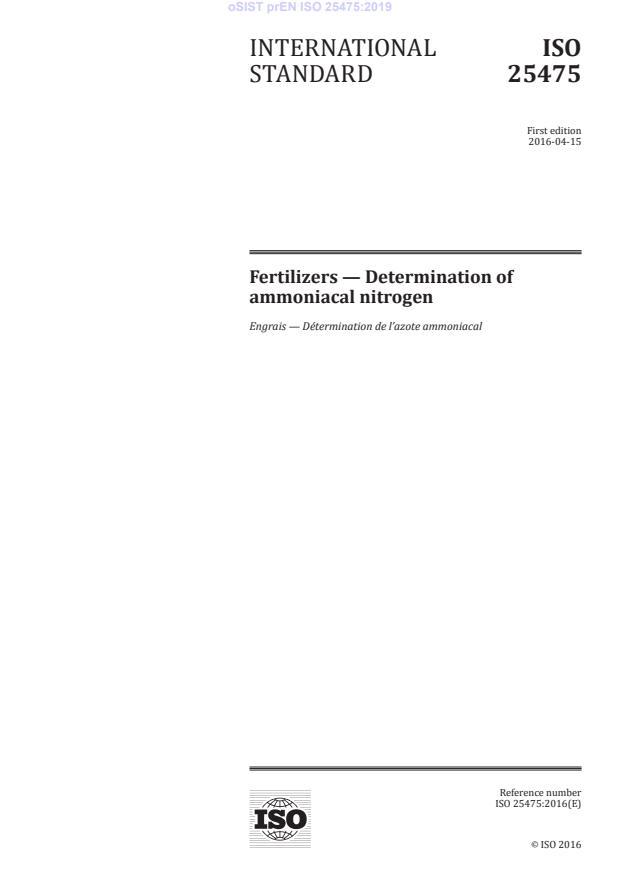
INTERNATIONAL ISO
STANDARD 25475
First edition
2016-04-15
Fertilizers — Determination of
ammoniacal nitrogen
Engrais — Détermination de l’azote ammoniacal
Reference number
ISO 25475:2016(E)
©
ISO 2016
ISO 25475:2016(E)
© ISO 2016, Published in Switzerland
All rights reserved. Unless otherwise specified, no part of this publication may be reproduced or utilized otherwise in any form
or by any means, electronic or mechanical, including photocopying, or posting on the internet or an intranet, without prior
written permission. Permission can be requested from either ISO at the address below or ISO’s member body in the country of
the requester.
ISO copyright office
Ch. de Blandonnet 8 • CP 401
CH-1214 Vernier, Geneva, Switzerland
Tel. +41 22 749 01 11
Fax +41 22 749 09 47
copyright@iso.org
www.iso.org
ii © ISO 2016 – All rights reserved
ISO 25475:2016(E)
Contents Page
Foreword .iv
1 Scope . 1
2 Normative references . 1
3 Terms and definitions . 1
4 Principle . 1
5 Reagents . 1
6 Apparatus . 2
7 Sampling and sample preparation . 7
8 Procedure. 7
8.1 Preparation of the solution . 7
8.2 Analysis of the solution . 7
8.3 Blank . 9
8.4 Control test . 9
9 Calculation and expression of the result . 9
10 Precision . 9
10.1 Inter-laboratory test. 9
10.2 Repeatability . 9
10.3 Reproducibility .10
11 Test report .10
Annex A (informative) Results of the inter-laboratory tests .11
Bibliography .12
ISO 25475:2016(E)
Foreword
ISO (the International Organization for Standardization) is a worldwide federation of national standards
bodies (ISO member bodies). The work of preparing International Standards is normally carried out
through ISO technical committees. Each member body interested in a subject for which a technical
committee has been established has the right to be represented on that committee. International
organizations, governmental and non-governmental, in liaison with ISO, also take part in the work.
ISO collaborates closely with the International Electrotechnical Commission (IEC) on all matters of
electrotechnical standardization.
The procedures used to develop this document and those intended for its further maintenance are
described in the ISO/IEC Directives, Part 1. In particular the different approval criteria needed for the
different types of ISO documents should be noted. This document was drafted in accordance with the
editorial rules of the ISO/IEC Directives, Part 2 (see www.iso.org/directives).
Attention is drawn to the possibility that some of the elements of this document may be the subject of
patent rights. ISO shall not be held responsible for identifying any or all such patent rights. Details of
any patent rights identified during the development of the document will be in the Introduction and/or
on the ISO list of patent declarations received (see www.iso.org/patents).
Any trade name used in this document is information given for the convenience of users and does not
constitute an endorsement.
For an explanation on the meaning of ISO specific terms and expressions related to conformity assessment,
as well as information about ISO’s adherence to the World Trade Organization (WTO) principles in the
Technical Barriers to Trade (TBT) see the following URL: www.iso.org/iso/foreword.html.
ISO 25475 was prepared by CEN/TC 260 as EN 15475:2009 and was adopted (without modification
other than those stipulated below) by Technical Committee ISO/TC 134, Fertilizers and soil conditioners.
Modifications were made in the following subclauses:
a) General: The references to EN 1482-1 and -2 were changed to ISO 14820-1 and -2;
b) 5.9: added “mass fraction”;
c) 5.12: p.a. = pro analysis = analytical grade;
d) 6.1: First two sentences joined together.
e) 6.4: “35 to 40 revolutions per minute” was changed to “35 r/min to 40 r/min”;
f) 8.1: “Filter through a filter into a 500 ml graduated flask and make up to the volume with water”
was changed to “Pass the solution through a filter into a 500 ml graduated flask and make up to the
volume with water”;
g) 8.2, Table 3: “F = factor comprising the amount weighed, the dilution, the aliquot part of solution of
the sample to be distilled and the volumetric equivalent. expressed as percentage of ammoniacal
nitrogen in the fertilizer” was changed to “F = factor comprising the amount weighed, the dilution,
the aliquot part of the solution of the sample to be distilled and the volumetric equivalent”.
h) 10.1 Line 1: “Test was carried out in 2004 with 24, respectively 22 participating labs” was changed
to “A test was carried out in 2004 with 24 participating labs”;
i) Bibliography: Reference [3] was removed.
iv © ISO 2016 – All rights reserved
INTERNATIONAL STANDARD ISO 25475:2016(E)
Fertilizers — Determination of ammoniacal nitrogen
1 Scope
This International Standard specifies a method for the determination of the ammoniacal nitrogen
content in fertilizers. The method is applicable to all nitrogenous fertilizers including compound
fertilizers, in which nitrogen is found exclusively either in the form of ammonium salts or ammonium
salts together with nitrates.
This International Standard is not applicable to fertilizers containing urea, cyanamide or other organic
nitrogenous compounds.
2 Normative references
The following documents, in whole or in part, are normatively referenced in this document and are
indispensable for its application. For dated references, only the edition cited applies. For undated
references, the latest edition of the referenced document (including any amendments) applies.
ISO 3696, Water for analytical laboratory use — Specification and test methods
ISO 14820-2, Fertilizers and liming materials — Sampling and sample preparation — Part 2: Sample
preparation
EN 12944-1, Fertilizers and liming materials — Vocabulary — Part 1: General terms
EN 12944-2, Fertilizers and liming materials — Vocabulary — Part 2: Terms relating to fertilizers
3 Terms and definitions
For the purposes of this document, the terms and definitions given in EN 12944-1 and EN 12944-2 apply.
4 Principle
Displacement of ammonia by means of an excess of sodium hydroxide, distillation and determining the
yield of ammonia in a given volume of a standard sulfuric acid and titration of the excess acid by means
of a standard solution of sodium or potassium hydroxide.
5 Reagents
5.1 General
Use only reagents of recognized analytical grade and distilled or demineralized water, free from carbon
dioxide and all nitrogenous compounds (grade 3 according to ISO 3696).
5.2 Hydrochloric acid, diluted. Mix one volume of ρ(HCl) = 1,18 g/ml with one volume of water.
5.3 Sulfuric acid (for variant a), c = 0,05 mol/l.
5.4 Sodium or potassium hydroxide solution (for variant a), carbonate free, c = 0,1 mol/l.
5.5 Sulfuric acid (for variant b, see NOTE in 8.2), c = 0,1 mol/l.
ISO 25475:2016(E)
5.6 Sodium or potassium hydroxide solution (for variant b, see NOTE in 8.2), carbonate free,
c = 0,2 mol/l.
5.7 Sulfuric acid (for variant c, see NOTE in 8.2), c = 0,25 mol/l.
5.8 Sodium or potassium hydroxide solution (for variant c, see NOTE in 8.2), carbonate free,
c = 0,5 mol/l.
5.9 Sodium hydroxide, 30 % (mass fraction), of approximately ρ(NaOH) = 1,33 g/ml, ammonia free.
5.10 Indicator solutions.
5.10.1 Mixed indicator.
Solution A: Dissolve 1 g of methyl red in 37 ml of sodium hydroxide solution (5.4) c = 0,1 mol/l and make
up to 1 l with water.
Solution B: Dissolve 1 g of methylene blue in water and make up to 1 l.
Mix one volume of A with two volumes of B.
This indicator is violet in acid solution, grey in neutral solution and green in alkaline solution. Use 0,5 ml
(10 drops) of this indicator solution.
5.10.2 Methyl red indicator solution.
Dissolve 0,1 g of methyl red in 50 ml of 95 % ethanol. Make up to 100 ml with water and filter if
necessary. This indicator may be used (four to five drops) instead of the preceding one. This indicator is
red in acid solution and yellow in alkaline solution.
5.11 Anti-bump granules (i. e. pumice stone, glass pearls), washed in hydrochloric acid and calcined.
5.12 Ammonium sulfate, p. a. (p.a. = pro analysis = analytical grade).
6 Apparatus
6.1 Distillation apparatus
The equipment is made of borosilicate glass and consists of a round-bottomed flask of suitable capacity
connected to a condenser by means of a splash head.
The different types of equipment recommended for this determination are reproduced, showing all the
features of construction in Figures 1, 2, 3 and 4.
An automatic distillation apparatus may also be used, provided that the results are statistically
equivalent.
2 © ISO 2016 – All rights reserved
ISO 25475:2016(E)
Dimensions in millimetres
Key
1 round-bottomed, long-necked flask of 1 000 ml capacity
2 distillation tube with a splash head, connected to the condenser by means of a spherical joint (No 18) (the
spherical joint
...
Questions, Comments and Discussion
Ask us and Technical Secretary will try to provide an answer. You can facilitate discussion about the standard in here.
Loading comments...