


EN 338:2009
(Main)Structural timber - Strength classes
Structural timber - Strength classes
This European Standard establishes a system of strength classes for general use in structural codes.
It gives characteristic strength and stiffness properties and density values for each class and the rules for the allocation of timber populations (i.e. combinations of species, source and grade) to the classes.
This standard is applicable to all softwood and hardwood timber for structural use.
Bauholz für tragende Zwecke - Festigkeitsklassen
Diese Europäische Norm legt ein System von Festigkeitsklassen für den allgemeinen Gebrauch in Bemessungsnormen fest.
Sie gibt charakteristische Werte der Festigkeit, Steifigkeit und Rohdichte für jede Klasse sowie Regeln für die Zuordnung von Holzgrundgesamtheiten (d. h. Kombinationen von Holzarten, Herkunft und Sortierklasse) zu den Klassen an.
Diese Norm gilt für alle Nadel- und Laubhölzer für tragende Zwecke.
Bois de structure - Classes de résistance
La présente norme établit un système de classes de résistance d’utilisation générale pour les codes de calculs de structures.
Elle donne, pour chaque classe, les valeurs caractéristiques des propriétés de résistance et de rigidité et les valeurs de masse volumique, ainsi que les règles d'affectation des populations de bois (c’est-à-dire les combinaisons d’essences, de provenance et de qualités) aux classes.
Cette norme s’applique à tous les bois résineux et feuillus à usage structurel.
Konstrukcijski les - Trdnostni razredi
Ta evropski standard vzpostavlja sistem trdnostnih razredov za splošno uporabo v konstrukcijskih kodeksih. Podaja značilne trdnostne lastnosti in lastnosti togosti ter vrednosti gostote za vsak razred, ter pravila za dodeljevanje populacij lesa (t.j. kombinacij vrst, vira in stopnje) v razrede. Ta standard se uporablja za ves mehki les in trdi les, ki se uporablja za konstrukcije.
General Information
- Status
- Withdrawn
- Publication Date
- 27-Oct-2009
- Withdrawal Date
- 13-Apr-2025
- Technical Committee
- CEN/TC 124 - Timber structures
- Drafting Committee
- CEN/TC 124/WG 2 - Solid timber
- Current Stage
- 9960 - Withdrawal effective - Withdrawal
- Start Date
- 06-Apr-2016
- Completion Date
- 14-Apr-2025
Relations
- Effective Date
- 22-Dec-2008
- Effective Date
- 08-Jun-2022

Frequently Asked Questions
EN 338:2009 is a standard published by the European Committee for Standardization (CEN). Its full title is "Structural timber - Strength classes". This standard covers: This European Standard establishes a system of strength classes for general use in structural codes. It gives characteristic strength and stiffness properties and density values for each class and the rules for the allocation of timber populations (i.e. combinations of species, source and grade) to the classes. This standard is applicable to all softwood and hardwood timber for structural use.
This European Standard establishes a system of strength classes for general use in structural codes. It gives characteristic strength and stiffness properties and density values for each class and the rules for the allocation of timber populations (i.e. combinations of species, source and grade) to the classes. This standard is applicable to all softwood and hardwood timber for structural use.
EN 338:2009 is classified under the following ICS (International Classification for Standards) categories: 79.040 - Wood, sawlogs and sawn timber. The ICS classification helps identify the subject area and facilitates finding related standards.
EN 338:2009 has the following relationships with other standards: It is inter standard links to EN 338:2003, EN 338:2016. Understanding these relationships helps ensure you are using the most current and applicable version of the standard.
You can purchase EN 338:2009 directly from iTeh Standards. The document is available in PDF format and is delivered instantly after payment. Add the standard to your cart and complete the secure checkout process. iTeh Standards is an authorized distributor of CEN standards.
Standards Content (Sample)
2003-01.Slovenski inštitut za standardizacijo. Razmnoževanje celote ali delov tega standarda ni dovoljeno.Konstrukcijski les - Trdnostni razrediBauholz für tragende Zwecke - FestigkeitsklassenBois de structure - Classes de résistanceStructural timber - Strength classes79.040Les, hlodovina in žagan lesWood, sawlogs and sawn timberICS:Ta slovenski standard je istoveten z:EN 338:2009SIST EN 338:2010en,fr,de01-april-2010SIST EN 338:2010SLOVENSKI
STANDARDSIST EN 338:20041DGRPHãþD
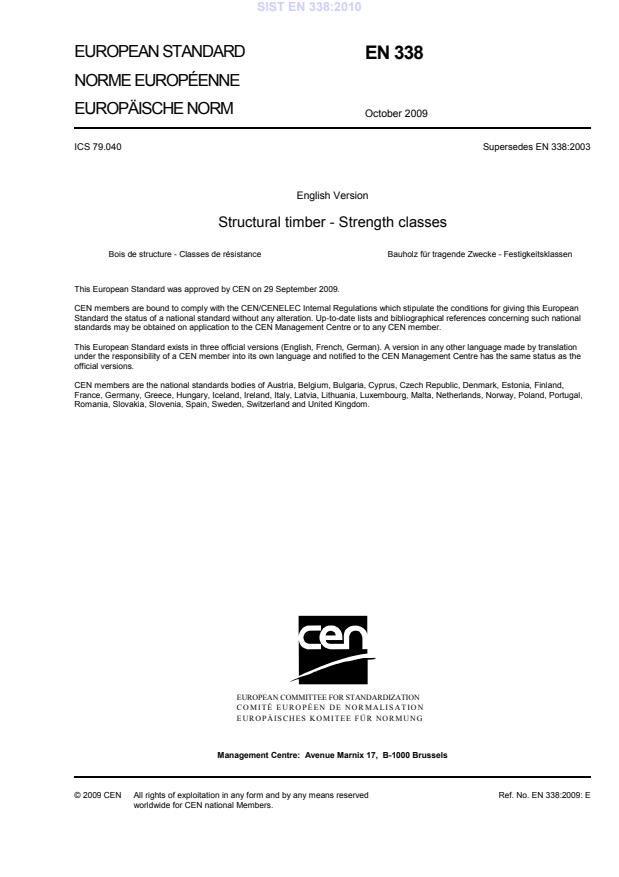
EUROPEAN STANDARD NORME EUROPÉENNE EUROPÄISCHE NORM
EN 338
October 2009 ICS 79.040 Supersedes EN 338:2003English Version
Structural timber - Strength classes
Bois de structure - Classes de résistance
Bauholz für tragende Zwecke - Festigkeitsklassen This European Standard was approved by CEN on 29 September 2009.
CEN members are bound to comply with the CEN/CENELEC Internal Regulations which stipulate the conditions for giving this European Standard the status of a national standard without any alteration. Up-to-date lists and bibliographical references concerning such national standards may be obtained on application to the CEN Management Centre or to any CEN member.
This European Standard exists in three official versions (English, French, German). A version in any other language made by translation under the responsibility of a CEN member into its own language and notified to the CEN Management Centre has the same status as the official versions.
CEN members are the national standards bodies of Austria, Belgium, Bulgaria, Cyprus, Czech Republic, Denmark, Estonia, Finland, France, Germany, Greece, Hungary, Iceland, Ireland, Italy, Latvia, Lithuania, Luxembourg, Malta, Netherlands, Norway, Poland, Portugal, Romania, Slovakia, Slovenia, Spain, Sweden, Switzerland and United Kingdom.
EUROPEAN COMMITTEE FOR STANDARDIZATION
COMITÉ EUROPÉEN DE NORMALISATION EUROPÄISCHES KOMITEE FÜR NORMUNG
Management Centre:
Avenue Marnix 17,
B-1000 Brussels © 2009 CEN All rights of exploitation in any form and by any means reserved worldwide for CEN national Members. Ref. No. EN 338:2009: ESIST EN 338:2010
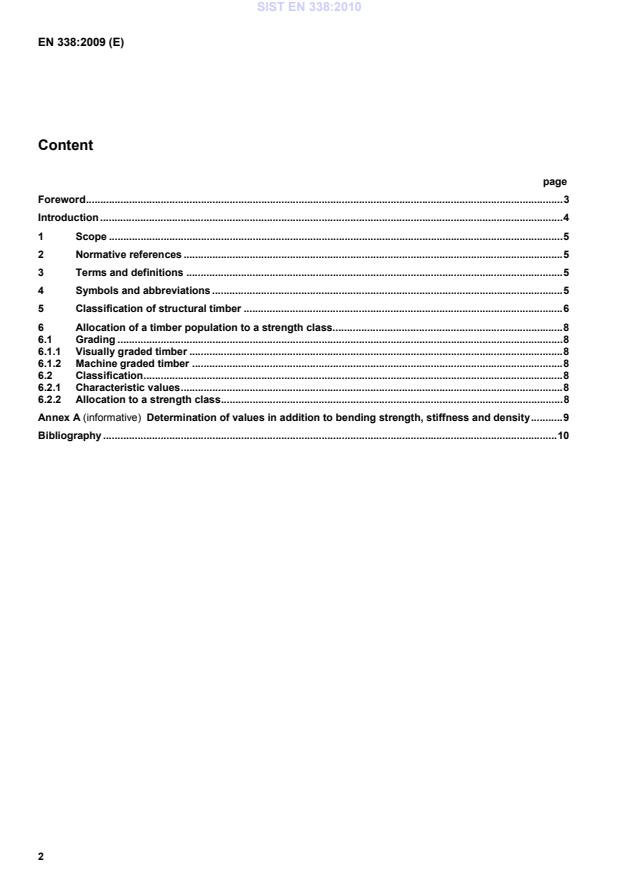
Determination of values in addition to bending strength, stiffness and density . 9Bibliography . 10 SIST EN 338:2010
Due to variations in the type and quality of timber available, the variety of end uses and the size of production output of the local timber industry, many different combinations of species and strength grade exist with different strength properties, which therefore complicate the design and specification of timber structures. A strength class system groups together grades and species with similar strength properties thus making them interchangeable. This then permits an engineer to specify a chosen strength class and use the characteristic strength values of that class in design calculations.
Advantages of the strength class system are:
a) Additional species/grades can be incorporated into the system at any time without affecting existing specifications for structural timber.
b) At the time of carrying out design calculations, an engineer need not be aware of the costs and availability of alternative species and grades. He can simply design using the strength, stiffness and density values of a particular class and then specify that class; he can then use the tenders to select the most suitable and economic species/grade on offer. Note that, where a particular species is not acceptable (e.g. for reasons of durability) for a project, the specification needs to make
...
The EN 338:2009 standard, titled "Structural timber - Strength classes," plays a crucial role in the construction industry by providing a comprehensive system for the classification of strength properties of timber. The scope of this standard is significant, as it establishes clear guidelines for the allocation of timber to various strength classes based on characteristic strength, stiffness properties, and density values. This is essential for ensuring the structural integrity and safety of timber used in construction. One of the strengths of EN 338:2009 is the detailed classification system it offers, which includes both softwood and hardwood timber. By defining specific strength classes, this standard facilitates a uniform approach to timber grading across Europe, allowing for consistency in structural codes and regulations. This uniformity is particularly relevant in an era where sustainable building practices and material efficiency are increasingly emphasized. The standard helps end-users make informed decisions regarding timber selection, ensuring that the appropriate strength class is chosen for the intended structural application. Furthermore, the standard’s rules for the allocation of timber populations, encompassing combinations of species, source, and grade, highlight its thoroughness. This aspect allows for a more precise matching of timber materials to structural requirements, thereby minimizing risks related to structural failures. The inclusion of characteristic values for strength and stiffness also aids engineers and architects in designing safe and efficient timber structures. Overall, EN 338:2009 serves as an indispensable reference for structural timber applications, reinforcing its relevance as it aligns with contemporary engineering practices and sustainability goals. The clarity and comprehensiveness of the standard make it a valuable resource for professionals working with timber in structural contexts.
EN 338:2009は、構造用木材に関する強度クラスを定義するヨーロッパの標準規格であり、その範囲は非常に広範囲にわたります。この標準は、構造コードにおける一般的な使用のための強度クラスのシステムを確立しており、各クラスに対して特性強度、剛性特性、密度値を提供しています。これにより、設計者やエンジニアは、異なる種類の木材を適切に評価し、選択する際の信頼性の高い基準を持つことができます。 この標準の強みとしては、全ての針葉樹および広葉樹の構造用途に適用可能である点が挙げられます。これにより、様々な地域や市場で使用される木材に対して一貫した評価基準を提供し、国際的な取引を促進します。また、木材の種、出所、等級の組み合わせに基づくクラスへの配分ルールが明確に規定されているため、多様な木材資源を有効に活用することが可能です。 さらに、EN 338:2009は、木材の強度と剛性に関する明確な特性を示すことで、設計の信頼性を向上させる役割を果たしています。この標準の適用により、安全で効率的な構造物の設計が実現され、建築業界における持続可能性にも寄与しています。全体として、EN 338:2009は、構造用木材の標準として非常に重要で、広く受け入れられる信頼性の高い資源となっています。
SIST EN 338:2010 표준은 구조 목재의 강도 클래스를 규정하는 유럽 표준으로, 구조 코드에서 일반적으로 사용되는 강도 클래스 체계를 세우고 있습니다. 이 표준은 각 클래스에 대한 특성 강도 및 강성 속성과 밀도 값을 명시하고 있으며, 목재 집합체(즉, 종, 출처 및 등급의 조합)를 클래스에 할당하는 규칙도 포함하고 있습니다. 이 표준의 주요 강점 중 하나는 구조용으로 사용되는 모든 연질 목재와 경질 목재에 적용 가능하다는 점입니다. 이를 통해 다양한 목재 종류와 특성을 효과적으로 분류하고 활용할 수 있어, 건축 및 구조물 설계에 있어 매우 중요한 기준이 됩니다. 더불어 EN 338:2009는 강도 클래스별로 고유한 강도 및 강성 값을 명확히 제공함으로써, 각 목재의 물리적 특성을 이해하고, 이를 기반으로 한 설계와 시공이 이루어질 수 있도록 돕습니다. 이러한 명확한 기준은 엔지니어와 설계자가 신뢰할 수 있는 데이터를 제공하며, 실질적인 구조 안전성 향상에도 기여합니다. 또한, 이 표준은 목재의 품질과 성능을 harmonize(조화)하며 유럽 전역에서 일관된 체크포인트를 제공함으로써, 다양한 지역적 요소와 요구 사항을 충족시킬 수 있도록 합니다. 이는 건축 산업에서의 표준화와 효율성을 높이는 데 큰 도움을 줍니다. 종합적으로 볼 때, SIST EN 338:2010은 구조 목재의 강도 클래스 체계를 효과적으로 정의하고 있으며, 건축 설계와 시공에 있어 매우 중요한 역할을 충실히 수행하고 있습니다.
Questions, Comments and Discussion
Ask us and Technical Secretary will try to provide an answer. You can facilitate discussion about the standard in here.
Loading comments...