

EN 384:2016+A2:2022
(Main + Amendment)Structural timber - Determination of characteristic values of mechanical properties and density
- Abstract
This European Standard gives a method for determining characteristic values of mechanical properties and density, for defined populations of visual grades and/or strength classes of machine graded structural timber. Additionally it covers the stages of sampling, testing, analysis and presentation of the data.
The standard provides methods to derive strength, stiffness and density properties for structural timber from tests with defect-free specimen.
The values determined in accordance with this standard for mechanical properties and density are suitable for assigning grades and species to the strength classes of EN 338.
NOTE 1 For assigning grades and species to the strength classes in EN 338 only three properties, i.e. bending or tension strength, modulus of elasticity parallel to grain in bending or tension and density need to be determined from test data, other properties can be calculated according to Table 2.
NOTE 2 EN 1912 gives examples of established visual grades assigned to strength classes.
- Status
- Published
- Publication Date
- 07-Jun-2022
- Withdrawal Date
- 30-Dec-2022
- Technical Committee
- CEN/TC 124 - Timber structures
- Drafting Committee
- CEN/TC 124/WG 2 - Solid timber
- Current Stage
- 6060 - Definitive text made available (DAV) - Publishing
- Start Date
- 08-Jun-2022
- Completion Date
- 08-Jun-2022



Overview
EN 384:2016+A2:2022 - Structural timber - Determination of characteristic values of mechanical properties and density - is a CEN European standard that specifies how to derive characteristic values (e.g., 5-percentile strengths and mean moduli) for populations of structural timber. The standard covers the full workflow: sampling, testing, data analysis and presentation of results for visual grades and machine-graded timber. Values determined in accordance with EN 384 are suitable for assigning grades and species to the strength classes of EN 338.
Key topics and requirements
- Scope: Methods to derive strength, stiffness (modulus of elasticity) and density from tests of defect‑free specimens for structural timber.
- Sampling: Representative sampling of a defined timber population; samples should reflect commercial practices and sources (sawmills, tree size, origin). For visual grading, each sub‑sample requires at least 40 specimens.
- Testing: Mechanical tests performed in accordance with EN 408 (bending, tension, modulus of elasticity, density, moisture content). A critical section in each piece is selected where failure is expected.
- Reference conditions: Results are referenced to environmental conditions (20 °C and 65 % RH - normally ~12 % moisture content).
- Adjustment factors: Corrections for moisture content, specimen size and test length, and modulus of elasticity; methods to use historical test data when properly adjusted.
- Data analysis: Procedures for sub‑sample analysis, calculation of characteristic 5‑percentile values for strength and density, and mean values for modulus of elasticity. The standard allows reduction factors to account for lower confidence with limited test data.
- Practical test details: Minimum specimen lengths (e.g., for bending: at least 30× the depth or 3.6 m, whichever is lesser; for tension: at least 2 m plus grips) and requirements for clear specimens for perpendicular or shear tests.
Applications and users
- Useful for: Timber testing laboratories, timber manufacturers, machine and visual graders, product certification bodies, structural engineers and researchers.
- Practical uses: Assigning timber to EN 338 strength classes, validating machine‑grading systems (EN 14081 series), deriving design values for structural design, and supporting factory production control and quality assurance.
- Benefits: Ensures consistent, comparable characteristic property values across jurisdictions and supports reliable structural design and safety.
Related standards
- EN 338 - Structural timber: Strength classes
- EN 408 - Determination of physical and mechanical properties (test methods)
- EN 14081‑1/2/3 - Strength graded structural timber (machine grading)
- EN 13183‑2 / EN 13183‑3 - Moisture content estimation methods
- EN 1912 - Examples of visual grades assigned to strength classes
- EN 14358 - Calculation and verification of characteristic values
Keywords: EN 384:2016+A2:2022, structural timber, characteristic values, mechanical properties, density, modulus of elasticity, bending strength, sampling, EN 338, EN 408.
Relations
- Effective Date
- 19-Jan-2023
- Effective Date
- 18-Jan-2023
- Effective Date
- 22-Jul-2026
- Effective Date
- 22-Jul-2026
- Effective Date
- 28-Jan-2026
- Effective Date
- 28-Jan-2026
- Effective Date
- 24-Jun-2026
- Referred By
EN 1912:2024 - Structural Timber - Strength classes - Assignment of visual grades and species - Effective Date
- 28-Jan-2026
- Effective Date
- 28-Jan-2026
- Effective Date
- 28-Jan-2026
- Effective Date
- 28-Jan-2026
- Effective Date
- 28-Jan-2026
- Effective Date
- 28-Jan-2026
- Effective Date
- 28-Jan-2026
- Referred By
EN 1912:2012 - Structural Timber - Strength classes - Assignment of visual grades and species - Effective Date
- 28-Jan-2026
Get Certified
Connect with accredited certification bodies for this standard

Gozdarski inštitut Slovenije
Slovenian Forestry Institute. Forest management certification support, timber testing.
Sponsored listings
Frequently Asked Questions
EN 384:2016+A2:2022 is a standard published by the European Committee for Standardization (CEN). Its full title is "Structural timber - Determination of characteristic values of mechanical properties and density". This standard covers: This European Standard gives a method for determining characteristic values of mechanical properties and density, for defined populations of visual grades and/or strength classes of machine graded structural timber. Additionally it covers the stages of sampling, testing, analysis and presentation of the data. The standard provides methods to derive strength, stiffness and density properties for structural timber from tests with defect-free specimen. The values determined in accordance with this standard for mechanical properties and density are suitable for assigning grades and species to the strength classes of EN 338. NOTE 1 For assigning grades and species to the strength classes in EN 338 only three properties, i.e. bending or tension strength, modulus of elasticity parallel to grain in bending or tension and density need to be determined from test data, other properties can be calculated according to Table 2. NOTE 2 EN 1912 gives examples of established visual grades assigned to strength classes.
This European Standard gives a method for determining characteristic values of mechanical properties and density, for defined populations of visual grades and/or strength classes of machine graded structural timber. Additionally it covers the stages of sampling, testing, analysis and presentation of the data. The standard provides methods to derive strength, stiffness and density properties for structural timber from tests with defect-free specimen. The values determined in accordance with this standard for mechanical properties and density are suitable for assigning grades and species to the strength classes of EN 338. NOTE 1 For assigning grades and species to the strength classes in EN 338 only three properties, i.e. bending or tension strength, modulus of elasticity parallel to grain in bending or tension and density need to be determined from test data, other properties can be calculated according to Table 2. NOTE 2 EN 1912 gives examples of established visual grades assigned to strength classes.
EN 384:2016+A2:2022 is classified under the following ICS (International Classification for Standards) categories: 79.040 - Wood, sawlogs and sawn timber. The ICS classification helps identify the subject area and facilitates finding related standards.
EN 384:2016+A2:2022 has the following relationships with other standards: It is inter standard links to EN 384:2016+A1:2018/FprA2, EN 384:2016+A1:2018, EN 13183-3:2005, EN 13183-2:2002, EN 14358:2016, EN 408:2010+A1:2012, EN 302-8:2023+A1:2026, EN 1912:2024, EN 338:2009, EN 14081-2:2018, EN 14081-1:2016, EN 14081-3:2012+A1:2018, EN 302-5:2023, EN 302-1:2023, EN 1912:2012. Understanding these relationships helps ensure you are using the most current and applicable version of the standard.
EN 384:2016+A2:2022 is available in PDF format for immediate download after purchase. The document can be added to your cart and obtained through the secure checkout process. Digital delivery ensures instant access to the complete standard document.
Standards Content (Sample)
SLOVENSKI STANDARD
01-september-2022
Konstrukcijski les - Ugotavljanje karakterističnih vrednosti mehanskih lastnosti in
gostote (vključno z dopolnilom A2)
Structural timber - Determination of characteristic values of mechanical properties and
density
Bauholz für tragende Zwecke - Bestimmung charakteristischer Werte für mechanische
Eigenschaften und Rohdichte
Bois de structure - Détermination des valeurs caractéristiques des propriétés
mécaniques et de la masse volumique
Ta slovenski standard je istoveten z: EN 384:2016+A2:2022
ICS:
79.040 Les, hlodovina in žagan les Wood, sawlogs and sawn
timber
91.080.20 Lesene konstrukcije Timber structures
2003-01.Slovenski inštitut za standardizacijo. Razmnoževanje celote ali delov tega standarda ni dovoljeno.
EN 384:2016+A2
EUROPEAN STANDARD
NORME EUROPÉENNE
June 2022
EUROPÄISCHE NORM
ICS 79.040 Supersedes EN 384:2016+A1:2018
English Version
Structural timber - Determination of characteristic values
of mechanical properties and density
Bois de structure - Détermination des valeurs Bauholz für tragende Zwecke - Bestimmung
caractéristiques des propriétés mécaniques et de la charakteristischer Werte für mechanische
masse volumique Eigenschaften und Rohdichte
This European Standard was approved by CEN on 8 October 2018 and includes Amendment 2 approved by CEN on 13 March
2022.
CEN members are bound to comply with the CEN/CENELEC Internal Regulations which stipulate the conditions for giving this
European Standard the status of a national standard without any alteration. Up-to-date lists and bibliographical references
concerning such national standards may be obtained on application to the CEN-CENELEC Management Centre or to any CEN
member.
This European Standard exists in three official versions (English, French, German). A version in any other language made by
translation under the responsibility of a CEN member into its own language and notified to the CEN-CENELEC Management
Centre has the same status as the official versions.
CEN members are the national standards bodies of Austria, Belgium, Bulgaria, Croatia, Cyprus, Czech Republic, Denmark, Estonia,
Finland, France, Germany, Greece, Hungary, Iceland, Ireland, Italy, Latvia, Lithuania, Luxembourg, Malta, Netherlands, Norway,
Poland, Portugal, Republic of North Macedonia, Romania, Serbia, Slovakia, Slovenia, Spain, Sweden, Switzerland, Turkey and
United Kingdom.
EUROPEAN COMMITTEE FOR STANDARDIZATION
COMITÉ EUROPÉEN DE NORMALISATION
EUROPÄISCHES KOMITEE FÜR NORMUNG
CEN-CENELEC Management Centre: Rue de la Science 23, B-1040 Brussels
© 2022 CEN All rights of exploitation in any form and by any means reserved Ref. No. EN 384:2016+A2:2022 E
worldwide for CEN national Members.
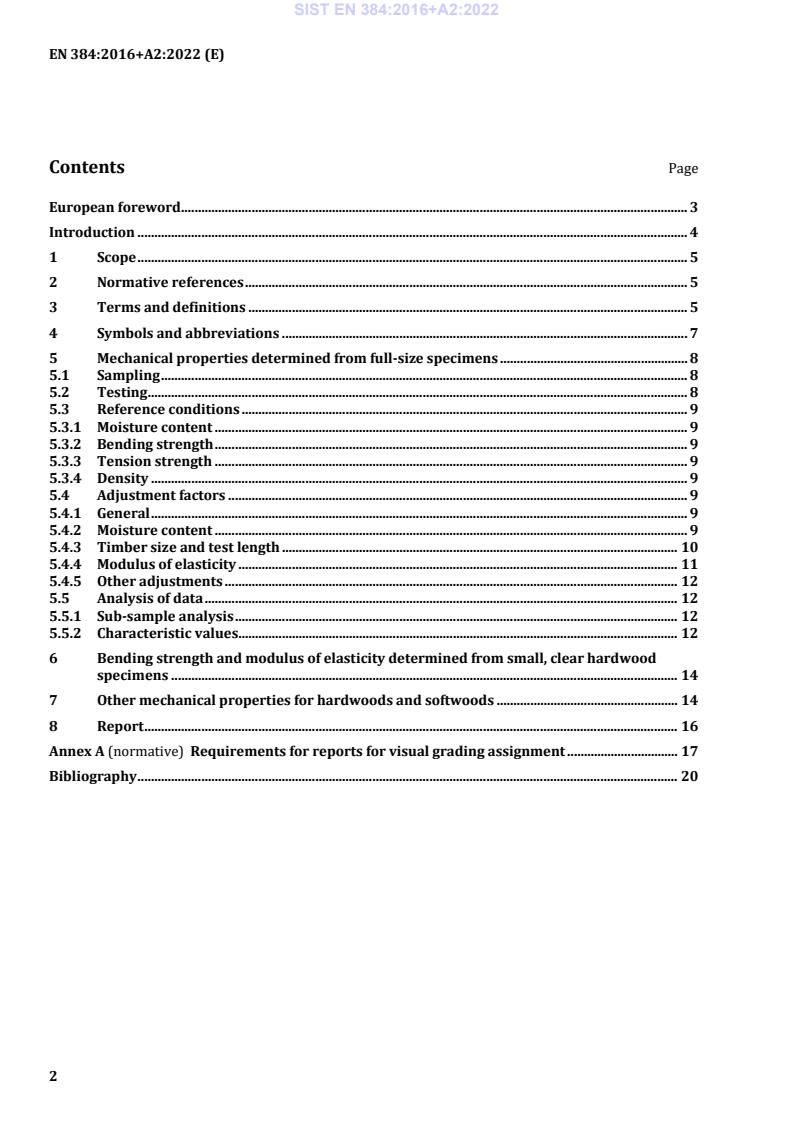
Contents Page
European foreword . 3
Introduction . 4
1 Scope . 5
2 Normative references . 5
3 Terms and definitions . 5
4 Symbols and abbreviations . 7
5 Mechanical properties determined from full-size specimens . 8
5.1 Sampling . 8
5.2 Testing . 8
5.3 Reference conditions . 9
5.3.1 Moisture content . 9
5.3.2 Bending strength . 9
5.3.3 Tension strength . 9
5.3.4 Density . 9
5.4 Adjustment factors . 9
5.4.1 General . 9
5.4.2 Moisture content . 9
5.4.3 Timber size and test length . 10
5.4.4 Modulus of elasticity . 11
5.4.5 Other adjustments . 12
5.5 Analysis of data . 12
5.5.1 Sub-sample analysis . 12
5.5.2 Characteristic values . 12
6 Bending strength and modulus of elasticity determined from small, clear hardwood
specimens . 14
7 Other mechanical properties for hardwoods and softwoods . 14
8 Report . 16
Annex A (normative) Requirements for reports for visual grading assignment . 17
Bibliography . 20
European foreword
This document (EN 384:2016+A2:2022) has been prepared by Technical Committee CEN/TC 124
“Timber structures”, the secretariat of which is held by AFNOR.
This European Standard shall be given the status of a national standard, either by publication of an
identical text or by endorsement, at the latest by December 2022, and conflicting national standards
shall be withdrawn at the latest by December 2022.
Attention is drawn to the possibility that some of the elements of this document may be the subject of
patent rights. CEN shall not be held responsible for identifying any or all such patent rights.
This document includes Amendment 1 approved by CEN on 8 October 2018 and Amendment 2
approved by CEN on 13 March 2022.
This document supersedes !EN 384:2016+A1:2018".
The start and finish of text introduced or altered by amendment is indicated in the text by tags !"
and #$.
!Deleted text"
Any feedback and questions on this document should be directed to the users’ national standards body.
A complete listing of these bodies can be found on the CEN website.
According to the CEN-CENELEC Internal Regulations, the national standards organisations of the
following countries are bound to implement this European Standard: Austria, Belgium, Bulgaria,
Croatia, Cyprus, Czech Republic, Denmark, Estonia, Finland, France, Germany, Greece, Hungary, Iceland,
Ireland, Italy, Latvia, Lithuania, Luxembourg, Malta, Netherlands, Norway, Poland, Portugal, Republic of
North Macedonia, Romania, Serbia, Slovakia, Slovenia, Spain, Sweden, Switzerland, Turkey and the
United Kingdom.
Introduction
Structural design codes can only function effectively if standard methods of determining the mechanical
and physical properties exist. The aim of the procedures given in this standard is to derive
characteristic values that are comparable in terms of the populations they represent. The standard
permits the use of as much existing test data as possible from various sampling and testing techniques.
Where methods are given to permit characteristic values to be determined from a less than ideal
amount of structural size test data, reduction factors to reflect a lower degree of confidence are
employed.
1 Scope
This European Standard gives a method for determining characteristic values of mechanical properties
and density, for defined populations of visual grades and/or strength classes of machine graded
structural timber. Additionally, it covers the stages of sampling, testing, analysis and presentation of the
data.
The standard provides methods to derive strength, stiffness and density properties for structural
timber from tests with defect-free specimen.
The values determined in accordance with this standard for mechanical properties and density are
suitable for assigning grades and species to the strength classes of EN 338.
NOTE 1 For assigning grades and species to the strength classes in EN 338 only three properties, i.e. bending or
tension strength, modulus of elasticity parallel to grain in bending or tension and density need to be determined
from test data, other properties can be calculated according to Table 2.
NOTE 2 EN 1912 gives examples of established visual grades assigned to strength classes.
2 Normative references
The following documents are referred to in the text in such a way that some or all of their content
constitutes requirements of this document. For dated references, only the edition cited applies. For
undated references, the latest edition of the referenced document (including any amendments) applies.
EN 338, Structural timber — Strength classes
EN 408, Timber structures — Structural timber and glued laminated timber — Determination of some
physical and mechanical properties
EN 13183-2, Moisture content of a piece of sawn timber — Part 2: Estimation by electrical resistance
method
EN 13183-3, Moisture content of a piece of sawn timber — Part 3: Estimation by capacitance method
EN 14081-1:2016, Timber structures — Strength graded structural timber with rectangular cross section
— Part 1: General requirements
EN 14081-2, Timber structures — Strength graded structural timber with rectangular cross section —
Part 2: Machine grading; additional requirements for initial type testing
EN 14081-3, Timber structures — Strength graded structural timber with rectangular cross section —
Part 3: Machine grading; additional requirements for factory production control
EN 14358:2016, Timber structures — Calculation and verification of characteristic values
3 Terms and definitions
For the purposes of this document, the following terms and definitions apply.
ISO and IEC maintain terminological databases for use in standardization at the following addresses:
— IEC Electropedia: available at https://www.electropedia.org/
— ISO Online browsing platform: available at https://www.iso.org/obp
3.1
characteristic value
representative value of a material property used for design, which is based either on 5-percentile values
(e.g. strength properties and density) or mean values (e.g. modulus of elasticity)
3.2
p-percentile
value for which the probability of getting lower values is p %
3.3
population
timber for which the characteristic values are relevant
3.4
timber source
identifiable geographical origin of a species or species combination from which timber is, or is intended
to be, strength graded
3.5
sample
a number of ungraded specimens of one timber species or species combination, one source, with sizes
and quality representative of the timber population (see 5.1)
3.6
sub-sample
part of one or more samples consisting of specimens of one grade
3.7
small clear test
test to determine mechanical properties of small defect-free specimens
3.8
specimen
piece of timber from which the test piece is taken
3.9
thickness
lesser dimension perpendicular to the longitudinal axis of a piece of timber
3.10
width
larger dimension perpendicular to the longitudinal axis of a piece of timber
3.11
depth
in the case of bending, cross-sectional dimension parallel to the direction of loading; in the case of
tension, the width
4 Symbols and abbreviations
a distance between the inner load points of the bending test (in mm)
f
E modulus of elasticity parallel to grain (in N/mm )
E mean characteristic value of modulus of elasticity parallel to grain (in N/mm )
0,mean
E 5-percentile characteristic value of modulus of elasticity parallel to grain (in N/mm )
0,k
E mean characteristic value of modulus of elasticity perpendicular to grain (in N/mm )
90,mean
mean modulus of elasticity for one sub-sample (in N/mm )
E
i
lowest mean modulus of elasticity of all sub-samples (in N/mm )
E
i,min
E global modulus of elasticity in bending (in N/mm )
m,global
E local modulus of elasticity in bending (in N/mm )
m,local
f strength property
f 5- percentile characteristic value of compression strength parallel to grain (in N/mm )
c,0,k
f 5- percentile characteristic value of compression strength perpendicular to grain (in
c,90,k
N/mm )
f 5- percentile characteristic value of strength (in N/mm )
k
f 5- percentile characteristic value of bending strength (in N/mm )
m,k
f 5- percentile characteristic value of tension strength parallel to grain (in N/mm )
t,0,k
f 5- percentile characteristic value of tension strength perpendicular to grain (in N/mm )
t,90,k
f 5-percentile value for each sub-sample (in N/mm )
05,i
f lowest 5-percentile value of all sub-samples (in N/mm )
05,i,min
f 5- percentile characteristic value of shear strength (in N/mm )
v,k
G mean characteristic value of shear modulus (in N/mm )
mean
h depth (in mm)
k factor for adjusting f when h is not 150 mm
h
k factor for adjusting f when test span is not 18 h
l
k factor to adjust for the number of sub-samples
n
k factor to allow for the lower variability of f values between sub-samples for machine
v 05
grades in comparison with visual grades
span (in mm)
effective length for the test (in mm)
et
n total number of specimens
n number of specimens in a sub-sample
i
n number of sub-samples
s
u moisture content (in %)
u reference moisture content, normally at 12 %
ref
ρ density (in kg/m )
ρ mean density (in kg/m )
mean
ρ characteristic density (5-percentile) (in kg/m )
k
ρ 5-percentile density for a sub-sample (in kg/m )
05,i
ρ lowest 5-percentile density of all sub-samples (in kg/m )
05,i,min
5 Mechanical properties determined from full-size specimens
5.1 Sampling
The sampling shall be representative of the population, #including commercial practices$.
Any known or suspected difference in the mechanical properties of the population due to e.g. sawmills,
tree size, countries or silviculture shall be represented within the sampling by a similar proportion to
their frequency in the population. This shall be the major influence in determining the number and size
of samples.
Samples shall be selected from one source of timber and shall be graded visually or by machine to sub-
samples according to the requirements given in EN 14081-1.
For visual grading, each sub-sample shall consist of at least 40 specimens and be of one source.
For bending and tension parallel to grain tests, specimens shall have a sufficient length so that critical
defects can be located in the critical test zone (see 5.2). #However, care should be taken to avoid
biasing the sample through selection of unusually long lengths compared to industrial practice.
NOTE 1 For bending specimens, a length of at least 30 times the depth or 3,6 m, whichever is the lesser, meets
this requirement. Shorter lengths are accepted if they are justified in the report (see Clause 8) and meet the
requirements of EN 408.
NOTE 2 For tension specimens, a length of at least 2 m plus the length required for the grips meets this
requirement. Shorter lengths are accepted if they are justified in the report (see Clause 8) and meet the
requirements of EN 408.$
For the determination of strengths perpendicular to the grain and shear strength clear specimens shall
be sampled.
5.2 Testing
Testing shall be carried out in accordance with EN 408 for strength, modulus of elasticity, density and
moisture content. For bending parallel to grain, tension parallel to grain or modulus of elasticity, a
critical section shall be selected in each piece of timber. This section is the position at which failure is
expected to occur and therefore determines the grade for that piece. For bending the tension edge shall
be selected at random. Whenever possible the critical section shall be placed inside the inn
...