


FprEN 16087-1
(Main)Soil improvers and growing media - Determination of the aerobic biological degradation rate of organic matter - Part 1: Oxygen uptake rate (OUR)
General Information
- Abstract
This document describes a method to determine the stability of materials (e.g. compost, digestate) used as components (ingredients) in growing media, soil improvers and organic fertilizers by measuring the oxygen uptake rate (OUR). It can also be used for growing media and soil improvers. The oxygen uptake rate is a direct parameter for the degradation rate of biodegradable organic matter that is being broken down within a specified time period. The method is not suitable for materials with a content of particle sizes > 20 mm exceeding 20 % by volume.
NOTE 1 The relation between the degradation rate and the oxygen uptake rate under the same conditions is depending on the type of material, for example by the C/N ratio. So it is important for the interpretation and limit values to be set based on the type of material.
NOTE 2 This method has been validated in an interlaboratory study with specific products that were present on the market during the study (as included in Annex C, being biowaste compost, green compost, solid digestate and liquid digestate).
- Status
- Not Published
- Publication Date
- 13-Jan-2027
- Technical Committee
- CEN/TC 223 - Soil improvers and growing media
- Drafting Committee
- CEN/TC 223/WG 4 - Analytical methods
- Current Stage
- 4599 - Dispatch of FV draft to CMC - Finalization for Vote
- Start Date
- 28-Jul-2026
- Due Date
- 12-Oct-2024
- Completion Date
- 28-Jul-2026
- Mandate
- M/XXX - M/XXX

Overview
FprEN 16087-1: Soil Improvers and Growing Media - Determination of the Aerobic Biological Degradation Rate of Organic Matter - Part 1: Oxygen Uptake Rate (OUR) is a draft European standard developed by CEN. It specifies a method for assessing the biological stability of materials such as compost, digestate, soil improvers, and growing media. The core of the method is the measurement of the oxygen uptake rate (OUR), which reflects the degradation rate of biodegradable organic matter over a defined period.
This standard is crucial for producers, laboratories, and regulators involved in the quality assurance and regulatory compliance of organic fertilizers, soil improvers, and components of growing media. By measuring the biological activity of these materials, FprEN 16087-1 helps determine their environmental performance, maturity, and suitability for various agricultural and horticultural uses.
Key Topics
- Oxygen Uptake Rate (OUR) Measurement: The standard describes laboratory procedures to determine how much oxygen is consumed during the aerobic biological degradation of organic matter in the material.
- Scope of Application: Applies to compost, digestate, and other soil improvers and growing media components, but is not recommended for materials with more than 20% (by volume) particle sizes greater than 20 mm.
- Sample Preparation: Guidelines ensure that representative, homogenized samples are tested under controlled temperature (20°C or 30°C) and nutrient conditions.
- Data Interpretation: The relation between the oxygen uptake rate and actual biodegradation depends on material parameters like the C/N ratio and material type.
- Performance Characteristics: Validated through interlaboratory studies using real market products (biowaste compost, green compost, solid and liquid digestate), ensuring reproducible and reliable results.
- Regulatory Context: Supports compliance with EU Fertilising Product Regulation (EU 2019/1009) and can be used to demonstrate product quality and stability.
Applications
- Product Certification and Market Approval: The method supports manufacturers and suppliers in providing evidence of material stability and maturity for compost, digestate, and organic fertilizers placed on the European market.
- Quality Control: Enables routine monitoring of biological activity during composting and digestion processes, helping optimize production and ensure consistent end-product quality.
- Environmental Risk Assessment: OUR data are used to predict the decomposition rate and environmental impact of soil improvers, growing media, and organic fertilizers, especially regarding nutrient cycling and potential phytotoxicity.
- Research and Development: Laboratories and researchers utilize this standard for comparative studies of new materials and for process optimization in biowaste treatment.
- Regulatory Compliance: Assists stakeholders in meeting EU regulatory requirements for organic materials, particularly under the Fertilising Product Regulation.
Related Standards
- EN 12579: Soil improvers and growing media - Sampling
- CEN/TS 17732: Soil improvers and growing media - Terminology
- prEN 13039 & prEN 13040-1: Determination of organic matter and sample preparation for chemical and physical tests
- ISO 5725-2: Guidelines for accuracy (repeatability and reproducibility) in measurement methods
- EN 16087-2: Related standard addressing alternative parameters for biological degradation
- EU Regulation 2019/1009: Lays out market rules for fertilising products within the European Union
Following FprEN 16087-1 helps ensure reliable, comparable assessment of biological stability in organic materials, supporting both environmental safety and the quality of soil-related products in agriculture and horticulture. This standard is integral to a harmonized approach for testing across the industry, benefiting producers, regulators, and end-users alike.
Relations
- Effective Date
- 19-Apr-2023
- Effective Date
- 18-Jan-2023
Get Certified
Connect with accredited certification bodies for this standard

Control Union Certifications
Global certification for agriculture and sustainability.

ECOCERT
Organic and sustainability certification.

Rainforest Alliance Certification
Sustainable agriculture and forestry certification.
Sponsored listings
Frequently Asked Questions
FprEN 16087-1 is a draft published by the European Committee for Standardization (CEN). Its full title is "Soil improvers and growing media - Determination of the aerobic biological degradation rate of organic matter - Part 1: Oxygen uptake rate (OUR)". This standard covers: This document describes a method to determine the stability of materials (e.g. compost, digestate) used as components (ingredients) in growing media, soil improvers and organic fertilizers by measuring the oxygen uptake rate (OUR). It can also be used for growing media and soil improvers. The oxygen uptake rate is a direct parameter for the degradation rate of biodegradable organic matter that is being broken down within a specified time period. The method is not suitable for materials with a content of particle sizes > 20 mm exceeding 20 % by volume. NOTE 1 The relation between the degradation rate and the oxygen uptake rate under the same conditions is depending on the type of material, for example by the C/N ratio. So it is important for the interpretation and limit values to be set based on the type of material. NOTE 2 This method has been validated in an interlaboratory study with specific products that were present on the market during the study (as included in Annex C, being biowaste compost, green compost, solid digestate and liquid digestate).
This document describes a method to determine the stability of materials (e.g. compost, digestate) used as components (ingredients) in growing media, soil improvers and organic fertilizers by measuring the oxygen uptake rate (OUR). It can also be used for growing media and soil improvers. The oxygen uptake rate is a direct parameter for the degradation rate of biodegradable organic matter that is being broken down within a specified time period. The method is not suitable for materials with a content of particle sizes > 20 mm exceeding 20 % by volume. NOTE 1 The relation between the degradation rate and the oxygen uptake rate under the same conditions is depending on the type of material, for example by the C/N ratio. So it is important for the interpretation and limit values to be set based on the type of material. NOTE 2 This method has been validated in an interlaboratory study with specific products that were present on the market during the study (as included in Annex C, being biowaste compost, green compost, solid digestate and liquid digestate).
FprEN 16087-1 is classified under the following ICS (International Classification for Standards) categories: 65.080 - Fertilizers. The ICS classification helps identify the subject area and facilitates finding related standards.
FprEN 16087-1 has the following relationships with other standards: It is inter standard links to EN 16087-1:2020, EN 16087-1:2011. Understanding these relationships helps ensure you are using the most current and applicable version of the standard.
FprEN 16087-1 is associated with the following European legislation: EU Directives/Regulations: 2019/1009; Standardization Mandates: M/564, M/564 AMD 1, M/564 AMD 2, M/XXX. When a standard is cited in the Official Journal of the European Union, products manufactured in conformity with it benefit from a presumption of conformity with the essential requirements of the corresponding EU directive or regulation.
FprEN 16087-1 is available in PDF format for immediate download after purchase. The document can be added to your cart and obtained through the secure checkout process. Digital delivery ensures instant access to the complete standard document.
Standards Content (Sample)
SLOVENSKI STANDARD
01-december-2025
Izboljševalci tal in rastni substrati - Določanje aerobne biološke razgradljivosti
organskih snovi - 1. del: Stopnja porabe kisika (OUR)
Soil improvers and growing media - Determination of the aerobic biological degradation
rate of organic matter - Part 1: Oxygen uptake rate (OUR)
Bodenverbesserungsmittel und Kultursubstrate - Bestimmung der aeroben biologischen
Abbaurate organischer Substanz - Teil 1: Sauerstoffaufnahme (OUR)
Amendements du sol et supports de culture - Détermination de la cinétique de
dégradation biologique aérobie de la matière organique - Partie 1 : Cinétique
d’absorption de l’oxygène (OUR)
Ta slovenski standard je istoveten z: prEN 16087-1
ICS:
65.080 Gnojila Fertilizers
2003-01.Slovenski inštitut za standardizacijo. Razmnoževanje celote ali delov tega standarda ni dovoljeno.
DRAFT
EUROPEAN STANDARD
prEN 16087-1
NORME EUROPÉENNE
EUROPÄISCHE NORM
October 2025
ICS 65.080 Will supersede EN 16087-1:2020
English Version
Soil improvers and growing media - Determination of the
aerobic biological degradation rate of organic matter - Part
1: Oxygen uptake rate (OUR)
Amendements du sol et supports de culture - Bodenverbesserungsmittel und Kultursubstrate -
Détermination de la cinétique de dégradation Bestimmung der aeroben biologischen Abbaurate
biologique aérobie de la matière organique - Partie 1 : organischer Substanz - Teil 1: Sauerstoffaufnahme
Cinétique d'absorption de l'oxygène (OUR) (OUR)
This draft European Standard is submitted to CEN members for enquiry. It has been drawn up by the Technical Committee
CEN/TC 223.
If this draft becomes a European Standard, CEN members are bound to comply with the CEN/CENELEC Internal Regulations
which stipulate the conditions for giving this European Standard the status of a national standard without any alteration.
This draft European Standard was established by CEN in three official versions (English, French, German). A version in any other
language made by translation under the responsibility of a CEN member into its own language and notified to the CEN-CENELEC
Management Centre has the same status as the official versions.
CEN members are the national standards bodies of Austria, Belgium, Bulgaria, Croatia, Cyprus, Czech Republic, Denmark, Estonia,
Finland, France, Germany, Greece, Hungary, Iceland, Ireland, Italy, Latvia, Lithuania, Luxembourg, Malta, Netherlands, Norway,
Poland, Portugal, Republic of North Macedonia, Romania, Serbia, Slovakia, Slovenia, Spain, Sweden, Switzerland, Türkiye and
United Kingdom.
Recipients of this draft are invited to submit, with their comments, notification of any relevant patent rights of which they are
aware and to provide supporting documentation.
Warning : This document is not a European Standard. It is distributed for review and comments. It is subject to change without
notice and shall not be referred to as a European Standard.
EUROPEAN COMMITTEE FOR STANDARDIZATION
COMITÉ EUROPÉEN DE NORMALISATION
EUROPÄISCHES KOMITEE FÜR NORMUNG
CEN-CENELEC Management Centre: Rue de la Science 23, B-1040 Brussels
© 2025 CEN All rights of exploitation in any form and by any means reserved Ref. No. prEN 16087-1:2025 E
worldwide for CEN national Members.
prEN 16087-1:2025 (E)
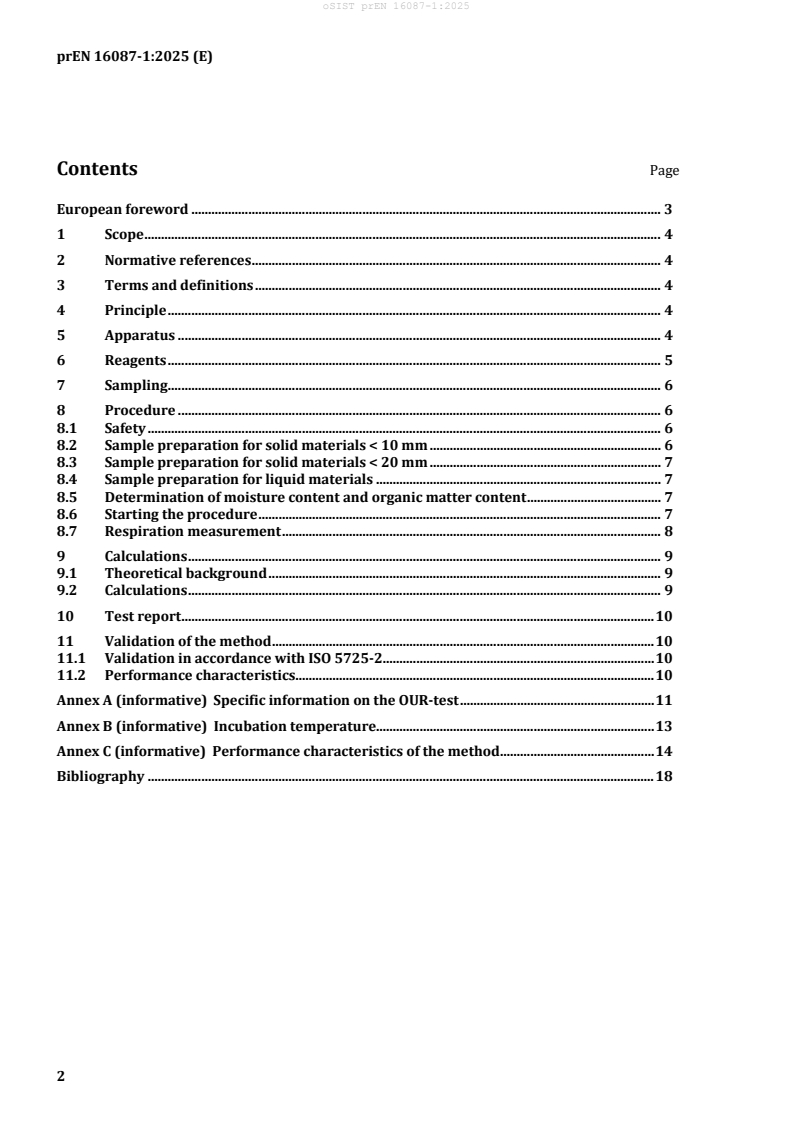
Contents Page
European foreword . 3
1 Scope . 4
2 Normative references . 4
3 Terms and definitions . 4
4 Principle . 4
5 Apparatus . 4
6 Reagents . 5
7 Sampling . 6
8 Procedure . 6
8.1 Safety . 6
8.2 Sample preparation for solid materials < 10 mm . 6
8.3 Sample preparation for solid materials < 20 mm . 7
8.4 Sample preparation for liquid materials . 7
8.5 Determination of moisture content and organic matter content . 7
8.6 Starting the procedure . 7
8.7 Respiration measurement . 8
9 Calculations . 9
9.1 Theoretical background . 9
9.2 Calculations . 9
10 Test report . 10
11 Validation of the method . 10
11.1 Validation in accordance with ISO 5725-2. 10
11.2 Performance characteristics. 10
Annex A (informative) Specific information on the OUR-test . 11
Annex B (informative) Incubation temperature. 13
Annex C (informative) Performance characteristics of the method . 14
Bibliography . 18
prEN 16087-1:2025 (E)
European foreword
This document (prEN 16087-1:2025) has been prepared by Technical Committee CEN/TC 223 “Soil
improvers and growing media”, the secretariat of which is held by NEN.
This document is currently submitted to the CEN Enquiry.
This document will supersede EN 16087-1:2011.
prEN 16087-1:2025 includes the following significant technical changes with respect to
EN 16087-1:2011:
— For the balance (5.6) requirements have been added;
— Clarification of sample preparation (8.2) has been added;
— Formula (3) and 5 have been corrected;
— The figures in Annex A have been updated;
— The Bibliography has been corrected;
— The temperature of testing was for all products 30 °C but it has been changed. Products may be tested
at 20 or 30 °C. Background about the differences between the testing temperatures and the to choose
temperature can be found in Annex B.
This document has been prepared under a standardization request addressed to CEN by the European
Commission. The Standing Committee of the EFTA States subsequently approves these requests for its
Member States.
prEN 16087-1:2025 (E)
1 Scope
This document describes a method to determine the stability of materials (e.g. compost, digestate) used
as components (ingredients) in growing media, soil improvers and organic fertilisers by measuring the
oxygen uptake rate (OUR). The oxygen uptake rate is a direct parameter for the degradation rate of
biodegradable organic matter that is being broken down within a specified time period. The method is
not suitable for material with a content of particle sizes > 20 mm exceeding 20 % by volume.
NOTE The relation between the degradation rate and the oxygen uptake rate under the same conditions is
depending on the type of material, for example by the C/N ratio. So it is important for the interpretation and limit
values to be set based on the type of material.
2 Normative references
The following documents are referred to in the text in such a way that some or all of their content
constitutes requirements of this document. For dated references, only the edition cited applies. For
undated references, the latest edition of the referenced document (including any amendments) applies.
CEN/TS 17732:2022, Soil improvers and growing media — Terminology
EN 12579:2024, Soil improvers and growing media — Sampling
prEN 13039:2025, Soil improvers and growing media — Determination of organic matter content and ash
prEN 13040-1:2025, Soil improvers and growing media — Sample preparation — Part 1: Sample
preparation for chemical and physical tests, determination of dry matter content, moisture content and
laboratory bulk density
EN 45501, Metrological aspects of non-automatic weighing instruments
3 Terms and definitions
For the purposes of this document, the terms and definitions given in CEN/TS 17732:2022 apply.
ISO and IEC maintain terminology databases for use in standardization at the following addresses:
— ISO Online browsing platform: available at https://www.iso.org/obp/
— IEC Electropedia: available at https://www.electropedia.org/
4 Principle
The material is suspended in water. The respiration rate (i.e. oxygen uptake rate) is indirectly determined
by measuring the pressure drop in the headspace (i.e. gas phase in the closed space above the water
phase). The produced CO (carbon dioxide) is removed by a suitable alkaline absorbent. The
measurements are performed under defined conditions.
5 Apparatus
5.1 Testing facility
Temperature controlled room, climate cabinet or water bath, temperature adjustable to 20 °C ± 2 °C or
30 °C ± 2 °C.
5.2 Pressure transducer
prEN 16087-1:2025 (E)
Operating range 0 kPa to 20 kPa (accuracy ± 0,1 kPa) and record for measuring 2 to 4 times per hour for
seven days.
5.3 CO -absorbent containing unit
5.4 Reaction vessel
1 000 ml to 2 500 ml with a CO -absorbent containing unit (5.3) and the pressure transducer (5.2)
gastight connected (see Figure A.1).
5.5 Mixing device
Shaking Table 120 rpm ± 20 rpm or magnetic stirring unit and banded magnetic stirrer (see Figure A.2).
5.6 Balance
Meeting EN 45501 class II tolerances with a verification scale interval of 0,01 g.
5.7 pH meter
With slope adjustment and temperature control.
5.8 Dispenser
Dispensers or pipettes, adjustable units of 0,5 ml.
5.9 Glassware
Beakers and measuring cylinder.
5.10 Sieves
10 mm and 20 mm square aperture size.
5.11 Filter paper
Filter paper, with low ash content and high retentive properties.
6 Reagents
6.1 Water with a specific conductivity not higher than 0,2 mS/m at 25 °C
6.2 pH buffer
86 g/l KH PO , 89 g/l Na HPO ⋅ 2H O, mix ratio of 1:4 for pH 7; the solution is stable for 2 months if
2 4 2 4 2
stored at 1 °C to 5 °C. When a particulate precipitation is found a fresh solution is to be made.
Commercially available buffers may be used as well.
6.3 Macronutrient solution
Dissolve the following masses of chemical compounds in 1 000 ml water (6.1): 4,3 g NH Cl,
5,4 g CaCl ⋅ 2H O, 4,3 g MgSO ⋅ 7H O
2 2 4 2
The solution is stable for 2 months if stored at 3 °C ± 2°C. When a particulate precipitation is found a fresh
solution is to be made.
6.4 Micronutrient solution
prEN 16087-1:2025 (E)
Dissolve the following masses or volumes of chemical compounds in 1 000 ml water (6.1): 5,0 g EDDHA
iron chelate (60 g Fe/kg), 1,4 g MnSO , 1,1 g ZnSO , 4,2 g Na B O , 0,2 g CuSO , 0,13 g Na MoO ,
4 4 2 4 7 4 2 4
1 ml/l HCl (360 g/kg).
The solution is stable for 2 months if stored at 3 °C ± 2°C. When a particulate precipitation is found a fresh
solution is to be made.
6.5 Complete nutrient solution
Add 1 ml of micronutrient solution (6.4) to 1 000 ml of macronutrient solution (6.3). The solution is
stable for 2 months if stored at 3 °C ± 2°C. When a particulate precipitation is found a fresh solution is to
be made.
6.6 Nitrification inhibitor
4 g/l N-Allylthiourea, C H N S (ATU).
4 8 2
Store the solution in a closed container at 1 °C to 5 °C. The solution is stable for not more than 2 weeks.
6.7 CO -absorbent
Such as NaOH-pellets, KOH-pellets or soda lime (mixture of Ca(OH) , NaOH, KOH and water), preferably
with colour indicator.
NOTE Based on experience, 4,0 g of pellets (carbon dioxide absorption capacity > 200 g/kg) per container is
sufficient.
6.8 NaOH (0,5 mol/l)
6.9 HCI (0,5 mol/l)
6.10 Inoculum (to be added for materials without or low microbial activity)
–1 −1
Prepare an extract by shaking an active compost (OUR level 25 to 30 mmol O · kg · OM · hour ) with
water at mass:volume, 1:10 and filter it over a filter paper (5.11).
7 Sampling
Sampling is not part of the method specified in this document. Follow EN 12579:2024 dealing with soil
improvers and growing media. It is important that the laboratory receives a sample that is representative
of the product under consideration. The sample should not have been damaged or changed during
transport or storage.
8 Procedure
8.1 Safety
SAFETY PRECAUTIONS — Care should be taken when handling substances of caustic nature or samples
that may contain sharps or is of a dusty nature.
8.2 Sample preparation for solid materials < 10 mm
Take minimally 1 l of material. Manually, but carefully, break up lumps and agglomerates only that have
been caused by, for example, compress ion during transport. Break up lumps and agglomerates only and
pass the sample through a 10 mm sieve (5.10), gently agitating the material if required. Particles > 10 mm
shall not be broken up and shall be removed. Record the % mass of particles > 10 mm. If this amount
prEN 16087-1:2025 (E)
is > 20 % of the total fresh mass the procedure for materials < 20 mm (8.3) is to be followed. The moist
sample shall be stored at 3 °C ± 2 °C (total storage time max. 2 weeks).
8.3 Sample preparation for solid materials < 20 mm
Take minimally 1 l of material. Manually, but carefully, break up lumps and agglomerates only that have
been caused by, for example, compression during transport. Break up lumps and agglomerates only and
pass the sample through a 20 mm sieve (5.10), gently agitating the material if required. Particles > 20 mm
shall not be broken up and shall be removed. Record the % mass of particles > 20 mm. If this amount
is > 20 % of the total fresh mass, the test is not applicable. The moist sample shall be stored at 3 °C ± 2°C
(total storage time max. 2 weeks).
8.4 Sample preparation for liquid materials
Take minimally 1 l of material. Homogenize the sample by stirring. Break up lumps and agglomerates
only and pass the sample through a 10 mm sieve (5.10), gently agitating the material if required.
Particles > 10 mm shall not be broken up and shall be removed. Record the % mass of particles > 10 mm.
If this amount is > 20 % of the total fresh mass, the test is not applicable. The sample shall be stored at
3 °C ± 2 °C (total storage time max. 2 weeks). Stir the sample just before using it again.
8.5 Determination of moisture content and organic matter content
The moisture content shall be determined according to prEN 13040-1:2025 and the organic matter
content according to prEN 13039:2025, both determinations should take place after the sample
preparation.
8.6 Starting the procedure
For solid materials < 10 mm and liquid materials (8.2 and 8.4), calculate the mass of fresh material (EOM)
to be added to the reaction vessel based on 2 g of organic matter per litre according to Formula (1).
EOM g = (1)
( )
WW×
om d
where
W is the organic matter content, in % mass of the dried sample according to prEN 13039:2025;
om
W is the dry matter content, in % mass of the fresh sample according to prEN 13040-1:2025.
d
Calculate the required mass of sample (W ) to perform the test according to Formula (2).
S
W g EOM× C (2)
( )
S V
where
C is the capacity of the vessel in litres.
V
Place the calculated quantity of the sample in the clean reaction vessel (5.4). Add 180 ml water (6.1) and
10 ml complete nutrient solution (6.5) using a dispenser (5.8). Add 10 ml pH buffer (6.2) using a
dispenser (5.8). Add 2,5 ml nitrification inhibitor (6.6) using a dispenser (5.8). For materials without or
low microbial activity (e.g. wood fibre directly after production), 5 ml inoculum (6.10) can be added.
Then, measure the pH of the suspension. The value should be between 6,5 and 7,5. If this is not the case,
base or acid should be added (see 6.8 and 6.9). Place the sample on the mixing device (5.5) and start the
mixing for 4 h to 8 h in the conditioned room (5.1).
The analyses shall be performed at least
...