

prEN 14532-1
(Main)Welding consumables - Test methods and quality requirements - Part 1: Primary methods and assessment of consumables for steel, nickel and nickel alloys
- Abstract
This document describes the basic verification tests, the testing methods, the amount of testing and the requirements for the qualification of welding consumables for steel, nickel and nickel alloys intended for all fields of application.
This document describes a wide range of tests, which are appropriate for the majority of applications. When supplementary tests are required (see EN 14532-2), these can be carried out at any time without the need to repeat the primary tests.
NOTE Additional information is given in Annex O.
- Status
- Not Published
- Publication Date
- 09-Dec-2027
- Technical Committee
- CEN/TC 121 - Welding
- Drafting Committee
- CEN/TC 121/WG 3 - Welding consumables
- Current Stage
- 4060 - Closure of enquiry - Enquiry
- Start Date
- 16-Jul-2026
- Due Date
- 20-Nov-2026
- Completion Date
- 16-Jul-2026
Overview
prEN 14532-1:2026 is the European draft standard developed by CEN/TC 121, focusing on welding consumables for steel, nickel, and nickel alloys. This document establishes the primary test methods, assessment procedures, and quality requirements necessary for verifying and qualifying welding consumables across all industrial applications. Harmonized and stringent verification protocols ensure product reliability, safety, and conformity for manufacturers, suppliers, and end users throughout the supply chain.
Key Topics
- Type Qualification Tests: Outlines the rigorous verification and assessment needed before a welding consumable is qualified. This includes documenting scope, chemical composition, mechanical properties, and brand identification.
- Test Methods: Describes standardized methods for testing all-weld metal and welded joints, including tensile, impact, and chemical composition tests.
- Assessment Procedures: Details the qualification process, including product sampling, marking requirements, and product documentation in compliance with relevant EN and ISO standards.
- Scope of Application: Addresses a wide variety of welding consumables intended for use with steel, nickel, and nickel alloys, covering multiple welding processes and industrial needs.
- Supplementary Testing: Provides guidance for additional testing as required by specific applications, which can be conducted without repeating primary tests, ensuring flexibility and efficiency in qualification.
Applications
prEN 14532-1 is vital for organizations involved in the procurement, manufacturing, or distribution of welding consumables. Its practical applications include:
- Manufacturer and Supplier Qualification: Ensures that fillers, electrodes, rods, and fluxes meet strict performance and safety criteria before they enter the market.
- Quality Control: Provides a comprehensive framework for ongoing quality assurance of welding consumables, reducing the risk of failure or defects in welded joints.
- Industrial Welding Projects: Supports compliance and traceability in critical applications such as construction, automotive manufacturing, energy infrastructure, and shipbuilding by defining requirements for consumables used with steel, nickel, and their alloys.
- Regulatory Compliance: Facilitates adherence to European and international regulations governing welding materials, improving market access and client confidence.
- Documentation and Certification: Details requirements for product marking, certificates, and reporting, contributing to transparency and effective quality management throughout the product lifecycle.
Related Standards
prEN 14532-1 references and builds upon a set of established European and international standards, including:
- EN ISO 544: Technical delivery conditions for filler materials and fluxes.
- EN ISO 14175: Gases and gas mixtures for fusion welding.
- EN ISO 15792 (Parts 1-3): Test methods for welding consumables.
- EN ISO 15608: Grouping system for metallic materials.
- EN ISO 5178, EN ISO 4136, EN ISO 5173: Mechanical and destructive testing of welds.
- EN 14532-2: Supplementary tests and additional assessment requirements.
- EN 12074: Manufacturer, supplier, and distributor qualification requirements.
- EN ISO 3690, EN ISO 8249: Determination of hydrogen and ferrite content in welds.
For organizations seeking compliance and assurance in the use of welding consumables for steel, nickel, and nickel alloys, prEN 14532-1 delivers a unified, reliable, and practical approach to verification and testing, supporting elevated standards in safety and performance.
Relations
- Effective Date
- 08-Oct-2025
Get Certified
Connect with accredited certification bodies for this standard

DVS-ZERT GmbH
German welding certification society.
CARES (UK Certification Authority for Reinforcing Steels)
UK certification for reinforcing steels and construction.
EWF/IIW (European/International Welding Federation)
International welding personnel certification.
Sponsored listings
Frequently Asked Questions
prEN 14532-1 is a draft published by the European Committee for Standardization (CEN). Its full title is "Welding consumables - Test methods and quality requirements - Part 1: Primary methods and assessment of consumables for steel, nickel and nickel alloys". This standard covers: This document describes the basic verification tests, the testing methods, the amount of testing and the requirements for the qualification of welding consumables for steel, nickel and nickel alloys intended for all fields of application. This document describes a wide range of tests, which are appropriate for the majority of applications. When supplementary tests are required (see EN 14532-2), these can be carried out at any time without the need to repeat the primary tests. NOTE Additional information is given in Annex O.
This document describes the basic verification tests, the testing methods, the amount of testing and the requirements for the qualification of welding consumables for steel, nickel and nickel alloys intended for all fields of application. This document describes a wide range of tests, which are appropriate for the majority of applications. When supplementary tests are required (see EN 14532-2), these can be carried out at any time without the need to repeat the primary tests. NOTE Additional information is given in Annex O.
prEN 14532-1 is classified under the following ICS (International Classification for Standards) categories: 25.160.20 - Welding consumables. The ICS classification helps identify the subject area and facilitates finding related standards.
prEN 14532-1 has the following relationships with other standards: It is inter standard links to EN 14532-1:2004. Understanding these relationships helps ensure you are using the most current and applicable version of the standard.
prEN 14532-1 is available in PDF format for immediate download after purchase. The document can be added to your cart and obtained through the secure checkout process. Digital delivery ensures instant access to the complete standard document.
Standards Content (Sample)
SLOVENSKI STANDARD
01-junij-2026
Dodajni in pomožni materiali za varjenje - Preskusne metode in zahteve po
kakovosti - 1. del: Glavne metode in ocenjevanje skladnosti dodajnih materialov za
jeklo, nikelj in nikljeve zlitine
Welding consumables - Test methods and quality requirements - Part 1: Primary
methods and assessment of consumables for steel, nickel and nickel alloys
Schweißzusätze - Prüfverfahren und Qualitätsanforderungen - Teil 1: Grundprüfungen
und Bewertung von Schweißzusätzen für Stahl, Nickel und Nickellegierungen
Produits consommables de soudage - Méthodes d'essai et exigences de qualité - Partie
1: Méthodes primaires et évaluation des produits consommables pour l’acier, le nickel et
les alliages de nickel
Ta slovenski standard je istoveten z: prEN 14532-1
ICS:
25.160.20 Potrošni material pri varjenju Welding consumables
77.080.20 Jekla Steels
77.120.40 Nikelj, krom in njune zlitine Nickel, chromium and their
alloys
2003-01.Slovenski inštitut za standardizacijo. Razmnoževanje celote ali delov tega standarda ni dovoljeno.
DRAFT
EUROPEAN STANDARD
NORME EUROPÉENNE
EUROPÄISCHE NORM
April 2026
ICS 25.160.20 Will supersede EN 14532-1:2004
English Version
Welding consumables - Test methods and quality
requirements - Part 1: Primary methods and assessment of
consumables for steel, nickel and nickel alloys
Produits consommables de soudage - Méthodes d'essai Schweißzusätze - Prüfverfahren und
et exigences de qualité - Partie 1: Méthodes primaires Qualitätsanforderungen - Teil 1: Grundprüfungen und
et évaluation des produits consommables pour l'acier, Bewertung von Schweißzusätzen für Stahl, Nickel und
le nickel et les alliages de nickel Nickellegierungen
This draft European Standard is submitted to CEN members for enquiry. It has been drawn up by the Technical Committee
CEN/TC 121.
If this draft becomes a European Standard, CEN members are bound to comply with the CEN/CENELEC Internal Regulations
which stipulate the conditions for giving this European Standard the status of a national standard without any alteration.
This draft European Standard was established by CEN in three official versions (English, French, German). A version in any other
language made by translation under the responsibility of a CEN member into its own language and notified to the CEN-CENELEC
Management Centre has the same status as the official versions.
CEN members are the national standards bodies of Austria, Belgium, Bulgaria, Croatia, Cyprus, Czech Republic, Denmark, Estonia,
Finland, France, Germany, Greece, Hungary, Iceland, Ireland, Italy, Latvia, Lithuania, Luxembourg, Malta, Netherlands, Norway,
Poland, Portugal, Republic of North Macedonia, Romania, Serbia, Slovakia, Slovenia, Spain, Sweden, Switzerland, Türkiye and
United Kingdom.
Recipients of this draft are invited to submit, with their comments, notification of any relevant patent rights of which they are
aware and to provide supporting documentation.
Warning : This document is not a European Standard. It is distributed for review and comments. It is subject to change without
notice and shall not be referred to as a European Standard.
EUROPEAN COMMITTEE FOR STANDARDIZATION
COMITÉ EUROPÉEN DE NORMALISATION
EUROPÄISCHES KOMITEE FÜR NORMUNG
CEN-CENELEC Management Centre: Rue de la Science 23, B-1040 Brussels
© 2026 CEN All rights of exploitation in any form and by any means reserved Ref. No. prEN 14532-1:2026 E
worldwide for CEN national Members.
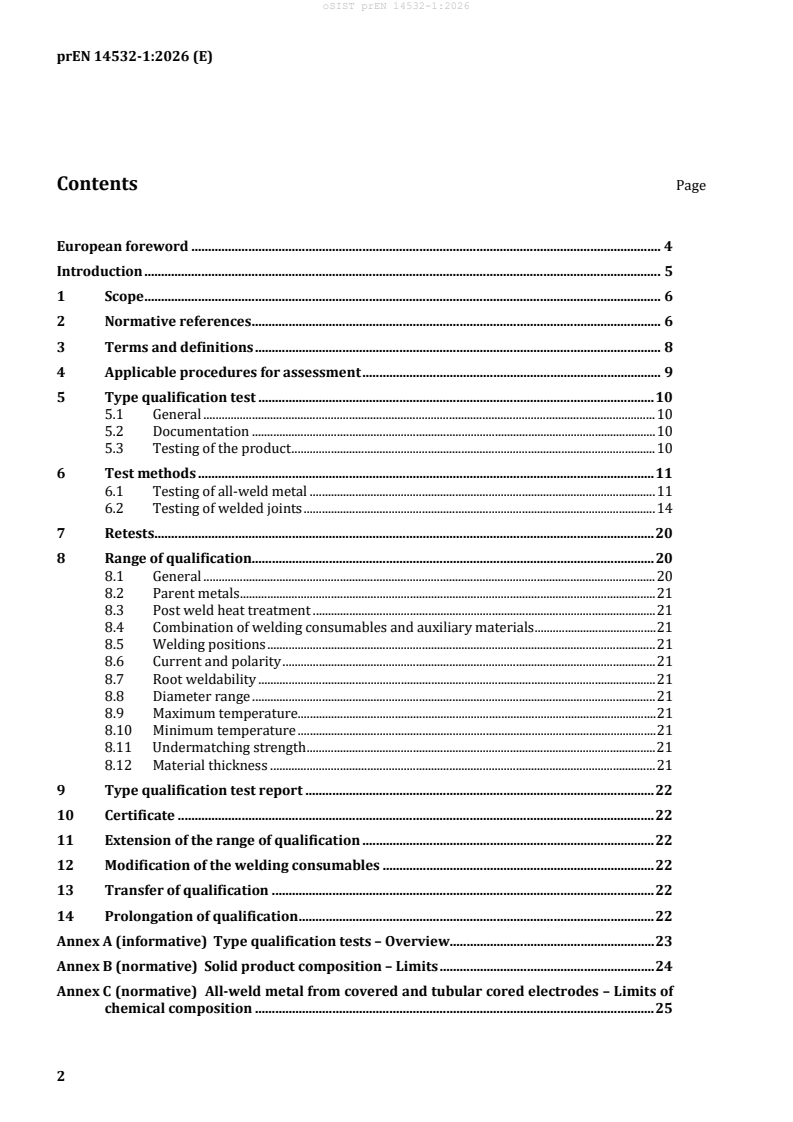
Contents Page
European foreword . 4
Introduction . 5
1 Scope . 6
2 Normative references . 6
3 Terms and definitions . 8
4 Applicable procedures for assessment . 9
5 Type qualification test . 10
5.1 General . 10
5.2 Documentation . 10
5.3 Testing of the product . 10
6 Test methods . 11
6.1 Testing of all-weld metal . 11
6.2 Testing of welded joints . 14
7 Retests . 20
8 Range of qualification. 20
8.1 General . 20
8.2 Parent metals . 21
8.3 Post weld heat treatment . 21
8.4 Combination of welding consumables and auxiliary materials . 21
8.5 Welding positions . 21
8.6 Current and polarity . 21
8.7 Root weldability . 21
8.8 Diameter range . 21
8.9 Maximum temperature. 21
8.10 Minimum temperature . 21
8.11 Undermatching strength . 21
8.12 Material thickness . 21
9 Type qualification test report . 22
10 Certificate . 22
11 Extension of the range of qualification . 22
12 Modification of the welding consumables . 22
13 Transfer of qualification . 22
14 Prolongation of qualification . 22
Annex A (informative) Type qualification tests – Overview . 23
Annex B (normative) Solid product composition – Limits . 24
Annex C (normative) All-weld metal from covered and tubular cored electrodes – Limits of
chemical composition . 25
Annex D (normative) All-weld metal of welding consumables for steel, nickel and nickel
alloys – Requirements . 27
Annex E (normative) Calculation of delta ferrite . 28
Annex F (informative) Range of qualification for steels . 29
Annex G (normative) Butt welds – Thickness limits . 30
Annex H (normative) Welded joints – Technical requirements . 31
Annex I (normative) Number of test pieces in a type qualification test . 32
Annex J (informative) Suggested qualification test report . 34
Annex K (informative) Type qualification certificate . 36
Annex L (informative) Transfer of qualification – Application . 37
Annex M (informative) Transfer of qualification – Declaration of identity . 38
Annex N (normative) Prolongation of qualification –tests . 39
Annex O (informative) Qualification under the supervision of an examiner or an
examination body . 40
O.1 Introduction . 40
O.2 Conformity of the product . 40
O.3 Marking of products . 40
O.4 Certificate . 40
O.5 Transfer of qualifications . 40
O.6 Prolongation of the type qualification of welding consumables . 41
O.7 Dormant welding consumables type qualification . 41
Annex P (informative) List of material groups according to EN ISO 15608:2025 . 42
Annex Q (informative) Example of constituents for coating or fluxes in welding consumables
................................................................................................................................................................... 45
Bibliography . 46
European foreword
This document (prEN 14532-1:2026) has been prepared by Technical Committee CEN/TC 121 “Welding
and allied processes”, the secretariat of which is held by AFNOR.
This document is currently submitted to the CEN Enquiry.
This document will supersede EN 14532-1:2004.
Introduction
This document proposes harmonized verification test conditions for the qualification of welding
consumables.
The extent of the tests to be carried out is determined by the competent entity in accordance with market
requirements.
It should be noted that tests in accordance with this document are made in a way which is not necessarily
representative of a real welded structure.
The requirements for the qualification of welding consumable manufacturers, suppliers and distributors
are given in EN 12074.
NOTE A competent entity can include a manufacturer or supplier.
1 Scope
This document specifies the type qualification tests, test methods, the amount of testing and the
requirements for the qualification of welding consumables for steel, nickel and nickel alloys intended for
all fields of application.
This document describes a wide range of tests, which are appropriate for the majority of applications.
When supplementary tests are required (see EN 14532-2), these are carried out at any time without the
need to repeat the type qualification tests.
NOTE Additional information is given in Annex O.
2 Normative references
The following documents are referred to in the text in such a way that some or all of their content
constitutes requirements of this document. For dated references, only the edition cited applies. For
undated references, the latest edition of the referenced document (including any amendments) applies.
EN 1011-1, Welding - Recommendations for welding of metallic materials - Part 1: General guidance for arc
welding
EN 10204, Metallic products - Types of inspection documents
EN ISO 14175, Welding consumables - Gases and gas mixtures for fusion welding and allied processes (ISO
14175)
EN ISO 14341, Welding consumables - Wire electrodes and weld deposits for gas shielded metal arc welding
of non alloy and fine grain steels - Classification (ISO 14341)
EN ISO 2560, Welding consumables - Covered electrodes for manual metal arc welding of non-alloy and fine
grain steels - Classification (ISO 2560)
EN ISO 14171, Welding consumables - Solid wire electrodes, tubular cored electrodes and electrode/flux
combinations for submerged arc welding of non alloy and fine grain steels - Classification (ISO 14171)
EN ISO 18275, Welding consumables - Covered electrodes for manual metal arc welding of high-strength
steels - Classification (ISO 18275)
EN ISO 17632, Welding consumables - Tubular cored electrodes for gas shielded and non-gas shielded metal
arc welding of non-alloy and fine grain steels - Classification (ISO 17632)
EN ISO 14174, Welding consumables - Fluxes for submerged arc welding and electroslag welding -
Classification (ISO 14174)
EN ISO 9016, Destructive tests on welds in metallic materials - Impact tests - Test specimen location, notch
orientation and examination (ISO 9016)
EN ISO 5178, Destructive tests on welds in metallic materials - Longitudinal tensile test on weld metal in
fusion welded joints (ISO 5178)
EN ISO 4136, Destructive tests on welds in metallic materials - Transverse tensile test (ISO 4136)
EN ISO 5173, Destructive tests on welds in metallic materials - Bend tests (ISO 5173)
EN ISO 17637, Non-destructive testing of welds - Visual testing of fusion-welded joints (ISO 17637)
EN ISO 9015-1, Destructive tests on welds in metallic materials - Hardness testing - Part 1: Hardness test on
arc welded joints (ISO 9015-1)
EN ISO 17639, Destructive tests on welds in metallic materials - Macroscopic and microscopic examination
of welds (ISO 17639)
EN ISO 17636-1, Non-destructive testing of welds - Radiographic testing - Part 1: X- and gamma-ray
techniques with film (ISO 17636-1)
EN ISO 17636-2, Non-destructive testing of welds - Radiographic testing - Part 2: X- and gamma-ray
techniques with digital detectors (ISO 17636-2)
EN ISO 15792-1, Welding consumables - Test methods - Part 1: Preparation of all-weld metal test pieces
and specimens in steel, nickel and nickel alloys (ISO 15792-1)
EN ISO 15792-2, Welding consumables - Test methods - Part 2: Preparation of single-run and two-run
technique test pieces and specimens in steel (ISO 15792-2)
EN ISO 15792-3, Welding consumables - Test methods - Part 3: Classification testing of positional capacity
and root penetration of welding consumables in a fillet weld (ISO 15792-3)
EN ISO 3580, Welding consumables - Covered electrodes for manual metal arc welding of creep-resisting
steels - Classification (ISO 3580)
EN ISO 3581, Welding consumables - Covered electrodes for manual metal arc welding of stainless and heat-
resisting steels - Classification (ISO 3581)
EN ISO 636, Welding consumables - Rods, wires and deposits for tungsten inert gas welding of non-alloy and
fine-grain steels - Classification (ISO 636)
EN ISO 148-1, Metallic materials - Charpy pendulum impact test - Part 1: Test method (ISO 148-1)
EN ISO 21952, Welding consumables - Wire electrodes, wires, rods and deposits for gas shielded arc welding
of creep-resisting steels - Classification (ISO 21952)
EN ISO 17634, Welding consumables - Tubular cored electrodes for gas shielded metal arc welding of creep-
resisting steels - Classification (ISO 17634)
EN ISO 14343, Welding consumables - Wire electrodes, strip electrodes, wires and rods for arc welding of
stainless and heat resisting steels - Classification (ISO 14343)
EN ISO 17633, Welding consumables - Tubular cored electrodes and rods for gas shielded and non-gas
shielded metal arc welding of stainless and heat-resisting steels - Classification (ISO 17633)
EN ISO 10675-1, Non-destructive testing of welds - Acceptance levels for radiographic testing - Part 1: Steel,
nickel, titanium and their alloys (ISO 10675-1)
EN ISO 16834, Welding consumables - Wire electrodes, wires, rods and deposits for gas shielded arc welding
of high strength steels - Classification (ISO 16834)
EN ISO 18276, Welding consumables - Tubular cored electrodes for gas-shielded and non-gas-shielded
metal arc welding of high strength steels - Classification (ISO 18276)
EN ISO 20378, Welding consumables - Rods for gas welding of non-alloy and creep-resisting steels -
Classification (ISO 20378)
EN ISO 544, Welding consumables - Technical delivery conditions for filler materials and fluxes - Type of
product, dimensions, tolerances and markings (ISO 544)
EN ISO 3690, Welding and allied processes - Determination of hydrogen content in arc weld metal (ISO
3690)
EN ISO 4063, Welding, brazing, soldering and cutting - Nomenclature of processes and reference numbers
(ISO 4063)
EN ISO 5817, Welding - Fusion-welded joints in steel, nickel, titanium and their alloys (beam welding
excluded) - Quality levels for imperfections (ISO 5817)
EN ISO 6947, Welding and allied processes - Welding positions (ISO 6947)
EN ISO 8249, Welding - Determination of Ferrite Number (FN) in austenitic and duplex ferritic-austenitic
Cr-Ni stainless steel weld metals (ISO 8249)
EN ISO 14172, Welding consumables - Covered electrodes for manual metal arc welding of nickel and nickel
alloys - Classification (ISO 14172)
EN ISO 17641-2, Destructive tests on welds in metallic materials - Hot cracking tests for weldments - Arc
welding processes - Part 2: Self-restraint tests (ISO 17641-2)
EN ISO 17663, Welding - Quality requirements for heat treatment in connection with welding and allied
processes (ISO 17663)
EN ISO 18274, Welding consumables - Solid wire electrodes, solid strip electrodes, solid wires and solid rods
for fusion welding of nickel and nickel alloys - Classification (ISO 18274)
EN ISO 15608:2025, Welding - Grouping system for metallic materials (ISO 15608:2025)
ISO 14344, Welding consumables — Procurement of filler materials and fluxes
3 Terms and definitions
For the purposes of this document, the following terms and definitions apply.
ISO and IEC maintain terminology databases for use in standardization at the following addresses:
— ISO Online browsing platform: available at https://www.iso.org/obp/
— IEC Electropedia: available at https://www.electropedia.org/
3.1
auxiliary material
material, which is not designed to influence the chemical composition and the mechanical properties of
the weld and is not incorporated in the weld, e.g. temporary backing strips
In this document “austenitic-ferritic” is used instead of “ferritic-austenitic”.
3.2
classification
process that is carried out on the product to verify the designation according to the appropriate
consumable standard
3.3
qualified welding consumable
welding consumable complying with the requirements of this document
Note 1 to entry: Additional information is given in Annex O.
3.4
manufacturer
organization that produces and packages welding consumables
EXAMPLE 1 A manufacturer purchases a semi-finished product with his own specification. For example: a wire
rod with a diameter of 5,5 mm and reduces it in several processing steps to a final diameter of 1,2 mm.
EXAMPLE 2 A manufacturer creates a recipe for the production of a rod electrode. He buys the core wire ready-
drawn from another manufacturer, coats the core wire, manufactures and assembles the electrodes.
EXAMPLE 3 A manufacturer purchases a welding filler metal with its own specification in the final diameter and
rewinds it or straighten and identifies it (for TIG rods).
3.5
supplier
organization supplying welding consumables under their own brand name and obtained them from a
manufacturer that fulfils the requirements of this document
Note 1 to entry: Both, the manufacturer and the supplier, have to take full responsibility for the quality of the
product.
3.6
lot
quantity of welding consumables defined as the manufacturer’s standard lot in his quality assurance
manual or as defined in ISO 14344
3.7
applicant
type of organisation defined in this document manufacturing or suppling welding consumable
4 Applicable procedures for assessment
The procedures for assessment are described below. Tests and evaluation for the qualification of welding
consumables are given in Clauses 5 to 9.
The product testing as well as all welding and testing of the test pieces shall be witnessed by an examiner
or an examining body.
The product label shall provide an indication that the product has successfully passed the required tests.
NOTE Additional information is given in Annex O.
5 Type qualification test
5.1 General
The compliance of a welding consumable with this document shall be demonstrated by a type
qualification test and ongoing control to ensure consistent quality.
The type qualification test (see Annex A) shall consist of:
— testing of the product (see 5.3);
— testing of all-weld metal (see 6.1);
— testing of welded joints (see 6.2).
5.2 Documentation
The following product information shall be documented:
— scope of qualification;
— whether qualification is for butt welds and fillet welds or only for fillet welds;
— brand and product name;
— European Standard designation;
— manufacturer's limits of chemical composition of the product or the all-weld metal; these shall not
exceed the values given in Annexes B and C, respectively;
— description of the covering, flux or filling material in terms of those major constituents which define
the characteristics of the consumable (e.g. oxides, carbonates, fluorides and metals);
— limits of mechanical properties of the all-weld metal in the as welded condition and/or, if applicable,
in post weld heat treated conditions;
— ferrite content (if requested);
— hydrogen content (if requested).
5.3 Testing of the product
5.3.1 Testing to demonstrate applicability
The range of testing shall be defined to demonstrate applicability in such a way that the mechanical
properties of the all-weld metal are in accordance with the minimum requirements of this document.
The range of qualification shall be subdivided with relevant information as follows:
— parent metals;
— heat treatment;
— any restriction on material thickness;
— highest and lowest test temperature;
— type of current and polarity;
— root weldability (without backing or sealing run);
— welding positions;
— applicability for single-run and/or multi-run techniques;
— other specific product information (e.g. shielding gas or flux).
5.3.2 Sampling for verification of product physical characteristics
All welding consumables for type qualification tests shall be sampled at the applicant’s premises. The
sizes and dimensions of welding consumables involved in the type qualification test shall be examined in
accordance with EN ISO 544 or EN ISO 14174 for fluxes. In addition other characteristics of the product
shall be examined where applicable, e.g. the colour, physical condition and marking.
5.3.3 Chemical composition of the product
The chemical composition of the solid wire and/or strip welding consumable shall meet the requirements
of the product specification and the limits given in Annex B.
The constituent materials of the consumables shall be documented.
NOTE In the Annex Q, an example is given of constituent materials. It is possible to include detailed values or a
range.
For the purpose of qualifying a welding consumable, the identification of shielding gas shall be in
accordance with EN ISO 14175.
5.3.4 Marking of products
The marking of the product and the packaging shall be in accordance with EN ISO 544 and for fluxes with
EN ISO 14174. When other markings replacing the product name are used, such markings shall be unique
and unambiguous and are entered into the qualification certificate.
6 Test methods
6.1 Testing of all-weld metal
6.1.1 General
All-weld metal test pieces shall be prepared in accordance with EN ISO 15792-1; Test piece form 1.3. All-
weld metal test pieces are not prepared for welding consumables intended for the following welding
processes:
— electrogas welding (process 73 according to EN ISO 4063);
— electroslag welding (process 72 according to EN ISO 4063);
— overlay welding;
— single and two run welding, where qualification is not required for multi run welding;
— oxy-fuel gas-welding (process 31 according to EN ISO 4063).
6.1.2 Type and number of test pieces and diameters of welding consumables to be tested
The type of test piece is given in the corresponding welding consumable standard. The number of test
pieces depends on the type and diameter of the welding consumable as shown in Table 1.
Table 1 — Number of all weld metal test pieces and diameters of welding consumable to be
tested
Number of all-weld metal test
Type of welding consumable Diameter of welding consumable
pieces
a
covered electrodes 1 4,0 mm
1 maximum to be qualified
c
rods for tungsten inert gas 1 2,4 mm
b
welding
wire electrodes for gas-shielded 1 maximum to be qualified
b
metal arc welding
b
tubular cored electrodes 1 maximum to be qualified
flux-wire combinations for 1 4,0 mm wire electrodes or
d
submerged arc welding maximum to be qualified
Powders 1 45 µm to 180 µm free-flowable?
a
Where 4,0 mm diameter has not been manufactured, the closest diameter to 4,0 mm shall be used.
b
For each shielding gas or gas group for which qualification is required a separate all-weld metal test piece
shall be prepared.
c
Where 2,4 mm diameter has not been manufactured, the closest diameter to 2,4 mm shall be used. Rods
qualifies solid wires for TIG welding.
d
The used wires for flux-wire-combinations may be either solid wires or tubular cored wires.
6.1.3 Welding conditions
Welding conditions for the preparation of test pieces shall be selected in accordance with the relevant
consumable classification standard, where applicable, or as recommended (for example as provided in a
technical data sheet). Regarding covered electrodes; diameters not covered by the consumable
classification standard shall be welded with 70 % to 90 % of the maximum welding current
recommended by the applicant. Furthermore, the number of layers shall be adjusted to common welding
practice as recommended (for example as provided in a technical data sheet). When qualification is for
both direct current (d.c.) and alternating current (a.c.) operation then testing shall be carried out using
alternating current (a.c.).
When qualification is for d.c. operation with both polarities then the polarity recommended (for example
as provided in a technical data sheet) shall be used.
The welding shall be performed in the flat position.
Preheating shall be applied where it is prescribed in the relevant European Standard or material
specifications for the material and material thickness in question. An interpass temperature between
150 °C and 200 °C shall be maintained; if different interpass temperatures are intended by the applicant
and used for the welding shall this be given clearly in the qualification test report and in the qualification
certificate.
Post weld heat treatment shall be in accordance with the relevant classification standard.
When qualification is for submerged arc welding, the testing shall be carried out by using d.c. positive, or
on a.c. when the flux is specially designed for a.c. When the flux is tested on d.c., a.c. can be included in the
qualification if the applicant can provide positive results from internal tests (see EN 10204).
It is recommended that the welding heat input used for welding is to be recorded and included in the
qualification test report (see Annex J).
6.1.4 Testing conditions, test specimen type, number of test specimens and requirements
6.1.4.1 General
In addition to the requirements listed below those from the product standard classification according to
the product standard shall be complied with.
If the applicant classifies a welding consumable with symbol Z, he shall specify the requirements for the
consumable prior to the tests.
6.1.4.2 Tensile tests
The all-weld metal tensile test specimens of ferritic welding consumables may be exposed to a
temperature not exceeding 250 °C for a period not exceeding 16 h for hydrogen removal prior to testing,
alternatively a temperature not exceeding 105 °C for a time not to exceed 48 h may be used.
Two tensile test specimens of 10 mm diameter in accordance with EN ISO 5178 shall be prepared. For all
weld metal, the test should be carried out in accordance with EN ISO 5178 at room temperature and the
tensile strength, lower yield strength or proof strength, elongation after fracture (A ) and reduction of
area shall be determined.
For all groups of welding consumables the 0,2 % proof strength shall be determined, except in the case
of consumables for non alloy and fine grain steels when the lower yield strength shall be determined.
All results shall meet the requirements of the relevant consumable standard.
6.1.4.3 Impact tests
Charpy V test specimens shall be prepared in accordance with EN ISO 15792-1 and tested in accordance
with EN ISO 148-1 (radius of the hammer fin 2 mm, KV2). Tests to be carried out at temperatures other
than room temperature shall be held at the test temperature for a minimum of 10 min prior to testing.
For all materials the test temperature shall be the lowest temperature proposed by the applicant.
One set of three impact test specimens shall be tested at each required temperature in each heat
treatment condition.
The average value from Charpy V specimens in each set shall not be lower than the minimum value of
impact energy according to Annex D. For parent metal groups 1 to 5 only one individual value may be
lower than 47 J but higher than 32 joules.
For consumables for which the classification standard does not require impact properties is impact
testing required by this document.
6.1.4.4 Chemical composition of all-weld metal
The sample for the analysis of the all-weld metal can be taken from the broken pieces of an all-weld metal
tensile test specimen or on a pad in accordance with EN ISO 6847. Alternatively, analysis may be carried
out on a transverse section of the all-weld metal sample. All elements specified in the product standard
shall be determined.
The chemical composition of the all-weld metal shall be determined for each diameter tested (see
Annex C).
For electro-gas and electro-slag the chemical analysis may be performed on a weldment.
The chemical composition of the all-weld metal shall meet the requirements of the applicant’s product
specification and Annex C.
6.1.4.5 Determination of ferrite content (stainless steel weld metal)
For information the ferrite content of the weld metal shall be determined by one of the following methods.
1) Determination of Ferrite Number in accordance with EN ISO 8249;
2) Calculation of Ferrite Number in accordance with Annex E;
3) Metallographic measurement of ferrite percentage.
The method of determination shall be reported. The average ferrite content shall be within the limits
given in the product standard or in the applicant’s specification.
6.1.4.6 Determination of hydrogen content
When required, the hydrogen content shall be assessed in the deposited weld metal on three specimens
in accordance with EN ISO 3690. The average hydrogen content shall not exceed the limits given in the
product standard or in the applicant’s product specification.
Prior to hydrogen testing the electrodes or welding fluxes shall be baked/dried at the minimum times
and temperatures within the applicant’s recommended ranges.
6.2 Testing of welded joints
6.2.1 Parent metals
Test pieces shall be prepared with a parent metal selected from Table F.1 (see Annex F) to define the steel
material sub-groups according to EN ISO 15608:2025, Table 1 or according to EN ISO 15608:2025,
Table 4 to define the nickel or nickel alloy group, for which qualification is required. All materials not
mentioned in a material group shall be tested individually.
For a wire-flux combination intended for multi run submerged arc welding only one test piece shall be
prepared with a parent metal with the highest strength or the highest alloy content of the material groups
according to EN ISO 15608:2025 for which qualification is required.
Test plate material shall have an inspection document, e.g. in accordance with EN 10204.
6.2.2 Type and dimensions of the test pieces
The actual length, b (see Figure 1), will be influenced by the welding process and shall be sufficient to
allow the welding process to stabilize and the specimens required and any retest specimens to be taken.
The width, a (see Figure 1), of the welded test pieces shall be sufficient to permit the necessary test
specimens to be prepared.
Key
a = 3t minimum value 150 mm
b = 6t minimum value 350 mm
Figure 1 — Test piece for a butt weld in plate
A joint preparation in accordance with the applicant’s welding procedure specification shall be used. The
material thickness of the test pieces shall be selected from Annex G. When the term unlimited is requested
at least one test piece shall use minimum 25 mm material thickness or 20 mm for stainless steel.
NOTE Guidance for joint preparation is given in EN ISO 15792-2, EN ISO 15792-3 and EN ISO 9692-1.
For testing covered electrodes with a nominal electrode efficiency of > 125 %, a fillet weld joint in
accordance with EN ISO 15792-3 shall also be made. In this case the minimum weld length is 500 mm.
The plate thickness shall be between 10 mm and 12 mm (single layer welding).
Where welding consumables are intended only for fillet welding (e.g. gravity welding), a test piece in
accordance with EN ISO 15792-3 shall be performed instead of the butt weld.
For two-run technique with the submerged arc welding process a test piece in accordance with
EN ISO 15792-2 shall be used. If the field of application does not include two-run technique, the test piece
shall be welded with butt weld preparation using multi-run technique.
6.2.3 Welding conditions
6.2.3.1 General
On carrying out the test welds, the following welding conditions shall be observed.
6.2.3.2 Preheating
Preheating shall only be applied where it is prescribed in the relevant European Standard or material
specifications for the material and thickness in question.
6.2.3.3 Interpass temperature and heat input
Interpass temperature shall be as recommended by the steel manufacturer and/or the consumable
manufacturer. When not specified the requirements for the interpass temperature given in Table 2 shall
be used. Limitation in heat input shall be applied if given in parent metal standards and/or specifications
in accordance with EN 1011-1.
Table 2 — Interpass temperature for testing of welded joints
a
Interpass temperature
Welding consumable
°C
Non-alloy and fine grain 120 to 200
Creep resisting Preheat temperature +50
Ferritic Cr-steels 200 to 300
Martensitic Cr-steels 200 to 300
Soft martensitic CrNi-steels 100 to 160
Austenitic CrNi(Mo)-steels 150
Austenitic - Ferritic CrNiMoN-steels 150
Nickel and nickel alloys 100
a
Single values in the table means maximum temperatures.
6.2.3.4 Welding positions
One weldment for each welding position for which qualification is required shall be used for the tests.
Welding consumables for manual metal arc welding, tubular cored electrode welding, gas shielded metal
arc welding and tungsten inert gas welding tested in the flat position (PA) also includes the qualification
in the horizontal-vertical position (PC) according to EN ISO 6947. This does not apply to high efficiency
covered electrodes (>125 %).
6.2.3.5 Type of current and polarity
When qualification is for both direct (d.c.) and alternating (a.c.) current, each type of current shall be used
at least once in the test programme. The same principle applies for the choice of the positive and negative
pole when qualification is only for direct current. In cases where the applicant recommends a polarity
change in completing the weld, both polarities may be used in a single weld in order to minimize the
number of test pieces.
6.2.3.6 Welding parameters and bead sequence
Welding of the joints shall be carried out with welding parameters consistent with the welding position,
the diameter of welding consumable and the welding process as recommended by the applicant.
6.2.3.7 Consumable diameters
The diameters to be used for the test are given in Table 3. The weld shall be carried out from the root
bead to the final pass using a sequence of increasing diameters.
Table 3 — Consumable diameters
Range of Diameter to be
Diameter to be used for
Type of welding consumable qualification used for other
a
the flat position (PA)
diameter position
mm mm mm
b c
Covered electrodes 2,5 to 6,0 2,5 or 3,2 and 4,0 and 5,0 as recommended
and 6,0 for the position
Rods for tungsten inert gas welding 0,6 to 1,2 1,0
or 1,0 to 4,0 1,6 and 2,4 or 2,5
oxyacetylene welding 2,0 to 6,0 2,4 or 2,5 and 4,0 and 6,0
Wire electrodes for 0,6 to 1,6 0,8 and 1,2 or 1,6
gas shielded metal arc welding 0,6 to 3,2 0,8 or 1,0 and 1,6 or 2,4
b
Tubular cored electrodes 1,2 to 2,4 1,2 or 1,6 and 2,0
1,2 to 4,0 1,2 or 1,6 and 2,4 or 3,2
d
Wire electrodes for submerged arc 3,0 to 5,0 4,0 –
welding
a
Depending on diameter range submitted to qualification.
b
Smaller or larger diameters, if needed.
c
Only root pass and second pass or layer.
d
If a smaller or larger diameter is applied for, the smallest or the largest diameters applied for shall be included
additionally in the test.
6.2.3.8 Root weldability
A welding consumable also intended for root welding without any backing or sealing run shall be tested
in the flat (PA) position in accordance with EN ISO 6947. The root shall be evaluated for steels according
to EN ISO 5817 level B. If other preparations are selected in order to achieve the root weld, these shall be
indicated in the certificate.
6.2.3.9 Shielding gases
Shielding gases to be used in the test shall be selected from Table 4 in relation to the qualification
required.
For welding of test pieces with tungsten inert gas welding any gas in group I of EN ISO 14175 may be
used. For other gases not included in EN ISO 14175 the qualification is for that gas only.
Table 4 — Shielding gases
Shielding gases Qualification
Gas tested
range
EN ISO 14175 EN ISO 14175
N N
2 2
M12 M12
M13 M13
M2 M2
M32 M3
C C
C + M21 (2 tests) M2; M3; C
I I
R + I (2 tests) R; I
Z Only for the Z-gas used in the test
6.2.4 Number of test pieces
During preparation of welded joints for the qualification test the combination of material thickness,
welding position and parent metals shall be considered to minimize the number of test pieces, see
Annex I.
6.2.5 Number of test specimens
6.2.5.1 General
The following test specimens shall be taken from each test piece as required in 6.2.6.
6.2.5.2 Butt welds
For the testing described in 6.2.6 the following test specimens shall be prepared:
— 2 transverse tensile test specimens according to EN ISO 4136;
— 2 face bend test specimens according to EN ISO 5173;
— 2 root bend test specimens according to EN ISO 5173;
— 1 macro section according to EN ISO 17639 with hardness test (HV 10), EN ISO 9015-1;
— 1 micro section according to EN ISO 17639;
— in addition if applicable: 1 set of 3 impact test specimens according to EN ISO 148-1 notch in the
centre of the weld tested at the lowest temperature for which qualification is required.
In addition, for electro-gas and electro-slag butt welds with a material thickness above 20 mm, a
longitudinal tensile test specimen according to EN ISO 5178 shall be tested. For single-run and two-run
technique reference is made to EN ISO 15792-2.
6.2.5.3 Fillet welds
For the testing described in 6.2.6 the following test specimens shall be prepared:
— 1 macro section according to EN ISO 17639;
— 1 fracture test according to EN ISO 15792-3.
Where qualification is required only for fillet welding hardness testing HV 10 in accordance with
EN ISO 9015-1 is required, except for material group 8 in accordance with EN ISO 15608:2025.
6.2.6 Test conditions and specimen geometry
...