

EN 15341:2019+A1:2022
(Main + Amendment)Maintenance - Maintenance Key Performance Indicators
- Abstract
This document lists Key Performance Indicators (KPIs) of the Maintenance Function and gives guidelines to define a set of suitable indicators, to appraise and to improve effectiveness, efficiency and sustainability in the maintenance of the existing physical assets either industrial, infrastructures, facilities, civil buildings or transportation systems, etc. in the framework of the external and internal influencing factors.
- Status
- Published
- Publication Date
- 07-Jun-2022
- Withdrawal Date
- 30-Dec-2022
- Technical Committee
- CEN/TC 319 - Maintenance
- Drafting Committee
- CEN/TC 319/WG 6 - Maintenance performance and indicators
- Current Stage
- 9093 - Decision to confirm - Review Enquiry
- Start Date
- 22-Apr-2025
- Completion Date
- 21-Oct-2026
Buy Documents

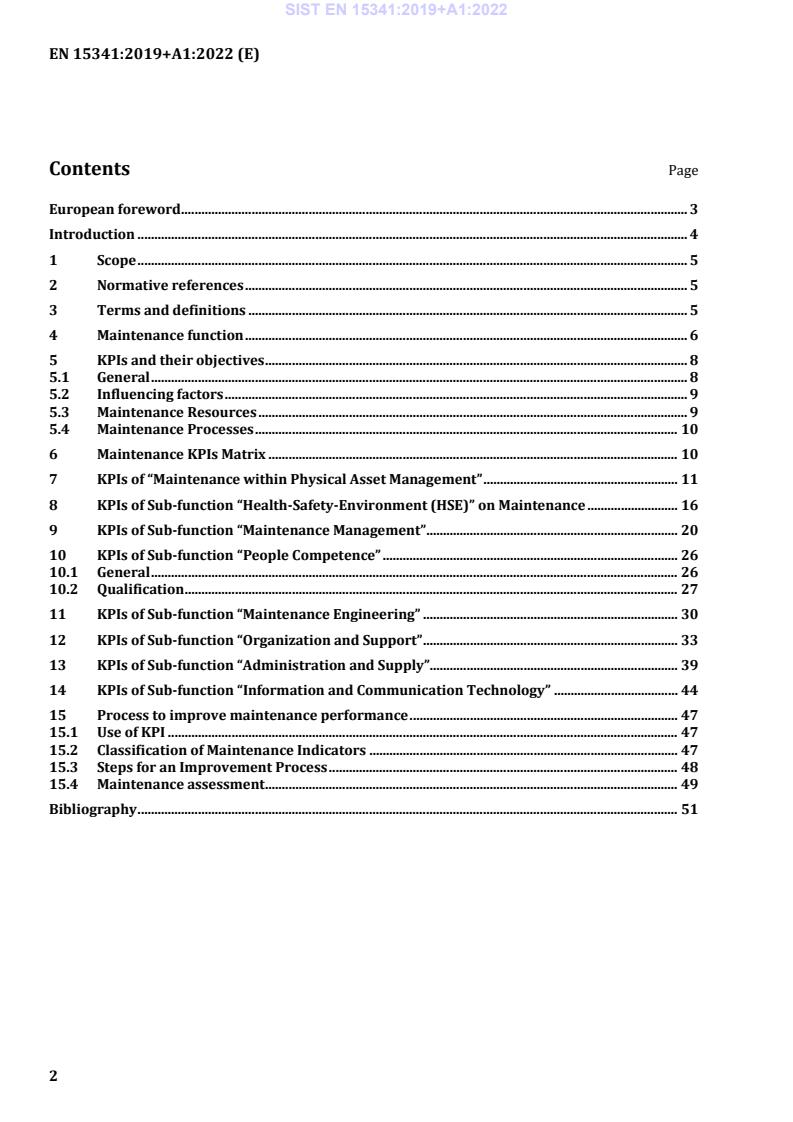
EN 15341:2019+A1:2022 - BARVE
Overview
EN 15341:2019+A1:2022 - Maintenance: Maintenance Key Performance Indicators (CEN) defines a structured set of Key Performance Indicators (KPIs) and guidance to select, measure and improve maintenance performance for physical assets - industrial plants, infrastructure, buildings and transportation systems. The standard supports appraisal of effectiveness, efficiency and sustainability of maintenance within the context of internal and external influencing factors and includes Amendment 1 (2022).
Key topics and requirements
- KPI scope and purpose: Use KPIs to measure status, benchmark (internal/external), diagnose strengths/weaknesses, set targets, plan improvements and monitor change over time.
- Structured KPI groups: Indicators are arranged into eight groups - one for Physical Asset Management, six for maintenance sub‑functions (HSE on Maintenance; Maintenance Management; People Competence; Maintenance Engineering; Organization & Support; Administration & Supply), and one for Information and Communication Technology (ICT).
- Maintenance function model: The standard presents an organizational model integrating sub‑functions, ICT and enabling technologies (e.g., Industry 4.0) to achieve maintenance objectives.
- Influencing factors: Requires accounting for external and internal factors that affect KPI interpretation (examples: location, laws, labour costs, asset criticality, age, utilization).
- Resources and processes: Addresses measurement of maintenance resources (labour, competence, spares) and maintenance processes as inputs to KPI calculation.
- KPI matrix and assessment process: Provides a KPI matrix and guidance for classification, selection and use of indicators, plus steps for improvement and maintenance assessment activities.
- Normative references: Cross‑references EN 13306:2017 (maintenance terminology), EN 15628:2014 (qualification of maintenance personnel) and IEC 60050-192:2015 (dependability vocabulary).
Practical applications
- Establish a consistent set of maintenance indicators for performance reporting and executive dashboards.
- Support benchmarking across sites, sectors or time periods to identify improvement opportunities.
- Drive targeted improvements in reliability, availability, cost control, HSE and sustainability of physical assets.
- Inform maintenance strategy, resource planning, training needs and investment decisions.
- Use in audits, supplier performance management and integration with ICT/enabling technologies for data-driven maintenance.
Who should use this standard
- Maintenance and asset managers
- Reliability and condition‑based maintenance engineers
- Facility and infrastructure operators
- HSE managers involved in maintenance activities
- ICT managers implementing asset management systems or Industry 4.0 solutions
- Consultants, auditors and organisations seeking standardized maintenance KPIs
Related standards
- EN 13306:2017 - Maintenance terminology
- EN 15628:2014 - Qualification of maintenance personnel
- IEC 60050-192:2015 - Dependability vocabulary
EN 15341:2019+A1:2022 is the reference for organizations wanting a harmonized, practical KPI framework to measure and improve maintenance performance across diverse physical asset portfolios.
Relations
- Effective Date
- 19-Jan-2023
- Effective Date
- 30-Mar-2022
- Refers
IEC 60050-192:2015 - International Electrotechnical Vocabulary (IEV) - Part 192: Dependability - Effective Date
- 25-Aug-2026
- Effective Date
- 28-Jan-2026
- Effective Date
- 28-Jan-2026
- Effective Date
- 28-Jan-2026
Buy Documents
EN 15341:2019+A1:2022 - BARVE
Get Certified
Connect with accredited certification bodies for this standard

BSI Group
BSI (British Standards Institution) is the business standards company that helps organizations make excellence a habit.

Bureau Veritas
Bureau Veritas is a world leader in laboratory testing, inspection and certification services.

DNV
DNV is an independent assurance and risk management provider.
Sponsored listings
Frequently Asked Questions
EN 15341:2019+A1:2022 is a standard published by the European Committee for Standardization (CEN). Its full title is "Maintenance - Maintenance Key Performance Indicators". This standard covers: This document lists Key Performance Indicators (KPIs) of the Maintenance Function and gives guidelines to define a set of suitable indicators, to appraise and to improve effectiveness, efficiency and sustainability in the maintenance of the existing physical assets either industrial, infrastructures, facilities, civil buildings or transportation systems, etc. in the framework of the external and internal influencing factors.
This document lists Key Performance Indicators (KPIs) of the Maintenance Function and gives guidelines to define a set of suitable indicators, to appraise and to improve effectiveness, efficiency and sustainability in the maintenance of the existing physical assets either industrial, infrastructures, facilities, civil buildings or transportation systems, etc. in the framework of the external and internal influencing factors.
EN 15341:2019+A1:2022 is classified under the following ICS (International Classification for Standards) categories: 03.100.99 - Other standards related to company organization and management. The ICS classification helps identify the subject area and facilitates finding related standards.
EN 15341:2019+A1:2022 has the following relationships with other standards: It is inter standard links to EN 15341:2019, EN 15341:2019/FprA1, IEC 60050-192:2015, EN 13306:2017, EN 15628:2014, CEN/TR 15628:2007. Understanding these relationships helps ensure you are using the most current and applicable version of the standard.
EN 15341:2019+A1:2022 is available in PDF format for immediate download after purchase. The document can be added to your cart and obtained through the secure checkout process. Digital delivery ensures instant access to the complete standard document.
Standards Content (Sample)
SLOVENSKI STANDARD
01-september-2022
Vzdrževanje - Ključni kazalniki učinkovitosti in uspešnosti vzdrževanja
Maintenance - Maintenance Key Performance Indicators
Instandhaltung - Wesentliche Leistungskennzahlen für die Instandhaltung
Maintenance - Indicateurs de performance clés pour la maintenance
Ta slovenski standard je istoveten z: EN 15341:2019+A1:2022
ICS:
03.100.99 Drugi standardi v zvezi z Other standards related to
organizacijo in vodenjem company organization and
podjetja management
2003-01.Slovenski inštitut za standardizacijo. Razmnoževanje celote ali delov tega standarda ni dovoljeno.
EN 15341:2019+A1
EUROPEAN STANDARD
NORME EUROPÉENNE
June 2022
EUROPÄISCHE NORM
ICS 03.100.99 Supersedes EN 15341:2019
English Version
Maintenance - Maintenance Key Performance Indicators
Maintenance - Indicateurs de performance clés pour la Instandhaltung - Wesentliche Leistungskennzahlen für
maintenance die Instandhaltung
This European Standard was approved by CEN on 14 July 2019 and includes Amendment 1 approved by CEN on 20 April 2022.
CEN members are bound to comply with the CEN/CENELEC Internal Regulations which stipulate the conditions for giving this
European Standard the status of a national standard without any alteration. Up-to-date lists and bibliographical references
concerning such national standards may be obtained on application to the CEN-CENELEC Management Centre or to any CEN
member.
This European Standard exists in three official versions (English, French, German). A version in any other language made by
translation under the responsibility of a CEN member into its own language and notified to the CEN-CENELEC Management
Centre has the same status as the official versions.
CEN members are the national standards bodies of Austria, Belgium, Bulgaria, Croatia, Cyprus, Czech Republic, Denmark, Estonia,
Finland, France, Germany, Greece, Hungary, Iceland, Ireland, Italy, Latvia, Lithuania, Luxembourg, Malta, Netherlands, Norway,
Poland, Portugal, Republic of North Macedonia, Romania, Serbia, Slovakia, Slovenia, Spain, Sweden, Switzerland, Turkey and
United Kingdom.
EUROPEAN COMMITTEE FOR STANDARDIZATION
COMITÉ EUROPÉEN DE NORMALISATION
EUROPÄISCHES KOMITEE FÜR NORMUNG
CEN-CENELEC Management Centre: Rue de la Science 23, B-1040 Brussels
© 2022 CEN All rights of exploitation in any form and by any means reserved Ref. No. EN 15341:2019+A1:2022 E
worldwide for CEN national Members.
Contents Page
European foreword . 3
Introduction . 4
1 Scope . 5
2 Normative references . 5
3 Terms and definitions . 5
4 Maintenance function . 6
5 KPIs and their objectives . 8
5.1 General . 8
5.2 Influencing factors . 9
5.3 Maintenance Resources . 9
5.4 Maintenance Processes . 10
6 Maintenance KPIs Matrix . 10
7 KPIs of “Maintenance within Physical Asset Management” . 11
8 KPIs of Sub-function “Health-Safety-Environment (HSE)” on Maintenance . 16
9 KPIs of Sub-function “Maintenance Management” . 20
10 KPIs of Sub-function “People Competence” . 26
10.1 General . 26
10.2 Qualification . 27
11 KPIs of Sub-function “Maintenance Engineering” . 30
12 KPIs of Sub-function “Organization and Support” . 33
13 KPIs of Sub-function “Administration and Supply”. 39
14 KPIs of Sub-function “Information and Communication Technology” . 44
15 Process to improve maintenance performance . 47
15.1 Use of KPI . 47
15.2 Classification of Maintenance Indicators . 47
15.3 Steps for an Improvement Process . 48
15.4 Maintenance assessment . 49
Bibliography . 51
European foreword
This document (EN 15341:2019+A1:2022) has been prepared by Technical Committee CEN/TC 319
“Maintenance”, the secretariat of which is held by UNI.
This European Standard shall be given the status of a national standard, either by publication of an
identical text or by endorsement, at the latest by December 2022, and conflicting national standards shall
be withdrawn at the latest by December 2022.
Attention is drawn to the possibility that some of the elements of this document may be the subject of
patent rights. CEN shall not be held responsible for identifying any or all such patent rights.
This document includes Amendment 1 approved by CEN on 20 April 2022.
This document supersedes !EN 15341:2019".
The start and finish of text introduced or altered by amendment is indicated in the text by tags !".
The main technical changes compared to the previous EN 15341:2007 are the following:
— the standard was fully revised;
— the vision on all the Maintenance Components was enlarged, structuring the standard in a more
complete way maintaining the economical, technical, organizational KPI of the previous edition.
Any feedback and questions on this document should be directed to the users’ national standards body.
A complete listing of these bodies can be found on the CEN website.
According to the CEN-CENELEC Internal Regulations, the national standards organisations of the
following countries are bound to implement this European Standard: Austria, Belgium, Bulgaria, Croatia,
Cyprus, Czech Republic, Denmark, Estonia, Finland, France, Germany, Greece, Hungary, Iceland, Ireland,
Italy, Latvia, Lithuania, Luxembourg, Malta, Netherlands, Norway, Poland, Portugal, Republic of North
Macedonia, Romania, Serbia, Slovakia, Slovenia, Spain, Sweden, Switzerland, Turkey and the United
Kingdom.
Introduction
Maintenance Key Performance Indicators (KPI) of the Maintenance Function apply to all the physical
assets either industrial, infrastructures or civil buildings or transportation systems, etc.
These indicators should be used to:
a) measure the status;
b) compare (internal and external benchmarks);
c) diagnose (analysis of strengths and weaknesses);
d) identify objectives and define targets to be reached;
e) plan improvement actions;
f) regular measurement of changes over time.
Maintenance of software alone is not covered in this document. However, maintenance of items and
systems containing software is considered.
1 Scope
This document lists Key Performance Indicators (KPIs) of the Maintenance Function and gives guidelines
to define a set of suitable indicators, to appraise and to improve effectiveness, efficiency and
sustainability in the maintenance of the existing physical assets either industrial, infrastructures,
facilities, civil buildings or transportation systems, etc. in the framework of the external and internal
influencing factors.
2 Normative references
The following documents are referred to in the text in such a way that some or all of their content
constitutes requirements of this document. For dated references, only the edition cited applies. For
undated references, the latest edition of the referenced document (including any amendments) applies.
EN 13306:2017, Maintenance — Maintenance terminology
EN 15628:2014, Maintenance — Qualification of maintenance personnel
IEC 60050-192:2015, International Electrotechnical Vocabulary (IEV) — Part 192: Dependability
3 Terms and definitions
For the purposes of this document, the terms and definitions given in EN 13306:2017 and in
IEC 60050-192:2015, and the following apply.
ISO and IEC maintain terminological databases for use in standardization at the following addresses:
— IEC Electropedia: available at https://www.electropedia.org/
— ISO Online browsing platform: available at https://www.iso.org/obp
3.1
asset
item that has potential or actual value for the organization
[SOURCE: EN 13306:2017, 3.2]
3.2
main area
fundamental part of a management discipline, which represents the more important knowledge and
competence to achieve and maintain an excellent status within existing influencing factors
3.3
indicator
quantitative or qualitative measure of a characteristic or a set of characteristics of a phenomenon or
performance of activities, according to defined criteria or a given formula or questionnaire
Note 1 to entry: The indicator is a tool for development and implementation of a strategy for monitoring progress
towards the goals outlined in the strategy.
3.4
item
part, component, device, subsystem, functional unit, equipment that can be individually described and
considered
[SOURCE: EN 13306:2017, 3.1]
3.5
key performance indicator
KPI
indicator considered significant
3.6
time
generally used to describe time units related to the physical assets-equipment and its performance
3.7
man-hour
points the hours of labour spent in delivering maintenance activities
3.8
work order
document used by the maintenance function
Note 1 to entry: It specifies the deliverables, scope and cost of the approved work.
Note 2 to entry: It contains a pre-defined set of activities with specified materials, spare parts, tools and labour
required to complete the job.
4 Maintenance function
The Maintenance Function is operating in various industrial plants, facilities, infrastructures, acting in
different frameworks and contexts with different sizes, structures, objectives, specific constraints and
influencing factors (see 5.2 and 5.3).
In this context, it is suitable to define an organizational Model of Maintenance Function, as standard
reference to be implemented in relation with required objectives, available resources, and existing
constraints.
This Model of Maintenance Function is reported in Figure 1.
The Model considers that for the Maintenance function to achieve the assigned objectives and excellence,
it shall use an appropriate combination or parts of the various disciplines as HSE (Health Safety
Environment), Administration, ICT (Information and Communication Technology), etc.
It is Management task:
a) to implement the appropriate resources, knowledge, rules, procedures activities;
b) to select how the maintenance needs to build and organize the various matters and disciplines in the
following Sub Functions/Areas:
— HSE on Maintenance;
— Maintenance Management;
— Maintenance People Competence;
— Maintenance Engineering;
— Organization and Support for Maintenance;
— Administration and Supply.
The maintenance function maintains the physical assets so that it can perform the required functions and
consequently, the management shall act in a core framework that involves:
— The company
— The available resources
— The application of ICT and Enabling Technologies (e.g. Industry 4.0)
Acknowledging the fast development within maintenance, both from organizational and technological
point, this document provides an overview of the content of sub-functions, activities, and tools to be
considered when establishing activities and indicators to reach the targets.
It is suitable to use all the disciplines of Maintenance Function in the integrated framework to achieve the
objectives assigned to the Maintenance of the Physical Assets with the support of ICT and Enabling
Technologies (e.g. Industry 4.0).
The size and the depth of utilization depends on the maturity degree of each maintenance department
and from its commitment to develop Maintenance activities towards the excellence.
During the life of each physical asset and its components, it is necessary to carry out maintenance
activities to repair the failures, contain the degradation and wear with appropriate preventive actions, so
as to lengthen the life of the unit and meet the required level of performance.
The Maintenance Function is an integration of 6 Sub-functions with the addition of methodology of
Physical Asset Management and hardware and software of the Information and Communication
Technology (see Figure 1).
Figure 1 — Maintenance function and core framework
In this integrated maintenance system each sub function shall be developed in order to achieve the
objectives assigned to the Maintenance Function. These objectives can include e.g. H.S.E. issues, integrity
and competitiveness of the physical assets, balancing productivity, costs and service.
In order to cover all the major aspects of physical assets management the key performance indicators are
structured into eight groups, one for physical asset management, six dedicated to maintenance sub-
functions, and the last one for the information communication technologies.
5 KPIs and their objectives
5.1 General
When the actual or expected performance is not satisfactory, management shall define objectives and
strategies to improve the resources utilization of involved sub-functions using the KPIs, allowing the
organization to:
a) define the objectives;
b) measure the performance;
c) compare the performance versus the historical value of benchmarks;
d) identify strengths and weaknesses;
e) control progress and changes;
f) define plan and strategies of improvements;
g) make regular measurement of changes over time;
h) share the results.
These indicators can be used:
• on a periodic basis, for instance by preparing and following-up a budget, during performance
assessment, comparing results in many ways: budgeted, expected, predicted, planned, actual, etc.;
• on a spot basis, for instance within the framework of specific audits, studies and/or benchmarking.
The period of time to be considered for measurement depends on the organization policy, aims and time
constants of measured phenomena; it can be: day, week, month, quarter, semester, year, etc.
The KPIs can be often calculated as a ratio between factors (numerator and denominator) measuring the
activities, resources or events, according to a given formula, but can also be the result of the quantitative
or qualitative questionnaire.
The numerical values, the qualitative and the quantitative data to calculate each KPI shall be collected
and elaborated based on available methods and procedures of general industrial accounting and specific
management accounting rules, applied to the maintenance function.
These indicators are used to measure any qualitative or quantitative characteristics of an item or a
process to create a homogeneous base to compare and set objectives to improve.
In some cases it is suitable to use specific pre-prepared questionnaire to give to the managers and experts
the possibility to carry out qualitative assessments in a simple and efficient way.
5.2 Influencing factors
The Influencing factors are variable conditions outside of Maintenance Function which have an impact
on the measured indicator. They can be general or specific, internal or external, controllable or non-
controllable.
Examples of external influencing factors are:
a) location,
b) society culture,
c) national labour policies and costs,
d) market and economy,
e) laws and regulations,
f) sector / branches,
g) stakeholders,
h) technology,
i) environmental conditions.
Examples of internal Influencing factors are:
j) organization culture,
k) organization scale,
l) organization objectives,
m) criticality of the physical asset,
n) severity and complexity of the process,
o) product mix,
p) physical assets scale and complexity,
q) utilization rate,
r) age of physical asset.
These factors shall be considered as reference conditions to understand the framework where
maintenance is operating. It is necessary to consider the influence and the impact of factors, in order to
achieve homogeneous and appropriate evaluations without misunderstandings and misleading.
5.3 Maintenance Resources
The maintenance resources are:
— competence of direct and indirect people;
— labour internal and external;
— spare parts and materials;
— diagnostics and predictive technologies;
— maintenance tools and equipments;
— engineering knowledge;
— good maintenance practices to repair, restore, prevent and improve;
— information technology systems: hardware and software and enabling technologies (e.g Industry
4.0);
— supply and supporting services.
The role of management is to achieve the best maintenance performance, in line with the stated company
objectives, using and dosing the appropriate resources, optimizing all the management, organizational
and administrative aspects with an integrated information system.
5.4 Maintenance Processes
The maintenance processes are the various actions used by each sub-function to implement the activities
to achieve the best competitiveness and suitable results according to the stated aim of the organization,
see EN 17007.
6 Maintenance KPIs Matrix
Table 1 shows the KPIs of Maintenance within a Physical Asset Management, the 6 maintenance Sub-
functions and the Information Communication Technology.
The KPIs reported in the matrix related to each subsystems/methodology are divided in areas, which
represent the fundamental contents or characteristic to be measured, controlled and improved to achieve
a quantitatively and qualitatively excellent assessment.
Most indicators can be used at different aggregation levels depending on whether they are used to
measure the performance of physical assets, production lines, given equipment, item, etc.
The indicators can be split by professional levels in relation to the organizational structure established
by each organization.
Table 1 — Maintenance KPIs matrix
SUB FUNCTIONS,
TOOLS AND KPIs MAIN AREAS
METHODOLOGIES
Capacity
Maintenance within
Sustainability Effectiveness Service Level Economics
PHA
physical asset
i
i = 1 to 3 Integrity i = 12 to 13 i = 14 to 20
management
i = 4 to 11
Sub-function 1 Laws- Rules Statistical Prevention and
Safe Practice
HSE
Health - Safety conformity Records Improvements
i
i = 13 to 17
Environment i = 1 to 3 i = 4 to 12 i = 18 to 22
Sub-function 2 Technical Continuous
Strategy Function
M
Maintenance Assessment Improvement
i
i = 1 to 3 i = 4 to 10
Management i = 11 to 16 i = 17 to 22
Maintenance
Maintenance
Maintenance Supervisor/
Sub-function 3 Technician Education
P
i Manager Maintenance
People Competence Specialist i = 13 to 21
i = 1 to 3 Engineer
i = 10 to 12
i = 4 to 9
Capability
Sub-function 4 Preventive Engineering
Durability
E
Maintenance Maintenance Improvements
i Criticality
i = 4 to 9
Engineering i = 10 to 16 i = 17 to 19
i = 1 to 3
Sub-function 5 Structure and Planning and Productivity
Quality
O&S
Organization and Support Control Effectiveness
i
i = 29 to 30
Support i = 1 to 8 i = 9 to 22 i = 23 to 28
Sub-function 6 Budget Outsourcing Materials and
Economics
A&S
Administration and &Control services spare parts
i
i = 1 to 6
Supply i = 7 to 19 i = 20 to 25 i = 26 to 29
Information
Engineering
Administration Organization
Communication
Management
ICT i = 14 to 20
and Supply and Support
i
Technology,
i = 1 to 6
i = 7 to 10 i = 11 to 13
TEC 18.20
Enabling technologies
7 KPIs of “Maintenance within Physical Asset Management”
Maintenance within physical asset management allows the optimal life cycle management of physical
assets to sustainably achieve the stated organization objectives.
The Maintenance activities play a significant role in the life cycle management of physical assets, because
the maintenance function takes care of their integrity for the majority of the life.
Physical asset management indicates the appropriate importance of maintenance in the various life cycle
stages and helps the maintenance management to define effective long term maintenance strategy.
The physical assets management provides the interrelations between the maintenance and the other
physical asset processes, in order to measure the performances through the whole asset life, in line with
vision, mission, values and organization objectives.
The main KPIs, named PHA , shared by driven areas as reported in Table 2 are the following:
i
— Sustainability: PHA1, PHA2, PHA3;
— Capacity, Effectiveness, Integrity: PHA4, PHA5, PHA6, PHA7, PHA8, PHA9, PHA10, PHA11;
— Service Level: PHA12, PHA13;
— Economics: PHA14, PHA15, PHA16, PHA17, PHA18, PHA19, PHA20
Table 2 — KPI of maintenance within physical asset
KPI FACTORS DEFINITIONS AND NOTES
Annual maintenance cost to The cost of maintenance resources spent
PHA1
improve sustainability yearly to improve the sustainability
Maintenance
contribution to improve
sustainability
Annual turnover generated by the physical
Physical assets turnover
(%)
asset
Maintenance
PHA2
Maintenance issues/projects included in
issues/projects included in
Maintenance issues-
the strategic life plan of the physical assets
the strategic life plan
projects
included in the strategic
Maintenance issues-projects Strategic issues/projects evaluated and
life plan
proposed proposed by maintenance in the budget
(%)
Annual turnover generated by the physical
Physical asset turnover
asset
PHA3
Capital intensity
!Physical asset replacement value is the
required
estimated amount of capital that can be
Physical asset replacement
to generate turnover
required to build the existing physical
value
asset"
Actual production output Total effective output
PHA4
Utilization rate of
Production capacity in term of output is
production capacity
Standard production pre-defined production standard capacity
(%)
capacity for a period of time according to
manufacturing rules
Annual expenditures to replace the existing
Replacement costs
physical assets
PHA5
Rate of replacement
!The estimated amount of capital that
(%)
Physical assets replacement
would be requested to build the existing
value
physical asset"
KPI FACTORS DEFINITIONS AND NOTES
Required time less down time due to
maintenance reasons as:
− stoppages due to failures,
− anomalous situations as reduction of
R1
quality, quantity and speed,
Maintenance effectiveness
(availability defined in − preventive actions: predictive, on
IEC 60050-192:2015) condition predetermined,
(%)
− maintenance improvements
Required time fulfilling the expected
technical standard and product
characteristics
Required time less down time due to
maintenance less lost time due to
manufacturing causes as:
− start up,
− shutdown,
PHA6
− change over,
Total equipment
− speed reduction,
effectiveness
− less quantity and quality for
R2
R1 x R2 x R3
operations reasons
Manufacturing effectiveness
(%) (see Figure 2)
(%)
Required time less lost time due to
maintenance reasons as:
− failures stoppages,
− anomalous situations as reduction of
quality, quantity and speed,
− preventive actions: predictive, on
condition, predetermined,
− maintenance improvements
Lost time due to non conformity of quality
materials, and process yield with technical
standard
R3
Quality
Manufacturing time less lost time due to
effectiveness
manufacturing reasons as a start-up,
(%)
shutdown, change over, speed reduction,
quality defects of materials and poor quality
for operation mistakes
1) T.E.E., time based, see Figure 2. Named also Overall Equipment Effectiveness =O.E.E.
KPI FACTORS DEFINITIONS AND NOTES
The appraisal values due to the compliance
of existing physical asset to:
a) laws,
-High
b) regulations,
-Medium
PHA7
c) international standard,
-Sufficient
Integrity
-Insufficient
d) physical status measured by:
-Poor
1) integrity tests
2) predictive analysis
3) non-destructive tests
Total Operating time
Time when the physical asset is performing
as required
PHA8
Time when the physical asset is performing
Operational availability
Total Operating time + as required plus the time lost due to
due to maintenance
Downtime failures and preventive maintenance
(%)
activities
Total operating time
Actual cumulative
PHA9
operational life
See maintenance records
Age of physical asset
Expected cumulative Expected operating time
(%)
operational life See management reports
PHA10 Total actual cumulative Life See maintenance records
Economic life ratio
Depreciation Life See economics reports book keeping rules
(%)
PHA11 Total costs direct and indirect related to the
Total unavailability costs
Average unavailability unavailability due to maintenance
Costs due to
Total hours of unavailability due to
maintenance reasons
Total hours of unavailability
maintenance reasons
(Euro/hour)
Mix of performance as safety, operational
PHA12
Achieved availability, total maintenance cost,
Maintenance service
performance/required quantity of preventive maintenance, etc.
level
performance measured by predefined indicators to
(%)
compare the achieved versus the required
PHA13 Total maintenance cost !See M17"
Average maintenance
cost for operational
Hours of operational
See maintenance records
available time
availability
(Euro/Hour)
PHA14 Annual maintenance costs !See M17 (annually)"
Annual maintenance
cost on annual total life
Annual total industrial life See total industrial annual cost to keep the
cost
cost physical asset running
(%)
KPI FACTORS DEFINITIONS AND NOTES
Annual maintenance cost !See M17 (annually)"
PHA15
Impact of maintenance
Annual technical standard output of a
on standard technical
Annual standard technical physical asset is the quantitative output
output
output generated fulfilling the qualitative
(Euro/output unit)
characteristics
Saving generated by
PHA16
See accounting reports
improvements
Return on
improvements
Cost of the implemented Total expenditures due to the
(%)
improvements implementation of the improvements
PHA17 Total maintenance cost !See M17"
Impact of maintenance
cost on an annual
Turnover generated by the sales of
turnover of physical
Annual turnover products/services developed by physical
asset
asset
(%)
Total maintenance cost +
PHA18
unavailability costs + See accounting and maintenance reports
Direct and indirect cost
depreciation
impact of asset on
annual turnover of the
Turnover generated by the sales of
asset
Annual turnover product/service developed by the physical
(%)
assets
PHA19
Down time due to
Proportion of
See records of maintenance
maintenance works
maintenance time on
annual planned time
(%)
Total annual planned time See production plan records
Value of the annual average inventory of
capitalized critical spare parts.
Cost of capitalized critical
The critical spare parts are the spare parts
PHA20
spare parts
having high unit value, long lead time,
Contribution of
whose unavailability !can" create big
capitalized spare parts
production loss
on replacement value of
physical asset
!Physical asset replacement value is the
(%)
Physical Asset
estimated amount of capital that can be
required to build the existing physical
Replacement Value
asset."
Key
Lost time due maintenance reasons: failures, predictive, preventive,
T 2 AVAILABLE
R1=
quantity and quality out of standard
T1 REQUIRED
Lost time due to production reasons: start- up, shutdown, change over,
T3 PRODUCTION
R2=
speed and quality under standard
T 2 AVAILABLE
Lost time due to quality not conform because of quality of materials and
T 4 QUALITY CONFORM
R3=
process yield
T3 PRODUCTION
T.E.E. = 7/8 (= 87,5 %) X 6/7 (=85,7 %) X 5/6 (= 83,3 %) = 62,45 %
Standard time based 8 h/shift fulfilling technical standards and products characteristics
Figure 2 — Total Overall Equipment Effectiveness (T.E.E.) (example)
8 KPIs of Sub-function “Health-Safety-Environment (HSE)” on Maintenance
This sub-function concerns the implementation of policies, procedures by the maintenance management
using adequate resources to prevent injuries and losses and be compliant with laws, rules and company
objectives.
The H.S.E. laws, rules and procedures are fundamental requirements for Maintenance to carry out Risk
Analysis and to do preventive actions, keeping the integrity of each equipment in the condition that
enable them to run (operate) in a sustainable way according to requirements of law and standards.
The whole can be considered a subsystem that involves so much maintenance because is widely
recognized prone to accidents in any field of activities.
It means that the Operational Availability of the Physical Asset includes conformity to HSE requirements
to prevent any unacceptable risk and unassessed danger to people and environment.
The Failure and Injury Risk Analysis is a Tool to be used as preventive action in each corrective, proactive,
predictive, on condition, preventive maintenance work or technical improvement.
The Main Contents and knowledge to be complied are:
— Laws, Policy and Strategy on HSE,
— HSE Responsibility, Objectives and Plans,
2)
— HSE Risk Analysis and RAMS evaluations,
— HSE Procedure and Device to Prevent Accidents,
— Risk Analysis and Hazard Assessment,
— HSE Records and related Indicator,
— Failure Mode, Effects and criticality analysis,
— Good practices in health- safety- environment,
— Protective Equipment (collective and personal),
— Safety manual and Handbook,
— Emergency Plan,
— Accident report and Investigation report,
— Occupational Diseases and Accidents,
— Safety Education and Training.
It includes the HSE performance and competence of maintenance personnel, internal or external both
insourced and outsourced, in order to meet the requirements of influencing factors (see 5.2).
The 4 main driven areas of HSE, related to the Maintenance performances and the KPIs, named HSE1-22,
are:
— Conformity to Laws and Rules: HSE1, HSE2, HSE3,
— Statistical Records: HSE4, HSE5, HSE6, HSE7, HSE8, HSE9, HSE10, HSE11, HSE12,
— Maintenance safety practices HSE13, HSE14, HSE15, HSE16, HSE17,
— Prevention-Improvements: HSE18, HSE19, HSE20, HSE21, HSE22.
Table 3 — KPI of health-safety-environment on maintenance
KPI FACTORS DEFINITIONS AND NOTES
HSE1
HSE laws and rules By results of HSE audits to the
Conformity of maintenance
implemented physical asset
activities to standards,
procedures, law and rules
HSE laws and rules required to be
Law and rules required
(%)
implemented
Risk analysis performed Risk analysis of potential failures
HSE2
Completion of failures risk
Risk analysis of potential failures
analysis
Risk analysis required generated by physical asset status,
(%)
configuration and operation plans
2)
RAMS means Reliability, Availability, Maintainability, Safety.
KPI FACTORS DEFINITIONS AND NOTES
Down time due to non- Shutdown and lost time of physical
HSE3
conformity to HSE asset due to non-conformity to HSE
Unavailability due to non HSE
conformity
Total required operating
See operating plan
(%)
time
HSE4 Number of injuries of
See safety maintenance records
Frequency of maintenance maintenance people
injury
Total man-hours worked by
(Number/ Man hours
See safety maintenance records
maintenance people
worked)
HSE5 Frequency of injuries of
See safety maintenance records
maintenance personnel
Contribution of maintenance
frequency index to the site
Frequency of injuries for the
frequency index
See safety site reports
whole site
(%)
Total lost work days due to
See safety site reports
injuries
HSE6
Severity of injuries of
Total number of recordable
maintenance
incidents generating lost
(%)
See maintenance records
work days
HSE7 Maintenance severity index See maintenance safety records
Contribution of maintenance
severity index on site
Site severity index See safety site records
severity index see OSHA
(%)
See safety records of external
Number of injuries of
personnel related to maintenance
HSE8
external maintenance
Injury frequency of external
maintenance
Total man-hours worked by
(Event/Hour)
external maintenance (see See maintenance reports
HSE6)
Lost days + % Invalidity
times 7500 + 7500 by See safety records
HSE9
fatality
Injury severity of external
maintenance (%)
Total working days of
See maintenance reports
external maintenance
Number of failures causing
HSE10
See failure reports
injuries (including fatalities)
Frequency of failures causing
to people
injuries to people
Actual working time See production records
KPI FACTORS DEFINITIONS AND NOTES
Number of failures causing
injuries (including fatalities)
See maintenance reports
to people
HSE11
Incidence rate
Total number of
See production records
maintenance people
Number of maintenance
people exposed to
See maintenance reports
occupational disease X
HSE12
number of days of exposure
Exposure to occupational
diseases
Total work days of
maintenance people in a See production records
given period of time
HSE13 See company reports
Number of failures causing
Frequency of item failures
damage to environment
and specific criteria of evaluation
causing damage to the
environment
Total number of failures See maintenance records
Number of potential failures
See failure reports
causing damage to the
HSE14
environmental
Environmental near miss (%)
Total number of failures See maintenance records
-High
HSE15
-Medium According to background and
-Sufficient preventive competence necessary to
Preventive culture within
-Insufficient prevent injuries
HSE
-Poor
Number of safe work permit
See safety reports and records
issued
HSE16
See safety maintenance records
Safe work permit required
Number of safe work permit
and a definition of permissions
(%)
required
related to the processes, laws and
/or Internal rules
Number of safety audits
See safety plan and report
HSE17
performed
Safety control rate
Maintenance annual
(N°/man-hours)
See maintenance records
man hours worked
Number of safe working
See safety and engineering records
HSE18
procedure defined
Safe working procedure
Number of safe working
rate (%)
See safety and maintenance plan
procedure required
KPI FACTORS DEFINITIONS AND NOTES
See environmental and maintenance
operational procedure defined as
Number of environmental
HSE19
working procedure defined
good practice to prevent
Environmental working
environmental damages
procedure
rate (%)
Number of environmental See environmental and maintenance
working procedure required engineering records
Items replaced before
HSE20
See maintenance records
failure
Injury prevention rate for
HSE reasons
Items to be replaced before See risk analysis and preventive
(%)
failure maintenance plans
HSE21 Maintenance cost spent to All the resources internal and
Safety and health improve H.S. level external spent to ensure HSE level
improvements
Total maintenance cost !See M17"
rate (%)
Maintenance expenditures All the resources internal and
HSE22
to reduce environmental external spent to improve
Environment improvements
risks environment
rate
(%)
Total maintenance cost !See M17"
9 KPIs of Sub-function “Maintenance Management”
Maintenance Management is a combination of the resources, disciplines, knowledge, competences and
tools to define a medium term plan in line with the industrial company plan. It is the coordination and
control of activities implemented on physical assets to achieve the established objectives in the existing
framework and constraints.
The Maintenance Management applies theories, applications and practices of management, available
internal and external resources to coordinate the activities of the maintenance in order to achieve the
best suitable maintenance performances. The physical assets are utilized in the existing framework,
according to the vision, mission, values, policies and stated objectives of the organization.
The Maintenance Management has:
— to comply with the laws, HSE, rules and company procedure;
— to define the maintenance strategy and implement it, see ISO 55001;
— to manage the Maintenance Function and the related sub-functions;
— to optimize people competence, productivity of maintenance resources, effectiveness and efficiency
of the processes;
— to improve the technical standard;
— to achieve the ”best added value” for plants, facilities and infrastructures in the optimal life cycle,
established by industrial strategies and physical asset management;
— to consider the external and internal influencing factors that are fundamental to understand the
status of the organization /site /plant and his evolution towards the excellent organizational models.
The main driven areas and related KPIs, named M, are the following:
— Maintenance Strategy: M1, M2, M3;
— Management of Function: M4, M5, M6, M7, M8, M9, M10, M11, M12, M13;
— Technical Assessment: M11, M12, M13, M14, M15, M16, M17, M18, M19;
— Continuous Improvement: M20, M21, M22.
The indicators M1, M2, M3, M4, M5, M6, M7, M8, M9 are qualitative, not defined by a formula.
In order to get a qualitative value it is recommended to use an “Evaluation Questionnaire” to appraise the
specific degree of the subject in each specific reality for each indicator.
In this way it will be possible to assess the position of maintenance function in the framework of
maintenance maturity model and estimate the level with votes of merit.
Table 4 — Maintenance management Key Performance Indicators
KPI DEFINITION AND APPRAISAL METHOD, EXAMPLES AND
MAIN DEFINITIONS
CHARACTERISTICS
M1 VOTES OF MERIT MAINTENANCE MODELS EVOLUTION EXAMPLES
Maturity of High = 5 Maturity degree established by audits of maintenance
maintenance experts providing a quantitative or qualitative merit
Medium = 4
function (vote) for each site, plants,company,etc in relation
Sufficient = 3
with existing situations
Insufficient = 2
1. REACTIVE
Poor = 1
Activities based on corrective actions immediate or
postponed and planned. Control based on
effectiveness
2. RATIONALIZED
Planning and control, preventive and predetermined
actions, budget, efficiency control, external
maintenance, open service, spare parts warehousing
3. PROACTIVE
Criticality analysis, diagnostic, FMECA preventive on
condition, outages optimization
4. WORLD CLASS MAINTENANCE
TPM, predictive and condition monitoring, spare parts
optimization, RCM, lean organization, continuous
improvements.
Full Service, Standards ISO and CEN
5. TECHNOLOGICAL AND COMPUTERIZED
Software, KPIs and Cockpit, RMAS, info-mobility
remote control and maintenance, global service
6. ICT INTEGRATED
Application of enabling technologies:
Big data, learning machine, M2M, prognostic
KPI DEFINITION AND APPRAISAL METHOD, EXAMPLES AND
MAIN DEFINITIONS
CHARACTERISTICS
M2 High = 5 • Prepared, approved, integrated in long term
basis
Integration of Medium = 4
maintenance • Prepared, approved, integrated in short-terms
Sufficient = 3
strategy in strategic basis
Insufficient = 2
industrial plan
• Prepared but non integrated
Poor = 1
• Prepared but non approved
• Partially prepared
M3 Quantitative Maintenance strategy is showing the main
Maintenance accomplishment maintenance objectives, the resources as well plans
strategy and actions to achieve them
%
implementation
Quarterly or annual % of quantitative
accomplishment
M4 Once every 6 months Number of internal + external benchmarking
performed
Benchmarking
Once ev
...
ba
SIST EN 15341:2019+A1
SL O V EN S K I
S T ANDAR D september 2022
Vzdrževanje – Ključni kazalniki učinkovitosti in uspešnosti
vzdrževanja
Maintenance – Maintenance Key Performance Indicators
Maintenance – Indicateurs de performance clés pour la maintenance
Instandhaltung – Wesentliche Leistungskennzahlen für die Instandhaltung
Referenčna oznaka
ICS 03.100.99 SIST EN 15341:2019+A1:2022 (sl)
Nadaljevanje na straneh II in od 1 do 99
© 2023-11. Slovenski inštitut za standardizacijo. Razmnoževanje ali kopiranje celote ali delov tega standarda ni dovoljeno.
SIST EN 15341:2019+A1 : 2022
NACIONALNI UVOD
Standard SIST EN 15341:2019+A1 (sl, en), Vzdrževanje – Ključni kazalniki učinkovitosti in uspešnosti
vzdrževanja, 2022, ima status slovenskega standarda in je istoveten evropskemu standardu
EN 15341:2019+A1, Maintenance – Maintenance Key Performance Indicators, 2022.
NACIONALNI PREDGOVOR
Besedilo standarda EN 15341:2019+A1:2022 je pripravil tehnični odbor CEN/TC 319 Vzdrževanje,
katerega sekretariat vodi UNI. Slovenski standard SIST EN 15341:2019+A1:2022 je prevod angleškega
besedila evropskega standarda EN 15341:2019+A1:2022. V primeru spora glede besedila slovenskega
prevoda v tem standardu je odločilen izvirni evropski standard v angleškem jeziku. Slovensko-angleško
izdajo standarda je pripravil tehnični odbor SIST /TC VZD Vzdrževanje in obvladovanje premoženja.
Odločitev za privzem tega standarda je 14. julija 2022 sprejel tehnični odbor SIST/TC VZD Vzdrževanje
in obvladovanje premoženja.
ZVEZA S STANDARDI
S privzemom tega evropskega standarda veljajo za omejeni namen referenčnih standardov vsi
standardi, navedeni v izvirniku, razen standarda, ki smo ga že sprejeli v nacionalno standardizacijo:
SIST EN 13306:2018 (sl, en, ne, fr) Vzdrževanje – Terminologija s področja vzdrževanja
SIST EN 15628:2014 (sl, en) Vzdrževanje – Kvalificiranje vzdrževalcev
SIST IEC 60050-192:2019 (en, fr) Mednarodni elektrotehniški slovar – 192. del: Zagotovljivost
OSNOVA ZA IZDAJO STANDARDA
̶ privzem standarda EN 15341:2019+A1:2022
OPOMBE
Povsod, kjer se v besedilu standarda uporablja izraz "evropski standard", v SIST EN
15341:2019+A1:2022 to pomeni "slovenski standard".
̶ Nacionalni uvod in nacionalni predgovor nista sestavni del standarda.
̶ Ta nacionalni dokument je istoveten EN 15341:2019+A1:2022 in je objavljen z dovoljenjem
CEN-CENELEC
Upravni center
Rue de la Science 23
B-1040 Brussel
This national document is identical with EN 15341:2019+A1:2022 and is published with the
permission of
CEN-CENELEC
Management Centre
Rue de la Science 23
B-1040 Brussel
II
EVROPSKI STANDARD EN 15341:2019+A1
EUROPEAN STANDARD
EUROPÄISCHE NORM
junij 2022
NORME EUROPÉENNE
ICS 03.100.99
Slovenska izdaja
Vzdrževanje – Ključni kazalniki učinkovitosti in uspešnosti
vzdrževanja
Maintenance – Maintenance Key Instandhaltung – Wesentliche Maintenance – Indicateurs de
Performance Indicators Leistungskennzahlen für die performance clés pour la
Instandhaltung maintenance
Ta evropski standard je CEN odobril 14. julija 2019 in vključuje dopolnilo A1, ki ga je CEN odobril
20. aprila 2022.
Člani CEN morajo izpolnjevati notranje predpise CEN/CENELEC, ki določajo pogoje, pod katerimi dobi
ta evropski standard status nacionalnega standarda brez kakršnihkoli sprememb. Sezname najnovejših
izdaj teh nacionalnih standardov in njihove bibliografske podatke je mogoče na zahtevo dobiti pri
Upravnem centru CEN-CENELEC ali pri članih CEN.
Ta evropski standard obstaja v treh uradnih izdajah (angleški, francoski in nemški). Izdaje v drugih
jezikih, ki jih člani CEN na lastno odgovornost prevedejo in izdajo ter priglasijo pri Upravnem centru
CEN-CENELEC, veljajo kot uradne izdaje.
Člani CEN so nacionalni organi za standarde Avstrije, Belgije, Bolgarije, Cipra, Češke republike,
Danske, Estonije, Finske, Francije, Grčije, Hrvaške, Irske, Islandije, Italije, Latvije, Litve, Luksemburga,
Madžarske, Malte, Nekdanje jugoslovanske republike Makedonije, Nemčije, Nizozemske, Norveške,
Poljske, Portugalske, Romunije, Slovaške, Slovenije, Srbije, Španije, Švedske, Švice, Turčije in
Združenega kraljestva.
CEN
Evropski komite za standardizacijo
European committee for standardization
Comité européen de normalisation
Europäisches komitee für normung
Upravni center CEN-CENELEC: Rue de la Science 23, B-1040 Brussels
© 2022 CEN Vse pravice do izkoriščanja v kakršnikoli obliki in na Ref. oznaka EN 15341:2019+A1:2022 E
kakršenkoli način imajo nacionalni člani CEN.
SIST EN 15341:2019+A1 : 2022
VSEBINA Stran
1 Področje uporabe . 8
2 Zveze s standardi . 8
3 Izrazi in definicije . 8
4 Funkcija vzdrževanja .10
5 KPI in njihovi cilji .14
5.1 Splošno . 14
5.2 Vplivni dejavniki . 16
5.3 Viri vzdrževanja . 16
5.4 Vzdrževalni procesi . 18
6 Matrika KPI vzdrževanja.18
7 KPI "Vzdrževanje v okviru vodenja/upravljanja fizičnega premoženja" .20
8 KPI podfunkcije vzdrževanja "Zdravje-varnost-okolje (HSE) " .30
9 KPI podfunkcije "Vodenje/upravljanje vzdrževanja" .38
10 KPI podfunkcije "Kompetentnost ljudi" .50
10.1 Splošno . 50
10.2 Kvalifikacija . 50
11 KPI podfunkcije " Vzdrževalni inženiring" .58
12 KPI podfunkcije "Organizacija in podpora" .64
13 KPI podfunkcije "Uprava in oskrba" .74
14 KPI podfunkcije "Informacijska in komunikacijska tehnologija" .82
15 Proces izboljšanja učinkovitosti vzdrževanja .88
15.1 Uporaba KPI . 88
15.2 Razvrstitev kazalnikov vzdrževanja . 90
15.3 Koraki za proces izboljševanja . 92
15.4 Ocena vzdrževanja . 94
Literatura .98
SIST EN 15341:2019+A1 : 2022
Contents Page
1 Scope . 9
2 Normative references . 9
3 Terms and definitions . 9
4 Maintenance function .11
5 KPIs and their objectives .15
5.1 General . 15
5.2 Influencing factors . 17
5.3 Maintenance Resources . 17
5.4 Maintenance Processes . 19
6 Maintenance KPIs Matrix .19
7 KPIs of "Maintenance within Physical Asset Management" .21
8 KPIs of Sub-function "Health-Safety-Environment (HSE) " on Maintenance .31
9 KPIs of Sub-function "Maintenance Management" .39
10 KPIs of Sub-function "People Competence" .51
10.1 General . 51
10.2 Qualification . 51
11 KPIs of Sub-function "Maintenance Engineering" .59
12 KPIs of Sub-function "Organization and Support" .65
13 KPIs of Sub-function "Administration and Supply" .75
14 KPIs of Sub-function "Information and Communication Technology" .83
15 Process to improve maintenance performance .89
15.1 Use of KPI . 89
15.2 Classification of Maintenance Indicators . 91
15.3 Steps for an Improvement Process . 92
15.4 Maintenance assessment . 95
Bibliography .99
SIST EN 15341:2019+A1 : 2022
Evropski predgovor
Ta dokument (EN 15341:2019+A1:2022) je pripravil tehnični odbor CEN/TC 319 "Vzdrževanje",
katerega tajništvo vodi UNI.
Ta evropski standard mora dobiti status nacionalnega standarda bodisi z objavo istovetnega besedila
bodisi z razglasitvijo najpozneje do februarja 2022, nasprotujoče nacionalne standarde pa je treba
razveljaviti najpozneje decembra 2022.
Opozoriti je treba na možnost, da so nekateri elementi tega dokumenta lahko predmet patentnih pravic.
CEN ne prevzema odgovornosti za opredelitev nekaterih ali vseh takih patentnih pravic.
Ta dokument vključuje dopolnilo 1, ki ga je CEN odobril 20. aprila 2022.
Ta dokument nadomešča EN 15341:2019 .
Začetek in konec besedila, vnesenega ali spremenjenega z dopolnilom, sta v besedilu označena z
oznakami .
Glavne tehnične spremembe v primerjavi s prejšnjim EN 15341:2007 so naslednje:
̶ standard je v celoti spremenjen;
̶ vizija vseh sestavin vzdrževanja je razširjena in celoviteje strukturira standard ter ohranja
ekonomske, tehnične in organizacijske KPI iz prejšnje izdaje.
Vse povratne informacije in vprašanja o tem dokumentu je treba nasloviti na nacionalni organ za
standardizacijo v državi uporabnikov. Celoten seznam teh organov je na voljo na spletni strani CEN.
V skladu z določili notranjih predpisov CEN-CENELEC so ta evropski standard dolžne privzeti
nacionalne organizacije za standarde naslednjih držav: Avstrija, Belgija, Bolgarija, Hrvaška, Ciper,
Češka, Danska, Estonija, Finska, Francija, Nemčija, Grčija, Madžarska, Islandija, Irska, Italija, Latvija,
Litva, Luksemburg, Malta, Nizozemska, Norveška, Poljska, Portugalska, Republika Severna
Makedonija, Romunija, Srbija, Slovaška, Slovenija, Španija, Švedska, Švica, Turčija in Združeno
kraljestvo.
SIST EN 15341:2019+A1 : 2022
European foreword
This document (EN 15341:2019+A1:2022) has been prepared by Technical Committee CEN/TC 319
"Maintenance", the secretariat of which is held by UNI.
This European Standard shall be given the status of a national standard, either by publication of an
identical text or by endorsement, at the latest by December 2022, and conflicting national standards
shall be withdrawn at the latest by December 2022.
Attention is drawn to the possibility that some of the elements of this document may be the subject of
patent rights. CEN shall not be held responsible for identifying any or all such patent rights.
This document includes Amendment 1 approved by CEN on 20 April 2022.
This document supersedes EN 15341:2019 .
The start and finish of text introduced or altered by amendment is indicated in the text by tags .
The main technical changes compared to the previous EN 15341:2007 are the following:
̶ the standard was fully revised;
̶ the vision on all the Maintenance Components was enlarged, structuring the standard in a more
complete way maintaining the economical, technical, organizational KPI of the previous edition.
Any feedback and questions on this document should be directed to the users’ national standards body.
A complete listing of these bodies can be found on the CEN website.
According to the CEN-CENELEC Internal Regulations, the national standards organisations of the
following countries are bound to implement this European Standard: Austria, Belgium, Bulgaria, Croatia,
Cyprus, Czech Republic, Denmark, Estonia, Finland, France, Germany, Greece, Hungary, Iceland,
Ireland, Italy, Latvia, Lithuania, Luxembourg, Malta, Netherlands, Norway, Poland, Portugal, Republic
of North Macedonia, Romania, Serbia, Slovakia, Slovenia, Spain, Sweden, Switzerland, Turkey and the
United Kingdom.
SIST EN 15341:2019+A1 : 2022
Uvod
Ključni kazalniki uspešnosti (KPI) funkcije vzdrževanja veljajo za vse fizično premoženje, bodisi
industrijsko premoženje, infrastrukturne ali javne objekte ali transportne sisteme idr.
Ti kazalniki naj se uporabljajo za:
a) merjenje stanja,
b) primerjavo (notranje in zunanje medsebojne primerjave),
c) diagnosticiranje (analiza prednosti in slabosti),
d) prepoznavanje ciljev in opredelitev rezultatov, ki jih je treba doseči,
e) planiranje/načrtovanje ukrepov za izboljšanje,
f) redno merjenje sprememb skozi čas.
V tem dokumentu ni zajeto vzdrževanje same programske opreme. Kljub temu pa obravnava
vzdrževanje predmetov/elementov in sistemov, ki vsebujejo programsko opremo.
SIST EN 15341:2019+A1 : 2022
Introduction
Maintenance Key Performance Indicators (KPI) of the Maintenance Function apply to all the physical
assets either industrial, infrastructures or civil buildings or transportation systems, etc.
These indicators should be used to:
a) measure the status;
b) compare (internal and external benchmarks);
c) diagnose (analysis of strengths and weaknesses);
d) identify objectives and define targets to be reached;
e) plan improvement actions;
f) regular measurement of changes over time.
Maintenance of software alone is not covered in this document. However, maintenance of items and
systems containing software is considered.
SIST EN 15341:2019+A1 : 2022
1 Področje uporabe
Ta dokument navaja ključne kazalnike uspešnosti (KPI) funkcije vzdrževanja in daje smernice za
opredelitev niza primernih kazalnikov, za ocenitev in izboljšanje uspešnosti, učinkovitosti in trajnostnosti
pri vzdrževanju obstoječega fizičnega premoženja, bodisi industrijskega premoženja, infrastrukturnih in
javnih objektov ali transportnih sistemov idr. v okviru zunanjih in notranjih vplivnih dejavnikov.
2 Zveze s standardi
V besedilu so naslednji dokumenti navedeni tako, da nekatere ali vse njihove vsebine predstavljajo
zahteve tega dokumenta. Za datirane reference velja samo navedena izdaja. Za nedatirane reference
velja zadnja izdaja referenčnega dokumenta (vključno z vsemi dopolnili).
SIST EN 13306:2017 Vzdrževanje – Terminologija s področja vzdrževanja
EN 15628:2014 Vzdrževanje – Kvalificiranje vzdrževalcev
IEC 60050-192:2015 Mednarodni elektrotehniški slovar (IEV) – 192. del: Zagotovljivost
3 Izrazi in definicije
V tem dokumentu so uporabljeni izrazi in definicije iz EN 13306:2017 in IEC 60050-192:2015 ter
definicije, navedene v nadaljevanju.
ISO in IEC vzdržujeta terminološke zbirke podatkov za uporabo v standardizaciji na naslednjih naslovih:
̶ IEC Electropedia: dostopno na https://www.electropedia.org/
̶ Platforma ISO za spletno brskanje: dostopna na https://www.iso.org/obp
3.1
premoženje
predmet/element, ki ima mogočo ali dejansko vrednost za organizacijo
[VIR: EN 13306:2017, 3.2]
3.2
glavno področje
temeljni del vodstvene discipline, ki predstavlja pomembnejše znanje in kompetence za doseganje in
ohranjanje odličnega stanja v okviru obstoječih vplivnih dejavnikov
3.3
kazalnik
kvantitativno ali kvalitativno merilo karakteristike ali niz karakteristik pojava ali izvajanja dejavnosti v
skladu z opredeljenimi merili ali dano formulo ali vprašalnikom
Opomba 1: Kazalnik je merilo razvoja in izvajanja strategije za spremljanje napredka pri doseganju ciljev, ki so navedeni v
strategiji.
3.4
predmet/element
del, komponenta, naprava, podsistem, funkcijska enota, oprema, ki jih je mogoče posamično opisati in
obravnavati
[VIR: EN 13306: 2017, 3.1]
SIST EN 15341:2019+A1 : 2022
1 Scope
This document lists Key Performance Indicators (KPIs) of the Maintenance Function and gives
guidelines to define a set of suitable indicators, to appraise and to improve effectiveness, efficiency and
sustainability in the maintenance of the existing physical assets either industrial, infrastructures,
facilities, civil buildings or transportation systems, etc. in the framework of the external and internal
influencing factors.
2 Normative references
The following documents are referred to in the text in such a way that some or all of their content
constitutes requirements of this document. For dated references, only the edition cited applies. For
undated references, the latest edition of the referenced document (including any amendments) applies.
EN 13306:2017, Maintenance – Maintenance terminology
EN 15628:2014, Maintenance – Qualification of maintenance personnelle
IEC 60050-192:2015, International Electrotechnical Vocabulary (IEV) – Part 192: Dependability
3 Terms and definitions
For the purposes of this document, the terms and definitions given in EN 13306:2017 and in IEC
60050-192:2015, and the following apply.
ISO and IEC maintain terminological databases for use in standardization at the following addresses:
̶ IEC Electropedia: available at https://www.electropedia.org/
̶ ISO Online browsing platform: available at https://www.iso.org/obp
3.1
asset
item that has potential or actual value for the organization
[SOURCE: EN 13306:2017, 3.2]
3.2
main area
fundamental part of a management discipline, which represents the more important knowledge and
competence to achieve and maintain an excellent status within existing influencing factors
3.3
indicator
quantitative or qualitative measure of a characteristic or a set of characteristics of a phenomenon or
performance of activities, according to defined criteria or a given formula or questionnaire
Note 1 to entry: The indicator is a tool for development and implementation of a strategy for monitoring progress towards the goals
outlined in the strategy.
3.4
item
part, component, device, subsystem, functional unit, equipment that can be individually described and
considered
[SOURCE: EN 13306:2017, 3.1]
SIST EN 15341:2019+A1 : 2022
3.5
ključni kazalnik uspešnosti
KPI
pomemben kazalnik
3.6
čas
navadno se uporablja za opis časovnih enot, povezanih s fizičnim premoženjem – opremo in njenimi
tehničnimi lastnostmi
3.7
človek-ura
kaže na ure dela, porabljene za izvajanje vzdrževalnih aktivnosti
3.8
delovni nalog
dokument, ki se uporablja pri funkciji vzdrževanja
Opomba 1: Določa pričakovane rezultate, obseg in stroške odobrenega dela.
Opomba 2: Vsebuje vnaprej določen niz aktivnosti z določenimi materiali, rezervnimi deli, orodjem in delovno silo, potrebnimi
za dokončanje dela.
4 Funkcija vzdrževanja
Funkcija vzdrževanja se izvaja v različnih industrijskih obratih, objektih, infrastrukturah, deluje v različnih
okvirih in pomenih v različnem obsegu, z različnimi strukturami, cilji, posebnimi omejitvami in vplivnimi
dejavniki (glej 5.2 in 5.3).
V tem pomenu je primerno opredeliti organizacijski model funkcije vzdrževanja kot standardno
izhodišče, ki ga je treba uporabiti glede na zahtevane cilje, razpoložljive vire in obstoječe omejitve.
Ta model funkcije vzdrževanja je predstavljen na sliki 1.
Model upošteva, da mora funkcija vzdrževanja doseči zastavljene cilje in odličnost, uporabiti ustrezno
kombinacijo ali dele različnih disciplin, kot so HSE (zdravje, varnost, okolje), uprava, IKT (informacijska
in komunikacijska tehnologija) itd.
Naloga vodenja/upravljanja je:
a) uporabiti ustrezne vire, znanje, pravila, postopke,
b) izbrati, kako mora vzdrževanje graditi in organizirati različne zadeve in discipline v naslednjih
podfunkcijah/podpodročjih:
̶ HSE pri vzdrževanju,
̶ vodenje/upravljanje vzdrževanja,
̶ kompetentnost vzdrževalcev,
̶ vzdrževalni inženiring,
̶ organizacija in podpora vzdrževanju,
̶ uprava in oskrba.
SIST EN 15341:2019+A1 : 2022
3.5
key performance indicator
KPI
indicator considered significant
3.6
time
generally used to describe time units related to the physical assets-equipment and its performance
3.7
man-hour
points the hours of labour spent in delivering maintenance activities
3.8
work order
document used by the maintenance function
Note 1 to entry: It specifies the deliverables, scope and cost of the approved work.
Note 2 to entry: It contains a pre-defined set of activities with specified materials, spare parts, tools and labour required to
complete the job.
4 Maintenance function
The Maintenance Function is operating in various industrial plants, facilities, infrastructures, acting in
different frameworks and contexts with different sizes, structures, objectives, specific constraints and
influencing factors (see 5.2 and 5.3).
In this context, it is suitable to define an organizational Model of Maintenance Function, as standard
reference to be implemented in relation with required objectives, available resources, and existing
constraints.
This Model of Maintenance Function is reported in Figure 1.
The Model considers that for the Maintenance function to achieve the assigned objectives and
excellence, it shall use an appropriate combination or parts of the various disciplines as HSE (Health
Safety Environment), Administration, ICT (Information and Communication Technology), etc.
It is Management task:
a) to implement the appropriate resources, knowledge, rules, procedures activities;
b) to select how the maintenance needs to build and organize the various matters and disciplines in
the following Sub Functions/Areas:
̶ HSE on Maintenance;
̶ Maintenance Management;
̶ Maintenance People Competence.
̶ Maintenance Engineering.
̶ Organization and Support for Maintenance.
̶ Administration and Supply.
SIST EN 15341:2019+A1 : 2022
Fizično premoženje se vzdržuje tako, da se lahko opravljajo zahtevane funkcije, zato mora vodstvo
delovati v osnovnem okviru, ki vključuje:
̶ podjetje,
̶ razpoložljive vire,
̶ uporabo IKT in omogočitvenih/prebojnih tehnologij (npr. industrija 4.0).
Ta dokument ob priznavanju hitrega razvoja vzdrževanja, tako z organizacijske kot s tehnološke strani,
zagotavlja pregled vsebine podfunkcij, aktivnosti in orodij, ki jih je treba upoštevati pri opredelitvi
aktivnosti in kazalnikov za doseganje ciljev.
Za doseganje ciljev vzdrževanja fizičnega premoženja je primerno uporabiti vse discipline funkcije
vzdrževanja v integriranem okviru skupaj s podporo IKT in omogočitvenih tehnologij (npr. industrija 4.0).
Obseg in intenzivnost uporabe sta odvisna od stopnje zrelosti vsakega oddelka vzdrževanja in od
njegove zavezanosti razvoju vzdrževanja v smeri odličnosti.
Med življenjsko dobo vsakega fizičnega premoženja in njegovih komponent je treba izvajati vzdrževalne
aktivnosti za odpravljanje odpovedi, omejiti poslabšanje in obrabo z ustreznimi preventivnimi ukrepi, da
se ohranja življenjska doba enote in doseže zahtevana raven tehničnih lastnosti.
Funkcija vzdrževanja je integracija šestih podfunkcij, ki jih nadgrajuje metodologija vodenja/upravljanja
fizičnega premoženja ter strojne in programske opreme informacijske in komunikacijske tehnologije (glej
sliko 1).
Slika 1: Funkcija vzdrževanja in krovne naloge
SIST EN 15341:2019+A1 : 2022
The maintenance function maintains the physical assets so that it can perform the required functions
and consequently, the management shall act in a core framework that involves:
̶ The company
̶ The available resources
̶ The application of ICT and Enabling Technologies (e.g. Industry 4.0)
Acknowledging the fast development within maintenance, both from organizational and technological
point, this document provides an overview of the content of sub-functions, activities, and tools to be
considered when establishing activities and indicators to reach the targets.
It is suitable to use all the disciplines of Maintenance Function in the integrated framework to achieve
the objectives assigned to the Maintenance of the Physical Assets with the support of ICT and Enabling
Technologies (e.g. Industry 4.0).
The size and the depth of utilization depends on the maturity degree of each maintenance department
and from its commitment to develop Maintenance activities towards the excellence.
During the life of each physical asset and its components, it is necessary to carry out maintenance
activities to repair the failures, contain the degradation and wear with appropriate preventive actions, so
as to lengthen the life of the unit and meet the required level of performance.
The Maintenance Function is an integration of 6 Sub-functions with the addition of methodology of
Physical Asset Management and hardware and software of the Information and Communication
Technology (see Figure 1).
Figure 1 — Maintenance function and core framework
SIST EN 15341:2019+A1 : 2022
V tem integriranem sistemu vzdrževanja je treba razviti vsako podfunkcijo za doseganje ciljev, ki jih ima
funkcija vzdrževanja. Ti cilji lahko vključujejo npr. vprašanja HSE, celovitost in konkurenčnost fizičnega
premoženja, uravnoteženje produktivnosti, stroškov in storitev.
Da bi bili zajeti vsi glavni vidiki vodenja/upravljanja fizičnega premoženja, so ključni kazalniki uspešnosti
strukturirani v osem skupin, eno za vodenje/upravljanje fizičnega premoženja, šest za vzdrževalne
podfunkcije in zadnjo za informacijsko-komunikacijske tehnologije.
5 KPI in njihovi cilji
5.1 Splošno
Kadar dejanska ali pričakovana uspešnost ni zadovoljiva, mora vodstvo opredeliti cilje in strategije za
izboljšanje izkoriščenosti vključenih podfunkcij s pomočjo ključnih kazalnikov uspešnosti, kar
organizaciji omogoča:
a) opredeliti cilje,
b) meriti uspešnost,
c) primerjati uspešnost s preteklimi referenčnimi vrednostmi,
d) prepoznati prednosti in slabosti,
e) nadzirati napredek in spremembe,
f) opredeliti plane/načrte in strategije izboljšav,
g) redno meriti spremembe v času,
h) obveščati o rezultatih.
Ti kazalniki se lahko uporabijo:
̶ občasno, na primer s pripravo in spremljanjem proračuna med ocenjevanjem uspešnosti, pri čemer
se rezultati primerjajo na več načinov: kot proračunski, pričakovani, predvideni,
planirani/načrtovani, dejanski itd.,
̶ na kraju samem, na primer v okviru posebnih revizij, študij in/ali primerjalnih analiz.
Časovno obdobje, ki se upošteva za merjenje, je odvisno od organizacijske politike, ciljev in časovnih
konstant merjenih pojavov in je lahko dan, teden, mesec, četrtletje, polletje, leto itd.
KPI se lahko pogosto izračunajo kot razmerje med dejavniki (števcem in imenovalcem) pri merjenju
aktivnosti, virov ali dogodkov v skladu z dano formulo, lahko pa so tudi rezultat kvantitativnega ali
kvalitativnega vprašalnika.
Številčne vrednosti ter kvalitativne in kvantitativne podatke za izračun vsakega KPI je treba zbrati in
izdelati na podlagi razpoložljivih metod in postopkov splošnega industrijskega računovodstva in
posebnih pravil vodstvenega računovodstva, ki se uporabljajo za funkcijo vzdrževanja.
Ti kazalniki se uporabljajo za merjenje vsakršnih kvalitativnih ali kvantitativnih značilnosti
predmeta/elementa ali procesa za ustvarjanje homogene osnove za primerjavo in določitev ciljev za
izboljšanje.
V nekaterih primerih je ustrezneje uporabiti poseben vnaprej pripravljen vprašalnik, da lahko vodje in
strokovnjaki na preprost in učinkovit način opravijo kvalitativne ocene.
SIST EN 15341:2019+A1 : 2022
In this integrated maintenance system each sub function shall be developed in order to achieve the
objectives assigned to the Maintenance Function. These objectives can include e.g. H.S.E. issues,
integrity and competitiveness of the physical assets, balancing productivity, costs and service.
In order to cover all the major aspects of physical assets management the key performance indicators
are structured into eight groups, one for physical asset management, six dedicated to maintenance
subfunctions, and the last one for the information communication technologies.
5 KPIs and their objectives
5.1 General
When the actual or expected performance is not satisfactory, management shall define objectives and
strategies to improve the resources utilization of involved sub-functions using the KPIs, allowing the
organization to:
a) define the objectives;
b) measure the performance;
c) compare the performance versus the historical value of benchmarks;
d) identify strengths and weaknesses;
e) control progress and changes;
f) define plan and strategies of improvements;
g) make regular measurement of changes over time;
h) share the results.
These indicators can be used:
̶ on a periodic basis, for instance by preparing and following-up a budget, during performance
assessment, comparing results in many ways: budgeted, expected, predicted, planned, actual, etc.;
̶ on a spot basis, for instance within the framework of specific audits, studies and/or benchmarking.
The period of time to be considered for measurement depends on the organization policy, aims and time
constants of measured phenomena; it can be: day, week, month, quarter, semester, year, etc.
The KPIs can be often calculated as a ratio between factors (numerator and denominator) measuring
the activities, resources or events, according to a given formula, but can also be the result of the
quantitative or qualitative questionnaire.
The numerical values, the qualitative and the quantitative data to calculate each KPI shall be collected
and elaborated based on available methods and procedures of general industrial accounting and
specific management accounting rules, applied to the maintenance function.
These indicators are used to measure any qualitative or quantitative characteristics of an item or a
process to create a homogeneous base to compare and set objectives to improve.
In some cases it is suitable to use specific pre-prepared questionnaire to give to the managers and
experts the possibility to carry out qualitative assessments in a simple and efficient way.
SIST EN 15341:2019+A1 : 2022
5.2 Vplivni dejavniki
Vplivni dejavniki so spremenljivi pogoji zunaj funkcije vzdrževanja, ki vplivajo na spremljani kazalnik.
Lahko so splošni ali posebni, notranji ali zunanji, obvladljivi ali neobvladljivi.
Primeri zunanjih vplivnih dejavnikov so:
a) lokacija,
b) družbeno okolje,
c) nacionalne politike dela in stroški,
d) trg in gospodarstvo,
e) zakoni in predpisi,
f) področje/panoge,
g) deležniki,
h) tehnologija,
i) okoljski pogoji.
Primeri notranjih vplivnih dejavnikov so:
j) organizacijska kultura,
k) obseg organizacije,
l) cilji organizacije,
m) kritičnost fizičnega premoženja,
n) resnost in zapletenost procesa,
o) nabor izdelkov,
p) obseg in kompleksnost fizičnega premoženja,
q) stopnja izkoriščenosti,
r) starost fizičnega premoženja.
Te dejavnike je treba obravnavati kot referenčne pogoje za razumevanje okvira, v katerem deluje
vzdrževanje. Upoštevati je treba vpliv in učinek dejavnikov za doseganje homogenih in ustreznih ocen,
ki niso napačno razumljene in zavajajoče.
5.3 Viri vzdrževanja
Viri vzdrževanja so:
– kompetence neposredno in posredno zaposlenih,
– notranje in zunanje delo,
– rezervni deli in materiali,
– diagnostika in predvidevanje tehnologij,
– orodja in oprema za vzdrževanje,
– inženirsko znanje,
SIST EN 15341:2019+A1 : 2022
5.2 Influencing factors
The Influencing factors are variable conditions outside of Maintenance Function which have an impact
on the measured indicator. They can be general or specific, internal or external, controllable or non-
controllable.
Examples of external influencing factors are:
a) location,
b) society culture,
c) national labour policies and costs,
d) market and economy,
e) laws and regulations,
f) sector / branches,
g) stakeholders,
h) technology,
i) environmental conditions.
Examples of internal Influencing factors are:
j) organization culture,
k) organization scale,
l) organization objectives,
m) criticality of the physical asset,
n) severity and complexity of the process,
o) product mix,
p) physical assets scale and complexity,
q) utilization rate,
r) age of physical asset.
These factors shall be considered as reference conditions to understand the framework where
maintenance is operating. It is necessary to consider the influence and the impact of factors, in order to
achieve homogeneous and appropriate evaluations without misunderstandings and misleading.
5.3 Maintenance Resources
The maintenance resources are:
– competence of direct and indirect people;
– labour internal and external;
– spare parts and materials;
– diagnostics and predictive technologies;
– maintenance tools and equipments;
– engineering knowledge;
SIST EN 15341:2019+A1 : 2022
– dobre prakse vzdrževanja za popravila, obnovo, preprečevanje in izboljšave,
– sistemi informacijske tehnologije: strojna in programska oprema ter omogočitvene tehnologije (npr.
industrija 4.0),
– storitve podpore in oskrbe.
Vloga vodstva je doseči najboljše rezultate vzdrževanja skladno z opredeljenimi cilji podjetja, z uporabo
in dovajanjem ustreznih virov, optimizacijo vseh upravljavskih, organizacijskih in upravnih vidikov z
integriranim informacijskim sistemom.
5.4 Vzdrževalni procesi
Vzdrževalni procesi so različni ukrepi, ki jih vsaka podfunkcija uporablja za izvajanje dejavnosti za
doseganje najboljše učinkovitosti in primernih rezultatov v skladu z navedenim ciljem organizacije, glej
EN 17007.
6 Matrika KPI vzdrževanja
Preglednica 1 prikazuje kazalnike KPI vzdrževanja v okviru vodenja/upravljanja fizičnega premoženja,
šestih podfunkcij vzdrževanja in informacijsko-komunikacijske tehnologije.
Ključni kazalniki uspešnosti, navedeni v matriki, povezani z vsakim podsistemom/metodologijo, so
razdeljeni na področja, ki predstavljajo temeljne vsebine ali značilnosti, ki jih je treba meriti, nadzorovati
in izboljšati, da se doseže kvantitativno in kvalitativno odlična ocena.
Večino kazalnikov je mogoče uporabiti na različnih stopnjah združevanja odvisno od tega, ali se
uporabljajo za merjenje uspešnosti fizičnega premoženja, proizvodnih linij, dane opreme,
predmeta/elementa idr.
Kazalniki se lahko razdelijo po poklicnih ravneh glede na organizacijsko strukturo, ki jo vzpostavi vsaka
organizacija.
SIST EN 15341:2019+A1 : 2022
– good maintenance practices to repair, restore, prevent and improve;
– information technology systems: hardware and software and enabling technologies (e.g Industry
4.0);
– supply and supporting services.
The role of management is to achieve the best maintenance performance, in line with the stated
company objectives, using and dosing the appropriate resources, optimizing all the management,
organizational and administrative aspects with an integrated information system.
5.4 Maintenance Processes
The maintenance processes are the various actions used by each sub-function to implement the
activities to achieve the best competitiveness and suitable results according to the stated aim of the
organization, see EN 17007.
6 Maintenance KPIs Matrix
Table 1 shows the KPIs of Maintenance within a Physical Asset Management, the 6 maintenance
Subfunctions and the Information Communication Technology.
The KPIs reported in the matrix related to each subsystems/methodology are divided in areas, which
represent the fundamental contents or characteristic to be measured, controlled and improved to
achieve a quantitatively and qualitatively excellent assessment.
Most indicators can be used at different aggregation levels depending on whether they are used to
measure the performance of physical assets, production lines, given equipment, item, etc.
The indicators can be split by professional levels in relation to the organizational structure established
by each organization.
SIST EN 15341:2019+A1 : 2022
Preglednica 1: Matrika KPI vzdrževanja
PODFUNKCIJE,
ORODJA IN KPI GLAVNA PODROČJA
METODOLOGIJE
Vzdrževanje v
Zmogljivost
Raven
okviru vodenja/
Vzdržljivost Učinkovitost Ekonomija
storitev
upravljanja s PHA
i
Celovitost
i = 1 do 3 i = 14 do 20
fizičnim
i = 12 do 13
i = 4 do 11
premoženjem
Zakoni – Statistični Varno Preventiva
Podfunkcija 1
skladnost pravil zapisi ravnanje in izboljšave
Zdravje-varnost- HSE
i
okolje
i = 1 do 3 i = 4 do 12 i = 13 do 17 i = 18 do 22
Tehnična
Podfunkcija 2 Nenehno
Strategija Delovanje
ocena
Vodenje/upravljanje M izboljševanje
i
i = 1 do 3 i = 4 to 10
vzdrževanja i = 17 do 22
i = 11 do 16
Nadzornik
Vodja vzdrževanja Tehnik
Podfunkcija 3
Izobrazba
vzdrževanja /inženir vzdrževanja
Kompetentnost Pi
i = 13 do 21
vzdrževanja
zaposlenih
i = 1 do 3 i = 10 do 12
i = 4 do 9
Preprečevalno
Sposobnost Inženirske
Podfunkcija 4
Trajnost (preventivno)
Kritičnost izboljšave
Vzdrževalni E
i
vzdrževanje
i = 4 do 9
inženiring
i = 1 do 3 i = 17 do 19
i = 10 do 16
Zgradba in Načrtovanje Produktivnost
Podfunkcija 5
Kakovost
podpora in nadzor Učinkovitost
Organizacija in O&Si
i = 29 do 30
podpora
i = 1 do 8 i = 9 do 22 i = 23 do 28
Storitve
Proračun in Materiali in
Ekonomija zunanjega
Podfunkcija 6
nadzor rezervni deli
A&Si
izvajanja
Uprava in oskrba
i = 1 do 6
i = 7 do 19 i = 26 do 29
i = 20 do 25
Informacijsko-
Inženiring
Vodenje/ Uprava in Organizacija
komunikacijska
upravljanje oskrba in podpora
tehnologija, ICT i = 14 do 20
i
omogočitvene
i = 1 do 6 i = 7 do 10 i = 11 do 13
TEC 18.20
tehnologije
7 KPI "Vzdrževanje v okviru vodenja/upravljanja fizičnega premoženja"
Vzdrževanje znotraj vodenja/upravljanja s fizičnim premoženjem omogoča optimalno
vodenje/upravljanje fizičnega premoženja v življenjskem ciklu za trajnostno doseganje navedenih
organizacijskih ciljev.
Vzdrževalne dejavnosti igrajo pomembno vlogo v življenjskem ciklu vodenja/upravljanja fizičnega
premoženja, ker funkcija vzdrževanja večino časa skrbi za njihovo integriteto.
Vodenje/upravljanje fizičnega premoženja kaže na ustrezen pomen vzdrževanja v različnih fazah
življenjskega cikla in pomaga vodstvu vzdrževanja opredeliti učinkovito dolgoročno strategijo
vzdrževanja.
SIST EN 15341:2019+A1 : 2022
Table 1 – Maintenance KPIs matrix
SUB FUNCTIONS,
TOOLS AND KPIs MAIN AREAS
METHODOLOGIES
Capacity
Service
Maintenance within
Sustainability Effectiveness Economics
Level
physical asset PHAi
i = 1 to 3 Integrity i = 14 to 20
i = 12 to 13
management
i = 4 to 11
Prevention
Sub-function 1 Laws- Rules Statistical
Safe Practice and
Health – Safety conformity Records
HSEi
i = 13 to 17 Improvements
Environment i = 1 to 3 i = 4 to 12
i,= 18 to 22
Sub-function 2 Technical Continuous
Strategy Function
Maintenance Assessment Improvement
Mi
i = 1 to 3 i = 4 to 10
i = 11 to 16 i = 17 to 22
Management
Maintenance
Maintenance
Maintenance Supervisor/
Sub-function 3
Technician Education
Manager Maintenance
People P
i
Specialist i = 13 to 21
i = 1 to 3 Engineer
Competence
i = 10 to 12
i = 4 to 9
Sub-function 4 Capability Preventive Engineering
Durability
Maintenance Criticality Maintenance Improvements
E
i
i = 4 to 9
Engineering i = 1 to 3 i = 10 to 16 i = 17 to 19
Sub-function 5 Structure Planning and Productivity
Quality
Organization and and Support Control Effectiveness
O&Si
i = 29 to 30
Support i = 1 to 8 i = 9 to 22 i = 23 to 28
Sub-function 6 Bu
...