

prEN IEC 60601-2-36:2026
(Main)Medical electrical equipment - Part 2-36: Particular requirements for the basic safety and essential performance of equipment for extracorporeally induced lithotripsy
- Status
- Not Published
- Publication Date
- 14-Dec-2027
- Technical Committee
- CLC/TC 62 - Electrical equipment in medical practice
- Current Stage
- 4060 - Enquiry results established and sent to TC, SR, BTTF - Enquiry
- Start Date
- 02-Oct-2026
- Completion Date
- 02-Oct-2026

prEN IEC 60601-2-36:2026 is a CLC draft European standard for medical electrical equipment used in extracorporeally induced lithotripsy. It specifies particular basic safety and essential performance requirements for therapy equipment that generates focused pressure pulses outside the patient, so manufacturers, test laboratories, and healthcare buyers can assess whether the equipment is suitable for this use.
What does prEN IEC 60601-2-36:2026 specify?
prEN IEC 60601-2-36:2026 sets particular requirements for the basic safety and essential performance of therapy equipment for extracorporeally induced focused pressure pulses. It applies to the equipment and to the parts directly involved in pressure pulse treatment, including their interaction with patient support, imaging, monitoring, or treatment planning devices.
The standard does not cover ultrasound physiotherapy equipment or high intensity therapeutic ultrasound (HITU) equipment. Those uses are redirected to other IEC 60601 parts.
The document follows the IEC 60601 structure. The main body runs through Clauses 201.1 to 201.17 and Clause 202, with two annexes: one for guidance and rationale, and one for coordinate and focal-volume definitions.
| Annex | What it covers |
|---|---|
| Annex AA | Informative guidance and rationale for selected clauses |
| Annex BB | Definitions of coordinates, FOCUS and TARGET LOCATION |
What are the key requirements of prEN IEC 60601-2-36:2026?
prEN IEC 60601-2-36:2026 adds safety and performance controls around shock wave generation, dose information, user instructions, output control, and electrical and EMC behavior. In practice, the standard asks the manufacturer to show how the equipment avoids wrong output, accidental release, and unsafe setup.
Output control and essential performance
Clause 201.4.3.101 requires the ME EQUIPMENT to be free from incorrect display of energy levels and from unintended shock wave release. Compliance is checked with the manufacturer’s test method and by conformity inspection to IEC 60601-1-2 during immunity testing. For users and buyers, this matters because the displayed dose and the actual pulse release must agree, and the machine must not fire unexpectedly.
Clause 201.12.4.3 and 201.12.4.4 require protection against unintended levels of PRESSURE PULSES and against incorrect output when more than one device can control the pulse system. The controls must remain safe in a SINGLE FAULT CONDITION, and multiple controllers must be interlocked or otherwise justified in the RISK MANAGEMENT FILE. That means the treatment chain must stay under control even if one control path fails.
Clause 201.12.4.6 requires PRESSURE PULSE release to be under deliberate operator action. This keeps the therapy from starting automatically or without clear user intent.
Information for use and technical description
Clause 201.7.9.2.101 requires the instructions for use to describe key precautions, including the risk of delivering PRESSURE PULSES to gas-containing organs, the need for bubble-free PRESSURE PULSE COUPLING, and the fact that tissue attenuates the pulse while bone absorbs additional energy. Extra precautions must come from the RISK MANAGEMENT process. In practice, this is the part the clinical team uses to avoid poor coupling and unsafe target selection.
Clause 201.7.9.3.101 requires the technical description to include positional precision of the TARGET MARKER, the position and size of the FOCAL VOLUME at minimum, typical, and maximum output settings, peak compressional and rarefactional acoustic pressures, and ENERGY FLUX DENSITY and ENERGY PER PULSE with the stated integration limits. For a rotationally symmetric field, the radius of the chosen circular cross section must be stated. This gives the reader the data needed for setup, comparison, and treatment planning.
Electrical safety, mechanical safety, and user protection
Clause 201.8.7.1 states that PATIENT LEAKAGE CURRENT is not measured during PRESSURE PULSE release. Clause 201.8.8.3 adds test factors for higher-voltage dielectric strength testing. This reflects the high-voltage pulsing nature of the equipment and changes how electrical verification is done.
Clause 201.9.6.2.1 sets limits for audible acoustic energy and notes that noise protection measures should be considered if the A-weighted sound pressure level exceeds 80 dBA. Clause 201.9.8.4.1 covers anti-drop devices. These points matter for operator exposure and for the safe mounting of moving parts.
Clause 201.11.8 requires a deliberate action, such as releasing and repressing a switch, before PRESSURE PULSE release can restart after power is restored. Clause 201.15.4.7.1 requires foot switches to need at least 10 N of operating force. These are practical safeguards against unintended restart and accidental activation.
Manufacturer methods and verification
Clause 201.12.1.101 requires the manufacturer to specify how alignment precision between TARGET MARKER and TARGET LOCATION is tested, including permitted deviations. Clause 201.12.1.102 requires methods to recognize deviations in physical variables that could increase PATIENT risk. Clause 201.12.1.103 makes constancy testing a manufacturer responsibility for initial quality control and for the equipment’s lifetime. This tells the reader that the standard expects documented verification methods, not just a finished device.
Clause 202 keeps IEC 60601-1-2 electromagnetic compatibility requirements in place, except during the triggering and generation cycle of PRESSURE PULSE release. In practice, the equipment is expected to meet EMC rules during normal use, while the pulse-generation moment is treated as a special operating condition.
What terms does prEN IEC 60601-2-36:2026 define?
- EXTRACORPOREALLY INDUCED LITHOTRIPSY - lithotripsy inside the patient using pressure pulses generated outside the patient.
- PRESSURE PULSE - the acoustic wave emitted by the ME EQUIPMENT.
- EXTRACORPOREALLY INDUCED FOCUSED PRESSURE PULSE - an acoustic wave generated outside the patient and focused to a defined location or finite zone.
- FOCAL VOLUME - the spatial volume enclosed by the -6 dB or n MPa isobar of maximum peak compressional acoustic pressure.
- ENERGY FLUX DENSITY - the time-integrated pulse intensity at the focus, used to describe acoustic dose.
- ENERGY PER PULSE - the spatially integrated pulse energy over a chosen cross-sectional area, with stated time limits and area dimensions.
- LOCALIZATION DEVICE - a device used to determine the position of the calculi in three-dimensional space.
- TARGET MARKER - a marker used to indicate the TARGET LOCATION.
Who uses prEN IEC 60601-2-36:2026?
prEN IEC 60601-2-36:2026 is used by manufacturers of lithotripsy equipment, design engineers, test laboratories, and conformity assessment teams. It is also relevant to quality managers, regulatory specialists, and clinical engineering staff who need to check safety data, user instructions, EMC behavior, and verification methods.
Healthcare buyers and procurement teams use it to compare equipment documentation and to understand what safety and performance evidence should accompany the product. Service and maintenance teams use it to understand operating limits, control logic, and the manufacturer’s lifetime testing approach.
What changed in prEN IEC 60601-2-36:2026 from the previous edition?
prEN IEC 60601-2-36:2026 is the third edition and cancels and replaces the second edition published in 2014. The foreword says it is a technical revision aligned structurally with IEC 60601-1:2005 and its Amendments 1:2012 and 2:2020.
The introduction also explains a title change. The scope was generalized from extracorporeal shock wave lithotripsy language to extracorporeally induced focused pressure pulses, so the standard covers the physical mode of action rather than only one medical application name.
Which standards are used with prEN IEC 60601-2-36:2026?
- IEC 60601-1:2005, IEC 60601-1:2005/AMD1:2012, IEC 60601-1:2005/AMD2:2020 - the general standard for basic safety and essential performance that this part amends and supplements.
- IEC 60601-1-2:2014 and IEC 60601-1-2:2014/AMD1:2020 - electromagnetic compatibility requirements and tests, applied as modified by Clause 202.
- IEC 60601-2-5:202x - referenced for ultrasonic physiotherapy equipment, which is excluded from this part.
- IEC 60601-2-62:2013 - referenced for HITU equipment, which is also excluded from this part.
- IEC 61846:2025 - provides field characterization terms and methods used for ENERGY FLUX DENSITY, ENERGY PER PULSE, and TARGET LOCATION.
What does the prEN IEC 60601-2-36:2026 document contain?
The document contains a full IEC 60601-style clause structure, including requirements for scope, references, terms, general requirements, testing, classification, marking, electrical hazards, mechanical hazards, radiation, temperature, control accuracy, hazardous situations, PEMS, construction, ME SYSTEMS, and EMC. It also includes added requirements for user instructions and the technical description, plus inspection-based checks and manufacturer-defined test methods.
Table 6 and Table 7 add special dielectric strength considerations for higher voltages. Annex AA gives the reasoning behind selected requirements, and Annex BB provides a coordinate sketch for FOCUS, TARGET LOCATION, and the -6 dB or n MPa isobar. The bibliography and the index of defined terms help readers cross-check the standard with IEC 61846 and the IEC 60601 series.
Relations
- Effective Date
- 07-Nov-2023
Get Certified
Connect with accredited certification bodies for this standard

BSI Group
BSI (British Standards Institution) is the business standards company that helps organizations make excellence a habit.

TÜV Rheinland
TÜV Rheinland is a leading international provider of technical services.

TÜV SÜD
TÜV SÜD is a trusted partner of choice for safety, security and sustainability solutions.
Sponsored listings
Frequently Asked Questions
prEN IEC 60601-2-36:2026 is a draft published by CLC. Its full title is "Medical electrical equipment - Part 2-36: Particular requirements for the basic safety and essential performance of equipment for extracorporeally induced lithotripsy". This standard covers: Medical electrical equipment - Part 2-36: Particular requirements for the basic safety and essential performance of equipment for extracorporeally induced lithotripsy
Medical electrical equipment - Part 2-36: Particular requirements for the basic safety and essential performance of equipment for extracorporeally induced lithotripsy
prEN IEC 60601-2-36:2026 is classified under the following ICS (International Classification for Standards) categories: 11.040.01 - Medical equipment in general. The ICS classification helps identify the subject area and facilitates finding related standards.
prEN IEC 60601-2-36:2026 has the following relationships with other standards: It is inter standard links to EN 60601-2-36:2015. Understanding these relationships helps ensure you are using the most current and applicable version of the standard.
prEN IEC 60601-2-36:2026 is associated with the following European legislation: EU Directives/Regulations: 2017/745, 93/42/EEC; Standardization Mandates: M/295, M/575, M/575 Amd 1, M/575 Amd 2. When a standard is cited in the Official Journal of the European Union, products manufactured in conformity with it benefit from a presumption of conformity with the essential requirements of the corresponding EU directive or regulation.
prEN IEC 60601-2-36:2026 is available in PDF format for immediate download after purchase. The document can be added to your cart and obtained through the secure checkout process. Digital delivery ensures instant access to the complete standard document.
Standards Content (Sample)
SLOVENSKI STANDARD
01-september-2026
Medicinska električna oprema - 2-36. del: Posebne zahteve za osnovno varnost in
bistvene lastnosti opreme za zunajtelesno litotripsijo
Medical electrical equipment - Part 2-36: Particular requirements for the basic safety and
essential performance of equipment for extracorporeally induced lithotripsy
Medizinische elektrische Geräte - Teil 2-36: Besondere Festlegungen für die Sicherheit
einschließlich der wesentlichen Leistungsmerkmale von Geräten zur extrakorporal
induzierten Lithotripsie
Appareils électromédicaux - Partie 2-36: Exigences particulières pour la sécurité de base
et les performances essentielles des appareils pour lithotritie créée de façon
extracorporelle
Ta slovenski standard je istoveten z: prEN IEC 60601-2-36:2026
ICS:
11.040.01 Medicinska oprema na Medical equipment in general
splošno
2003-01.Slovenski inštitut za standardizacijo. Razmnoževanje celote ali delov tega standarda ni dovoljeno.
62D/2311/CDV
COMMITTEE DRAFT FOR VOTE (CDV)
PROJECT NUMBER:
IEC 60601-2-36 ED3
DATE OF CIRCULATION: CLOSING DATE FOR VOTING:
2026-07-10 2026-10-02
SUPERSEDES DOCUMENTS:
62D/2240/CD, 62D/2266A/CC
IEC SC 62D : PARTICULAR MEDICAL EQUIPMENT, SOFTWARE, AND SYSTEMS
SECRETARIAT: SECRETARY:
United States of America Ms Ladan Bulookbashi
OF INTEREST TO THE FOLLOWING COMMITTEES: HORIZONTAL FUNCTION(S):
TC 87
ASPECTS CONCERNED:
Electromagnetic Compatibility,Safety
SUBMITTED FOR CENELEC PARALLEL VOTING NOT SUBMITTED FOR CENELEC PARALLEL VOTING
Attention IEC-CENELEC parallel voting
The attention of IEC National Committees, members of
CENELEC, is drawn to the fact that this Committee Draft for
Vote (CDV) is submitted for parallel voting.
The CENELEC members are invited to vote through the
CENELEC online voting system.
This document is still under study and subject to change. It should not be used for reference purposes.
Recipients of this document are invited to submit, with their comments, notification of any relevant patent rights of which t hey
are aware and to provide supporting documentation.
Recipients of this document are invited to submit, with their comments, notification of any relevant “In Some Countries”
clauses to be included should this proposal proceed. Recipients are reminded that the CDV stage is the final stage for
submitting ISC clauses. (SEE AC/22/2007 OR NEW GUIDANCE DOC).
TITLE:
Medical electrical equipment - Part 2-36: Particular requirements for the basic safety and essential
performance of equipment for extracorporeally induced lithotripsy
PROPOSED STABILITY DATE: 2030
NOTE FROM TC/SC OFFICERS:
electronic file, to make a copy and to print out the content for the sole purpose of preparing National Committee positions.
You may not copy or "mirror" the file or printed version of the document, or any part of it, for any other purpose without
permission in writing from IEC.
IEC CDV 60601-2-36 © IEC 2026
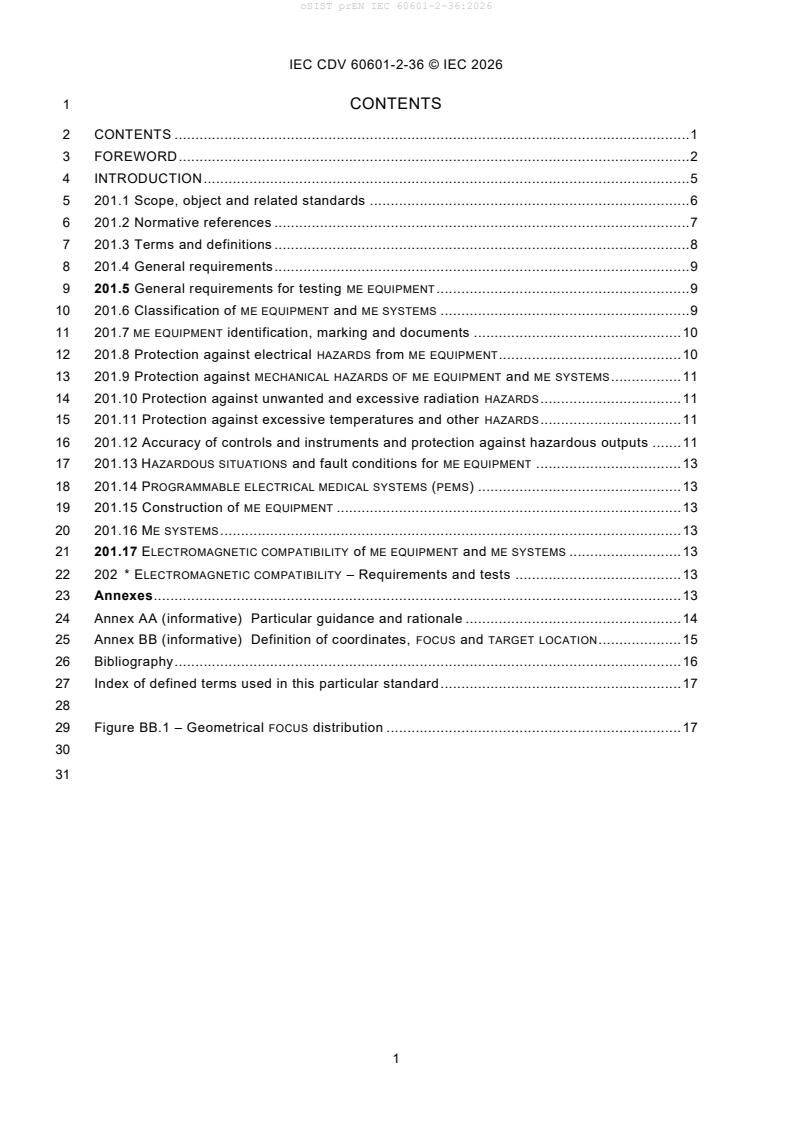
1 CONTENTS
2 CONTENTS . 1
3 FOREWORD . 2
4 INTRODUCTION . 5
5 201.1 Scope, object and related standards . 6
6 201.2 Normative references . 7
7 201.3 Terms and definitions . 8
8 201.4 General requirements . 9
9 201.5 General requirements for testing ME EQUIPMENT . 9
10 201.6 Classification of ME EQUIPMENT and ME SYSTEMS . 9
11 201.7 ME EQUIPMENT identification, marking and documents . 10
12 201.8 Protection against electrical HAZARDS from ME EQUIPMENT . 10
13 201.9 Protection against MECHANICAL HAZARDS OF ME EQUIPMENT and ME SYSTEMS . 11
14 201.10 Protection against unwanted and excessive radiation HAZARDS . 11
15 201.11 Protection against excessive temperatures and other HAZARDS . 11
16 201.12 Accuracy of controls and instruments and protection against hazardous outputs . 11
17 201.13 HAZARDOUS SITUATIONS and fault conditions for ME EQUIPMENT . 13
18 201.14 PROGRAMMABLE ELECTRICAL MEDICAL SYSTEMS (PEMS) . 13
19 201.15 Construction of ME EQUIPMENT . 13
20 201.16 ME SYSTEMS . 13
21 201.17 ELECTROMAGNETIC COMPATIBILITY of ME EQUIPMENT and ME SYSTEMS . 13
22 202 * ELECTROMAGNETIC COMPATIBILITY – Requirements and tests . 13
23 Annexes . 13
24 Annex AA (informative) Particular guidance and rationale . 14
25 Annex BB (informative) Definition of coordinates, FOCUS and TARGET LOCATION . 15
26 Bibliography . 16
27 Index of defined terms used in this particular standard . 17
29 Figure BB.1 – Geometrical FOCUS distribution . 17
IEC CDV 60601-2-36 © IEC 2026
32 INTERNATIONAL ELECTROTECHNICAL COMMISSION
33 ____________
35 MEDICAL ELECTRICAL EQUIPMENT –
37 Part 2-36: Particular requirements for the basic safety and essential
38 performance of therapy equipment for extracorporeally induced focused
39 pressure pulses
41 FOREWORD
42 1) The International Electrotechnical Commission (IEC) is a worldwide organization for standardization comprising
43 all national electrotechnical committees (IEC National Committees). The object of IEC is to promote international
44 co-operation on all questions concerning standardization in the electrical and electronic fields. To this end and
45 in addition to other activities, IEC publishes International Standards, Technical Specifications, Technical Reports,
46 Publicly Available Specifications (PAS) and Guides (hereafter referred to as “IEC Publication(s)”). Their
47 preparation is entrusted to technical committees; any IEC National Committee interested in the subject dealt with
48 may participate in this preparatory work. International, governmental and non-governmental organizations liaising
49 with the IEC also participate in this preparation. IEC collaborates closely with the International Organization for
50 Standardization (ISO) in accordance with conditions determined by agreement between the two organizations.
51 2) The formal decisions or agreements of IEC on technical matters express, as nearly as possible, an international
52 consensus of opinion on the relevant subjects since each technical committee has representation from all
53 interested IEC National Committees.
54 3) IEC Publications have the form of recommendations for international use and are accepted by IEC National
55 Committees in that sense. While all reasonable efforts are made to ensure that the technical content of IEC
56 Publications is accurate, IEC cannot be held responsible for the way in which they are used or for any
57 misinterpretation by any end user.
58 4) In order to promote international uniformity, IEC National Committees undertake to apply IEC Publications
59 transparently to the maximum extent possible in their national and regional publications. Any divergence between
60 any IEC Publication and the corresponding national or regional publication shall be clearly indicated in the latter.
61 5) IEC itself does not provide any attestation of conformity. Independent certification bodies provide conformity
62 assessment services and, in some areas, access to IEC marks of conformity. IEC is not responsible for any
63 services carried out by independent certification bodies.
64 6) All users should ensure that they have the latest edition of this publication.
65 7) No liability shall attach to IEC or its directors, employees, servants or agents including individual experts and
66 members of its technical committees and IEC National Committees for any personal injury, property damage or
67 other damage of any nature whatsoever, whether direct or indirect, or for costs (including legal fees) and
68 expenses arising out of the publication, use of, or reliance upon, this IEC Publication or any other IEC
69 Publications.
70 8) Attention is drawn to the Normative references cited in this publication. Use of the referenced publications is
71 indispensable for the correct application of this publication.
72 9) Attention is drawn to the possibility that some of the elements of this IEC Publication may be the subject of patent
73 rights. IEC shall not be held responsible for identifying any or all such patent rights.
74 International standard IEC 60601-2-36 has been prepared by IEC subcommittee 62D: Particular
75 medical equipment, software, and systems, of IEC technical committee 62: Medical equipment,
76 software, and systems.
77 This third edition cancels and replaces the second edition of IEC 60601-2-36 published in 2014.
78 This edition constitutes a technical revision to align structurally with IEC 60601-1:2005 and its
79 Amendment 1:2012 and Amendment 2:2020.
IEC CDV 60601-2-36 © IEC 2026
81 The text of this particular standard is based on the following documents:
FDIS Report on voting
62D/xxxx/FDIS 62D/xxxx/RVD
83 Full information on the voting for the approval of this particular standard can be found in the
84 report on voting indicated in the above table.
85 This publication has been drafted in accordance with the ISO/IEC Directives, Part 2.
86 In this standard, the following print types are used:
87 – Requirements and definitions: roman type.
88 – Test specifications: italic type.
89 – Informative material appearing outside of tables, such as notes, examples and references: in smaller type.
90 Normative text of tables is also in a smaller type.
91 – TERMS DEFINED IN CLAUSE 3 OF THE GENERAL STANDARD, IN THIS PARTICULAR STANDARD OR AS
92 NOTED: SMALL CAPITALS.
93 In referring to the structure of this standard, the term
94 – “clause” means one of the numbered divisions within the table of contents, inclusive of all
95 subdivisions (e.g. Clause 7 includes subclauses 7.1, 7.2, etc.);
96 – “subclause” means a numbered subdivision of a clause (e.g. 7.1, 7.2 and 7.2.1 are all
97 subclauses of Clause 7).
98 References to clauses within this standard are preceded by the term “Clause” followed by the
99 clause number. References to subclauses within this particular standard are by number only.
100 In this standard, the conjunctive “or” is used as an “inclusive or” so a statement is true if any
101 combination of the conditions is true.
102 The verbal forms used in this standard conform to usage described in Annex H of the ISO/IEC
103 Directives, Part 2. For the purposes of this standard, the auxiliary verb:
104 – “shall” means that compliance with a requirement or a test is mandatory for compliance with
105 this standard;
106 – “should” means that compliance with a requirement or a test is recommended but is not
107 mandatory for compliance with this standard;
108 – “may” is used to describe a permissible way to achieve compliance with a requirement or
109 test.
110 An asterisk (*) as the first character of a title or at the beginning of a paragraph or table title
111 indicates that there is guidance or rationale related to that item in Annex AA.
112 A list of all parts of the IEC 60601 series, published under the general title Medical electrical
113 equipment, can be found on the IEC website.
IEC CDV 60601-2-36 © IEC 2026
115 The committee has decided that the contents of this publication will remain unchanged until the
116 stability date indicated on the IEC web site under "http://webstore.iec.ch" in the data related to
117 the specific publication. At this date, the publication will be
118 • reconfirmed,
119 • withdrawn,
120 • replaced by a revised edition, or
121 • amended.
IEC CDV 60601-2-36 © IEC 2026
124 INTRODUCTION
125 This particular standard concerns the BASIC SAFETY and ESSENTIAL PERFORMANCE of therapy
126 equipment for EXTRACORPOREALLY INDUCED FOCUSED PRESSURE PULSES. It amends and
127 supplements IEC 60601-1:2005, IEC 60601-1:2005/A1:2012 and IEC 60601-1:2005/A2:2020:
128 Medical electrical equipment – Part 1: General requirements for basic safety and essential
129 performance), hereinafter referred to as the general standard.
130 The aim of this third edition is to bring this particular standard up to date with reference to the
131 third edition of the general standard through reformatting and technical changes.
132 This particular standard applied to BASIC SAFETY and ESSENTIAL PERFORMANCE of equipment for
133 EXTRACORPOREALLY INDUCED LITHOTRIPSY as defined in 201.3.206 including equipment for other
134 medical applications of therapeutic EXTRACORPOREALLY INDUCED FOCUSED PRESSURE PULSES,
135 hereafter referred to as ME EQUIPMENT.
136 Only naming extracorporeal shock wave LITHOTRIPSY (ESWL) in the title was misleading
137 because that method does only describe the medical application for stone fragmentation
138 (LITHOTRIPSY) and does not cover other applications where for example tissue is stimulated by
139 extracorporeal shock wave therapy (ESWT).
140 In order to generalize the title and don´t restrict it to a medical application method the title
141 was changed as following.
142 “Particular requirements for the BASIC SAFETY and ESSENTIAL PERFORMANCE of therapy
143 equipment for EXTRACORPOREALLY INDUCED FOCUSED PRESSURE PULSES”.
144 ESWL and ESWT are both representing therapies where EXTRACORPOREALLY INDUCED FOCUSED
145 PRESSURE PULSES are used. The title change reflects the change from a possibly restricted
146 description of the medical application method to the universal description of the physical mode
147 of action.
148 The requirements of this particular standard take priority over those of the general standard.
149 A “General guidance and rationale” for the more important requirements of this particular
150 standard is included in Annex AA. It is considered that knowledge of the reasons for these
151 requirements will not only facilitate the proper application of the standard but will, in due course,
152 expedite any revision necessitated by changes in clinical practice or as a result of developments
153 in technology. However, Annex AA does not form part of the requirements of this standard.
IEC CDV 60601-2-36 © IEC 2026
155 MEDICAL ELECTRICAL EQUIPMENT –
157 Part 2-36: Particular requirements for basic safety and essential
158 performance of therapy equipment for extracorporeally induced focused
159 pressure pulses
163 201.1 Scope, object and related standards
164 IEC 60601-1:2005, IEC 60601-1:2005/AMD1:2012 and IEC 60601-1:2005/AMD2:2020,
165 Clause 1, applies, except as follows:
166 201.1.1 Scope
167 Replacement:
168 This particular standard applies to BASIC SAFETY and ESSENTIAL PERFORMANCE of therapy
169 equipment for EXTRACORPOREALLY INDUCED FOCUSED PRESSURE PULSES as defined in 201.3.212,
170 hereafter referred to as ME EQUIPMENT. The applicability of this particular standard is limited to
171 components directly involved in the PRESSURE PULSE treatment, such as, but not limited to, the
172 generator of the PRESSURE PULSE, and their interactions with other devices, such as e.g. patient
173 support, imaging, monitoring or treatment planning devices. Such devices themselves are
174 excluded from this standard, because they are treated in other applicable IEC standards.
175 This particular standard does not apply to:
176 – ULTRASOUND PHYSIOTHERAPY EQUIPMENT intended to be used for physiotherapy;
177 – ULTRASOUND equipment intended to be used for high intensity therapeutic ULTRASOUND
178 (HITU) and other therapy equipment as described in Annex AA;
179 Note:
180 IEC 60601-2-5 is the particular standard for ULTRASOUND PHYSIOTHERAPY EQUIPMENT and
181 IEC 60601-2-62 is the particular standard for HITU equipment.
182 201.1.2 * Object
183 Replacement:
184 The object of this particular standard is to establish particular BASIC SAFETY and ESSENTIAL
185 PERFORMANCE requirements of therapy equipment for EXTRACORPOREALLY INDUCED PRESSURE
186 PULSES as defined in 201.3.212.
187 201.1.3 Collateral standards
188 Addition:
189 This particular standard refers to those applicable collateral standards that are listed in Clause
190 2 of the general standard and Clause 201.2 of this particular standard.
191 IEC 60601-1-2 applies as modified in Clause 202. IEC 60601-1-3, IEC 60601-1-10, IEC 60601-
192 1-11 and IEC 60601-1-12 do not apply. All other published collateral standards in the
193 IEC 60601-1 series apply as published.
194 IEC 60601-1-8 is also not applicable because appropriate warning signals are sufficiently
195 specified in IEC 60601-1.
IEC CDV 60601-2-36 © IEC 2026
196 201.1.4 Particular standards
197 Replacement:
198 In the IEC 60601 series, particular standards may modify, replace or delete requirements
199 contained in the general standard and collateral standards as appropriate for the particular
200 ME EQUIPMENT under consideration, and may add other BASIC SAFETY and ESSENTIAL
201 PERFORMANCE requirements.
202 A requirement of a particular standard takes priority over the general standard.
203 For brevity, IEC 60601-1 is referred to in this particular standard as the general standard.
204 Collateral standards are referred to by their document number.
205 The numbering of clauses and subclauses of this particular standard corresponds to that of the
206 general standard with the prefix “201” (e.g. 201.1 in this standard addresses the content of
207 Clause 1 of the general standard) or applicable collateral standard with the prefix “20x” where
208 x is the final digit(s) of the collateral standard document number (e.g. 202.4 in this particular
209 standard addresses the content of Clause 4 of the IEC 60601-1-2 collateral standard, 203.4 in
210 this particular standard addresses the content of Clause 4 of the IEC 60601-1-3 collateral
211 standard, etc.). The changes to the text of the general standard are specified by the use of the
212 following words:
213 "Replacement" means that the clause or subclause of the general standard or applicable
214 collateral standard is replaced completely by the text of this particular standard.
215 "Addition" means that the text of this particular standard is additional to the requirements of the
216 general standard or applicable collateral standard.
217 "Amendment" means that the clause or subclause of the general standard or applicable
218 collateral standard is amended as indicated by the text of this particular standard.
219 Subclauses, figures or tables which are additional to those of the general standard are
220 numbered starting from 201.101. However, due to the fact that definitions in the general
221 standard are numbered 3.1 through 3.139, additional definitions in this standard are numbered
222 beginning from 201.3.201. Additional annexes are lettered AA, BB, etc., and additional items
223 aa), bb), etc.
224 Subclauses, figures or tables which are additional to those of a collateral standard are
225 numbered starting from 20x, where “x” is the number of the collateral standard, e.g. 202 for
226 IEC 60601-1-2, 203 for IEC 60601-1-3, etc.
227 The term "this standard" is used to make reference to the general standard, any applicable
228 collateral standards and this particular standard taken together.
229 Where there is no corresponding clause or subclause in this particular standard, the clause or
230 subclause of the general standard or applicable collateral standard, although possibly not
231 relevant, applies without modification; where it is intended that any part of the general standard
232 or applicable collateral standard, although possibly relevant, is not to be applied, a statement
233 to that effect is given in this particular standard.
234 201.2 Normative references
235 Clause 2 of the general standard applies, except as follows:
236 Replacement:
IEC CDV 60601-2-36 © IEC 2026
237 IEC 60601-1-2:2014, Medical electrical equipment – Part 1-2: General requirements for basic
238 safety and essential performance – Collateral standard: Electromagnetic compatibility –
239 Requirements and tests
240 IEC 60601-1-2:2014/AMD1:2020
241 Addition:
242 IEC 60601-1:2005, Medical electrical equipment – Part 1: General requirements for basic safety
243 and essential performance
244 IEC 60601-1:2005/AMD1:2012
245 IEC 60601-1:2005/AMD2:2020
246 IEC 60601-2-5:202x, Medical electrical equipment – Part 2-5: Particular requirements for the
247 basic safety and essential performance of ultrasonic physiotherapy equipment
248 IEC 60601-2-62:2013, Particular requirements for the basic safety and essential performance
249 of high intensity therapeutic ultrasound (HITU) equipment
250 IEC 61846:2025, Ultrasonics–Therapeutic focused short pressure pulse sources:
251 Characterization of fields
252 201.3 Terms and definitions
253 NOTE An index of defined terms is found beginning on page 20.
254 For the purpose of this document, the terms and definitions given in IEC 60601-1:2005,
255 IEC 60601-1:2005/AMD1:2012 and IEC 60601-1:2005/AMD2:2020 apply, except as follows:
256 Additional definitio
...