

EN IEC 63287-4:2026
(Main)Semiconductor devices - Guidelines for reliability qualification plans - Part 4: Early failure assessment
- Status
- Not Published
- Publication Date
- 22-Oct-2026
- Technical Committee
- CLC/TC 47X - Semiconductor devices and trusted chips
- Current Stage
- 6055 - Ratification Completed (DOR) - Publishing
- Start Date
- 02-Oct-2026
- Completion Date
- 02-Oct-2026

EN IEC 63287-4:2026 is part 4 of the Semiconductor devices - Guidelines for reliability qualification plans series. EN IEC 63287-4:2026 gives guidelines for developing reliability qualification plans using early failure assessment, based on environmental conditioning and the proposed usage of the product. It is written for people who plan, run, or review semiconductor reliability qualification work, and it is not intended for military- and space-related applications.
What does EN IEC 63287-4:2026 specify?
EN IEC 63287-4:2026 specifies how to assess early failures in semiconductor device reliability qualification, especially when a fixed-time test produces zero failures. The document is organized into a short technical body, two informative annexes, and a bibliography.
| Annex | What it covers |
|---|---|
| Annex A | Deriving the distribution function in case of zero failures |
| Annex B | Equivalent failures when the number of failures is zero |
The main clauses are Scope, Normative references, Terms and definitions, and Clause 4 on Early failure assessment. In practice, this gives readers a clear path from the test result to the confidence-based estimate they need for qualification decisions.
What are the key requirements of EN IEC 63287-4:2026?
EN IEC 63287-4:2026 centers on one point: when no failures are observed, the assessment must move from point estimation to a one-sided confidence limit for cumulative failure probability. That matters because a zero-failure result still needs a defensible reliability statement for screening, burn-in, and similar qualification tests.
Zero-failure results are handled with confidence limits
Clause 4.2 says that if no failure occurs in a fixed-time reliability test, point estimation with F(t) = 0 is not enough for the early failure calculation used in IEC 63287-1. The document therefore uses the upper limit of the one-sided confidence early failure assessment. In practice, the engineer or quality team must base the conclusion on the test duration, the sample size, and the chosen confidence level.
Method A uses the chi-square distribution
Clause 4.2.1 gives the chi-square-based method for the case where the lifetime distribution can be treated as exponential. The method uses total operating time, number of failures, and sample size to estimate the failure rate and then the cumulative failure probability. In practice, this is the method to use when the failure rate can reasonably be treated as constant and the sample is large enough for that assumption.
Method B uses Weibull distribution
Clause 4.2.2 gives a Weibull-based method that extends the chi-square approach through time conversion. This method needs the Weibull shape parameter m to be established in advance from information on similar products. In practice, this means historical data or comparable device experience must be available before the calculation can be used.
Method C is nonparametric
Clause 4.2.2 also notes a nonparametric method that uses cumulative failure probability as a binomial quantity rather than assuming a lifetime distribution. In practice, this is useful when the user wants to avoid a parametric lifetime assumption. The document shows that, with large sample sizes, Methods A, B, and C converge to similar results.
Annexes support the calculations
Annex A derives the equations behind the zero-failure case for exponential, Weibull-transformed, and binomial approaches. Annex B gives the substitute-failure values used when zero failures are observed, which helps readers compare methods and interpret small-sample effects.
What terms does EN IEC 63287-4:2026 define?
- failure mode - A style classification of a fault phenomenon that causes product failure, such as disconnection, short circuit, loss, abrasion, or characteristic deterioration.
- early failure assessment - The confidence-based evaluation used when early failures are being judged from reliability qualification data.
- cumulative failure probability - The probability measure used to express the chance of failure up to a given time.
- confidence level (C.L.) - The one-sided confidence percentage used in the upper-limit calculations.
- chi-square distribution - The distribution used in Method A to derive the confidence-based failure-rate estimate.
- Weibull distribution - The lifetime model used in Method B and in the Weibull transformation shown in Annex A.
- MTTF - The time-based quantity used in the chi-square method and related derivations for zero-failure assessment.
Who uses EN IEC 63287-4:2026?
EN IEC 63287-4:2026 is used by semiconductor device reliability engineers, qualification engineers, and quality managers who design or review reliability qualification plans. It is also relevant to test laboratories that run fixed-time environmental and burn-in tests, and to organizations that need to justify zero-failure results with a documented confidence method. The document is useful wherever proposed product usage and environmental conditioning have to be translated into a reliability assessment.
Which standards are used with EN IEC 63287-4:2026?
EN IEC 63287-4:2026 is to be read with IEC 63287-1:2021, Semiconductor devices - Generic semiconductor qualification guidelines - Part 1: Guidelines for IC reliability qualification. That companion part provides the broader qualification framework and the equations that this part builds on for early failure assessment.
What does the EN IEC 63287-4:2026 document contain?
EN IEC 63287-4:2026 contains the main calculation approach for early failure assessment, including the fixed-time zero-failure case and the two parametric and one nonparametric method families. It includes comparison tables for confidence levels of 60% and 90% showing how sample size affects the upper limit of cumulative failure probability. Annex A gives the derivations, including the chi-square and Weibull transformations, and Annex B gives substitute values for zero failures. The bibliography lists related environmental test methods and semiconductor reliability guides used for further study or supporting test planning.
Relations
- Effective Date
- 22-Sep-2026
Frequently Asked Questions
EN IEC 63287-4:2026 is a draft published by CLC. Its full title is "Semiconductor devices - Guidelines for reliability qualification plans - Part 4: Early failure assessment". This standard covers: Semiconductor devices - Guidelines for reliability qualification plans - Part 4: Early failure assessment
Semiconductor devices - Guidelines for reliability qualification plans - Part 4: Early failure assessment
EN IEC 63287-4:2026 is classified under the following ICS (International Classification for Standards) categories: 31.080.01 - Semiconductor devices in general. The ICS classification helps identify the subject area and facilitates finding related standards.
EN IEC 63287-4:2026 has the following relationships with other standards: It is inter standard links to EN IEC 63287-1:2021. Understanding these relationships helps ensure you are using the most current and applicable version of the standard.
EN IEC 63287-4:2026 is available in PDF format for immediate download after purchase. The document can be added to your cart and obtained through the secure checkout process. Digital delivery ensures instant access to the complete standard document.
Standards Content (Sample)
SLOVENSKI STANDARD
oSIST prEN IEC 63287-4:2025
01-julij-2025
Polprevodniški elementi - Smernice za načrtovanje ocenjevanja zanesljivosti - 4.
del: Ocena zgodnje odpovedi
Semiconductor devices - Guidelines for reliability qualification plans - Part 4: Early failure
assessment
Dispositifs à semiconducteurs - Lignes directrices concernant les plans de qualification
de la fiabilité - Partie 4: évaluation des défaillances précoces
Ta slovenski standard je istoveten z: prEN IEC 63287-4:2025
ICS:
31.080.01 Polprevodniški elementi Semiconductor devices in
(naprave) na splošno general
oSIST prEN IEC 63287-4:2025 en
2003-01.Slovenski inštitut za standardizacijo. Razmnoževanje celote ali delov tega standarda ni dovoljeno.
oSIST prEN IEC 63287-4:2025
oSIST prEN IEC 63287-4:2025
47/2917/CDV
COMMITTEE DRAFT FOR VOTE (CDV)
PROJECT NUMBER:
IEC 63287-4 ED1
DATE OF CIRCULATION: CLOSING DATE FOR VOTING:
2025-05-30 2025-08-22
SUPERSEDES DOCUMENTS:
47/2892/CD, 47/2914/CC
IEC TC 47 : SEMICONDUCTOR DEVICES
SECRETARIAT: SECRETARY:
Korea, Republic of Mr Cheolung Cha
OF INTEREST TO THE FOLLOWING COMMITTEES: HORIZONTAL FUNCTION(S):
ASPECTS CONCERNED:
SUBMITTED FOR CENELEC PARALLEL VOTING NOT SUBMITTED FOR CENELEC PARALLEL VOTING
Attention IEC-CENELEC parallel voting
The attention of IEC National Committees, members of
CENELEC, is drawn to the fact that this Committee Draft for
Vote (CDV) is submitted for parallel voting.
The CENELEC members are invited to vote through the
CENELEC online voting system.
This document is still under study and subject to change. It should not be used for reference purposes.
Recipients of this document are invited to submit, with their comments, notification of any relevant patent rights of which they are
aware and to provide supporting documentation.
Recipients of this document are invited to submit, with their comments, notification of any relevant “In Some Countries” clau ses
to be included should this proposal proceed. Recipients are reminded that the CDV stage is the final stage for submitting ISC
clauses. (SEE AC/22/2007 OR NEW GUIDANCE DOC).
TITLE:
Semiconductor devices - Guidelines for reliability qualification plans - Part 4: Early failure assessment
PROPOSED STABILITY DATE: 2030
NOTE FROM TC/SC OFFICERS:
electronic file, to make a copy and to print out the content for the sole purpose of preparing National Committee positions. You
may not copy or "mirror" the file or printed version of the document, or any part of it, for any other purpose without permis sion in
writing from IEC.
oSIST prEN IEC 63287-4:2025
IEC CDV 63287-4 © IEC 2025 2 47/2917/CDV
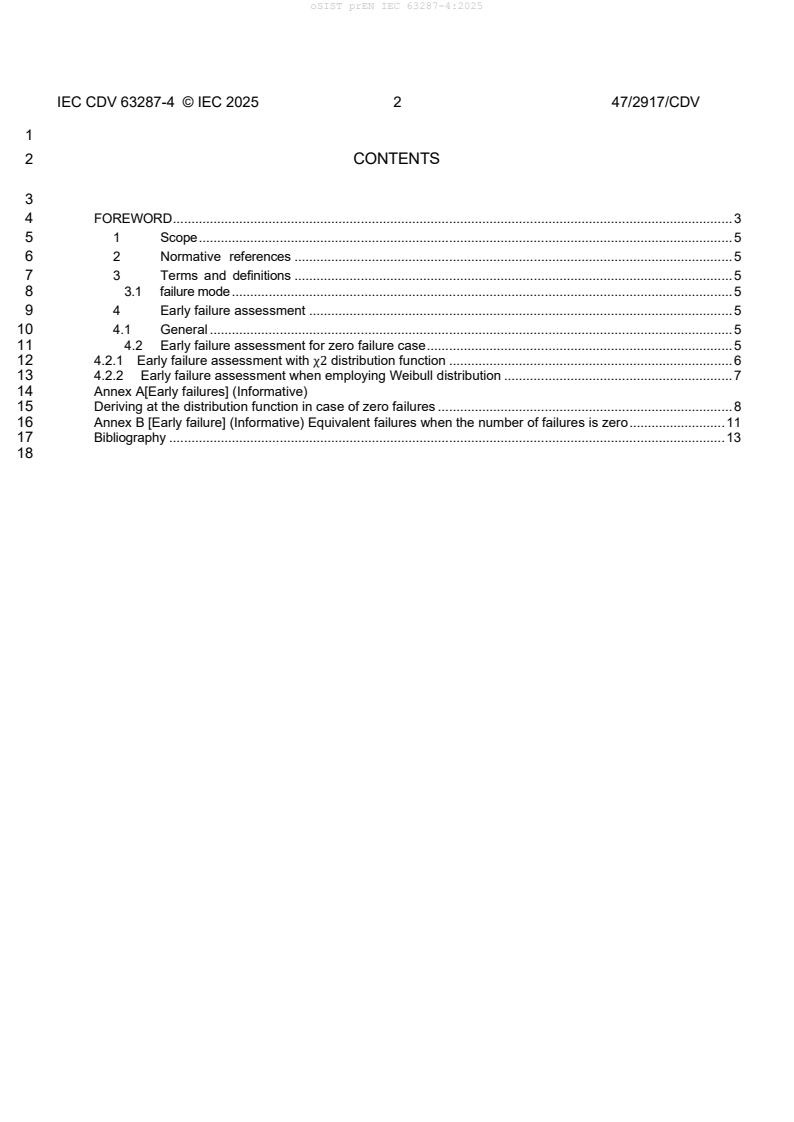
2 CONTENTS
4 FOREWORD . 3
5 1 Scope . 5
6 2 Normative references . 5
7 3 Terms and definitions . 5
8 3.1 failure mode . 5
9 4 Early failure assessment . 5
10 4.1 General . 5
11 4.2 Early failure assessment for zero failure case . 5
12 4.2.1 Early failure assessment with χ2 distribution function . 6
13 4.2.2 Early failure assessment when employing Weibull distribution . 7
14 Annex A[Early failures] (Informative)
15 Deriving at the distribution function in case of zero failures . 8
16 Annex B [Early failure] (Informative) Equivalent failures when the number of failures is zero . 11
17 Bibliography . 13
oSIST prEN IEC 63287-4:2025
IEC CDV 63287-4 © IEC 2025 3 47/2917/CDV
19 INTERNATIONAL ELECTROTECHNICAL COMMISSION
23 SEMICONDUCTOR DEVICES –
24 GUIDELINES FOR RELIABILITY QUALIFICATION PLANS –
26 Part 4 : Early failure assessment
28 FOREWORD
29 1) The International Electrotechnical Commission (IEC) is a worldwide organization for standardization comprising
30 all national electrotechnical committees (IEC National Committees). The object of IEC is to promote international co-
31 operation on all questions concerning standardization in the electrical and electronic fields. To this end and in
32 addition to other activities, IEC publishes International Standards, Technical Specifications, Technical Reports, Publicly
33 Available Specifications (PAS) and Guides (hereafter referred to as “IEC Publication(s)”). Their preparation is
34 entrusted to technical committees; any IEC National Committee interested in the subject dealt with may participate in
35 this preparatory work. International, governmental and non-governmental organizations liaising with the IEC also
36 participate in this preparation. IEC collaborates closely with the International Organization for Standardization (ISO) in
37 accordance with conditions determined by agreement between the two organizations.
38 2) The formal decisions or agreements of IEC on technical matters express, as nearly as possible, an international
39 consensus of opinion on the relevant subjects since each technical committee has representation from all interested
40 IEC National Committees.
41 3) IEC Publications have the form of recommendations for international use and are accepted by IEC National Committees
42 in that sense. While all reasonable efforts are made to ensure that the technical content of IEC Publications is
43 accurate, IEC cannot be held responsible for the way in which they are used or for any misinterpretation by any
44 end user.
45 4) In order to promote international uniformity, IEC National Committees undertake to apply IEC Publications transparently
46 to the maximum extent possible in their national and regional publications. Any divergence between any IEC Publication
47 and the corresponding national or regional publication shall be clearly indicated in the latter.
48 5) IEC itself does not provide any attestation of conformity. Independent certification bodies provide conformity assessment
49 services and, in some areas, access to IEC marks of conformity. IEC is not responsible for any services carried out
50 by independent certification bodies.
51 6) All users should ensure that they have the latest edition of this publication.
52 7) No liability shall attach to IEC or its directors, employees, servants or agents including individual experts and members
53 of its technical committees and IEC National Committees for any personal injury, property damage or other damage
54 of any nature whatsoever, whether direct or indirect, or for costs (including legal fees) and expenses arising
55 out of the publication, use of, or reliance upon, this IEC Publication or any other IEC Publications.
56 8) Attention is drawn to the Normative references cited in this publication. Use of the referenced publications is
57 indispensable for the correct application of this publication.
58 9) Attention is drawn to the possibility that some of the elements of this IEC Publication may be the subject of patent
59 rights. IEC shall not be held responsible for identifying any or all such patent rights.
61 IEC 63287 Part 4 has been prepared by IEC technical committee 47: Semiconductor devices.
62 It is an International Standard.
64 The text of this International Standard is based on the following documents:
Draft Report on voting
47/XX/FDIS 47/XX/RVD
67 Full information on the voting for its approval can be found in the report on voting indicated in
68 the above table.
70 The language used for the development of this International Standard is English.
oSIST prEN IEC 63287-4:2025
IEC CDV 63287-4 © IEC 2025 4 47/2917/CDV
72 This document was drafted in accordance with ISO/IEC Directives, Part 2, and developed in accordance
73 with ISO/IEC Directives, Part 1 and ISO/IEC Directives, IEC Supplement, available at
74 www.iec.ch/members_experts/refdocs. The main document types developed by IEC are described
75 in greater detail at www.iec.ch/standardsdev/publications.
77 This International Standard is to be read in conjunction with IEC 63287-1.
79 A list of all parts in the IEC 63287 series, published under the general title Semiconductor devices,
80 can be found on the IEC website.
82 The committee has decided that the contents of this document will remain unchanged until the stability
83 date indicated on the IEC website under webstore.iec.ch in the data related to the specific
84 document. At this date, the document will be
86 • reconfirmed,
87 • withdrawn,
88 • replaced by a revised edition, or
89 • amended.
IMPORTANT – The "colour inside" logo on the cover page of this document indicates
that it contains colours which are considered to be useful for the correct understanding
of its contents. Users should therefore print this document using a colour printer.
oSIST prEN IEC 63287-4:2025
IEC CDV 63287-4 © IEC 2025 5 47/2917/CDV
94 SEMICONDUCTOR DEVICES –
95 GUIDELINES FOR RELIABILITY QUALIFICATION PLANS –
97 Part 4 : Early failure assessment
100 1 Scope
102 This part of IEC 63287 gives guidelines for the development of reliability qualification
103 plans using the early failure assessment, based on the environmental conditioning and
104 proposed usage of the product. This document is not intended for military- and space-
105 related applications.
107 2 Normative references
109 The following documents are referred to in the text in such a way that some or all of their
110 content constitutes requirements of this document. For dated references, only the edition
111 cited applies. For undated references, the latest edition of the referenced document
112 (including any amendments) applies.
114 IEC 63287-1:2021, Semiconductor devices – Generic semiconductor qualification
115 guidelines – Part 1: Guidelines for IC reliability qualification
117 3 Terms and definitions
119 For the purposes of this document, the following terms and definitions apply.
121 ISO and IEC maintain terminological databases for use in standardization at the following
122 addresses:
124 • IEC Electropedia: available at https://www.electropedia.org/
125 • ISO Online browsing platform: available at https://www.iso.org/obp
126 3.1
127 failure mode
128 style classification of a fault phenomenon which causes product failure
130 Note 1 to entry: Disconnection, a short circuit, occasional loss, abrasion, characteristic deterioration, etc.
131 are typical items considered as failure modes.
133 4 Early failure assessment
135 4.1 General
136 The estimate of the confidence interval of the early failure assessment
138 4.2 Early failure assessment for zero failure case
139 If failure does not occur in the fixed-time type reliability test for confirmation of convergence
̂
140 in screening, etc., it means that if zero failure cannot be obtained as a result, 𝐹(𝑡 ) = 0 is
𝑏
141 assumed in point estimation. Hence, 𝜂̂ cannot be obtained with Eq. (2) follow by IEC 63287-
142 1. For this reason, the method employing the upper limit of the estimate of the confidence
̂
( )
143 interval 𝐹 𝑡 of the cumulative failure probability obtained with one-sided confidence early
c 𝑏
̂
144 failure assessment of 𝐹(𝑡 ) is used. 𝐹 (𝑡 )is obtained with, for instance, parametric methods
𝑏 c 𝑏
145 that assume a defined distribution for device lifetime distribution and nonparametric methods
146 that do not assume any defined distribution for lifetime distribution and consider the
147 cumulative failure probability only. An example of the former is Method A in Table 1 and Table
oSIST prEN IEC 63287-4:2025
IEC CDV 63287-4 © IEC 2025 6 47/2917/CDV
149 2, the method that makes use of 2𝑇⁄𝑀𝑇𝑇𝐹forming𝜒 distribution with degree of freedom 𝜙 =
150 2𝑛 , when lifetime distribution can be assumed to be exponential distribution. Although this
151 method is been used widely, the sample size n must be large for the failure rate to be set
152 constant, when estimating early failure rate. Another method (Method B in table 1 and Table
153 2) assumes the lifetime distribution to be Weibull distribution and extends Method A by means
154 of time measurement conversion. This method requires value of the shape parameter 𝑚 to
155 be established in advance, based on information on similar products in the past. A
̂
( )
156 nonparametric method (Method C in table 1 and Table 2) uses 𝐹 𝑡 as failure probability in
c 𝑏
157 binomial distribution. When sample size 𝑛 is large, these methods arrive at the same estimate
158 of the cumulative failure probability at the point when failure is confirmed to be 0 at time point
159 𝑡 .Further details on Method A and Method B will be found in 4.2.1 and 4.2.2, respectively.
𝑏
160 Also, the estimation results of methods A, B and C as shown in the table below. The table
161 shows that the upper limit of the confidence early failure assessment for cumulative failure
162 probability differs when the sample size 𝑛 is small. Conversely, when the sample size 𝑛 is
163 large (𝑛 = 1000 or more), estimate obtained with Method A that assumes the failure rate to
164 be constant will match the results of Methods B and C.
166 Table 1 C.L. 60 % (α = 0.4) Upper limit of one-sided early failure assessment of cumulative failure
167 probability
Sample size (𝑛) Method A Method B Method C
1 0.91629 0.60000 0.60000
10 0.09163 0.08756 0.08756
22 0.04165 0.04079 0.04079
45 0.02036 0.02016 0.02016
77 0.01190 0.01183 0.01183
100 0.00916 0.00912 0.00912
231 0.00397 0.00396 0.00396
500 0.00183 0.00183 0.00183
1000 0.00092 0.00092 0.00092
169 Table 2 C.L. 90 % (α = 0.1) Upper limit of one-sided early failure assessment of cumulative
170 failure probability
Sample size (𝑛)
Method A Method B Method C
1 0.90000 0.90000
10 0.23026 0.20567 0.20567
22 0.10466 0.09937 0.09937
...