

EN 50289-1-17:2015
(Main)Communication cables - Specifications for test methods - Part 1-17: Electrical test methods - Exogenous Crosstalk ExNEXT and ExFEXT
General Information
- Abstract
Part 1-17 of EN 50289 details the test methods used to determine the cable to cable (exogenous) crosstalk between 4 pair cables used in analogue and digital communication systems. These exogenous Crosstalk effects are near end crosstalk (ExNEXT), far end crosstalk (ExFEXT), equal level far end crosstalk (ExELFEXT). This document should be read in conjunction with EN 50289-1-1, which contains essential provisions for its application. Reference is made also to EN 50289-1-10 in which the definitions and test methods for crosstalk is given. The exogenous crosstalk test method is described, as well as the treatment of the results to simulate the installation condition of a disturbed cable in contact with six disturbing cables.
- Status
- Published
- Publication Date
- 12-Nov-2015
- Withdrawal Date
- 27-Sep-2018
- Technical Committee
- CLC/TC 46X - Communication cables
- Drafting Committee
- CLC/SC 46XC - Multicore, Multipair and Quad Data communication cables
- Current Stage
- 6060 - Document made available - Publishing
- Start Date
- 13-Nov-2015
- Due Date
- 18-Jan-2017
- Completion Date
- 13-Nov-2015


Overview
EN 50289-1-17:2015 (CLC) defines repeatable test methods for exogenous crosstalk between separate 4‑pair communication cables used in analogue and digital systems. The standard specifies how to measure cable‑to‑cable interference-primarily ExNEXT (exogenous near‑end crosstalk), ExFEXT (exogenous far‑end crosstalk) and ExACR‑F (equal level far‑end crosstalk) -and how to treat results to simulate realistic installation conditions (for example, a disturbed cable in contact with six disturbing cables).
Key topics and requirements
- Measurements defined: ExNEXT, ExFEXT (including input/output FEXT), ExACR‑F and associated Power Sum (PS) metrics to quantify aggregate influence of multiple disturbing circuits.
- Test method references: Equipment, sample preparation and step‑by‑step procedures follow IEC 61156‑1 (clauses 6.3.7–6.3.9). EN 50289‑1‑1 supplies general application provisions.
- Result treatment: Procedures to simulate a disturbed cable in contact with six adjacent disturbing cables and rules for calculating Power Sum exogenous metrics (PSExNEXT, PSExACR‑F).
- Reporting requirements: Test reports must record test conditions such as temperature, frequency range, and the measured crosstalk values; ACR can be provided on request.
- NEXT scaling: Annex A provides a scaling factor to convert NEXT measured on short cable lengths to a 100 m basis; differences can be significant at low frequencies (example: ~3.9 dB at 1 MHz, ~0.1 dB at 200 MHz).
Practical applications
- Validating electromagnetic compatibility between adjacent multi‑pair cables in bundled installations (telecom ducts, data centers, industrial cabling).
- Supporting product specifications and quality control for communication cable manufacturers (4‑pair UTP/FTP).
- Guiding independent test laboratories and QA teams in reproducible crosstalk testing and reporting.
- Informing system designers and installers on expected performance impacts from cable proximity and bundling for analogue and digital communication systems.
Who should use this standard
- Cable manufacturers and R&D teams for design verification.
- Conformance and test laboratories performing crosstalk and EMC assessments.
- Network planners, installers, and specifiers assessing inter‑cable interference risks in deployments.
- Standards committees and procurement officers writing cable performance requirements.
Related standards
- EN 50289‑1‑1 - electrical test methods: general requirements
- EN 50289‑1‑10 - crosstalk definitions and basic test methods
- IEC 61156‑1:2007 - generic specifications and detailed test clauses referenced by EN 50289‑1‑17
Keywords: EN 50289-1-17:2015, exogenous crosstalk, ExNEXT, ExFEXT, ExACR-F, communication cables, crosstalk testing, Power Sum, four-pair cables.
Relations
- Effective Date
- 03-Feb-2026
- Effective Date
- 03-Feb-2026
Get Certified
Connect with accredited certification bodies for this standard

ANCE
Mexican certification and testing association.

Intertek Slovenia
Intertek testing, inspection, and certification services in Slovenia.

LNE (Laboratoire National de Métrologie et d'Essais)
French national laboratory for metrology and testing.
Sponsored listings
Frequently Asked Questions
EN 50289-1-17:2015 is a standard published by CLC. Its full title is "Communication cables - Specifications for test methods - Part 1-17: Electrical test methods - Exogenous Crosstalk ExNEXT and ExFEXT". This standard covers: Part 1-17 of EN 50289 details the test methods used to determine the cable to cable (exogenous) crosstalk between 4 pair cables used in analogue and digital communication systems. These exogenous Crosstalk effects are near end crosstalk (ExNEXT), far end crosstalk (ExFEXT), equal level far end crosstalk (ExELFEXT). This document should be read in conjunction with EN 50289-1-1, which contains essential provisions for its application. Reference is made also to EN 50289-1-10 in which the definitions and test methods for crosstalk is given. The exogenous crosstalk test method is described, as well as the treatment of the results to simulate the installation condition of a disturbed cable in contact with six disturbing cables.
Part 1-17 of EN 50289 details the test methods used to determine the cable to cable (exogenous) crosstalk between 4 pair cables used in analogue and digital communication systems. These exogenous Crosstalk effects are near end crosstalk (ExNEXT), far end crosstalk (ExFEXT), equal level far end crosstalk (ExELFEXT). This document should be read in conjunction with EN 50289-1-1, which contains essential provisions for its application. Reference is made also to EN 50289-1-10 in which the definitions and test methods for crosstalk is given. The exogenous crosstalk test method is described, as well as the treatment of the results to simulate the installation condition of a disturbed cable in contact with six disturbing cables.
EN 50289-1-17:2015 is classified under the following ICS (International Classification for Standards) categories: 33.120.10 - Coaxial cables. Waveguides. The ICS classification helps identify the subject area and facilitates finding related standards.
EN 50289-1-17:2015 has the following relationships with other standards: It is inter standard links to EN 50407-3:2014, EN 50289-4-16:2016. Understanding these relationships helps ensure you are using the most current and applicable version of the standard.
EN 50289-1-17:2015 is associated with the following European legislation: Standardization Mandates: M/117, M/212. When a standard is cited in the Official Journal of the European Union, products manufactured in conformity with it benefit from a presumption of conformity with the essential requirements of the corresponding EU directive or regulation.
EN 50289-1-17:2015 is available in PDF format for immediate download after purchase. The document can be added to your cart and obtained through the secure checkout process. Digital delivery ensures instant access to the complete standard document.
Standards Content (Sample)
2003-01.Slovenski inštitut za standardizacijo. Razmnoževanje celote ali delov tega standarda ni dovoljeno.Kommunikationskabel - Spezifikationen für Prüfverfahren - Teil 1-17: Elektrische Prüfverfahren – Externes Nebensprechen ExNEXT und ExFEXT (Nebensprechen zwischen Kabeln)Câbles de communication - Spécifications des méthodes d'essai - Partie 1-17: Méthodes d'essais électriques - Diaphonie exogène ExNEXT et ExFEXTCommunications cables - Specifications for test methods Part 1-17: Electrical test methods - Exogenous Crosstalk ExNEXT and ExFEXT33.120.10Koaksialni kabli. ValovodiCoaxial cables. WaveguidesICS:Ta slovenski standard je istoveten z:EN 50289-1-17:2015SIST EN 50289-1-17:2016en,fr,de01-februar-2016SIST EN 50289-1-17:2016SLOVENSKI
STANDARD
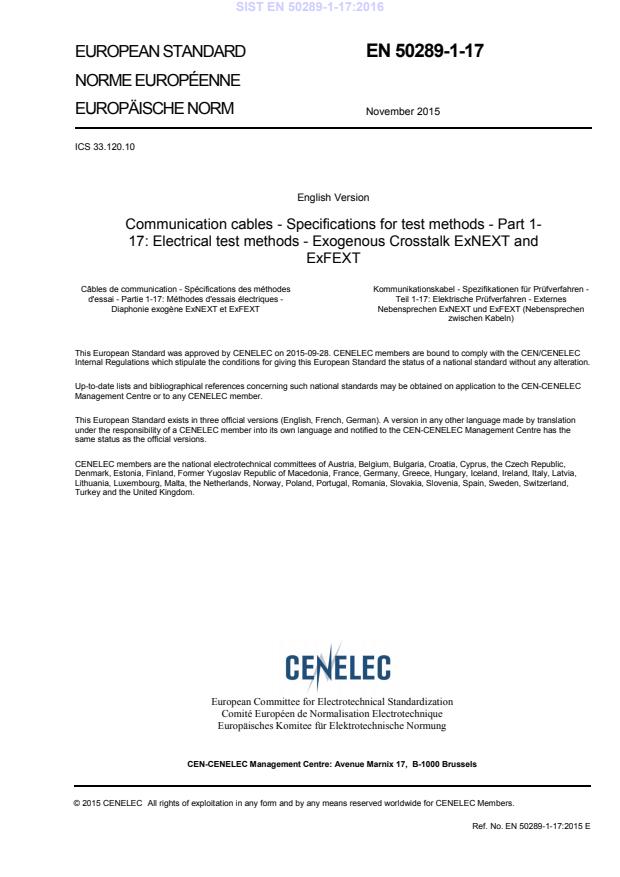
EUROPEAN STANDARD NORME EUROPÉENNE EUROPÄISCHE NORM
EN 50289-1-17
November 2015 ICS 33.120.10 English Version
Communication cables - Specifications for test methods - Part 1-17: Electrical test methods - Exogenous Crosstalk ExNEXT and ExFEXT
Câbles de communication - Spécifications des méthodes d'essai - Partie 1-17: Méthodes d'essais électriques - Diaphonie exogène ExNEXT et ExFEXT
Kommunikationskabel - Spezifikationen für Prüfverfahren - Teil 1-17: Elektrische Prüfverfahren - Externes Nebensprechen ExNEXT und ExFEXT (Nebensprechen zwischen Kabeln) This European Standard was approved by CENELEC on 2015-09-28. CENELEC members are bound to comply with the CEN/CENELEC Internal Regulations which stipulate the conditions for giving this European Standard the status of a national standard without any alteration.Up-to-date lists and bibliographical references concerning such national standards may be obtained on application to the CEN-CENELEC Management Centre or to any CENELEC member.
This European Standard exists in three official versions (English, French, German). A version in any other language made by translation under the responsibility of a CENELEC member into its own language and notified to the CEN-CENELEC Management Centre has the same status as the official versions. CENELEC members are the national electrotechnical committees of Austria, Belgium, Bulgaria, Croatia, Cyprus, the Czech Republic, Denmark, Estonia, Finland, Former Yugoslav Republic of Macedonia, France, Germany, Greece, Hungary, Iceland, Ireland, Italy, Latvia, Lithuania, Luxembourg, Malta, the Netherlands, Norway, Poland, Portugal, Romania, Slovakia, Slovenia, Spain, Sweden, Switzerland, Turkey and the United Kingdom. European Committee for Electrotechnical Standardization
Comité Européen de Normalisation Electrotechnique Europäisches Komitee für Elektrotechnische Normung CEN-CENELEC Management Centre: Avenue Marnix 17,
B-1000 Brussels © 2015 CENELEC All rights of exploitation in any form and by any means reserved worldwide for CENELEC Members.
Ref. No. EN 50289-1-17:2015 ESIST EN 50289-1-17:2016
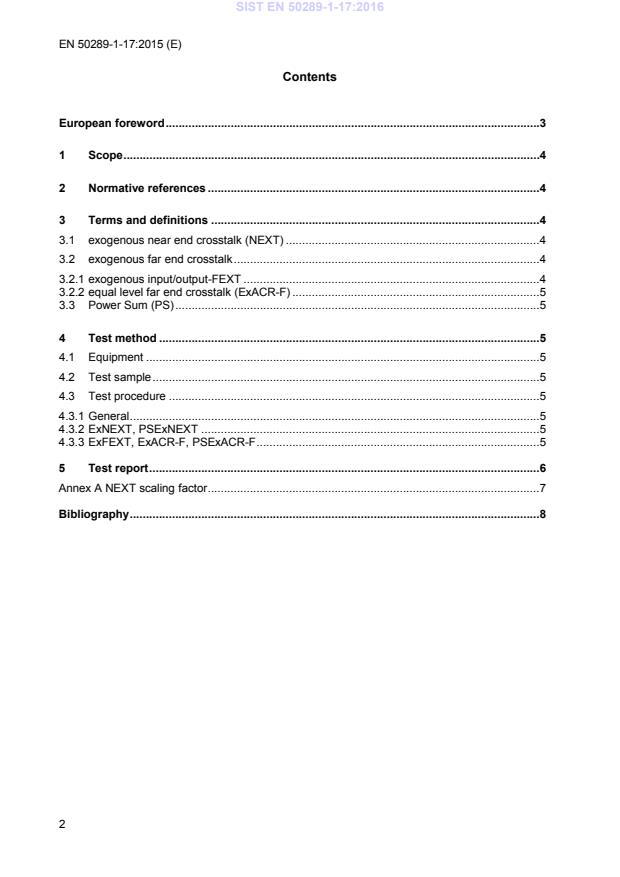
Contents European foreword . 3 1 Scope . 4 2 Normative references . 4 3 Terms and definitions . 4 3.1 exogenous near end crosstalk (NEXT) . 4 3.2 exogenous far end crosstalk . 4 3.2.1 exogenous input/output-FEXT . 4 3.2.2 equal level far end crosstalk (ExACR-F) . 5 3.3 Power Sum (PS) . 5 4 Test method . 5 4.1 Equipment . 5 4.2 Test sample . 5 4.3 Test procedure . 5 4.3.1 General . 5 4.3.2 ExNEXT, PSExNEXT . 5 4.3.3 ExFEXT, ExACR-F, PSExACR-F . 5 5 Test report . 6 Annex A NEXT scaling factor . 7 Bibliography .
...