


EN IEC 61439-3:2024
(Main)Low-voltage switchgear and controlgear assemblies - Part 3: Distribution boards intended to be operated by ordinary persons (DBO)
Low-voltage switchgear and controlgear assemblies - Part 3: Distribution boards intended to be operated by ordinary persons (DBO)
IEC 61439-3:2024 defines the specific requirements for distribution boards intended to be operated by ordinary persons (abbreviated DBO throughout this document, see 3.1.101) as follows: - assemblies intended to be operated by ordinary persons (e.g. switching operations and replacing fuse-links), e.g. in domestic (household) applications; - assemblies containing outgoing circuits with protective devices intended to be operated by ordinary persons, complying e.g. with IEC 60898-1, the IEC 61008 series, the IEC 61009 series, IEC 62606, IEC 62423 and IEC 60269-3; - assemblies for applications where the nominal voltage to earth does not exceed 300 V AC (see Table G.1 of IEC 61439-1:2020); NOTE The voltage limits for DC applications are under consideration. - assemblies with a rated current (Inc) of the outgoing circuits not exceeding 125 A and a rated current (InA) not exceeding 250 A; - assemblies intended for use in connection with the generation, transmission, distribution and conversion of electrical energy, and for the control of equipment consuming electrical energy and for associated data processing; - enclosed, stationary assemblies; - assemblies for indoor or outdoor use. This second edition cancels and replaces the first edition published in 2012. This edition constitutes a technical revision. This edition includes the following significant technical changes with respect to the previous edition: a) alignment with the structure of IEC 61439-1:2020; b) inclusion in the scope of more examples of the type of protection and control devices; c) deletion of type A and Type B DBOs; d) addition of a new Annex BB related to DBOs used in a prosumer’s electrical installation (PEI); e) addition of a new Annex CC related to rated current of a DBO with additional source of supply in parallel/simultaneously with another source that is connected to the DBO e.g. PV.
Niederspannungs-Schaltgerätekombinationen - Teil 3: Installationsverteiler für die Bedienung durch Laien (DBO)
Ensembles d'appareillage à basse tension - Partie 3: Tableaux de répartition destinés à être utilisés par des personnes ordinaires (DBO)
L'IEC 61439-3:2024 définit les exigences spécifiques pour les tableaux de répartition destinés à être utilisés par des personnes ordinaires (abrégés DBO dans l'ensemble du présent document, voir 3.1.101) ci-après: - ensembles destinés à être utilisés par des personnes ordinaires (par exemple, pour manœuvrer des appareils de commande et remplacer des éléments de fusible), par exemple dans des applications domestiques; - ensembles qui contiennent des circuits de départ avec des dispositifs de protection, destinés à être utilisés par des personnes ordinaires, qui satisfont par exemple à l'IEC 60898-1, à la série IEC 61008, à la série IEC 61009, à l'IEC 62606, à l'IEC 62423 et à l'IEC 60269-3; - ensembles destinés à des applications pour lesquelles la tension nominale à la terre ne dépasse pas 300 V en courant alternatif (voir Tableau G.1 de l'IEC 61439-1:2020); NOTE Les limites de tension pour les applications en courant continu sont à l'étude. - ensembles dans lesquels le courant assigné (Inc) des circuits de départ est inférieur ou égal à 125 A et dont le courant assigné (InA) est inférieur ou égal à 250 A; - ensembles destinés à être utilisés avec des équipements conçus pour la production, le transport, la distribution et la conversion de l'énergie électrique, la commande des matériels qui consomment de l'énergie électrique et le traitement des données associées; - ensembles fixes sous enveloppe; - ensembles pour utilisation en intérieure ou en extérieur. Cette seconde édition annule et remplace la première édition parue en 2012. Cette édition constitue une révision technique. Cette édition inclut les modifications techniques majeures suivantes par rapport à l'édition précédente: a) alignement sur la structure de l'IEC 61439-1:2020; b) inclusion dans le domaine d'application de plus d'exemples de types de dispositifs de protection et de commande; c) suppression des DBO de type A et de type B; d) ajout d'une nouvelle Annexe BB relative aux DBO utilisés dans une installation électrique de prosommateur (PEI); e) ajout d'une nouvelle Annexe CC relative au courant assigné d'un DBO avec une source d'alimentation supplémentaire parallèlement/simultanément avec une autre source reliée au DBO, par exemple un panneau photovoltaïque (PV).
Sestavi nizkonapetostnih stikalnih in krmilnih naprav - 3. del: Električni razdelilniki, s katerimi lahko ravnajo nestrokovnjaki (DBO) (IEC 61439-3:2024)
Standard IEC 61439-3:2024 določa posebne zahteve za električne razdelilnike, s katerimi lahko ravnajo nestrokovnjaki (v tem dokumentu se uporablja kratica DBO, glej točko 3.1.101), kar zajema:
– sestave, s katerimi lahko ravnajo nestrokovnjaki (npr. stikalne operacije in zamenjava povezav varovalk), npr. v gospodinjstvu;
– sestave z izhodnimi tokokrogi, ki vsebujejo zaščitne naprave, s katerimi lahko ravnajo nestrokovnjaki in so v skladu s standardom IEC 60898-1, skupino standardov IEC 61008, skupino standardov IEC 61009 ter standardi IEC 62606, IEC 62423 in IEC 60269-3;
– sestave za uporabo v primerih, ko naznačena napetost proti zemlji ne presega 300 V pri izmeničnem toku (glej preglednico G.1 standarda IEC 61439-1:2020);
OPOMBA: Mejne vrednosti napetosti za uporabo z enosmernim tokom so v obravnavi.
– sestave, pri katerih naznačeni tok (Inc) izhodnih tokokrogov ne presega 125 A in naznačeni tok (InA) ne presega 250 A;
– sestave za uporabo na področju proizvodnje, prenosa, distribucije in pretvarjanja električne energije ter za nadzor opreme, ki uporablja električno energijo, in s tem povezano obdelavo podatkov;
– zaprte, stacionarne sestave;
– sestave za uporabo v zaprtih prostorih ali na prostem.
Druga izdaja razveljavlja in nadomešča prvo izdajo, objavljeno leta 2012. Ta izdaja je tehnično popravljena izdaja.
Ta izdaja v primerjavi s prejšnjo vključuje naslednje pomembne tehnične spremembe:
a) vsebina je bila usklajena s strukturo standarda IEC 61439-1:2020;
b) vključenih je več primerov vrste zaščite in krmilnih naprav;
c) naprave DBO tipov A in B so bile izbrisane;
d) dodan je bil nov dodatek BB v zvezi z napravami DBO, ki se uporabljajo v električni inštalaciji aktivnega odjemalca (PEI);
e) dodan je bil nov dodatek CC v zvezi z naznačenim tokom naprave DBO z dodatnim virom napajanja vzporedno/sočasno z drugim virom, ki je priključen na napravo DBO (npr. PV).
General Information
- Status
- Published
- Publication Date
- 21-Nov-2024
- Technical Committee
- CLC/SR 121B - Low-voltage switchgear and controlgear assemblies
- Drafting Committee
- IEC/SC 121B - Low-voltage switchgear and controlgear assemblies
- Current Stage
- 6060 - Document made available - Publishing
- Start Date
- 22-Nov-2024
- Due Date
- 29-Dec-2023
- Completion Date
- 22-Nov-2024
Relations
- Effective Date
- 08-Feb-2022
- Effective Date
- 08-Feb-2022
- Effective Date
- 03-Feb-2026
- Effective Date
- 03-Feb-2026
- Effective Date
- 03-Feb-2026
- Effective Date
- 03-Feb-2026
- Effective Date
- 03-Feb-2026
- Effective Date
- 03-Feb-2026
- Effective Date
- 03-Feb-2026
- Effective Date
- 03-Feb-2026
- Effective Date
- 03-Feb-2026
- Effective Date
- 03-Feb-2026
- Effective Date
- 03-Feb-2026
- Effective Date
- 03-Feb-2026
- Effective Date
- 03-Feb-2026
Overview
EN IEC 61439-3:2024 - published by CLC/CENELEC and aligned with IEC 61439-1:2020 - specifies requirements for low-voltage distribution boards intended to be operated by ordinary persons (DBO). It covers enclosed, stationary distribution boards for domestic and similar applications where users perform simple operations (e.g., switching and replacing fuse-links). Key scope limits include assemblies for AC systems with nominal voltage to earth not exceeding 300 V, outgoing circuit rated current (Inc) ≤ 125 A, and assembly rated current (InA) ≤ 250 A. This second edition (2024) updates the 2012 edition, adds new annexes for prosumer installations and parallel supply sources, and removes previous DBO type A/B classifications.
Key topics and technical requirements
- Constructional and performance requirements: enclosure, mechanical strength, degrees of protection, internal separation and accessibility for ordinary persons.
- Protection devices and examples: guidance for assemblies containing devices intended for non‑expert operation (e.g., circuit-breakers and RCCBs compliant with IEC 60898‑1, IEC 61008, IEC 61009, IEC 62606, IEC 62423, IEC 60269‑3).
- Verification and testing: design verification and routine verification procedures derived from IEC 61439‑1 principles (temperature rise, short‑circuit withstand, dielectric tests, etc.).
- Information and marking: manufacturer instructions and user information appropriate for ordinary persons.
- Service conditions and interface characteristics: ambient, mounting and connection conditions affecting design and verification.
- New annexes of interest:
- Annex BB - effects and design considerations when DBOs are used in prosumer’s electrical installations (PEI).
- Annex CC - treatment of rated current when an additional supply source (e.g., PV) is connected in parallel.
Practical applications
- Domestic consumer units and small commercial distribution boards intended for everyday user interaction.
- Distribution boards in residential buildings with rooftop PV or other local generation (prosumer installations) where additional sources may operate concurrently.
- Manufacture, type‑testing, and installation of DBOs for apartments, single‑family homes, small offices and similar low‑voltage installations.
Who should use this standard
- Manufacturers and designers of distribution boards (DBO)
- Electrical installers, specifiers and consulting engineers
- Test laboratories and conformity assessment bodies
- Authorities having jurisdiction and product certification schemes
- PV/prosumer system integrators assessing DBO compatibility with additional supply sources
Related standards (examples)
- IEC 61439‑1:2020 (general rules)
- IEC 60898‑1, IEC 61008 series, IEC 61009 series (protective devices)
- IEC 62606, IEC 62423, IEC 60269‑3, IEC 60947‑3
Keywords: EN IEC 61439‑3:2024, DBO, distribution boards, low‑voltage switchgear, prosumer electrical installation, PV, IEC 61439‑1.

Get Certified
Connect with accredited certification bodies for this standard

Intertek Testing Services NA Inc.
Intertek certification services in North America.

UL Solutions
Global safety science company with testing, inspection and certification.

ANCE
Mexican certification and testing association.
Sponsored listings
Frequently Asked Questions
EN IEC 61439-3:2024 is a standard published by CLC. Its full title is "Low-voltage switchgear and controlgear assemblies - Part 3: Distribution boards intended to be operated by ordinary persons (DBO)". This standard covers: IEC 61439-3:2024 defines the specific requirements for distribution boards intended to be operated by ordinary persons (abbreviated DBO throughout this document, see 3.1.101) as follows: - assemblies intended to be operated by ordinary persons (e.g. switching operations and replacing fuse-links), e.g. in domestic (household) applications; - assemblies containing outgoing circuits with protective devices intended to be operated by ordinary persons, complying e.g. with IEC 60898-1, the IEC 61008 series, the IEC 61009 series, IEC 62606, IEC 62423 and IEC 60269-3; - assemblies for applications where the nominal voltage to earth does not exceed 300 V AC (see Table G.1 of IEC 61439-1:2020); NOTE The voltage limits for DC applications are under consideration. - assemblies with a rated current (Inc) of the outgoing circuits not exceeding 125 A and a rated current (InA) not exceeding 250 A; - assemblies intended for use in connection with the generation, transmission, distribution and conversion of electrical energy, and for the control of equipment consuming electrical energy and for associated data processing; - enclosed, stationary assemblies; - assemblies for indoor or outdoor use. This second edition cancels and replaces the first edition published in 2012. This edition constitutes a technical revision. This edition includes the following significant technical changes with respect to the previous edition: a) alignment with the structure of IEC 61439-1:2020; b) inclusion in the scope of more examples of the type of protection and control devices; c) deletion of type A and Type B DBOs; d) addition of a new Annex BB related to DBOs used in a prosumer’s electrical installation (PEI); e) addition of a new Annex CC related to rated current of a DBO with additional source of supply in parallel/simultaneously with another source that is connected to the DBO e.g. PV.
IEC 61439-3:2024 defines the specific requirements for distribution boards intended to be operated by ordinary persons (abbreviated DBO throughout this document, see 3.1.101) as follows: - assemblies intended to be operated by ordinary persons (e.g. switching operations and replacing fuse-links), e.g. in domestic (household) applications; - assemblies containing outgoing circuits with protective devices intended to be operated by ordinary persons, complying e.g. with IEC 60898-1, the IEC 61008 series, the IEC 61009 series, IEC 62606, IEC 62423 and IEC 60269-3; - assemblies for applications where the nominal voltage to earth does not exceed 300 V AC (see Table G.1 of IEC 61439-1:2020); NOTE The voltage limits for DC applications are under consideration. - assemblies with a rated current (Inc) of the outgoing circuits not exceeding 125 A and a rated current (InA) not exceeding 250 A; - assemblies intended for use in connection with the generation, transmission, distribution and conversion of electrical energy, and for the control of equipment consuming electrical energy and for associated data processing; - enclosed, stationary assemblies; - assemblies for indoor or outdoor use. This second edition cancels and replaces the first edition published in 2012. This edition constitutes a technical revision. This edition includes the following significant technical changes with respect to the previous edition: a) alignment with the structure of IEC 61439-1:2020; b) inclusion in the scope of more examples of the type of protection and control devices; c) deletion of type A and Type B DBOs; d) addition of a new Annex BB related to DBOs used in a prosumer’s electrical installation (PEI); e) addition of a new Annex CC related to rated current of a DBO with additional source of supply in parallel/simultaneously with another source that is connected to the DBO e.g. PV.
EN IEC 61439-3:2024 is classified under the following ICS (International Classification for Standards) categories: 29.130.20 - Low voltage switchgear and controlgear. The ICS classification helps identify the subject area and facilitates finding related standards.
EN IEC 61439-3:2024 has the following relationships with other standards: It is inter standard links to EN 61439-3:2012, EN 61439-3:2012/AC:2019-04, EN 61008-1:2012/A1:2014, EN 62606:2013, EN 61009-1:2012, EN 62423:2012, EN 61009-1:2012/A1:2014, EN 60068-2-75:2014, EN 61008-1:2012, EN 61008-1:2012/A2:2014, EN IEC 60269-3:2025, EN 61009-1:2012/A12:2016, HD 60364-8-82:2025, EN IEC 60669-2-4:2025, EN 60898-1:2019. Understanding these relationships helps ensure you are using the most current and applicable version of the standard.
EN IEC 61439-3:2024 is associated with the following European legislation: EU Directives/Regulations: 2014/30/EU, 2014/35/EU; Standardization Mandates: M/511, M/552. When a standard is cited in the Official Journal of the European Union, products manufactured in conformity with it benefit from a presumption of conformity with the essential requirements of the corresponding EU directive or regulation.
EN IEC 61439-3:2024 is available in PDF format for immediate download after purchase. The document can be added to your cart and obtained through the secure checkout process. Digital delivery ensures instant access to the complete standard document.
Standards Content (Sample)
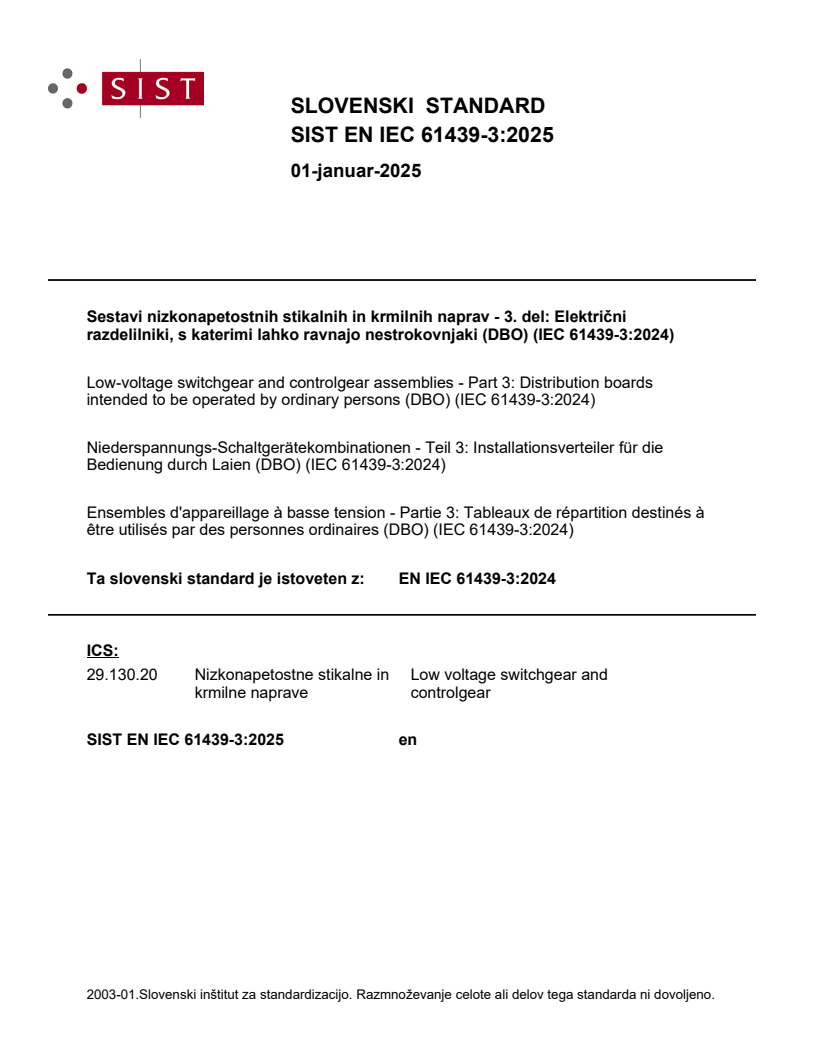
SLOVENSKI STANDARD
01-januar-2025
Sestavi nizkonapetostnih stikalnih in krmilnih naprav - 3. del: Električni
razdelilniki, s katerimi lahko ravnajo nestrokovnjaki (DBO) (IEC 61439-3:2024)
Low-voltage switchgear and controlgear assemblies - Part 3: Distribution boards
intended to be operated by ordinary persons (DBO) (IEC 61439-3:2024)
Niederspannungs-Schaltgerätekombinationen - Teil 3: Installationsverteiler für die
Bedienung durch Laien (DBO) (IEC 61439-3:2024)
Ensembles d'appareillage à basse tension - Partie 3: Tableaux de répartition destinés à
être utilisés par des personnes ordinaires (DBO) (IEC 61439-3:2024)
Ta slovenski standard je istoveten z: EN IEC 61439-3:2024
ICS:
29.130.20 Nizkonapetostne stikalne in Low voltage switchgear and
krmilne naprave controlgear
2003-01.Slovenski inštitut za standardizacijo. Razmnoževanje celote ali delov tega standarda ni dovoljeno.
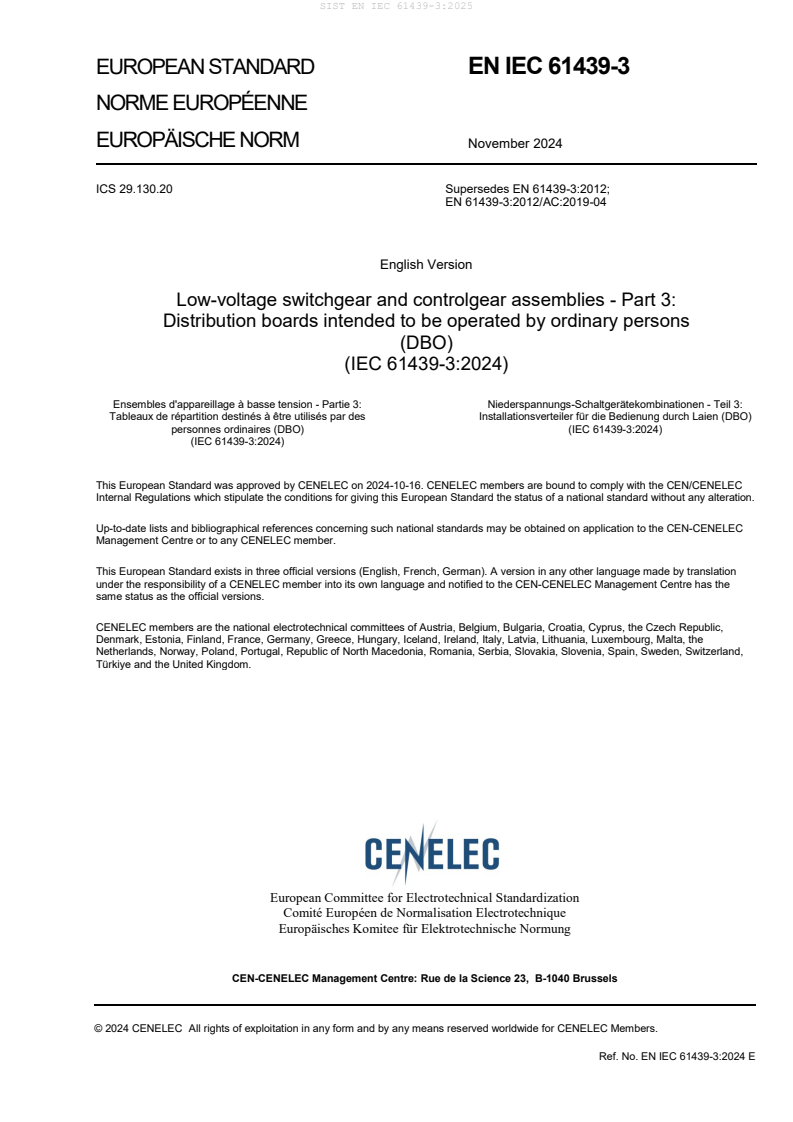
EUROPEAN STANDARD EN IEC 61439-3
NORME EUROPÉENNE
EUROPÄISCHE NORM November 2024
ICS 29.130.20 Supersedes EN 61439-3:2012;
EN 61439-3:2012/AC:2019-04
English Version
Low-voltage switchgear and controlgear assemblies - Part 3:
Distribution boards intended to be operated by ordinary persons
(DBO)
(IEC 61439-3:2024)
Ensembles d'appareillage à basse tension - Partie 3: Niederspannungs-Schaltgerätekombinationen - Teil 3:
Tableaux de répartition destinés à être utilisés par des Installationsverteiler für die Bedienung durch Laien (DBO)
personnes ordinaires (DBO) (IEC 61439-3:2024)
(IEC 61439-3:2024)
This European Standard was approved by CENELEC on 2024-10-16. CENELEC members are bound to comply with the CEN/CENELEC
Internal Regulations which stipulate the conditions for giving this European Standard the status of a national standard without any alteration.
Up-to-date lists and bibliographical references concerning such national standards may be obtained on application to the CEN-CENELEC
Management Centre or to any CENELEC member.
This European Standard exists in three official versions (English, French, German). A version in any other language made by translation
under the responsibility of a CENELEC member into its own language and notified to the CEN-CENELEC Management Centre has the
same status as the official versions.
CENELEC members are the national electrotechnical committees of Austria, Belgium, Bulgaria, Croatia, Cyprus, the Czech Republic,
Denmark, Estonia, Finland, France, Germany, Greece, Hungary, Iceland, Ireland, Italy, Latvia, Lithuania, Luxembourg, Malta, the
Netherlands, Norway, Poland, Portugal, Republic of North Macedonia, Romania, Serbia, Slovakia, Slovenia, Spain, Sweden, Switzerland,
Türkiye and the United Kingdom.
European Committee for Electrotechnical Standardization
Comité Européen de Normalisation Electrotechnique
Europäisches Komitee für Elektrotechnische Normung
CEN-CENELEC Management Centre: Rue de la Science 23, B-1040 Brussels
© 2024 CENELEC All rights of exploitation in any form and by any means reserved worldwide for CENELEC Members.
Ref. No. EN IEC 61439-3:2024 E
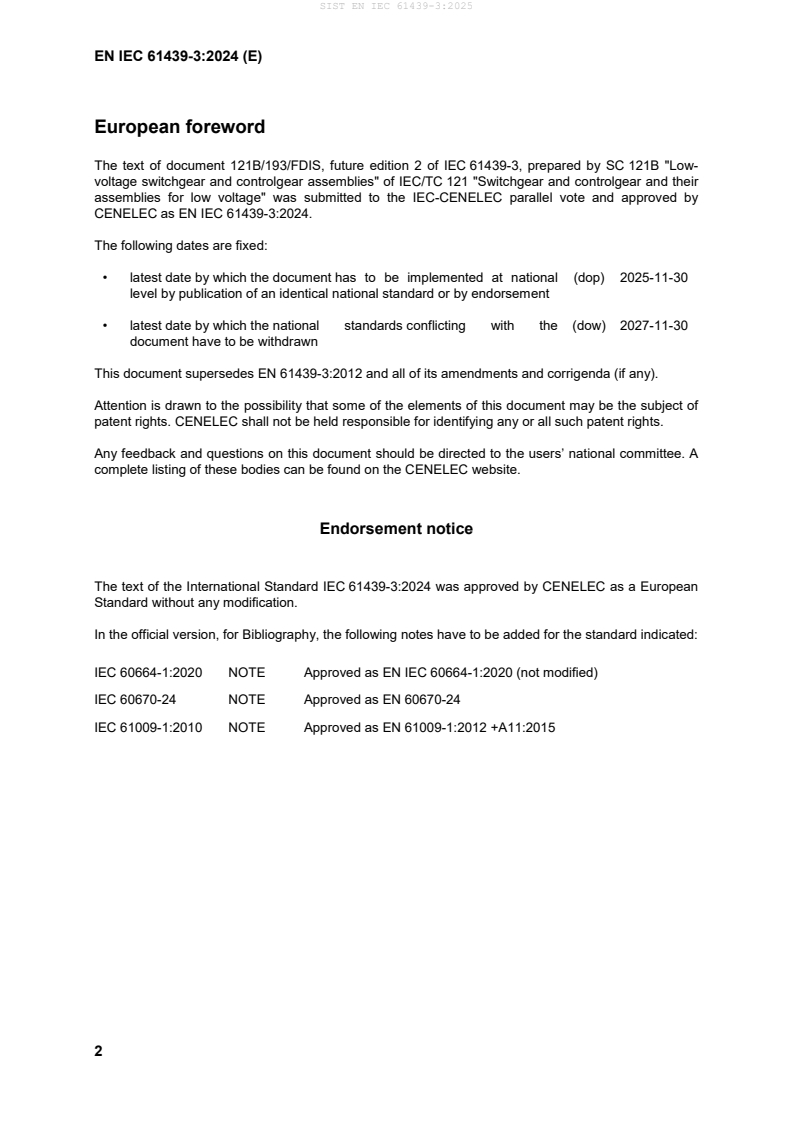
European foreword
The text of document 121B/193/FDIS, future edition 2 of IEC 61439-3, prepared by SC 121B "Low-
voltage switchgear and controlgear assemblies" of IEC/TC 121 "Switchgear and controlgear and their
assemblies for low voltage" was submitted to the IEC-CENELEC parallel vote and approved by
CENELEC as EN IEC 61439-3:2024.
The following dates are fixed:
• latest date by which the document has to be implemented at national (dop) 2025-11-30
level by publication of an identical national standard or by endorsement
• latest date by which the national standards conflicting with the (dow) 2027-11-30
document have to be withdrawn
This document supersedes EN 61439-3:2012 and all of its amendments and corrigenda (if any).
Attention is drawn to the possibility that some of the elements of this document may be the subject of
patent rights. CENELEC shall not be held responsible for identifying any or all such patent rights.
Any feedback and questions on this document should be directed to the users’ national committee. A
complete listing of these bodies can be found on the CENELEC website.
Endorsement notice
The text of the International Standard IEC 61439-3:2024 was approved by CENELEC as a European
Standard without any modification.
In the official version, for Bibliography, the following notes have to be added for the standard indicated:
IEC 60664-1:2020 NOTE Approved as EN IEC 60664-1:2020 (not modified)
IEC 60670-24 NOTE Approved as EN 60670-24
IEC 61009-1:2010 NOTE Approved as EN 61009-1:2012 +A11:2015
Annex ZA
(normative)
Normative references to international publications
with their corresponding European publications
The following documents are referred to in the text in such a way that some or all of their content
constitutes requirements of this document. For dated references, only the edition cited applies. For
undated references, the latest edition of the referenced document (including any amendments)
applies.
NOTE 1 Where an International Publication has been modified by common modifications, indicated by (mod),
the relevant EN/HD applies.
NOTE 2 Up-to-date information on the latest versions of the European Standards listed in this annex is available
here: www.cencenelec.eu.
Clause 2 of EN IEC 61439-1:2021 is applicable, except as follows:
Add the following references:
Publication Year Title EN/HD Year
IEC 60068-2-75 - Environmental testing - Part 2-75: Tests - EN 60068-2-75 -
Test Eh: Hammer tests
IEC 60269-3 - Low-voltage fuses - Part 3: Supplementary HD 60269-3 -
requirements for fuses for operation by
unskilled persons (fuses mainly for
household and similar applications) -
Examples of standardized systems of
fuses A to F
IEC 60364-8-82 - Low-voltage electrical installations - Part 8- HD 60364-8-82 -
82: Functional aspects - Prosumer's low-
voltage electrical installations
IEC 60669-2-4 - Switches for household and similar fixed EN 60669-2-4 -
electrical installations - Part 2-4: Particular
requirements - Isolating switches
IEC 60898-1 - Electrical accessories - Circuit-breakers for EN 60898-1 -
overcurrent protection for household and
similar installations - Part 1: Circuit-
breakers for a.c. operation
IEC 60947-3 - Low-voltage switchgear and controlgear - EN IEC 60947-3 -
Part 3: Switches, disconnectors, switch-
disconnectors and fuse-combination units
IEC 61008 series Residual current operated circuit-breakers EN 61008 series
without integral overcurrent protection for
household and similar uses (RCCBs) - Part
1: General rules
IEC 61009 series Residual current operated circuit-breakers EN 61009 series
with integral overcurrent protection for
household and similar uses (RCBOs) - Part
1: General rules
Publication Year Title EN/HD Year
IEC 61439-1 2020 Low-voltage switchgear and controlgear EN IEC 61439-1 2021
assemblies - Part 1: General rules
IEC 62262 - Degrees of protection provided by EN 62262 -
enclosures for electrical equipment against
external mechanical impacts (IK code)
IEC 62423 (mod) 2009 Type F and type B residual current EN 62423 2012
operated circuit-breakers with and without
integral overcurrent protection for
household and similar uses
- - + A11 2021
- - + A12 2022
IEC 62606 - General requirements for arc fault EN 62606 -
detection devices
IEC 61439-3 ®
Edition 2.0 2024-03
INTERNATIONAL
STANDARD
NORME
INTERNATIONALE
Low-voltage switchgear and controlgear assemblies –
Part 3: Distribution boards intended to be operated by ordinary persons (DBO)
Ensembles d'appareillage à basse tension –
Partie 3: Tableaux de répartition destinés à être utilisés par des personnes
ordinaires (DBO)
INTERNATIONAL
ELECTROTECHNICAL
COMMISSION
COMMISSION
ELECTROTECHNIQUE
INTERNATIONALE
ICS 29.130.20 ISBN 978-2-8322-8364-6
– 2 – IEC 61439-3:2024 © IEC 2024
CONTENTS
FOREWORD . 3
1 Scope . 5
2 Normative references . 5
3 Terms and definitions . 6
4 Symbols and abbreviations . 7
5 Interface characteristics. 7
6 Information . 8
7 Service conditions . 9
8 Constructional requirements . 9
9 Performance requirements. 11
10 Design verification . 11
11 Routine verification . 15
Annexes . 18
Annex AA (informative) Items subject to agreement between the DBO manufacturer
and the user . 19
Annex BB (informative) Effects upon a DBO design and related ratings, instructions,
etc. when used in a prosumer’s electrical installation (PEI) . 23
Annex CC (informative) Rated current of an assembly (I ) . 24
nA
Annex DD (informative) List of notes concerning certain countries . 26
Bibliography . 40
Figure CC.1 – Example of overloading where I + I is greater than I . 25
n gen(s) nA
Figure DD.1 – Example of temperature rise verification by test of a complete split‑load
DBO as in 10.10.2.3.6 . 32
Figure DD.2 – Calibration of the test circuit . 36
Figure DD.3 – Test circuit to prove coordination of characteristics . 39
Table 101 – Values of assumed loading . 16
Table 102 – Tightening torque values for the verification of mechanical strength . 17
Table AA.1 – Items subject to agreement between the DBO manufacturer and the user . 19
Table DD.1 – Requirements for final circuit protective devices: Circuit-breakers
complying with BS EN 60898 and RCBOs complying with BS EN 61009 . 33
Table DD.2 – Requirements for final circuit protective devices: Semi-enclosed fuses
complying with BS 3036 and cartridge fuses complying with BS 88.3 . 34
Table DD.3 – Cross-sections of copper conductors on load side of protective device
under test . 34
Table DD.4 – Preparation for Test B . 37
IEC 61439-3:2024 © IEC 2024 – 3 –
INTERNATIONAL ELECTROTECHNICAL COMMISSION
____________
LOW-VOLTAGE SWITCHGEAR AND CONTROLGEAR ASSEMBLIES –
Part 3: Distribution boards intended to be operated
by ordinary persons (DBO)
FOREWORD
1) The International Electrotechnical Commission (IEC) is a worldwide organization for standardization comprising
all national electrotechnical committees (IEC National Committees). The object of IEC is to promote international
co-operation on all questions concerning standardization in the electrical and electronic fields. To this end and
in addition to other activities, IEC publishes International Standards, Technical Specifications, Technical Reports,
Publicly Available Specifications (PAS) and Guides (hereafter referred to as “IEC Publication(s)”). Their
preparation is entrusted to technical committees; any IEC National Committee interested in the subject dealt with
may participate in this preparatory work. International, governmental and non-governmental organizations liaising
with the IEC also participate in this preparation. IEC collaborates closely with the International Organization for
Standardization (ISO) in accordance with conditions determined by agreement between the two organizations.
2) The formal decisions or agreements of IEC on technical matters express, as nearly as possible, an international
consensus of opinion on the relevant subjects since each technical committee has representation from all
interested IEC National Committees.
3) IEC Publications have the form of recommendations for international use and are accepted by IEC National
Committees in that sense. While all reasonable efforts are made to ensure that the technical content of IEC
Publications is accurate, IEC cannot be held responsible for the way in which they are used or for any
misinterpretation by any end user.
4) In order to promote international uniformity, IEC National Committees undertake to apply IEC Publications
transparently to the maximum extent possible in their national and regional publications. Any divergence between
any IEC Publication and the corresponding national or regional publication shall be clearly indicated in the latter.
5) IEC itself does not provide any attestation of conformity. Independent certification bodies provide conformity
assessment services and, in some areas, access to IEC marks of conformity. IEC is not responsible for any
services carried out by independent certification bodies.
6) All users should ensure that they have the latest edition of this publication.
7) No liability shall attach to IEC or its directors, employees, servants or agents including individual experts and
members of its technical committees and IEC National Committees for any personal injury, property damage or
other damage of any nature whatsoever, whether direct or indirect, or for costs (including legal fees) and
expenses arising out of the publication, use of, or reliance upon, this IEC Publication or any other IEC
Publications.
8) Attention is drawn to the Normative references cited in this publication. Use of the referenced publications is
indispensable for the correct application of this publication.
9) IEC draws attention to the possibility that the implementation of this document may involve the use of (a)
patent(s). IEC takes no position concerning the evidence, validity or applicability of any claimed patent rights in
respect thereof. As of the date of publication of this document, IEC had not received notice of (a) patent(s), which
may be required to implement this document. However, implementers are cautioned that this may not represent
the latest information, which may be obtained from the patent database available at https://patents.iec.ch. IEC
shall not be held responsible for identifying any or all such patent rights.
IEC 61439-3 has been prepared by subcommittee 121B: Low-voltage switchgear and
controlgear assemblies, of IEC technical committee 121: Switchgear and controlgear and their
assemblies for low voltage. It is an International Standard.
This second edition cancels and replaces the first edition published in 2012. This edition
constitutes a technical revision.
This edition includes the following significant technical changes with respect to the previous
edition:
a) alignment with the structure of IEC 61439-1:2020;
b) inclusion in the scope of more examples of the type of protection and control devices;
c) deletion of type A and type B DBOs;
– 4 – IEC 61439-3:2024 © IEC 2024
d) addition of a new Annex BB related to DBOs used in a prosumer’s electrical installation
(PEI);
e) addition of a new Annex CC related to rated current of a DBO with additional source of
supply in parallel/simultaneously with another source that is connected to the DBO e.g. PV.
The text of this International Standard is based on the following documents:
Draft Report on voting
121B/193/FDIS 121B/195/RVD
Full information on the voting for its approval can be found in the report on voting indicated in
the above table.
The language used for the development of this International Standard is English.
This document was drafted in accordance with ISO/IEC Directives, Part 2, and developed in
accordance with ISO/IEC Directives, Part 1 and ISO/IEC Directives, IEC Supplement, available
at www.iec.ch/members_experts/refdocs. The main document types developed by IEC are
described in greater detail at www.iec.ch/publications.
This document is to be read in conjunction with IEC 61439-1:2020. The provisions of the general
rules dealt with in IEC 61439-1 are only applicable to this document insofar as they are
specifically cited. When this document states "addition", "modification" or "replacement", the
relevant text in IEC 61439-1:2020 is to be adapted accordingly.
Subclauses that are numbered with a 101 (102, 103, etc.) suffix are additional to the same
subclause in IEC 61439-1:2020.
Tables and figures in this document that are new are numbered starting with 101.
New annexes in this document are lettered AA, BB, etc.
The reader’s attention is drawn to the fact that Annex DD lists all of the "in some-country"
clauses on differing practices of a less permanent nature relating to the subject of this
document.
A list of all parts in the IEC 61439 series, published under the general title Low-voltage
switchgear and controlgear assemblies, can be found on the IEC website.
The committee has decided that the contents of this document will remain unchanged until the
stability date indicated on the IEC website under webstore.iec.ch in the data related to the
specific document. At this date, the document will be
• reconfirmed,
• withdrawn, or
• revised.
IMPORTANT – The "colour inside" logo on the cover page of this document indicates
that it contains colours which are considered to be useful for the correct understanding
of its contents. Users should therefore print this document using a colour printer.
IEC 61439-3:2024 © IEC 2024 – 5 –
LOW-VOLTAGE SWITCHGEAR AND CONTROLGEAR ASSEMBLIES –
Part 3: Distribution boards intended to be operated
by ordinary persons (DBO)
1 Scope
This part of IEC 61439 defines the specific requirements for distribution boards intended to be
operated by ordinary persons (abbreviated DBO throughout this document, see 3.1.101) as
follows:
– assemblies intended to be operated by ordinary persons (e.g. switching operations and
replacing fuse-links), e.g. in domestic (household) applications;
– assemblies containing outgoing circuits with protective devices intended to be operated by
ordinary persons, complying e.g. with IEC 60898-1, the IEC 61008 series, the IEC 61009
series, IEC 62606, IEC 62423 and IEC 60269-3;
– assemblies for applications where the nominal voltage to earth does not exceed 300 V AC
(see Table G.1 of IEC 61439-1:2020);
NOTE The voltage limits for DC applications are under consideration.
– assemblies with a rated current (I ) of the outgoing circuits not exceeding 125 A and a
nc
rated current (I ) not exceeding 250 A;
nA
– assemblies intended for use in connection with the generation, transmission, distribution
and conversion of electrical energy, and for the control of equipment consuming electrical
energy and for associated data processing;
– enclosed, stationary assemblies;
– assemblies for indoor or outdoor use.
DBOs can contain protection devices, control devices, signalling devices alone or a combination
of devices e.g. circuit-breakers, load shedding relay, energy management, communication
devices, lighting control.
This document does not apply to an empty enclosure nor to individual devices and
self-contained components, such as circuit-breakers, fuse-switches, electronic equipment.
which comply with the relevant product standards, it describes the integration of devices, or
self-contained components, or both, into a DBO or into an empty enclosure forming a DBO.
This document applies to DBOs designed, manufactured, and verified on a one-off basis or fully
standardized and manufactured in quantity.
This document does not apply to the specific types of assemblies covered by other parts of the
IEC 61439 series.
NOTE Enclosures for electrical accessories for household and similar fixed electrical installations are covered in
IEC 60670-24.
2 Normative references
The following documents are referred to in the text in such a way that some or all of their content
constitutes requirements of this document. For dated references, only the edition cited applies.
For undated references, the latest edition of the referenced document (including any
amendments) applies.
– 6 – IEC 61439-3:2024 © IEC 2024
Clause 2 of IEC 61439-1:2020 is applicable in addition to the following.
Addition:
IEC 60068-2-75, Environmental testing – Part 2-75: Tests – Test Eh: Hammer tests
IEC 60269-3, Low-voltage fuses – Part 3: Supplementary requirements for fuses for use by
unskilled persons (fuses mainly for household and similar applications) – Examples of
standardized systems of fuses A to F
IEC 60364-8-82, Low-voltage electrical installations – Part 8-82: Functional aspects –
Prosumer's low-voltage electrical installations
IEC 60898-1, Electrical accessories – Circuit-breakers for overcurrent protection for household
and similar installations – Part 1: Circuit-breakers for a.c. operation
IEC 60669-2-4, Switches for household and similar fixed electrical installations – Part 2-4:
Particular requirements – Isolating switches
IEC 60947-3, Low-voltage switchgear and controlgear – Part 3: Switches, disconnectors,
switch-disconnectors and fuse-combination units
IEC 61008 (all parts), Residual current operated circuit-breakers without integral overcurrent
protection for household and similar uses (RCCBs)
IEC 61009 (all parts), Residual current operated circuit-breakers with integral overcurrent
protection for household and similar uses (RCBOs)
IEC 61439-1:2020, Low-voltage switchgear and controlgear assemblies – Part 1: General rules
IEC 62423:2009, Type F and type B residual current operated circuit-breakers with and without
integral overcurrent protection for household and similar uses
IEC 62262, Degrees of protection provided by enclosures for electrical equipment against
external mechanical impacts (IK code)
IEC 62606, General requirements for arc fault detection devices
3 Terms and definitions
For the purposes of this document, the terms and definitions given in IEC 61439-1:2020 and
the following apply.
ISO and IEC maintain terminology databases for use in standardization at the following
addresses:
• IEC Electropedia: available at https://www.electropedia.org/
• ISO Online browsing platform: available at https://www.iso.org/obp
Clause 3 of IEC 61439-1:2020 is applicable except as follows.
IEC 61439-3:2024 © IEC 2024 – 7 –
3.1 General terms
Additional terms and definitions:
3.1.101
distribution board intended to be operated by ordinary persons
DBO
assembly used to distribute and control electrical energy for all types of electrical supplies and
loads, intended for operation by ordinary persons
Note 1 to entry: For operation by ordinary persons, see 8.4.6.1 of IEC 61439-1:2020.
Note 2 to entry: Switching operations and replacing fuse-links are examples of operations intended to be carried
out by ordinary persons.
Note 3 to entry: Definition 3.1.101 does not preclude the DBO from being operated by skilled or instructed persons,
and also being used in non-domestic installations.
Note 4 to entry: DBOs can be assembled outside the factory of the original manufacturer. DBOs can be assembled
by the original manufacturer or by an assembly manufacturer.
4 Symbols and abbreviations
Clause 4 of IEC 61439-1:2020 is applicable.
5 Interface characteristics
Clause 5 of IEC 61439-1:2020 is applicable except as follows.
5.1 General
Addition:
This objective can be achieved through one of two typical processes; the user will either select
a catalogue product, the characteristics of which meet the required user needs, or make a
specific agreement with the manufacturer.
In both cases, the specification schedule according to Annex AA is intended to help the user to
provide all data necessary to specify, and to help the manufacturer to provide the actual DBO
characteristics. In some cases information declared by the DBO manufacturer may take the
place of an agreement.
5.2.4 Rated impulse withstand voltage (U ) (of the assembly)
imp
Replacement:
The rated impulse withstand voltage of the assembly shall be equal to or higher than the values
stated for the transient overvoltages occurring in the electrical system(s) to which the circuit is
designed to be connected.
DBOs shall comply with a minimum overvoltage category III (see IEC 60364-4-44) according to
Table G.1 of IEC 61439-1:2020.
– 8 – IEC 61439-3:2024 © IEC 2024
5.3.1 Rated current of an assembly (I )
nA
Addition:
See Annex CC for examples of when a generator, for example a photovoltaic system, wind
turbine, battery is used as additional source(s) of supply in parallel with another source that is
connected to the DBO.
5.4 Rated diversity factor (RDF)
Addition:
In the absence of an agreement between the DBO manufacturer and user concerning the actual
load currents, the type of load, the assumed loading of the outgoing circuits of the DBO or group
of outgoing circuits can be based on the values in Table 101.
The assumed load current is the rated current of the protective device I , as required by the
n
user, multiplied with the assumed loading factor of Table 101.
NOTE 101 The rated current I of a protective device is defined in their product standard.
n
6 Information
Clause 6 of IEC 61439-1:2020 is applicable except as follows.
6.1 Assembly designation marking
Addition to the first paragraph:
The test of 10.2.7.1 only applies to DBOs intended for outdoor installation.
Addition of the following new item:
h) degree of protection if greater than IP2XC.
6.2.2 Instructions for handling, installation, operation and maintenance
Addition to the first paragraph:
The original or assembly manufacturer shall provide in their documentation, any routine
verification required to be carried out by the installer for the DBO to conform to IEC 61439-3.
6.3 Device and/or component identification
Addition:
For RCDs supplying more than one final circuit, it shall be possible for ordinary persons to
identify which outgoing circuits the RCD supplies, for example when the RCD is adjacent to the
outgoing group of circuits it supplies or by providing labels for the installer to apply to the DBO
after installation. The identification means shall be visible without accessing live parts.
IEC 61439-3:2024 © IEC 2024 – 9 –
7 Service conditions
Clause 7 of IEC 61439-1:2020 is applicable except as follows.
7.1.2 Pollution degree
Addition:
A minimum pollution degree 2 applies.
7.2 Special service conditions
Addition:
NOTE 101 The effects upon a DBO design and related ratings, instructions, etc. when used in a prosumer’s
electrical installation (PEI) can take account of the relevant requirements in IEC 60364-8-82. See Annex BB.
8 Constructional requirements
Clause 8 of IEC 61439-1:2020 is applicable except as follows.
8.1.3.2.2 Resistance of insulating materials to normal heat
Addition:
NOTE 101 This Subclause 8.1.3.2.2 also applies to covers and enclosures made of insulating materials.
8.2.1 Protection against mechanical impact (IK code)
Replacement:
The DBO shall comply with the following IK codes according to IEC 62262:
– IK05 for a DBO for indoor use;
– IK07 for a DBO for outdoor use.
Compliance shall be verified according to 10.2.6.
8.2.2 Protection against contact with live parts, ingress of solid foreign bodies and
water (IP code)
Replacement of the second paragraph:
The degree of protection of a DBO shall be at least IP2XC after installation in accordance with
the DBO manufacturer’s instructions.
IP2XC shall be maintained when operating devices e.g. switching and operating test buttons in
normal use. The degree of protection can be temporarily reduced when permitted in a product
standard for use by ordinary or unskilled persons e.g. IEC 60269-3 for replacing a fuse-link.
NOTE 101 A DBO can have more than one IP rating e.g. door open IP2XC and door closed IP3X or drain holes
IPXXD.
Paragraphs 5 and 6 and the associated examples in IEC 61439-1 do not apply to this document.
– 10 – IEC 61439-3:2024 © IEC 2024
8.4.2.3 Barriers or enclosures
Replacement of the first paragraph:
Bare live parts shall be inside enclosures or behind barriers. The enclosures or barriers shall
provide a degree of protection of at least IPXXC.
8.5.3 Selection of switching devices and components
Addition:
When a switch-disconnector, circuit-breaker without overcurrent protection or an isolating
switch is incorporated in the DBO, it shall conform to IEC 60947-3, IEC 60947-2 or
IEC 60669‑2‑4 as appropriate to the DBO ratings.
Outgoing circuits shall contain protective devices, intended to be operated by ordinary persons,
for example conforming to IEC 60898-1, the IEC 61008 series, the IEC 61009 series,
IEC 62423, IEC 62606 and IEC 60269-3.
An incoming protective device incorporated within the DBO not conforming to a product
standard intended to be operated by ordinary persons, shall require a key or tool for re-closing
after tripping and for the replacement of a fuse-link. Alternatively, a label shall be located in the
vicinity of the incoming protective device stating that re-closing of the tripped device and the
replacement of a fuse-link shall only be carried out by an instructed or skilled person.
Circuit-breakers shall be designed or installed in a way that it shall not be possible to modify
their settings or calibration without a deliberate act involving the use of a key or tool.
NOTE 101 These requirements reflect that protective device product standards for ordinary people are limited to a
maximum rated current of 125 A. Household premises can require electrical supplies greater than 125 A and the use
of DBOs therefore, these particular installations are within the scope of IEC 61439-3.
8.6.1 Main circuits
Replacement of the second paragraph:
Each of the conductors between the incoming unit and outgoing unit as well as the components
included in these units can be rated on the basis of the reduced short-circuit stresses occurring
on the load side of the respective outgoing short-circuit protective device, provided that these
conductors are arranged so that an internal short-circuit between live parts and between live
parts and earth is not to be expected as required by 8.6.4 and Table 4 of IEC 61439-1:2020.
8.8 Terminals for external cables
Addition:
When a device or component in an outgoing circuit does not incorporate a neutral terminal, the
number of neutral terminals of a DBO shall be not less than one outgoing terminal for each
outgoing circuit requiring a neutral terminal. These terminals shall be located or identified in the
same sequence as their respective line conductor terminals.
The maximum number of neutral conductors that are permitted to be connected to each device
or component neutral terminal, shall be as stated in the manufacturer’s instructions.
DBOs shall have a minimum of two terminals for electrical installation protective bonding
conductors.
IEC 61439-3:2024 © IEC 2024 – 11 –
9 Performance requirements
Clause 9 of IEC 61439-1:2020 is applicable except as follows.
9.1.1 General
Addition:
NOTE IEC 60664-1:2020 contains the requirements for supplementary and reinforced insulation (Class II).
10 Design verification
Clause 10 of IEC 61439-1:2020 is applicable except as follows.
10.2.2.2 Severity test A
Addition:
The following is an alternative test.
All grease is removed from the parts or representative samples of the steel enclosures of the
DBO to be tested, by immersion in a cold chemical degreaser such as methyl chloroform or
refined petrol for 10 min. The parts are then immersed for 10 min in a 10 % solution of
ammonium chloride in water at a temperature of (20 ± 5) °C.
Without drying but after shaking off any drops, the parts are placed for 10 min in a box
containing air saturated with moisture at a temperature of (20 ± 5) °C.
After the parts have dried for 10 min in a heating cabinet at a temperature of (100 ± 5) °C and
have been left at room temperature for 24 h, their surfaces shall show no signs of iron
oxidization.
Traces of iron oxide on sharp edges and any yellowish film removable by rubbing are ignored.
For small helical springs and the like, and for inaccessible parts exposed to abrasion, a layer
of grease can provide sufficient protection against iron oxidization. Such parts are subjected to
the test only if there is doubt about the effectiveness of the grease film, and the test is then
made without previous removal of the grease.
10.2.2.4 Results to be obtained
The first paragraph of 10.2.2.4 of IEC 61439-1:2020 does not apply to the alternative test of
this document.
10.2.3.2.1 Verification by test
Addition:
NOTE 101 850 °C does not apply to accessible parts of the enclosure after mounting in hollow walls e.g. covers,
doors.
10.2.6 Verification of protection against mechanical impact (IK code)
Replacement:
Verification of the degree of protection against mechanical impacts shall be carried out in
accordance with IEC 62262.
– 12 – IEC 61439-3:2024 © IEC 2024
The test shall be carried out by means of a hammer test apparatus as described in
IEC 60068‑2‑75, for example an impact spring hammer at an ambient air temperature between
10 °C and 40 °C immediately after the DBO has been kept for 2 h at a temperature of
−5 °C ± 1 K for indoor use and −25 °C ± 1 K for outdoor use. A test at −25 °C for outdoor use
also validates the −5 °C for indoor use, so only one test at −25 °C is required.
Compliance is checked on those exposed parts of the DBO which can be subjected to
mechanical impact when mounted as in normal use.
The sample with a cover, or the enclosure, if any, shall be fixed as in normal use or placed
against a rigid support.
Three blows shall be applied on separate places of each of the accessible faces and door (if
provided). The impacts shall be evenly distributed on the faces of the enclosure(s) under test.
In no case shall the impacts be applied in the surrounding area of the same point of the
enclosure. A new sample for each accessible face is used, unless the previous test has not
influenced the results of the subsequent test(s), then the sample may be reused. The blows
shall not be applied to knock-outs, built-in components complying with other standards, or other
fastening means which are recessed below the surface so as not to be subjected to an actual
impact.
Cable entries which are not provided with knock-outs shall be left open. If they are provided
with knock-outs, two of them shall be opened.
Before applying the blows, fixing screws of bases, covers and the like shall be tightened with a
torque equal to that specified in Table 102.
After the test, a visual inspection shall verify that:
– the degree of protection (IP code) of the enclosure is not impaired, where doubt exists the
appropriate IP test according to 10.3 should be carried out;
– dielectric properties have been maintained, where doubt exists the appropriate dielectric
tests according to 10.9 of IEC 61439-1:2020 as modified in this document, should be carried
out;
– removable covers can be removed and reinstalled;
– doors can be opened and closed.
10.2.7.1 Verification by test
Addition of a new first paragraph:
This test only applies to DBOs intended for outdoor installation.
10.2.8 Mechanical operation
10.2.8.1 Verification by test
Replacement of the first and second sentences of the second paragraph:
For parts, required to be verified by test e.g. mobile parts such as doors (see 8.1.5 of
IEC 61439-1:2020), satisfactory mechanical operation shall be verified after installation in the
DBO. The number of operating cycles shall be 50.
10.3 Degree of protection of assemblies (IP Code)
Replacement of the second paragraph and dashed items:
Degree of protection (IP code) tests shall be carried out:
IEC 61439-3:2024 © IEC 2024 – 13 –
• for the test of protection against contact with live parts, all covers and doors which are
required to be opened or removed without the use of a key or tool shall be opened or
removed;
• for the test of protection against contact with live parts, all covers and doors which are
required to be opened or removed to provide access for operating devices by ordinary
persons, for example resetting circuit-breakers, RCDs or pressing an RCD test button,
shall be opened or removed;
• with all covers and doors in place and closed as in normal service, irrespective of
whether they can be opened or removed, with or without the use of a key or tool;
• tests shall be carried out in a de-energized state (main and auxiliary circuits).
Where the assembly is made up of multiple sections or is described as extendable, joined
sections shall be included.
10.10.2.2.3 Functional units
Replacement of the second and third paragraphs of 10.10.2.2.3 b):
Where outgoing devices for the DBO have a range of rated currents, a single I test can be
nc
used to establish the I ratings for the complete range without further testing where:
nc
1) the ranges covered are from the same manufacturer’s series;
2) the ranges covered all have the same physical dimensions;
3) the ranges covered have the same electrical connection arrangements line and load;
4) using the data given by the device manufacturer, the device with the highest total power
loss within the product range is used for the test;
5) the device is placed in the most onerous position with respect to mutual heating, and
insulating effects.
10.10.2.3.1 General
Addition after the fourth paragraph:
In the absence of manufacturer’s instructions, the tightening torque applied to terminals shall
be in accordance with those specified for the temperature rise test in the relevant device product
standard.
10.10.2.3.2 Test conductors
Modification:
Bullet points b), c) and d) do not apply to this document.
10.10.2.3.6 Verification considering individual functional units separately and the
complete assembly
Addition to the second paragraph:
A method to determine the most onerous group for continuously loaded and adjacent circuits to
be tested, so that the highest possible temperature-rise is obtained, is for the rated current of
the DBO (I ), to be distributed amongst the smallest possible number of adjacent, continually
nA
and simultaneously loaded outgoing circuits, so that each of these circuits is loaded with:
(i) I or I × RDF; I and RDF being estimated values by the manufacturer so as to estimate
ng nc ng
and provides the
the test currents. If verified by the test, this produces a rated value I
ng
possibility to calculate the RDF; or
– 14 – IEC 61439-3:2024 © IEC 2024
(ii) I × the assumed loading factor in Table 101. This method uses the assumed loading factor
nc
as a means to estimate the RDF to use for the test. If verified by the test, this produces a
rated value I .
ng
In both (i) and (ii), the actual RDF per circuit is calculated by dividing I by I from their verified
ng nc
tested values.
10.10.2.3.7 Verification considering functional units and the main and distribution
busbars separately as well as the complete assembly
Addition to item c):
Where the device tested achieves an I equal to its rated current I , all other devices in the
nc n
same constructional range have an I equal to their I .
nc n
Where the device tested achieves an I lower than its rated current I , the same reduction is
nc n
applied to all other devices in the constructional range. For example, a device with an I of 63 A
n
achieves an I of 55 A: 55 / 63 = 0,874. The I of the other devices in the same constructional
nc nc
range is I × 0,874.
n
Addition to item d):
A method to determine the most onerous group for continuously loaded and adjacent circuits to
be tested, so that the highest possible temperature-rise is obtained, is for the rated current of
the DBO (I ), to be distributed amongst the smallest possible number of adjacent, continually
nA
and simultaneously loaded outgoing circuits, so that each of these circuits is loaded with:
(i) I or I × RDF; I and RDF being estimated values by the manufacturer so as to estimate
ng nc ng
the test currents. If verified by the test, this produces a rated value I and provides the
ng
possibility to calculate the RDF; or
(ii) I × the assumed loading factor in Table 101. This method uses the assumed loading factor
nc
as a means to estimate the RDF to use for the test. If verified by the test, this produces a
rated value I .
ng
In both (i) and (ii), the actual RDF per circuit is calculated by dividing I by I from their verified
ng nc
tested values.
10.10.3.2 Assemblies
Addition:
DBOs with synthetic enclosures are considered representative of DBOs with metallic
enclosures, if the highest temperature rise on the inside surfaces of the synthetic enclosure
does not exceed the maximum surface temperature rise for the accessible external metal
surfaces according to Table 6 of IEC 61439-1:2020. When it has been verified that the highest
surface of the enclosure is the hottest location, the internal air thermocouple l
...
Questions, Comments and Discussion
Ask us and Technical Secretary will try to provide an answer. You can facilitate discussion about the standard in here.
Loading comments...