


EN 50414:2006
(Main)Test methods for analysis of lead in PVC taken from insulation and sheath of electric and optical fibre cables - Method A: Total lead content determination with flame excitation atomic absorption spectrometry - Method B: Qualitative analysis of lead by lead sulphide staining
Test methods for analysis of lead in PVC taken from insulation and sheath of electric and optical fibre cables - Method A: Total lead content determination with flame excitation atomic absorption spectrometry - Method B: Qualitative analysis of lead by lead sulphide staining
This European Standard describes two methods for the analysis of lead in PVC-insulating and sheathing materials for electric and for optical fibre cables. The samples of PVC are taken from the finished cable. Method A provides a quantitative method and Method B provides a qualitative method. NOTE 1 Users may refer to either Method A or Method B or to both methods. NOTE 2 Other methods of determination not specified here are known to be capable of achieving equivalent results, but do not conform to this EN (see “Introduction”). Both Method A and Method B are applicable to products having a total lead content greater than or equal to 0,01 %.
Prüfverfahren für die Analyse von Blei in PVC entnommen aus Isolierung und Mantel von Kabeln, isolierten Leitungen und Lichtwellenleiterkabeln - Verfahren A: Bestimmung des Gesamtbleigehalts mit der Flammen-Atomabsorptionsspektrometrie - Verfahren B: Qualitative Analyse des Bleigehalts durch Bleisulfidverfärbung
Diese Europäische Norm beschreibt zwei Verfahren der Bestimmung von Blei in PVC-Isolier- und Mantelmischungen in elektrischen und optischen Kabeln. Die PVC-Proben sind dem fertigen Kabel zu entnehmen. Das Verfahren A beschreibt eine quantitative und das Verfahren B eine qualitative Methode. ANMERKUNG 1 Anwender können sich entweder auf Verfahren A oder Verfahren B oder auf beide Verfahren beziehen. ANMERKUNG 2 Mit anderen, hier nicht aufgeführten, Verfahren kann man bekanntlich gleichwertige Ergebnisse erzielen; sie sind jedoch nicht konform mit dieser EN (siehe „Einleitung“). Beide Verfahren A und B können auf Produkte mit einem Gesamtbleigehalt von größer oder gleich 0,01 % angewendet werden.
Méthodes d'analyse du plomb dans le PVC prélevé de l'enveloppe isolante et des gaines des câbles électriques et à fibres optiques - Méthode A: Détermination de la teneur totale en plomb par spectrométrie atomique d'absorption dans la flamme - Méthode B: Analyse qualitative du plomb par production de sulfure de plomb
Cette Norme Européenne décrit deux méthodes pour l’analyse du plomb dans des matériaux d’isolation et de gainage en PVC, utilisés pour les câbles électriques et les câbles à fibres optiques. Les échantillons de PVC sont prélevés sur le câble fini. La méthode A est une méthode quantitative et la méthode B est une méthode qualitative. NOTE 1 Les utilisateurs peuvent se référer, soit à la méthode A, soit à la méthode B, ou aux deux méthodes. NOTE 2 D’autres méthodes pour la détermination, non spécifiées ici, sont connues comme étant capables d’obtenir des résultats équivalents, mais elles ne sont pas conformes à la présente EN (voir “Introduction”). Les deux méthodes, A et B, sont applicables aux produits ayant une teneur totale en plomb supérieure ou égale à 0,01 %.
Preskusne metode za analizo svinca v PVC (polivinilkloridu), ki se uporablja za izolacijo in oplaščenje električnih kablov in kablov z optičnimi vlakni - Metoda A: Določevanje celotnega svinca z atomsko absorpcijsko spektrometrijo z vzbujanjem plamena - Metoda B: Kvalitativna metoda z barvanjem s svinčevim sulfidom
General Information
- Status
- Published
- Publication Date
- 20-Apr-2006
- Withdrawal Date
- 28-Feb-2009
- Technical Committee
- CLC/TC 20 - Electric cables
- Drafting Committee
- IEC/TC 20 - IEC_TC_20
- Parallel Committee
- IEC/TC 20 - IEC_TC_20
- Current Stage
- 9093 - Decision to confirm - Review Enquiry
- Start Date
- 23-Oct-2024
- Completion Date
- 20-Feb-2026
Relations
- Effective Date
- 03-Feb-2026
Overview
EN 50414:2006 (CLC) defines two standardized test methods for the analysis of lead in PVC taken from the insulation and sheath of electric and optical fibre cables. The standard addresses both a quantitative route (Method A) and a qualitative spot-check (Method B). Samples are taken from finished cables and both methods apply to products with total lead content ≥ 0,01 %.
This document is intended for cable manufacturers, test laboratories and compliance teams performing lead analysis for quality control, regulatory verification and material assessment.
Key Topics
Method A - Quantitative determination (flame excitation atomic absorption spectrometry, FAAS):
- Based on dry calcination of PVC, followed by acid extraction of the residue and determination by flame AAS (wavelength around 283.3 nm).
- Typical preparative steps in the standard include: representative sampling from the finished cable, cutting samples into small pieces (~0,05 g), weighing ≈1 g into silica crucibles, and controlled calcination (muffle furnace up to ~475 °C with staged heating).
- Extraction procedures differ if antimony is present; reagents and apparatus lists are specified (e.g., sodium carbonate, sulfur, hydrochloric and nitric acids, reference lead solutions, FAAS instrument, hollow cathode lamp).
- Calibration using prepared lead reference solutions and measurement of blanks is required for reliable quantitative results.
Method B - Qualitative analysis (lead sulphide staining):
- A rapid, qualitative spot-test that uses lead sulphide staining to indicate the presence of lead compounds in PVC.
- Best suited to light-coloured or natural materials where staining contrast is clear.
- Intended as a screening test rather than a substitute for quantitative analysis.
Scope and applicability:
- Users may apply one or both methods depending on analytical needs.
- Other analytical techniques (XRF, graphite furnace AAS, ICP, etc.) can detect lead but do not claim conformity to EN 50414 unless explicitly adopted.
Applications
- Material compliance checks for cable insulation and sheaths
- Incoming material inspection and supplier verification
- Routine quality control in cable manufacturing
- Forensic or failure analysis where lead presence is suspected
Related Standards
EN 50414 references and aligns with relevant laboratory and analytical standards, including:
- EN ISO 1042 (volumetric glassware)
- EN ISO 3696 (laboratory water quality)
- ISO 385-1 (burettes)
- ISO 5725 (accuracy of measurement methods)
- ISO 6503 (total lead by flame AAS)
For labs seeking to implement EN 50414:2006, follow the method selection guidance, maintain traceable calibration, and document sampling and test reports to support compliance and quality assurance.

Get Certified
Connect with accredited certification bodies for this standard

Intertek Testing Services NA Inc.
Intertek certification services in North America.

UL Solutions
Global safety science company with testing, inspection and certification.

ANCE
Mexican certification and testing association.
Sponsored listings
Frequently Asked Questions
EN 50414:2006 is a standard published by CLC. Its full title is "Test methods for analysis of lead in PVC taken from insulation and sheath of electric and optical fibre cables - Method A: Total lead content determination with flame excitation atomic absorption spectrometry - Method B: Qualitative analysis of lead by lead sulphide staining". This standard covers: This European Standard describes two methods for the analysis of lead in PVC-insulating and sheathing materials for electric and for optical fibre cables. The samples of PVC are taken from the finished cable. Method A provides a quantitative method and Method B provides a qualitative method. NOTE 1 Users may refer to either Method A or Method B or to both methods. NOTE 2 Other methods of determination not specified here are known to be capable of achieving equivalent results, but do not conform to this EN (see “Introduction”). Both Method A and Method B are applicable to products having a total lead content greater than or equal to 0,01 %.
This European Standard describes two methods for the analysis of lead in PVC-insulating and sheathing materials for electric and for optical fibre cables. The samples of PVC are taken from the finished cable. Method A provides a quantitative method and Method B provides a qualitative method. NOTE 1 Users may refer to either Method A or Method B or to both methods. NOTE 2 Other methods of determination not specified here are known to be capable of achieving equivalent results, but do not conform to this EN (see “Introduction”). Both Method A and Method B are applicable to products having a total lead content greater than or equal to 0,01 %.
EN 50414:2006 is classified under the following ICS (International Classification for Standards) categories: 29.035.20 - Plastics and rubber insulating materials. The ICS classification helps identify the subject area and facilitates finding related standards.
EN 50414:2006 has the following relationships with other standards: It is inter standard links to HD 605 S2:2008. Understanding these relationships helps ensure you are using the most current and applicable version of the standard.
EN 50414:2006 is available in PDF format for immediate download after purchase. The document can be added to your cart and obtained through the secure checkout process. Digital delivery ensures instant access to the complete standard document.
Standards Content (Sample)
SLOVENSKI SIST EN 50414:2006
STANDARD
oct 2006
Preskusne metode za analizo svinca v PVC (polivinilkloridu), ki se uporablja
za izolacijo in oplaščenje električnih kablov in kablov z optičnimi vlakni -
Metoda A: Določevanje celotnega svinca z atomsko absorpcijsko
spektrometrijo z vzbujanjem plamena - Metoda B: Kvalitativna metoda z
barvanjem s svinčevim sulfidom
Test methods for analysis of lead in PVC taken from insulation and sheath of
electric and optical fibre cables - Method A: Total lead content determination with
flame excitation atomic absorption spectrometry - Method B: Qualitative analysis of
lead by lead sulphide staining
ICS 29.035.20; 29.060.20 Referenčna številka
© Standard je založil in izdal Slovenski inštitut za standardizacijo. Razmnoževanje ali kopiranje celote ali delov tega dokumenta ni dovoljeno
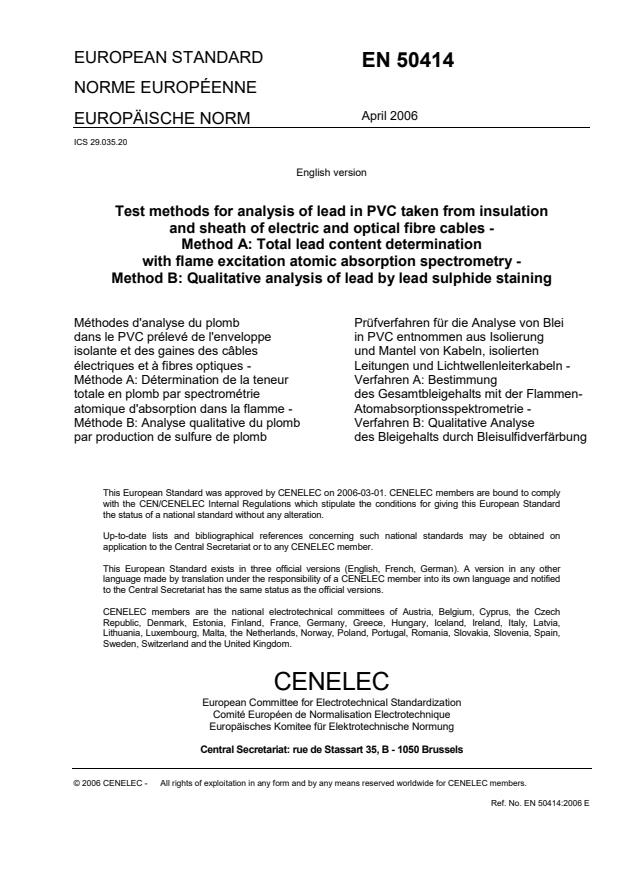
EUROPEAN STANDARD
EN 50414
NORME EUROPÉENNE
April 2006
EUROPÄISCHE NORM
ICS 29.035.20
English version
Test methods for analysis of lead in PVC taken from insulation
and sheath of electric and optical fibre cables -
Method A: Total lead content determination
with flame excitation atomic absorption spectrometry -
Method B: Qualitative analysis of lead by lead sulphide staining
Méthodes d'analyse du plomb Prüfverfahren für die Analyse von Blei
dans le PVC prélevé de l'enveloppe in PVC entnommen aus Isolierung
isolante et des gaines des câbles und Mantel von Kabeln, isolierten
électriques et à fibres optiques - Leitungen und Lichtwellenleiterkabeln -
Méthode A: Détermination de la teneur Verfahren A: Bestimmung
totale en plomb par spectrométrie des Gesamtbleigehalts mit der Flammen-
atomique d'absorption dans la flamme - Atomabsorptionsspektrometrie -
Méthode B: Analyse qualitative du plomb Verfahren B: Qualitative Analyse
par production de sulfure de plomb des Bleigehalts durch Bleisulfidverfärbung
This European Standard was approved by CENELEC on 2006-03-01. CENELEC members are bound to comply
with the CEN/CENELEC Internal Regulations which stipulate the conditions for giving this European Standard
the status of a national standard without any alteration.
Up-to-date lists and bibliographical references concerning such national standards may be obtained on
application to the Central Secretariat or to any CENELEC member.
This European Standard exists in three official versions (English, French, German). A version in any other
language made by translation under the responsibility of a CENELEC member into its own language and notified
to the Central Secretariat has the same status as the official versions.
CENELEC members are the national electrotechnical committees of Austria, Belgium, Cyprus, the Czech
Republic, Denmark, Estonia, Finland, France, Germany, Greece, Hungary, Iceland, Ireland, Italy, Latvia,
Lithuania, Luxembourg, Malta, the Netherlands, Norway, Poland, Portugal, Romania, Slovakia, Slovenia, Spain,
Sweden, Switzerland and the United Kingdom.
CENELEC
European Committee for Electrotechnical Standardization
Comité Européen de Normalisation Electrotechnique
Europäisches Komitee für Elektrotechnische Normung
Central Secretariat: rue de Stassart 35, B - 1050 Brussels
© 2006 CENELEC - All rights of exploitation in any form and by any means reserved worldwide for CENELEC members.
Ref. No. EN 50414:2006 E
Foreword
This European Standard was prepared by the Technical Committee CENELEC TC 20, Electric cables.
The text of the draft was submitted to the formal vote and was approved by CENELEC as EN 50414 on
2006-03-01.
The following dates were fixed:
– latest date by which the EN has to be implemented
at national level by publication of an identical
national standard or by endorsement (dop) 2007-03-01
– latest date by which the national standards conflicting
with the EN have to be withdrawn (dow) 2009-03-01
__________
- 3 - EN 50414:2006
Contents
Introduction.4
1 Scope .4
2 Normative references .4
3 Methods of analysis .5
3.1 General .5
3.2 Method A.5
3.2.1 Principle .5
3.2.2 Reagents.5
3.2.3 Apparatus.6
3.2.4 Sampling .6
3.2.5 Test procedure .6
3.2.6 Determination .7
3.2.7 Tests results.9
3.2.8 Test report.10
3.3 Method B.10
3.3.1 Principle .10
3.3.2 Reagents.10
3.3.3 Apparatus.10
3.3.4 Procedure.10
3.3.5 Determination .11
3.3.6 Test report.11
Table 1 - Preparation of reference solutions.8
Introduction
The determination of small quantities of lead in PVC is possible using a number of analytical techniques.
For the purposes of this European Standard two alternative methods are given.
Method A uses flame excitation atomic absorption spectrometry, for the total lead determination in the
PVC.
Method B uses a qualitative method for the analysis of lead in the PVC. The method utilises the lead
sulfide staining test and is therefore best suited to light coloured or natural materials. It can be considered
to be a spot check for the presence of lead or lead compounds.
Other decomposition and determination methods are capable of detecting and analysing small amounts
of lead in cable grade PVC. Examples of such methods are X-ray fluorescence spectroscopy, graphite
furnace atomic absorption spectrometry, inductively coupled plasma spectrometry and polarography.
Contracting parties may agree to use such other methods, but such methods cannot claim conformity to
EN 50414. If used, it is recommended that such methods have at least equivalent sensitivity and
detection levels as those in this EN.
1 Scope
This European Standard describes two methods for the analysis of lead in PVC-insulating and sheathing
materials for electric and for optical fibre cables. The samples of PVC are taken from the finished cable.
Method A provides a quantitative method and Method B provides a qualitative method.
NOTE 1 Users may refer to either Method A or Method B or to both methods.
NOTE 2 Other methods of determination not specified here are known to be capable of achieving equivalent results, but do not
conform to this EN (see “Introduction”).
Both Method A and Method B are applicable to products having a total lead content greater than or equal
to 0,01 %.
2 Normative references
The following referenced documents are indispensable for the application of this document. For dated
references, only the edition cited applies. For undated references, the latest edition of the referenced
document (including any amendments) applies.
Publication Year Title
EN ISO 1042 1999 Laboratory glassware - One-mark volumetric flasks (ISO 1042:1998)
EN ISO 3696 1995 Water for analytical laboratory use - Specification and test methods
(ISO 3696:1987)
ISO 385-1 1984 Laboratory glassware - Burettes - Part 1: General requirements
ISO 5725 Series Accuracy (trueness and precision) of measurement methods and
results
ISO 6503 1984 Paints and varnishes - Determination of total lead - Flame atomic
absorption spectrometric method
- 5 - EN 50414:2006
3 Methods of analysis
3.1 General
In case of dispute, the decomposition of the material by the dry calcination method and the analysis of the
material by the flame excitation atomic absorption spectrometry (Method A of this standard) shall be the
reference method. Method A has been derived from ISO 6503.
3.2 Method A
3.2.1 Principle
The lead content is determined using flame excitation atomic absorption spectrometry following the
decomposition of a sample by dry calcination and acid extraction of the residue.
3.2.2 Reagents
During the decomposition and extraction, use only reagents of a recognized analytical quality, and
demineralized or distilled water of a purity of at least Grade 3 in accordance with EN ISO 3696.
3.2.2.1 sodium carbonate, anhydrous
3.2.2.2 magnesium carbonate
3.2.2.3 sulfur
3.2.2.4 sodium sulfide, solution at 10 g/l
3.2.2.5 hydrochloric acid, at approximately 180 g/l
450 ml of concentrated hydrochloric acid (36 %, with a specific gravity ρ of approximately 1,18 g/ml) shall
be added to approximately 450 ml of water and shall be made up to 1 000 ml.
3.2.2.6 hydrochloric acid, at approximately 18 g/l
100 ml of hydrochloric acid (made up in 3.2.2.5) shall be added to water, and shall be made up to
1 000 ml.
3.2.2.7 nitric acid, at approximately 315 g/l
One volume of concentrated nitric acid (about 65 %, with a specific gravity ρ of approximately 1,40 g/ml)
shall be added to two volumes of water.
3.2.2.8 lead reference solution, containing 1 g of lead per litre
Exactly 1 g of lead shall be dissolved in 30 ml of the nitric acid prepared in 3.2.2.7 and shall be
transferred, using a funnel, to a 1 000 ml volumetric flask. Distilled or deionized water shall be used to
dilute the solution to the mark and shall be mixed well.
1 ml of this reference solution shall contain 1 mg of lead.
NOTE ISO 6503 gives further details for the preparation of this solution.
3.2.2.9 lead reference solution, containing 100 mg of lead per litre
This solution shall be prepared fresh each day of its use.
10 ml of the reference solution (see 3.2.2.8) shall be transferred with the aid of a pipette into a 100 ml
volumetric flask, and shall be diluted to the mark with hydrochloric acid (see 3.2.2.6) and shall be mixed
well.
1 ml of this reference solution shall contain 100 µg of lead.
3.2.3 Apparatus
Ordinary laboratory apparatus, and
3.2.3.1 silica crucibles, preferably new
3.2.3.2 muffle furnace, at (475 ± 25) °C
3.2.3.3 hot plate with thermostatic control
3.2.3.4 desiccator
3.2.4 Sampling
Take from the cable a representative sample of the material to be tested. The sample shall be cut into
small pieces of approximately 0,05 g.
3.2.5 Test procedure
3.2.5.1 Preliminary tests
If the composition of the material to be tested is not known, carry out qualitative tests to determine
whether antimony is present. If the results of these tests confirm the presence of antimony, the extraction
shall be carried out as specified in 3.2.5.4.2; if not, use the method described in 3.2.5.4.1.
3.2.5.2 Sampl
...
Questions, Comments and Discussion
Ask us and Technical Secretary will try to provide an answer. You can facilitate discussion about the standard in here.
Loading comments...