

prEN IEC 61853-3:2026
(Main)Photovoltaic (PV) module performance testing and energy rating - Part 3: Energy rating of PV modules
- Status
- Not Published
- Publication Date
- 22-Nov-2027
- Technical Committee
- CLC/TC 82 - Solar photovoltaic energy systems
- Drafting Committee
- IEC/TC 82 - IEC_TC_82
- Current Stage
- 4060 - Enquiry results established and sent to TC, SR, BTTF - Enquiry
- Start Date
- 24-Jul-2026
- Completion Date
- 24-Jul-2026

prEN IEC 61853-3:2026 is the draft IEC/CENELEC document for photovoltaic (PV) module performance testing and energy rating, Part 3. It specifies how to calculate yearly PV module energy output and Climate-Specific Energy Rating (CSER) from measured module data and standard reference climate profiles, so manufacturers, test laboratories, and buyers can compare modules on the same basis.
What does prEN IEC 61853-3:2026 specify?
prEN IEC 61853-3:2026 defines the calculation method for PV module energy rating under standardized climate conditions. It is part of the IEC 61853 series, which addresses power, energy, and performance ratio for PV modules.
The document applies to all PV technologies and module designs, including bifacial PV modules. It also notes cases where the method may be less suitable, such as technologies whose performance changes gradually with time or shows strong nonlinear behaviour, and applications such as VIPV, BIPV, floating PV systems, anti-glare treatments, and curved designs where site-specific thermal effects can increase uncertainty.
| Annex | What it covers |
|---|---|
| Annex 1 | List of quantities and units used in the energy rating calculations |
| Annex 2 | Reference values of spectral integrals used to check the integration procedure |
The document is organized into Scope, Normative references, Terms and definitions, Testing, Input for energy rating, Calculation procedure for energy rating, and Report.
What are the key requirements of prEN IEC 61853-3:2026?
prEN IEC 61853-3:2026 is a calculation document, not a test method. The rating is built from measured module data and standardized climate inputs, then turned into annual energy output and CSER.
Inputs and applicability
Clause 4 states that no testing is performed in this part. The calculations use measurements from IEC 61853-1 and IEC 61853-2 together with the standard reference climate profiles from IEC 61853-4.
Clause 5 ties the calculation to four mounting settings and six climate profiles from IEC 61853-4. In practice, this matters because the same module can rate differently depending on whether it is treated as closed rack, open rack, vertical, or single-axis tracking.
Irradiance and spectral correction
Clause 6.1 corrects direct, diffuse, and ground-reflected irradiance for angle of incidence effects. This means the method adjusts the incoming sunlight to match how a module actually “sees” the sun during each hour.
Clause 6.2 then applies spectral correction using module spectral responsivity and the IEC 60904-3 reference spectrum. For multi-junction PV modules, the correction is only applied when the same junction or sub-cell is limiting under both the reference and hourly spectra.
Bifacial modules and temperature
Clause 6.3 adds rear-side irradiance calculations for bifacial modules. For monofacial modules, the rear-side contribution is treated as zero.
Clause 6.4 combines front and rear contributions through maximum power bifaciality. Clause 6.5 calculates module temperature from ambient temperature, wind speed, and irradiance using thermal coefficients from IEC 61853-2. In practice, this is the step that links climate data to operating temperature, which strongly affects power output.
Power, annual energy, and report
Clause 6.6 uses interpolation and extrapolation of the measured power matrix from IEC 61853-1 to obtain hourly module power at the calculated irradiance and temperature. Clause 6.7 sums the hourly values over 8760 hours to obtain yearly module energy output and CSER.
Clause 7 requires the report to identify the laboratory, the module, the climate data version used, the yearly energy output, the CSER value, the estimated uncertainty, and any deviations from the method. That makes the result traceable and easier to review in procurement, qualification, or certification work.
What terms does prEN IEC 61853-3:2026 define?
- Climate-Specific Energy Rating (CSER) - The yearly energy yield under a reference climate divided by the energy the module would produce in the same climate if it always operated at standard test conditions efficiency.
- Standard Test Conditions (STC) - The reference conditions used for comparison in the calculations, including the standard irradiance and spectrum stated in the document.
- Angle of incidence - The angle between the sun and the normal to the module surface; it is used to correct irradiance losses.
- Maximum power bifaciality (φmax) - The factor that expresses the rear-side power contribution of a bifacial module; it is zero for monofacial modules.
- Equivalent irradiance (Ge) - The combined irradiance used to determine module power after front-side and, where relevant, rear-side contributions are included.
- Module temperature (Tmod) - The calculated operating temperature of the module at each hour, used together with irradiance to determine power.
Who uses prEN IEC 61853-3:2026?
prEN IEC 61853-3:2026 is used by PV module manufacturers, test laboratories, and certification bodies that need a repeatable way to rate module energy output. It is also relevant to quality managers, buyers, and technical evaluators who compare modules for rooftop, ground-mounted, vertical, tracking, monofacial, or bifacial applications.
What changed in prEN IEC 61853-3:2026 from the previous edition?
prEN IEC 61853-3:2026 is the second edition and replaces the first edition published in 2018-08. The foreword states these technical changes:
- Energy rating calculations were updated to include bifacial PV modules.
- Different module orientation settings were added for typical monofacial and bifacial installations.
- The spectral correction procedure was improved and clarified.
- Interpolation and extrapolation procedures were improved and clarified.
- A bibliography was added.
- A list of quantities and units was added as an annex.
Which standards are used with prEN IEC 61853-3:2026?
- IEC TS 60904-1-2 - Provides the bifacial current-voltage measurement basis used to determine bifaciality.
- IEC 60904-3 - Provides the AM1.5 reference spectral irradiance used in spectral correction.
- IEC 60904-8 - Provides spectral responsivity measurement principles for PV devices.
- IEC 60904-8-1 - Provides the multi-junction spectral responsivity method used when sub-cells limit differently.
- IEC TS 61836 - Supplies general PV terms, definitions, and symbols.
- IEC 61853-1 - Provides the measured power matrix versus irradiance and temperature.
- IEC 61853-2 - Provides angle-of-incidence, spectral responsivity, and thermal coefficient measurements.
- IEC 61853-4 - Provides the standard reference climate profiles and hourly climate data.
What does the prEN IEC 61853-3:2026 document contain?
prEN IEC 61853-3:2026 contains the calculation chain for turning hourly climate data and measured module properties into annual energy output and CSER. Clause 6 includes the step-by-step equations for irradiance correction, spectral correction, bifacial rear-side treatment, temperature calculation, power interpolation and extrapolation, and annual summation.
The document also contains two informative annexes. Annex 1 lists the symbols and units used throughout the calculation, and Annex 2 gives reference values for the spectral integration step so implementers can check their software or spreadsheets.
Clause 5 includes Table 1, which summarizes the four mounting settings used in the method. Clause 7 gives the reporting checklist that laboratories need when issuing an energy rating result.
Relations
- Effective Date
- 29-Mar-2022
Get Certified
Connect with accredited certification bodies for this standard

DNV
DNV is an independent assurance and risk management provider.

Lloyd's Register
Lloyd's Register is a global professional services organisation specialising in engineering and technology.
DNV Energy Systems
Energy and renewable energy certification.
Sponsored listings
Frequently Asked Questions
prEN IEC 61853-3:2026 is a draft published by CLC. Its full title is "Photovoltaic (PV) module performance testing and energy rating - Part 3: Energy rating of PV modules". This standard covers: Photovoltaic (PV) module performance testing and energy rating - Part 3: Energy rating of PV modules
Photovoltaic (PV) module performance testing and energy rating - Part 3: Energy rating of PV modules
prEN IEC 61853-3:2026 is classified under the following ICS (International Classification for Standards) categories: 27.160 - Solar energy engineering. The ICS classification helps identify the subject area and facilitates finding related standards.
prEN IEC 61853-3:2026 has the following relationships with other standards: It is inter standard links to EN IEC 61853-3:2018. Understanding these relationships helps ensure you are using the most current and applicable version of the standard.
prEN IEC 61853-3:2026 is available in PDF format for immediate download after purchase. The document can be added to your cart and obtained through the secure checkout process. Digital delivery ensures instant access to the complete standard document.
Standards Content (Sample)
SLOVENSKI STANDARD
01-september-2026
Preskušanje zmogljivosti in energijske učinkovitosti fotonapetostnega (PV)
modula - 3. del: Energijska učinkovitost fotonapetostnega (PV) modula
Photovoltaic (PV) module performance testing and energy rating - Part 3: Energy rating
of PV modules
Prüfung des Leistungsverhaltens von photovoltaischen (PV)-Modulen und
Energiebemessung - Teil 3: Energiebemessung von PV-Modulen
Essais de performance et caractéristiques assignées d'énergie des modules
photovoltaïques (PV) - Partie 3: Caractéristiques assignées d’énergie des modules PV
Ta slovenski standard je istoveten z: prEN IEC 61853-3:2026
ICS:
27.015 Energijska učinkovitost. Energy efficiency. Energy
Ohranjanje energije na conservation in general
splošno
27.160 Sončna energija Solar energy engineering
2003-01.Slovenski inštitut za standardizacijo. Razmnoževanje celote ali delov tega standarda ni dovoljeno.
82/2592/CDV
COMMITTEE DRAFT FOR VOTE (CDV)
PROJECT NUMBER:
IEC 61853-3 ED2
DATE OF CIRCULATION: CLOSING DATE FOR VOTING:
2026-05-01 2026-07-24
SUPERSEDES DOCUMENTS:
82/2454/CD, 82/2502A/CC
IEC TC 82 : SOLAR PHOTOVOLTAIC ENERGY SYSTEMS
SECRETARIAT: SECRETARY:
United States of America Mr George Kelly
OF INTEREST TO THE FOLLOWING COMMITTEES: HORIZONTAL FUNCTION(S):
ASPECTS CONCERNED:
SUBMITTED FOR CENELEC PARALLEL VOTING NOT SUBMITTED FOR CENELEC PARALLEL VOTING
Attention IEC-CENELEC parallel voting
The attention of IEC National Committees, members of
CENELEC, is drawn to the fact that this Committee Draft
for Vote (CDV) is submitted for parallel voting.
The CENELEC members are invited to vote through the
CENELEC online voting system.
This document is still under study and subject to change. It should not be used for reference purposes.
Recipients of this document are invited to submit, with their comments, notification of any relevant patent rights of
which they are aware and to provide supporting documentation.
Recipients of this document are invited to submit, with their comments, notification of any relevant “In Some
Countries” clauses to be included should this proposal proceed. Recipients are reminded that the CDV stage is
the final stage for submitting ISC clauses. (SEE AC/22/2007 OR NEW GUIDANCE DOC).
TITLE:
Photovoltaic (PV) module performance testing and energy rating - Part 3: Energy rating of PV
modules
PROPOSED STABILITY DATE: 2032
NOTE FROM TC/SC OFFICERS:
This project was discussed and supported by WG2 during their meeting in 2025-09. It was decided to
change from and Amendment to an Edition 2.
electronic file, to make a copy and to print out the content for the sole purpose of preparing National Committee positions.
You may not copy or "mirror" the file or printed version of the document, or any part of it, for any other purpose without
permission in writing from IEC.
IEC CDV 61853-3 © IEC 2026
1 CONTENTS
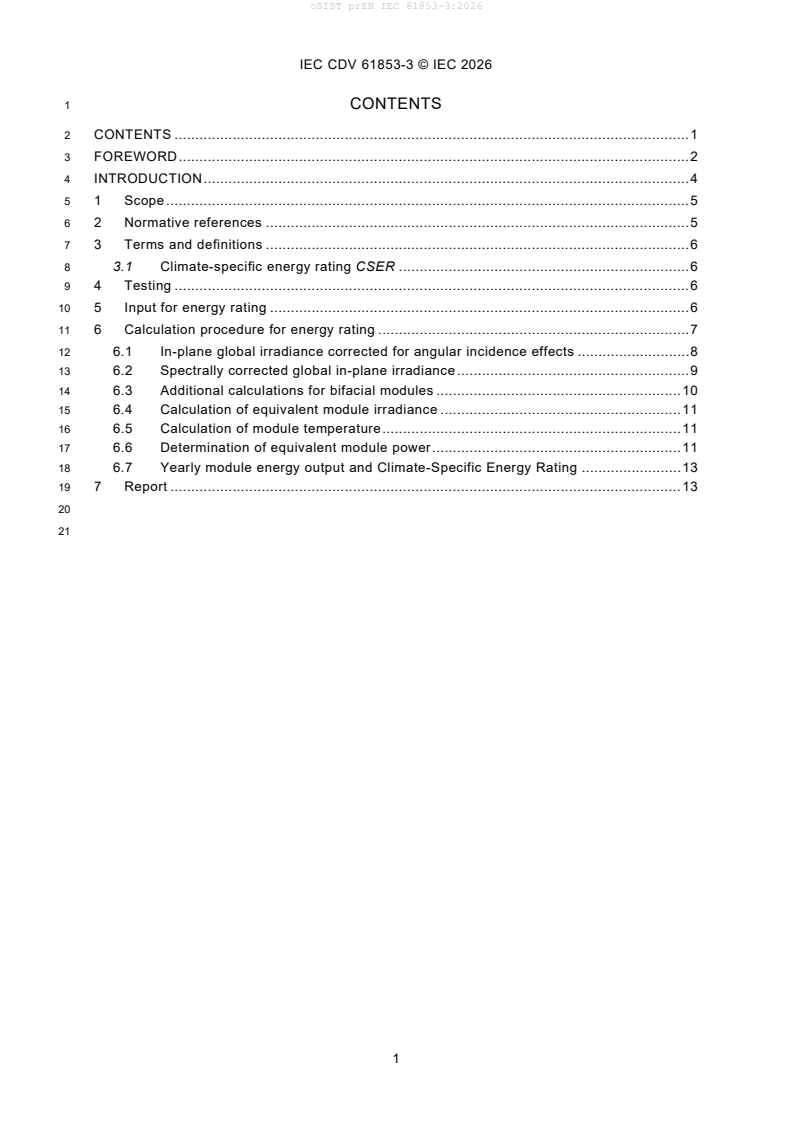
2 CONTENTS . 1
3 FOREWORD . 2
4 INTRODUCTION . 4
5 1 Scope . 5
6 2 Normative references . 5
7 3 Terms and definitions . 6
8 3.1 Climate-specific energy rating CSER . 6
9 4 Testing . 6
10 5 Input for energy rating . 6
11 6 Calculation procedure for energy rating . 7
12 6.1 In-plane global irradiance corrected for angular incidence effects . 8
13 6.2 Spectrally corrected global in-plane irradiance . 9
14 6.3 Additional calculations for bifacial modules . 10
15 6.4 Calculation of equivalent module irradiance . 11
16 6.5 Calculation of module temperature . 11
17 6.6 Determination of equivalent module power . 11
18 6.7 Yearly module energy output and Climate-Specific Energy Rating . 13
19 7 Report . 13
IEC CDV 61853-3 © IEC 2026
22 INTERNATIONAL ELECTROTECHNICAL COMMISSION
23 ____________
25 PHOTOVOLTAIC (PV) MODULE PERFORMANCE
26 TESTING AND ENERGY RATING –
28 Part 3: Energy rating of PV modules
30 FOREWORD
31 1) The International Electrotechnical Commission (IEC) is a worldwide organization for standardization comprising
32 all national electrotechnical committees (IEC National Committees). The object of IEC is to promote international
33 co-operation on all questions concerning standardization in the electrical and electronic fields. To this end and
34 in addition to other activities, IEC publishes International Standards, Technical Specifications, Technical Reports,
35 Publicly Available Specifications (PAS) and Guides (hereafter referred to as “IEC Publication(s)”). Their
36 preparation is entrusted to technical committees; any IEC National Committee interested in the subject dealt with
37 may participate in this preparatory work. International, governmental and non-governmental organizations liaising
38 with the IEC also participate in this preparation. IEC collaborates closely with the International Organization for
39 Standardization (ISO) in accordance with conditions determined by agreement between the two organizations.
40 2) The formal decisions or agreements of IEC on technical matters express, as nearly as possible, an international
41 consensus of opinion on the relevant subjects since each technical committee has representation from all
42 interested IEC National Committees.
43 3) IEC Publications have the form of recommendations for international use and are accepted by IEC National
44 Committees in that sense. While all reasonable efforts are made to ensure that the technical content of IEC
45 Publications is accurate, IEC cannot be held responsible for the way in which they are used or for any
46 misinterpretation by any end user.
47 4) In order to promote international uniformity, IEC National Committees undertake to apply IEC Publications
48 transparently to the maximum extent possible in their national and regional publications. Any divergence between
49 any IEC Publication and the corresponding national or regional publication shall be clearly indicated in the latter.
50 5) IEC itself does not provide any attestation of conformity. Independent certification bodies provide conformity
51 assessment services and, in some areas, access to IEC marks of conformity. IEC is not responsible for any
52 services carried out by independent certification bodies.
53 6) All users should ensure that they have the latest edition of this publication.
54 7) No liability shall attach to IEC or its directors, employees, servants or agents including individual experts and
55 members of its technical committees and IEC National Committees for any personal injury, property damage or
56 other damage of any nature whatsoever, whether direct or indirect, or for costs (including legal fees) and
57 expenses arising out of the publication, use of, or reliance upon, this IEC Publication or any other IEC
58 Publications.
59 8) Attention is drawn to the Normative references cited in this publication. Use of the referenced publications is
60 indispensable for the correct application of this publication.
61 9) Attention is drawn to the possibility that some of the elements of this IEC Publication may be the subject of patent
62 rights. IEC shall not be held responsible for identifying any or all such patent rights.
63 IEC 61853 has been prepared by WG2: Modules, non-concentrating, of IEC technical committee
64 82: Solar photovoltaic energy systems. It is an International Standard.
65 This second edition cancels and replaces the first edition published in 2018-08. This edition
66 constitutes a technical revision.
67 This edition includes the following significant technical changes with respect to the previous
68 edition:
69 a) The energy rating calculations have been modified to include bifacial PV modules;
70 b) Settings defining different module orientations have been introduced to accommodate for
71 typical installation situations of monofacial and bifacial modules;
72 c) The spectral correction procedure has been improved and clarified according to [1];
73 d) Interpolation and extrapolation procedures have been improved and clarified;
74 e) A bibliography has been added;
75 f) A list of all quantities and their units used throughout the document has been added as
76 annex.
IEC CDV 61853-3 © IEC 2026
78 The text of this International Standard is based on the following documents:
Draft Report on voting
80 Full information on the voting for its approval can be found in the report on voting indicated in
81 the above table.
82 The language used for the development of this International Standard is English.
83 This document was drafted in accordance with ISO/IEC Directives, Part 2, and developed in
84 accordance with ISO/IEC Directives, Part 1 and ISO/IEC Directives, IEC Supplement, available
85 at www.iec.ch/members_experts/refdocs. The main document types developed by IEC are
86 described in greater detail at www.iec.ch/publications.
87 A list of all parts in the IEC 61853, published under the general title Photovoltaic (PV) module
88 performance testing and energy rating, can be found on the IEC website.
89 The committee has decided that the contents of this document will remain unchanged until the
90 stability date indicated on the IEC website under http://webstore.iec.ch in the data related to
91 the specific document. At this date, the document will be
92 • reconfirmed,
93 • withdrawn,
94 • replaced by a revised edition, or
95 • amended.
IEC CDV 61853-3 © IEC 2026
98 INTRODUCTION
99 Photovoltaic (PV) modules are typically rated at standard test conditions (STC) of 25 °C cell
–2
100 temperature, 1 000 W m total irradiance, normal incidence and air mass (AM) 1,5 spectrum.
101 However, PV modules in the field operate over a range of temperatures, total and spectral
102 irradiances, and incidence angles. Hence, PV modules can also be rated based on the
103 calculated energy production under a standardized set of environmental and climatic conditions.
104 This series proposes a standard method for energy rating and consists of four parts:
105 • IEC 61853-1: Irradiance and temperature performance measurements and power rating,
106 which describes requirements for evaluating PV module performance in terms of power
107 rating over a range of irradiances and temperatures;
108 • IEC 61853-2: Spectral responsivity, incidence angle, and nominal module operating
109 temperature measurements, which describes test procedures for measuring the effect of
110 varying angle of incidence and sunlight spectra as well as the estimation of module
111 temperature from irradiance, ambient temperature, and wind speed;
112 • IEC 61853-3: Energy rating of PV modules, which describes the calculations for PV module
113 energy ratings; and
114 • IEC 61853-4: Standard reference climatic profiles, which describes the standard time
115 periods and weather conditions that can be used for the energy rating calculations.
IEC CDV 61853-3 © IEC 2026
116 PHOTOVOLTAIC (PV) MODULE
117 PERFORMANCE TESTING AND ENERGY RATING
119 Part 3: Energy rating of PV modules
123 1 Scope
124 The IEC 61853 series establishes IEC requirements for evaluating PV module performance
125 based on power (watts), energy (joule or watthours) and performance ratio. It is written to be
126 applicable to all PV technologies and module designs, including bifacial PV modules, but can
127 be unsuitable for any technology where the module performance changes gradually with time
128 (e.g. modules change their behaviour depending on cumulative light or high temperature
129 exposure), or which experience significant non-linearities in any of their characteristics used for
130 the modelling.
131 The purpose of this third part of IEC 61853 is to define a methodology to determine the
132 photovoltaic (PV) module energy output (watt-hours), and the Climate-Specific Energy Rating
133 (CSER, dimensionless) for a complete year at maximum power operation for the reference
134 climate profile(s) given in IEC 61853-4. It is applied to determine a specific module output in a
135 standard reference climate profile for the purposes of comparison of rated modules.
136 PV modules designed for vehicle-integrated applications (VIPV), building-integrated PV (BIPV),
137 and floating PV systems may experience highly site-specific thermal effects that are not
138 adequately captured by this methodology. In addition, certain anti-glare treatments and curved
139 module designs can introduce increased uncertainty.
140 This is the second edition of the IEC 61853-3 standard. It is not compatible with the first editions
141 of IEC 61853-1, IEC 61853-2 and IEC 61853-4.
143 2 Normative references
144 The following documents are referred to in the text in such a way that some or all of their content
145 constitutes requirements of this document. For dated references, only the edition cited applies.
146 For undated references, the latest edition of the referenced document (including any
147 amendments) applies.
148 IEC TS 60904-1-2, Photovoltaic devices – Part 1-2: Measurement of current-voltage
149 characteristics of bifacial photovoltaic (PV) devices
150 IEC 60904-3, Photovoltaic devices – Part 3: Measurement principles for terrestrial photovoltaic
151 (PV) solar devices with reference spectral irradiance data
152 IEC 60904-8, Photovoltaic devices – Part 8: Measurement of spectral responsivity of a
153 photovoltaic (PV) device
154 IEC 60904-8-1, Photovoltaic devices – Part 8-1: Measurement of spectral responsivity of multi-
155 junction photovoltaic (PV) devices
156 IEC TS 61836, Solar photovoltaic energy systems – Terms, definitions and symbols
157 IEC 61853-1, Photovoltaic (PV) module performance testing and energy rating – Part 1:
158 Irradiance and temperature performance measurements and power rating
159 IEC 61853-2, Photovoltaic (PV) module performance testing and energy rating – Part 2:
160 Spectral responsivity, incidence angle and module operating temperature measurements
IEC CDV 61853-3 © IEC 2026
161 IEC 61853-4, Photovoltaic (PV) module performance testing and energy rating – Part 4:
162 Standard reference climate profiles
164 3 Terms and definitions
165 For the purposes of this document, the terms and definitions given in IEC TS 61836 and the
166 following apply.
167 ISO and IEC maintain terminological databases for use in standardization at the following
168 addresses:
169 • IEC Electropedia: available at http://www.electropedia.org/
170 • ISO Online browsing platform: available at http://www.iso.org/obp
172 3.1 Climate-specific energy rating CSER
173 CSER is the actual energy yield under a reference climate divided by the energy you would get
174 in that same climate if the module always operated at its STC efficiency.
175 Note 1 to entry: CSER is dimensionless.
177 4 Testing
178 No testing is performed within this document; however, the energy rating calculations defined
179 in Clause 6 use data from measurements made according to IEC 61853-1 and IEC 61853-2 and
180 the standard reference climate profiles from IEC 61853-4.
182 5 Input for energy rating
183 The PV module output power is influenced by both device characteristics and environmental
184 conditions. IEC 61853-4 provides the standard reference climate profiles to be used for energy
185 rating in the form of environmental conditions including spectrally resolved and broadband
186 irradiance values, ambient temperature and wind speed, tabulated as hourly data sets. The
187 orientation of the PV module has a direct effect on the irradiance reaching its surface (both
188 front- and rear-side), so IEC 61853-4 provides six sets of climate profiles with pre-calculated
189 direct and diffuse irradiance values for the corresponding module orientations (Settings 1-4),
190 as defined in Table 1. Setting 1 represents an equator-facing installation with negligible rear-
191 side irradiance, typical of most rooftop-mounted systems. This configuration is therefore termed
192 a closed-rack installation. Despite this designation, an air gap between the module and the
193 rooftop ensures ventilation, distinguishing it from BIPV systems, where ventilation between the
194 module and the building surface is highly restricted. Setting 2 resembles the same orientation
195 as Setting 1, but with rear-side irradiance entering the rack, which are typically ground-mounted
196 installations where bifacial modules do receive additional irradiance at their rear compared to
197 monofacial devices. This system is therefore called an open rack installation. Setting 3 is an
198 east-west oriented vertical installation, which is common for agricultural PV installations, fences
199 or noise barriers, and Setting 4 describes single-axis PV trackers with a horizontal north-south
200 axis, enabling east-west rotation. While monofacial and bifacial PV devices will perform similar
201 in rooftop applications due to their severe self-shading, in all other settings bifacial devices will
202 outperform monofacial devices due to the output power gain from their rear side.
IEC CDV 61853-3 © IEC 2026
206 Table 1: Overview of the four different settings for typical PV module mounting conditions.
Setting 1 Setting 2 Setting 3 Setting 4
Tracking
Description closed rack open rack vertical
(single axis)
Inclination angle 𝜷𝜷
20° 20° 90° variable
𝒋𝒋
front to East,
Orientation Equator Equator East/West
rear to West
207 In addition, angle of incidence, spectral effects, module temperature and bifaciality are included
208 in the calculations to account for the unique characteristics of a PV module and provide accurate
209 performance ratings for the different settings and climate profiles. The following characteristics
210 are required for monofacial modules:
211 a) The angle of incidence fitting parameter a , (IEC 61853-2) which is used to correct irradiance
r
212 for angle of incidence losses.
( )
213 b) The spectral responsivity 𝑠𝑠 𝜆𝜆 (IEC 61853-2), which is used to correct irradiance for
𝜆𝜆
214 spectral mismatch losses. It is provided as a table of values for a range of wavelengths over
215 which the PV module is sensitive to irradiance.
216 c) The thermal coefficients u and u (IEC 61853-2), which are used to calculate the module
0 1
217 temperature 𝑇𝑇 as a function of irradiance, ambient temperature and wind speed.
mod
218 d) A matrix of module power values 𝑃𝑃(𝐺𝐺,𝑇𝑇) as a function of irradiance and temperature (IEC
219 61853-1) which is interpolated to obtain the equivalent module power 𝑃𝑃 �𝐺𝐺 ,𝑇𝑇 � at a
mod,𝑗𝑗 e,𝑗𝑗 mod,𝑗𝑗
220 given equivalent irradiance 𝐺𝐺 and module temperature 𝑇𝑇 at hour j of the environmental
e,𝑗𝑗 mod,𝑗𝑗
221 data given by the climate profiles. 𝑃𝑃(𝐺𝐺,𝑇𝑇) must be a complete matrix, if there are any NA
222 values, extrapolate the missing values as described in IEC 61853-1.
223 Furthermore, for bifacial modules also the following characteristics are required:
224 e) The maximum power bifaciality 𝜑𝜑 of the PV device. In the case of monofacial modules,
𝑃𝑃
max
225 𝜑𝜑 = 0. In the case of bifacial modules (𝜑𝜑 > 0), the rear-side angle of incidence fitting
𝑃𝑃 𝑃𝑃
𝑚𝑚𝑚𝑚𝑚𝑚 max
226 parameter 𝑚𝑚 and rear-side spectral responsitivity 𝑠𝑠 (𝜆𝜆) shall also be provided.
r,rear λ,rear
227 The PV module parameters referred to in poin
...