

FprEN IEC 61508-3:2026
(Main)Functional safety of electrical/electronic/programmable electronic safety-related systems - Part 3: Software requirements
- Status
- Not Published
- Publication Date
- 14-Feb-2027
- Technical Committee
- CLC/TC 65X - Industrial-process measurement, control and automation
- Drafting Committee
- SC 65A - Safety aspects
- Current Stage
- 5060 - Voting results sent to TC, SR - Formal Approval
- Start Date
- 13-Nov-2026
- Due Date
- 13-Nov-2026
- Completion Date
- 13-Nov-2026
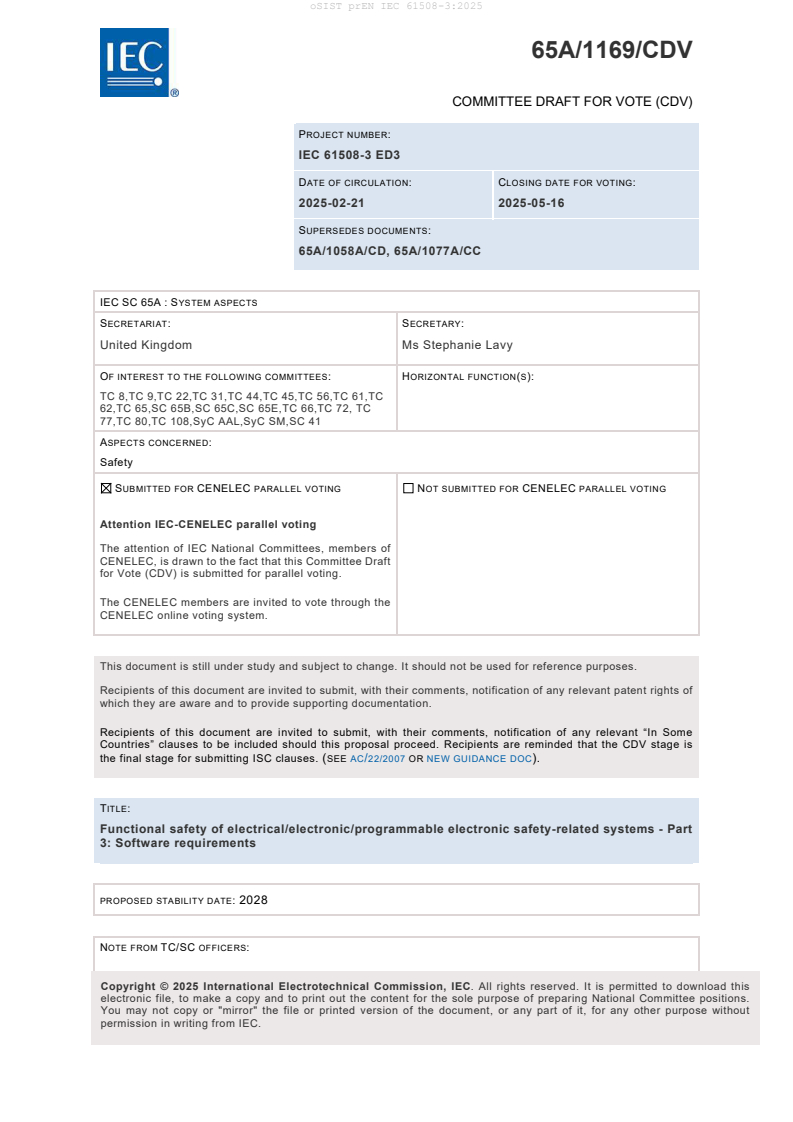

FprEN IEC 61508-3:2026 is a CLC draft of IEC 61508-3, Part 3 of the IEC 61508 series. It specifies software requirements for functional safety of electrical/electronic/programmable electronic safety-related systems, including safety-related software and the support tools used to develop and configure it. It is written for people who need to design, integrate, assess, operate, maintain, or standardize such software.
What does FprEN IEC 61508-3:2026 specify?
FprEN IEC 61508-3:2026 covers the software side of functional safety for E/E/PE safety-related systems. It is intended to be used together with IEC 61508-1 and IEC 61508-2, and it applies to safety-related software used in the system itself or used to develop the system.
The document organizes the software safety lifecycle from documentation and management through specification, design, implementation, testing, validation, modification, and verification. It also adds annexes that give technique selection tables, capability properties, guidance for tools, and special guidance for models and data-driven systems.
| Annex | What it covers |
|---|---|
| Annex A | Guide to the selection of techniques and measures |
| Annex B | Detailed tables |
| Annex C | Properties for systematic capability of software elements |
| Annex D | Safety manual for compliant items - additional requirements for software elements |
| Annex E | Relationships between IEC 61508-2 and this document |
| Annex F | Techniques for achieving non-interference between software elements on a single computer |
| Annex G | Guidance for systems configured by application data |
| Annex H | Confidence in the usage of Software Off-line Support Tools |
| Annex I | Model Based Software Development and Verification Guidelines |
| Annex J | Data Driven Systems |
What are the key requirements of FprEN IEC 61508-3:2026?
FprEN IEC 61508-3:2026 requires a structured software safety lifecycle, with the level of rigor chosen according to the required systematic capability. In practice, that means the organization must plan, design, verify, validate, and control software work in a way that matches the safety target of the system.
1. Use the standard as part of the wider IEC 61508 framework
Clause 1 says this part is used only after a thorough understanding of IEC 61508-1 and IEC 61508-2. It applies to software that is part of a safety-related system or used to develop one, including operating systems, system software, communication software, human-machine interface functions, firmware, and application software. For a project team, this means software requirements cannot be treated in isolation from the system safety requirements.
2. Specify software safety functions and systematic capability
Clause 1 requires the software safety functions and their systematic capability to be specified. The text notes that this is iterative and may already be covered at system level in IEC 61508-2. In practice, the team needs to make the software safety case explicit so that later design and test work can be traced back to the intended safety function.
3. Follow the software safety lifecycle in Clause 7
Clause 7 structures the work into software safety requirements specification, validation planning, software design and development, programmable electronics integration, operation and modification procedures, software aspects of system safety validation, software modification, and software verification. This matters because each phase has its own objectives and evidence, so design work, test work, and change control do not become ad hoc.
4. Apply management and documentation controls throughout
Clause 5 covers documentation, and Clause 6 covers management of safety-related software. Annex A.11 and Annex C.20 emphasize traceability, project management, documentation, and observance of guidelines and standards across the full lifecycle. In practice, teams need controlled records showing how requirements move into design, code, tests, and verification results.
5. Select techniques and measures according to systematic capability
Annex A is the main technique-selection guide, and Annex C explains how to justify choices. The tables grade methods for different systematic capability levels, SC 1 to SC 4, across specification, architecture, programming language, detailed design, module testing, integration, validation, modification, verification, and lifecycle activities. This means a developer or assessor must choose methods that are proportionate to the required safety level, not simply preferred by the team.
6. Use the lifecycle techniques that matter most in practice
The technique tables highlight methods such as structured methods, semi-formal methods, formal methods, modular design, defensive programming, design and coding standards, model-based test case generation, regression testing, static analysis, and performance testing. They also cover traceability, code protection, failure detection by on-line monitoring, and software failure analysis. In practice, these tables act as the checklist for deciding what to use, document, or justify.
7. Control software modification and re-verification
Clause 7.8 and Annex A.8 require impact analysis, re-verification of changed and affected modules, revalidation where needed, regression validation, configuration management, and data recording and analysis. This matters for maintenance and field changes, because even small changes can affect safety behavior and must be assessed before release.
8. Address support tools, non-interference, models, and data-driven systems
Clause 7 and Annex H require attention to support tools such as development tools, translators, testing tools, debugging tools, and configuration management tools. Annex F gives guidance on non-interference between software elements on a single computer, Annex I gives guidance for model based software development and verification, and Annex J addresses data driven systems. For users, this means the standard is not limited to source code - it also covers the tools, models, and configuration approach that shape the software behavior.
What terms does FprEN IEC 61508-3:2026 define?
- Electrical/electronic/programmable electronic (E/E/PE) - The hardware and software technologies that the IEC 61508 series treats as the basis for the safety-related system.
- Safety-related software - Software that forms part of a safety-related system or is used to develop one, including firmware, operating systems, and application software.
- Systematic capability (SC) - A measure of confidence that the software avoids and controls systematic faults to the level needed for the safety function.
- Safety Integrity Level (SIL) - The target safety integrity level used in the wider IEC 61508 framework for the safety function.
- Model Based Testing (MBT) - A testing approach where test cases are generated from models of requirements or behavior.
- Test Usage Safety (TUS) - The usage-context classification used in Annex H for Software Off-line Support Tools.
- Technology class I, II, III - The software algorithm classes referenced in Clause 1 for software technologies associated with AI terminology.
Who uses FprEN IEC 61508-3:2026?
FprEN IEC 61508-3:2026 is used by software engineers, system integrators, safety engineers, assessors, and quality managers working on E/E/PE safety-related systems. It is also used by technical committees that prepare product or sector standards based on the IEC 61508 series.
In practice, it supports software development, safety requirements specification, architecture design, coding, module testing, integration testing, validation, modification control, and safety assessment. It is relevant across application sectors that use industrial process measurement, control and automation, and more broadly across safety-related system development.
What changed in FprEN IEC 61508-3:2026 from the previous edition?
FprEN IEC 61508-3:2026 replaces the second edition published in 2010 and states that this edition is a technical revision. The foreword lists these significant changes:
- Updated to the 2024 version of the ISO/IEC Directives, with editorial changes and clause renumbering throughout.
- Requirements on artificial intelligence, security, and human factors are limited to the references to external guidance in the scope.
- Requirements from IEC TS 61508-3-1 were incorporated into Clause 7 and extended for SC3 and SC4.
- Interfaces to other parts of IEC 61508 were clarified and duplicated requirements removed.
- Software functional failure analysis was moved to architectural design and renamed software failure analysis.
- The distinction between SIL and SC was clarified.
- Formal methods requirements were clarified, semi-formal methods were restored, and the meaning of unambiguously defined methods was clarified.
- Software off-line support tool requirements were refined.
- Guidance on data driven systems was separated from guidance on data configuration and limited variability programming.
- Modification requirements in Annex A were reinstated and clarified.
- A lifecycle-wide management table was added, including traceability requirements.
- Regression testing, verification versus validation terminology, and object-oriented design and development requirements were clarified.
Which standards are used with FprEN IEC 61508-3:2026?
| Standard or publication | What it contributes |
|---|---|
| IEC 61508-1 | Overall framework and system-level safety lifecycle |
| IEC 61508-2 | Hardware-related requirements and system integration context for this software part |
| IEC 61508-4 | Definitions, including systematic capability and software-related terms |
| IEC 61508-7 | Techniques, detailed guidance, and annex material referenced by the technique tables |
| IEC TS 61508-3-1 | Requirements incorporated into Clause 7 in this edition |
| IEC TS 61508-3-2 | Formal-methods guidance and related verification detail |
| IEC 61131-1 | Consistency reference for limited variability programming |
| ISO/IEC 22989 | AI terminology referenced for software algorithm classes |
| ISO/IEC TR 5469:2024 | Further detail on software algorithm classes |
| ISO/IEC TS 22440 series | Further detail on software algorithm classes |
| IEC Guide 104 | Basis for treating the document as a basic safety publication |
| ISO/IEC Guide 51 | Principles for preparing safety standards |
What does the FprEN IEC 61508-3:2026 document contain?
The document contains the software clauses, the full software safety lifecycle, and the tables that connect lifecycle phases to techniques and measures. Annex A and Annex B provide the selection guidance and detailed technique tables; Annex C explains how those techniques support systematic capability. Annex D gives the safety manual requirements for software elements used in compliant items, and Annex H sets out how to build confidence in Software Off-line Support Tools.
It also contains figures for the overall IEC 61508 framework, the E/E/PE safety lifecycle, the software safety lifecycle, and the relationships between parts of the series. Annex F, Annex I, and Annex J add specialized guidance for non-interference, model based software development and verification, and data driven systems.
Relations
- Effective Date
- 11-Oct-2022
Get Certified
Connect with accredited certification bodies for this standard

DVS-ZERT GmbH
German welding certification society.

CARES (UK Certification Authority for Reinforcing Steels)
UK certification for reinforcing steels and construction.

EWF/IIW (European/International Welding Federation)
International welding personnel certification.
Sponsored listings
Frequently Asked Questions
FprEN IEC 61508-3:2026 is a draft published by CLC. Its full title is "Functional safety of electrical/electronic/programmable electronic safety-related systems - Part 3: Software requirements". This standard covers: Functional safety of electrical/electronic/programmable electronic safety-related systems - Part 3: Software requirements
Functional safety of electrical/electronic/programmable electronic safety-related systems - Part 3: Software requirements
FprEN IEC 61508-3:2026 is classified under the following ICS (International Classification for Standards) categories: 25.040.40 - Industrial process measurement and control. The ICS classification helps identify the subject area and facilitates finding related standards.
FprEN IEC 61508-3:2026 has the following relationships with other standards: It is inter standard links to EN 61508-3:2010. Understanding these relationships helps ensure you are using the most current and applicable version of the standard.
FprEN IEC 61508-3:2026 is available in PDF format for immediate download after purchase. The document can be added to your cart and obtained through the secure checkout process. Digital delivery ensures instant access to the complete standard document.
Standards Content (Sample)
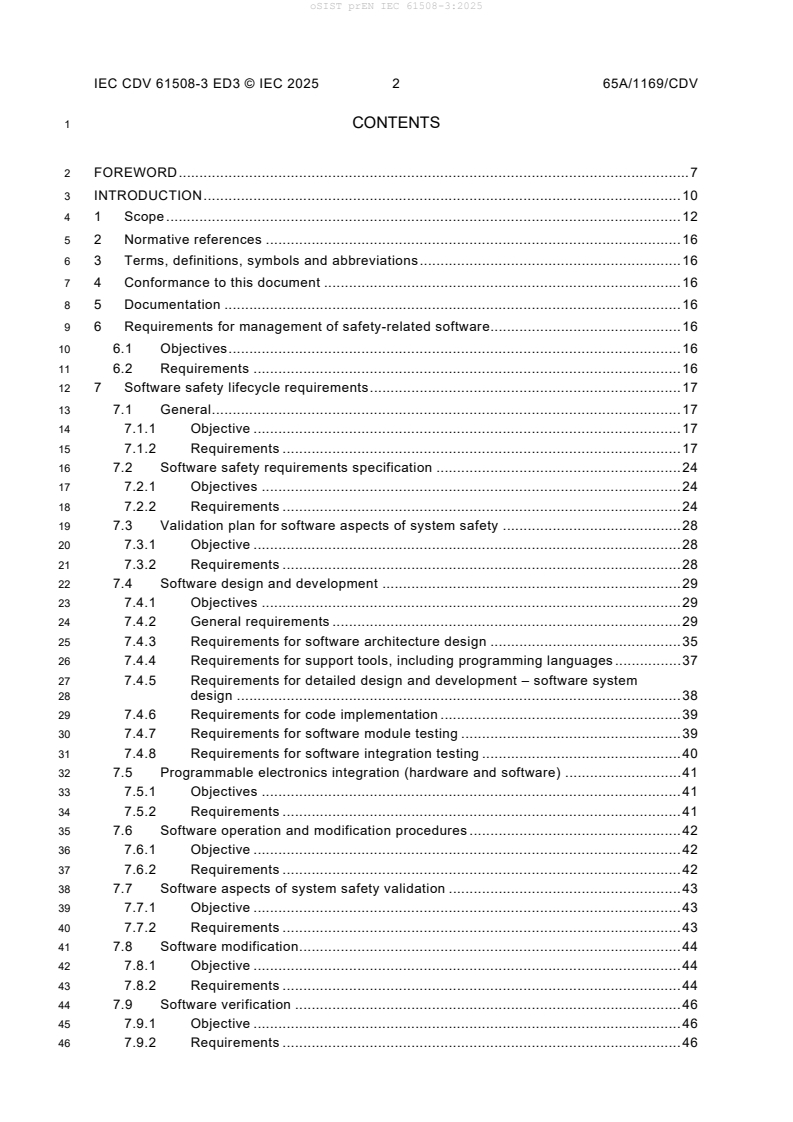
Contents
- 2 FOREWORD
- 3 INTRODUCTION
- 4 1 Scope
- 5 2 Normative references
- 6 3 Terms, definitions, symbols and abbreviations
- 7 4 Conformance to this document
- 8 5 Documentation
- 9 6 Requirements for management of safety-related software
- 10 6.1 Objectives
- 11 6.2 Requirements
- 12 7 Software safety lifecycle requirements
- 13 7.1 General
- 14 7.1.1 Objective
- 15 7.1.2 Requirements
- 16 7.2 Software safety requirements specification
- 17 7.2.1 Objectives
- 18 7.2.2 Requirements
- 19 7.3 Validation plan for software aspects of system safety
- 20 7.3.1 Objective
- 21 7.3.2 Requirements
- 22 7.4 Software design and development
- 23 7.4.1 Objectives
- 24 7.4.2 General requirements
- 25 7.4.3 Requirements for software architecture design
- 26 7.4.4 Requirements for support tools, including programming languages
- 27 7.4.5 Requirements for detailed design and development – software system 28 design
- 29 7.4.6 Requirements for code implementation
- 30 7.4.7 Requirements for software module testing
- 31 7.4.8 Requirements for software integration testing
- 32 7.5 Programmable electronics integration (hardware and software)
- 33 7.5.1 Objectives
- 34 7.5.2 Requirements
- 35 7.6 Software operation and modification procedures
- 36 7.6.1 Objective
- 37 7.6.2 Requirements
- 38 7.7 Software aspects of system safety validation
- 39 7.7.1 Objective
- 40 7.7.2 Requirements
- 41 7.8 Software modification
- 42 7.8.1 Objective
- 43 7.8.2 Requirements
- 44 7.9 Software verification
- 45 7.9.1 Objective
- 46 7.9.2 Requirements
- oSIST prEN IEC 61508-3:2025 IEC CDV 61508-3 ED3 © IEC 2025 3 65A/1169/CDV 47 8 Functional safety assessment
- 48 9 Bibliography
- 49 Annex A (normative) Guide to the selection of techniques and measures
- 50 Annex B (informative) Detailed tables
- 51 Annex C (informative) Properties for systematic capability of software elements
- 52 C.1 Introduction
- 53 C.1.1 Structure of Annex C, relating to Annexes A and B
- 54 C.1.2 Method of use – 1
- 55 C.1.3 Method of use – 2
- 56 C.2 Properties for systematic capability
- 57 C.3 Properties for systematic capability – Detailed tables
- 58 Annex D (normative) Safety manual for compliant items – additional requirements for 59 software elements
- 60 D.1 Purpose of the safety manual
- 61 D.2 Contents of the safety manual for a software element
- 62 D.3 Justification of claims in the safety manual for compliant items
- 63 Annex E (informative) Relationships between IEC 61508-2 and this document
- 64 Annex F (informative) Techniques for achieving non-interference between software 65 elements on a single computer
- 66 F.1 Introduction
- 67 F.2 Domains of behaviour
- 68 F.3 Causal factor analysis
- 69 F.4 Achieving spatial independence
- 70 F.5 Achieving temporal independence
- 71 F.6 Requirements for supporting software
- 72 F.7 Independence of software modules – programming language aspects
- 73 Annex G (informative) Guidance for systems configured by application data
- 74 G.1 Introduction
- 75 G.2 Aspects influencing lifecycle requirements
- 76 G.2.1 Complexity of E/E/PE systems
- 77 G.2.2 Rationale for the lifecycle requirements
- 78 G.2.3 Complexity in software
- 79 G.2.4 Programming language characteristics and safety
- 80 G.2.5 Role of the tools
- 81 G.3 Guidance for tailoring the lifecycle
- 82 G.3.1 Recommendations for tailoring the lifecycle
- 83 G.3.2 Tailoring principles
- 84 G.3.3 Fixed functionalities and configuration
- 85 G.3.4 Fixed functionalities and programming
- 86 G.3.5 Limited functionalities and configuration
- 87 G.3.6 Limited functionalities and programming
- 88 G.3.7 Open functionalities and configuration
- 89 G.3.8 Open functionalities and programming
- 90 Annex H (normative) Confidence in the usage of Software Off-line Support Tools
- 91 H.1 Scope and conventions
- 92 H.2 Software off-line support tool usage confidence approach overview
- 93 H.2.1 Software off-line support tool usage confidence objectives
- 94 H.2.2 Software off-line support tool confidence approach
- oSIST prEN IEC 61508-3:2025 IEC CDV 61508-3 ED3 © IEC 2025 4 65A/1169/CDV 95 H.2.3 Software off-line support tool usage confidence measures overview
- 96 H.3 Measures concerning software off-line support tool usage
- 97 H.3.1 Software off-line support tool usage planning and qualification planning
- 98 H.3.2 Software off-line support tool classification in the usage context
- 99 H.3.3 Software off-line support tool user documentation
- 100 H.3.4 Software off-line support tool integration and assessment in the usage 101 environment
- 102 H.3.5 Software off-line support tool configuration management in the tool user 103 context
- 104 H.3.6 Software off-line support tool operation
- 105 H.4 Measures concerning software off-line support tool development including 106 verification
- 107 H.4.1 Software off-line support tool development with avoidance of systematic 108 faults
- 109 H.4.2 Confidence from software off-line support tool usage history
- 110 H.4.3 Software off-line support tool documentation and problem management
- 111 H.5 Required evidence for software off-line support tool usage confidence
- 112 Annex I (informative) Model Based Software Development and Verification Guidelines
- 113 I.1 Objectives and scope of this annex
- 114 I.2 Rationale for this annex
- 115 I.3 Approach and relationship with the body of this document
- 116 I.4 Documentation
- 117 I.5 Safety lifecycle planning
- 118 I.6 Techniques and measures
- 119 I.7 Software safety requirements specification
- 120 I.8 Software architecture design
- 121 I.9 Requirements for software off-line support tools, including programming 122 languages
- 123 I.10 Detailed design and development
- 124 I.11 Code Implementation
- 125 I.12 Software module testing
- 126 I.13 Software integration testing
- 127 I.14 Model Verification
- 128 I.15 Model-Based verification
- 129 Annex J (Informative) Data Driven Systems
- 130 J.1 General
- 131 J.2 Systems with Minimal Configurable Parameters
- 132 J.3 Systems with Comprehensive Configurability
- 133 J.4 Role of the tools
- 135 Figure 1 – Overall framework of the IEC 61508 series
- 136 Figure 2 – Overall E/E/PE system safety lifecycle
- 137 Figure 3 – E/E/PE system safety lifecycle (in realisation phase)
- 138 Figure 4 – Software safety lifecycle (in realisation phase)
- 139 Figure 5 – Relationship and scope for IEC 61508-2 and this document (see also 140 Annex E)
- 141 Figure 6 – Systematic capability for software and the development lifecycle (the V- 142 model)
- 143 Figure H.1 – Tool Confidence Principle
335 INTRODUCTION 336 Systems comprised of electrical and/or electronic elements have been used for many years to 337 perform safety functions in most application sectors. Computer-based systems (generically 338 referred to as programmable electronic systems) are being used in all application sectors to 339 perform non-safety functions and, increasingly, to perform safety functions. If computer system 340 technology is to be effectively and safely exploited, it is essential that those responsible for 341 making decisions have sufficient guidance on the safety aspects on which to make these 342 decisions.
343 This document sets out a generic approach for all safety lifecycle activities for systems 344 comprised of electrical and/or electronic and/or programmable electronic (E/E/PE) elements 345 that are used to perform safety functions. This unified approach has been adopted in order that 346 a rational and consistent technical policy be developed for all electrically-based safety-related 347 systems. A major objective is to facilitate the development of product and application sector 348 international standards based on the IEC 61508 series.
349 NOTE 1 Examples of product and application sector international standards based on the IEC 61508 series are 350 given in the bibliography.
351 In most situations, safety is achieved by a number of systems which rely on many technologies (for 352 example mechanical, hydraulic, pneumatic, electrical, electronic, programmable electronic). Any 353 safety strategy considers not only all the elements within an individual system (for example sensors, 354 controlling devices and actuators) and humans as part of the system, as part of the realization 355 process, operation, and management of verification/decision making), but also all the safety-related 356 systems making up the total combination of safety-related systems. Therefore, while this document is 357 concerned with E/E/PE safety-related systems, it can also provide a framework within which safety- 358 related systems based on other technologies can be considered.
359 It is recognized that there is a great variety of applications using E/E/PE safety-related systems 360 in a variety of application sectors and covering a wide range of complexity, hazard and risk 361 potentials. In any particular application, the required safety measures will be dependent on 362 many factors specific to the application. This document, by being generic, will enable such 363 measures to be formulated in future product and application sector international standards and 364 in revisions of those that already exist.
365 This document 366 – considers all relevant overall, E/E/PE system and software safety lifecycle phases (for example, 367 from initial concept, through design, implementation, operation and maintenance to 368 decommissioning) when E/E/PE systems are used to perform safety functions; 369 – has been conceived with a rapidly developing technology in mind; the framework is sufficiently 370 robust and comprehensive to cater for future developments; 371 – enables product and application sector international standards, dealing with E/E/PE safety- 372 related systems, to be developed; the development of product and application sector 373 international standards, within the framework of this document, should lead to a high level of 374 consistency (for example, of underlying principles, terminology etc.) both within application 375 sectors and across application sectors; this will have both safety and economic benefits; 376 – provides a method for the development of the safety requirements specification necessary to 377 achieve the required functional safety for E/E/PE safety-related systems; 378 – adopts a risk-based approach by which the safety integrity requirements can be determined; 379 – introduces safety integrity levels for specifying the target level of safety integrity for the safety 380 functions to be implemented by the E/E/PE safety-related systems; 381 NOTE 1 The standard does not specify the safety integrity level requirements for any safety function, nor does it 382 mandate how the safety integrity level is determined. Instead, it provides a risk-based conceptual framework and 383 example techniques.
384 – sets target failure measures for safety functions carried out by E/E/PE safety-related systems, 385 which are linked to the safety integrity levels;
386 – sets a lower limit on the target failure measures for a safety function carried out by a single 387 E/E/PE safety-related system. For E/E/PE safety-related systems operating in 388 • a low demand mode of operation, the lower limit is set at an average probability of a –5 389 dangerous failure on demand of 10 ; 390 • a high demand or a continuous mode of operation, the lower limit is set at an average –9 -1 391 frequency of a dangerous failure of 10 [h ]; 392 NOTE 2 A single E/E/PE safety-related system does not necessarily mean a single-channel architecture. 393 NOTE 3 It can be possible to achieve designs of safety-related systems with lower values for the target safety 394 integrity for non-complex systems, but these limits are considered to represent what can be achieved for relatively 395 complex systems (for example programmable electronic safety-related systems) at the present time. 396 – sets requirements for the avoidance and control of systematic faults, which are based on 397 experience and judgement from practical experience gained in industry. Even though the 398 probability of occurrence of systematic failures cannot in general be quantified the standard 399 does, however, allow a claim to be made, for a specified safety function, that the target failure 400 measure associated with the safety function can be considered to be achieved if all the 401 requirements in the standard have been met; 402 – introduces systematic capability as a measure of confidence that an E/E/PE system meets the 403 safety requirements with regards to avoidance and control of systematic faults; 404 – adopts a broad range of principles, techniques and measures to achieve functional safety for 405 E/E/PE safety-related systems but does not explicitly use the concept of fail safe. However, the 406 concepts of “fail safe” can be applicable and adoption of such concepts is acceptable provi
...