

EN IEC 61298-1:2026
(Main)Process measurement and control devices - General methods and procedures for evaluating performance - Part 1: General considerations
- Status
- Published
- Publication Date
- 13-Aug-2026
- Technical Committee
- CLC/TC 65X - Industrial-process measurement, control and automation
- Current Stage
- 6060 - Document made available - Publishing
- Start Date
- 14-Aug-2026
- Due Date
- 31-Mar-2025
- Completion Date
- 14-Aug-2026


EN IEC 61298-1:2026 is a CLC/IEC standard for process measurement and control devices. It specifies general methods and procedures for evaluating performance of process instrumentation, including analogue and digital devices, and is intended for manufacturers, test laboratories, purchasers and users who need comparable performance data. The document is the general foundation for the IEC 61298 series, while Process Measurement Transmitters (PMT) are covered by IEC series 62828.
What does EN IEC 61298-1:2026 specify?
EN IEC 61298-1:2026 sets out the common test and reporting framework for evaluating the functional and performance characteristics of process instrumentation. It applies to devices with defined input and output variables and a transfer function between them, and it is meant to be used together with product-specific standards when special tests are needed.
The document is organized into clauses 1 to 7:
- Scope
- Normative references
- Terms and definitions
- Test categories
- General criteria
- General conditions for tests and samples
- General testing procedures and precautions
Clause 1 limits the subject to process instrumentation and excludes PMT standardized by IEC series 62828. Clause 4 separates tests into complete tests and simplified tests, and clauses 5 to 7 explain how to plan, run and report the evaluations.
What are the key requirements of EN IEC 61298-1:2026?
EN IEC 61298-1:2026 focuses on making performance evaluations repeatable, comparable and documented. In practice, it tells parties how to agree the test program, control the test conditions, choose measuring equipment and handle anomalies.
Test planning and categories
- Clause 4 distinguishes complete tests from simplified tests. Complete tests are used for full performance evaluation or type tests, while simplified tests cover selected checks such as routine tests or sample tests. This matters because the report must state when only part of the full program was run.
- Clause 4 requires the test program to be agreed before testing starts. The test house, purchaser or initiator, and where relevant the supplier or manufacturer, should agree the program and any deviations. That avoids later disputes over what the results actually prove.
General criteria for the evaluation
- Clause 5 says tests should reflect realistic operating conditions, but in a practical laboratory way. The standard therefore supports a limited set of standard conditions that can be compared across devices.
- Clause 5 requires standardized methods wherever possible, and it expects influence factors to be held constant except for the condition being studied. This helps keep one variable from masking another.
- Clause 5 says results are processed by conventional methods rather than statistical methods, because the number of measurements is often small. For the reader, that means performance values are generally based on maximum or averaged deviations, depending on the quantity.
- Clause 5 requires care so that one test does not affect the next. Sequence and handling matter because earlier tests can change later results.
Test conditions, samples and equipment
- Clause 6 sets out environmental, supply and load conditions, together with mounting position, vibration control and mechanical constraints. The practical point is that the device should be tested as it would normally be installed, without extra restraints that would hide its behaviour.
- Clause 6 also covers selection of devices for performance evaluation, routine tests and sample tests. Representative sampling is important when results from a subset are being used to judge a batch.
- Clause 7 requires an accredited test laboratory for standard tests, unless a specialized test makes accreditation impracticable and this is stated in the report.
- Clause 7 requires reference measuring equipment with higher accuracy than the device under test, with uncertainty not greater than one-fourth of the stated limit of error, and traceable calibration. That is the basis for credible comparisons.
- Clause 7 requires a complete evaluation report in accordance with IEC 61298-4, and the test laboratory must keep the original measurement documentation for at least two years after issue of the report.
What terms does EN IEC 61298-1:2026 define?
- Variable - A quantity or condition that can change and is usually measurable, such as temperature, flow rate, speed or signal.
- Range - The interval between two extreme values within which a variable can be measured within the specified accuracy.
- Span - The algebraic difference between the upper and lower limits of the measuring range.
- Inaccuracy - The maximum positive and negative deviation from the specified characteristic curve seen during testing under specified conditions.
- Error - The algebraic difference between the indicated value and the comparison value of the measured variable.
- Hysteresis - A property where the output depends on the direction in which the input values were applied.
- Dead band - A finite input range that produces no measurable output change.
- Unexpected event - A breakdown, failure, anomaly or inadvertent damage during evaluation that requires correction by the manufacturer.
Who uses EN IEC 61298-1:2026?
EN IEC 61298-1:2026 is used by manufacturers of process measurement and control devices, test laboratories, purchasers, and users who need performance evaluations they can compare across products or sites. It is especially relevant in industrial process measurement and control, where devices may be tested for type approval, routine checking, or batch sampling.
Quality teams use it to define test programs and reporting rules. Engineers use it to set up test conditions, select reference instruments and judge results. Buyers and users use it when they need a common basis for comparing a supplier’s performance claims with measured data.
What changed in EN IEC 61298-1:2026 from the previous edition?
EN IEC 61298-1:2026 replaces the first edition published in 1995. The document describes this edition as a general revision and states that it does not include significant changes.
Which standards are used with EN IEC 61298-1:2026?
- IEC 60050-300 - Provides vocabulary for electrical and electronic measurements and measuring instruments.
- IEC 60050-351 - Provides vocabulary for control technology.
- IEC 60410 - Gives sampling plans and procedures for inspection by attributes, useful for sample tests.
- IEC 61298-2 - Covers tests under reference conditions.
- IEC 61298-3 - Covers tests for the effects of influence quantities.
- IEC 61298-4 - Defines evaluation report content.
- ISO/IEC 80000 (all parts) - Provides quantities and units.
- IEC series 62828 - Standardizes Process Measurement Transmitters (PMT), which are outside the scope of this part.
What does the EN IEC 61298-1:2026 document contain?
The document contains the common procedures and conditions needed to evaluate process instrumentation in a repeatable way. Table 1 sets the environmental test conditions, and clauses 6 and 7 cover supply conditions, load conditions, mounting position, vibration control, sample selection, laboratory preparation, reference measuring equipment, preconditioning, input/output relationships, error assessment and reporting.
It also explains how to deal with anomalies, interruptions and restarts during testing. The report requirements are tied to IEC 61298-4, so the document is not just about running measurements but also about documenting them in a form that others can review and compare.
Relations
- Effective Date
- 26-Sep-2023
- Effective Date
- 07-Jul-2026
- Effective Date
- 07-Jul-2026
- Refers
IEC 60050-351:2013 - International Electrotechnical Vocabulary (IEV) - Part 351: Control technology - Effective Date
- 07-Jul-2026
- Effective Date
- 07-Jul-2026
- Effective Date
- 07-Jul-2026
- Referred By
EN 60534-2-3:2016 - Industrial-process control valves - Part 2-3: Flow capacity - Test procedures - Effective Date
- 18-Aug-2026
- Effective Date
- 18-Aug-2026
- Effective Date
- 18-Aug-2026
- Effective Date
- 18-Aug-2026
- Effective Date
- 18-Aug-2026
Get Certified
Connect with accredited certification bodies for this standard

DVS-ZERT GmbH
German welding certification society.
CARES (UK Certification Authority for Reinforcing Steels)
UK certification for reinforcing steels and construction.
EWF/IIW (European/International Welding Federation)
International welding personnel certification.
Sponsored listings
Frequently Asked Questions
EN IEC 61298-1:2026 is a draft published by CLC. Its full title is "Process measurement and control devices - General methods and procedures for evaluating performance - Part 1: General considerations". This standard covers: Process measurement and control devices - General methods and procedures for evaluating performance - Part 1: General considerations
Process measurement and control devices - General methods and procedures for evaluating performance - Part 1: General considerations
EN IEC 61298-1:2026 is classified under the following ICS (International Classification for Standards) categories: 25.040.40 - Industrial process measurement and control. The ICS classification helps identify the subject area and facilitates finding related standards.
EN IEC 61298-1:2026 has the following relationships with other standards: It is inter standard links to EN 61298-1:2008, EN IEC 61298-3:2026, EN IEC 61298-2:2026, IEC 60050-351:2013, IEC 60050-300:2001, EN 61298-4:2008, EN 60534-2-3:2016, EN IEC 61987-1:2024, EN 60770-2:2010, EN 60770-1:2011, EN 61003-2:2016. Understanding these relationships helps ensure you are using the most current and applicable version of the standard.
EN IEC 61298-1:2026 is available in PDF format for immediate download after purchase. The document can be added to your cart and obtained through the secure checkout process. Digital delivery ensures instant access to the complete standard document.
Standards Content (Sample)
SLOVENSKI STANDARD
oSIST prEN IEC 61298-1:2024
01-november-2024
Naprave za merjenje in nadzor procesa - Splošne metode in postopki za
ocenjevanje lastnosti - 1. del: Splošna načela pristopov
Process measurement and control devices - General methods and procedures for
evaluating performance - Part 1: General considerations
Prozessmess-, -steuer- und -regelgeräte - Allgemeine Methoden und Verfahren für die
Bewertung des Betriebsverhaltens - Teil 1: Allgemeine Betrachtungen
Dispositifs de mesure et de commande de processus - Méthodes et procédures
générales d'évaluation des performances - Partie 1: Généralités
Ta slovenski standard je istoveten z: prEN IEC 61298-1:2024
ICS:
25.040.40 Merjenje in krmiljenje Industrial process
industrijskih postopkov measurement and control
oSIST prEN IEC 61298-1:2024 en,fr,de
2003-01.Slovenski inštitut za standardizacijo. Razmnoževanje celote ali delov tega standarda ni dovoljeno.
oSIST prEN IEC 61298-1:2024
oSIST prEN IEC 61298-1:2024
65B/1269/CDV
COMMITTEE DRAFT FOR VOTE (CDV)
PROJECT NUMBER:
IEC 61298-1 ED3
DATE OF CIRCULATION: CLOSING DATE FOR VOTING:
2024-09-06 2024-11-29
SUPERSEDES DOCUMENTS:
65B/1245/CD, 65B/1258/CC
IEC SC 65B : MEASUREMENT AND CONTROL DEVICES
SECRETARIAT: SECRETARY:
United States of America Mr Wallie Zoller
OF INTEREST TO THE FOLLOWING COMMITTEES: HORIZONTAL FUNCTION(S):
ASPECTS CONCERNED:
SUBMITTED FOR CENELEC PARALLEL VOTING NOT SUBMITTED FOR CENELEC PARALLEL VOTING
Attention IEC-CENELEC parallel voting
The attention of IEC National Committees, members of
CENELEC, is drawn to the fact that this Committee Draft
for Vote (CDV) is submitted for parallel voting.
The CENELEC members are invited to vote through the
CENELEC online voting system.
This document is still under study and subject to change. It should not be used for reference purposes.
Recipients of this document are invited to submit, with their comments, notification of any relevant patent rights of
which they are aware and to provide supporting documentation.
Recipients of this document are invited to submit, with their comments, notification of any relevant “In Some
Countries” clauses to be included should this proposal proceed. Recipients are reminded that the CDV stage is the
final stage for submitting ISC clauses. (SEE AC/22/2007 OR NEW GUIDANCE DOC).
TITLE:
Process measurement and control devices - General methods and procedures for evaluating
performance - Part 1: General considerations
PROPOSED STABILITY DATE: 2028
NOTE FROM TC/SC OFFICERS:
electronic file, to make a copy and to print out the content for the sole purpose of preparing National Committee positions.
You may not copy or "mirror" the file or printed version of the document, or any part of it, for any other purpose without
permission in writing from IEC.
oSIST prEN IEC 61298-1:2024
– 2 – IEC 61298-1 2024 IEC:2024
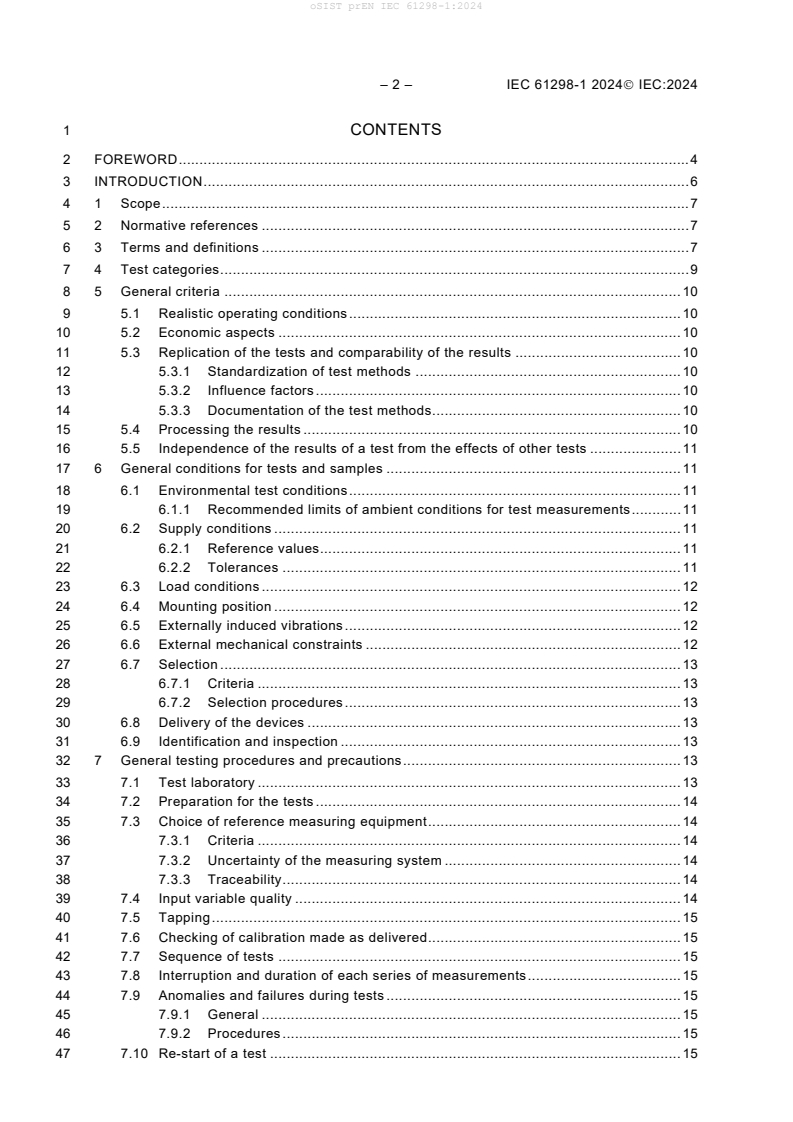
1 CONTENTS
2 FOREWORD . 4
3 INTRODUCTION . 6
4 1 Scope . 7
5 2 Normative references . 7
6 3 Terms and definitions . 7
7 4 Test categories . 9
8 5 General criteria . 10
9 5.1 Realistic operating conditions . 10
10 5.2 Economic aspects . 10
11 5.3 Replication of the tests and comparability of the results . 10
12 5.3.1 Standardization of test methods . 10
13 5.3.2 Influence factors . 10
14 5.3.3 Documentation of the test methods . 10
15 5.4 Processing the results . 10
16 5.5 Independence of the results of a test from the effects of other tests . 11
17 6 General conditions for tests and samples . 11
18 6.1 Environmental test conditions . 11
19 6.1.1 Recommended limits of ambient conditions for test measurements . 11
20 6.2 Supply conditions . 11
21 6.2.1 Reference values. 11
22 6.2.2 Tolerances . 11
23 6.3 Load conditions . 12
24 6.4 Mounting position . 12
25 6.5 Externally induced vibrations . 12
26 6.6 External mechanical constraints . 12
27 6.7 Selection . 13
28 6.7.1 Criteria . 13
29 6.7.2 Selection procedures . 13
30 6.8 Delivery of the devices . 13
31 6.9 Identification and inspection . 13
32 7 General testing procedures and precautions . 13
33 7.1 Test laboratory . 13
34 7.2 Preparation for the tests . 14
35 7.3 Choice of reference measuring equipment . 14
36 7.3.1 Criteria . 14
37 7.3.2 Uncertainty of the measuring system . 14
38 7.3.3 Traceability . 14
39 7.4 Input variable quality . 14
40 7.5 Tapping . 15
41 7.6 Checking of calibration made as delivered . 15
42 7.7 Sequence of tests . 15
43 7.8 Interruption and duration of each series of measurements . 15
44 7.9 Anomalies and failures during tests . 15
45 7.9.1 General . 15
46 7.9.2 Procedures . 15
47 7.10 Re-start of a test . 15
oSIST prEN IEC 61298-1:2024
61298-1 IEC:2024 – 3 –
48 7.11 Setting of adjustments . 16
49 7.12 Preconditioning . 16
50 7.12.1 Criteria . 16
51 7.12.2 Procedure . 16
52 7.13 Calibration adjustments of lower range value and span . 16
53 Constancy of the operating conditions and settings . 16
7.14
54 7.15 Input/output variable relationships . 16
55 7.15.1 Criteria . 16
56 7.15.2 Procedure . 16
57 7.16 Error assessment . 17
58 7.17 Symbols and units of measurement . 17
59 Test report and documentation . 17
7.18
oSIST prEN IEC 61298-1:2024
– 4 – IEC 61298-1 2024 IEC:2024
63 INTERNATIONAL ELECTROTECHNICAL COMMISSION
64 ____________
66 PROCESS MEASUREMENT AND CONTROL DEVICES –
67 GENERAL METHODS AND PROCEDURES FOR
68 EVALUATING PERFORMANCE –
70 Part 1: General considerations
73 FOREWORD
74 1) The International Electrotechnical Commission (IEC) is a worldwide organization for standardization comprising
75 all national electrotechnical committees (IEC National Committees). The object of IEC is to promote
76 international co-operation on all questions concerning standardization in the electrical and electronic fields. To
77 this end and in addition to other activities, IEC publishes International Standards, Technical Specifications,
78 Technical Reports, Publicly Available Specifications (PAS) and Guides (hereafter referred to as “IEC
79 Publication(s)”). Their preparation is entrusted to technical committees; any IEC National Committee interested
80 in the subject dealt with may participate in this preparatory work. International, governmental and non-
81 governmental organizations liaising with the IEC also participate in this preparation. IEC collaborates closely
82 with the International Organization for Standardization (ISO) in accordance with conditions determined by
83 agreement between the two organizations.
84 2) The formal decisions or agreements of IEC on technical matters express, as nearly as possible, an international
85 consensus of opinion on the relevant subjects since each technical committee has representation from all
86 interested IEC National Committees.
87 3) IEC Publications have the form of recommendations for international use and are accepted by IEC National
88 Committees in that sense. While all reasonable efforts are made to ensure that the technical content of IEC
89 Publications is accurate, IEC cannot be held responsible for the way in which they are used or for any
90 misinterpretation by any end user.
91 4) In order to promote international uniformity, IEC National Committees undertake to apply IEC Publications
92 transparently to the maximum extent possible in their national and regional publications. Any divergence
93 between any IEC Publication and the corresponding national or regional publication shall be clearly indicated in
94 the latter.
95 5) IEC provides no marking procedure to indicate its approval and cannot be rendered responsible for any
96 equipment declared to be in conformity with an IEC Publication.
97 6) All users should ensure that they have the latest edition of this publication.
98 7) No liability shall attach to IEC or its directors, employees, servants or agents including individual experts and
99 members of its technical committees and IEC National Committees for any personal injury, property damage or
100 other damage of any nature whatsoever, whether direct or indirect, or for costs (including legal fees) and
101 expenses arising out of the publication, use of, or reliance upon, this IEC Publication or any other IEC
102 Publications.
103 8) Attention is drawn to the Normative references cited in this publication. Use of the referenced publications is
104 indispensable for the correct application of this publication.
105 9) Attention is drawn to the possibility that some of the elements of this IEC Publication may be the subject of
106 patent rights. IEC shall not be held responsible for identifying any or all such patent rights.
107 International Standard IEC 61298-1 has been prepared by subcommittee 65B: Devices and
108 process analysis, of IEC technical committee 65: Industrial-process measurement, control and
109 automation.
110 This second edition cancels and replaces the first edition published in 1995 and constitutes a
111 technical revision.
112 This edition is a general revision with respect to the previous edition and does not include any
113 significant changes (see Introduction).
oSIST prEN IEC 61298-1:2024
61298-1 IEC:2024 – 5 –
115 The text of this standard is based on the following documents:
FDIS Report on voting
65B/685/FDIS 65B/693/RVD
117 Full information on the voting for the approval of this standard can be found in the report on
118 voting indicated in the above table.
119 This publication has been drafted in accordance with the ISO/IEC Directives, Part 2.
120 A list of all parts of the IEC 61298 series, under the general title Process measurement and
121 control devices – General methods and procedures for evaluating performance, can be found
122 on the IEC website.
123 The committee has decided that the contents of this publication will remain unchanged until
124 the maintenance result date indicated on the IEC web site under "http://webstore.iec.ch" in
125 the data related to the specific publication. At this date, the publication will be
126 • reconfirmed,
127 • withdrawn,
128 • replaced by a revised edition, or
129 • amended.
oSIST prEN IEC 61298-1:2024
– 6 – IEC 61298-1 2024 IEC:2024
132 INTRODUCTION
133 This standard is not intended as a substitute for existing standards, but is rather intended as a
134 reference document for any future standards developed within the IEC or other standards
135 organizations, concerning the evaluation of process instrumentation, except Process
136 Measurement Transmitters (PMT) which are standardized by IEC series 62828. .
137 This common standardized basis should be utilized for the preparation of future relevant
138 standards, as follows:
139 – any test method or procedure, already treated in this standard, should be specified and
140 described in the new standard by referring to the corresponding clause of this standard.
141 Consequently new editions of this standard are revised without any change in numbering
142 and scope of each clause;
143 – any particular method or procedure, not covered by this standard, should be developed
144 and specified in the new standard in accordance with the criteria, as far as they are
145 applicable, stated in this standard;
146 – any conceptual or significant deviation from the content of this standard, should clearly be
147 identified and justified if introduced in a new standard.
oSIST prEN IEC 61298-1:2024
61298-1 IEC:2024 – 7 –
151 PROCESS MEASUREMENT AND CONTROL DEVICES –
152 GENERAL METHODS AND PROCEDURES FOR
153 EVALUATING PERFORMANCE –
155 Part 1: General considerations
159 1 Scope
160 This part of IEC 61298 specifies general methods and procedures for conducting tests, and
161 reporting on the functional and performance characteristics of process instrumentation except
162 Process Measurement Transmitters (PMT) which are standardized by IEC series 62828. The
163 tests are applicable to any such devices characterized by their own specific input and output
164 variables, and by the specific relationship (transfer function) between the inputs and outputs,
165 and include analogue and digital devices. For devices that require special tests, this standard
166 should be used, together with any product specific standard specifying special tests.
167 This standard covers general principles which apply to the series.
168 2 Normative references
169 The following referenced documents are indispensable for the application of this document.
170 For dated references, only the edition cited applies. For undated references, the latest edition
171 of the referenced document (including any amendments) applies.
172 IEC 60050-300, International Electrotechnical Vocabulary (IEV) – Electrical and electronic
173 measurements and measuring instruments (composed of Part 311, 312, 313 and 314)
174 IEC 60050-351, International Electrotechnical Vocabulary (IEV) – Part 351: Control
175 technology
176 IEC 60410, Sampling plans and procedures for inspection by attributes
177 IEC 61298-2, Process measurement and control devices – General methods and procedures
178 for evaluating performance – Part 2: Tests under reference conditions
180 IEC 61298-3, Process measurement and control devices – General methods and procedures
181 for evaluating performance – Part 2: Tests for the effects of influence quantities
182 IEC 61298-4, Process measurement and control devices – General methods and procedures
183 for evaluating performance – Part 4: Evaluation report content
184 ISO/IEC 80000 (all parts), Quantities and units
185 3 Terms and definitions
186 For the purpose of this document, the following relevant terms and definitions, some of them
187 based on IEC 60050(300) or IEC 60050(351), apply.
oSIST prEN IEC 61298-1:2024
– 8 – IEC 61298-1 2024 IEC:2024
188 3.1 variable
189 quantity or condition whose value is subject to change and can usually be measured (e.g.,
190 temperature, flow rate, speed, signal, etc.)
191 [IEV 351-41-01, modified]
192 3.2
193 range
194 range of values defined by the two extreme values, within which a variable can be measured
195 within the specified accuracy
196 [IEV 311-03-14, modified]
197 3.3
198 span
199 algebraic difference between the values of the upper and lower limits of the measuring range
200 [IEV 311-03-13]
201 3.4
202 inaccuracy
203 maximum positive and negative deviation from the specified characteristic curve observed in
204 testing a device under specified conditions and by a specified procedure
205 NOTE Accuracy is defined in IEC 60050-300, definition 311-06-08.
206 3.5
207 error
208 algebraic difference between the indicated value and a comparison value of the measured
209 variable
210 [IEV 192-03-02, modified]
211 NOTE The error is positive when the indicated value is greater than the comparison value. The error is generally
212 expressed as a percentage of the relevant ideal span.
213 3.6
214 measured error
215 largest positive or negative value of errors of the average upscale or downscale values at
216 each point of measurement
217 3.7
218 non-linearity
219 deviation from linearity
220 NOTE 1 Linearity is defined in IEC 60050(300), definition 311-06-05.
221 NOTE 2 Non-linearity does not include hysteresis.
222 3.8
223 non-repeatability
224 deviation from repeatability
225 NOTE Repeatability is defined in IEC 60050(300), definition 311-06-06.
226 3.9
227 hysteresis
228 property of a device or instrument whereby it gives different output values in relation to its
229 input values depending on the directional sequence in which the input values have been
230 applied
oSIST prEN IEC 61298-1:2024
61298-1 IEC:2024 – 9 –
231 [IEV 351-45-16, modified]
233 3.10
234 dead band
235 finite range of values within which a variation of the input variable does not produce any
236 measurable change in the output variable
237 [IEV 351-45-15, modified]
238 3.11
239 unexpected event
240 device breakdown, failure to work, anomaly, or inadvertent damage occurring during an
241 evaluation, which requires correction by the device manufacturer
242 3.12
243 test procedure
244 statement of the tests to be carried out, and the conditions for each test, agreed between the
245 manufacturer, the test laboratory, and the purchaser/user before the evaluation starts
246 3.13
247 type tests
248 a test of one or more devices made to a certain design to show that the design meets certain
249 specifications
250 NOTE The type tests are in principle applied only on a sample. Normally are not repeated on all the individual
251 units of equipment made in series.
252 3.14
253 signal
254 physical quantity, one or more parameters of which carry information about one or more
255 variables which the signal represents
256 4 [IEV 351-41-17, modified]Test categories
257 The tests specified can be considered under two categories.
258 a) Complete tests
259 These cover performance evaluations or type tests to establish the performance of a device
260 under any likely operating conditions; to permit comparison with
...