

prEN IEC 63405:2026
(Main)High-voltage test techniques - Dielectric loss measurements "PROPOSED HORIZONTAL STANDARD"
General Information
- Abstract
- Status
- Not Published
- Publication Date
- 04-Oct-2027
- Technical Committee
- CLC/SR 42 - High-voltage testing techniques
- Drafting Committee
- IEC/TC 42 - IEC_TC_42
- Current Stage
- 4060 - Enquiry results established and sent to TC, SR, BTTF - Enquiry
- Start Date
- 05-Jun-2026
- Completion Date
- 05-Jun-2026

Overview
prEN IEC 63405:2026 - High-voltage test techniques: Dielectric loss measurements is a proposed horizontal standard developed by the International Electrotechnical Commission (IEC) and CLC. This international standard specifies general principles and requirements for the measurement of capacitance and dielectric loss at power frequency in electrical apparatus, components, and systems with highest voltages above 1 kV. Dielectric loss measurements play a central role in assessing the insulation condition of high-voltage equipment like capacitors, cables, transformers, bushings, switches, circuit breakers, and instrument transformers.
This standard supports consistency, traceability, and reliability for high-voltage dielectric loss measurements across various testing facilities, promoting harmonization and confidence in results worldwide.
Key Topics
Key topics addressed in prEN IEC 63405:2026 include:
Terminology and Definitions: Establishes a common vocabulary for dielectric measuring systems, insulation properties, measurement procedures, and system components (such as standard capacitors and measuring instruments).
Requirements for Measuring Systems: Outlines qualification, performance, calibration, and traceability requirements for dielectric measuring systems used in high-voltage test applications.
Test Procedures and Test Object Connections: Provides guidance for connecting test objects, selecting appropriate measurement methods, and ensuring proper testing conditions.
Types of Measurement Methods:
- Null methods using bridge circuits (e.g., Schering Bridge)
- Digital sampling methods for modern high-voltage measurement systems
Qualification and Performance: Specifies type and routine test schedules for standard capacitors and measuring instruments, ensuring accuracy and long-term stability.
Uncertainty and Traceability: Describes evaluation of uncertainty components in capacitance and dielectric dissipation factor measurements, supporting traceable and reliable test results.
Documentation: Emphasizes maintaining a detailed record of performance, including results of initial and periodic performance tests and checks.
Applications
The guidelines in prEN IEC 63405:2026 are applicable to:
Manufacturers of High-voltage Electrical Equipment: Ensuring that products such as capacitors, transformers, and switchgear meet international performance criteria.
Power Utilities and Grid Operators: Supporting regular maintenance, reliability assessments, and diagnostics of equipment insulation.
Testing and Inspection Laboratories: Standardizing procedures for high-voltage calibration, measurements, and reporting, and supporting third-party certification.
Academic and Research Institutions: Providing a reference for education, research, and development activities focused on dielectric properties and high-voltage testing.
By following this standard, organizations can improve the reliability of insulation diagnostics, minimize equipment failures, and comply with industry best practices for high-voltage measurements.
Related Standards
prEN IEC 63405:2026 references and complements several key international standards, including:
- IEC 60060-1: High-voltage test techniques - Part 1: General definitions and test requirements
- IEC 60060-2: High-voltage test techniques - Part 2: Measuring systems
- ISO/IEC Guide 98-3:2008: Uncertainty of measurement (Guide to the expression of uncertainty in measurement - GUM)
Other relevant standards for high-voltage test techniques and dielectric measurements may apply, depending on specific national or industry requirements.
Keywords: dielectric loss measurement, high-voltage test techniques, capacitance measurement, dielectric dissipation factor, insulation testing, calibration, uncertainty, IEC 63405, electrical equipment testing, standard capacitor, power transformers, instrument transformers, switchgear testing, IEC standards.
Frequently Asked Questions
prEN IEC 63405:2026 is a draft published by CLC. Its full title is "High-voltage test techniques - Dielectric loss measurements "PROPOSED HORIZONTAL STANDARD"". This standard covers: High-voltage test techniques - Dielectric loss measurements "PROPOSED HORIZONTAL STANDARD"
High-voltage test techniques - Dielectric loss measurements "PROPOSED HORIZONTAL STANDARD"
prEN IEC 63405:2026 is available in PDF format for immediate download after purchase. The document can be added to your cart and obtained through the secure checkout process. Digital delivery ensures instant access to the complete standard document.
Standards Content (Sample)
SLOVENSKI STANDARD
01-maj-2026
Visokonapetostne preskusne tehnike - Meritve dielektičnih izgub "predlagan
horizontalni standard"
High-voltage test techniques - Dielectric loss measurements "PROPOSED
HORIZONTAL STANDARD"
Techniques des essais à haute tension - Mesurages des pertes diélectriques "NORME
HORIZONTALE PROPOSÉE"
Ta slovenski standard je istoveten z: prEN IEC 63405:2026
ICS:
19.080 Električno in elektronsko Electrical and electronic
preskušanje testing
2003-01.Slovenski inštitut za standardizacijo. Razmnoževanje celote ali delov tega standarda ni dovoljeno.
42/473/CDV
COMMITTEE DRAFT FOR VOTE (CDV)
PROJECT NUMBER:
IEC 63405 ED1
DATE OF CIRCULATION: CLOSING DATE FOR VOTING:
2026-03-13 2026-06-05
SUPERSEDES DOCUMENTS:
42/461/CD, 42/470/CC
IEC TC 42 : HIGH-VOLTAGE AND HIGH-CURRENT TEST TECHNIQUES
SECRETARIAT: SECRETARY:
Canada Mr Howard G. Sedding
OF INTEREST TO THE FOLLOWING COMMITTEES: HORIZONTAL FUNCTION(S):
TC 2,TC 14,TC 17,SC 17A,SC 17C,SC 18A,TC 20,TC 23,TC
32,TC 36,TC 37,TC 112,TC 122
ASPECTS CONCERNED:
SUBMITTED FOR CENELEC PARALLEL VOTING NOT SUBMITTED FOR CENELEC PARALLEL VOTING
Attention IEC-CENELEC parallel voting
The attention of IEC National Committees, members of
CENELEC, is drawn to the fact that this Committee Draft for
Vote (CDV) is submitted for parallel voting.
The CENELEC members are invited to vote through the
CENELEC online voting system.
This document is still under study and subject to change. It should not be used for reference purposes.
Recipients of this document are invited to submit, with their comments, notification of any relevant patent rights of which
they are aware and to provide supporting documentation.
Recipients of this document are invited to submit, with their comments, notification of any relevant “In Some Countries”
clauses to be included should this proposal proceed. Recipients are reminded that the CDV stage is the final stage for
submitting ISC clauses. (SEE AC/22/2007 OR NEW GUIDANCE DOC).
TITLE:
High-voltage test techniques - Dielectric loss measurements "PROPOSED HORIZONTAL STANDARD"
PROPOSED STABILITY DATE: 2028
NOTE FROM TC/SC OFFICERS:
electronic file, to make a copy and to print out the content for the sole purpose of preparing National Committee positions.
You may not copy or "mirror" the file or printed version of the document, or any part of it, for any other purpose without
permission in writing from IEC.
IEC CDV 63405 © IEC 2026
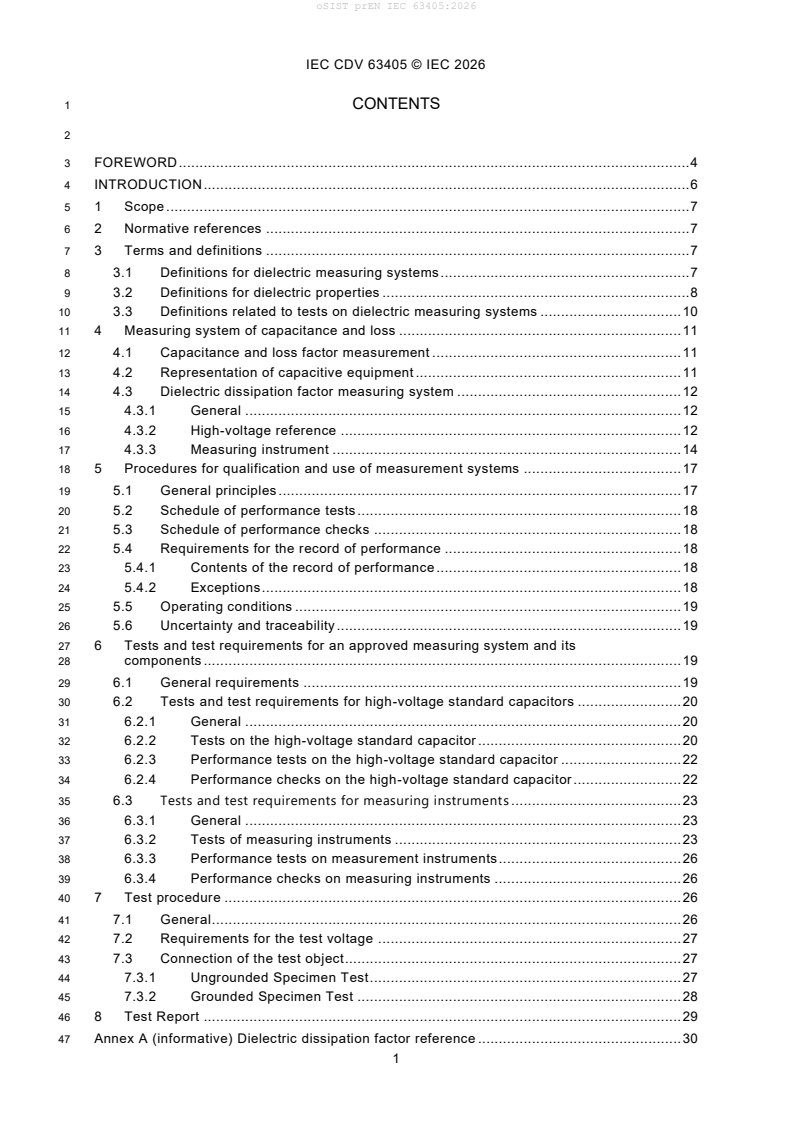
1 CONTENTS
3 FOREWORD . 4
4 INTRODUCTION . 6
5 1 Scope . 7
6 2 Normative references . 7
7 3 Terms and definitions . 7
8 3.1 Definitions for dielectric measuring systems . 7
9 3.2 Definitions for dielectric properties . 8
10 3.3 Definitions related to tests on dielectric measuring systems . 10
11 4 Measuring system of capacitance and loss . 11
12 4.1 Capacitance and loss factor measurement . 11
13 4.2 Representation of capacitive equipment . 11
14 4.3 Dielectric dissipation factor measuring system . 12
15 4.3.1 General . 12
16 4.3.2 High-voltage reference . 12
17 4.3.3 Measuring instrument . 14
18 5 Procedures for qualification and use of measurement systems . 17
19 5.1 General principles . 17
20 5.2 Schedule of performance tests . 18
21 5.3 Schedule of performance checks . 18
22 5.4 Requirements for the record of performance . 18
23 5.4.1 Contents of the record of performance . 18
24 5.4.2 Exceptions . 18
25 5.5 Operating conditions . 19
26 5.6 Uncertainty and traceability . 19
27 6 Tests and test requirements for an approved measuring system and its
28 components . 19
29 6.1 General requirements . 19
30 6.2 Tests and test requirements for high-voltage standard capacitors . 20
31 6.2.1 General . 20
32 6.2.2 Tests on the high-voltage standard capacitor . 20
33 6.2.3 Performance tests on the high-voltage standard capacitor . 22
34 6.2.4 Performance checks on the high-voltage standard capacitor . 22
35 6.3 Tests and test requirements for measuring instruments . 23
36 6.3.1 General . 23
37 6.3.2 Tests of measuring instruments . 23
38 6.3.3 Performance tests on measurement instruments . 26
39 6.3.4 Performance checks on measuring instruments . 26
40 7 Test procedure . 26
41 7.1 General . 26
42 7.2 Requirements for the test voltage . 27
43 7.3 Connection of the test object . 27
44 7.3.1 Ungrounded Specimen Test . 27
45 7.3.2 Grounded Specimen Test . 28
46 8 Test Report . 29
47 Annex A (informative) Dielectric dissipation factor reference . 30
IEC CDV 63405 © IEC 2026
48 Annex B (informative) Example for measurement uncertainty of capacitance and
49 dielectric dissipation factor of a high-voltage standard capacitor . 32
50 B.1 Purpose . 32
51 B.2 Measurement model. 32
52 B.3 Sensitivity coefficient . 33
53 B.4 Description of each uncertainty component input . 33
54 B.4.1 Uncertainty component input u(x ) . 33
1in
55 B.4.2 Uncertainty component input u(x ) . 34
2in
56 B.4.3 Uncertainty component input u(x ) . 34
3in
57 B.4.4 Uncertainty component input u(x ) . 34
4in
58 B.4.5 Uncertainty component input u(x ) . 34
5in
59 B.4.6 Uncertainty component input u(x ) . 34
6in
60 B.4.7 Uncertainty component input u(d ) . 34
1in
61 B.4.8 Uncertainty component input u(d ) . 34
2in
62 B.4.9 Uncertainty component input u(d ) . 35
3in
63 B.4.10 Uncertainty component input u(d ) . 35
4in
64 B.4.11 Uncertainty component input u(d ) . 35
5in
65 B.4.12 Uncertainty component input u(d ) . 35
6in
66 B.5 Summary of all uncertainty components . 35
67 B.6 Expression of expanded uncertainty of measurement results . 37
68 B.6.1 Capacitance Measurement Results . 37
69 B.6.2 Dielectric Dissipation Factor Measurement Results . 37
70 Annex C (Informative) Example for measuring dielectric dissipation factor with UST . 38
71 C.1 General . 38
72 C.2 Test Object . 38
73 C.3 Preparation . 38
74 C.4 Test Procedure . 38
75 C.5 Test Results . 39
76 Annex D (Informative) Example for measuring dielectric dissipation factor with GST . 40
77 D.1 General . 40
78 D.2 Test Object . 40
79 D.3 Preparation . 40
80 D.4 Test Procedure . 40
81 D.5 Test Results . 41
82 Bibliography . 42
84 Figure 1 – Vector diagram for a test object showing the voltage and current vectors. 11
85 Figure 2 – Series equivalent representation and parallel representation of a
86 capacitive equipment . 12
87 Figure 3 – Coaxial electrode type high-voltage standard capacitor . 13
88 Figure 4 – Typical circuit diagram for a Schering Bridge . 15
89 Figure 5 – Typical circuit diagram for a transformer ratio-arm bridge with manual
90 adjustment . 16
91 Figure 6 – Typical circuit diagrams of digital sampling equipment . 17
92 Figure 7 – Test circuit for calibration of the high-voltage bridge . 24
IEC CDV 63405 © IEC 2026
93 Figure 8 – circuit diagram based on the low-voltage conductivity method for
94 Dielectric dissipation factor calibration . 24
95 Figure 9 – circuit diagram for calibration of the instruments with built-in high-voltage
96 power supply . 25
97 Figure 10 – An example circuit diagram for device of performance check . 26
98 Figure 11 –Typical circuit diagram using impedance ratio-arm bridge for Ungrounded
99 Specimen Test . 28
100 Figure 12 – Typical circuit diagram using digital sampling instruments for
101 Ungrounded Specimen Test . 28
102 Figure 13 –Typical circuit diagram using digital sampling instrument for grounded
103 Specimen Test . 29
104 Figure A.1 – Structural diagram of dielectric dissipation factor reference . 30
105 Figure C.1 Test circuit for measuring tanδ of the main insulation of the wall bushing
106 with UST method . 38
107 Figure D.1 Test circuit for measuring tanδ of the end screen of the wall bushing with
108 GST method . 40
110 Table 1 – Tests for qualification of a high-voltage standard capacitor . 20
111 Table 2 – Tests required for approved measurement instruments . 23
112 Table B.1 –The results of 10 times measurements . 33
113 Table B.2 – uncertainty components for capacitance . 37
114 Table C.1 – Test Results of the main insulation of the wall bushing with UST . 39
115 Table D.1 –Test Results of the end screen of the wall bushing with GST . 41
IEC CDV 63405 © IEC 2026
118 CAPACITANCE AND DIELECTRIC LOSS MEASUREMENTS
119 ____________
121 HIGH-VOLTAGE TEST TECHNIQUES – CAPACITANCE AND DIELECTRIC
122 LOSS MEASUREMENTS
124 FOREWORD
125 1) The International Electrotechnical Commission (IEC) is a worldwide organization for standardization comprising
126 all national electrotechnical committees (IEC National Committees). The object of IEC is to promote international
127 co-operation on all questions concerning standardization in the electrical and electronic fields. To this end and
128 in addition to other activities, IEC publishes International Standards, Technical Specifications, Technical Reports,
129 Publicly Available Specifications (PAS) and Guides (hereafter referred to as "IEC Publication(s)"). Their
130 preparation is entrusted to technical committees; any IEC National Committee interested in the subject dealt with
131 may participate in this preparatory work. International, governmental and non-governmental organizations liaising
132 with the IEC also participate in this preparation. IEC collaborates closely with the International Organization for
133 Standardization (ISO) in accordance with conditions determined by agreement between the two organizations.
134 2) The formal decisions or agreements of IEC on technical matters express, as nearly as possible, an international
135 consensus of opinion on the relevant subjects since each technical committee has representation from all
136 interested IEC National Committees.
137 3) IEC Publications have the form of recommendations for international use and are accepted by IEC National
138 Committees in that sense. While all reasonable efforts are made to ensure that the technical content of IEC
139 Publications is accurate, IEC cannot be held responsible for the way in which they are used or for any
140 misinterpretation by any end user.
141 4) In order to promote international uniformity, IEC National Committees undertake to apply IEC Publications
142 transparently to the maximum extent possible in their national and regional publications. Any divergence between
143 any IEC Publication and the corresponding national or regional publication shall be clearly indicated in the latter.
144 5) IEC itself does not provide any attestation of conformity. Independent certification bodies provide conformity
145 assessment services and, in some areas, access to IEC marks of conformity. IEC is not responsible for any
146 services carried out by independent certification bodies.
147 6) All users should ensure that they have the latest edition of this publication.
148 7) No liability shall attach to IEC or its directors, employees, servants or agents including individual experts and
149 members of its technical committees and IEC National Committees for any personal injury, property damage or
150 other damage of any nature whatsoever, whether direct or indirect, or for costs (including legal fees) and
151 expenses arising out of the publication, use of, or reliance upon, this IEC Publication or any other IEC
152 Publications.
153 8) Attention is drawn to the Normative references cited in this publication. Use of the referenced publications is
154 indispensable for the correct application of this publication.
155 9) IEC draws attention to the possibility that the implementation of this document may involve the use of (a)
156 patent(s). IEC takes no position concerning the evidence, validity or applicability of any claimed patent rights in
157 respect thereof. As of the date of publication of this document, IEC had not received notice of patents, which may
158 be required to implement this document. However, implementers are cautioned that this may not represent the
159 latest information, which may be obtained from the patent database available at https://patents.iec.ch or
160 www.iso.org/patents. IEC shall not be held responsible for identifying any or all such patent rights.
161 IEC 63405 has been prepared by working group WG24: High-voltage test techniques - Dielectric
162 loss measurements, of IEC technical committee 42: High-voltage and high-current test
163 techniques. It is an International Standard.
164 The text of this International Standard is based on the following documents:
Draft Report on voting
XX/XX/FDIS XX/XX/RVD
166 Full information on the voting for its approval can be found in the report on voting indicated in
167 the above table.
168 The language used for the development of this International Standard is English.
169 This document was drafted in accordance with ISO/IEC Directives, Part 2, and developed in
170 accordance with ISO/IEC Directives, Part 1 and ISO/IEC Directives, IEC Supplement, [and the
171 ISO/IEC Directives, JTC 1 Supplement] available at www.iec.ch/members_experts/refdocs. The
IEC CDV 63405 © IEC 2026
172 main document types developed by IEC are described in greater detail at
173 www.iec.ch/publications.
174 The committee has decided that the contents of this document will remain unchanged until the
175 stability date indicated on the IEC website under webstore.iec.ch in the data related to the
176 specific document. At this date, the document will be
177 • reconfirmed,
178 • withdrawn,
179 • replaced by a revised edition, or
180 • amended.
IEC CDV 63405 © IEC 2026
182 INTRODUCTION
183 The electric power industry requires standardized tools to provide confidence in the
184 measurement of capacitance and dielectric loss, and to prove equivalence between tests
185 performed in different test facilities.
186 The measurement of capacitance and dielectric loss are effective methods to determine the
187 insulation status of electrical equipment. Capacitance and dielectric loss measurement are
188 widely used in electrical equipment manufacturers, power grid companies, colleges and
189 universities, testing and inspection institutions and other units. IEC 63405 specifies the general
190 principles and requirements for the measurement of capacitance and dielectric loss.
191 The procedures of Clause 5 have been modelled on IEC 60060-2:2025, Clause 4.
IEC CDV 63405 © IEC 2026
193 HIGH-VOLTAGE TEST TECHNIQUES ─ CAPACITANCE AND DIELECTRIC
194 LOSS MEASUREMENTS
199 1 Scope
200 This document of IEC 63405 is applicable to the measurement of capacitance and dielectric
201 loss at power frequency for electrical apparatus, components, or systems, with the highest
202 voltage for equipment U above 1 kV.
m
203 This document
204 - defines the terms used
205 - suggests methods of test
206 - suggests test object connections
207 - provides possible test procedures
208 - provides guidance on requirements of calibration
209 This document is primarily concerned with capacitance and dielectric loss measurements for
210 electrical equipment, such as capacitors, cables, power transformers, bushings, switches,
211 circuit breakers, and instrument transformers. The tests of insulation materials (solid, liquid,
212 gas, etc.) or power electronics components are NOT included in this standard.
213 2 Normative references
214 The following documents are referred to in the text in such a way that some or all of their content
215 constitutes requirements of this document. For dated references, only the edition cited applies.
216 For undated references, the latest edition of the referenced document (including any
217 amendments) applies.
218 IEC 60060-1, High-voltage test techniques – Part 1: General definitions and test requirements
219 IEC 60060-2, High-voltage test techniques – Part 2: Measuring systems
220 ISO/IEC Guide 98-3:2008, Uncertainty of measurement – Part 3: Guide to the expression of
221 Uncertainty in measurements (GUM: 1995)
222 3 Terms and definitions
223 For the purposes of this document, the following terms and definitions apply.
224 ISO and IEC maintain terminology databases for use in standardization at the following
225 addresses:
226 • IEC Electropedia: available at https://www.electropedia.org/
227 • ISO Online browsing platform: available at https://www.iso.org/obp
228 3.1 Definitions for dielectric measuring systems
229 3.1.1
230 dielectric measuring system
231 complete set of devices suitable for performing a dielectric measurement
232 Note 1 to entry: A dielectric measuring system usually comprises the following components:
233 – a converting device with the leads required for connecting this device to the test object or into the circuit and the
234 connections to earth;
IEC CDV 63405 © IEC 2026
235 – a transmission system connecting the output terminals of the converting device to the measuring instruments with
236 its attenuating, terminating and adapting impedances or networks;
237 – a measuring instrument together with any connection to the power supply;
238 – and in some cases, the measuring system can include software to calculate the measured value.
239 3.1.2
240 record of performance
241 detailed record, established and maintained by the user, describing the dielectric measuring
242 system and containing evidence that the requirements given in this standard have been met
243 Note 1 to entry: This evidence includes the results of the initial performance test and the schedule and results of
244 each subsequent performance test and performance check.
245 [SOURCE: IEC 60060-2:2025, term 3.1.2]
246 3.1.3
247 approved dielectric measuring system
248 dielectric measuring system that is shown to comply with one or more of the sets of
249 requirements in this document
250 3.1.4
251 reference dielectric measuring system
252 dielectric measuring system with its calibration traceable to relevant national or international
253 standards of measurement, and having sufficient accuracy and stability for use in the approval
254 of other systems by making simultaneous comparative measurements with specific types of
255 waveform and ranges of voltage
256 Note 1 to entry: A reference dielectric measuring system (maintained according to the requirements of this
257 standard) can be used as an approved dielectric measuring system but the converse is not true.
258 3.1.5
259 scale factor
260 factor by which the value of the measuring-instrument
261 reading is multiplied to obtain the value of the input quantity of the complete dielectric
262 measuring system
263 Note 1 to entry: A dielectric measuring system can have multiple scale factors for different assigned measurement
264 ranges, frequency ranges or waveforms.
265 Note 2 to entry: For dielectric measuring systems that display the value of the input quantity directly, the nominal
266 scale factor of the dielectric measuring system is unity.
267 [SOURCE: IEC 60060-2:2025, term 3.3.1]
268 3.2 Definitions for dielectric properties
269 3.2.1
270 electric constant
271 permittivity of vacuum
273 scalar constant linking the electric quantities and the mechanical quantities, obtained from the
274 relation
1 QQ
ε=
(1)
0 2
4πF
r
275 based on Coulomb's law in a vacuum, where F is the magnitude of the force between two
276 particles with electric charges Q and Q respectively, placed at a distance r apart.
1 2
E
277 Note 1 to entry: In a vacuum, the product of the electric constant and the electric field vector is equal to
D : D = E
278 the electric flux density vector .
279 Note 2 to entry: The electric constant is related to the magnetic permeability of vacuum and to the speed
0 0
280 of light in vacuum c by the relation c =1.
0 0 0 0
IEC CDV 63405 © IEC 2026
-12
281 Note 3 to entry: The value of the electric constant is equal to .
8,8541878128(13) 10 As / (V m)
282 [SOURCE: IEC 60050-121:2021, 121-11-03]
283 3.2.2
284 absolute permittivity
285 permittivity
286 scalar quantity or tensor quantity, the product of which by the electric field strength E in a
287 medium is equal to the electric flux density D:
DE=
(2)
288 Note 1 to entry: For an isotropic medium, the absolute permittivity is a scalar quantity; for an anisotropic medium,
289 it is a tensor quantity.
290 [SOURCE: IEC 60050-121:2021, 121-12-12]
291 3.2.3
292 relative permittivity
r
293 scalar quantity or tensor quantity equal to the absolute permittivity divided by the electric
294 constant
295 Note 1 to entry: For an isotropic medium, the relative permittivity is a scalar quantity; for an anisotropic medium, it
296 is a tensor quantity.
297 Note 2 to entry: In the case of constant fields and alternating fields of sufficiently low frequency, the relative
298 permittivity of an isotropic or quasi-isotropic dielectric is equal to the ratio of the capacitance of a capacitor, in which
299 the space between and around the electrodes is entirely and exclusively filled with the dielectric medium, to the
300 capacitance of the same configuration of electrodes in vacuum. However, this use is not recommended.
301 Note 3 to entry: In practical engineering, it is usual to employ the term "permittivity" when referring to relative
302 permittivity, but this use is deprecated since "permittivity" is a synonym for "absolute permittivity".
303 [SOURCE: IEC 60050-121:2021, 121-12-13]
304 3.2.4
r
305 complex relative permittivity
306 under sinusoidal conditions in a medium where the phasors D and E representing respectively
307 the electric flux density vector and the electric field vector are linearly related, complex quantity
308 defined by the relation
r
DE=
(3)
0r
309 where
310 Ɛ is the electric constant
311 Note 1 to entry: The complex relative permittivity is generally frequency dependent. For an isotropic medium, the
312 complex relative permittivity is a scalar quantity; for an anisotropic medium, it is a tensor quantity.
' '' ’ ”
Note 2 to entry: Generally, Ɛ is expressed as =− j where Ɛ is the real relative permittivity and Ɛ is the
r rr
r r r
dielectric loss index, which represents dielectric losses.
315 [SOURCE: IEC 60050-121:2021, 121-12-14]
316 3.2.5
317 dielectric loss
318 power absorbed from a time-varying electric field by a polarised substance, excluding absorbed
319 power due to conductivity of the substance
320 Note 1 to entry: The dielectric loss is usually dissipated as heat.
321 Note 2 to entry: In 60050-121 dielectric loss is defined as power absorbed from a time-varying electric field by a
322 polarized substance, excluding absorbed power due to the conductivity of the substance. In practice the loss due to
323 the conduction current in the dielectric is usually included in the dielectric loss.
324 [SOURCE: IEC 60050-212:2010, 212-11-27]
IEC CDV 63405 © IEC 2026
325 3.2.6
326 dielectric dissipation factor
327 tan δ
328 loss tangent
329 absolute value of the ratio of the imaginary to the real parts of the complex relative permittivity
''
ε
r
tan δ =
(4)
'
ε
r
330 Note 1 to entry: The dielectric dissipation factor is equal to the tangent of the dielectric loss angle.
331 Note 2 to entry: In English the abbreviation DDF is sometimes used to characterize the dielectric loss in insulating
332 materials.
333 [SOURCE: IEC 60050-212:2010, 212-11-29]
334 3.2.7
335 capacitance
336 C
337 for a capacitive two-terminal element with terminals A and B, quotient of the electric charge at
338 A or B by the voltage u between the terminals
AB
q
C=
(5)
u
AB
339 where the sign of the electric charge is determined by taking the electric current in the time
340 integral defining this charge as positive if its direction is from A to B and negative if its direction
341 is from B to A
342 Note 1 to entry: A capacitance cannot be negative.
343 Note 2 to entry: The coherent SI unit of capacitance is farad, F
344 [SOURCE: IEC 60050-131:2013, 131-12-13]
345 3.3 Definitions related to tests on dielectric measuring systems
346 3.3.1
347 calibration
348 set of operations that establishes, by reference to standards, the relationship which exists,
349 under specified conditions, between an indication and a result of a measurement
350 Note 1 to entry: The determination of the scale factor is included in the calibration.
351 [SOURCE: IEC 60050-311:2001, 311-01-09, modified – Notes 1 and 2 replaced by Note 1.]
352 3.3.2
353 type test
354 conformity test made on one or more items representative of the production
355 Note 1 to entry: For a dielectric measuring system, this is understood as a test performed on a component or on a
356 complete dielectric measuring system of the same design to characterise it under operating conditions.
357 [SOURCE: IEC 60050-151:2001, 151-16-16, modified – Note 1 has been added]
358 3.3.3
359 routine test
360 conformity test made on each individual item during or after manufacture
361 Note 1 to entry: This is understood as a test performed on each component or on each complete dielectric
362 measuring system to characterise it under operating conditions.
363 [SOURCE: IEC 60050-151:2001, 151-16-17, modified – Note 1 has been added]
IEC CDV 63405 © IEC 2026
364 3.3.4
365 performance test
366 test performed on a complete dielectric measuring system to characterise it under operating
367 conditions
368 [SOURCE: IEC 60060-2:2025, term 3.7.4]
369 3.3.5
370 performance check
371 simple procedure to ensure that the result of the most recent performance test is still valid
372 Note 1 to entry: The determination of the scale factor is included in the calibration.
373 [SOURCE: IEC 60060-2:2025, term 3.7.5]
374 4 Measuring system of capacitance and loss
375 4.1 Capacitance and loss factor measurement
376 The loss expressed as dielectric dissipation factor is an important indicator reflecting the
377 insulation status of high-voltage electrical apparatus, components, or systems.
378 As shown in Figure 1, the test voltage u is applied across the test object, and the total current
379 i flowing through the test object can be decomposed into a current component i (orthogonal to
C
380 the phase of the test voltage u ) and a current component i (in the same direction as the test
R
381 voltage u). Then, the dielectric dissipation factor can be expressed as
i
R
tan δ =
(6)
i
C
i
δ
i
C
i u
R
383 Key
384 u Test voltage
385 i Test current
386 i Active component of test current
R
387 i Reactive component of test current
C
388 Figure 1 – Vector diagram for a test object showing the voltage and current vectors
389 4.2 Representation of capacitive equipment
390 The dielectric dissipation factor can also be expressed by an equivalent circuit diagram using
391 an ideal capacitor with a resistor in series or parallel connection ( See Figure 2).
392 NOTE This model is only valid at a single frequency; indeed, it is often found that the dielectric dissipation factor
393 only changes marginally over a narrow range of power frequencies.
IEC CDV 63405 © IEC 2026
394 A capacitor with losses can be represented at any single angular frequency ω=f2π either by
395 capacitance C and resistance R in series, or by capacitance and resistance in
C R
s s p p
396 parallel.
tan δ =
tan δ =ωCR
ss
ωCR
pp
C
p
C R
s s
R
p
397 Figure 2 – Series equivalent representation and parallel representation of a capacitive
398 equipment
399 NOTE For the test of high-voltage electrical apparatus, components, or systems, tan δ is usually a small number,
400 thus tan δ ≈ δ.
401 Between the series components and the parallel components, the following relations hold:
C
s
C=
(7)
p
1+ tan δ
R = R (1+ )
(8)
ps
tan δ
tan δ =ωCR =
ss (9)
ωCR
pp
402 It is recommended to identify which representation that is reported.
403 4.3 Dielectric dissipation factor measuring system
404 4.3.1 General
405 A dielectric dissipation factor measurement system can be divided into subsystems: high -
406 voltage reference (for example, high-voltage standard capacitor) and measuring instruments.
407 4.3.2 High-voltage reference
408 4.3.2.1 General
409 In a dielectric measuring system, the high-voltage reference shall be a high-voltage standard
410 capacitor.
411 4.3.2.2 High-voltage standard capacitor
412 A high-voltage standard capacitor can for example be constructed with coaxial electrodes. Such
413 a structure is shown schematically in Figure 3.
IEC CDV 63405 © IEC 2026
1(high-voltage electrode)
2(measuring electrode-main capacitance C )
3(screening electrode-additional capacitance C )
4(grounding electrode-additional capacitance C )
415 Key
416 1 high-voltage electrode
417 2 measuring electrode-main capacitance C
418 3 screening electrode-additional capacitance C
419 4 grounding electrode-additional capacitance C
420 Figure 3 – Coaxial electrode type high-voltage standard capacitor
421 The given diagram does not represent the actual structure and details of the capacitor. It is for
422 illustration only.
423 Essential parameters of high-voltage standard capacitor are:
424 • Capacitance value
425 • Dielectric dissipation factor
426 Contributions to uncertainty of capacitance and dielectric dissipation factor shall include
427 evaluation of:
428 • Uncertainty of calibration
429 • Voltage dependence
430 • Short-term stability
431 • Long-term stability
432 • Ambient temperature effect
433 For type and routine tests, the calibrations should be performed for the intended range of
434 operating voltages.
435 NOTE 1 International availability of traceable calibration of dielectric dissipation factor at power frequency is
436 discussed in bibliographical reference [1].
437 NOTE 2 Methods to determine voltage dependence of high-voltage capacitors is discussed in bibliographical
438 references [2,3].
439 NOTE 3 Gas pressure in a capacitor insulated with pressurised gas will lead to a slight change of capacitance if
440 the amount of gas changes, e.g. due to leakage. Temperature change will also change the capacitance, although
441 this is thought to be caused by change of mechanical dimensions caused by thermal expansion of different materials.
IEC CDV 63405 © IEC 2026
442 4.3.3 Measuring instrument
443 4.3.3.1 General
444 Methods for measuring the capacitance and dielectric dissipation factor can be characterised
445 as null methods or digital sampling methods.
446 In the null methods, measurements of capacitance and dielectric dissipation factor are made in
447 a bridge circuit by means of balancing the arms of the network to achieve identical ratios in the
448 two arms. The values of capacitance and dielectric dissipation factor are obtained by utilizing
449 knowledge of the value of high-voltage standard capacitor and bridge elements. Commonly
450 used networks are the Schering bridge and the transformer bridge (i.e., a bridge with ratio arms
451 coupled by mutual inductance). Both bridge types require a null indicator to identify the
452 balanced condition.
453 In the digital sampling methods, a digital comparison is made between applied test voltage and
454 current through the device under test. Test voltage can be recorded either by measuring the
455 output of a voltage divider or by measuring the current through a high-voltage reference. Since
456 sampling instruments in general have voltage input, any current needs to be converted to a
457 voltage, e.g. with precision current shunt before being applied to the sampling system.
458 For both types of methods, a well characterised high-voltage reference is crucial.
459 A capacitance bridge can be designed to provide the result of capacitance and dissipation factor
460 either as a series or as a parallel representation. There are even measuring instruments that
461 can be set to supply either representation. For example, a Schering bridge such as depicted in
462 Figure 4 gives the result as a series representation, whereas the transformer ratio arm bridge
463 of Figure 5 gives the result as a parallel representation.
464 For test objects with high capacitance, external ratio devices as for example current
465 comparators can be needed.
466 4.3.3.2 Null methods (High-voltage capacitance bridge)
467 4.3.3.2.1 Impedance ratio-arm bridge
468 The impedance ratio-arm bridge is based on balancing the ratios on its arms using resistors
469 and capacitors, with the unknown impedance C and R forming one half-arm. The ratio of
x x
470 capacitance and the dielectric dissipation factor can be calculated from the bridge balance.
471 Schering Bridge is a typical impedance ratio-arm bridge (see Figure 4).
472 It should be noted that the bridge diagonal AB is at non-zero potential, which can result in
473 measuring errors unless compensated for. For example, manual or automatic adjustment shield
474 voltage to be equal to potential of the diagonal AB.
475 The performance of the impedance ratio-arm bridge depends on the performance and accuracy
476 of the null indicator.
R
x
C C
x s
NI
U
C
R
R
E
Key
IEC CDV 63405 © IEC 2026
Components
U Power Supply NI Null-indicator
C Device under test R Low-voltage arm resistor
x 3
R Equivalent parallel resistance of C R Low-voltage arm resistor
x x 4
C High-voltage standard capacitor C Low-voltage arm capacitor for dielectric
S 4
dissipation factor balance
E Terminal connected to earth
478 Figure 4 – Typical circuit diagram for a Schering Bridge
479 Essential parameters of Impedance ratio-arm bridge are:
480 • Capacitance and dielectric dissipation factor of C
s
481 • Resistance and residual inductance (or resistor time constant) of resistors R and R
3 4
482 Capacitance of C
•
483 Contributions to uncertainty of values of component of the bridge shall include evaluation of:
484 • Uncertainty of calibration
485 • Short-term stability
486 • Long-term stability
487 • Influence from ambient temperature
488 NOTE 1 The capacitance value of the device under test can be calculated by the ratio of capacitance if the
489 capacitance value of the high-voltage reference value is given.
490 NOTE 2 Determination of propagation of uncertainties is complex but can be aided by use of software such as GUM
491 Workbench.
492 NOTE 3 The depiction in Figure 4 of the unknown impedance as a parallel connection of a capacitor and resistor is
493 only relevant at a single frequency. It does however emphasise that the Schering bridge operates in series equivalent
494 circuit mode.
495 4.3.3.2.2 Transformer ratio-arm bridge
496 The transformer ratio-arm bridge is a bridge based on balancing ampere-turns in reference and
497 test object branches by changing the number of turns to achieve a zero magnetic flux condition
498 in the transformer. The zero-flux condition can be sensed with sense winding. Balance for
499 dielectric dissipation factor is achieved by injecting a current that is 90º out-of-phase. The ratio
500 of test object capacitance to high-voltage reference value is found from the turns ratio of the
501 bridge. The dielectric dissipation factor can be calculated from the bridge out-of-phase balance.
502 Many such bridges are, however, designed to be direct reading.
503 A transformer ratio arm bridge can be either manually balanced or be automatically balanced.
504 A typical circuit diagram for a transformer ratio-arm bridge with manual adjustment is shown in
505 Figure 5.
506 A typical transformer ratio-arm bridge cannot perform higher than 1 kHz.
IEC CDV 63405 © IEC 2026
C
C s
x
N
d
N N
s
x
U
...