

EN 60512-19-3:1997
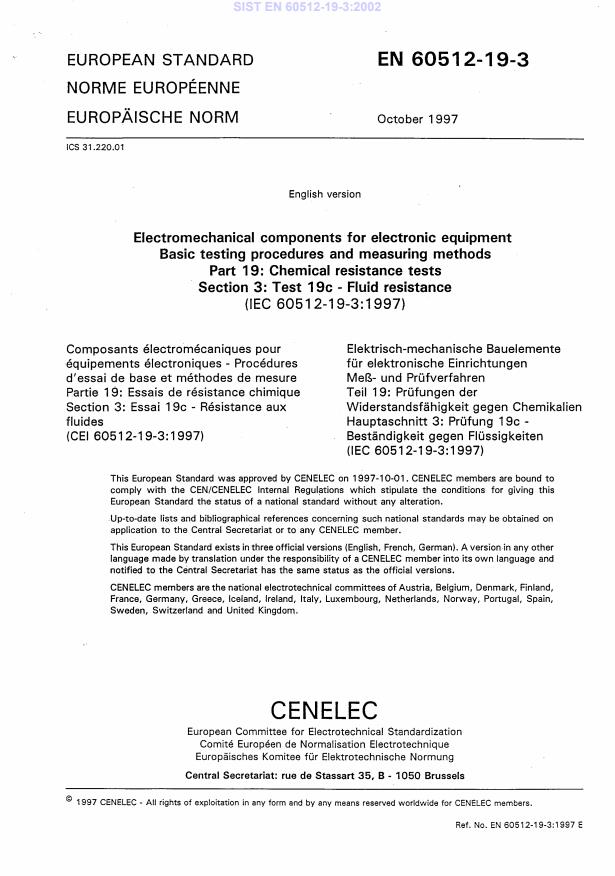
(Main)Electromechanical components for electronic equipment - Basic testing procedures and measuring methods - Part 19: Chemical resistance tests - Section 3: Test 19c - Fluid resistance
General Information
- Abstract
Defines a standard test method to assess the effects of accidental exposure to fluids and lubricants on electrical connecting devices.
- Status
- Published
- Publication Date
- 23-Oct-1997
- Withdrawal Date
- 30-Jun-1998
- Technical Committee
- CLC/SR 48B - Connectors
- Drafting Committee
- IEC/SC 48B - IEC_SC_48B
- Parallel Committee
- IEC/SC 48B - IEC_SC_48B
- Current Stage
- 6060 - Document made available - Publishing
- Start Date
- 24-Oct-1997
- Completion Date
- 24-Oct-1997


Overview
EN 60512-19-3:1997, published by CLC, specifies a standardized testing procedure to evaluate the chemical resistance of electromechanical components used in electronic equipment. This part of the IEC 60512 series focuses specifically on Test 19c – Fluid Resistance, which assesses the impact of accidental exposure to various fluids and lubricants on electrical connecting devices. The standard is essential for manufacturers, testing laboratories, and quality assurance teams seeking to verify durability and reliability of connectors and similar components under real-world chemical exposure conditions.
Understanding fluid resistance is crucial for ensuring that connectors maintain electrical performance, mechanical integrity, and safety during use in environments where exposure to fuels, hydraulic fluids, greases, cleaning agents, or other chemicals could occur.
Key Topics
- Scope and Object: Defines the purpose to assess effects of accidental fluid contact on electromechanical connectors.
- Test Specimens: Components fitted with accessories and wired per detail specifications to simulate real conditions.
- Conditioning Cycles:
- Immersion or grease application phase at specified temperatures.
- Storage under normal atmospheric conditions.
- Ageing phase with elevated temperature in an oven.
- Test Fluids: Includes various fluid families such as fuels, hydraulic fluids (mineral and synthetic), liquid lubricants, de-icing liquids, extinguishing liquids, and greases.
- Measurement Procedures: Visual exams, insulation resistance, contact resistance, engagement/separation force, and contact retention after conditioning.
- Test Parameters: Number of cycles, temperature controls, duration of fluid exposure, and fluid temperatures are adjustable based on detail specifications.
- Acceptance Criteria: No operational defects, legible markings post-test, and compliance with detailed technical specifications.
- Normative References: References IEC 60512 parts covering electrical continuity, contact resistance, insulation, voltage stress, and mechanical tests related to connectors.
Applications
EN 60512-19-3:1997 is widely applicable in industries such as:
- Electronics Manufacturing: Ensuring connectors in consumer electronics, industrial controls, and computing devices withstand chemical exposure.
- Automotive and Transportation: Testing electrical connectors susceptible to fuels, hydraulic fluids, greases, and cleaning agents used in vehicles.
- Aerospace and Defense: Verifying reliability of connectors exposed to varied fluid types under harsh conditions.
- Renewable Energy: Evaluating fluid resistance in connectors used in wind turbines or solar installations where environmental exposure is a concern.
- Industrial Automation: Guaranteeing connector performance in manufacturing environments involving lubricants and cleaning fluids.
By conforming to this standard, manufacturers can demonstrate product robustness and compliance with international testing methods that help reduce failures due to chemical exposure.
Related Standards
- IEC 60512-2: General examination, electrical continuity, and contact resistance testing methods.
- IEC 60512-3: Insulation resistance testing specific to electromechanical components.
- IEC 60512-13: Testing engagement and separation forces of connectors.
- IEC 60512-15: Contact retention testing in connector inserts.
- IEC 60512-19: Broader chemical resistance tests covering other subsections beyond fluid resistance.
- ISO Standards: Complementary standards related to mechanical and environmental testing of connectors may be referenced depending on regional or sectorial compliance.
Keywords: EN 60512-19-3, IEC 60512-19-3, chemical resistance tests, fluid resistance test, electromechanical components, electronic connectors, lubricant exposure testing, electrical connector durability, IEC connector testing standards, electromechanical testing procedures, fluid exposure electrical components.
Relations
- Effective Date
- 22-Sep-2026
- Referred By
EN 50173-10:2025 - Information technology - Generic cabling systems - Part 10: Single pair cabling - Effective Date
- 03-Feb-2026
- Effective Date
- 03-Feb-2026
- Effective Date
- 03-Feb-2026
- Effective Date
- 03-Feb-2026
- Effective Date
- 03-Feb-2026
- Effective Date
- 03-Feb-2026
- Effective Date
- 03-Feb-2026
- Effective Date
- 03-Feb-2026
- Effective Date
- 03-Feb-2026
- Effective Date
- 03-Feb-2026
Frequently Asked Questions
EN 60512-19-3:1997 is a standard published by CLC. Its full title is "Electromechanical components for electronic equipment - Basic testing procedures and measuring methods - Part 19: Chemical resistance tests - Section 3: Test 19c - Fluid resistance". This standard covers: Defines a standard test method to assess the effects of accidental exposure to fluids and lubricants on electrical connecting devices.
Defines a standard test method to assess the effects of accidental exposure to fluids and lubricants on electrical connecting devices.
EN 60512-19-3:1997 is classified under the following ICS (International Classification for Standards) categories: 31.220.01 - Electromechanical components in general. The ICS classification helps identify the subject area and facilitates finding related standards.
EN 60512-19-3:1997 has the following relationships with other standards: It is inter standard links to EN IEC 61076-2-117:2026, EN 50173-10:2025, EN IEC 61076-2-101:2025, EN IEC 61076-2-111:2018, EN IEC 62847:2023, EN IEC 61076-2-116:2023, EN IEC 61076-2-114:2020, EN IEC 61076-2-111:2026, EN IEC 61076-3-123:2019, CLC/TS 50467:2008, EN IEC 61076-3-126:2023. Understanding these relationships helps ensure you are using the most current and applicable version of the standard.
EN 60512-19-3:1997 is available in PDF format for immediate download after purchase. The document can be added to your cart and obtained through the secure checkout process. Digital delivery ensures instant access to the complete standard document.
Standards Content (Sample)
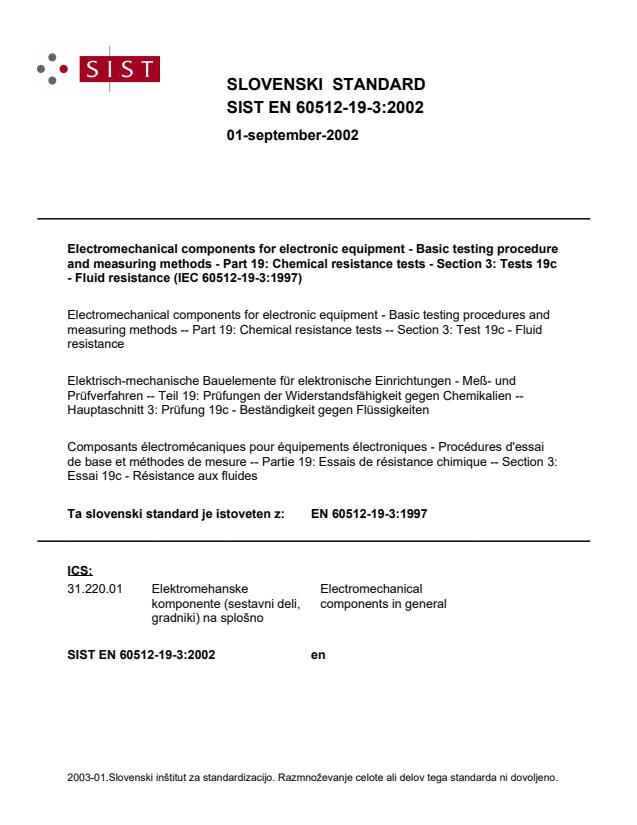
SLOVENSKI STANDARD
01-september-2002
Electromechanical components for electronic equipment - Basic testing procedure
and measuring methods - Part 19: Chemical resistance tests - Section 3: Tests 19c
- Fluid resistance (IEC 60512-19-3:1997)
Electromechanical components for electronic equipment - Basic testing procedures and
measuring methods -- Part 19: Chemical resistance tests -- Section 3: Test 19c - Fluid
resistance
Elektrisch-mechanische Bauelemente für elektronische Einrichtungen - Meß- und
Prüfverfahren -- Teil 19: Prüfungen der Widerstandsfähigkeit gegen Chemikalien --
Hauptaschnitt 3: Prüfung 19c - Beständigkeit gegen Flüssigkeiten
Composants électromécaniques pour équipements électroniques - Procédures d'essai
de base et méthodes de mesure -- Partie 19: Essais de résistance chimique -- Section 3:
Essai 19c - Résistance aux fluides
Ta slovenski standard je istoveten z: EN 60512-19-3:1997
ICS:
31.220.01 Elektromehanske Electromechanical
komponente (sestavni deli, components in general
gradniki) na splošno
2003-01.Slovenski inštitut za standardizacijo. Razmnoževanje celote ali delov tega standarda ni dovoljeno.
NORME
CEI
INTERNATIONALE
IEC
60512-19-3
INTERNATIONAL
Première édition
STANDARD
First edition
1997-07
Composants électromécaniques pour
équipements électroniques –
Procédures d’essai de base et
méthodes de mesure –
Partie 19:
Essais de résistance chimique –
Section 3: Essai 19c – Résistance aux fluides
Electromechanical components for
electronic equipment –
Basic testing procedures and
measuring methods –
Part 19:
Chemical resistance tests –
Section 3: Test 19c – Fluid resistance
IEC 1997 Droits de reproduction réservés Copyright - all rights reserved
Aucune partie de cette publication ne peut être reproduite ni No part of this publication may be reproduced or utilized in
utilisée sous quelque forme que ce soit et par aucun any form or by any means, electronic or mechanical,
procédé, électronique ou mécanique, y compris la photo- including photocopying and microfilm, without permission in
copie et les microfilms, sans l'accord écrit de l'éditeur. writing from the publisher.
International Electrotechnical Commission 3, rue de Varembé Geneva, Switzerland
Telefax: +41 22 919 0300 e-mail: inmail@iec.ch IEC web site http: //www.iec.ch
CODE PRIX
Commission Electrotechnique Internationale
F
PRICE CODE
International Electrotechnical Commission
Pour prix, voir catalogue en vigueur
For price, see current catalogue
60512-19-3 © IEC:1997 – 3 –
INTERNATIONAL ELECTROTECHNICAL COMMISSION
___________
ELECTROMECHANICAL COMPONENTS FOR
ELECTRONIC EQUIPMENT –
BASIC TESTING PROCEDURES AND MEASURING METHODS –
Part 19: Chemical resistance tests –
Section 3: Test 19c – Fluid resistance
FOREWORD
1) The IEC (International Electrotechnical Commission) is a worldwide organization for standardization comprising
all national electrotechnical committees (IEC National Committees). The object of the IEC is to promote
international co-operation on all questions concerning standardization in the electrical and electronic fields. To
this end and in addition to other activities, the IEC publishes International Standards. Their preparation is
entrusted to technical committees; any IEC National Committee interested in the subject dealt with may
participate in this preparatory work. International, governmental and non-governmental organizations liaising
with the IEC also participate in this preparation. The IEC collaborates closely with the International Organization
for Standardization (ISO) in accordance with conditions determined by agreement between the two
organizations.
2) The formal decisions or agreements of the IEC on technical matters express, as nearly as possible, an
international consensus of opinion on the relevant subjects since each technical committee has representation
from all interested National Committees.
3) The documents produced have the form of recommendations for international use and are published in the form
of standards, technical reports or guides and they are accepted by the National Committees in that sense.
4) In order to promote international unification, IEC National Committees undertake to apply IEC International
Standards transparently to the maximum extent possible in their national and regional standards. Any
divergence between the IEC Standard and the corresponding national or regional standard shall be clearly
indicated in the latter.
5) The IEC provides no marking procedure to indicate its approval and cannot be rendered responsible for any
equipment declared to be in conformity with one of its standards.
6) Attention is drawn to the possibility that some of the elements of this International Standard may be the subject
of patent rights. The IEC shall not be held responsible for identifying any or all such patent rights.
International Standard IEC 60512-19-3 has been prepared by IEC subcommittee 48B:
Connectors, of IEC technical committee 48: Electromechanical components and mechanical
structures for electronic equipment.
The text of this standard is based on the following documents:
FDIS Report on voting
48B/592/FDIS 48B/637/RVD
Full information on the voting for the approval of this standard can be found in the report on
voting indicated in the above table.
Annex A is for information only.
60512-19-3 © IEC:1997 – 5 –
ELECTROMECHANICAL COMPONENTS FOR
ELECTRONIC EQUIPMENT –
BASIC TESTING PROCEDURES AND MEASURING METHODS –
Part 19: Chemical resistance tests –
Section 3: Test 19c – Fluid resistance
1 Scope and object
This section of IEC 60512-19, when require
...