

IEC 60092-378:2024
(Main)Electrical installations in ships - Part 378: Optical fiber cables
General Information
- Abstract
CORRECTED VERSION 2025-12
IEC 60092-378:2024 is applicable to shipboard and offshore optical fibre cables, intended for fixed installations.
Cables designed to maintain functional integrity during fire given in 6.1 and to be installed in explosive atmospheres given in 6.2 are included.
The various types of optical fibre cables are given in Clause 6. The constructional requirements and test methods are aligned with those indicated in IEC 60092‑350, unless otherwise specified in this document.
The content of the corrigendum 1 (2025-12) has been included in this copy.
- Status
- Published
- Publication Date
- 05-Nov-2024
- Technical Committee
- SC 18A - Electric cables for ships and mobile and fixed offshore units
- Drafting Committee
- JWG 3 - TC 18/SC 18A/JWG 3
- Current Stage
- PPUB - Publication issued
- Start Date
- 06-Nov-2024
- Completion Date
- 15-Nov-2024
Overview
IEC 60092-378:2024 - "Electrical installations in ships - Part 378: Optical fiber cables" is the IEC international standard for shipboard and offshore optical fibre cables intended for fixed installations. This 2024 edition (including Corrigendum 1) defines types of optical fibre cables, constructional requirements, and test methods specific to marine and offshore environments. It aligns construction and testing practices with IEC 60092‑350 unless otherwise specified and mandates halogen-free cable compositions.
Key topics and requirements
- Scope and application
- Applies to optical fibre cables used on ships and mobile/fixed offshore units for fixed installations.
- Includes cables designed for functional integrity during fire and for use in explosive atmospheres.
- Cable types and construction
- Clause 6 lists the various cable types (loose tubes, breakout, armoured/unarmoured, etc.).
- Requirements for optical fibres, tensile strength elements, cabling, inner coverings, braids/armour, and outer sheaths.
- Color coding and marking requirements for fibre and sheath identification.
- Fire and safety performance
- Cables designed to maintain function during fire are covered (referenced tests include IEC 60331-series and IEC 60331-25 for optical fibres).
- All cables described are halogen‑free and include tests for low smoke and toxic emissions where applicable.
- Explosive atmosphere installations
- Special construction and tests for cables to be installed in explosive atmospheres and for transition between hazardous and non-hazardous zones.
- Testing and conformity
- Test methods and requirements follow IEC 60092‑350 with additional tests listed in Clause 7 and multiple tables (e.g., attenuation limits for multimode and single-mode fibres).
- Annex A offers informative recommendations for on-board installation practices.
Practical applications and users
Who uses IEC 60092-378:2024:
- Shipbuilders and naval architects specifying communication and control cabling.
- Cable manufacturers designing marine-certified optical fiber cables.
- Offshore operators and platform integrators deploying fiber for control, monitoring, and communications.
- Marine electrical engineers, installers, surveyors, and classification societies assessing cable conformity and safety.
- Procurement and maintenance teams requiring standards for fire-resistant, explosion-rated, and halogen-free cabling.
Practical uses:
- Specifying fiber optic cables for shipboard LANs, instrumentation, safety communication, and control systems.
- Ensuring cables meet marine fire performance and explosive atmosphere installation rules.
- Guiding testing, marking, and installation practices to meet regulatory and class society requirements.
Related standards
- IEC 60092‑350 (General construction & test methods for cables)
- IEC 60092‑352 (Choice & installation of cables)
- IEC 60092‑360 (Insulating & sheathing materials)
- IEC 60092‑401 (Installation & test of completed installation)
- IEC 60079‑14 (Explosive atmospheres)
- IEC 60331‑25 / IEC 60331 (Circuit integrity under fire)
- IEC 60332‑1‑2 (Vertical flame propagation)
- IEC 60304 (Standard colours for insulation)
Keywords: IEC 60092-378:2024, optical fiber cables, shipboard, offshore, fire resistant, halogen-free, explosive atmospheres, marine cable standards, IEC 60092-350.
Relations
- Effective Date
- 05-Dec-2025
Get Certified
Connect with accredited certification bodies for this standard

DNV
DNV is an independent assurance and risk management provider.

Lloyd's Register
Lloyd's Register is a global professional services organisation specialising in engineering and technology.

FSC International
Forest Stewardship Council certification.
Sponsored listings
Frequently Asked Questions
IEC 60092-378:2024 is a standard published by the International Electrotechnical Commission (IEC). Its full title is "Electrical installations in ships - Part 378: Optical fiber cables". This standard covers: CORRECTED VERSION 2025-12 IEC 60092-378:2024 is applicable to shipboard and offshore optical fibre cables, intended for fixed installations. Cables designed to maintain functional integrity during fire given in 6.1 and to be installed in explosive atmospheres given in 6.2 are included. The various types of optical fibre cables are given in Clause 6. The constructional requirements and test methods are aligned with those indicated in IEC 60092‑350, unless otherwise specified in this document. The content of the corrigendum 1 (2025-12) has been included in this copy.
CORRECTED VERSION 2025-12 IEC 60092-378:2024 is applicable to shipboard and offshore optical fibre cables, intended for fixed installations. Cables designed to maintain functional integrity during fire given in 6.1 and to be installed in explosive atmospheres given in 6.2 are included. The various types of optical fibre cables are given in Clause 6. The constructional requirements and test methods are aligned with those indicated in IEC 60092‑350, unless otherwise specified in this document. The content of the corrigendum 1 (2025-12) has been included in this copy.
IEC 60092-378:2024 is classified under the following ICS (International Classification for Standards) categories: 29.060.20 - Cables; 47.020.60 - Electrical equipment of ships and of marine structures. The ICS classification helps identify the subject area and facilitates finding related standards.
IEC 60092-378:2024 has the following relationships with other standards: It is inter standard links to IEC 60092-378:2024/COR1:2025. Understanding these relationships helps ensure you are using the most current and applicable version of the standard.
IEC 60092-378:2024 is available in PDF format for immediate download after purchase. The document can be added to your cart and obtained through the secure checkout process. Digital delivery ensures instant access to the complete standard document.
Standards Content (Sample)
IEC 60092-378 ®
Edition 1.0 2024-11
INTERNATIONAL
STANDARD
Electrical installations in ships –
Part 378: Optical fiber cables
All rights reserved. Unless otherwise specified, no part of this publication may be reproduced or utilized in any form
or by any means, electronic or mechanical, including photocopying and microfilm, without permission in writing from
either IEC or IEC's member National Committee in the country of the requester. If you have any questions about IEC
copyright or have an enquiry about obtaining additional rights to this publication, please contact the address below or
your local IEC member National Committee for further information.
IEC Secretariat Tel.: +41 22 919 02 11
3, rue de Varembé info@iec.ch
CH-1211 Geneva 20 www.iec.ch
Switzerland
About the IEC
The International Electrotechnical Commission (IEC) is the leading global organization that prepares and publishes
International Standards for all electrical, electronic and related technologies.
About IEC publications
The technical content of IEC publications is kept under constant review by the IEC. Please make sure that you have the
latest edition, a corrigendum or an amendment might have been published.
IEC publications search - webstore.iec.ch/advsearchform IEC Products & Services Portal - products.iec.ch
The advanced search enables to find IEC publications by a Discover our powerful search engine and read freely all the
variety of criteria (reference number, text, technical publications previews, graphical symbols and the glossary.
committee, …). It also gives information on projects, replaced With a subscription you will always have access to up to date
and withdrawn publications. content tailored to your needs.
IEC Just Published - webstore.iec.ch/justpublished
Electropedia - www.electropedia.org
Stay up to date on all new IEC publications. Just Published
The world's leading online dictionary on electrotechnology,
details all new publications released. Available online and once
containing more than 22 500 terminological entries in English
a month by email.
and French, with equivalent terms in 25 additional languages.
Also known as the International Electrotechnical Vocabulary
IEC Customer Service Centre - webstore.iec.ch/csc
(IEV) online.
If you wish to give us your feedback on this publication or need
further assistance, please contact the Customer Service
Centre: sales@iec.ch.
IEC 60092-378 ®
Edition 1.0 2024-11
INTERNATIONAL
STANDARD
Electrical installations in ships –
Part 378: Optical fiber cables
INTERNATIONAL
ELECTROTECHNICAL
COMMISSION
ICS 29.060.20; 47.020.60 ISBN 978-2-8322-4907-9
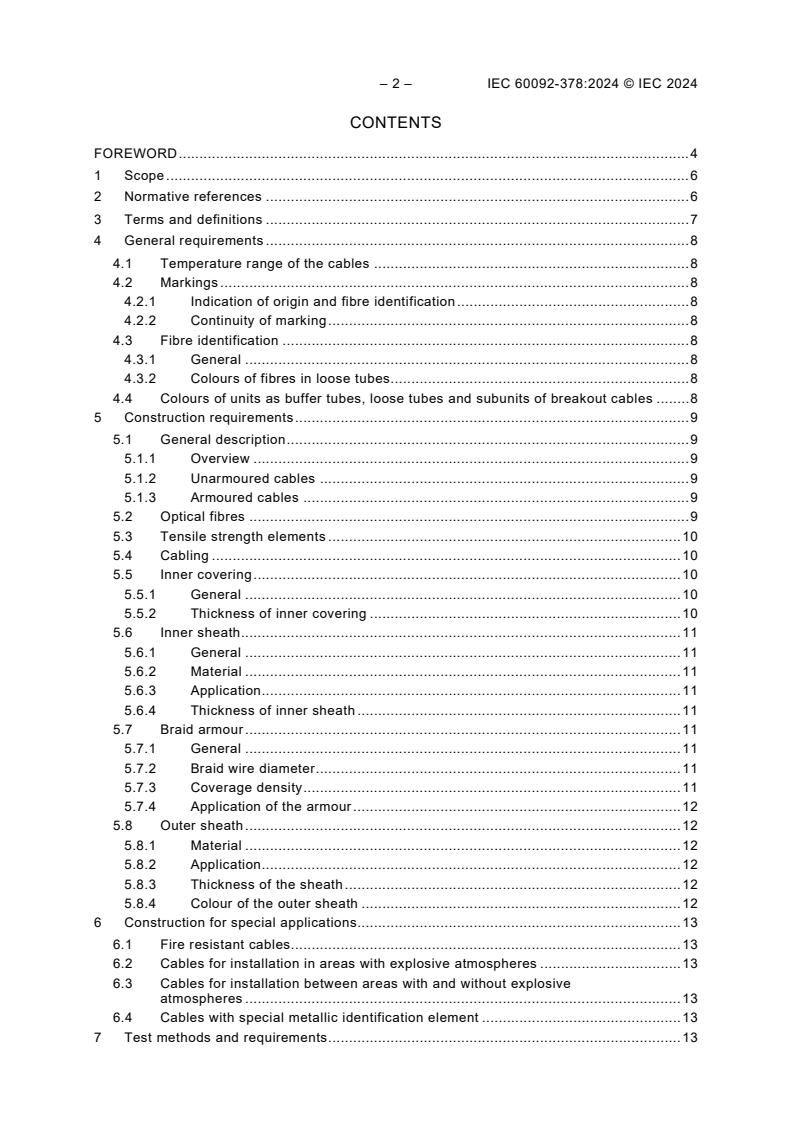
– 2 – IEC 60092-378:2024 © IEC 2024
CONTENTS
FOREWORD . 4
1 Scope . 6
2 Normative references . 6
3 Terms and definitions . 7
4 General requirements . 8
4.1 Temperature range of the cables . 8
4.2 Markings . 8
4.2.1 Indication of origin and fibre identification . 8
4.2.2 Continuity of marking . 8
4.3 Fibre identification . 8
4.3.1 General . 8
4.3.2 Colours of fibres in loose tubes. 8
4.4 Colours of units as buffer tubes, loose tubes and subunits of breakout cables . 8
5 Construction requirements . 9
5.1 General description . 9
5.1.1 Overview . 9
5.1.2 Unarmoured cables . 9
5.1.3 Armoured cables . 9
5.2 Optical fibres . 9
5.3 Tensile strength elements . 10
5.4 Cabling . 10
5.5 Inner covering . 10
5.5.1 General . 10
5.5.2 Thickness of inner covering . 10
5.6 Inner sheath . 11
5.6.1 General . 11
5.6.2 Material . 11
5.6.3 Application . 11
5.6.4 Thickness of inner sheath . 11
5.7 Braid armour . 11
5.7.1 General . 11
5.7.2 Braid wire diameter . 11
5.7.3 Coverage density . 11
5.7.4 Application of the armour . 12
5.8 Outer sheath . 12
5.8.1 Material . 12
5.8.2 Application . 12
5.8.3 Thickness of the sheath . 12
5.8.4 Colour of the outer sheath . 12
6 Construction for special applications. 13
6.1 Fire resistant cables. 13
6.2 Cables for installation in areas with explosive atmospheres . 13
6.3 Cables for installation between areas with and without explosive
atmospheres . 13
6.4 Cables with special metallic identification element . 13
7 Test methods and requirements . 13
7.1 General requirements . 13
7.2 Additional tests on cables with functional integrity during fire . 17
7.3 Tests on cables for installation in explosive atmospheres . 17
7.4 Tests on cables for installation between areas with and without explosive
atmospheres . 17
7.5 Tests on cables with special metallic identification element . 17
8 Recommendations for the installation of fibre optic cables on board of ships and
offshore units. 17
Annex A (informative) Recommendations for the installation of fibre optic cables on
board of ships and offshore units . 18
Bibliography . 19
Table 1 – Multimode fibre maximum cable attenuation coefficient (dB/km) . 10
Table 2 – Single-mode fibre maximum cable attenuation coefficient (dB/km) . 10
Table 3 – Colour of outer sheath . 13
Table 4 – Tests applicable to all cables . 14
Table 5 – Additional test required for low smoke cables . 16
Table 6 – Additional tests required for specific performances . 16
Table 7 – Additional test required for fire resistant cables . 17
Table 8 – Additional test for cables for installation between areas with and without
explosive atmospheres . 17
Table 9 – Additional test on cables with special metallic identification element . 17
– 4 – IEC 60092-378:2024 © IEC 2024
INTERNATIONAL ELECTROTECHNICAL COMMISSION
____________
ELECTRICAL INSTALLATIONS IN SHIPS –
Part 378: Optical fibre cables
FOREWORD
1) The International Electrotechnical Commission (IEC) is a worldwide organization for standardization comprising
all national electrotechnical committees (IEC National Committees). The object of IEC is to promote international
co-operation on all questions concerning standardization in the electrical and electronic fields. To this end and
in addition to other activities, IEC publishes International Standards, Technical Specifications, Technical Reports,
Publicly Available Specifications (PAS) and Guides (hereafter referred to as “IEC Publication(s)”). Their
preparation is entrusted to technical committees; any IEC National Committee interested in the subject dealt with
may participate in this preparatory work. International, governmental and non-governmental organizations liaising
with the IEC also participate in this preparation. IEC collaborates closely with the International Organization for
Standardization (ISO) in accordance with conditions determined by agreement between the two organizations.
2) The formal decisions or agreements of IEC on technical matters express, as nearly as possible, an international
consensus of opinion on the relevant subjects since each technical committee has representation from all
interested IEC National Committees.
3) IEC Publications have the form of recommendations for international use and are accepted by IEC National
Committees in that sense. While all reasonable efforts are made to ensure that the technical content of IEC
Publications is accurate, IEC cannot be held responsible for the way in which they are used or for any
misinterpretation by any end user.
4) In order to promote international uniformity, IEC National Committees undertake to apply IEC Publications
transparently to the maximum extent possible in their national and regional publications. Any divergence between
any IEC Publication and the corresponding national or regional publication shall be clearly indicated in the latter.
5) IEC itself does not provide any attestation of conformity. Independent certification bodies provide conformity
assessment services and, in some areas, access to IEC marks of conformity. IEC is not responsible for any
services carried out by independent certification bodies.
6) All users should ensure that they have the latest edition of this publication.
7) No liability shall attach to IEC or its directors, employees, servants or agents including individual experts and
members of its technical committees and IEC National Committees for any personal injury, property damage or
other damage of any nature whatsoever, whether direct or indirect, or for costs (including legal fees) and
expenses arising out of the publication, use of, or reliance upon, this IEC Publication or any other IEC
Publications.
8) Attention is drawn to the Normative references cited in this publication. Use of the referenced publications is
indispensable for the correct application of this publication.
9) IEC draws attention to the possibility that the implementation of this document may involve the use of (a)
patent(s). IEC takes no position concerning the evidence, validity or applicability of any claimed patent rights in
respect thereof. As of the date of publication of this document, IEC had not received notice of (a) patent(s), which
may be required to implement this document. However, implementers are cautioned that this may not represent
the latest information, which may be obtained from the patent database available at https://patents.iec.ch. IEC
shall not be held responsible for identifying any or all such patent rights.
IEC 60092-378 has been prepared by subcommittee 18A: Electric cables for ships and mobile
and fixed offshore units, of IEC technical committee 18: Electrical installations of ships and of
mobile and fixed offshore units. It is an International Standard.
The text of this International Standard is based on the following documents:
Draft Report on voting
18A/488/FDIS 18A/493/RVD
Full information on the voting for its approval can be found in the report on voting indicated in
the above table.
The language used for the development of this International Standard is English.
This document was drafted in accordance with ISO/IEC Directives, Part 2, and developed in
accordance with ISO/IEC Directives, Part 1 and ISO/IEC Directives, IEC Supplement, available
at www.iec.ch/members_experts/refdocs. The main document types developed by IEC are
described in greater detail at www.iec.ch/publications.
A list of all parts in the IEC 60092 series, published under the general title Electrical installations
in ships, can be found on the IEC website.
The committee has decided that the contents of this document will remain unchanged until the
stability date indicated on the IEC website under webstore.iec.ch in the data related to the
specific document. At this date, the document will be
• reconfirmed,
• withdrawn, or
• revised.
– 6 – IEC 60092-378:2024 © IEC 2024
ELECTRICAL INSTALLATIONS IN SHIPS –
Part 378: Optical fibre cables
1 Scope
This part of IEC 60092 is applicable to shipboard and offshore optical fibre cables, intended for
fixed installations.
Cables designed to maintain functional integrity during fire given in 6.1 and to be installed in
explosive atmospheres given in 6.2 are included.
The various types of optical fibre cables are given in Clause 6. The constructional requirements
and test methods are aligned with those indicated in IEC 60092-350, unless otherwise specified
in this document.
The object of this document is:
– to standardize cables whose safety and reliability is ensured when they are installed in
accordance with the requirements of IEC 60092-352 or IEC 60092-401 or IEC 61892-4;
– to lay down standard manufacturing requirements and characteristics of such cables directly
or indirectly bearing on safety, and;
– to specify test methods for checking conformity with those requirements.
All cables described in this document, are halogen-free as per Table 4.
2 Normative references
The following documents are referred to in the text in such a way that some or all of their content
constitutes requirements of this document. For dated references, only the edition cited applies.
For undated references, the latest edition of the referenced document (including any
amendments) applies.
IEC 60050-461, International Electrotechnical Vocabulary (IEV) – Part 461: Electric cables
IEC 60079-14:2013, Explosive atmospheres – Part 14: Electrical installations design, selection
and erection
IEC 60092-350:2020, Electrical installations in ships – Part 350: General construction and test
methods of power, control and instrumentation cables for shipboard and offshore applications
IEC 60092-352, Electrical installations in ships – Part 352: Choice and installation of electrical
cables
IEC 60092-360, Electrical installations in ships – Part 360: Insulating and sheathing materials
for shipboard and offshore units, power, control, instrumentation and telecommunication cables
IEC 60092-401, Electrical installations in ships – Part 401: Installation and test of completed
installation
IEC 60304, Standard colours for insulation for low-frequency cables and wires
IEC 60331-1, Tests for electric cables under fire conditions – Circuit integrity – Part 1: Test
method for fire with shock at a temperature of at least 830 °C for cables of rated voltage up to
and including 0,6/1,0 kV and with an overall diameter exceeding 20 mm
IEC 60331-2, Tests for electric cables under fire conditions – Circuit integrity – Part 2: Test
method for fire with shock at a temperature of at least 830 °C for cables of rated voltage up to
and including 0,6/1,0 kV and with an overall diameter not exceeding 20 mm
IEC 60331-25, Tests for electric cables under fire conditions – Circuit integrity – Part 25:
Procedures and requirements – Optical fibre cables
IEC 60332-1-2, Tests on electric and optical fibre cables under fire conditions – Part 1-2: Test
for vertical flame propagation for a single insulated wire or cable – Procedure for 1 kW
pre-mixed flame
IEC 60332-3-24, Tests on electric and optical fibre cables under fire conditions – Part 3-24:
Test for vertical flame spread of vertically-mounted bunched wires or cables – Category C
IEC 60684-2, Flexible insulating sleeving – Part 2: Methods of test
IEC 60754-2:2011, Test on gases evolved during combustion of materials from cables – Part 2:
Determination of acidity (by pH measurement) and conductivity
IEC 60794-1-1:2023, Optical fibre cables – Part 1-1: Generic specification – General
IEC 60794-1-21, Optical fibre cables – Part 1-21: Generic specification – Basic optical cable
test procedures – Mechanical tests methods
IEC 60794-1-22, Optical fibre cables – Part 1-22: Generic specification – Basic optical cable
test procedures – Environmental test methods
IEC 60794-1-23, Optical fibre cables – Part 1-23: Generic specification – Basic optical cable
test procedures – Cable element test methods
IEC 60793-1-40, Optical fibres – Part 1-40: Attenuation measurement methods
IEC 60794-1-111, Optical fibre cables – Part 1-111: Generic specification – Basic optical cable
test procedures – Mechanical tests methods – Bend, method E11
IEC 6
...