


ISO/IEC 29182-2:2013
(Main)Information technology - Sensor networks: Sensor Network Reference Architecture (SNRA) - Part 2: Vocabulary and terminology
Information technology - Sensor networks: Sensor Network Reference Architecture (SNRA) - Part 2: Vocabulary and terminology
ISO/IEC 29182-2:2013 is intended to facilitate the development of International Standards in sensor networks. It presents terms and definitions for selected concepts relevant to the field of sensor networks. It establishes a general description of concepts in this field and identifies the relationships among those concepts. It may also be used as guidance for development of other parts of ISO/IEC 29182 and any other sensor network related standard.
General Information
- Status
- Published
- Publication Date
- 02-Jun-2013
- Technical Committee
- ISO/IEC JTC 1/SC 41 - Internet of Things and Digital Twin
- Current Stage
- PPUB - Publication issued
- Start Date
- 03-Jun-2013
- Completion Date
- 13-Feb-2026
Overview
ISO/IEC 29182-2:2013, titled Information technology - Sensor networks: Sensor Network Reference Architecture (SNRA) - Part 2: Vocabulary and terminology, published by the International Electrotechnical Commission (IEC) and ISO, plays a crucial role in standardizing terminology within the sensor network field. This standard is designed to facilitate the development of international standards in sensor networks by providing a comprehensive vocabulary and clear definitions of key concepts. ISO/IEC 29182-2:2013 supports sensor network designers, developers, and service providers by establishing consistent terminology that ensures clear communication and interoperability across various sensor network applications and architectures.
Key Topics
The standard covers a wide range of technical terms and definitions essential for sensor networks, categorized into the following key areas:
General Concepts:
- Sensor: A device that measures physical properties and converts those measurements into signals.
- Actuator: A device that produces a physical output based on an input signal.
- Sensor Node: An element including sensors, possibly actuators, and communication and processing capabilities.
- Sensor Network: A system of spatially distributed sensor nodes that interact to gather and process environmental information.
Reference Architecture:
- Reference Architecture: A framework providing common features and guidelines for sensor network design, promoting reuse and interoperability.
- Sensor Network Application: Use cases such as environmental monitoring, seismic activity tracking, or pollution surveillance.
- Sensor Network Service: Functionalities offered by sensor networks, e.g., alarm generation or data aggregation.
- Sensor Network Gateway: Interfaces connecting sensor networks to other networks with different protocols.
Communications and Networking Layers:
- Definitions of OSI model layers adapted for sensor networks, including physical, data link, network, transport, and application layers.
- Concepts such as routing and relaying for data transmission within sensor networks.
Data and Information Processing:
- Terms like aggregation, fusion, and collaborative information processing that describe how sensor data from multiple sources is combined and analyzed.
Interfaces:
- Specification of physical interfaces, data interfaces, and sensor interfaces that enable hardware and software interaction among sensor nodes.
Security and Privacy:
- Critical security terminology such as authentication, authorization, confidentiality, data integrity, and privacy, addressing the protection and control of sensor network data.
Service Provision and Management:
- Concepts like device management, network management, quality of service, middleware, and sensor network integration platform for operational control and service delivery.
Types of Sensor Networks:
- Definitions distinguishing homogeneous and heterogeneous sensor networks based on node functionality and interoperability.
Applications
ISO/IEC 29182-2:2013 serves as an essential foundation for multiple stakeholders involved in sensor network technology:
- Sensor Network Designers can leverage standardized terminology to design architectures that are interoperable and scalable.
- Software Developers benefit from clear definitions to build compatible applications and middleware interfaces.
- Service Providers use this vocabulary to define and offer sensor network services aligned with international standards.
- Researchers and Educators gain a unified framework to communicate findings and foster innovation in sensor technologies.
- Standardization Bodies rely on this document to ensure consistency across sensor network standards and enhance global collaboration.
Typical applications impacted by this standard include environmental monitoring, industrial automation, health care, smart cities, and emergency response systems where sensor networks provide real-time data collection and control.
Related Standards
ISO/IEC 29182-2:2013 is part of the larger ISO/IEC 29182 series, focused on Sensor Network Reference Architecture:
- Part 1: General overview and requirements for sensor networks.
- Part 3: Reference architecture views presenting multiple perspectives.
- Part 4: Entity models detailing physical and functional sensor network components.
- Part 5: Interface definitions specifying sensor network communication protocols.
- Part 6: Applications (under preparation), focusing on sensor network use cases.
- Part 7: Interoperability guidelines for ensuring seamless sensor network integration.
These parts collectively provide comprehensive guidance for sensor network design, development, and deployment while supporting interoperability and standardization worldwide.
Keywords: ISO/IEC 29182-2:2013, sensor networks, sensor network reference architecture, SNRA, sensor network vocabulary, sensor network terminology, sensor node, sensor network gateway, sensor network standards, interoperability, sensor network security, sensor network applications, sensor data processing, sensor network glossary.

Get Certified
Connect with accredited certification bodies for this standard

BSI Group
BSI (British Standards Institution) is the business standards company that helps organizations make excellence a habit.

NYCE
Mexican standards and certification body.
Sponsored listings
Frequently Asked Questions
ISO/IEC 29182-2:2013 is a standard published by the International Electrotechnical Commission (IEC). Its full title is "Information technology - Sensor networks: Sensor Network Reference Architecture (SNRA) - Part 2: Vocabulary and terminology". This standard covers: ISO/IEC 29182-2:2013 is intended to facilitate the development of International Standards in sensor networks. It presents terms and definitions for selected concepts relevant to the field of sensor networks. It establishes a general description of concepts in this field and identifies the relationships among those concepts. It may also be used as guidance for development of other parts of ISO/IEC 29182 and any other sensor network related standard.
ISO/IEC 29182-2:2013 is intended to facilitate the development of International Standards in sensor networks. It presents terms and definitions for selected concepts relevant to the field of sensor networks. It establishes a general description of concepts in this field and identifies the relationships among those concepts. It may also be used as guidance for development of other parts of ISO/IEC 29182 and any other sensor network related standard.
ISO/IEC 29182-2:2013 is classified under the following ICS (International Classification for Standards) categories: 35.110 - Networking. The ICS classification helps identify the subject area and facilitates finding related standards.
ISO/IEC 29182-2:2013 is available in PDF format for immediate download after purchase. The document can be added to your cart and obtained through the secure checkout process. Digital delivery ensures instant access to the complete standard document.
Standards Content (Sample)
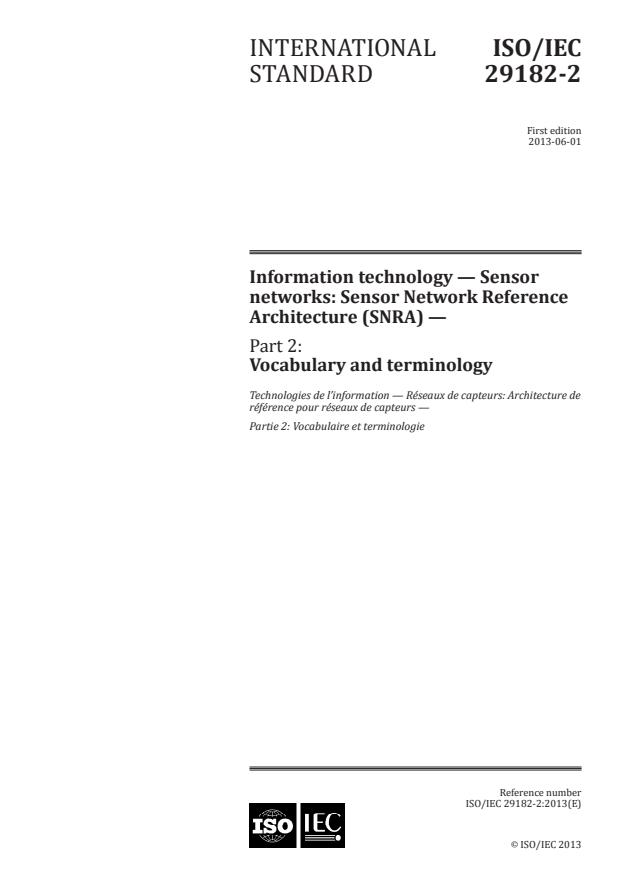
INTERNATIONAL ISO/IEC
STANDARD 29182-2
First edition
2013-06-01
Information technology — Sensor
networks: Sensor Network Reference
Architecture (SNRA) —
Part 2:
Vocabulary and terminology
Technologies de l’information — Réseaux de capteurs: Architecture de
référence pour réseaux de capteurs —
Partie 2: Vocabulaire et terminologie
Reference number
©
ISO/IEC 2013
© ISO/IEC 2013
All rights reserved. Unless otherwise specified, no part of this publication may be reproduced or utilized otherwise in any form
or by any means, electronic or mechanical, including photocopying, or posting on the internet or an intranet, without prior
written permission. Permission can be requested from either ISO at the address below or ISO’s member body in the country of
the requester.
ISO copyright office
Case postale 56 • CH-1211 Geneva 20
Tel. + 41 22 749 01 11
Fax + 41 22 749 09 47
E-mail copyright@iso.org
Web www.iso.org
Published in Switzerland
ii © ISO/IEC 2013 – All rights reserved
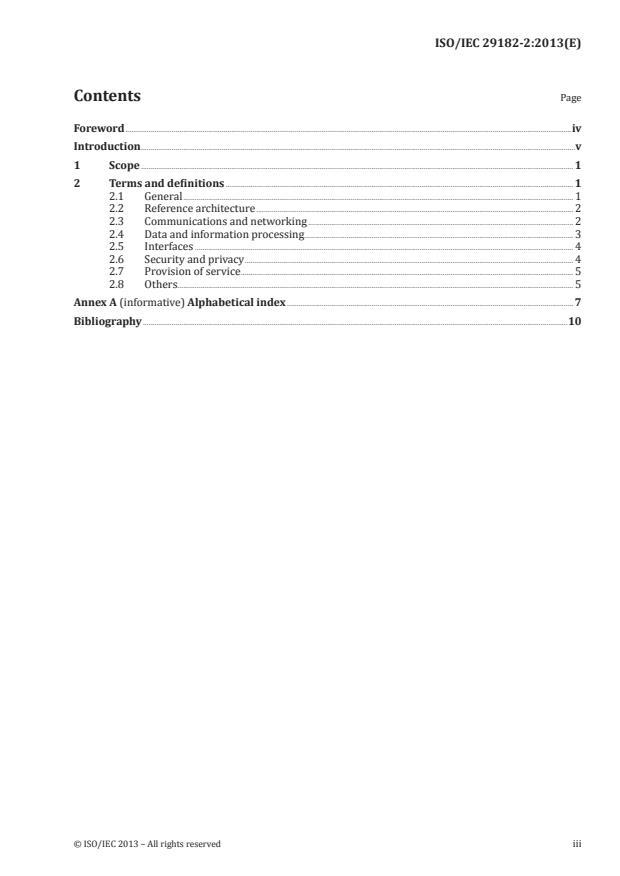
Contents Page
Foreword .iv
Introduction .v
1 Scope . 1
2 Terms and definitions . 1
2.1 General . 1
2.2 Reference architecture . 2
2.3 Communications and networking . 2
2.4 Data and information processing . 3
2.5 Interfaces . 4
2.6 Security and privacy . 4
2.7 Provision of service . 5
2.8 Others . 5
Annex A (informative) Alphabetical index . 7
Bibliography .10
© ISO/IEC 2013 – All rights reserved iii
Foreword
ISO (the International Organization for Standardization) and IEC (the International Electrotechnical
Commission) form the specialized system for worldwide standardization. National bodies that are
members of ISO or IEC participate in the development of International Standards through technical
committees established by the respective organization to deal with particular fields of technical
activity. ISO and IEC technical committees collaborate in fields of mutual interest. Other international
organizations, governmental and non-governmental, in liaison with ISO and IEC, also take part in the
work. In the field of information technology, ISO and IEC have established a joint technical committee,
ISO/IEC JTC 1.
International Standards are drafted in accordance with the rules given in the ISO/IEC Directives, Part 2.
The main task of the joint technical committee is to prepare International Standards. Draft International
Standards adopted by the joint technical committee are circulated to national bodies for voting.
Publication as an International Standard requires approval by at least 75 % of the national bodies
casting a vote.
Attention is drawn to the possibility that some of the elements of this document may be the subject of
patent rights. ISO and IEC shall not be held responsible for identifying any or all such patent rights.
This part of ISO/IEC 29182 was prepared by joint technical committee ISO/IEC JTC 1.
ISO/IEC 29182 consists of the following parts, under the general title Information technology — Sensor
networks: Sensor Network Reference Architecture (SNRA):
— Part 1: General overview and requirements
— Part 2: Vocabulary and terminology
— Part 3: Reference architecture views
— Part 4: Entity models
— Part 5: Interface definitions
— Part 7: Interoperability guidelines
The following part is under preparation:
— Part 6: Applications
iv © ISO/IEC 2013 – All rights reserved
Introduction
A wide range of applications has been proposed for sensor networks. In practice, however, sensor
networks have been built and deployed for a relatively small number of applications. This is partly due
to the lack of a business case for certain applications and partly due to technical challenges in building a
non-trivial sensor network of reasonable complexity. The main reason for this impediment is that multi-
disciplinary expertise – such as sensors, communications and networking, signal processing, electronics,
computing, and cyber security – is required to design a sensor network. Presently, the design process
is so complex that one can leverage little from one sensor network design to another. It appears as if
one has to start from almost scratch every time one wishes to design and deploy a sensor network. Yet,
upon closer inspection, there are many commonalities in instantiations of sensor networks that realize
various applications. These commonalities include similarities in the choice of network architecture and
the entities/functional blocks that are used in the architecture.
The purpose of the ISO/IEC 29182 series is to
— provide guidance to facilitate the design and development of sensor networks,
— improve interoperability of sensor networks, and
— make sensor networks plug-and-play, so that it becomes fairly easy to add/remove sensor nodes
to/from an existing sensor network.
The ISO/IEC 29182 series can be used by sensor network designers, software developers, and service
providers to meet customer requirements, including any applicable interoperability requirements.
The ISO/IEC 29182 series comprises seven parts. Brief descriptions of these parts are given next,
followed by an introduction to Part 4.
ISO/IEC 29182-1 provides a general overview and the requirements for the sensor network reference
architecture.
This part of ISO/IEC 29182 provides definitions for the terminology and vocabulary used in the reference
architecture.
ISO/IEC 29182-3 presents the reference architecture from various viewpoints, such as business,
operational, system, technical, functional, and logical views.
ISO/IEC 29182-4 categorizes the entities comprising the reference architecture into two classes of
physical and functional entities and presents models for the entities.
ISO/IEC 29182-5 provides detailed information on the interfaces among various entities in the reference
architecture.
ISO/IEC 29182-6 provides detailed information on the development of International Standardized Profiles.
ISO/IEC 29182-7 provides design principles for the reference architecture that take the interoperability
requirements into account.
There are no requirements for compliance in ISO/IEC 29182-1 to ISO/IEC 29182-7. Users should ensure
that the sensor nodes, and the related sensor network, are compliant with the application or deployment
governing body.
© ISO/IEC 2013 – All rights reserved v
INTERNATIONAL STANDARD ISO/IEC 29182-2:2013(E)
Information technology — Sensor networks: Sensor
Network Reference Architecture (SNRA) —
Part 2:
Vocabulary and terminology
1 Scope
This part of ISO/IEC 29182 is intended to facilitate the development of international standards in sensor
networks. It presents terms and definitions for selected concepts relevant to the field of sensor networks.
It establishes a general description of concepts in this field and identifies the relationships among those
concepts. It may also be used as guidance for development of other parts of ISO/IEC 29182 and any other
sensor network related standard.
2 Terms and definitions
For the purposes of this document, the following terms and definitions apply.
2.1 General
2.1.1
actuator
device that provides a physical output in response to an input signal in a predetermined way
2.1.2
backbone network
network that connects to sensor network gateways through different access networks to transmit
information from sensor network to service provider or user
Note 1 to entry: The Internet is one example of backbone networks.
2.1.3
entity
unit having distinct set of attributes and connected to other unit(s) defined in the sensor network
reference architecture
2.1.4
personal area network
network consisting of sensor nodes, communication devices, or networked peripheral devices all in the
vicinity of a person
2.1.5
sensor
device that observes and measures a physical property of a natural phenomenon or man-made process
and converts that measurement into a signal
Note 1 to entry: Signal can be electrical, chemical, etc.
© ISO/IEC 2013 – All rights reserved 1
2.1.6
sensor network
system of spatially distributed sensor nodes interacting with each other and, depending on applications,
possibly with other infrastructure in order to acquire, process, transfer, and provide information extracted
from its environment with a primary function of information gathering and possible control capability
Note 1 to entry: Distinguishing features of a sensor network can include wide area coverage, use of radio networks,
flexibility of purpose, self-organization, openness, and providing data
...
Questions, Comments and Discussion
Ask us and Technical Secretary will try to provide an answer. You can facilitate discussion about the standard in here.
Loading comments...