

IEC 60601-2-57:2023
(Main)Medical electrical equipment - Part 2-57: Particular requirements for the basic safety and essential performance of non-laser light source equipment intended for therapeutic, diagnostic, monitoring, cosmetic and aesthetic use
General Information
- Abstract
IEC 60601-2-57:2023 applies to basic safety and essential performance of equipment incorporating one or more sources of optical radiation in the wavelength range 200 nm to 3 000 nm, with the exception of laser radiation, and intended to create photobiological effects in humans for therapeutic, diagnostic, monitoring, and cosmetic or aesthetic applications; hereafter referred to as light source equipment (ls equipment).
- Status
- Published
- Publication Date
- 26-Jul-2023
- Technical Committee
- TC 76 - Optical radiation safety and laser equipment
- Drafting Committee
- WG 4 - TC 76/WG 4
- Current Stage
- PPUB - Publication issued
- Start Date
- 27-Jul-2023
- Completion Date
- 25-Aug-2023
Buy Documents
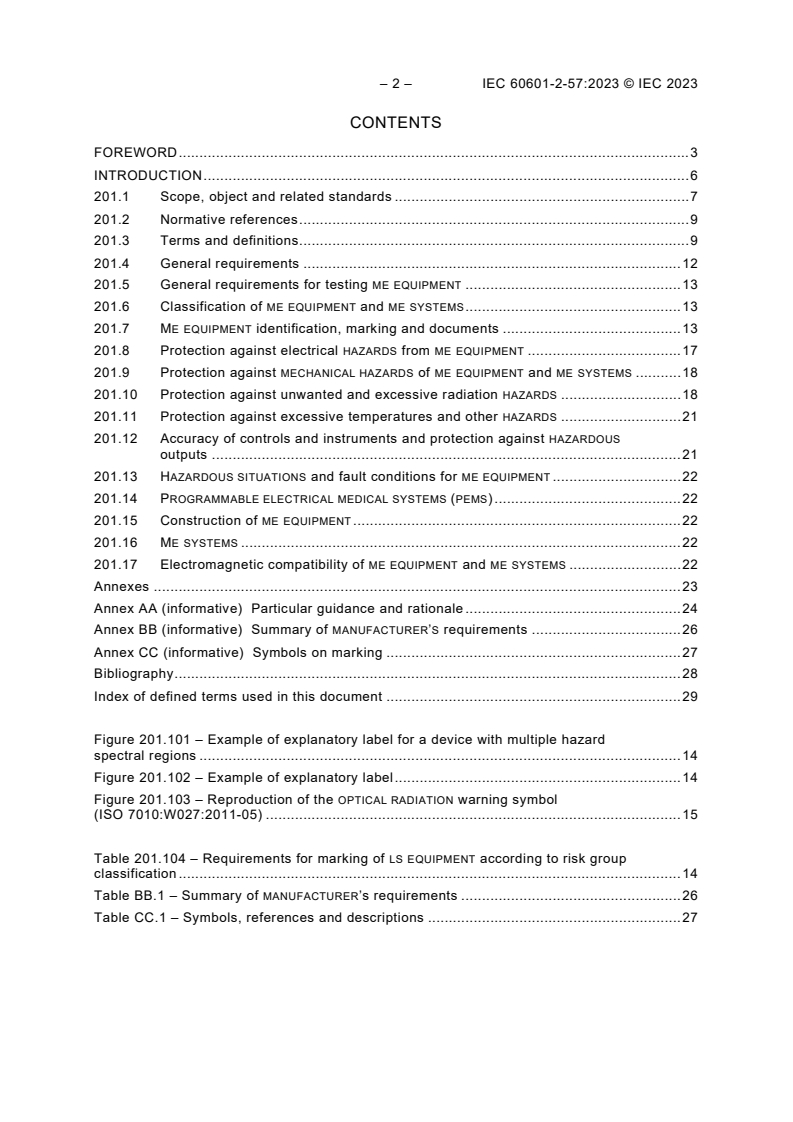
IEC 60601-2-57:2023 - Medical electrical equipment - Part 2-57: Particular requirements for the basic safety and essential performance of non-laser light source equipment intended for therapeutic, diagnostic, monitoring, cosmetic and aesthetic use Released:7/27/2023
Overview
IEC 60601-2-57:2023 is an international standard developed by the International Electrotechnical Commission (IEC) that specifies particular requirements for the basic safety and essential performance of non-laser light source equipment. This equipment is intended for therapeutic, diagnostic, monitoring, cosmetic, and aesthetic applications. The standard applies to medical electrical equipment incorporating optical radiation sources with wavelengths ranging from 200 nm to 3,000 nm, explicitly excluding laser radiation.
This second edition of IEC 60601-2-57 represents a significant update from the 2011 edition, including recent technological advancements in light source equipment. Its primary objective is to ensure reasonable levels of safety, reliability, and performance during the operation of these medical devices, helping manufacturers and healthcare providers maintain industry compliance and patient safety.
Key Topics
- Scope and Application: Covers equipment emitting optical radiation (non-laser) intended to produce photobiological effects on humans for therapeutic, diagnostic, monitoring, cosmetic, and aesthetic use.
- Risk Group Classification: Introduces and clarifies risk groups including the new Risk Group 1C (RG-1C), which adds technical measures to inhibit emission if the applicator is not in proper contact with target tissue.
- Safety Requirements: Details requirements for electrical safety, mechanical protection, prevention of hazardous radiation exposure, and mitigation of excessive temperatures.
- Hazard Controls: Covers protection against electrical and mechanical hazards, unwanted or excessive radiation, hazardous outputs, and fault conditions.
- Testing and Compliance: Specifies general testing procedures to verify equipment safety and performance.
- Marking and Documentation: Mandates clear equipment identification, labelling, and instructions, including specific hazard and warning symbols related to optical radiation exposure.
- Electromagnetic Compatibility: Addresses compatibility to prevent interference affecting device function.
- Exclusions: Excludes lasers and light source equipment intended for veterinary use.
- Normative References: Draws from related IEC standards and provides guidance consistent with IEC 60601-1 series general safety requirements.
Applications
IEC 60601-2-57:2023 applies broadly across a variety of medical devices using non-laser optical radiation for health-related purposes:
- Therapeutic Equipment: Devices that provide light-based treatments such as phototherapy for skin conditions or wound healing.
- Diagnostic Instruments: Tools using optical radiation for patient monitoring and diagnostic imaging.
- Cosmetic and Aesthetic Devices: Equipment delivering light therapy for skin rejuvenation, hair removal, or other aesthetic procedures.
- Monitoring Systems: Optical sensors and devices for continuous patient condition monitoring without laser emissions.
This standard enables manufacturers to design medical electrical equipment that is safe and effective when used in hospitals, clinics, and aesthetic practices worldwide. Compliance also supports regulatory approval and market access in many countries.
Related Standards
- IEC 60601-1: General requirements for basic safety and essential performance of medical electrical equipment - IEC 60601-2-57 complements this foundational standard with tailored requirements for non-laser light sources.
- IEC 62471: Photobiological safety of lamps and lamp systems - Provides the risk group classification terminology and safety limits referenced in IEC 60601-2-57 for optical radiation.
- ISO/IEC Directives: Framework outlining the drafting and development of IEC standards, ensuring consistency and quality.
Keywords: IEC 60601-2-57, non-laser light source equipment, medical electrical equipment, photobiological effects, optical radiation safety, therapeutic devices, diagnostic equipment, cosmetic medical devices, IEC standards, medical device safety, risk group classification, electromagnetic compatibility.
Relations
- Effective Date
- 05-Sep-2023
Buy Documents
IEC 60601-2-57:2023 - Medical electrical equipment - Part 2-57: Particular requirements for the basic safety and essential performance of non-laser light source equipment intended for therapeutic, diagnostic, monitoring, cosmetic and aesthetic use Released:7/27/2023
Get Certified
Connect with accredited certification bodies for this standard

BSI Group
BSI (British Standards Institution) is the business standards company that helps organizations make excellence a habit.

TÜV Rheinland
TÜV Rheinland is a leading international provider of technical services.

TÜV SÜD
TÜV SÜD is a trusted partner of choice for safety, security and sustainability solutions.
Sponsored listings
Frequently Asked Questions
IEC 60601-2-57:2023 is a standard published by the International Electrotechnical Commission (IEC). Its full title is "Medical electrical equipment - Part 2-57: Particular requirements for the basic safety and essential performance of non-laser light source equipment intended for therapeutic, diagnostic, monitoring, cosmetic and aesthetic use". This standard covers: IEC 60601-2-57:2023 applies to basic safety and essential performance of equipment incorporating one or more sources of optical radiation in the wavelength range 200 nm to 3 000 nm, with the exception of laser radiation, and intended to create photobiological effects in humans for therapeutic, diagnostic, monitoring, and cosmetic or aesthetic applications; hereafter referred to as light source equipment (ls equipment).
IEC 60601-2-57:2023 applies to basic safety and essential performance of equipment incorporating one or more sources of optical radiation in the wavelength range 200 nm to 3 000 nm, with the exception of laser radiation, and intended to create photobiological effects in humans for therapeutic, diagnostic, monitoring, and cosmetic or aesthetic applications; hereafter referred to as light source equipment (ls equipment).
IEC 60601-2-57:2023 is classified under the following ICS (International Classification for Standards) categories: 11.040.50 - Radiographic equipment; 11.040.60 - Therapy equipment. The ICS classification helps identify the subject area and facilitates finding related standards.
IEC 60601-2-57:2023 has the following relationships with other standards: It is inter standard links to IEC 60601-2-57:2011. Understanding these relationships helps ensure you are using the most current and applicable version of the standard.
IEC 60601-2-57:2023 is available in PDF format for immediate download after purchase. The document can be added to your cart and obtained through the secure checkout process. Digital delivery ensures instant access to the complete standard document.
Standards Content (Sample)
IEC 60601-2-57 ®
Edition 2.0 2023-07
INTERNATIONAL
STANDARD
NORME
INTERNATIONALE
colour
inside
Medical electrical equipment –
Part 2-57: Particular requirements for the basic safety and essential performance
of non-laser light source equipment intended for therapeutic, diagnostic,
monitoring, cosmetic and aesthetic use
Appareils électromédicaux –
Partie 2-57: Exigences particulières pour la sécurité de base et les performances
essentielles des appareils à source de lumière non laser destinés à des usages
thérapeutiques, de diagnostic, de surveillance, cosmétiques et esthétiques
All rights reserved. Unless otherwise specified, no part of this publication may be reproduced or utilized in any form
or by any means, electronic or mechanical, including photocopying and microfilm, without permission in writing from
either IEC or IEC's member National Committee in the country of the requester. If you have any questions about IEC
copyright or have an enquiry about obtaining additional rights to this publication, please contact the address below or
your local IEC member National Committee for further information.
Droits de reproduction réservés. Sauf indication contraire, aucune partie de cette publication ne peut être reproduite ni
utilisée sous quelque forme que ce soit et par aucun procédé, électronique ou mécanique, y compris la photocopie et
les microfilms, sans l'accord écrit de l'IEC ou du Comité national de l'IEC du pays du demandeur. Si vous avez des
questions sur le copyright de l'IEC ou si vous désirez obtenir des droits supplémentaires sur cette publication, utilisez
les coordonnées ci-après ou contactez le Comité national de l'IEC de votre pays de résidence.
IEC Secretariat Tel.: +41 22 919 02 11
3, rue de Varembé info@iec.ch
CH-1211 Geneva 20 www.iec.ch
Switzerland
About the IEC
The International Electrotechnical Commission (IEC) is the leading global organization that prepares and publishes
International Standards for all electrical, electronic and related technologies.
About IEC publications
The technical content of IEC publications is kept under constant review by the IEC. Please make sure that you have the
latest edition, a corrigendum or an amendment might have been published.
IEC publications search - webstore.iec.ch/advsearchform IEC Products & Services Portal - products.iec.ch
The advanced search enables to find IEC publications by a Discover our powerful search engine and read freely all the
variety of criteria (reference number, text, technical publications previews. With a subscription you will always have
committee, …). It also gives information on projects, replaced access to up to date content tailored to your needs.
and withdrawn publications.
Electropedia - www.electropedia.org
IEC Just Published - webstore.iec.ch/justpublished
The world's leading online dictionary on electrotechnology,
Stay up to date on all new IEC publications. Just Published
containing more than 22 300 terminological entries in English
details all new publications released. Available online and once
and French, with equivalent terms in 19 additional languages.
a month by email.
Also known as the International Electrotechnical Vocabulary
(IEV) online.
IEC Customer Service Centre - webstore.iec.ch/csc
If you wish to give us your feedback on this publication or need
further assistance, please contact the Customer Service
Centre: sales@iec.ch.
A propos de l'IEC
La Commission Electrotechnique Internationale (IEC) est la première organisation mondiale qui élabore et publie des
Normes internationales pour tout ce qui a trait à l'électricité, à l'électronique et aux technologies apparentées.
A propos des publications IEC
Le contenu technique des publications IEC est constamment revu. Veuillez vous assurer que vous possédez l’édition la
plus récente, un corrigendum ou amendement peut avoir été publié.
Recherche de publications IEC - IEC Products & Services Portal - products.iec.ch
webstore.iec.ch/advsearchform Découvrez notre puissant moteur de recherche et consultez
La recherche avancée permet de trouver des publications IEC gratuitement tous les aperçus des publications. Avec un
en utilisant différents critères (numéro de référence, texte, abonnement, vous aurez toujours accès à un contenu à jour
comité d’études, …). Elle donne aussi des informations sur les adapté à vos besoins.
projets et les publications remplacées ou retirées.
Electropedia - www.electropedia.org
IEC Just Published - webstore.iec.ch/justpublished
Le premier dictionnaire d'électrotechnologie en ligne au monde,
Restez informé sur les nouvelles publications IEC. Just
avec plus de 22 300 articles terminologiques en anglais et en
Published détaille les nouvelles publications parues.
français, ainsi que les termes équivalents dans 19 langues
Disponible en ligne et une fois par mois par email.
additionnelles. Egalement appelé Vocabulaire
Electrotechnique International (IEV) en ligne.
Service Clients - webstore.iec.ch/csc
Si vous désirez nous donner des commentaires sur cette
publication ou si vous avez des questions contactez-nous:
sales@iec.ch.
IEC 60601-2-57 ®
Edition 2.0 2023-07
INTERNATIONAL
STANDARD
NORME
INTERNATIONALE
colour
inside
Medical electrical equipment –
Part 2-57: Particular requirements for the basic safety and essential
performance of non-laser light source equipment intended for therapeutic,
diagnostic, monitoring, cosmetic and aesthetic use
Appareils électromédicaux –
Partie 2-57: Exigences particulières pour la sécurité de base et les
performances essentielles des appareils à source de lumière non laser destinés
à des usages thérapeutiques, de diagnostic, de surveillance, cosmétiques et
esthétiques
INTERNATIONAL
ELECTROTECHNICAL
COMMISSION
COMMISSION
ELECTROTECHNIQUE
INTERNATIONALE
ICS 11.040.50, 11.040.60 ISBN 978-2-8322-7296-1
– 2 – IEC 60601-2-57:2023 © IEC 2023
CONTENTS
FOREWORD . 3
INTRODUCTION . 6
201.1 Scope, object and related standards . 7
201.2 Normative references . 9
201.3 Terms and definitions . 9
201.4 General requirements . 12
201.5 General requirements for testing ME EQUIPMENT . 13
201.6 Classification of ME EQUIPMENT and ME SYSTEMS . 13
201.7 ME EQUIPMENT identification, marking and documents . 13
201.8 Protection against electrical HAZARDS from ME EQUIPMENT . 17
201.9 Protection against MECHANICAL HAZARDS of ME EQUIPMENT and ME SYSTEMS . 18
201.10 Protection against unwanted and excessive radiation HAZARDS . 18
201.11 Protection against excessive temperatures and other HAZARDS . 21
201.12 Accuracy of controls and instruments and protection against HAZARDOUS
outputs . 21
201.13 HAZARDOUS SITUATIONS and fault conditions for ME EQUIPMENT . 22
201.14 PROGRAMMABLE ELECTRICAL MEDICAL SYSTEMS (PEMS) . 22
201.15 Construction of ME EQUIPMENT . 22
201.16 ME SYSTEMS . 22
201.17 Electromagnetic compatibility of ME EQUIPMENT and ME SYSTEMS . 22
Annexes . 23
Annex AA (informative) Particular guidance and rationale . 24
Annex BB (informative) Summary of MANUFACTURER’S requirements . 26
Annex CC (informative) Symbols on marking . 27
Bibliography . 28
Index of defined terms used in this document . 29
Figure 201.101 – Example of explanatory label for a device with multiple hazard
spectral regions . 14
Figure 201.102 – Example of explanatory label . 14
Figure 201.103 – Reproduction of the OPTICAL RADIATION warning symbol
(ISO 7010:W027:2011-05) . 15
Table 201.104 – Requirements for marking of LS EQUIPMENT according to risk group
classification . 14
Table BB.1 – Summary of MANUFACTURER’s requirements . 26
Table CC.1 – Symbols, references and descriptions . 27
INTERNATIONAL ELECTROTECHNICAL COMMISSION
____________
MEDICAL ELECTRICAL EQUIPMENT –
Part 2-57: Particular requirements for the basic safety and essential
performance of non‑laser light source equipment intended for therapeutic,
diagnostic, monitoring, cosmetic and aesthetic use
FOREWORD
1) The International Electrotechnical Commission (IEC) is a worldwide organization for standardization comprising
all national electrotechnical committees (IEC National Committees). The object of IEC is to promote international
co-operation on all questions concerning standardization in the electrical and electronic fields. To this end and
in addition to other activities, IEC publishes International Standards, Technical Specifications, Technical Reports,
Publicly Available Specifications (PAS) and Guides (hereafter referred to as "IEC Publication(s)"). Their
preparation is entrusted to technical committees; any IEC National Committee interested in the subject dealt with
may participate in this preparatory work. International, governmental and non-governmental organizations liaising
with the IEC also participate in this preparation. IEC collaborates closely with the International Organization for
Standardization (ISO) in accordance with conditions determined by agreement between the two organizations.
2) The formal decisions or agreements of IEC on technical matters express, as nearly as possible, an international
consensus of opinion on the relevant subjects since each technical committee has representation from all
interested IEC National Committees.
3) IEC Publications have the form of recommendations for international use and are accepted by IEC National
Committees in that sense. While all reasonable efforts are made to ensure that the technical content of IEC
Publications is accurate, IEC cannot be held responsible for the way in which they are used or for any
misinterpretation by any end user.
4) In order to promote international uniformity, IEC National Committees undertake to apply IEC Publications
transparently to the maximum extent possible in their national and regional publications. Any divergence between
any IEC Publication and the corresponding national or regional publication shall be clearly indicated in the latter.
5) IEC itself does not provide any attestation of conformity. Independent certification bodies provide conformity
assessment services and, in some areas, access to IEC marks of conformity. IEC is not responsible for any
services carried out by independent certification bodies.
6) All users should ensure that they have the latest edition of this publication.
7) No liability shall attach to IEC or its directors, employees, servants or agents including individual experts and
members of its technical committees and IEC National Committees for any personal injury, property damage or
other damage of any nature whatsoever, whether direct or indirect, or for costs (including legal fees) and
expenses arising out of the publication, use of, or reliance upon, this IEC Publication or any other IEC
Publications.
8) Attention is drawn to the Normative references cited in this publication. Use of the referenced publications is
indispensable for the correct application of this publication.
9) IEC draws attention to the possibility that the implementation of this document may involve the use of
(a) patent(s). IEC takes no position concerning the evidence, validity or applicability of any claimed patent rights
in respect thereof. As of the date of publication of this document, IEC had not received notice of (a) patent(s),
which may be required to implement this document. However, implementers are cautioned that this may not
represent the latest information, which may be obtained from the patent database available at
https://patents.iec.ch. IEC shall not be held responsible for identifying any or all such patent rights.
IEC 60601-2-57 has been prepared by IEC technical committee 76: Optical radiation safety and
laser equipment. It is an International Standard.
This second edition cancels and replaces the first edition published in 2011. This edition
constitutes a technical revision.
This edition includes the following significant technical changes with respect to the previous
edition:
a) This edition constitutes a major review of the previous edition and covers the recent
development of LS EQUIPMENT. It now includes the RISK GROUP 1C (RG-1C). LS EQUIPMENT
of RG-1C incorporates technical means which inhibit emission into free space when the
APPLICATOR is not in GOOD CONTACT with the target tissue.
– 4 – IEC 60601-2-57:2023 © IEC 2023
b) It now excludes LS EQUIPMENT of RG-1 and RG-2 as these are assumed to represent no
hazard. RG-1C is only included if the incorporated light source is of RG-3.
c) It clarifies its relation to the concept of Risk Groups (RGs), as introduced in IEC 62471.
d) Although the previous edition was applicable to LS EQUIPMENT containing UV sources, more
emphasis is given to UV applications of the equipment in this edition.
e) This edition excludes LS EQUIPMENT which is intended to be used on animals.
The text of this International Standard is based on the following documents:
Draft Report on voting
76/734/FDIS 76/737/RVD
Full information on the voting for its approval can be found in the report on voting indicated in
the above table.
The language used for the development of this International Standard is English.
This document was drafted in accordance with ISO/IEC Directives, Part 2, and developed in
accordance with ISO/IEC Directives, Part 1 and ISO/IEC Directives, IEC Supplement, available
at www.iec.ch/members_experts/refdocs. The main document types developed by IEC are
described in greater detail at www.iec.ch/publications.
In this document, the following print types are used:
– Requirements and definitions: roman type.
– Test specifications: italic type.
– Informative material appearing outside of tables, such as notes, examples and references:
in smaller type. Normative text of tables is also in a smaller type.
– Terms defined in Clause 3 of IEC 60601-1:2005, IEC 60601-1:2005/AMD1:2012 and
IEC 60601-1:2005/AMD2:2020, in this document or as noted: SMALL CAPITALS.
In referring to the structure of this document, the term
– "clause" means one of the seventeen numbered divisions within the table of contents,
inclusive of all subdivisions (e.g. Clause 7 includes subclauses 7.1, 7.2, etc.);
– "subclause" means a numbered subdivision of a clause (e.g. 7.1, 7.2 and 7.2.1 are all
subclauses of Clause 7).
References to clauses within this document are preceded by the term "Clause" followed by the
clause number. References to subclauses within this document are by number only.
In this document, the conjunctive "or" is used as an "inclusive or" so a statement is true if any
combination of the conditions is true.
The verbal forms used in this document conform to usage described in Clause 7 of the
ISO/IEC Directives, Part 2:2021. For the purposes of this document, the auxiliary verb:
– "shall" means that compliance with a requirement or a test is mandatory for compliance with
this document;
– "should" means that compliance with a requirement or a test is recommended but is not
mandatory for compliance with this document;
– "may" is used to describe a permissible way to achieve compliance with a requirement or
test.
An asterisk (*) as the first character of a title or at the beginning of a paragraph or table title
indicates that there is guidance or rationale related to that item in Annex AA.
A list of all parts of the IEC 60601 series, published under the general title: Medical electrical
equipment, can be found on the IEC website.
The committee has decided that the contents of this document will remain unchanged until the
stability date indicated on the IEC website under webstore.iec.ch in the data related to the
specific document. At this date, the document will be
• reconfirmed,
• withdrawn,
• replaced by a revised edition, or
• amended.
IMPORTANT – The "colour inside" logo on the cover page of this document indicates
that it contains colours which are considered to be useful for the correct understanding
of its contents. Users should therefore print this document using a colour printer.
– 6 – IEC 60601-2-57:2023 © IEC 2023
INTRODUCTION
This document amends and supplements IEC 60601-1:2005, IEC 60601-1:2005/AMD1:2012
and IEC 60601-1:2005/AMD2:2020, Medical electrical equipment – Part 1: General
requirements for basic safety and essential performance.
The requirements of this document should be taken as the minimum to comply with, in order to
achieve a reasonable level of safety and reliability during operation and application of non-laser
light source equipment intended for therapeutic, diagnostic, monitoring and cosmetic or
aesthetic use.
An asterisk (*) notes clauses for which there is rationale comment in Annex AA. It is considered
that knowledge of the reasons for these requirements will facilitate the proper application of this
document and be of use in any revision that may be necessitated by changes in clinical practice
or as a result of developments in technology.
MEDICAL ELECTRICAL EQUIPMENT –
Part 2-57: Particular requirements for the basic safety and essential
performance of non‑laser light source equipment intended for therapeutic,
diagnostic, monitoring, cosmetic and aesthetic use
201.1 Scope, object and related standards
Clause 1 of IEC 60601-1:2005, IEC 60601-1:2005/AMD1:2012 and
IEC 60601-1:2005/AMD2:2020 applies, except as follows:
201.1.1 *Scope
Replacement:
This part of IEC 60601-2 applies to BASIC SAFETY and ESSENTIAL PERFORMANCE of equipment
incorporating one or more sources of OPTICAL RADIATION in the wavelength range 200 nm to
3 000 nm, with the exception of laser radiation, and intended to create photobiological effects
in humans for therapeutic, diagnostic, monitoring, and cosmetic or aesthetic applications;
hereafter referred to as light source equipment (LS EQUIPMENT).
This document applies to LS EQUIPMENT of RISK GROUP 1C if the incorporated source of OPTICAL
RADIATION is of RG-3, and of Risk Group 3.
NOTE 1 For classification rules for Risk Groups, see 201.6.1.102.
This document does not apply to equipment for sun tanning such as sunlamp products, for
ophthalmic instruments, for lighting purposes in medical or cosmetic environments, for
photography/video, for equipment which produces visual or non-visual effects such as circadian
entrainment, or for infant phototherapy and infant radiant warmers. This document does not
apply to sterilization equipment.
This document does not apply to home-use appliances. It does not apply to home light therapy
equipment, such as equipment which is intended to be used in the HOME HEALTHCARE
ENVIRONMENT and is typically used by a LAY OPERATOR.
NOTE 2 Home-use appliances are covered by IEC 60335-2-113:2016 [1] . Appliances for skin exposure to OPTICAL
RADIATION, such as sunlamp products, are covered by IEC 60335-2-27 [2]. Home light therapy equipment providing
light therapy by means of eye-mediated photobiological effects, which can be visual or non-visual, and skin-mediated
photobiological effects, possible applications including pain relief, psoriasis treatment, and treatment of winter
depression (SAD), are also covered by IEC 60601-2-83:2019 [3].
NOTE 3 Safety requirements in this document are intended to address only HAZARDS to the eye and superficial
tissues including skin or mucosa. As OPTICAL RADIATION does not penetrate more than a few millimetres in tissue,
HAZARDS to underlying tissues are not considered.
___________
Numbers in square brackets refer to the Bibliography.
– 8 – IEC 60601-2-57:2023 © IEC 2023
201.1.2 Object
Replacement:
The objects of this document are:
– to establish the risk from OPTICAL RADIATION, specify basic safety and essential performance
requirements for LS EQUIPMENT;
– to specify requirements for the MANUFACTURER to supply information and establish
procedures so that proper precautions can be adopted;
– to provide warning to individuals of risks associated with accessible OPTICAL RADIATION from
LS EQUIPMENT through signs, labels and instructions;
– to reduce the possibility of adverse effects and injuries by minimizing unnecessary
accessible OPTICAL RADIATION; to provide means of improved control of the HAZARDS related
to OPTICAL RADIATION through engineering controls;
– to specify requirements for protection against other HAZARDS resulting from the operation
and use of LS EQUIPMENT.
201.1.3 Collateral standards
Addition:
This document refers to the applicable collateral standards that are listed in Clause 2 of
IEC 60601-1:2005, IEC 60601-1:2005/AMD1:2012 and IEC 60601-1:2005/AMD2:2020.
All collateral standards apply, except IEC 60601-1-11.
201.1.4 Particular standards
Replacement:
In the IEC 60601 series, particular standards may modify, replace or delete requirements
contained in IEC 60601-1:2005, IEC 60601-1:2005/AMD1:2012 and
IEC 60601 1:2005/AMD2:2020 and collateral standards as appropriate for the particular
ME EQUIPMENT under consideration, and may add other basic safety and essential performance
requirements.
A requirement of a particular standard takes priority over IEC 60601-1:2005,
IEC 60601-1:2005/AMD1:2012 and IEC 60601-1:2005/AMD2:2020.
The numbering of clauses and subclauses of this document corresponds to that of
IEC 60601-1:2005, IEC 60601-1:2005/AMD1:2012 and IEC 60601-1:2005/AMD2:2020 with the
prefix "201" (e.g. 201.1 in this document addresses the content of Clause 1 of
IEC 60601-1:2005, IEC 60601-1:2005/AMD1:2012 and IEC 60601-1:2005/AMD2:2020) or
applicable collateral standard with the prefix "20x" where x is the final digit(s) of the collateral
standard document number (e.g. 202.4 in this document addresses the content of Clause 4 of
the IEC 60601-1-2 collateral standard, 203.4 in this document addresses the content of Clause
4 of the IEC 60601-1-3 collateral standard, etc.). The changes to the text of IEC 60601-1:2005,
IEC 60601-1:2005/AMD1:2012 and IEC 60601-1:2005/AMD2:2020 are specified by the use of
the following words:
"Replacement" means that the clause or subclause of IEC 60601-1:2005,
IEC 60601-1:2005/AMD1:2012 and IEC 60601-1:2005/AMD2:2020 or applicable collateral
standard is replaced completely by the text of this document.
"Addition" means that the text of this document is additional to the requirements of
IEC 60601-1:2005, IEC 60601-1:2005/AMD1:2012 and IEC 60601-1:2005/AMD2:2020 or
applicable collateral standard.
"Amendment" means that the clause or subclause of IEC 60601-1:2005,
IEC 60601-1:2005/AMD1:2012 and IEC 60601-1:2005/AMD2:2020 or applicable collateral
standard is amended as indicated by the text of this document.
Subclauses, figures or tables which are additional to those of IEC 60601-1:2005,
IEC 60601-1:2005/AMD1:2012 and IEC 60601-1:2005/AMD2:2020 are numbered starting from
201.101. However, due to the fact that definitions in IEC 60601-1:2005,
IEC 60601-1:2005/AMD1:2012 and IEC 60601-1:2005/AMD2:2020 are numbered 3.1 through
3.139, additional definitions in this document are numbered beginning from 201.3.201.
Additional annexes are lettered AA, BB, etc., and additional items aa), bb), etc.
Subclauses, figures or tables which are additional to those of a collateral standard are
numbered starting from 20x, where "x" is the final digit(s) of the collateral standard document
number, e.g. 202 for IEC 60601-1-2, 203 for IEC 60601-1-3, etc.
The term "this standard" is used to make reference to IEC 60601-1:2005,
IEC 60601-1:2005/AMD1:2012 and IEC 60601-1:2005/AMD2:2020, any applicable collateral
standards and this document taken together.
Where there is no corresponding clause or subclause in this document, the clause or subclause
of IEC 60601-1:2005, IEC 60601-1:2005/AMD1:2012 and IEC 60601-1:2005/AMD2:2020 or
applicable collateral standard, although possibly not relevant, applies without modification;
where it is intended that any part of IEC 60601-1:2005, IEC 60601-1:2005/AMD1:2012 and
IEC 60601-1:2005/AMD2:2020 or applicable collateral standard, although possibly relevant, is
not to be applied, a statement to that effect is given in this document.
201.2 Normative references
NOTE Informative references are listed in the Bibliography.
Clause 2 of IEC 60601-1:2005, IEC 60601-1:2005/AMD1:2012 and
IEC 60601-1:2005/AMD2:2020 applies, except as follows:
Addition:
IEC 60947-3, Low-voltage switchgear and controlgear – Part 3: Switches, disconnectors,
switch-disconnectors and fuse-combination units
IEC 62471, Photobiological safety of lamps and lamp systems
ISO 3864-2, Graphical symbols – Safety colours and safety signs – Part 2: Design principles
for product safety labels
201.3 Terms and definitions
Clause 3 of IEC 60601-1:2005, IEC 60601-1:2005/AMD1:2012 and
IEC 60601-1:2005/AMD2:2020 applies, except as follows:
Replacement:
201.3.18
CONTINUOUS OPERATION
operation with a continuous OPTICAL RADIATION output for a duration equal to or greater than
0,25 s for wavelengths in the range 400 nm to 700 nm and 10 s for all other wavelengths
– 10 – IEC 60601-2-57:2023 © IEC 2023
201.3.73
OPERATOR
person handling the LS EQUIPMENT
Note 1 to entry: In general, the OPERATOR controls the delivery of optical radiation. The OPERATOR can appoint one
or more other persons who assist with the selection and/or setting of the parameters. The more general term "user"
is interpreted in its generic meaning. The meaning of "user" may include the definition of "OPERATOR".
201.3.76
PATIENT
person undergoing the treatment or diagnostic procedure
Addition:
201.3.201
APPLICATOR
mechanical or optical means of transferring OPTICAL RADIATION from the source to the human
tissue
201.3.202
EMERGENCY STOP
device intended to stop the LS EQUIPMENT OUTPUT immediately in case of emergency
201.3.203
EMISSION APERTURE
opening or window through which the OPTICAL RADIATION is emitted
201.3.204
EXPOSURE DURATION
duration of a PULSE, or series, or train of PULSES or of continuous emission of OPTICAL RADIATION
LS EQUIPMENT
incident upon the human body during operation, maintenance or servicing of
Note 1 to entry: For a single PULSE, this is the duration between the half-peak power point of the leading edge and
the corresponding point on the trailing edge. For a train of PULSES (or subsections of a train of PULSES), this is the
duration between the first half-peak power point of the leading PULSE and the last half-peak power point of the last
PULSE.
Note 2 to entry: EXPOSURE DURATION is measured in seconds (s).
201.3.205
GOOD CONTACT
state that is established when the APPLICATOR of the LS EQUIPMENT which is classified RG-1C is
positioned at the target tissue so as to effectively prevent HAZARDOUS eye exposure to STRAY
OPTICAL RADIATION
201.3.206
LS EQUIPMENT
ME EQUIPMENT which incorporates one or more sources of OPTICAL RADIATION in the wavelength
range 200 nm to 3 000 nm, with the exception of laser radiation, and which is intended to create
photobiological effects for therapeutic, diagnostic, monitoring, and cosmetic or aesthetic
applications
201.3.207
LS EQUIPMENT OUTPUT
radiant power, radiant energy, irradiance or radiant exposure emitted by and as relevant to the
LS EQUIPMENT
201.3.208
OCULAR EXPOSURE LIMIT
maximum level of exposure to the eye that is not expected to result in adverse biological effects
Note 1 to entry: OCULAR EXPOSURE LIMITS can be found in ICNIRP Guidelines:
https://www.icnirp.org/cms/upload/publications/ICNIRPVisible_Infrared2013.pdf [4]
https://www.icnirp.org/cms/upload/publications/ICNIRPUV2004.pdf [5].
201.3.209
OCULAR HAZARD DISTANCE
OHD
shortest distance from an EMISSION APERTURE at which the projected radiant exposure or
irradiance for a given EXPOSURE DURATION equals the applicable OCULAR EXPOSURE LIMIT
Note 1 to entry: OCULAR HAZARD DISTANCE is measured in metres (m).
201.3.210
OPTICAL RADIATION
electromagnetic radiation with wavelengths between 100 nm and 1 mm
201.3.211
PULSE
PULSED
emission with the duration shorter than 0,25 s in the range 400 nm to 700 nm and shorter than
10 s at all other wavelengths
201.3.212
PULSE DURATION
time increment measured between the half-peak (50 %) power points at the leading and trailing
edges of a PULSE
Note 1 to entry: PULSE DURATION is measured in seconds (s).
201.3.213
PULSE INTERVAL
time between the end of one PULSE and the onset of the following PULSE, measured at the 50 %
trailing and leading edges, respectively
Note 1 to entry: PULSE INTERVAL is measured in seconds (s).
201.3.214
PULSE TRAIN
series of PULSES where the total on time of the PULSES in any series of PULSES in any single
exposure sequence does not exceed 0,25 s for wavelengths in the range 400 nm to 700 nm and
does not exceed 10 s for all other wavelengths
201.3.215
READY
condition in which the LS EQUIPMENT is capable of emitting OPTICAL RADIATION and emission
takes place when the control switch is activated
201.3.216
READY INDICATOR
visible or audible signal that indicates when LS EQUIPMENT is in the READY condition
Note 1 to entry: The purpose of the READY INDICATOR is to make all persons present in the vicinity aware of the need
to take precautions against HAZARDOUS OPTICAL RADIATION.
– 12 – IEC 60601-2-57:2023 © IEC 2023
201.3.217
RISK GROUP 1C
RG-1C
classification of LS EQUIPMENT that contains a source of up to Risk Group 3, that is used in
contact with the skin, and that has engineering controls which contain the optical radiation so
that any leakage does not exceed RG-1 in any of the hazard spectral regions, when assessed
at 0,5 m from the APPLICATOR
201.3.218
SET VALUE
intended LS EQUIPMENT OUTPUT incident on the TREATMENT AREA, as set by the OPERATOR
201.3.219
STAND-BY
condition in which the power supply (SUPPLY MAINS or battery) is connected, and the SUPPLY
MAINS switch activated, and the LS EQUIPMENT is not capable of emitting the OPTICAL RADIATION
even if the control switch is activated
201.3.220
STRAY OPTICAL RADIATION
OPTICAL RADIATION that is unintentionally emitted from the EMISSION APERTURE or from the target
tissue, including scattered, reflected and leakage radiation
201.3.221
TREATMENT AREA
extent of the field over which the OPTICAL RADIATION is intended to produce a therapeutic
response
Note 1 to entry: For LS EQUIPMENT where OPTICAL RADIATION exposure is carried out in contact with the surface to
be treated, this is equivalent to the device aperture.
201.3.222
ULTRAVIOLET
UV
OPTICAL RADIATION having wavelengths between 100 nm and 400 nm
Note 1 to entry: For ULTRAVIOLET (UV) radiation, the range between 100 nm and 400 nm is commonly subdivided
into: UV-A, from 315 nm to 400 nm; UV-B, from 280 nm to 315 nm; and UV-C, from 100 nm to 280 nm. These
designations for the UV are not precise limits, particularly for photobiological effects. In some fields of photobiology
the wavelength bands are taken from 200 nm to 290 nm, from 290 nm to 320 nm, and from 320 nm to 400 nm.
Sometimes these are (incorrectly) called by the names UV-A, UV-B and UV-C, respectively.
201.3.223
VISIBLE
VIS
OPTICAL RADIATION having wavelengths between 380 nm and 780 nm
Note 1 to entry: There are no precise limits for the spectral range of VISIBLE radiation since they depend on the
amount of radiant power reaching the retina and the responsivity of the observer, The lower limit is generally taken
between 360 and 400 nm and the upper limit between 760 and 830 nm.
201.4 General requirements
Clause 4 of IEC 60601-1:2005, IEC 60601-1:2005/AMD1:2012 and
IEC 60601-1:2005/AMD2:2020 applies.
The requirements for manufacturers are summarized in Annex BB.
201.5 General requirements for testing ME EQUIPMENT
Clause 5 of IEC 60601-1:2005, IEC 60601-1:2005/AMD1:2012 and
IEC 60601-1:2005/AMD2:2020 applies.
201.6 Classification of ME EQUIPMENT and ME SYSTEMS
Clause 6 of IEC 60601-1:2005, IEC 60601-1:2005/AMD1:2012 and
IEC 60601-1:2005/AMD2:2020 applies, except as follows:
201.6.1 General
Addition:
201.6.1.101 Classification responsibilities
The LS EQUIPMENT shall be classified by the manufacturer according to the classification rules
as defined in IEC 62471, if the Risk Group is not 1C.
201.6.1.102 Classification rules
LS EQUIPMENT is different from lamps used in general lighting, as the radiation is used for
treatment or diagnosis purposes on humans rather than general exposure purposes such as
general lighting, illumination or disinfection. To be able to attribute a Risk Group to LS EQUIPMENT,
its handpieces, APPLICATORS or its incorporated freely emitting sources shall be considered as
"lamps" as covered by IEC 62471.
201.7 ME EQUIPMENT identification, marking and documents
Clause 7 of IEC 60601-1:2005, IEC 60601-1:2005/AMD1:2012 and
IEC 60601-1:2005/AMD2:2020 applies, except as follows:
201.7.2 Marking on the outside of ME EQUIPMENT or ME EQUIPMENT parts
Addition:
201.7.2.101 Labels and marking of LS EQUIPMENT
201.7.2.101.1 Specification of labels and marking
The MANUFACTURER of LS EQUIPMENT shall provide risk group marking. The label shall include
the designated risk group and wording according to Table 201.104.
Wording that conveys an equivalent meaning is acceptable.
– 14 – IEC 60601-2-57:2023 © IEC 2023
Table 201.104 – Requirements for marking of LS EQUIPMENT
according to risk group classification
HAZARD RISK GROUP 1C Risk Group 3
WARNING
Actinic UV CAUTION
UV emitted from this device may be hazardous
180 nm to 400 nm UV emitted from this device
Avoid non-intended skin exposure and avoid eye
exposure
WARNING
Near UV CAUTION
UV emitted from this device may be hazardous
315 nm to 400 nm UV emitted from this device
Avoid eye exposure
Blue-light
Not required
WARNING
300 nm to 700 nm
The light emitted may result in eye injury
Retinal thermal
Not applicable Do not look at the light source
380 nm to 1 400 nm
Retinal thermal,
Not applicable WARNING
weak visual stimulus
IR emitted from this device may cause eye injury
Corneal and lens IR CAUTION
Avoid eye exposure
> 780 nm IR emitted from this device
When LS EQUIPMENT emits OPTICAL RADIATION in more than one hazard spectral region, it shall
be classified for the most restrictive case. If the OPTICAL RADIATION in other spectral regions
exceeds the EMISSION LIMITS for the Exempt Group, appropriate warning shall be included in the
product explanatory label. See IEC 62471 for the emission limits of the Exempt Group and for
the hazard spectral regions.
RISK GROUP 3
WARNING IR emitted from this device may cause eye injury.
Avoid eye exposure
CAUTION UV emitted from this device. Eye irritation may result
Figure 201.101 – Example of explanatory label for a device
with multiple hazard spectral regions
RISK GROUP 1C
CAUTION Optical radiation – follow instructions
Figure 201.102 – Example of explanatory label
201.7.2.101.2 Product label design and labelling information
LS EQUIPMENT shall carry an explanatory label (Figure 201.101 for RG-3, or Figure 201.102 for
RG-1C) and the OPTICAL RADIATION warning symbol, as defined in ISO 7010:W027:2011-05
(Figure 201.103) in accordance with the requirements of this standard and ISO 3864-2. The
labels shall be durable, permanently affixed, legible, and clearly visible during operation,
maintenance or service, according to their purpose. They shall be positioned so that they can
be read without the necessity for human exposure to OPTICAL RADIATION emitted from this
equipment. Text borders and symbols shall be black on a yellow background.
If the size or design of the LS EQUIPMENT makes labelling impractical, the label shall be included
with the user information or on the package.
Direct printing or engraving of equivalent labels on the LS EQUIPMENT or panels is acceptable.
The explanatory label may be of any size necessary to contain the required lettering and border.
The minimum width of each border dimension should be 0,06 times the length of the shorter
side of the label.
Figure 201.103 – Reproduction of the OPTICAL RADIATION warning symbol
(ISO 7010:W027:2011-05)
201.7.2.101.3 EMISSION APERTURE label
LS EQUIPMENT classified RG-1C, and RG-3 shall have a label affixed close to each EMISSION
APERTURE. The label(s) shall bear the words:
OPTICAL RADIATION APERTURE
or
APERTURE FOR OPTICAL RADIATION
or (for RG-3 only)
AVOID EYE EXPOSURE – OPTICAL RADIATION IS EMITTED FROM THIS
APERTURE
– 16 – IEC 60601-2-57:2023 © IEC 2023
201.7.2.101.4 Radiation output and standards information
The name and publication date of the standard to which the product is classified shall be
included on the explanatory label or elsewhere near to the product. Each LS EQUIPMENT shall
be described on the explanatory label by a statement of the maximum output of OPTICAL
RADIATION, the PULSE DURATION range (if appropriate) and the emitted wavelength range.
201.7.9 Accompanying documents
201.7.9.1 General
Addition:
MANUFACTURERS of LS EQUIPMENT shall provide instructions for proper operation, including clear
warnings concerning precautions to avoid possible exposure to HAZARDOUS OPTICAL RADIATION.
201.7.9.2 Instructions for use
201.7.9.2.13 Maintenance
Addition:
MANUFACTURERS of LS EQUIPMENT shall provide instructions for maintenance including warnings
concerning precautions to avoid possible exposure to HAZARDOUS OPTICAL RADIATION.
201.7.9.2.17 ME EQUIPMENT emitting radiation
Addition:
201.7.9.2.17.101 Specific information for LS EQUIPMENT
201.7.9.2.17.101.1 Information on output
The MANUFACTURER of LS EQUIPMENT shall provide the following information:
– spectral irradiance or spectral radiant exposure measured at the TREATMENT AREA for all
intended configurations of LS EQUIPMENT;
– maximum LS EQUIPMENT OUTPUT for all intended configurations of LS EQUIPMENT, measured
at the TREATMENT AREA. If the LS EQUIPMENT is designed for providing treatment in different
TREATMENT AREAS, these parameters shall be specified for each of the TREATMENT AREAS;
– maximum variation of the LS EQUIPMENT OUTPUT from the mean value across the TREATMENT
AREA for all intended configurations of the LS EQUIPMENT;
– OCULAR HAZARD DISTANCE when the LS EQUIPMENT is classified Risk Group 3.
For PULSED LS EQUIPMENT, for all intended operational SET VALUES of the equipment, the
MANUFACTURER shall provide an additional statement of:
– PULSE DURATION of individual PULSES;
– duration of a PULSE TRAIN;
– PULSE INTERVAL;
– PULSE repetition rate;
– number of PULSES in a PULSE TRAIN.
201.7.9.2.17.101.2 Safety information
MANUFACTURERS of LS EQUIPMENT shall provide the following information in the user instructions,
if applicable:
– instructions for installation, maintenance, pre-use checks and safe use, including clear
warnings concerning precautions to avoid possible exposure to HAZARDOUS radiation or risk
of fire;
– description of the procedures of the intended use, indications, pre-treatment evaluations,
counter-indications. When the LS EQUIPMENT emits UV-A, UV-B or UV-C, warning about the
risks that PATIENTS will suffer from future potential carcinogenic occurrences.
– recommendations for training;
– legible reproductions (colour optional) of all required labels and HAZARD warnings affixed to
the LS EQUIPMENT;
– a clear indication of all locations of EMISSION APERTURES;
– a list of controls, adjustments and procedures for operation and maintenance, including the
warning "Caution – Use of controls or adjustments or performance of procedures other than
those specified herein may result in HAZARDOUS radiation exposure";
– a note, saying that LS EQUIPMENT should be protected against unauthorized use, for example
by removal of the key from the key switch;
– when technical means are insufficient to provide a safe environment, e.g. when the
APPLICATOR can freely be moved while the emission can be triggered, recommendations for
eye and skin protection for the personnel and for the PATIENT. This includes a technical
specification of the recommended safety eyewear and a technical specification of the
recommended skin protection or cloth;
– when the LS EQUIPMENT is RG-1C, instructions for recommended use so that GOOD CONTACT
is maintained. This is to include clear warnings concerning possible exposure to HAZARDOUS
radiation if the contact sensors are inappropriately manipulated by the OPERATOR or
malfunctioning due to a technical SINGLE FAULT CONDITION or any other foreseeable reason;
– advice about the measures to minimize visual disturbances to personnel, such as increasing
the level of ambient light, applying spot lighting of the target area and use of p
...