

IEC 63310:2025
(Main)Functional performance criteria for AAL robots used in connected home environment
General Information
- Abstract
IEC 63310:2025 deals with the functional performance criteria and guidelines for robots intended for use in the active assisted living connected home environment (AAL CHE).
This document does not cover safety requirements of robots.
This document is applicable to robots which provide the AAL user (or AAL care recipient) with one or more of the following services and support in the AAL CHE:
- information and data management;
- monitoring service;
- communication support;
- activity support;
- mobility support;
- other support.
AAL robots can be subject to additional relevant regulations and standards.
This document is not applicable to robots used for medical purposes.
- Status
- Published
- Publication Date
- 16-Jan-2025
- Technical Committee
- SyC AAL - Active Assisted Living
- Drafting Committee
- WG 5 - SyC AAL/WG 5
- Current Stage
- PPUB - Publication issued
- Start Date
- 17-Jan-2025
- Completion Date
- 31-Jan-2025
Overview
IEC 63310:2025 - Functional performance criteria for AAL robots used in connected home environment defines functional performance criteria and guidance for robots intended for Active Assisted Living (AAL) in the Connected Home Environment (CHE). The standard focuses on non-medical AAL robots that provide services such as information and data management, monitoring, communication support, activity support, mobility support and other assistive functions.
Important exclusions: IEC 63310 does not cover safety requirements and is not applicable to robots used for medical purposes. It complements other regulatory and standards requirements that may apply to AAL devices.
Key topics and technical requirements
The standard sets out functional performance areas and test-related guidance (see clauses and annexes). Key topics include:
- General requirements: power consumption, airborne acoustical noise, usability, accessibility and reliability expectations for AAL robots.
- Information & data management: personalized data handling, storage and data security and privacy considerations tailored to AAL users.
- Monitoring services: multi‑sensory monitoring capability (vision, auditory, touch, smell), reminders, emergency alarms, interconnection and collaborative actions.
- Communication support: audio and video communication performance and quality for remote interaction and telecare.
- Activity support: diversity of supported daily activities, human–robot interaction and connected home management integration.
- Mobility support: criteria for wearable, wheeled and other mobility assistance robots in the home.
- Testing and conformity: environmental test conditions, sample selection, battery preparation, robot operation, test methods and the required test report content.
- User guidance: instructions for use and required training documentation for AAL users and caregivers.
Practical applications and who uses this standard
IEC 63310 is designed to help practitioners ensure functional suitability of AAL robots for older adults and care recipients in smart homes. Typical users include:
- Robot manufacturers and product designers (requirements-driven design)
- System integrators and IoT/home-automation developers (CHE interoperability)
- Test laboratories and conformity assessment bodies (functional testing and reporting)
- Healthcare purchasers, assisted‑living facility operators and caregivers (procurement specifications)
- Policy makers and standards developers (benchmarking non-medical AAL robotics)
Benefits: improved product quality, clearer test criteria for certification, increased market acceptance, and better support for independent living in connected homes.
Related standards and references
- IEC 60050-871 (Active Assisted Living terminology) is normatively referenced.
- Annex B of IEC 63310 lists relevant existing ISO/IEC standards; implementers should consult that annex and local regulatory requirements for safety, medical device classification, cybersecurity and privacy compliance.
Get Certified
Connect with accredited certification bodies for this standard

BSI Group
BSI (British Standards Institution) is the business standards company that helps organizations make excellence a habit.

TÜV Rheinland
TÜV Rheinland is a leading international provider of technical services.

TÜV SÜD
TÜV SÜD is a trusted partner of choice for safety, security and sustainability solutions.
Sponsored listings
Frequently Asked Questions
IEC 63310:2025 is a standard published by the International Electrotechnical Commission (IEC). Its full title is "Functional performance criteria for AAL robots used in connected home environment". This standard covers: IEC 63310:2025 deals with the functional performance criteria and guidelines for robots intended for use in the active assisted living connected home environment (AAL CHE). This document does not cover safety requirements of robots. This document is applicable to robots which provide the AAL user (or AAL care recipient) with one or more of the following services and support in the AAL CHE: - information and data management; - monitoring service; - communication support; - activity support; - mobility support; - other support. AAL robots can be subject to additional relevant regulations and standards. This document is not applicable to robots used for medical purposes.
IEC 63310:2025 deals with the functional performance criteria and guidelines for robots intended for use in the active assisted living connected home environment (AAL CHE). This document does not cover safety requirements of robots. This document is applicable to robots which provide the AAL user (or AAL care recipient) with one or more of the following services and support in the AAL CHE: - information and data management; - monitoring service; - communication support; - activity support; - mobility support; - other support. AAL robots can be subject to additional relevant regulations and standards. This document is not applicable to robots used for medical purposes.
IEC 63310:2025 is classified under the following ICS (International Classification for Standards) categories: 03.080 - Services; 11.180 - Aids for disabled or handicapped persons. The ICS classification helps identify the subject area and facilitates finding related standards.
IEC 63310:2025 is available in PDF format for immediate download after purchase. The document can be added to your cart and obtained through the secure checkout process. Digital delivery ensures instant access to the complete standard document.
Standards Content (Sample)
IEC 63310 ®
Edition 1.0 2025-01
INTERNATIONAL
STANDARD
Functional performance criteria for AAL robots used in connected home
environment
All rights reserved. Unless otherwise specified, no part of this publication may be reproduced or utilized in any form
or by any means, electronic or mechanical, including photocopying and microfilm, without permission in writing from
either IEC or IEC's member National Committee in the country of the requester. If you have any questions about IEC
copyright or have an enquiry about obtaining additional rights to this publication, please contact the address below or
your local IEC member National Committee for further information.
IEC Secretariat Tel.: +41 22 919 02 11
3, rue de Varembé info@iec.ch
CH-1211 Geneva 20 www.iec.ch
Switzerland
About the IEC
The International Electrotechnical Commission (IEC) is the leading global organization that prepares and publishes
International Standards for all electrical, electronic and related technologies.
About IEC publications
The technical content of IEC publications is kept under constant review by the IEC. Please make sure that you have the
latest edition, a corrigendum or an amendment might have been published.
IEC publications search - webstore.iec.ch/advsearchform IEC Products & Services Portal - products.iec.ch
The advanced search enables to find IEC publications by a Discover our powerful search engine and read freely all the
variety of criteria (reference number, text, technical publications previews, graphical symbols and the glossary.
committee, …). It also gives information on projects, replaced With a subscription you will always have access to up to date
and withdrawn publications. content tailored to your needs.
IEC Just Published - webstore.iec.ch/justpublished
Electropedia - www.electropedia.org
Stay up to date on all new IEC publications. Just Published
The world's leading online dictionary on electrotechnology,
details all new publications released. Available online and once
containing more than 22 500 terminological entries in English
a month by email.
and French, with equivalent terms in 25 additional languages.
Also known as the International Electrotechnical Vocabulary
IEC Customer Service Centre - webstore.iec.ch/csc
(IEV) online.
If you wish to give us your feedback on this publication or need
further assistance, please contact the Customer Service
Centre: sales@iec.ch.
IEC 63310 ®
Edition 1.0 2025-01
INTERNATIONAL
STANDARD
Functional performance criteria for AAL robots used in connected home
environment
INTERNATIONAL
ELECTROTECHNICAL
COMMISSION
ICS 03.080; 11.180 ISBN 978-2-8327-0130-0
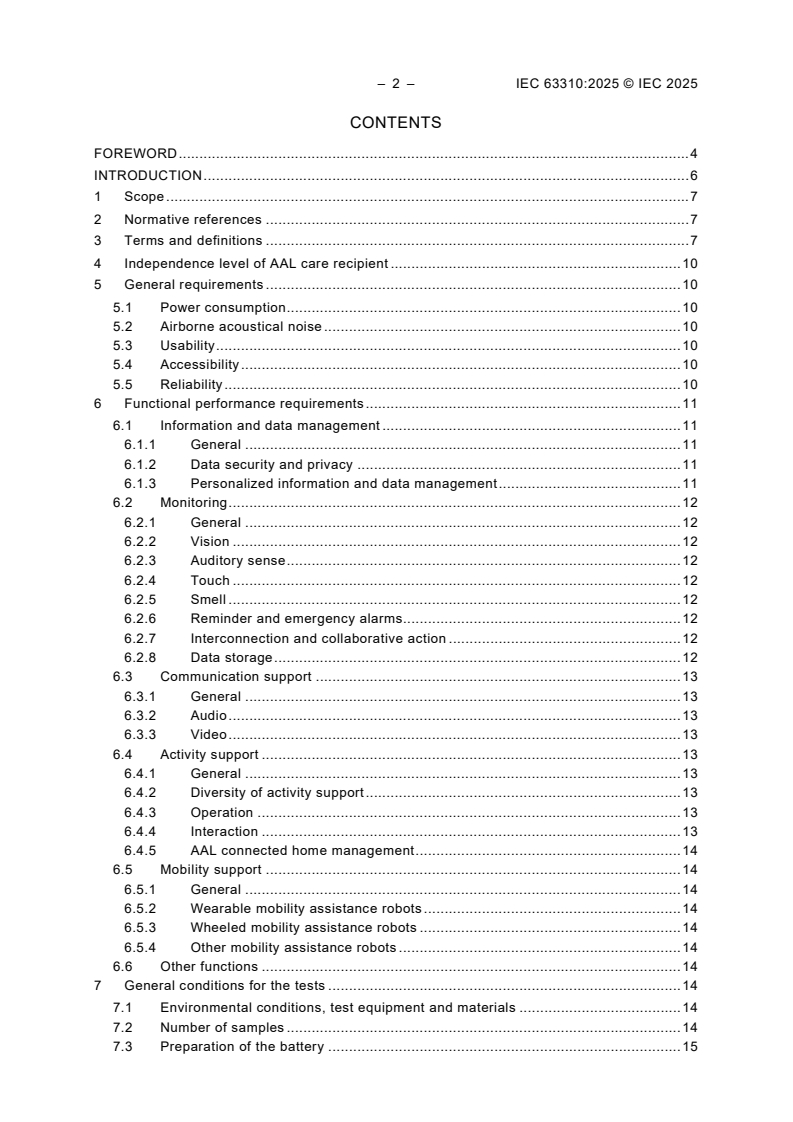
– 2 – IEC 63310:2025 © IEC 2025
CONTENTS
FOREWORD . 4
INTRODUCTION . 6
1 Scope . 7
2 Normative references . 7
3 Terms and definitions . 7
4 Independence level of AAL care recipient . 10
5 General requirements . 10
5.1 Power consumption . 10
5.2 Airborne acoustical noise . 10
5.3 Usability . 10
5.4 Accessibility . 10
5.5 Reliability . 10
6 Functional performance requirements . 11
6.1 Information and data management . 11
6.1.1 General . 11
6.1.2 Data security and privacy . 11
6.1.3 Personalized information and data management . 11
6.2 Monitoring . 12
6.2.1 General . 12
6.2.2 Vision . 12
6.2.3 Auditory sense . 12
6.2.4 Touch . 12
6.2.5 Smell . 12
6.2.6 Reminder and emergency alarms. 12
6.2.7 Interconnection and collaborative action . 12
6.2.8 Data storage . 12
6.3 Communication support . 13
6.3.1 General . 13
6.3.2 Audio . 13
6.3.3 Video . 13
6.4 Activity support . 13
6.4.1 General . 13
6.4.2 Diversity of activity support . 13
6.4.3 Operation . 13
6.4.4 Interaction . 13
6.4.5 AAL connected home management . 14
6.5 Mobility support . 14
6.5.1 General . 14
6.5.2 Wearable mobility assistance robots . 14
6.5.3 Wheeled mobility assistance robots . 14
6.5.4 Other mobility assistance robots . 14
6.6 Other functions . 14
7 General conditions for the tests . 14
7.1 Environmental conditions, test equipment and materials . 14
7.2 Number of samples . 14
7.3 Preparation of the battery . 15
7.4 Robot operation . 15
8 Test methods . 15
9 Test report . 15
10 Instructions for use and training . 16
10.1 Instructions for use . 16
10.2 Training . 16
Annex A (informative) Examples of activities supported by AAL robots . 17
Annex B (informative) Relevant existing ISO/IEC International Standards . 18
Bibliography . 20
– 4 – IEC 63310:2025 © IEC 2025
INTERNATIONAL ELECTROTECHNICAL COMMISSION
____________
FUNCTIONAL PERFORMANCE CRITERIA FOR AAL ROBOTS USED IN THE
CONNECTED HOME ENVIRONMENT
FOREWORD
1) The International Electrotechnical Commission (IEC) is a worldwide organization for standardization comprising
all national electrotechnical committees (IEC National Committees). The object of IEC is to promote international
co-operation on all questions concerning standardization in the electrical and electronic fields. To this end and
in addition to other activities, IEC publishes International Standards, Technical Specifications, Technical Reports,
Publicly Available Specifications (PAS) and Guides (hereafter referred to as “IEC Publication(s)”). Their
preparation is entrusted to technical committees; any IEC National Committee interested in the subject dealt with
may participate in this preparatory work. International, governmental and non-governmental organizations liaising
with the IEC also participate in this preparation. IEC collaborates closely with the International Organization for
Standardization (ISO) in accordance with conditions determined by agreement between the two organizations.
2) The formal decisions or agreements of IEC on technical matters express, as nearly as possible, an international
consensus of opinion on the relevant subjects since each technical committee has representation from all
interested IEC National Committees.
3) IEC Publications have the form of recommendations for international use and are accepted by IEC National
Committees in that sense. While all reasonable efforts are made to ensure that the technical content of IEC
Publications is accurate, IEC cannot be held responsible for the way in which they are used or for any
misinterpretation by any end user.
4) In order to promote international uniformity, IEC National Committees undertake to apply IEC Publications
transparently to the maximum extent possible in their national and regional publications. Any divergence between
any IEC Publication and the corresponding national or regional publication shall be clearly indicated in the latter.
5) IEC itself does not provide any attestation of conformity. Independent certification bodies provide conformity
assessment services and, in some areas, access to IEC marks of conformity. IEC is not responsible for any
services carried out by independent certification bodies.
6) All users should ensure that they have the latest edition of this publication.
7) No liability shall attach to IEC or its directors, employees, servants or agents including individual experts and
members of its technical committees and IEC National Committees for any personal injury, property damage or
other damage of any nature whatsoever, whether direct or indirect, or for costs (including legal fees) and
expenses arising out of the publication, use of, or reliance upon, this IEC Publication or any other IEC
Publications.
8) Attention is drawn to the Normative references cited in this publication. Use of the referenced publications is
indispensable for the correct application of this publication.
9) IEC draws attention to the possibility that the implementation of this document may involve the use of (a)
patent(s). IEC takes no position concerning the evidence, validity or applicability of any claimed patent rights in
respect thereof. As of the date of publication of this document, IEC had not received notice of (a) patent(s), which
may be required to implement this document. However, implementers are cautioned that this may not represent
the latest information, which may be obtained from the patent database available at https://patents.iec.ch. IEC
shall not be held responsible for identifying any or all such patent rights.
IEC 63310 has been prepared by IEC SyC AAL: Systems Committee on Active Assisted Living.
It is an International Standard.
The text of this International Standard is based on the following documents:
Draft Report on voting
SyCAAL/375/FDIS SyCAAL/379/RVD
Full information on the voting for its approval can be found in the report on voting indicated in
the above table.
The language used for the development of this International Standard is English.
This document was drafted in accordance with ISO/IEC Directives, Part 2, and developed in
accordance with ISO/IEC Directives, Part 1 and ISO/IEC Directives, IEC Supplement, available
at www.iec.ch/members_experts/refdocs. The main document types developed by IEC are
described in greater detail at www.iec.ch/publications.
The committee has decided that the contents of this document will remain unchanged until the
stability date indicated on the IEC website under webstore.iec.ch in the data related to the
specific document. At this date, the document will be
• reconfirmed,
• withdrawn, or
• revised.
– 6 – IEC 63310:2025 © IEC 2025
INTRODUCTION
The purpose of this document is to consider the needs and characteristics of an active assisted
living (AAL) user and to integrate these into the development, design and evaluation of an AAL
robot for use in the connected home environment (CHE).
With the increase of the global population aging, it is going to be increasingly difficult for family
members or healthcare workers to adequately undertake home care duty. Personal service
robots could be an option for addressing the resulting bottleneck in daily life and health care by
supporting the independent living of the AAL user in their connected home environment. From
a market perspective, global sales of robots have been increasing in recent years and this is
expected to continue in the future. More and more autonomous robotic systems have been used
widely by consumers in the home environment, especially in the AAL connected home
environment (CHE). However, the gap analysis of standards shows that the current robots'
functional performance standards do not focus on the characteristics and needs of the AAL
user.
It is within the scope and responsibility of IEC SyC AAL to consider the needs and
characteristics of the AAL user and to integrate these into AAL standardization work.
This document will make it possible to recognize and define AAL robots’ function and
performance and specific technical requirements in the CHE. This document will provide criteria
and guidelines for the products design, testing and certification, and help to improve the quality
of the robot products. AAL robots can be subject to additional relevant regulations and
standards.
As a result, by providing AAL robots to the market that are in accordance with this document,
the following benefits will be achieved:
• assist the AAL users (including AAL care recipients) to live more independently in their
homes;
• increase AAL robots’ market acceptance;
• facilitate AAL robots’ industry scale acceptance.
FUNCTIONAL PERFORMANCE CRITERIA FOR AAL ROBOTS USED IN THE
CONNECTED HOME ENVIRONMENT
1 Scope
This document deals with the functional performance criteria and guidelines for robots intended
for use in the active assisted living connected home environment (AAL CHE).
This document does not cover safety requirements of robots.
This document is applicable to robots which provide the AAL user (or AAL care recipient) with
one or more of the following services and support in the AAL CHE:
– information and data management;
– monitoring service;
– communication support;
– activity support;
– mobility support;
– other support.
AAL robots can be subject to additional relevant regulations and standards.
This document is not applicable to robots used for medical purposes.
2 Normative references
The following documents are referred to in the text in such a way that some or all of their content
constitutes requirements of this document. For dated references, only the edition cited applies.
For undated references, the latest edition of the referenced document (including any
amendments) applies.
IEC 60050-871, International Electrotechnical Vocabulary – Part 871: Active Assisted Living
(AAL), available at https://www.electropedia.org
3 Terms and definitions
For the purposes of this document, the terms and definitions given in IEC 60050-871 and the
following apply.
ISO and IEC maintain terminology databases for use in standardization at the following
addresses:
• IEC Electropedia: available at https://www.electropedia.org/
• ISO Online browsing platform: available at https://www.iso.org/obp
– 8 – IEC 63310:2025 © IEC 2025
3.1
AAL
active assisted living
concepts, products, services, and systems combining technologies and social environment with
the aim of improving the quality of people's lives
[SOURCE: IEC 60050-871:2018, 871-01-02]
3.2
AAL user
person who uses or benefits from, or uses and benefits from, AAL devices, systems or services
[SOURCE: IEC 60050-871:2018, 871-02-05, modified – The term "active assisted living user"
has been omitted.]
3.3
AAL care recipient
person who receives and consumes AAL care services
Note 1 to entry: The concept denoted by the term "AAL user" (IEV 871-02-05) includes a wider range of people,
including people who do not necessarily require AAL care services.
[SOURCE: IEC 60050-871:2023, 871-02-18]
3.4
connected home environment
CHE
home environment that provides a home network (IEV 732-10-01) so that devices within the
home can communicate to one another and to devices outside the home
Note 1 to entry: AAL connected homes and smart homes share some commonalities.
[SOURCE: IEC 60050-871:2023, 871-05-10, modified – The abbreviated term "CHE" has been
added.]
3.5
robot
programmed actuated mechanism with a degree of autonomy to perform locomotion,
manipulation or positioning
Note 1 to entry: A robot includes the control system.
Note 2 to entry: Examples of mechanical structure of robots are manipulator, mobile platform and wearable robot.
[SOURCE: ISO 8373:2021, 3.1]
3.6
AAL robot
robot or robot system that provides AAL users with such services as monitoring, communication
support, activity support, mobility support, and information and data management
3.7
functional performance
characteristics defining the ability of the products or systems to achieve the intended functions
for which the products or systems are intended to be used
3.8
usability
extent to which a product can be used by specified users to achieve specified goals with
effectiveness, efficiency and satisfaction in a specified context of use
[SOURCE: IEC 60050-871:2018, 871-01-08]
3.9
accessibility
extent to which products, systems, services, environments and facilities can be used by people
from a population with the widest range of user needs, characteristics and capabilities to
achieve identified goals in identified contexts of use
Note 1 to entry: Context of use includes direct use or use supported by assistive technologies.
[SOURCE: IEC 60050-872:2022, 872-04-01]
3.10
reliability
ability to perform as required, without failure, for a given time interval, under given conditions
Note 1 to entry: The time interval duration can be expressed in units appropriate to the item concerned, e.g.
calendar time, operating cycles, distance run, etc., and the units should always be clearly stated.
Note 2 to entry: Given conditions include aspects that affect reliability, such as: mode of operation, stress levels,
environmental conditions, and maintenance.
Note 3 to entry: Reliability can be quantified using measures defined in Section 192-05, Reliability rel
...