

IEC TR 63094:2017
(Main)Multimedia systems and equipment - Multimedia signal transmission - Dependable line code with error correction
General Information
- Abstract
IEC TR 63094:2017(E) specifies the line code 4b/10b for dependable multimedia signal transmission required for complex machines, such as robots and automobiles. This document corresponds to the functions specified in layer 1 to layer 2 of the OSI reference model (ISO/IEC 7498).
The purpose of this document is to facilitate the development and use of the 4b/10b in dependable systems by providing a line code protocol. This document provides a line code protocol for interconnections among distributed real-time systems, including embedded systems, control systems, amusement systems, robot systems, and intelligent buildings. The 4b/10b can achieve the line code with ECC (error code correction).
- Status
- Published
- Publication Date
- 18-Jun-2017
- Technical Committee
- TC 100 - Audio, video and multimedia systems and equipment
- Current Stage
- PPUB - Publication issued
- Start Date
- 19-Jun-2017
- Completion Date
- 22-May-2017
Overview
IEC TR 63094:2017 - "Multimedia systems and equipment - Multimedia signal transmission - Dependable line code with error correction" - defines the 4b/10b line code for dependable multimedia signal transmission. The technical report targets layer‑1 to layer‑2 functions of the OSI model (ISO/IEC 7498) and provides a line‑code protocol tailored for distributed real‑time systems (embedded systems, control/robot systems, automobiles, intelligent buildings, amusement systems). The 4b/10b codec adds embedded clock, DC balance, error detection and error correction to enable low‑latency, noise‑tolerant links without retransmission.
Key topics and technical requirements
- 4b/10b line code definition: mapping of 4‑bit data into 10‑bit transmission symbols to support reliable serial links.
- Forward error correction (FEC): integrated error correction capability at the line‑code level to avoid upper‑layer retransmits for real‑time traffic.
- Embedded clock: clock recovery characteristics to support synchronous reception over serial links.
- DC balance: maintenance of running disparity to limit baseline wander and support AC‑coupled channels.
- Frame format and control words: specification of frame structure, setup and idle commands for link management.
- Encoding / decoding and error handling: procedures for symbol encoding/decoding and corrective measures for 1‑bit and 2‑bit errors (with guidance on larger error events).
- Real‑time considerations: guidance (Annex A) on scheduling impacts, worst‑case response time and the need for pre‑emptive/low‑latency communication to meet hard timing (examples include servo loops ≤1 ms and packet exchange latencies measured in microseconds).
- Implementation guidance: informative annexes on clock characteristics, DC balance, and decoder implementation.
Practical applications
IEC TR 63094:2017 is intended where dependable, low‑latency, noise‑resistant serial links are required:
- Distributed robot controllers and actuators (humanoid robots with tight servo cycles).
- Automotive in‑vehicle networks where retransmission is unacceptable for safety/real‑time control.
- Industrial automation and factory floor I/O where deterministic response times matter.
- Intelligent building systems, amusement systems, and embedded multimedia interconnects.
Using 4b/10b allows designers to reduce reliance on higher‑layer block ECC schemes (which can increase latency) by delivering line‑level error correction suitable for real‑time systems.
Who should use this standard
- Embedded systems and firmware engineers
- Hardware/interface designers (PHY/link layer)
- System architects for robotics, automotive and industrial control
- Test and validation engineers focused on deterministic latency and noise resilience
Related standards
- ISO/IEC 7498 (OSI reference model - layers 1–2)
- ISO/IEC 24740 (Responsive Link – pre‑emptive communication)
- Comparative line codes: 8b/10b (used in PCIe, USB3, SATA, IEEE1394b, 10GbE) - 4b/10b offers added line‑level ECC for noisier, real‑time environments.
Keywords: IEC TR 63094:2017, 4b/10b, line code, error correction, embedded clock, DC balance, multimedia signal transmission, real‑time communications, dependable link.
Get Certified
Connect with accredited certification bodies for this standard

BSI Group
BSI (British Standards Institution) is the business standards company that helps organizations make excellence a habit.

NYCE
Mexican standards and certification body.

ANCE
Mexican certification and testing association.
Sponsored listings
Frequently Asked Questions
IEC TR 63094:2017 is a technical report published by the International Electrotechnical Commission (IEC). Its full title is "Multimedia systems and equipment - Multimedia signal transmission - Dependable line code with error correction". This standard covers: IEC TR 63094:2017(E) specifies the line code 4b/10b for dependable multimedia signal transmission required for complex machines, such as robots and automobiles. This document corresponds to the functions specified in layer 1 to layer 2 of the OSI reference model (ISO/IEC 7498). The purpose of this document is to facilitate the development and use of the 4b/10b in dependable systems by providing a line code protocol. This document provides a line code protocol for interconnections among distributed real-time systems, including embedded systems, control systems, amusement systems, robot systems, and intelligent buildings. The 4b/10b can achieve the line code with ECC (error code correction).
IEC TR 63094:2017(E) specifies the line code 4b/10b for dependable multimedia signal transmission required for complex machines, such as robots and automobiles. This document corresponds to the functions specified in layer 1 to layer 2 of the OSI reference model (ISO/IEC 7498). The purpose of this document is to facilitate the development and use of the 4b/10b in dependable systems by providing a line code protocol. This document provides a line code protocol for interconnections among distributed real-time systems, including embedded systems, control systems, amusement systems, robot systems, and intelligent buildings. The 4b/10b can achieve the line code with ECC (error code correction).
IEC TR 63094:2017 is classified under the following ICS (International Classification for Standards) categories: 33.160.60 - Multimedia systems and teleconferencing equipment; 35.110 - Networking. The ICS classification helps identify the subject area and facilitates finding related standards.
IEC TR 63094:2017 is available in PDF format for immediate download after purchase. The document can be added to your cart and obtained through the secure checkout process. Digital delivery ensures instant access to the complete standard document.
Standards Content (Sample)
IEC TR 63094 ®
Edition 1.0 2017-06
TECHNICAL
REPORT
colour
inside
Multimedia systems and equipment – Multimedia signal transmission –
Dependable line code with error correction
All rights reserved. Unless otherwise specified, no part of this publication may be reproduced or utilized in any form
or by any means, electronic or mechanical, including photocopying and microfilm, without permission in writing from
either IEC or IEC's member National Committee in the country of the requester. If you have any questions about IEC
copyright or have an enquiry about obtaining additional rights to this publication, please contact the address below or
your local IEC member National Committee for further information.
IEC Central Office Tel.: +41 22 919 02 11
3, rue de Varembé Fax: +41 22 919 03 00
CH-1211 Geneva 20 info@iec.ch
Switzerland www.iec.ch
About the IEC
The International Electrotechnical Commission (IEC) is the leading global organization that prepares and publishes
International Standards for all electrical, electronic and related technologies.
About IEC publications
The technical content of IEC publications is kept under constant review by the IEC. Please make sure that you have the
latest edition, a corrigenda or an amendment might have been published.
colour
inside
IEC Catalogue - webstore.iec.ch/catalogue Electropedia - www.electropedia.org
The stand-alone application for consulting the entire The world's leading online dictionary of electronic and
bibliographical information on IEC International Standards, electrical terms containing 20 000 terms and definitions in
Technical Specifications, Technical Reports and other English and French, with equivalent terms in 16 additional
documents. Available for PC, Mac OS, Android Tablets and languages. Also known as the International Electrotechnical
iPad. Vocabulary (IEV) online.
IEC publications search - www.iec.ch/searchpub IEC Glossary - std.iec.ch/glossary
The advanced search enables to find IEC publications by a 65 000 electrotechnical terminology entries in English and
variety of criteria (reference number, text, technical French extracted from the Terms and Definitions clause of
committee,…). It also gives information on projects, replaced IEC publications issued since 2002. Some entries have been
and withdrawn publications. collected from earlier publications of IEC TC 37, 77, 86 and
CISPR.
IEC Just Published - webstore.iec.ch/justpublished
Stay up to date on all new IEC publications. Just Published IEC Customer Service Centre - webstore.iec.ch/csc
details all new publications released. Available online and If you wish to give us your feedback on this publication or
also once a month by email. need further assistance, please contact the Customer Service
Centre: csc@iec.ch.
IEC TR 63094 ®
Edition 1.0 2017-06
TECHNICAL
REPORT
colour
inside
Multimedia systems and equipment – Multimedia signal transmission –
Dependable line code with error correction
INTERNATIONAL
ELECTROTECHNICAL
COMMISSION
ICS 33.160.60; 35.110 ISBN 978-2-8322-4337-4
– 2 – IEC TR 63094:2017 © IEC 2017
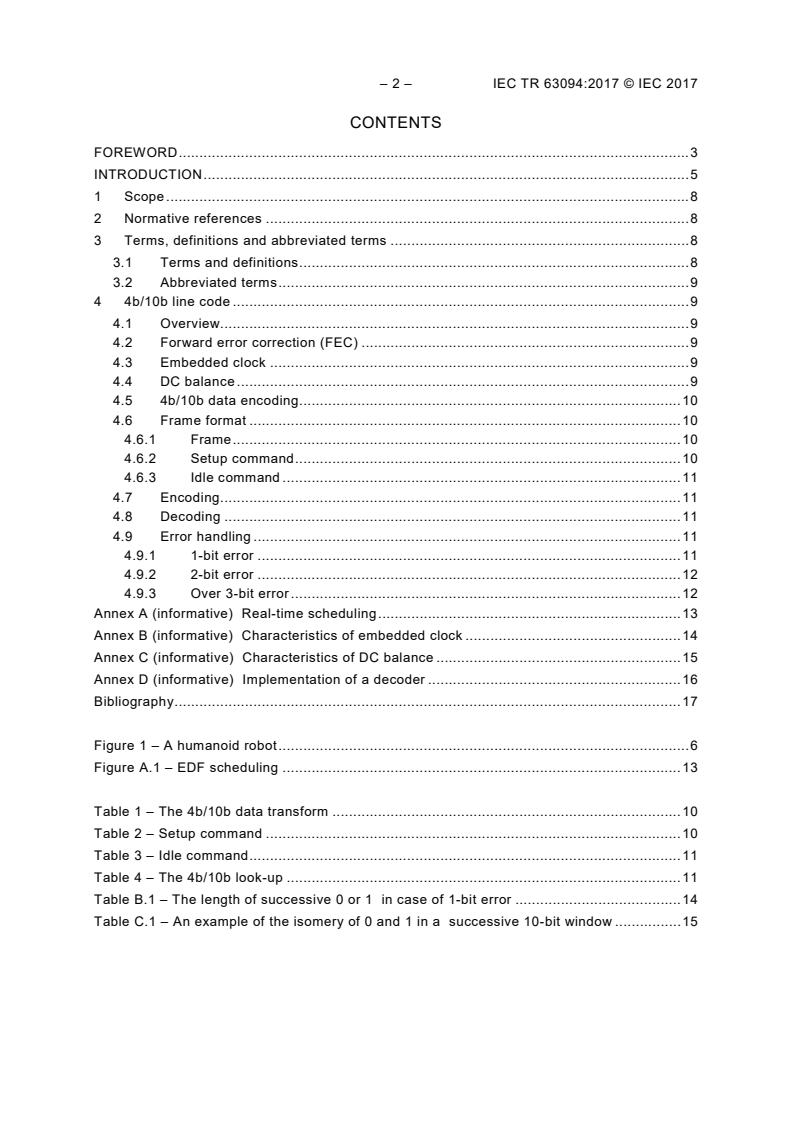
CONTENTS
FOREWORD . 3
INTRODUCTION . 5
1 Scope . 8
2 Normative references . 8
3 Terms, definitions and abbreviated terms . 8
3.1 Terms and definitions . 8
3.2 Abbreviated terms . 9
4 4b/10b line code . 9
4.1 Overview. 9
4.2 Forward error correction (FEC) . 9
4.3 Embedded clock . 9
4.4 DC balance . 9
4.5 4b/10b data encoding. 10
4.6 Frame format . 10
4.6.1 Frame . 10
4.6.2 Setup command . 10
4.6.3 Idle command . 11
4.7 Encoding. 11
4.8 Decoding . 11
4.9 Error handling . 11
4.9.1 1-bit error . 11
4.9.2 2-bit error . 12
4.9.3 Over 3-bit error . 12
Annex A (informative) Real-time scheduling . 13
Annex B (informative) Characteristics of embedded clock . 14
Annex C (informative) Characteristics of DC balance . 15
Annex D (informative) Implementation of a decoder . 16
Bibliography . 17
Figure 1 – A humanoid robot . 6
Figure A.1 – EDF scheduling . 13
Table 1 – The 4b/10b data transform . 10
Table 2 – Setup command . 10
Table 3 – Idle command . 11
Table 4 – The 4b/10b look-up . 11
Table B.1 – The length of successive 0 or 1 in case of 1-bit error . 14
Table C.1 – An example of the isomery of 0 and 1 in a successive 10-bit window . 15
INTERNATIONAL ELECTROTECHNICAL COMMISSION
____________
MULTIMEDIA SYSTEMS AND EQUIPMENT –
MULTIMEDIA SIGNAL TRANSMISSION –
DEPENDABLE LINE CODE WITH ERROR CORRECTION
FOREWORD
1) The International Electrotechnical Commission (IEC) is a worldwide organization for standardization comprising
all national electrotechnical committees (IEC National Committees). The object of IEC is to promote
international co-operation on all questions concerning standardization in the electrical and electronic fields. To
this end and in addition to other activities, IEC publishes International Standards, Technical Specifications,
Technical Reports, Publicly Available Specifications (PAS) and Guides (hereafter referred to as “IEC
Publication(s)”). Their preparation is entrusted to technical committees; any IEC National Committee interested
in the subject dealt with may participate in this preparatory work. International, governmental and non-
governmental organizations liaising with the IEC also participate in this preparation. IEC collaborates closely
with the International Organization for Standardization (ISO) in accordance with conditions determined by
agreement between the two organizations.
2) The formal decisions or agreements of IEC on technical matters express, as nearly as possible, an international
consensus of opinion on the relevant subjects since each technical committee has representation from all
interested IEC National Committees.
3) IEC Publications have the form of recommendations for international use and are accepted by IEC National
Committees in that sense. While all reasonable efforts are made to ensure that the technical content of IEC
Publications is accurate, IEC cannot be held responsible for the way in which they are used or for any
misinterpretation by any end user.
4) In order to promote international uniformity, IEC National Committees undertake to apply IEC Publications
transparently to the maximum extent possible in their national and regional publications. Any divergence
between any IEC Publication and the corresponding national or regional publication shall be clearly indicated in
the latter.
5) IEC itself does not provide any attestation of conformity. Independent certification bodies provide conformity
assessment services and, in some areas, access to IEC marks of conformity. IEC is not responsible for any
services carried out by independent certification bodies.
6) All users should ensure that they have the latest edition of this publication.
7) No liability shall attach to IEC or its directors, employees, servants or agents including individual experts and
members of its technical committees and IEC National Committees for any personal injury, property damage or
other damage of any nature whatsoever, whether direct or indirect, or for costs (including legal fees) and
expenses arising out of the publication, use of, or reliance upon, this IEC Publication or any other IEC
Publications.
8) Attention is drawn to the Normative references cited in this publication. Use of the referenced publications is
indispensable for the correct application of this publication.
9) Attention is drawn to the possibility that some of the elements of this IEC Publication may be the subject of
patent rights. IEC shall not be held responsible for identifying any or all such patent rights.
The main task of IEC technical committees is to prepare International Standards. However, a
technical committee may propose the publication of a technical report when it has collected
data of a different kind from that which is normally published as an International Standard, for
example "state of the art".
IEC TR 63094, which is a technical report, has been prepared by IEC technical committee 100:
Audio, video and multimedia systems and equipment.
The text of this technical report is based on the following documents:
Enquiry draft Report on voting
100/2823A/DTR 100/2871/RVDTR
Full information on the voting for the approval of this technical report can be found in the
report on voting indicated in the above table.
– 4 – IEC TR 63094:2017 © IEC 2017
This document has been drafted in accordance with the ISO/IEC Directives, Part 2.
The committee has decided that the contents of this document will remain unchanged until the
stability date indicated on the IEC website under "http://webstore.iec.ch" in the data related to
the specific document. At this date, the document will be
• reconfirmed,
• withdrawn,
• replaced by a revised edition, or
• amended.
A bilingual version of this publication may be issued at a later date.
IMPORTANT – The 'colour inside' logo on the cover page of this publication indicates
that it contains colours which are considered to be useful for the correct
understanding of its contents. Users should therefore print this document using a
colour printer.
INTRODUCTION
This document defines a line code that incorporates error correction capability to
communicate reliably among multimedia components, I/O peripherals and computers. A
number of complex multimedia machines, in particular robots, automobiles, and network
routers, have a growing demand for distributed processing. In addition, modernization of
facilities such as factories, offices, schools, and homes is creating a ubiquitous and
multimedia computing environment. Unlike conventional PC applications for documentation
and Internet applications that exchange texts without hard time constraints, these types of
cooperative computing require reliable real-time responses to physical events occurring in the
real world. In order for distributed nodes to cooperate in real-time, an interconnecting network
shall realize real-time and dependable communication without re-sending on noisy
environments. The 4b/10b provides a dependable line code for such real-time
communications between multimedia components, I/O peripherals and/or computers by
providing embedded clock, DC balance, error detection and error correction features.
The real-time aspect means that the exactness of the system including operations and
communications depends not only on the result, but also on the time it took to achieve the
result. In the narrow sense, the real-time aspect means that the time constraint, including
deadlines or cycles, must be met.
Real-time tasks with the time constraints are generally scheduled and executed by a real-time
scheduler and a real-time operating system. Most real-time scheduling algorithms assume
that the WCET (worst-case execution time) of each task is given. A real-time scheduling
algorithm converts a time constraint of each real-time task to a priority. Most real-time
operating systems based on such real-time schedulers pre-empt and execute tasks in order of
priority at every tick to meet the time constraint.
As real-time scheduling algorithms, the earliest deadline first (EDF) scheduler, the rate
monotonic (RM) scheduler, and their variations have been established, as explained in Annex
A. These algorithms commonly schedule tasks based on priorities determined by the time
constraints.
Most real-time scheduling algorithms assume that the WCRT (worst-case response time) of
each communication packet is given in case of communication. In order to apply real-time
scheduling algorithms to real-time communications, pre-emptive communication, which is
achieved by Responsive Link (ISO/IEC 24740), and the error correction capability to prevent
the re-sending a broken packet are required.
A line code is a lowest-level communication protocol on a communication line. Most current
line codes have a few typical functions including embedded clock, DC balance and basic error
detection features. The 8b/10b codec is a major example, which is used for PCI Express, USB
3.0, SATA, IEEE1394b, and 10GbE. But no conventional line code has an error correction
capability.
When an encoded code (a 10b code) is broken during communication, the multi-bits of the
decoded code (the 8b code) are corrupted. In other words, when a single bit error occurs in
an encoded 10-bit code, the decoded 8-bit code (a byte) is completely broken.
When an error is detected on the decoder, the broken data is normally re-transmitted under
an upper-level communication protocol. However, re-transmission is not allowed in order to
realize real-time communication.
It is hard for a bit-level error correction code that includes the Hamming code and the BCH
code to incorporate error correction capability, because multi-bits of the decoded code are
broken even if a single-bit error occurs on the encoded code.
– 6 – IEC TR 63094:2017 © IEC 2017
In order to incorporate error correction capability on the 8b/10b codec, a block-level error
correction including RS (Reed-Solomon) is required as a large packet-level error correction.
But the block-level error correction is not suitable for real-time communication, because the
communication latency becomes longer as it is impossible to correct the corrupted data until
all corresponding packets are received.
The line code 4b/10b has the following distinctive features for real
...