

IEC 61204:1993
(Main)Low-voltage power supply devices, d.c. output - Performance characteristics
General Information
- Abstract
Describes a method of specifying requirements for low-voltage power supply devices (including switching types) providing d.c. output(s) up to 200 V d.c. at a power level up to 30 kW, operating from a.c. or d.c. source voltages of up to 600 V. The devices are for use within class I equipment or for free-standing operation when used with adequate electrical and mechanical protection, except for medical applications and toys, where special considerations apply.
- Status
- Published
- Publication Date
- 07-May-2001
- Technical Committee
- SC 22E - Stabilized power supplies
- Drafting Committee
- WG 1 - TC 22/SC 22E/WG 1
- Current Stage
- PPUB - Publication issued
- Start Date
- 15-Feb-1993
- Completion Date
- 28-Aug-2026
Overview
IEC 61204:1993 is an international standard developed by the International Electrotechnical Commission (IEC) that specifies performance characteristics for low-voltage power supply devices with direct current (d.c.) outputs. It covers power supplies providing outputs up to 200 V d.c., with power levels up to 30 kW, and operating from alternating current (a.c.) or direct current (d.c.) sources up to 600 V. The standard applies to power supplies used either within class I equipment or as free-standing units with proper electrical and mechanical protection. Notably, this standard excludes medical devices and toys, which have specialized requirements.
This standard is essential for manufacturers, designers, and users of low-voltage d.c. power supplies, ensuring consistent quality, reliability, and safety in their performance.
Key Topics
Performance Characteristics
IEC 61204 defines key performance parameters for low-voltage d.c. power supplies, including:
- Rated output voltages and total output power
- Ambient operating, storage, and transportation temperature ranges
- Source voltage and frequency tolerances
- Source current specifications
- Source effect (source voltage regulation) and load effect (load regulation)
- Output voltage tolerance and adjustability
- Periodic and random output voltage deviations
- Cross regulation (interaction effects between multiple outputs)
- Temperature coefficients affecting output stability
- Hold-up time (ability to maintain output during input power interruptions)
- Start-up time and transient responses to load changes
- Overvoltage and overcurrent protection mechanisms
- Mean time between failures (MTBF), supporting reliability assessments
Protective Devices and Safety
The standard covers requirements for protective features to ensure safe operation, such as thermal protection and input overcurrent protection devices that prevent damage under fault conditions.
Additional Functional and Operational Features
IEC 61204 also addresses supplementary requirements including:
- Remote programming and control capabilities
- Remote sensing to compensate for voltage drops
- Mechanical characteristics supporting durability
- Parallel and series operation of power supplies
- Monitoring and control signal interfaces
- Acoustic noise limits ensuring minimal environmental interference
Testing and Markings
The standard prescribes environmental and performance tests to verify compliance. Furthermore, it establishes marking and instructional requirements that provide clear product identification and usage guidelines.
Applications
IEC 61204:1993 is applicable across a broad range of industries and applications that utilize low-voltage d.c. power supplies, such as:
- Industrial automation systems requiring stable d.c. power sources
- Telecommunications equipment demanding reliable power supply with remote control features
- Laboratory power supplies where precise voltage adjustability and fast transient response are critical
- Consumer electronics and embedded systems employing switching power supplies
- Free-standing power units with built-in protections for standalone or embedded use
By adhering to this standard, manufacturers ensure their power supply devices meet internationally accepted performance benchmarks, enhancing interoperability, safety, and user confidence.
Related Standards
Professionals working with IEC 61204:1993 may also find the following standards relevant:
- IEC 60950 (Safety of information technology equipment) - relates to protection and safety of electronic components used with power supplies
- IEC 61000 series (Electromagnetic compatibility) - addresses compatibility of power supplies with surrounding electronic systems
- IEC 61558 (Safety of power transformers and power supply units) - covers safety requirements that complement performance characteristics
- IEC 60038 (Standard voltages) - defines standard voltage levels that intersect with power supply specifications
Understanding related IEC standards helps ensure comprehensive compliance and integration within the electrical and electronic ecosystem.
Keywords: IEC 61204, low-voltage power supply devices, d.c. output performance, power supply standards, switching power supplies, output voltage regulation, overvoltage protection, overcurrent protection, remote programming, power supply reliability, IEC standards.
Relations
- Effective Date
- 05-Sep-2023
Get Certified
Connect with accredited certification bodies for this standard

IMQ S.p.A. (Certification)
Italian electrical product certification.

SLG Prüf- und Zertifizierungs GmbH
German testing and certification body.

UL Solutions
Global safety science company with testing, inspection and certification.
Sponsored listings
Frequently Asked Questions
IEC 61204:1993 is a standard published by the International Electrotechnical Commission (IEC). Its full title is "Low-voltage power supply devices, d.c. output - Performance characteristics". This standard covers: Describes a method of specifying requirements for low-voltage power supply devices (including switching types) providing d.c. output(s) up to 200 V d.c. at a power level up to 30 kW, operating from a.c. or d.c. source voltages of up to 600 V. The devices are for use within class I equipment or for free-standing operation when used with adequate electrical and mechanical protection, except for medical applications and toys, where special considerations apply.
Describes a method of specifying requirements for low-voltage power supply devices (including switching types) providing d.c. output(s) up to 200 V d.c. at a power level up to 30 kW, operating from a.c. or d.c. source voltages of up to 600 V. The devices are for use within class I equipment or for free-standing operation when used with adequate electrical and mechanical protection, except for medical applications and toys, where special considerations apply.
IEC 61204:1993 is classified under the following ICS (International Classification for Standards) categories: 29.200 - Rectifiers. Convertors. Stabilized power supply. The ICS classification helps identify the subject area and facilitates finding related standards.
IEC 61204:1993 has the following relationships with other standards: It is inter standard links to IEC 61204:1993/AMD1:2001. Understanding these relationships helps ensure you are using the most current and applicable version of the standard.
IEC 61204:1993 is available in PDF format for immediate download after purchase. The document can be added to your cart and obtained through the secure checkout process. Digital delivery ensures instant access to the complete standard document.
Standards Content (Sample)
IEC 61204 ®
Edition 1.1 2001-05
CONSOLIDATED VERSION
INTERNATIONAL
STANDARD
NORME
INTERNATIONALE
Low-voltage power supply devices, d.c. output – Performance characteristics
Dispositifs d’alimentation à basse tension à sortie en courant continu –
Caractéristiques de fonctionnement
All rights reserved. Unless otherwise specified, no part of this publication may be reproduced or utilized in any form
or by any means, electronic or mechanical, including photocopying and microfilm, without permission in writing from
either IEC or IEC's member National Committee in the country of the requester. If you have any questions about IEC
copyright or have an enquiry about obtaining additional rights to this publication, please contact the address below or
your local IEC member National Committee for further information.
Droits de reproduction réservés. Sauf indication contraire, aucune partie de cette publication ne peut être reproduite
ni utilisée sous quelque forme que ce soit et par aucun procédé, électronique ou mécanique, y compris la photocopie
et les microfilms, sans l'accord écrit de l'IEC ou du Comité national de l'IEC du pays du demandeur. Si vous avez des
questions sur le copyright de l'IEC ou si vous désirez obtenir des droits supplémentaires sur cette publication, utilisez
les coordonnées ci-après ou contactez le Comité national de l'IEC de votre pays de résidence.
IEC Central Office Tel.: +41 22 919 02 11
3, rue de Varembé Fax: +41 22 919 03 00
CH-1211 Geneva 20 info@iec.ch
Switzerland www.iec.ch
About the IEC
The International Electrotechnical Commission (IEC) is the leading global organization that prepares and publishes
International Standards for all electrical, electronic and related technologies.
About IEC publications
The technical content of IEC publications is kept under constant review by the IEC. Please make sure that you have the
latest edition, a corrigenda or an amendment might have been published.
IEC Catalogue - webstore.iec.ch/catalogue Electropedia - www.electropedia.org
The stand-alone application for consulting the entire The world's leading online dictionary of electronic and
bibliographical information on IEC International Standards, electrical terms containing 20 000 terms and definitions in
Technical Specifications, Technical Reports and other English and French, with equivalent terms in 15 additional
documents. Available for PC, Mac OS, Android Tablets and languages. Also known as the International Electrotechnical
iPad. Vocabulary (IEV) online.
IEC publications search - www.iec.ch/searchpub IEC Glossary - std.iec.ch/glossary
The advanced search enables to find IEC publications by a 65 000 electrotechnical terminology entries in English and
variety of criteria (reference number, text, technical French extracted from the Terms and Definitions clause of
committee,…). It also gives information on projects, replaced IEC publications issued since 2002. Some entries have been
and withdrawn publications. collected from earlier publications of IEC TC 37, 77, 86 and
CISPR.
IEC Just Published - webstore.iec.ch/justpublished
Stay up to date on all new IEC publications. Just Published IEC Customer Service Centre - webstore.iec.ch/csc
details all new publications released. Available online and If you wish to give us your feedback on this publication or
also once a month by email. need further assistance, please contact the Customer Service
Centre: csc@iec.ch.
A propos de l'IEC
La Commission Electrotechnique Internationale (IEC) est la première organisation mondiale qui élabore et publie des
Normes internationales pour tout ce qui a trait à l'électricité, à l'électronique et aux technologies apparentées.
A propos des publications IEC
Le contenu technique des publications IEC est constamment revu. Veuillez vous assurer que vous possédez l’édition la
plus récente, un corrigendum ou amendement peut avoir été publié.
Catalogue IEC - webstore.iec.ch/catalogue Electropedia - www.electropedia.org
Application autonome pour consulter tous les renseignements
Le premier dictionnaire en ligne de termes électroniques et
bibliographiques sur les Normes internationales,
électriques. Il contient 20 000 termes et définitions en anglais
Spécifications techniques, Rapports techniques et autres
et en français, ainsi que les termes équivalents dans 15
documents de l'IEC. Disponible pour PC, Mac OS, tablettes
langues additionnelles. Egalement appelé Vocabulaire
Android et iPad.
Electrotechnique International (IEV) en ligne.
Recherche de publications IEC - www.iec.ch/searchpub
Glossaire IEC - std.iec.ch/glossary
La recherche avancée permet de trouver des publications IEC
65 000 entrées terminologiques électrotechniques, en anglais
en utilisant différents critères (numéro de référence, texte,
et en français, extraites des articles Termes et Définitions des
comité d’études,…). Elle donne aussi des informations sur les
publications IEC parues depuis 2002. Plus certaines entrées
projets et les publications remplacées ou retirées.
antérieures extraites des publications des CE 37, 77, 86 et
CISPR de l'IEC.
IEC Just Published - webstore.iec.ch/justpublished
Restez informé sur les nouvelles publications IEC. Just Service Clients - webstore.iec.ch/csc
Published détaille les nouvelles publications parues. Si vous désirez nous donner des commentaires sur cette
Disponible en ligne et aussi une fois par mois par email. publication ou si vous avez des questions contactez-nous:
csc@iec.ch.
IEC 61204 ®
Edition 1.1 2001-05
CONSOLIDATED VERSION
INTERNATIONAL
STANDARD
NORME
INTERNATIONALE
Low-voltage power supply devices, d.c. output – Performance characteristics
Dispositifs d’alimentation à basse tension à sortie en courant continu –
Caractéristiques de fonctionnement
INTERNATIONAL
ELECTROTECHNICAL
COMMISSION
COMMISSION
ELECTROTECHNIQUE
INTERNATIONALE
ICS 29.200 ISBN 2-8318-5723-6
– 2 – 61204 © CEI:1993+A1:2001
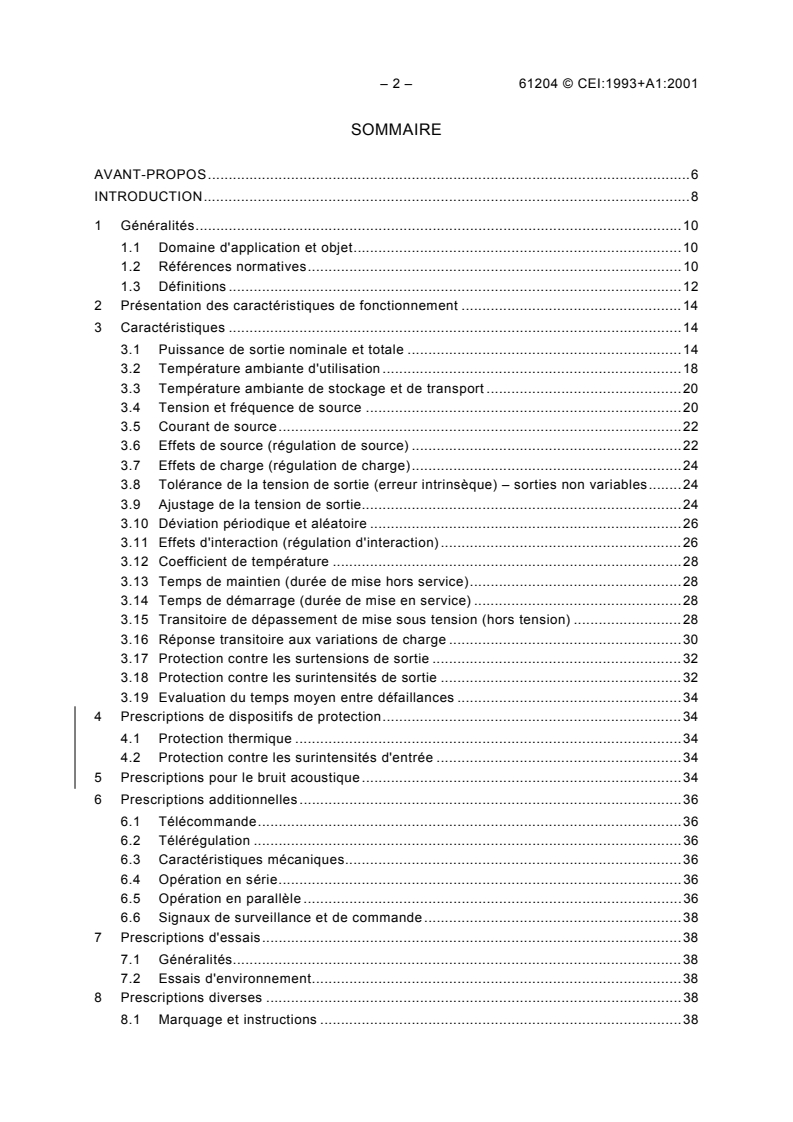
SOMMAIRE
AVANT-PROPOS.6
INTRODUCTION.8
1 Généralités.10
1.1 Domaine d'application et objet.10
1.2 Références normatives.10
1.3 Définitions .12
2 Présentation des caractéristiques de fonctionnement .14
3 Caractéristiques .14
3.1 Puissance de sortie nominale et totale .14
3.2 Température ambiante d'utilisation .18
3.3 Température ambiante de stockage et de transport .20
3.4 Tension et fréquence de source .20
3.5 Courant de source.22
3.6 Effets de source (régulation de source) .22
3.7 Effets de charge (régulation de charge).24
3.8 Tolérance de la tension de sortie (erreur intrinsèque) – sorties non variables.24
3.9 Ajustage de la tension de sortie.24
3.10 Déviation périodique et aléatoire .26
3.11 Effets d'interaction (régulation d'interaction) .26
3.12 Coefficient de température .28
3.13 Temps de maintien (durée de mise hors service).28
3.14 Temps de démarrage (durée de mise en service) .28
3.15 Transitoire de dépassement de mise sous tension (hors tension) .28
3.16 Réponse transitoire aux variations de charge .30
3.17 Protection contre les surtensions de sortie .32
3.18 Protection contre les surintensités de sortie .32
3.19 Evaluation du temps moyen entre défaillances .34
4 Prescriptions de dispositifs de protection.34
4.1 Protection thermique .34
4.2 Protection contre les surintensités d'entrée .34
5 Prescriptions pour le bruit acoustique.34
6 Prescriptions additionnelles.36
6.1 Télécommande.36
6.2 Télérégulation .36
6.3 Caractéristiques mécaniques.36
6.4 Opération en série.36
6.5 Opération en parallèle .36
6.6 Signaux de surveillance et de commande.38
7 Prescriptions d'essais.38
7.1 Généralités.38
7.2 Essais d'environnement.38
8 Prescriptions diverses .38
8.1 Marquage et instructions .38
61204 © IEC:1993+A1:2001 – 3 –
CONTENTS
FOREWORD.7
INTRODUCTION.9
1 General .11
1.1 Scope and object.11
1.2 Normative references .11
1.3 Definitions .13
2 Presentation of performance characteristics .15
3 Performance.15
3.1 Rated outputs and total output power .15
3.2 Ambient operating temperature range.19
3.3 Ambient storage and transit temperature range .21
3.4 Source voltage and frequency .21
3.5 Source current.23
3.6 Source effect (source regulation).23
3.7 Load effect (load regulation).25
3.8 Output voltage tolerance (intrinsic error) – fixed outputs.25
3.9 Adjustability of output voltage.25
3.10 Periodic and random deviation .27
3.11 Interaction effects (cross regulation).27
3.12 Temperature coefficient.29
3.13 Hold-up time (turn-off decay time) .29
3.14 Start-up time (turn-on delay time) .29
3.15 Turn-on (turn-off) overshoot .29
3.16 Transient response to load current changes .31
3.17 Output overvoltage protection.33
3.18 Output overcurrent protection .33
3.19 Mean time between failures (MTBF) .35
4 Requirements for protective devices.35
4.1 Thermal protection .35
4.2 Input overcurrent protection.35
5 Acoustic noise requirements.35
6 Additional requirements.37
6.1 Remote programming (remote control) .37
6.2 Remote sensing .37
6.3 Mechanical characteristics .37
6.4 Series operation .37
6.5 Parallel operation .37
6.6 Monitoring and control signals .39
7 Test requirements .39
7.1 General .39
7.2 Environmental tests.39
8 Miscellaneous requirements .39
8.1 Markings and instructions.39
– 4 – 61204 © CEI:1993+A1:2001
Annexe A (normative) Méthodes de mesure de la déviation périodique et aléatoire.40
Annexe B (normative) Protection contre les surtensions de sortie .46
Annexe C (normative) Protection contre les surintensités de sortie – caractéristiques.48
Annexe D (normative) Opération en parallèle.50
Figure 1 – Connexion d'une charge résistive aux bornes de sortie .30
Figure 2 – Débranchement d'une charge résistive aux bornes de sortie .30
Figure A.1 – Sonde différentielle d'essai .42
Figure A.2 – Circuit d'essai différentiel.42
Figure A.3 – Circuit d'essai sonde de courant .44
Figure C.1 – Protection contre les surintensités de sortie – caractéristiques .48
Tableau 1 – Présentation des caractéristiques de fonctionnement .16
Tableau 2 – Valeurs préférentielles des réponses transitoires.32
61204 © IEC:1993+A1:2001 – 5 –
Annex A (normative) Periodic and random deviation test methods .41
Annex B (normative) Output overvoltage protection .47
Annex C (normative) Overcurrent protection characteristics.49
Annex D (normative) Parallel operation .51
Figure 1 – Resistive load applied at the output terminals .31
Figure 2 – Resistive load removed at the output terminals .31
Figure A.1 – Differential test probe .43
Figure A.2 – Differential test arrangement.43
Figure A.3 – Current probe test arrangement .45
Figure C.1 – Overcurrent protection characteristics .49
Table 1 – Performance characteristics presentation .17
Table 2 – Preferred transient response .33
– 6 – 61204 © CEI:1993+A1:2001
COMMISSION ÉLECTROTECHNIQUE INTERNATIONALE
_________
DISPOSITIFS D'ALIMENTATION
À BASSE TENSION À SORTIE EN COURANT CONTINU –
CARACTÉRISTIQUES DE FONCTIONNEMENT
AVANT-PROPOS
1) La CEI (Commission Électrotechnique Internationale) est une organisation mondiale de normalisation
composée de l'ensemble des comités électrotechniques nationaux (Comités nationaux de la CEI). La CEI a
pour objet de favoriser la coopération internationale pour toutes les questions de normalisation dans les
domaines de l'électricité et de l'électronique. A cet effet, la CEI, entre autres activités, publie des Normes
internationales. Leur élaboration est confiée à des comités d'études, aux travaux desquels tout Comité national
intéressé par le sujet traité peut participer. Les organisations internationales, gouvernementales et non
gouvernementales, en liaison avec la CEI, participent également aux travaux. La CEI collabore étroitement
avec l'Organisation Internationale de Normalisation (ISO), selon des conditions fixées par accord entre les
deux organisations.
2) Les décisions ou accords officiels de la CEI concernant les questions techniques représentent, dans la mesure
du possible, un accord international sur les sujets étudiés, étant donné que les Comités nationaux intéressés
sont représentés dans chaque comité d’études.
3) Les documents produits se présentent sous la forme de recommandations internationales. Ils sont publiés
comme normes, spécifications techniques, rapports techniques ou guides et agréés comme tels par les
Comités nationaux.
4) Dans le but d'encourager l'unification internationale, les Comités nationaux de la CEI s'engagent à appliquer de
façon transparente, dans toute la mesure possible, les Normes internationales de la CEI dans leurs normes
nationales et régionales. Toute divergence entre la norme de la CEI et la norme nationale ou régionale
correspondante doit être indiquée en termes clairs dans cette dernière.
5) La CEI n’a fixé aucune procédure concernant le marquage comme indication d’approbation et sa responsabilité
n’est pas engagée quand un matériel est déclaré conforme à l’une de ses normes.
6) L’attention est attirée sur le fait que certains des éléments de la présente Norme internationale peuvent faire
l’objet de droits de propriété intellectuelle ou de droits analogues. La CEI ne saurait être tenue pour
responsable de ne pas avoir identifié de tels droits de propriété et de ne pas avoir signalé leur existence.
Cette version consolidée de la Norme IEC officielle et de son amendement a été préparée
pour la commodité de l'utilisateur.
La CEI 61204 édition 1.1 contient la première édition (1993) [documents 22E(BC)24 et
22E(BC)26 et son amendement 1 (2001) [documents 22E/77/FDIS et 22E/80/RVD].
Une ligne verticale dans la marge indique où la publication de base a été modifiée par
l’amendement 1.
La présente Norme internationale CEI 61204 a été établie par le sous-comité 22E:
Alimenations stabilisées, du comité d'études 22 de la CEI: Electronique de puissance.
Les annexes A à D font partie intégrante de cette norme.
Le comité a décidé que le contenu de la publication de base et de son amendement ne sera
pas modifié avant 2003. A cette date, la publication sera
• reconduite;
• supprimée;
• remplacée par une édition révisée, ou
• amendée.
61204 © IEC:1993+A1:2001 – 7 –
INTERNATIONAL ELECTROTECHNICAL COMMISSION
_________
LOW-VOLTAGE POWER SUPPLY DEVICES, DC OUTPUT –
PERFORMANCE CHARACTERISTICS
FOREWORD
1) The IEC (International Electrotechnical Commission) is a worldwide organization for standardization comprising
all national electrotechnical committees (IEC National Committees). The object of the IEC is to promote
international co-operation on all questions concerning standardization in the electrical and electronic fields. To
this end and in addition to other activities, the IEC publishes International Standards. Their preparation is
entrusted to technical committees; any IEC National Committee interested in the subject dealt with may
participate in this preparatory work. International, governmental and non-governmental organizations liaising
with the IEC also participate in this preparation. The IEC collaborates closely with the International
Organization for Standardization (ISO) in accordance with conditions determined by agreement between the
two organizations.
2) The formal decisions or agreements of the IEC on technical matters express, as nearly as possible, an
international consensus of opinion on the relevant subjects since each technical committee has representation
from all interested National Committees.
3) The documents produced have the form of recommendations for international use and are published in the form
of standards, technical specifications, technical reports or guides and they are accepted by the National
Committees in that sense.
4) In order to promote international unification, IEC National Committees undertake to apply IEC International
Standards transparently to the maximum extent possible in their national and regional standards. Any
divergence between the IEC Standard and the corresponding national or regional standard shall be clearly
indicated in the latter.
5) The IEC provides no marking procedure to indicate its approval and cannot be rendered responsible for any
equipment declared to be in conformity with one of its standards.
6) Attention is drawn to the possibility that some of the elements of this International Standard may be the subject
of patent rights. The IEC shall not be held responsible for identifying any or all such patent rights.
This consolidated version of the official IEC Standard and its amendment has been
prepared for user convenience.
IEC 61204 edition 1.1 contains the first edition (1993) [documents 22E(CO)24 and
22E(CO)26 and its amendment 1 (2001) [documents 22E/77/FDIS and 22E/80/RVD].
A vertical line in the margin shows where the base publication has been modified by
amendment 1.
This International Standard IEC 61204 has been prepared by subcommittee 22E: Stabi-lized
power supplies, of IEC technical committee 22: Power electronics.
Annexes A to D form an integral part of this standard.
The committee has decided that the contents of the base publication and its amendment will
remain unchanged until 2003. At this date, the publication will be
• reconfirmed;
• withdrawn;
• replaced by a revised edition, or
• amended.
– 8 – 61204 © CEI:1993+A1:2001
INTRODUCTION
La présente Norme internationale, issue de la Norme britannique BS6688: 1986, à été
remaniée et étendue pour prendre en compte les Normes de la CEI actuellement en
vigueur et en projet. Les textes relatifs à la sécurité ont été rédigés en étroite collaboration
avec le groupe de travail 6: Prescriptions de sécurité des alimentations, du comité
d'études 74 de la CEI.
61204 © IEC:1993+A1:2001 – 9 –
INTRODUCTION
This International Standard, based on the British Standard BS6688: 1986, has been reworked
and extended to take into account existing and forthcoming IEC standards. With regard to
safety, there was close collaboration with IEC technical committee 74, working group 6:
Safety requirements for power supplies.
– 10 – 61204 © CEI:1993+A1:2001
DISPOSITIFS D'ALIMENTATION
À BASSE TENSION À SORTIE EN COURANT CONTINU –
CARACTÉRISTIQUES DE FONCTIONNEMENT
1 Généralités
1.1 Domaine d'application et objet
La présente Norme internationale décrit une méthode de prescription des caractéristiques
pour les alimentations basse tension (y compris les alimentations à découpage) jusqu'à 200 V
c.c. à la sortie et de puissance jusqu'à 30 kW, opérant à partir d'une tension de source
continue ou alternative limitée jusqu'à 600 V. Les unités sont prévues pour utilisation à
l'intérieur d'équipement de classe I ou en opération autonome avec des protections
électriques et mécaniques adéquates.
Cette norme s'applique à tous les types d'alimentations à base de courant alternatif ou
continu comportant une ou plusieurs sorties, spécialement produites pour une application
finale non connue.
Dans les cas où les alimentations sont développées en tant que composants faisant l'objet de
normes de produits spécifiques, ces normes sont applicables. La norme CEI 61204 peut être
utilisée en tant que norme auxiliaire, surtout si les caractéristiques de performances sont
insuffisamment couvertes par la norme de produit.
Elle permet de définir une alimentation d'utilisation spécialisée en spécifiant ses paramètres
aux niveaux de performances requis, de fixer les définitions essentielles au type
d'équipement et d'établir un choix de niveaux de performances. Ces niveaux ont été
soigneusement gradués pour permettre aux constructeurs et aux utilisateurs de choisir et de
spécifier une gamme de dispositifs d'alimentation convenant à leurs applications.
1.2 Références normatives
Les documents normatifs suivants contiennent des dispositions qui, par suite de la référence
qui y est faite, constituent des dispositions valables pour la présente Norme Internationale.
Au moment de la publication, les éditions indiquées étaient en vigueur. Tout document
normatif est sujet à révision et les parties prenantes aux accords fondés sur la présente
Norme Internationale sont invitées à rechercher la possibilité d'appliquer les éditions les plus
récentes des documents normatifs indiqués ci-après. Les membres de la CEI et de l'ISO
possèdent le registre des Normes Internationales en vigueur.
CEI 60038:1983, Tensions normales de la CEI
CEI 60068: Essais d'environnement
CEI 60068-2-1:1990, Essais d'environnement – Deuxième partie: Essais – Essais A: Froid
CEI 60068-2-2:1974, Essais d'environnement – Deuxième partie: Essais – Essais B:
Chaleur sèche
CEI 60068-2-3:1969, Essais d'environnement – Deuxième partie: Essais – Essai Ca: Essais
continu de chaleur humide
CEI 60068-2-6:1982, Essais d'environnement – Deuxième partie: Essais – Essai Fc et
guide: Vibrations (sinusoïdales)
61204 © IEC:1993+A1:2001 – 11 –
LOW-VOLTAGE POWER SUPPLY DEVICES, DC OUTPUT –
PERFORMANCE CHARACTERISTICS
1 General
1.1 Scope and object
This international Standard describes a method for specifying requirements for low-voltage
power supply devices (including switching types) providing d.c. output(s) up to 200 V d.c. at a
power level of up to 30 kW, operating from a.c. or d.c. source voltages of up to 600 V.
The devices are for use within class I equipment or for free-standing operation when used
with adequate electrical and mechanical protection.
This standard is intended to be used for all types of a.c. or d.c. driver power supplies with any
number of outputs, specially produced for an unknown final application.
In the case where power supplies are developed as a component of equipment covered by
specific product standards, these standards apply; the additional application of IEC 61204
may be useful as an option, especially if the performance characteristics are not sufficiently
covered by the product standard.
It permits to specify a power unit to meet a particular application by the specification of
parameters at required performance levels, to establish the essential definitions related to this
type of equipment, and to establish a selection of levels of performance. These levels are
carefully graded to enable manufacturers and users to select and specify a range of power
supply devices suitable for their application.
1.2 Normative references
The following normative documents contain provisions which, through reference in this text,
constitute provisions of this International Standard. At the time of publication, the editions
indicated were valid. All normative documents are subject to revision, and parties to
agreements based on this International Standard are encouraged to investigate the possibility
of applying the most recent editions of the normative documents indicated below. Members of
IEC and ISO maintain registers of currently International Standards.
IEC 60038:1983, IEC standard voltages
IEC 60068: Environmental testing
IEC 60068-2-1:1990, Environmental testing – Part 2: Tests – Tests A: Cold
IEC 60068-2-2:1974, Environmental testing – Part 2: Tests – Tests B: Dry heat
IEC 60068-2-3:1969, Environmental testing – Part 2: Tests – Test Ca: Damp heat, steady
state
IEC 60068-2-6:1982, Environmental testing – Part 2: Tests – Test Fc and guidance:
Vibration (sinusoidal)
– 12 – 61204 © CEI:1993+A1:2001
CEI 60068-2-27:1987, Essais d'environnement – Deuxième partie: Essais – Essai Ea et
guide: Chocs
CEI 60068-2-29:1987, Essais d'environnement – Deuxième partie: Essais – Essai Eb et
guide: Secousses
CEI 60478: Alimentations stabilisées à sortie en courant continu
CEI 60478-1:1974, Alimentations stabilisées à sortie en courant continu – Première partie:
Termes et définitions
CEI 60478-2:1986, Alimentations stabilisées à sortie en courant continu – Deuxième partie:
Caractéristiques et performances
CEI 60478-3:1989, Alimentations stabilisées à sortie en courant continu – Troisième partie:
Niveaux de référence et mesure des perturbations électromagnétiques (PEM) par
conduction
CEI 60478-4:1976, Alimentations stabilisées à sortie en courant continu – Quatrième partie:
Essais autres que ceux concernant les perturbations radioélectriques
CEI 60478-5:1993, Alimentations stabilisées à sortie en courant continu – Cinquième partie:
Mesure de la composante magnétique du champ réactif proche
CEI 60651:1979, Sonomètres
CEI 60664-1:1992, Coordination de l'isolement des matériels dans les systèmes (réseaux) à
basse tension – Partie 1: Principes, prescriptions et essais
CEI 60721: Classification des conditions d'environnement
CEI 60721-3-1:1987, Classification des conditions d'environnement – Troisième partie:
Classification des groupements des agents d'environnement et de leurs sévérités. Stockage
CEI 60721-3-2:1985, Classification des conditions d'environnement – Troisième partie:
Classification des groupements des agents d'environnement et de leurs sévérités. Transport
CEI 60801: Compatibilité électromagnétique pour les matériels de mesure et de commande
dans les processus industriels
CEI 60801-4:1988, Compatibilité électromagnétique pour les matériels de mesure et de
commande dans les processus industriels – Quatrième partie: Prescriptions relatives aux
transitoires électriques rapides en salves
CEI 60950:1991, Sécurité des matériels de traitement de l'information, y compris les
matériels de bureau électriques
MIL-HDBK-217E:1974, Reliability prediction of electronic equipment
1.3 Définitions
Pour les besoins de la présente Norme internationale, les définitions mentionnées dans les
CEI 60478-1 et CEI 60950 sont applicables si elles n'ont pas été redéfinies dans cette
norme.
61204 © IEC:1993+A1:2001 – 13 –
IEC 60068-2-27:1987, Environmental testing – Part 2: Tests – Test Ea and Guidance: Shock
IEC 60068-2-29:1987, Environmental testing – Part 2: Tests – Test Eb and Guidance: Bump
IEC 60478: Stabilized power supplies, d.c. output
IEC 60478-1:1974, Stabilized power supplies, d.c. output – Part 1: Terms and definitions
IEC 60478-2:1986, Stabilized power supplies, d.c. output – Part 2: Rating and performance
IEC 60478-3:1989, Stabilized power supplies, d.c. output – Part 3: Reference levels and
measurement of conducted electromagnetic interference (EMI)
IEC 60478-4:1976, Stabilized power supplies, d.c. output – Part 4: Tests other than radio-
frequency interference
IEC 60478-5:1993, Stabilized power supplies, d.c. output – Part 5: Measurement of the
magnetic component of the reactive near field
IEC 60651:1979, Sound level meters
IEC 60664-1:1992, Insulation co-ordination for equipment within low-voltage systems –
Part 1: Principles, requirements and tests
IEC 60721: Classification of environmental conditions
IEC 60721-3-1:1987, Classification of environmental conditions – Part 3: Classification of
groups of environmental parameters and their severities. Storage
IEC 60721-3-2:1985, Classification of environmental conditions – Part 3: Classification of
groups of environmental parameters and their severities. Transport
IEC 60801: Electromagnetic compatibility for industrial-process measurement and control
equipment
IEC 60801-4:1988, Electromagnetic compatibility for industrial-process measurement and
control equipment – Part 4: Electrical fast transient/burst requirements
IEC 60950:1991, Safety of information technology equipment, including electrical business
equipment
MIL-HDBK-217E:1974, Reliability prediction of electronic equipment
1.3 Definitions
For the purpose of this International Standard the definitions given in IEC 60950 and
IEC 60478-1 apply, except where redefined in this standard.
– 14 – 61204 © CEI:1993+A1:2001
2 Présentation des caractéristiques de fonctionnement
Les caractéristiques de fonctionnement sont détaillées à partir de 3.1 jusqu'à 8.1 et sont en
accord avec la liste des performances du tableau III de la CEI 60478-2.
Le niveau de performance correspond à une variation maximale (pas typique) de la quantité
de mesure qui peut être aussi bien positive que négative sauf mentionné différemment. Par
conséquent, il est à noter qu'une variation de 1 % peut vouloir dire une différence maximum
de 2 % mesurée sur un nombre d'unités.
Les caractéristiques de fonctionnement sont mesurées à 25 °C sauf mentionné différemment.
Les essais relatifs aux caractéristiques de fonctionnement doivent correspondre au tableau III
de la CEI 60478-2. Dans le cas où un essai spécifique est en conflit avec l'un des tableaux I
ou III, l'essai décrit dans cette norme prédomine.
La présentation des caractéristiques de fonctionnement du tableau I illustre une application
typique. La mention du numéro d'article de la présente est obligatoire. L'absence du niveau
de performance indique qu'il existe pas d'exigence. La mention de la lettre de codage entre
parenthèses d'un niveau de performance est facultative.
3 Caractéristiques
3.1 Puissance de sortie nominale et totale
Les tensions de sortie et les niveaux de performance de l'unité doivent être mentionnés pour
chaque paramètre. Pour une alimentation à sorties multiples, les niveaux de performance
doivent être indiqués pour chaque sortie.
Le fabricant/(utilisateur) doit indiquer/(spécifier) que les variations de la tension de sortie de
l'unité sont conformes aux limites mentionnées de 3.2 à 3.18 en tenant compte de la combi-
naison la moins avantageuse de la tension de source, de la charge et de la température, et
cela pour le niveau de sortie declaré.
Pour une alimentation à sorties multiples, le fabricant/(utilisateur) doit indiquer/(spécifier) la
valeur de la charge minimale à appliquer sur la sortie régulateur afin de maintenir n'importe
quel paramètre dans la spécification. La nature de chaque sortie et sa polarité, si cette
dernière est fixée, doivent également être mentionnées ou spécifiées.
Dans le cas où les charges sont définies par l'utilisateur, la valeur nominale de ces charges
doit être utilisée pour les mesure des niveaux de performance. Dans tous les autres cas, la
sortie à mesurer doit être au maximum de sa charge, les autres sorties à 50 % de leur charge
nominale et la tension d'entrée de l'alimentation doit être à sa valeur nominale.
Le fabricant/(utilisateur) doit indiquer/(spécifier) la puissance totale de sortie à l'une des
valeurs préférentielles des températures ambiantes hautes d'utilisation données en 3.2.
61204 © IEC:1993+A1:2001 – 15 –
2 Presentation of performance characteristics
The performance characteristics are detailed in 3.1 to 8.1 and are in accordance with the
performance criteria listed in table III of IEC 60478-2.
The performance figure defines the maximum change (not typical) in the measured quantity
which may be either positive or negative unless specified otherwise. Note that this implies
that a 1 % change may mean a maximum difference of 2 % between quantities measured on
a number of units.
The performance parameters are measured at 25 °C unless otherwise stated.
Tests relating to performance characteristics shall be as stated in table III of IEC 60478-2.
Where a specific instruction appears to conflict with that indicated in table I or III, this
standard shall take precedence.
The performance characteristics presentation of table I illustrates a typical application. The
indication of the present IEC publication subclause numbering is mandatory. The absence of
a performance figure indicates that no requirements exist. Indicating the performance letter
coding within brackets is optional.
3 Performance
3.1 Rated outputs and total output power
The output voltages and performance levels of the unit shall be stated for each parameter.
For a multiple output power supply, performance levels shall be indicated for each output.
The manufacturer/(user) shall confirm/(specify) that the variations in output voltage of the unit
comply with the stated limits given in 3.2 to 3.18, as appropriate, under the least favourable
combination of source voltage, load and temperature at the stated output level of the unit.
The manufacturer/(user) shall confirm/(specify) the minimum load value for the controlling
output in a multiple output power supply that is required to maintain any other parameter
within the specification. The nature of each output and its polarity, if fixed, shall also be stated
or specified.
If the loads are defined by the customer, then the rated value of these loads shall be used in
performance measurements. In all other cases, the output to be measured shall be at
maximum, other outputs at 50 % of their rated output load, and voltage input of the power
supply shall be at rated value.
The manufacturer/(user) shall confirm/(specify) the total output power at one of the preferred
high ambient operating temperatures of 3.2.
– 16 – 61204 © CEI:1993+A1:2001
Tableau 1 – Présentation des caractéristiques de fonctionnement
CEI 61204
Article/paragraphe
3.1 Puissance nominales de sortie Sortie principale: 5 V 150 A
Aux. 1: 12 V 15 A
Aux. 2: 24 V 8 A
Puissance de sortie totale 1 000 W à 50 °C
3.2 Température ambiante d'utilisation Basse: 0 °C (D)
Haute: 50 °C (D)
(70 °C avec facteur de réduction
de 2,5 %/°C au-delà de 50 °C)
Ventilation forcée, ventilation interne
3.3 Température ambiante de stockage –40 °C à +85 °C (A)
3.4 Tension et fréquence de source Basse: 88 V à 132 V (D)
Haute: 176 V à 264 V (D)
Plage de fréquence: 48 Hz à 63 Hz
3.5 Courant de source
Valeur efficace réelle 20 A à 88 V d'entrée; 10 A à 176 V
Valeur crête périodique 50 A à 88 V d'entrée; 25 A à 176 V
Valeur crête d'appel 30 A
Distorsion harmonique 0,65
Facteur de puissance 0,65
Rendement 0,70
Sortie principale Sortie auxiliaire
3.6 Régulation de source 0,1 % (A) 0,1 % (A)
3.7 Régulation de charge 0,2 % (A) 0,2 % (A)
Variation de charge 0 à 100 % (A) 0 à 100 % (A)
3.8 Erreur intrinsèque N/A N/A
3.9 Ajustage en tension de sortie
Plage 80 à 120 % 80 à 120 %
Résolution 1 % 1 %
3.10 Déviation périodique et aléatoire
a) Fréquence source 0,1 % (A) 0,1 % (A)
b) Fréquence de découpage 0,5 % (A) 0,5 % (A)
c) Total (30 MHz) 1 % (B) 1 % (B)
3.11 Régulation d'interaction 0,2 % (A) 0,2 % (A)
Variation de charge 0 à 100 % (A) 0 à 100 % (A)
3.12 Coefficient de température 0,02 %/°C (B) 0,02 %/°C (B)
3.13 Temps de maintien 20 ms (A) N/A
3.14 Temps de démarrage 1 s (C) 1 s (C)
Transitoire de dépassement de mise sous Aucun (A) Aucun (A)
3.15
tension (hors tension)
3.16 Réponse transitoire aux variations de charge
Variation de tension 5 % (B) –
Temps de recouvrement 1 ms (A) –
Variation de charge 50 % à 100 % (D) –
61204 © IEC:1993+A1:2001 – 17 –
Table 1 – Performance characteristics presentation
IEC 61204
Clause/subclause
3.1 Rated outputs Main output: 5 V 150 A
Aux. 1: 12 V 15 A
Aux. 2: 24 V 8 A
Total output power 1 000 W at 50 °C
3.2 Ambient operating temperature range Low: 0 °C (D)
High: 50 °C (D)
(70 °C with de-rating of 2,5 %/°C
above 50 °C)
Forced air cooled, internal fan
3.3 Ambient storage temperature –40 °C to +85 °C (A)
3.4 Source voltage and frequency Low: 88 V to 132 V (D)
High: 176 V to 264 V (D)
Frequency range: 48 Hz to 63 Hz
3.5 Source current
True R.M.S. 20 A at 88 V input; 10 A at 176 V
Peak repetitive 50 A at 88 V input; 25 A at 176 V
Peak inrush 30 A
Harmonic distortion 0,65
Power factor 0,6
...