

ISO/IEC 14776-261:2012
(Main)Information technology - Small Computer System Interface (SCSI) - Part 261: SAS protocol layer (SPL)
General Information
- Abstract
ISO/IEC 14776-261:2012(E) defines the protocol layer of the Serial Attached SCSI (SAS) interconnect and three transport protocols that use the SAS interconnect: - Serial SCSI Protocol (SSP): a mapping of SCSI supporting multiple initiators and targets; - Serial ATA Tunneled Protocol (STP): a mapping of Serial ATA expanded to support multiple initiators and targets; and - Serial Management Protocol (SMP): a management protocol.
- Status
- Published
- Publication Date
- 07-Nov-2012
- Technical Committee
- ISO/IEC JTC 1/SC 25 - Interconnection of information technology equipment
- Current Stage
- PPUB - Publication issued
- Start Date
- 08-Nov-2012
- Completion Date
- 30-Nov-2012
Overview
ISO/IEC 14776-261:2012 defines the SAS protocol layer (SPL) for Serial Attached SCSI (SAS) interconnects. Often cited as the SPL component of the SCSI family, this standard specifies the protocol layer and three transport protocols that operate over the SAS interconnect: Serial SCSI Protocol (SSP), Serial ATA Tunneled Protocol (STP), and Serial Management Protocol (SMP). Edition 1.0 (2012) covers architecture, naming, state machines, phy behavior and protocol primitives required for interoperable SAS implementations.
Key topics and technical requirements
- SAS protocol layer scope: Defines mapping of SCSI over SAS (SSP), tunneling of SATA devices over SAS (STP), and management/control functions (SMP).
- Architecture and logical model: Ports, phys, logical links, domains, expanders, pathways and connections used to form SAS topologies.
- Naming and identifiers: Formats for SAS addresses, port identifiers and device naming to support multi-initiator/multi-target environments.
- State machines and connection management: Transmit/receive state machines, reset behavior, I_T nexus loss handling and discovery/configuration subprocesses.
- Expander behavior and routing: Expander device model, connection manager/router, broadcast handling, and topology constraints for route tables.
- Zoning and access control: Zoning mechanisms for isolating traffic and controlling reachability within SAS domains.
- Phy and link layer details: Phy layer primitives, 8b/10b encoding considerations, character/bit ordering, out‑of‑band (OOB) signals, phy reset sequences and power conditions.
- Transport protocols: SSP for SCSI command transport, STP for SATA tunneling (supports SATA devices in SAS environment), and SMP for management operations (discover, route management, configuration).
- Test and management functions: Phy test functions, power condition handling, and expander reduced-functionality modes.
Practical applications and users
ISO/IEC 14776-261 is essential for:
- Storage hardware vendors (SAS controllers, host bus adapters, expanders, enclosures)
- Firmware and device driver engineers implementing SSP, STP, or SMP
- System architects designing SANs, enterprise storage arrays and JBOD enclosures
- Test labs and interoperability teams performing conformance and interop testing
- Integrators combining SATA drives with SAS infrastructure via STP tunneling
Benefits include robust interoperability across multi-initiator/multi-target topologies, standardized management of expanders and devices, and a clear foundation for SAS-based storage ecosystems.
Related standards
- Other parts of the ISO/IEC 14776 (SCSI over serial transports) and the broader SCSI standards family
- Serial ATA (SATA) specifications (relevant for STP tunneling) For implementation or compliance work, consult the latest editions and any corrigenda or related SCSI/SAS documents.
Get Certified
Connect with accredited certification bodies for this standard

BSI Group
BSI (British Standards Institution) is the business standards company that helps organizations make excellence a habit.

NYCE
Mexican standards and certification body.
Sponsored listings
Frequently Asked Questions
ISO/IEC 14776-261:2012 is a standard published by the International Electrotechnical Commission (IEC). Its full title is "Information technology - Small Computer System Interface (SCSI) - Part 261: SAS protocol layer (SPL)". This standard covers: ISO/IEC 14776-261:2012(E) defines the protocol layer of the Serial Attached SCSI (SAS) interconnect and three transport protocols that use the SAS interconnect: - Serial SCSI Protocol (SSP): a mapping of SCSI supporting multiple initiators and targets; - Serial ATA Tunneled Protocol (STP): a mapping of Serial ATA expanded to support multiple initiators and targets; and - Serial Management Protocol (SMP): a management protocol.
ISO/IEC 14776-261:2012(E) defines the protocol layer of the Serial Attached SCSI (SAS) interconnect and three transport protocols that use the SAS interconnect: - Serial SCSI Protocol (SSP): a mapping of SCSI supporting multiple initiators and targets; - Serial ATA Tunneled Protocol (STP): a mapping of Serial ATA expanded to support multiple initiators and targets; and - Serial Management Protocol (SMP): a management protocol.
ISO/IEC 14776-261:2012 is classified under the following ICS (International Classification for Standards) categories: 35.200 - Interface and interconnection equipment. The ICS classification helps identify the subject area and facilitates finding related standards.
ISO/IEC 14776-261:2012 is available in PDF format for immediate download after purchase. The document can be added to your cart and obtained through the secure checkout process. Digital delivery ensures instant access to the complete standard document.
Standards Content (Sample)
ISO/IEC 14776-261
Edition 1.0 2012-11
INTERNATIONAL
STANDARD
colour
inside
Information technology – Small Computer System Interface (SCSI) –
Part 261: SAS protocol layer (SPL)
All rights reserved. Unless otherwise specified, no part of this publication may be reproduced or utilized in any form
or by any means, electronic or mechanical, including photocopying and microfilm, without permission in writing from
either IEC or IEC's member National Committee in the country of the requester.
If you have any questions about ISO/IEC copyright or have an enquiry about obtaining additional rights to this
publication, please contact the address below or your local IEC member National Committee for further information.
IEC Central Office Tel.: +41 22 919 02 11
3, rue de Varembé Fax: +41 22 919 03 00
CH-1211 Geneva 20 info@iec.ch
Switzerland www.iec.ch
About the IEC
The International Electrotechnical Commission (IEC) is the leading global organization that prepares and publishes
International Standards for all electrical, electronic and related technologies.
About IEC publications
The technical content of IEC publications is kept under constant review by the IEC. Please make sure that you have the
latest edition, a corrigenda or an amendment might have been published.
Useful links:
IEC publications search - www.iec.ch/searchpub Electropedia - www.electropedia.org
The advanced search enables you to find IEC publications The world's leading online dictionary of electronic and
by a variety of criteria (reference number, text, technical electrical terms containing more than 30 000 terms and
committee,…). definitions in English and French, with equivalent terms in
It also gives information on projects, replaced and additional languages. Also known as the International
withdrawn publications. Electrotechnical Vocabulary (IEV) on-line.
IEC Just Published - webstore.iec.ch/justpublished Customer Service Centre - webstore.iec.ch/csc
Stay up to date on all new IEC publications. Just Published If you wish to give us your feedback on this publication
details all new publications released. Available on-line and or need further assistance, please contact the
also once a month by email. Customer Service Centre: csc@iec.ch.
ISO/IEC 14776-261
Edition 1.0 2012-11
INTERNATIONAL
STANDARD
colour
inside
Information technology – Small Computer System Interface (SCSI) –
Part 261: SAS protocol layer (SPL)
INTERNATIONAL
ELECTROTECHNICAL
COMMISSION
PRICE CODE
XC
ICS 35.200 ISBN 978-2-83220-483-2
– 2 – 14776-261 © ISO/IEC:2012(E)
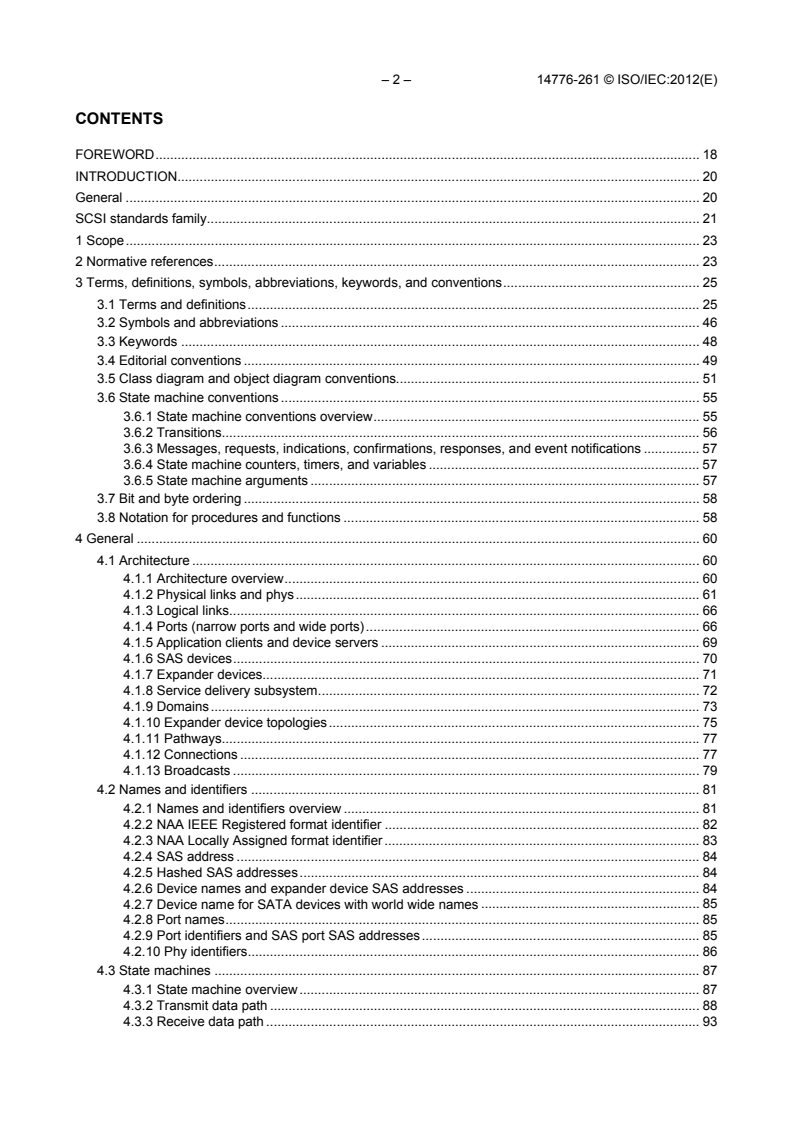
CONTENTS
FOREWORD. 18
INTRODUCTION. 20
General . 20
SCSI standards family. 21
1 Scope. 23
2 Normative references. 23
3 Terms, definitions, symbols, abbreviations, keywords, and conventions. 25
3.1 Terms and definitions. 25
3.2 Symbols and abbreviations . 46
3.3 Keywords . 48
3.4 Editorial conventions . 49
3.5 Class diagram and object diagram conventions. 51
3.6 State machine conventions . 55
3.6.1 State machine conventions overview.55
3.6.2 Transitions. 56
3.6.3 Messages, requests, indications, confirmations, responses, and event notifications . 57
3.6.4 State machine counters, timers, and variables . 57
3.6.5 State machine arguments . 57
3.7 Bit and byte ordering . 58
3.8 Notation for procedures and functions . 58
4 General . 60
4.1 Architecture . 60
4.1.1 Architecture overview. 60
4.1.2 Physical links and phys. 61
4.1.3 Logical links. 66
4.1.4 Ports (narrow ports and wide ports). 66
4.1.5 Application clients and device servers . 69
4.1.6 SAS devices. 70
4.1.7 Expander devices. 71
4.1.8 Service delivery subsystem. 72
4.1.9 Domains. 73
4.1.10 Expander device topologies. 75
4.1.11 Pathways. 77
4.1.12 Connections . 77
4.1.13 Broadcasts . 79
4.2 Names and identifiers . 81
4.2.1 Names and identifiers overview . 81
4.2.2 NAA IEEE Registered format identifier .82
4.2.3 NAA Locally Assigned format identifier. 83
4.2.4 SAS address . 84
4.2.5 Hashed SAS addresses. 84
4.2.6 Device names and expander device SAS addresses . 84
4.2.7 Device name for SATA devices with world wide names . 85
4.2.8 Port names. 85
4.2.9 Port identifiers and SAS port SAS addresses. 85
4.2.10 Phy identifiers. 86
4.3 State machines . 87
4.3.1 State machine overview. 87
4.3.2 Transmit data path . 88
4.3.3 Receive data path . 93
14776-261 © ISO/IEC:2012(E) – 3 –
4.3.4 State machines and SAS Device, SAS Port, and SAS Phy classes. 96
4.4 Resets . 98
4.4.1 Reset overview. 98
4.4.2 Hard reset . 100
4.5 I_T nexus loss . 100
4.6 Expander device model. 101
4.6.1 Expander device model overview . 101
4.6.2 Expander ports. 102
4.6.3 Expander connection manager (ECM). 103
4.6.4 Expander connection router (ECR). 103
4.6.5 Broadcast propagation processor (BPP). 104
4.6.6 Expander device interfaces. 104
4.6.7 Expander device routing . 111
4.6.8 Expander device reduced functionality . 115
4.6.9 Broadcast (Expander) handling. 116
4.7 Discover process. 116
4.7.1 Discover process overview . 116
4.7.2 Starting the discover process (Broadcast (Change) handling). 116
4.7.3 Discover process traversal. 116
4.7.4 Discover process in a self-configuring expander device. 118
4.7.5 Enabling multiplexing . 119
4.8 Configuration subprocess . 120
4.8.1 Configuration subprocess overview . 120
4.8.2 Allowed expander device topologies. 120
4.8.3 Externally configurable expander device route table optimization . 121
4.8.4 Externally configurable expander device expander route index order . 122
4.9 Zoning . 128
4.9.1 Zoning overview. 128
4.9.2 Zoning expander device requirements. 132
4.9.3 Zoning operation . 134
4.9.4 Zone phy information and link reset sequences. 140
4.9.5 Broadcast processing in a zoning expander device with zoning enabled. 142
4.9.6 Zone configuration . 143
4.10 Phy power conditions . 146
4.10.1 Low phy power conditions. 146
4.10.2 SATA phy power conditions. 148
4.11 SAS device and expander device power conditions . 148
4.12 Phy test functions. 149
4.12.1 Phy test functions overview. 149
4.12.2 Transmit pattern phy test function. 149
4.13 Phy events . 150
5 Phy layer . 155
5.1 Phy layer overview . 155
5.2 8b10b coding. 155
5.2.1 8b10b coding overview . 155
5.2.2 8b10b coding notation conventions.155
5.3 Character encoding and decoding . 156
5.3.1 Introduction . 156
5.3.2 Bit transmission order . 156
5.3.3 Character transmission order. 156
5.3.4 Frame transmission order . 156
5.3.5 Running disparity (RD). 157
5.3.6 Data characters. 157
– 4 – 14776-261 © ISO/IEC:2012(E)
5.3.7 Control characters. 163
5.3.8 Encoding characters in the transmitter.164
5.3.9 Decoding characters in the receiver. 164
5.4 Dwords, primitives, data dwords, and invalid dwords. 164
5.5 Bit order. 165
5.6 Out of band (OOB) signals. 166
5.6.1 OOB signals overview. 166
5.6.2 SP Transmission of OOB signals.166
5.6.3 Receiver detection of OOB signals .167
5.6.4 SATA port selection signal. 169
5.6.5 Phy power conditions. 170
5.7 Phy reset sequences. 170
5.7.1 Phy reset sequences overview . 170
5.7.2 SATA phy reset sequence . 171
5.7.3 SAS to SATA phy reset sequence . 172
5.7.4 SAS to SAS phy reset sequence . 174
5.7.5 Phy reset sequence after devices are attached. 196
5.8 Phy power condition sequences . 197
5.8.1 Transitioning from the active phy power condition to a low phy power condition. 197
5.8.2 Transitioning from a low phy power condition to the active phy power condition. 197
5.8.3 Events during low phy power condition. 198
5.9 SP (phy layer) state machine . 200
5.9.1 SP state machine overview. 200
5.9.2 SP transmitter and receiver. 202
5.9.3 OOB sequence states. 204
5.9.4 SAS speed negotiation states. 209
5.9.5 SAS phy power conditions states. 219
5.9.6 SATA host emulation states. 222
5.9.7 SATA port selector state SP25:SATA_PortSel . 227
5.9.8 SATA spinup hold state SP26:SATA_SpinupHold. 228
5.10 SP_DWS (phy layer dword synchronization) state machine. 228
5.10.1 SP_DWS state machine overview . 228
5.10.2 SP_DWS receiver . 230
5.10.3 SP_DWS0:AcquireSync state. 231
5.10.4 SP_DWS1:Valid1 state . 231
5.10.5 SP_DWS2:Valid2 state . 232
5.10.6 SP_DWS3:SyncAcquired state. 232
5.10.7 SP_DWS4:Lost1 state . 232
5.10.8 SP_DWS5:Lost1Recovered state. 233
5.10.9 SP_DWS6:Lost2 state . 233
5.10.10 SP_DWS7:Lost2Recovered state. 234
5.10.11 SP_DWS8:Lost3 state . 234
5.10.12 SP_DWS9:Lost3Recovered state. 234
5.11 Multiplexing . 235
5.12 Spinup . 236
6 Link layer. 237
6.1 Link layer overview. 237
6.2 Primitives. 237
6.2.1 Primitives overview . 237
6.2.2 Primitive summary. 238
6.2.3 Primitive encodings. 243
6.2.4 Primitive sequences. 248
6.2.5 Deletable primitives. 252
6.2.6 Primitives not specific to type of connections. 256
14776-261 © ISO/IEC:2012(E) – 5 –
6.2.7 Primitives used only inside SSP and SMP connections. 262
6.2.8 Primitives used only inside STP connections and on SATA physical links. 263
6.3 Physical link rate tolerance management . 264
6.3.1 Physical link rate tolerance management overview . 264
6.3.2 Phys originating dwords. 266
6.3.3 Expander phys forwarding dwords. 266
6.4 Idle physical links . 267
6.5 CRC . 267
6.5.1 CRC overview . 267
6.5.2 CRC generation . 269
6.5.3 CRC checking . 271
6.6 Scrambling . 272
6.7 Bit order of CRC and scrambler . 274
6.8 Address frames . 277
6.8.1 Address frames overview. 277
6.8.2 IDENTIFY address frame. 279
6.8.3 OPEN address frame. 282
6.9 Link reset sequence . 285
6.9.1 Link reset sequence overview. 285
6.9.2 Expander device handling of link reset sequences. 288
6.10 SL_IR (link layer identification and hard reset) state machines . 288
6.10.1 SL_IR state machines overview.288
6.10.2 SL_IR transmitter and receiver . 290
6.10.3 SL_IR_TIR (transmit IDENTIFY or HARD_RESET) state machine. 290
6.10.4 SL_IR_RIF (receive IDENTIFY address frame) state machine. 292
6.10.5 SL_IR_IRC (identification and hard reset control) state machine . 293
6.11 Entering a low phy power condition . 294
6.12 SAS domain changes (Broadcast (Change) usage) . 295
6.13 Connections . 296
6.13.1 Connections overview. 296
6.13.2 Opening a connection . 296
6.13.3 Arbitration fairness . 298
6.13.4 Arbitration inside an expander device. 300
6.13.5 BREAK handling . 304
6.13.6 Aborting a connection request . 305
6.13.7 Closing a connection. 307
6.13.8 Breaking a connection. 308
6.14 Rate matching . 309
6.15 SL (link layer for SAS logical phys) state machines.312
6.15.1 SL state machines overview . 312
6.15.2 SL transmitter and receiver. 315
6.15.3 SL_RA (receive OPEN address frame) state machine . 317
6.15.4 SL_CC (connection control) state machine. 317
6.16 XL (link layer for expander logical phys) state machine. 330
6.16.1 XL state machine overview . 330
6.16.2 XL transmitter and receiver. 335
6.16.3 XL0:Idle state . 336
6.16.4 XL1:Request_Path state . 338
6.16.5 XL2:Request_Open state. 340
6.16.6 XL3:Open_Confirm_Wait state . 340
6.16.7 XL4:Open_Reject state. 342
6.16.8 XL5:Forward_Open state. 342
6.16.9 XL6:Open_Response_Wait state. 343
6.16.10 XL7:Connected state. 344
– 6 – 14776-261 © ISO/IEC:2012(E)
6.16.11 XL8:Close_Wait state. 345
6.16.12 XL9:Break state. 346
6.16.13 XL10:Break_Wait state . 347
6.16.14 XL11:PS_Request state. 347
6.16.15 XL12:PS_Quiet state. 348
6.17 SSP link layer. 349
6.17.1 Opening an SSP connection. 349
6.17.2 Full duplex. 349
6.17.3 SSP frame transmission and reception. 350
6.17.4 SSP flow control. 350
6.17.5 Interlocked frames. 351
6.17.6 Breaking an SSP connection . 353
6.17.7 Closing an SSP connection. 353
6.17.8 SSP (link layer for SSP phys) state machines . 354
6.18 STP link layer . 365
6.18.1 STP frame transmission and reception. 365
6.18.2 STP flow control. 366
6.18.3 Continued primitive sequence. 370
6.18.4 Affiliations. 371
6.18.5 Opening an STP connection . 373
6.18.6 Closing an STP connection. 375
6.18.7 STP connection management examples . 376
6.18.8 STP (link layer for STP phys) state machines. 379
6.18.9 SMP target port support. 379
6.19 SMP link layer . 379
6.19.1 SMP frame transmission and reception . 379
6.19.2 SMP flow control . 379
6.19.3 Opening an SMP connection .379
6.19.4 Closing an SMP connection. 380
6.19.5 SMP (link layer for SMP phys) state machines. 380
7 Port layer. 385
7.1 Port layer overview. 385
7.2 PL (port layer) state machines . 385
7.2.1 PL state machines overview . 385
7.2.2 PL_OC (port layer overall control) state machine . 387
7.2.3 PL_PM (port layer phy manager) state machine. 398
8 Transport layer. 409
8.1 Transport layer overview. 409
8.2 SSP transport layer . 410
8.2.1 SSP frame format. 410
8.2.2 Information units. 414
8.2.3 Sequences of SSP frames. 424
8.2.4 SSP transport layer handling of link layer errors. 427
8.2.5 SSP transport layer error handling summary. 432
8.2.6 ST (transport layer for SSP ports) state machines. 434
8.3 STP transport layer . 470
8.3.1 Initial FIS . 470
8.3.2 BIST Activate FIS. 470
8.3.3 TT (transport layer for STP ports) state machines. 470
8.4 SMP transport layer . 471
8.4.1 SMP transport layer overview . 471
8.4.2 SMP_REQUEST frame. 472
8.4.3 SMP_RESPONSE frame .472
8.4.4 Sequence of SMP frames . 473
14776-261 © ISO/IEC:2012(E) – 7 –
8.4.5 MT (transport layer for SMP ports) state machines . 473
9 Application layer. 478
9.1 Application layer overview. 478
9.2 SCSI application layer. 478
9.2.1 SCSI transport protocol services. 478
9.2.2 Application client error handling. 490
9.2.3 Device server error handling. 491
9.2.4 Task router and task manager error handling. 492
9.2.5 SCSI transport protocol event notifications. 492
9.2.6 SCSI commands . 492
9.2.7 SCSI mode parameters. 493
9.2.8 SCSI log parameters. 504
9.2.9 SCSI diagnostic parameters . 507
9.2.10 SCSI power conditions. 514
9.2.11 SCSI vital product data (VPD). 523
9.3 ATA application layer . 526
9.4 Management application layer . 526
9.4.1 READY LED signal behavior. 526
9.4.2 Management protocol services . 527
9.4.3 SMP functions. 528
Annex A (normative) Jitter tolerance patterns. 641
Annex B (informative) SAS to SAS phy reset sequence examples . 649
Annex C (informative) CRC. 654
Annex D (informative) SAS address hashing. 658
Annex E (informative) Scrambling. 665
Annex F (informative) ATA architectural notes . 669
Annex G (informative) Minimum deletable primitive insertion rate summary. 672
Annex H (informative) Zone permission configuration descriptor examples. 673
Annex I (informative) SAS addressing . 676
Annex J (informative) Expander device handling of connections. 677
Annex K (informative) Primitive encoding . 698
Bibliography . 701
...