


IEC 62282-5-100:2018
(Main)Fuel cell technologies - Part 5-100: Portable fuel cell power systems - Safety
Fuel cell technologies - Part 5-100: Portable fuel cell power systems - Safety
IEC 62282-5-100:2018 covers construction, marking and test requirements for portable fuel cell power systems. These fuel cell systems are movable and not fastened or otherwise secured to a specific location. The purpose of the portable fuel cell power system is to produce electrical power. This document applies to AC and DC type portable fuel cell power systems, with a rated output voltage not exceeding 600 V AC, or 850 V DC for indoor and outdoor use.
Technologies des piles à combustible - Partie 5-100: Systèmes à piles à combustible portables – Sécurité
L’IEC 62282-5-100:2018 couvre les exigences de construction, de marquage et d'essai des systèmes à piles à combustible portables. Ces systèmes à piles à combustible sont mobiles et ne sont ni attachés ni fixés par un autre moyen à un emplacement spécifique. Un système à pile à combustible portable est destiné à produire une puissance électrique. Le présent document s'applique aux systèmes à piles à combustible portables à courant alternatif et à courant continu dont la tension de sortie assignée ne dépasse pas 600 V en courant alternatif ou 850 V en courant continu et qui sont destinés à un usage à l'intérieur et à l'extérieur.
General Information
- Status
- Published
- Publication Date
- 11-Apr-2018
- Technical Committee
- TC 105 - Fuel cell technologies
- Drafting Committee
- MT 401 - TC 105/MT 401
- Current Stage
- PPUB - Publication issued
- Start Date
- 12-Apr-2018
- Completion Date
- 03-Apr-2018
Relations
- Replaces
IEC 62282-5-1:2012 - Fuel cell technologies - Part 5-1: Portable fuel cell power systems - Safety - Effective Date
- 05-Sep-2023
Overview
IEC 62282-5-100:2018 is an international standard developed by the International Electrotechnical Commission (IEC) that specifies safety requirements for portable fuel cell power systems. These systems are movable, not secured to a fixed location, and designed to generate electrical power. The standard applies to both AC and DC portable fuel cell systems with rated output voltages up to 600 V AC or 850 V DC, for use in indoor and outdoor environments.
This standard plays a critical role in guiding manufacturers, designers, and users in the safe construction, operation, and maintenance of portable fuel cell technologies, promoting safety and reliability in emerging clean energy applications.
Key Topics
Design and Construction Requirements
This section ensures that portable fuel cell power systems are constructed to withstand various physical environments and operating conditions without compromising safety. It covers:- Material compatibility, including polymeric and elastomeric components
- Protection against mechanical hazards such as shocks and impacts
- Safeguards against toxic fuel exposure and explosion risks
- Electrical safety measures preventing electric shock and short circuits
- Fire hazard protection and controlling surface and component temperatures
- Mitigation of electromagnetic disturbances to ensure operational integrity
- Adequate enclosure designs for indoor and outdoor uses
- Proper design of fuel supplies, fuel processing units, pressure vessels, hoses, and valves
Hazard and Risk Assessment
The standard emphasizes thorough hazard identification and risk mitigation strategies including safety and reliability analysis to reduce potential operational hazards.Safety Control Circuits
Requirements include designing control circuits that maintain system safety under normal and abnormal conditions, including automatic shut-off valves and fail-safe components.Instruction Manuals and Labelling
Detailed user and maintenance manuals must accompany these systems specifying safe operation, handling, and emergency procedures. Clear, durable labelling and warning signs are mandated to inform users of potential risks.Type Testing Procedures
Comprehensive testing is prescribed to verify safety under various conditions, such as:- Leakage tests for liquid fuel systems
- Flammable gas concentration testing
- Surface and component temperature measurements
- Dielectric strength and humidity tests
- Abnormal operation performance evaluations
- Strain relief effectiveness
Applications
IEC 62282-5-100:2018 is vital for industries developing and utilizing portable fuel cell power supplies. Common applications include:
- Emergency backup power solutions requiring reliable, transportable electrical generation
- Portable devices and equipment in remote or off-grid locations
- Mobile communication stations and military applications where secure and safe energy sources are critical
- Consumer electronics and specialized professional equipment benefiting from clean, quiet fuel cell power
- Environmental monitoring and scientific expeditions needing dependable power in challenging scenarios
By adhering to these safety requirements, users can confidently deploy portable fuel cell systems knowing they meet internationally recognized safety benchmarks.
Related Standards
For comprehensive understanding and implementation, IEC 62282-5-100:2018 should be considered alongside related IEC standards in the fuel cell technologies series:
- IEC 62282-2: Stationary fuel cell power systems
- IEC 62282-3: Fuel cell modules
- IEC 62282-4: Fuel cell power system balance of plant components
- IEC 62282-5 (series): Portable fuel cell power systems – including additional parts addressing performance and interfaces
- Safety standards such as IEC 60079 series addressing explosive atmospheres may also apply where portable systems operate in hazardous environments
These interconnected standards ensure broad coverage of fuel cell safety, performance, and integration across diverse applications.
Keywords: Portable fuel cell power systems, IEC 62282-5-100, fuel cell safety standard, electrical power generation, fuel cell testing, hazard assessment, fuel cell design, portable energy solutions, fuel cell system labelling, international electrotechnical standards


Frequently Asked Questions
IEC 62282-5-100:2018 is a standard published by the International Electrotechnical Commission (IEC). Its full title is "Fuel cell technologies - Part 5-100: Portable fuel cell power systems - Safety". This standard covers: IEC 62282-5-100:2018 covers construction, marking and test requirements for portable fuel cell power systems. These fuel cell systems are movable and not fastened or otherwise secured to a specific location. The purpose of the portable fuel cell power system is to produce electrical power. This document applies to AC and DC type portable fuel cell power systems, with a rated output voltage not exceeding 600 V AC, or 850 V DC for indoor and outdoor use.
IEC 62282-5-100:2018 covers construction, marking and test requirements for portable fuel cell power systems. These fuel cell systems are movable and not fastened or otherwise secured to a specific location. The purpose of the portable fuel cell power system is to produce electrical power. This document applies to AC and DC type portable fuel cell power systems, with a rated output voltage not exceeding 600 V AC, or 850 V DC for indoor and outdoor use.
IEC 62282-5-100:2018 is classified under the following ICS (International Classification for Standards) categories: 27.070 - Fuel cells. The ICS classification helps identify the subject area and facilitates finding related standards.
IEC 62282-5-100:2018 has the following relationships with other standards: It is inter standard links to IEC 62282-5-1:2012. Understanding these relationships helps ensure you are using the most current and applicable version of the standard.
You can purchase IEC 62282-5-100:2018 directly from iTeh Standards. The document is available in PDF format and is delivered instantly after payment. Add the standard to your cart and complete the secure checkout process. iTeh Standards is an authorized distributor of IEC standards.
Standards Content (Sample)
IEC 62282-5-100 ®
Edition 1.0 2018-04
INTERNATIONAL
STANDARD
NORME
INTERNATIONALE
Fuel cell technologies –
Part 5-100: Portable fuel cell power systems – Safety
Technologies des piles à combustible –
Partie 5-100: Systèmes à piles à combustible portables – Sécurité
All rights reserved. Unless otherwise specified, no part of this publication may be reproduced or utilized in any form
or by any means, electronic or mechanical, including photocopying and microfilm, without permission in writing from
either IEC or IEC's member National Committee in the country of the requester. If you have any questions about IEC
copyright or have an enquiry about obtaining additional rights to this publication, please contact the address below or
your local IEC member National Committee for further information.
Droits de reproduction réservés. Sauf indication contraire, aucune partie de cette publication ne peut être reproduite
ni utilisée sous quelque forme que ce soit et par aucun procédé, électronique ou mécanique, y compris la photocopie
et les microfilms, sans l'accord écrit de l'IEC ou du Comité national de l'IEC du pays du demandeur. Si vous avez des
questions sur le copyright de l'IEC ou si vous désirez obtenir des droits supplémentaires sur cette publication, utilisez
les coordonnées ci-après ou contactez le Comité national de l'IEC de votre pays de résidence.
IEC Central Office Tel.: +41 22 919 02 11
3, rue de Varembé info@iec.ch
CH-1211 Geneva 20 www.iec.ch
Switzerland
About the IEC
The International Electrotechnical Commission (IEC) is the leading global organization that prepares and publishes
International Standards for all electrical, electronic and related technologies.
About IEC publications
The technical content of IEC publications is kept under constant review by the IEC. Please make sure that you have the
latest edition, a corrigenda or an amendment might have been published.
IEC Catalogue - webstore.iec.ch/catalogue Electropedia - www.electropedia.org
The stand-alone application for consulting the entire The world's leading online dictionary of electronic and
bibliographical information on IEC International Standards, electrical terms containing 21 000 terms and definitions in
Technical Specifications, Technical Reports and other English and French, with equivalent terms in 16 additional
documents. Available for PC, Mac OS, Android Tablets and languages. Also known as the International Electrotechnical
iPad. Vocabulary (IEV) online.
IEC publications search - webstore.iec.ch/advsearchform IEC Glossary - std.iec.ch/glossary
The advanced search enables to find IEC publications by a 67 000 electrotechnical terminology entries in English and
variety of criteria (reference number, text, technical French extracted from the Terms and Definitions clause of
committee,…). It also gives information on projects, replaced IEC publications issued since 2002. Some entries have been
and withdrawn publications. collected from earlier publications of IEC TC 37, 77, 86 and
CISPR.
IEC Just Published - webstore.iec.ch/justpublished
Stay up to date on all new IEC publications. Just Published IEC Customer Service Centre - webstore.iec.ch/csc
details all new publications released. Available online and If you wish to give us your feedback on this publication or
also once a month by email. need further assistance, please contact the Customer Service
Centre: sales@iec.ch.
A propos de l'IEC
La Commission Electrotechnique Internationale (IEC) est la première organisation mondiale qui élabore et publie des
Normes internationales pour tout ce qui a trait à l'électricité, à l'électronique et aux technologies apparentées.
A propos des publications IEC
Le contenu technique des publications IEC est constamment revu. Veuillez vous assurer que vous possédez l’édition la
plus récente, un corrigendum ou amendement peut avoir été publié.
Catalogue IEC - webstore.iec.ch/catalogue Electropedia - www.electropedia.org
Application autonome pour consulter tous les renseignements
Le premier dictionnaire en ligne de termes électroniques et
bibliographiques sur les Normes internationales,
électriques. Il contient 21 000 termes et définitions en anglais
Spécifications techniques, Rapports techniques et autres
et en français, ainsi que les termes équivalents dans 16
documents de l'IEC. Disponible pour PC, Mac OS, tablettes
langues additionnelles. Egalement appelé Vocabulaire
Android et iPad.
Electrotechnique International (IEV) en ligne.
Recherche de publications IEC -
Glossaire IEC - std.iec.ch/glossary
webstore.iec.ch/advsearchform
67 000 entrées terminologiques électrotechniques, en anglais
La recherche avancée permet de trouver des publications IEC et en français, extraites des articles Termes et Définitions des
en utilisant différents critères (numéro de référence, texte, publications IEC parues depuis 2002. Plus certaines entrées
comité d’études,…). Elle donne aussi des informations sur les antérieures extraites des publications des CE 37, 77, 86 et
projets et les publications remplacées ou retirées. CISPR de l'IEC.
IEC Just Published - webstore.iec.ch/justpublished Service Clients - webstore.iec.ch/csc
Restez informé sur les nouvelles publications IEC. Just Si vous désirez nous donner des commentaires sur cette
Published détaille les nouvelles publications parues. publication ou si vous avez des questions contactez-nous:
Disponible en ligne et aussi une fois par mois par email. sales@iec.ch.
IEC 62282-5-100 ®
Edition 1.0 2018-04
INTERNATIONAL
STANDARD
NORME
INTERNATIONALE
Fuel cell technologies –
Part 5-100: Portable fuel cell power systems – Safety
Technologies des piles à combustible –
Partie 5-100: Systèmes à piles à combustible portables – Sécurité
INTERNATIONAL
ELECTROTECHNICAL
COMMISSION
COMMISSION
ELECTROTECHNIQUE
INTERNATIONALE
ICS 27.070 ISBN 978-2-8322-5450-9
– 2 – IEC 62282-5-100:2018 © IEC 2018
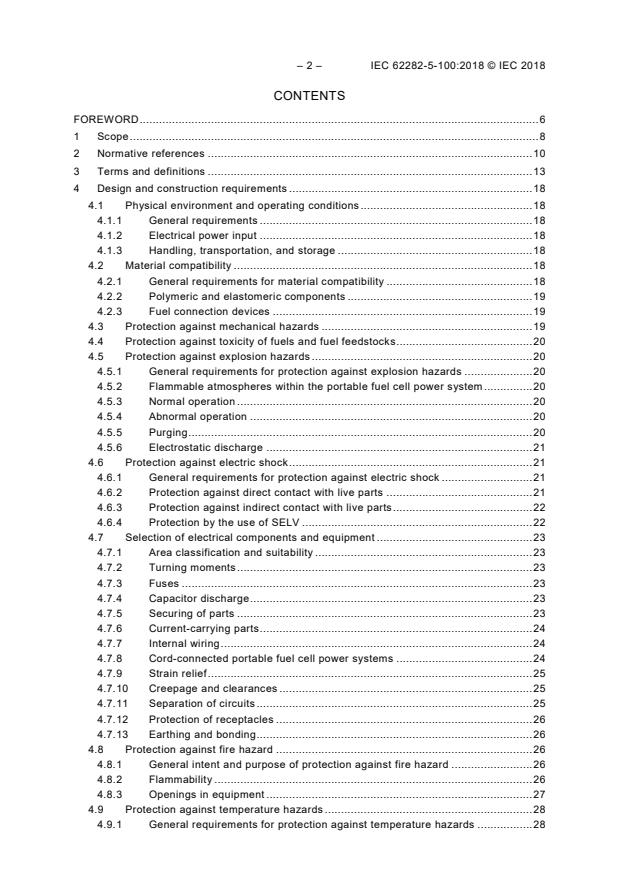
CONTENTS
FOREWORD . 6
1 Scope . 8
2 Normative references . 10
3 Terms and definitions . 13
4 Design and construction requirements . 18
4.1 Physical environment and operating conditions . 18
4.1.1 General requirements . 18
4.1.2 Electrical power input . 18
4.1.3 Handling, transportation, and storage . 18
4.2 Material compatibility . 18
4.2.1 General requirements for material compatibility . 18
4.2.2 Polymeric and elastomeric components . 19
4.2.3 Fuel connection devices . 19
4.3 Protection against mechanical hazards . 19
4.4 Protection against toxicity of fuels and fuel feedstocks . 20
4.5 Protection against explosion hazards . 20
4.5.1 General requirements for protection against explosion hazards . 20
4.5.2 Flammable atmospheres within the portable fuel cell power system . 20
4.5.3 Normal operation . 20
4.5.4 Abnormal operation . 20
4.5.5 Purging . 20
4.5.6 Electrostatic discharge . 21
4.6 Protection against electric shock . 21
4.6.1 General requirements for protection against electric shock . 21
4.6.2 Protection against direct contact with live parts . 21
4.6.3 Protection against indirect contact with live parts . 22
4.6.4 Protection by the use of SELV . 22
4.7 Selection of electrical components and equipment . 23
4.7.1 Area classification and suitability . 23
4.7.2 Turning moments . 23
4.7.3 Fuses . 23
4.7.4 Capacitor discharge . 23
4.7.5 Securing of parts . 23
4.7.6 Current-carrying parts . 24
4.7.7 Internal wiring . 24
4.7.8 Cord-connected portable fuel cell power systems . 24
4.7.9 Strain relief . 25
4.7.10 Creepage and clearances . 25
4.7.11 Separation of circuits . 25
4.7.12 Protection of receptacles . 26
4.7.13 Earthing and bonding . 26
4.8 Protection against fire hazard . 26
4.8.1 General intent and purpose of protection against fire hazard . 26
4.8.2 Flammability . 26
4.8.3 Openings in equipment . 27
4.9 Protection against temperature hazards . 28
4.9.1 General requirements for protection against temperature hazards . 28
4.9.2 Surface temperatures . 28
4.9.3 Component temperatures . 28
4.9.4 Wall, floor and ceiling temperatures . 28
4.10 Protection against electromagnetic disturbances . 28
4.11 Hazard and risk assessment . 28
4.11.1 General requirements for hazard and risk assessment and the approach . 28
4.11.2 Safety and reliability analysis . 29
4.12 Safety control circuits . 29
4.13 Protection against oxygen depletion . 29
4.14 Emission of effluents . 30
4.15 Fuel supply . 30
4.16 Fuel processing systems (if applicable) . 30
4.17 Enclosures . 31
4.17.1 General requirements for all enclosures. 31
4.17.2 Enclosure requirements for outdoor use . 31
4.18 Battery supplies . 31
4.18.1 General requirements for batteries . 31
4.18.2 Battery compartments . 31
4.18.3 Vented wet cell batteries. 32
4.18.4 Ventilation of battery compartments . 32
4.19 Pressure vessels and piping . 32
4.19.1 General requirements for pressure vessels and piping . 32
4.19.2 Piping systems . 32
4.20 Hoses . 33
4.21 Automatic shut-off valves . 33
4.22 Regulators . 33
4.23 Process control equipment . 33
4.24 Filters . 33
4.24.1 Air filters . 33
4.24.2 Liquid fuel filters . 34
4.25 Motors . 34
4.26 Fuel pumps . 34
5 Instructions . 34
5.1 Operation and maintenance manual . 34
5.2 User's information manual . 36
5.2.1 User’s information manual general requirements . 36
5.2.2 User's information manual front cover . 36
5.2.3 Users information manual safety section . 36
6 Labelling . 37
6.1 General labelling requirements . 37
6.2 Marking . 37
6.3 Warnings . 38
7 Type tests . 38
7.1 General requirements for type tests . 38
7.2 Tests sequence . 39
7.3 Leakage test for liquid fueled systems . 39
7.3.1 General requirements for leakage tests for liquid fueled systems . 39
7.3.2 Method of test. 39
7.4 Flammable fuel gas concentration test . 40
– 4 – IEC 62282-5-100:2018 © IEC 2018
7.4.1 General requirements for flammable gas concentration testing . 40
7.4.2 Method of test. 40
7.5 Surface temperature test . 40
7.6 Component temperature test . 40
7.7 Wall, floor and ceiling temperatures test . 40
7.8 Dielectric strength test . 41
7.8.1 General requirements for dielectric strength and testing . 41
7.8.2 Test method . 41
7.9 Humidity test . 41
7.10 Leakage current at operating temperature . 41
7.10.1 Leakage current testing requirement and duration . 41
7.10.2 Test method . 42
7.11 Abnormal operation testing . 42
7.11.1 Abnormal operation testing – General requirements. 42
7.11.2 Abnormal operation tests – Outcomes and further testing requirements . 42
7.11.3 Abnormal operation test methods . 42
7.12 Strain relief test . 43
7.13 Insulating material test . 43
7.14 Earthing test . 43
7.15 Tank pressure test . 43
7.16 Stability. 44
7.17 Impact test . 44
7.18 Free drop test . 45
7.19 Adhesion and legibility of marking materials . 46
7.20 Flammable gas accumulation . 46
7.20.1 Flammable gas accumulation test basis and applicability . 46
7.20.2 Test set-up . 47
7.20.3 Test method . 47
7.21 Oxygen depletion test . 47
7.21.1 Oxygen depletion test basis and applicability . 47
7.21.2 Test set-up . 47
7.21.3 Test method . 48
7.22 Emission of effluents tests . 48
7.22.1 Emission of effluents testing sequence . 48
7.22.2 Emission of effluents for indoors . 48
7.23 Wind test . 50
7.23.1 Wind test applicability . 50
7.23.2 Method of test. 50
7.24 Strength test . 51
7.24.1 Strength test sequencing and alternative compliance methods . 51
7.24.2 Method of test (liquid) . 51
7.24.3 Method of test (gas) . 51
7.24.4 Passing criteria . 51
7.25 Stress relief test . 52
7.26 Fuel supply securement test . 52
7.27 Shutdown parameters . 52
7.28 Non-metallic tubing conductivity test . 52
7.28.1 Passing criteria . 52
7.28.2 Test method . 52
7.29 Non-metallic tubing test for accumulation of static electricity . 53
7.29.1 Passing criteria . 53
7.29.2 Test method . 53
8 Routine tests . 53
8.1 Routine test requirements . 53
8.2 Liquid leakage test . 53
8.3 Gas leakage test . 53
8.4 Dielectric strength test . 54
8.5 Routine test records . 54
Annex A (normative) Ventilation rates for batteries . 55
A.1 Ventilation rate for valve regulated lead acid batteries . 55
A.2 Ventilation rate for vented wet cell batteries . 55
Annex B (informative) Shock and vibration limits for high shock environments . 56
B.1 Field of application . 56
B.2 Vertical axis test . 56
B.3 Longitudinal and lateral axes tests . 56
Annex C (normative) Uncertainty of measurements . 58
Bibliography . 59
Figure 1 – Portable fuel cell power systems . 9
Figure 2 – Articulated probe . 46
Table 1 – Emission limits based on STEL . 50
Table B.1 – Vertical axis vibration conditions . 56
Table B.2 – Longitudinal and lateral axes vibration conditions . 57
Table C.1 – Measurements and their maximum uncertainties . 58
– 6 – IEC 62282-5-100:2018 © IEC 2018
INTERNATIONAL ELECTROTECHNICAL COMMISSION
____________
FUEL CELL TECHNOLOGIES –
Part 5-100: Portable fuel cell power systems – Safety
FOREWORD
1) The International Electrotechnical Commission (IEC) is a worldwide organization for standardization comprising
all national electrotechnical committees (IEC National Committees). The object of IEC is to promote international
co-operation on all questions concerning standardization in the electrical and electronic fields. To this end and in
addition to other activities, IEC publishes International Standards, Technical Specifications, Technical Reports,
Publicly Available Specifications (PAS) and Guides (hereafter referred to as “IEC Publication(s)”). Their
preparation is entrusted to technical committees; any IEC National Committee interested in the subject dealt with
may participate in this preparatory work. International, governmental and non-governmental organizations liaising
with the IEC also participate in this preparation. IEC collaborates closely with the International Organization for
Standardization (ISO) in accordance with conditions determined by agreement between the two organizations.
2) The formal decisions or agreements of IEC on technical matters express, as nearly as possible, an international
consensus of opinion on the relevant subjects since each technical committee has representation from all
interested IEC National Committees.
3) IEC Publications have the form of recommendations for international use and are accepted by IEC National
Committees in that sense. While all reasonable efforts are made to ensure that the technical content of IEC
Publications is accurate, IEC cannot be held responsible for the way in which they are used or for any
misinterpretation by any end user.
4) In order to promote international uniformity, IEC National Committees undertake to apply IEC Publications
transparently to the maximum extent possible in their national and regional publications. Any divergence between
any IEC Publication and the corresponding national or regional publication shall be clearly indicated in the latter.
5) IEC itself does not provide any attestation of conformity. Independent certification bodies provide conformity
assessment services and, in some areas, access to IEC marks of conformity. IEC is not responsible for any
services carried out by independent certification bodies.
6) All users should ensure that they have the latest edition of this publication.
7) No liability shall attach to IEC or its directors, employees, servants or agents including individual experts and
members of its technical committees and IEC National Committees for any personal injury, property damage or
other damage of any nature whatsoever, whether direct or indirect, or for costs (including legal fees) and expenses
arising out of the publication, use of, or reliance upon, this IEC Publication or any other IEC Publications.
8) Attention is drawn to the Normative references cited in this publication. Use of the referenced publications is
indispensable for the correct application of this publication.
9) Attention is drawn to the possibility that some of the elements of this IEC Publication may be the subject of patent
rights. IEC shall not be held responsible for identifying any or all such patent rights.
International Standard IEC 62282-5-100 has been prepared by IEC technical committee 105:
Fuel cell technologies.
This edition cancels and replaces the second edition of IEC 62282-5-1, published in 2012. This
edition constitutes a technical revision.
This edition includes the following significant technical changes with respect to IEC 62282-5-1:
• the requirements and verification method regarding 4.13 and 7.21 for oxygen depletion have
been modified;
• the requirements and verification method regarding 4.14 and 7.22 for emission of effluents
have been modified;
• Subclauses 4.21 and 7.20.3, for fuel cell power systems with flammable gas generators
relying on water reactive technology, new safety requirements and test procedures have
been added;
• Subclause 7.11.1 e) has been updated; for an overcurrent test in abnormal operations, a new
test procedure in consideration of safety has been added.
The text of this International Standard is based on the following documents:
CDV Report on voting
105/649/CDV 105/670/RVC
Full information on the voting for the approval of this International Standard can be found in the
report on voting indicated in the above table.
This document has been drafted in accordance with the ISO/IEC Directives, Part 2.
A list of all parts in the IEC 62282 series, published under the general title Fuel cell technologies,
can be found on the IEC website.
The committee has decided that the contents of this document will remain unchanged until the
stability date indicated on the IEC website under "http://webstore.iec.ch" in the data related to
the specific document. At this date, the document will be
• reconfirmed,
• withdrawn,
• replaced by a revised edition, or
• amended.
– 8 – IEC 62282-5-100:2018 © IEC 2018
FUEL CELL TECHNOLOGIES –
Part 5-100: Portable fuel cell power systems – Safety
1 Scope
This part of IEC 62282 covers construction, marking and test requirements for portable fuel cell
power systems. These fuel cell systems are movable and not fastened or otherwise secured to
a specific location. The purpose of the portable fuel cell power system is to produce electrical
power.
This document applies to AC and DC type portable fuel cell power systems, with a rated output
voltage not exceeding 600 V AC, or 850 V DC for indoor and outdoor use. These portable fuel
cell power systems cannot be used in hazardous locations as defined in
IEC 60050-426:2008, 426-03-01 unless there are additional protective measures in accordance
1)
with IEC 60079-0[5] .
This document does not apply to portable fuel cell power systems that are
1) permanently connected (hard wired) to the electrical distribution system,
2) permanently connected to a utility fuel distribution system,
3) exporting power to the grid,
4) for propulsion of road vehicles,
5) intended to be used on board passenger aircraft.
Fuel cells that provide battery charging for hybrid vehicles where the battery provides power and
energy for propulsion of the vehicle are not included in the scope of this document
The following fuels and fuel feedstocks are considered within the scope of this document:
• natural gas,
• liquefied petroleum gas, such as propane and butane,
• liquid alcohols, for example methanol, ethanol,
• gasoline,
• diesel,
• kerosene,
• hydrogen,
• chemical hydrides.
This document does not preclude the use of similar fuels or oxidants from sources other than air
provided the unique hazards are addressed through additional requirements.
___________
)
Numbers in square brackets refer to the Bibliography.
Power inputs
electrical thermal Cabinet
Thermal
management
system
Waste heat
Fuel
Fuel supply
processing
system
system
Fuel
Power
cell
conditioning
module
system Useable power
electrical
Oxidant
Oxidant
processing Water
system treatment Internal power
Discharge water
system needs
Ventilation
Inert gas
Ventilation Exhaust gases,
Onboard
Water Automatic
system
ventilation
energy
control
storage
system
EMD
EMI
Vibration, Noise,
wind, rain, vibration
temperature
etc.
IEC
Key
1 EMD electromagnetic disturbance
2 EMI electromagnetic interference
Figure 1 – Portable fuel cell power systems
The overall design of a portable fuel cell power system anticipated by this document forms an
assembly of some or all of the following systems (see Figure 1), integrated as necessary, to
perform designated functions, as follows:
Fuel processing system – chemical processing equipment including any associated heat
exchangers and controls required to convert input fuel to a composition suitable for the fuel cell
stack.
Oxidant processing system – subsystem that meters, conditions, processes and may
pressurize the incoming oxidant supply for use within the fuel cell power system.
Thermal management system – subsystem intended to provide cooling and heat rejection in
order to maintain thermal equilibrium within the fuel cell power system, and, if necessary, to
provide for the recovery and utilization of excess heat and to assist in heating the fuel cell power
systems during start-up.
Power conditioning system – equipment which is used to change the magnitude or waveform
of the voltage, or otherwise alter or regulate the output of a power source.
Automatic control system – assembly of sensors, actuators, valves, switches and logic
components (including process controllers) that maintains the fuel cell power system
parameters within the manufacturer’s specified limits without manual intervention.
Fuel cell module – assembly, including a fuel cell stack(s), which electrochemically converts
chemical energy to electric energy and thermal energy intended to be integrated into a power
generation system.
Fuel supply system – either integral to the portable fuel cell power system or supplied through
a removable and refillable container assembly.
– 10 – IEC 62282-5-100:2018 © IEC 2018
On-board energy storage system – an internal energy source intended to aid or complement
the fuel cell module in providing power to internal or external loads.
Ventilation systems – subsystem of the fuel cell power system that provides, by mechanical
means, air to its cabinet.
Water treatment systems – provides for treatment and purification of recovered or added water
for use within the portable fuel cell power system.
These requirements are not intended to prevent the design and construction of a portable fuel
cell power system not specifically described in this document, provided that such alternatives
have been considered and equivalent testing yields equivalent safety performance to that
specified in this document. In considering alternative designs or construction, this document can
be used to evaluate the alternative materials or methods to be used as to their ability to yield
equivalent performance to that specified in this document.
This document does not cover requirements of pressurized or non-pressurized fuel supply
containers upstream of the appliance gaseous or liquid fuel supply connector that are not
integral to the portable fuel cell power system.
All pressures in this document are considered to be gauge pressures, unless otherwise
specified.
2 Normative references
The following documents are referred to in the text in such a way that some or all of their content
constitutes requirements of this document. For dated references, only the edition cited applies.
For undated references, the latest edition of the referenced document (including any
amendments) applies.
IEC 60034 (all parts), Rotating electrical machines
IEC 60068-2-75, Environmental testing – Part 2-75: Tests – Test Eh: Hammer tests
IEC 60079-2, Explosive atmospheres – Part 2: Equipment protection by pressurized enclosure
"p"
IEC 60079-10 (all parts), Explosive atmospheres – Part 10: Classification of areas
IEC 60079-15, Explosive atmospheres – Part 15: Equipment protection by type of protection "n"
IEC 60079-29 (all parts), Explosive atmospheres – Part 29: Gas detectors
IEC 60086-4, Primary batteries – Part 4: Safety of lithium batteries
IEC 60204-1:2016, Safety of machinery – Electrical equipment of machines – Part 1: General
requirements
IEC 60216-4-1, Electrical insulating materials – Thermal endurance properties – Part 4-1:
Ageing ovens – Single-chamber ovens
IEC 60335-1:2010, Household and similar electrical appliances – Safety – Part 1: General
requirements
IEC 60335-1:2010/AMD1:2013
IEC 60335-1:2010/AMD2:2016
IEC 60364-4-41, Low-voltage electrical installations – Part 4-41: Protection for safety –
Protection against electric shock
IEC 60529, Degrees of protection provided by enclosures (IP Code)
IEC 60695-2-11, Fire hazard testing – Part 2-11: Glowing/hot-wire based test methods –
Glow-wire flammability test method for end-products (GWEPT)
IEC 60695-2-13, Fire hazard testing – Part 2-13: Glowing/hot-wire based test methods –
Glow-wire ignition temperature (GWIT) test method for materials
IEC 60695-11-5, Fire hazard testing – Part 11-5: Test flames – Needle-flame test method –
Apparatus, confirmatory test arrangement and guidance
IEC 60695-11-10, Fire hazard testing – Part 11-10: Test flames – 50 W horizontal and vertical
flame test methods
IEC 60695-11-20, Fire hazard testing – Part 11-20: Test flames – 500 W flame test method
IEC 60730-1:2013, Automatic electrical controls – Part 1: General requirements
IEC 60730-1:2013/AMD1:2015
IEC 60730-2-5, Automatic electrical controls – Part 2-5: Particular requirements for automatic
electrical burner control systems
IEC 60730-2-17, Automatic electrical controls for household and similar use – Part 2-17:
Particular requirements for electrically operated gas valves, including mechanical
)
requirements
IEC 60812, Analysis techniques for system reliability – Procedure for failure mode and effects
analysis (FMEA)
IEC 60884-1, Plugs and socket-outlets for household and similar purposes – Part 1: General
requirements
IEC 60934, Circuit-breakers for equipment (CBE)
IEC 60950-1:2005, Information technology equipment – Safety – Part 1: General requirements
IEC 60950-1:2005/AMD1:2009
IEC 60950-1:2005/AMD2:2013
IEC 60990:2016, Methods of measurement of touch current and protective conductor current
IEC 61000-3-2, Electromagnetic compatibility (EMC) – Part 3-2: Limits – Limits for harmonic
currents emissions (equipment input current ≤ 16 A per phase)
IEC 61000-3-3, Electromagnetic compatibility (EMC) – Part 3-3: Limits – Limitation of voltage
changes, voltage fluctuations and flicker in public low-voltage supply systems, for equipment
with rated current ≤16 A per phase and not subject to conditional connection
IEC 61000-6-1, Electromagnetic compatibility (EMC) – Part 6-1: Generic standards – Immunity
standard for residential, commercial and light-industrial environments
___________
)
Withdrawn.
– 12 – IEC 62282-5-100:2018 © IEC 2018
IEC 61000-6-2, Electromagnetic compatibility (EMC) – Part 6-2: Generic standards – Immunity
standard for industrial environments
IEC 61000-6-3, Electromagnetic compatibility (EMC) – Part 6-3: Generic standards – Emission
standard for residential, commercial and light-industrial environments
IEC 61000-6-4, Electromagnetic compatibility (EMC) – Part 6-4: Generic standards – Emission
standard for industrial environments
IEC 61025, Fault tree analysis (FTA)
IEC 61032, Protection of persons and equipment by enclosures – Probes for verification
IEC 61508-1, Functional safety of electrical/electronic/programmable electronic safety-related
systems – Part 1: General requirements
IEC 61511-1, Functional safety – Safety instrumented systems for the process industry sector –
Part 1: Framework, definitions, system, hardware and application programming requirements
IEC 61511-3, Functional safety – Safety instrumented systems for the process industry sector –
Part 3: Guidance for the determination of the required safety integrity levels
IEC 61882, Hazard and operability studies (HAZOP studies) – Application guide
IEC 62040-1, Uninterruptible power systems (UPS) – Part 1: Safety requirements
IEC 62040-2, Uninterruptible power systems (UPS) – Part 2: Electromagnetic compatibility
(EMC) requirements
IEC 62133 (all parts), Secondary cells and batteries containing alkaline or other non-acid
electrolytes – Safety requirements for portable sealed secondary cells, and for batteries made
from them, for use in portable applications
IEC 62282-2, Fuel cell technologies – Part 2: Fuel cell modules
ISO 3864 (all parts), Graphical symbols – Safety colours and safety signs
ISO 7000, Graphical symbols for use on equipment (available at
http://www.graphical-symbols.info/equipment)
ISO 7010, Graphical symbols – Safety colours and safety signs – Registered safety signs
ISO 15649, Petroleum and natural gas industries – Piping
ISO 16000-3, Indoor air – Part 3: Determination of formaldehyde and other carbonyl compounds
in indoor air and test chamber air – Active sampling method
ISO 16000-6, Indoor air – Part 6: Determination of volatile organic compounds in indoor and test ®
chamber air by active sampling on Tenax TA sorbent, thermal desorption and gas
chromatography using MS or MS-FID
ISO 16017-1:2000, Indoor, ambient and workplace air – Sampling and analysis of volatile
organic compounds by sorbent tube/thermal desorption/capillary gas chromatography – Part 1:
Pumped sampling
ISO 16111, Transportable gas storage devices – Hydrogen absorbed in reversible metal hydride
ISO 16528 (all parts), Boilers and pressure vessels
3 Terms and definitions
For the purposes of this document, the following terms and definitions apply.
ISO and IEC maintain terminological databases for use in standardization at the following
addresses:
• IEC Electropedia: available at http://www.electropedia.org/
• ISO Online browsing platform: available at http://www.iso.org/obp
3.1
basic insulation
...
Questions, Comments and Discussion
Ask us and Technical Secretary will try to provide an answer. You can facilitate discussion about the standard in here.
Loading comments...