

IEC TR 60695-11-40:2026
(Main)Fire hazard testing - Part 11-40: Test flames - Confirmatory tests - Guidance
General Information
- Abstract
IEC TR 60695-11-40:2026, presents a general characterization of small-scale test flames and associated confirmatory tests based on copper block calorimetry. Information is presented for the selection of critical parameters in confirmatory test designs.
This basic safety publication is intended for use by technical committees in the preparation of safety publications in accordance with the principles laid down in IEC Guide 104 and ISO/IEC Guide 51.
This first edition cancels and replaces the second edition of IEC TS 60695-11-40 published in 2021. This edition constitutes a technical revision.
This edition includes the following significant technical changes with respect to the previous edition:
a) change of classification of this document (from Technical Specification to Technical Report), based on the nature of this publication, which provides solely general information and the theoretical basis for confirmatory tests using copper blocks;
b) minor editorial changes.
- Status
- Published
- Publication Date
- 21-Apr-2026
- Technical Committee
- TC 89 - Fire hazard testing
- Drafting Committee
- WG 12 - TC 89/WG 12
- Current Stage
- PPUB - Publication issued
- Start Date
- 22-Apr-2026
- Completion Date
- 08-May-2026
Overview
IEC TR 60695-11-40:2026 – "Fire hazard testing - Part 11-40: Test flames - Confirmatory tests - Guidance" – is an International Electrotechnical Commission (IEC) Technical Report that provides comprehensive guidance on the characterization of small-scale test flames and confirmatory tests using copper block calorimetry. This standard supports technical committees and safety professionals in developing fire hazard testing publications in alignment with international safety principles as set out in IEC Guide 104 and ISO/IEC Guide 51.
The guidance is particularly valuable for understanding critical parameters and the theoretical basis for designing and interpreting confirmatory tests. This first edition replaces the previous Technical Specification and features minor editorial improvements, emphasizing its function as a source of essential background and theory rather than prescriptive requirements.
Key Topics
- Types of test flames: The standard discusses both diffusion and pre-mixed flames, highlighting their characteristics, burner designs, and suitability for various fire hazard testing scenarios.
- Confirmatory tests using copper block calorimetry: Provides details for using copper blocks to assess flame power and consistency, supporting the verification of test flame performance through measurable heat delivery to a standard mass.
- Critical test parameters: Covers selection of burner designs, fuel gas and air flows, precise handling of copper block mass and geometry, and measurement techniques for reliable and repeatable results.
- Test hardware and instrumentation: Details requirements and recommendations for copper blocks, thermocouples, and flame stabilizers to ensure accurate and meaningful confirmatory tests.
- Test procedures: Outlines steps for preparing, executing, and interpreting copper block calorimetry tests, including environmental considerations, positioning, and measurement accuracy.
Applications
IEC TR 60695-11-40:2026 is a fundamental reference for:
- Technical committees drafting or revising fire hazard testing methods, ensuring harmonized and reliable flame sources in small-scale fire tests.
- Testing laboratories seeking to validate the performance and consistency of test flames used in conformity assessment, product certification, or research.
- Safety assessors and quality assurance teams in electrical and electronic industries aiming to comply with global fire safety requirements.
- Manufacturers and equipment designers who need to ensure that standardized test flames are used consistently across facilities and over time.
The practical use of confirmatory tests based on copper block calorimetry helps detect anomalies in burner setup, fuel supply, or test environment, thus protecting the integrity of fire hazard evaluation and product safety claims.
Related Standards
IEC TR 60695-11-40:2026 is closely associated with the following IEC 60695 fire hazard testing standards:
- IEC 60695-11-2:2017 – Guidance on the use and confirmation of 1,000 W flames.
- IEC 60695-11-3 – Procedures for 500 W flames with different flame types and methods.
- IEC 60695-11-4 – Details on 50 W flames for specific test scenarios.
- IEC 60695-11-5 – Focuses on needle-flame tests using small diffusion flames.
These documents collectively support harmonized approaches to fire hazard testing of electrotechnical products, providing cross-referenced procedures and definitions.
Additionally, relevant guidance on terminology can be found in IEC 60695-4:2021 and ISO 13943:2017, ensuring consistency in vocabulary and test interpretation across the fire safety domain.
Keywords: IEC TR 60695-11-40, fire hazard testing, confirmatory tests, copper block calorimetry, standardized test flames, burner design, flame testing procedures, fire safety standards, small-scale fire tests, electrotechnical safety, IEC Guide 104, ISO/IEC Guide 51.
Relations
- Effective Date
- 24-Apr-2026
- Effective Date
- 24-Apr-2026
Get Certified
Connect with accredited certification bodies for this standard

IMQ S.p.A. (Certification)
Italian electrical product certification.

SLG Prüf- und Zertifizierungs GmbH
German testing and certification body.

UL Solutions
Global safety science company with testing, inspection and certification.
Sponsored listings
Frequently Asked Questions
IEC TR 60695-11-40:2026 is a technical report published by the International Electrotechnical Commission (IEC). Its full title is "Fire hazard testing - Part 11-40: Test flames - Confirmatory tests - Guidance". This standard covers: IEC TR 60695-11-40:2026, presents a general characterization of small-scale test flames and associated confirmatory tests based on copper block calorimetry. Information is presented for the selection of critical parameters in confirmatory test designs. This basic safety publication is intended for use by technical committees in the preparation of safety publications in accordance with the principles laid down in IEC Guide 104 and ISO/IEC Guide 51. This first edition cancels and replaces the second edition of IEC TS 60695-11-40 published in 2021. This edition constitutes a technical revision. This edition includes the following significant technical changes with respect to the previous edition: a) change of classification of this document (from Technical Specification to Technical Report), based on the nature of this publication, which provides solely general information and the theoretical basis for confirmatory tests using copper blocks; b) minor editorial changes.
IEC TR 60695-11-40:2026, presents a general characterization of small-scale test flames and associated confirmatory tests based on copper block calorimetry. Information is presented for the selection of critical parameters in confirmatory test designs. This basic safety publication is intended for use by technical committees in the preparation of safety publications in accordance with the principles laid down in IEC Guide 104 and ISO/IEC Guide 51. This first edition cancels and replaces the second edition of IEC TS 60695-11-40 published in 2021. This edition constitutes a technical revision. This edition includes the following significant technical changes with respect to the previous edition: a) change of classification of this document (from Technical Specification to Technical Report), based on the nature of this publication, which provides solely general information and the theoretical basis for confirmatory tests using copper blocks; b) minor editorial changes.
IEC TR 60695-11-40:2026 is classified under the following ICS (International Classification for Standards) categories: 13.220.40 - Ignitability and burning behaviour of materials and products; 29.020 - Electrical engineering in general. The ICS classification helps identify the subject area and facilitates finding related standards.
IEC TR 60695-11-40:2026 has the following relationships with other standards: It is inter standard links to IEC TS 60695-11-40:2021, IEC TS 60695-11-40:2002. Understanding these relationships helps ensure you are using the most current and applicable version of the standard.
IEC TR 60695-11-40:2026 is available in PDF format for immediate download after purchase. The document can be added to your cart and obtained through the secure checkout process. Digital delivery ensures instant access to the complete standard document.
Standards Content (Sample)
IEC TR 60695-11-40 ®
Edition 1.0 2026-04
TECHNICAL
REPORT
Fire hazard testing-
Part 11-40: Test flames - Confirmatory tests - Guidance
ICS 13.220.40; 29.020 ISBN 978-2-8327-1184-2
All rights reserved. Unless otherwise specified, no part of this publication may be reproduced or utilized in any form or
by any means, electronic or mechanical, including photocopying and microfilm, without permission in writing from either
IEC or IEC's member National Committee in the country of the requester. If you have any questions about IEC copyright
or have an enquiry about obtaining additional rights to this publication, please contact the address below or your local
IEC member National Committee for further information.
IEC Secretariat Tel.: +41 22 919 02 11
3, rue de Varembé info@iec.ch
CH-1211 Geneva 20 www.iec.ch
Switzerland
About the IEC
The International Electrotechnical Commission (IEC) is the leading global organization that prepares and publishes
International Standards for all electrical, electronic and related technologies.
About IEC publications
The technical content of IEC publications is kept under constant review by the IEC. Please make sure that you have the
latest edition, a corrigendum or an amendment might have been published.
IEC publications search - IEC Products & Services Portal - products.iec.ch
webstore.iec.ch/advsearchform Discover our powerful search engine and read freely all the
The advanced search enables to find IEC publications by a
publications previews, graphical symbols and the glossary.
variety of criteria (reference number, text, technical With a subscription you will always have access to up to date
committee, …). It also gives information on projects, content tailored to your needs.
replaced and withdrawn publications.
Electropedia - www.electropedia.org
IEC Just Published - webstore.iec.ch/justpublished The world's leading online dictionary on electrotechnology,
Stay up to date on all new IEC publications. Just Published containing more than 22 500 terminological entries in English
details all new publications released. Available online and and French, with equivalent terms in 25 additional languages.
once a month by email. Also known as the International Electrotechnical Vocabulary
(IEV) online.
IEC Customer Service Centre - webstore.iec.ch/csc
If you wish to give us your feedback on this publication or
need further assistance, please contact the Customer
Service Centre: sales@iec.ch.
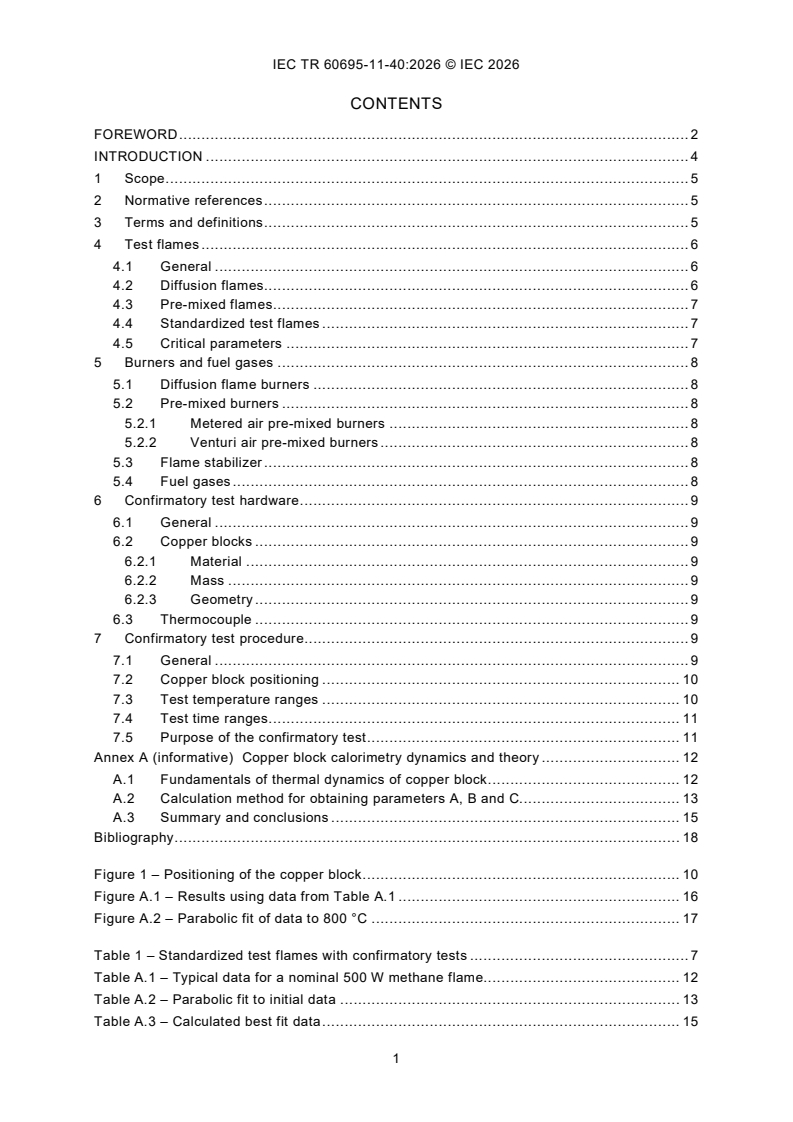
CONTENTS
FOREWORD . 2
INTRODUCTION . 4
1 Scope . 5
2 Normative references . 5
3 Terms and definitions . 5
4 Test flames . 6
4.1 General . 6
4.2 Diffusion flames . 6
4.3 Pre-mixed flames . 7
4.4 Standardized test flames . 7
4.5 Critical parameters . 7
5 Burners and fuel gases . 8
5.1 Diffusion flame burners . 8
5.2 Pre-mixed burners . 8
5.2.1 Metered air pre-mixed burners . 8
5.2.2 Venturi air pre-mixed burners . 8
5.3 Flame stabilizer . 8
5.4 Fuel gases . 8
6 Confirmatory test hardware . 9
6.1 General . 9
6.2 Copper blocks . 9
6.2.1 Material . 9
6.2.2 Mass . 9
6.2.3 Geometry . 9
6.3 Thermocouple . 9
7 Confirmatory test procedure . 9
7.1 General . 9
7.2 Copper block positioning . 10
7.3 Test temperature ranges . 10
7.4 Test time ranges . 11
7.5 Purpose of the confirmatory test . 11
Annex A (informative) Copper block calorimetry dynamics and theory . 12
A.1 Fundamentals of thermal dynamics of copper block . 12
A.2 Calculation method for obtaining parameters A, B and C. 13
A.3 Summary and conclusions . 15
Bibliography . 18
Figure 1 – Positioning of the copper block . 10
Figure A.1 – Results using data from Table A.1 . 16
Figure A.2 – Parabolic fit of data to 800 °C . 17
Table 1 – Standardized test flames with confirmatory tests . 7
Table A.1 – Typical data for a nominal 500 W methane flame. 12
Table A.2 – Parabolic fit to initial data . 13
Table A.3 – Calculated best fit data . 15
INTERNATIONAL ELECTROTECHNICAL COMMISSION
____________
Fire hazard testing-
Part 11-40: Test flames - Confirmatory tests - Guidance
FOREWORD
1) The International Electrotechnical Commission (IEC) is a worldwide organization for
standardization comprising all national electrotechnical committees (IEC National Committees).
The object of IEC is to promote international co-operation on all questions concerning
standardization in the electrical and electronic fields. To this end and in addition to other
activities, IEC publishes International Standards, Technical Specifications, Technical Reports,
Publicly Available Specifications (PAS) and Guides (hereafter referred to as "IEC
Publication(s)"). Their preparation is entrusted to technical committees; any IEC National
Committee interested in the subject dealt with may participate in this preparatory work.
International, governmental and non-governmental organizations liaising with the IEC also
participate in this preparation. IEC collaborates closely with the International Organization for
Standardization (ISO) in accordance with conditions determined by agreement between the two
organizations.
2) The formal decisions or agreements of IEC on technical matters express, as nearly as
possible, an international consensus of opinion on the relevant subjects since each technical
committee has representation from all interested IEC National Committees.
3) IEC Publications have the form of recommendations for international use and are accepted
by IEC National Committees in that sense. While all reasonable efforts are made to ensure that
the technical content of IEC Publications is accurate, IEC cannot be held responsible for the
way in which they are used or for any misinterpretation by any end user.
4) In order to promote international uniformity, IEC National Committees undertake to apply IEC
Publications transparently to the maximum extent possible in their national and regional
publications. Any divergence between any IEC Publication and the corresponding national or
regional publication shall be clearly indicated in the latter.
5) IEC itself does not provide any attestation of conformity. Independent certification bodies
provide conformity assessment services and, in some areas, access to IEC marks of conformity.
IEC is not responsible for any services carried out by independent certification bodies.
6) All users should ensure that they have the latest edition of this publication.
7) No liability shall attach to IEC or its directors, employees, servants or agents including
individual experts and members of its technical committees and IEC National Committees for
any personal injury, property damage or other damage of any nature whatsoever, whether direct
or indirect, or for costs (including legal fees) and expenses arising out of the publication, use
of, or reliance upon, this IEC Publication or any other IEC Publications.
8) Attention is drawn to the Normative references cited in this publication. Use of the referenced
publications is indispensable for the correct application of this publication.
9) IEC draws attention to the possibility that the implementation of this document may involve
the use of (a) patent(s). IEC takes no position concerning the evidence, validity or applicability
of any claimed patent rights in respect thereof. As of the date of publication of this document,
IEC had not received notice of (a) patent(s), which may be required to implement this document.
However, implementers are cautioned that this may not represent the latest information, which
may be obtained from the patent database available at https://patents.iec.ch and
www.iso.org/patents. IEC shall not be held responsible for identifying any or all such patent
rights.
IEC TR 60695-11-40 has been prepared by IEC technical committee 89: Fire hazard testing. It
is a Technical Report.
This first edition cancels and replaces the second edition of IEC TS 60695-11-40 published in
2021. This edition constitutes a technical revision.
This edition includes the following significant technical changes with respect to the previous
edition:
a) change of classification of this document (from Technical Specification to Technical Report),
based on the nature of this publication, which provides solely general information and the
theoretical basis for confirmatory tests using copper blocks;
b) minor editorial changes.
The text of this Technical Report is based on the following documents:
Draft Report on voting
89/1640/DTR 89/1656/RVDTR
Full information on the voting for its approval can be found in the report on voting indicated in
the above table.
The language used for the development of this Technical Report is English.
This document was drafted in accordance with ISO/IEC Directives, Part 2, and developed in
accordance with ISO/IEC Directives, Part 1 and ISO/IEC Directives, IEC Supplement, available
at www.iec.ch/members_experts/refdocs. The main document types developed by IEC are
described in greater detail at www.iec.ch/publications.
This Technical Report is to be used in conjunction with IEC 60695-11-2:2017 [1], IEC 60695-
11-3 [2], IEC 60695-11-4 [3] and IEC 60695-11-5 [4].
A list of all the parts in the IEC 60695 series, under the general title Fire hazard testing, can be
found on the IEC website.
It has the status of a basic safety publication in accordance with IEC Guide 104 [5] and ISO/IEC
Guide 51 [6].
The committee has decided that the contents of this document will remain unchanged until the
stability date indicated on the IEC website under webstore.iec.ch in the data related to the
specific document. At this date, the document will be
– reconfirmed,
– withdrawn, or
– revised.
INTRODUCTION
Standard flames are specified for various small-scale fire tests. Apparatus design and test
parameters are specified in an effort to ensure consistent and defined flames. Burner designs,
material specifications and fuel and air specifications are typical necessary parameters.
Experience has shown that the quality of the flames and the resulting test measurements are
influenced significantly by subtle variations in the equipment and test technique. Simple checks
on flame qualities, such as flame colour and dimensions, or the melting characteristics of silver
wire, are also sometimes specified .
The need for a relatively simple check on the power of a flame has been recognized, leading to
the introduction of confirmatory tests based on copper block calorimetry. This document is
intended to provide information about small-scale standard flames and the various copper block
confirmatory tests.
1 Scope
This part of IEC 60695, which is a Technical Report, presents a general characterization of
small-scale test flames and associated confirmatory tests based on copper block calorimetry.
Information is presented for the selection of critical parameters in confirmatory test designs.
NOTE A theory of thermal dynamics presents, in Annex A, additional performance parameters for confirmatory
tests, enabling a precise implicit mathematical characterization of confirmatory test heating curves.
This basic safety publication is intended for use by technical committees in the preparation of
safety publications in accordance with the principles laid down in IEC Guide 104 [5] and ISO/IEC
Guide 51 [6].
One of the responsibilities of a technical committee is, wherever applicable, to make use of
basic safety publications in the preparation of its publications. The information, test methods or
test conditions of this basic safety publication will not apply unless specifically referred to or
included in the relevant publications.
2 Normative references
The following documents are referred to in the text in such a way that some or all of their content
constitutes requirements of this document. For dated references, only the edition cited applies.
For undated references, the latest edition of the referenced document (including any
amendments) applies.
IEC 60695-4:2021, Fire hazard testing - Part 4: Terminology concerning fire tests for
electrotechnical products
ISO 13943:2017, Fire safety — Vocabulary
3 Terms and definitions
For the purposes of this document, the terms and definitions given in IEC 60695-4:2021 and
ISO 13943:2017, as well as the following apply.
ISO and IEC maintain terminological databases for use in standardization at the following
addresses:
– IEC Electropedia: available at http://www.electropedia.org/
– ISO Online browsing platform: available at http://www.iso.org/obp
3.1
confirmatory test
calorimetric procedure intended as a diagnostic indicator to reveal anomalous behaviour or
conditions in a test flame, burner or associated hardware
[SOURCE: IEC 60695-4:2021 [7], 3.2.4]
3.2
draught-free environment
space in which the results of experiments are not significantly affected by the local air speed
Note 1 to entry: A qualitative example is a space in which a wax candle flame remains essentially undisturbed.
−1 −1
Quantitative examples are small-scale fire tests in which a maximum air speed of 0,1 ms or 0,2 ms is sometimes
specified.
[SOURCE: ISO 13943:2017 [8], 3.83]
3.3
diffusion flame
flame in which combustion occurs in a zone where the fuel and the oxidizing agent mix, having
been initially separate
Note 1 to entry: Compare with the term pre-mixed flame (3.5).
[SOURCE: ISO 13943:2017 [8], 3.82]
3.4
flame stabilizer
assembly normally fitted to the top of a standard laboratory Bunsen or Tirrill burner intended to
mitigate the destabilizing effect of the turbulent mixing of flame gases with the ambient air, by
providing an intervening layer of gas having an intermediate velocity between the ambient still
air and the faster flame gases
[SOURCE: ISO 13943:2017 [8], 3.173]
3.5
pre-mixed flame
flame in which combustion occurs in an intimate mixture of fuel and oxidizing agent
Note 1 to entry: Compare with the term diffusion flame (3.3).
[SOURCE: ISO 13943:2017 [8], 3.307]
3.6
small-scale fire test
fire test performed on a test specimen of small dimensions
Note 1 to entry: There is no clear upper limit for the dimensions of the test specimen in a small-scale fire test. In
some instances, a fire test performed on a test specimen with a maximum dimension of less than 1 m is called a
small-scale fire test. However, a fire test performed on a test specimen of which the maximum dimension is between
0,5 m and 1,0 m is often called a medium-scale fire test.
[SOURCE: ISO 13943:2017 [8], 3.346]
3.7
Venturi effect
reduction in pressure as a result of the increase in velocity of a fluid when it passes through a
constriction in a pipe
4 Test flames
4.1 General
Flames consist of chemically exothermic reacting gaseous mixtures of oxidizer (typically oxygen
or air mixture) and reducer or fuel (typically fuel gas or vapour). For standardized test flames,
suitable hardware with supplies of combustible materials (i.e. fuel gas) delivers a continuous
flow of the needed gaseous reactants to maintain the desired standardized flame. There are
two types of test flames, as follows.
4.2 Diffusion flames
Diffusion flames are produced by a simple flow of fuel gases that combust at the point of mixing
with air at the exit orifice of the hardware (e.g. the outlet of the burner tube). The advantages
of diffusion flames are the simplicity of the hardware (often a simple tube), and the better
simulation of actual flames likely to be encountered in equipment. The disadvantage is that they
are geometrically less stable.
4.3 Pre-mixed flames
Pre-mixed flames are produced by mixing a part of the combustion air with the fuel gas prior to
the combustion point at the outlet of the burner tube. The remaining part of the combustion air
is provided in a similar way as with diffusion flames. The resulting flame has an inner/lower
cone that is typically a lighter blue colour consisting of the pre-mixed gas and air mixture with
excess fuel gas, and an outer/upper cone that is typically a very faint darker blue colour where
the remaining needed additional air
...