

ISO/IEC 27572:2026
(Main)Information technology - Brain–computer interfaces - Reference architecture
- Abstract
ISO/IEC 27572:2026 specifies the brain–computer interface (BCI) reference architecture (RA). The BCI RA defines the key characteristics of BCI systems, provides a common language for stakeholders, and addresses their concerns. It also provides guidance to system architects on efficient BCI system design, typical implementation categories and effects of using BCI technology in developing applications. Additionally, this document serves as a technical reference for architects, manufacturers, vendors, service providers, regulators and the public to better understand the BCI architecture, its functions and the underlying technology that supports the BCI systems.
- Status
- Published
- Publication Date
- 01-Sep-2026
- Technical Committee
- ISO/IEC JTC 1/SC 43 - Brain-computer Interfaces
- Current Stage
- PPUB - Publication issued
- Start Date
- 02-Sep-2026
- Completion Date
- 25-Sep-2026


ISO/IEC 27572:2026 is an International Standard from ISO/IEC on brain-computer interfaces (BCI). It specifies a BCI reference architecture (RA) that defines key characteristics of BCI systems, gives stakeholders a common language, and guides system architects on design choices, implementation categories, and the effects of using BCI technology in applications.
The document is aimed at architects, manufacturers, vendors, service providers, regulators, users and the public. In practice, it helps readers understand how a BCI system is structured, what concerns the architecture is meant to address, and how common BCI approaches differ.
What does ISO/IEC 27572:2026 specify?
ISO/IEC 27572:2026 specifies the brain-computer interface reference architecture and uses the architecture description approach and terminology of ISO/IEC/IEEE 42010. The standard is meant to frame BCI systems at an abstract architectural level so that different stakeholders can discuss the same system in the same terms.
Its structure is straightforward: Clause 1 gives the scope, Clause 2 names the normative reference, Clause 3 points to the shared terms and definitions from ISO/IEC 8663, Clause 4 lists abbreviated terms, and Clauses 5 to 9 develop the architecture through context, viewpoints, functions, and implementation categories. The document ends with a bibliography.
The core of the standard is organized around four viewpoints:
- Foundational viewpoint
- Usage viewpoint
- Functional viewpoint
- Implementation viewpoint
Each viewpoint addresses a different set of concerns, from what BCI is, to how it is used, to what functions it needs, to how it is typically implemented.
What are the key requirements of ISO/IEC 27572:2026?
ISO/IEC 27572:2026 is mainly a reference and architectural guidance document, so its most important content is the way it structures BCI systems and the concerns around them. For an engineer or buyer, the practical value is knowing what has to be considered when defining, designing, comparing, or deploying a BCI system.
Clause 5: the RA context
Clause 5 states that the document uses the ISO/IEC/IEEE 42010 approach for architecture description. It also identifies the stakeholder groups that shape BCI architecture: users, architects, manufacturers, vendors, service providers, regulators, and the public.
That matters because a BCI system is not just a signal-processing chain. The standard expects design decisions to be made with usability, safety, privacy, ethics, regulation, and deployment context in view.
Clause 6: the foundational viewpoint
Clause 6 defines BCI in practical architectural terms as a direct communication link between the activity of the central nervous system and an external software or hardware system, or both. It also highlights two essential characteristics: the system must sense brain activity, and it must convert neural signals into functionally useful outputs in real time.
Clause 6 also groups BCI characteristics into ethics, safety, and functional characteristics. These include autonomy, agency, fairness and justice, accountability, societal and environmental well-being, risk management, beneficence and non-maleficence, privacy and confidentiality, accuracy, efficiency, stability, user-friendliness, and effectiveness. For readers, this means the architecture is not only about performance - it also has to support responsible data handling, safe use, and practical usability.
Clause 7: the usage viewpoint
Clause 7 describes how BCI systems are used, grouping usage effects into monitoring, substitution, recovery, enhancement, and supplementation. These categories help a reader identify whether a BCI is intended to observe a state, replace a lost function, support rehabilitation, improve capability, or add another control channel.
This is useful in procurement and system planning because the expected use case affects the interface, feedback, training, and performance priorities of the system.
Clause 8: the functional viewpoint
Clause 8 gives the function model of a BCI system. The main functional categories are signal acquisition, signal preprocessing, feature extraction and decoding, external applications, feedback, and stimulation.
In practical terms, this means a BCI architecture should show how signals are captured, cleaned, interpreted, and used to drive an application. Clause 8 also explains that acquisition may include filtering, amplification, and analogue-to-digital conversion, while preprocessing improves signal quality and should support secure storage and data integrity. Feature extraction and decoding may use temporal, spatial, or spectral features and machine learning methods to map neural activity to commands.
Clause 8 also distinguishes feedback, which uses visual, auditory, or tactile stimuli to guide the user, from stimulation, which covers neuromodulation techniques used for sensory or motor restoration. For implementers, this clause is the clearest map of the logical building blocks of a BCI system.
Clause 9: the implementation viewpoint
Clause 9 classifies BCI implementation into active BCI, passive BCI, reactive BCI, and hybrid BCI. Active BCI depends on intentional changes in brain activity, often motor imagery. Passive BCI monitors cognitive or disease states without intentional control. Reactive BCI decodes responses to external stimulation such as P300 or SSVEP. Hybrid BCI combines multiple paradigms or adds physiological inputs such as EMG, EOG, NIRS, or eye-tracking.
This matters because the implementation choice affects user training, signal type, interface design, and reliability. It also helps architects match the technology to the task, such as assistive control, rehabilitation, monitoring, or selection interfaces.
What terms does ISO/IEC 27572:2026 define?
ISO/IEC 27572:2026 uses the terms and definitions from ISO/IEC 8663, and it also lists a set of abbreviations used throughout the document.
- BCI - Brain-computer interface; the standard uses this for systems that link brain activity with external software or hardware.
- RA - Reference architecture; the architectural framework the document specifies for BCI systems.
- EEG - Electroencephalography; used for measuring electrical brain activity, especially in reactive BCI.
- ERP - Event-related potential; a brain response tied to a stimulus or decision event.
- SSVEP - Steady state visual evoked potential; a response used in reactive BCI when a user focuses on a visual stimulus.
- DBS - Deep brain stimulation; an invasive stimulation method mentioned in the implementation viewpoint.
- MI - Motor imagery; the intentional imagined movement used in active BCI.
Who uses ISO/IEC 27572:2026?
ISO/IEC 27572:2026 is used by people who design, build, regulate, buy, or explain BCI systems. The document names architects, manufacturers, vendors, service providers, regulators, users, and the public.
Architects and service providers use it to structure system design and deployment. Manufacturers and vendors use it to align products with the expected architecture and application category. Regulators use it to understand the system functions and concerns they need to review. Users and the public can use it to understand what a BCI system does, how it works, and what concerns it raises in practice.
Which standards are used with ISO/IEC 27572:2026?
ISO/IEC 27572:2026 uses ISO/IEC 8663 as its normative reference for BCI vocabulary and shared terms. That gives the standard its formal language for concepts such as BCI and related terminology.
It also refers to ISO/IEC/IEEE 42010 in Clause 5.1 for the architecture-description approach and terminology. ISO/IEC 27001 and ISO/IEC 27559 are named in the privacy and confidentiality discussion as useful standards for information security management and privacy-enhancing de-identification. In practice, these standards help readers handle neural data, security controls, and privacy risks around BCI systems.
What does the ISO/IEC 27572:2026 document contain?
ISO/IEC 27572:2026 contains a viewpoint-based architecture for BCI systems, supported by a concise set of models rather than detailed product requirements. The document includes a definition model, a characteristics model, a usage effect model, a function model, and an implementation category model.
It also includes five figures that show the viewpoint structure, the functional view and function model, and the active, passive, and reactive BCI categories. These figures help readers see how the architecture is organized and how information or control flows through a BCI system.
The document’s body describes common BCI functions such as acquisition, preprocessing, decoding, feedback, and stimulation, and it explains typical implementation patterns for motor imagery, monitoring, selection, and hybrid systems. That makes it useful for design reviews, system scoping, technical comparisons, and explaining BCI architecture to non-specialists.
Get Certified
Connect with accredited certification bodies for this standard

BSI Group
BSI (British Standards Institution) is the business standards company that helps organizations make excellence a habit.

NYCE
Mexican standards and certification body.
Sponsored listings
Frequently Asked Questions
ISO/IEC 27572:2026 is a standard published by the International Electrotechnical Commission (IEC). Its full title is "Information technology - Brain–computer interfaces - Reference architecture". This standard covers: ISO/IEC 27572:2026 specifies the brain–computer interface (BCI) reference architecture (RA). The BCI RA defines the key characteristics of BCI systems, provides a common language for stakeholders, and addresses their concerns. It also provides guidance to system architects on efficient BCI system design, typical implementation categories and effects of using BCI technology in developing applications. Additionally, this document serves as a technical reference for architects, manufacturers, vendors, service providers, regulators and the public to better understand the BCI architecture, its functions and the underlying technology that supports the BCI systems.
ISO/IEC 27572:2026 specifies the brain–computer interface (BCI) reference architecture (RA). The BCI RA defines the key characteristics of BCI systems, provides a common language for stakeholders, and addresses their concerns. It also provides guidance to system architects on efficient BCI system design, typical implementation categories and effects of using BCI technology in developing applications. Additionally, this document serves as a technical reference for architects, manufacturers, vendors, service providers, regulators and the public to better understand the BCI architecture, its functions and the underlying technology that supports the BCI systems.
ISO/IEC 27572:2026 is classified under the following ICS (International Classification for Standards) categories: 35.020 - Information technology (IT) in general. The ICS classification helps identify the subject area and facilitates finding related standards.
ISO/IEC 27572:2026 is available in PDF format for immediate download after purchase. The document can be added to your cart and obtained through the secure checkout process. Digital delivery ensures instant access to the complete standard document.
Standards Content (Sample)
ISO/IEC 27572
Edition 1.0 2026-09
INTERNATIONAL
STANDARD
Information technology - Brain–computer interfaces - Reference architecture
ICS 35.020 ISBN 978-2-8327-1463-8
All rights reserved. Unless otherwise specified, no part of this publication may be reproduced or utilized in any form or
by any means, electronic or mechanical, including photocopying and microfilm, without permission in writing from either
IEC or IEC's member National Committee in the country of the requester. If you have any questions about IEC copyright
or have an enquiry about obtaining additional rights to this publication, please contact the address below or your local
IEC member National Committee for further information.
IEC Secretariat Tel.: +41 22 919 02 11
3, rue de Varembé info@iec.ch
CH-1211 Geneva 20 www.iec.ch
Switzerland
About the IEC
The International Electrotechnical Commission (IEC) is the leading global organization that prepares and publishes
International Standards for all electrical, electronic and related technologies.
About IEC publications
The technical content of IEC publications is kept under constant review by the IEC. Please make sure that you have the
latest edition, a corrigendum or an amendment might have been published.
IEC publications search - IEC Products & Services Portal - products.iec.ch
webstore.iec.ch/advsearchform Discover our powerful search engine and read freely all the
The advanced search enables to find IEC publications by a publications previews, graphical symbols and the glossary. With
variety of criteria (reference number, text, technical a subscription you will always have access to up to date content
committee, …). It also gives information on projects, replaced tailored to your needs.
and withdrawn publications.
Electropedia - www.electropedia.org
The world's leading online dictionary on electrotechnology,
IEC Just Published - webstore.iec.ch/justpublished
Stay up to date on all new IEC publications. Just Published containing more than 22 500 terminological entries in English
details all new publications released. Available online and and French, with equivalent terms in 25 additional languages.
once a month by email. Also known as the International Electrotechnical Vocabulary
(IEV) online.
IEC Customer Service Centre - webstore.iec.ch/csc
If you wish to give us your feedback on this publication or need
further assistance, please contact the Customer Service
Centre: sales@iec.ch.
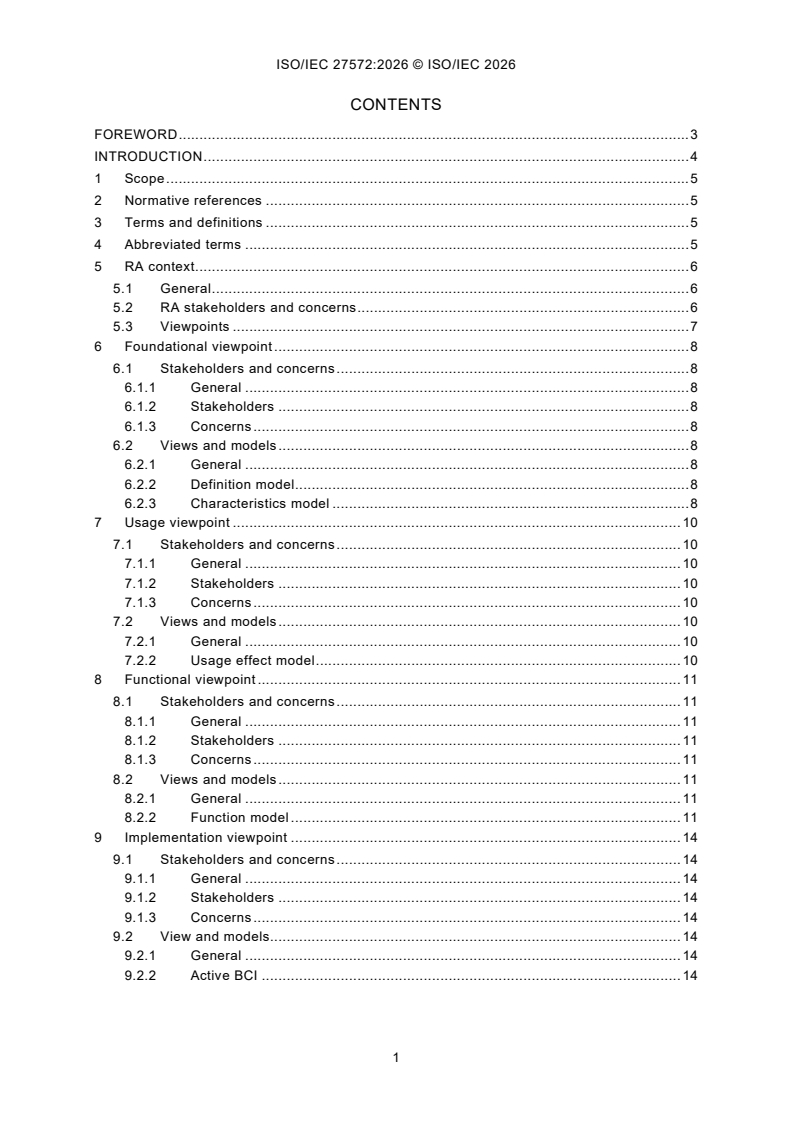
CONTENTS
FOREWORD . 3
INTRODUCTION . 4
1 Scope . 5
2 Normative references . 5
3 Terms and definitions . 5
4 Abbreviated terms . 5
5 RA context . 6
5.1 General . 6
5.2 RA stakeholders and concerns . 6
5.3 Viewpoints . 7
6 Foundational viewpoint . 8
6.1 Stakeholders and concerns . 8
6.1.1 General . 8
6.1.2 Stakeholders . 8
6.1.3 Concerns . 8
6.2 Views and models . 8
6.2.1 General . 8
6.2.2 Definition model . 8
6.2.3 Characteristics model . 8
7 Usage viewpoint . 10
7.1 Stakeholders and concerns . 10
7.1.1 General . 10
7.1.2 Stakeholders . 10
7.1.3 Concerns . 10
7.2 Views and models . 10
7.2.1 General . 10
7.2.2 Usage effect model . 10
8 Functional viewpoint . 11
8.1 Stakeholders and concerns . 11
8.1.1 General . 11
8.1.2 Stakeholders . 11
8.1.3 Concerns . 11
8.2 Views and models . 11
8.2.1 General . 11
8.2.2 Function model . 11
9 Implementation viewpoint . 14
9.1 Stakeholders and concerns . 14
9.1.1 General . 14
9.1.2 Stakeholders . 14
9.1.3 Concerns . 14
9.2 View and models. 14
9.2.1 General . 14
9.2.2 Active BCI . 14
9.2.3 Passive BCI . 15
9.2.4 Reactive BCI . 16
9.2.5 Hybrid BCI . 17
Bibliography . 18
Figure 1 – BCI RA viewpoints . 7
Figure 2 – Functional view and function model . 12
Figure 3 – Active BCI category . 15
Figure 4 – Passive BCI category . 16
Figure 5 – Reactive BCI category . 17
Information technology -
Brain–computer interfaces -
Reference architecture
FOREWORD
1) ISO (the International Organization for Standardization) and IEC (the International Electrotechnical Commission)
form the specialized system for worldwide standardization. National bodies that are members of ISO or IEC
participate in the development of International Standards through technical committees established by the
respective organization to deal with particular fields of technical activity. ISO and IEC technical committees
collaborate in fields of mutual interest. Other international organizations, governmental and non-governmental,
in liaison with ISO and IEC, also take part in the work.
2) The formal decisions or agreements of IEC and ISO on technical matters express, as nearly as possible, an
international consensus of opinion on the relevant subjects since each technical committee has representation
from all interested IEC and ISO National bodies.
3) IEC and ISO documents have the form of recommendations for international use and are accepted by IEC and
ISO National bodies in that sense. While all reasonable efforts are made to ensure that the technical content of
IEC and ISO documents is accurate, IEC and ISO cannot be held responsible for the way in which they are used
or for any misinterpretation by any end user.
4) In order to promote international uniformity, IEC and ISO National bodies undertake to apply IEC and
ISO documents transparently to the maximum extent possible in their national and regional publications. Any
divergence between any IEC and ISO document and the corresponding national or regional publication shall be
clearly indicated in the latter.
5) IEC and ISO do not provide any attestation of conformity. Independent certification bodies provide conformity
assessment services and, in some areas, access to IEC and ISO marks of conformity. IEC and ISO are not
responsible for any services carried out by independent certification bodies.
6) All users should ensure that they have the latest edition of this document.
7) No liability shall attach to IEC and ISO or their directors, employees, servants or agents including individual
experts and members of its technical committees and IEC and ISO National bodies for any personal injury,
property damage or other damage of any nature whatsoever, whether direct or indirect, or for costs (including
legal fees) and expenses arising out of the publication, use of, or reliance upon, this ISO/IEC document or any
other IEC and ISO documents.
8) Attention is drawn to the Normative references cited in this document. Use of the referenced publications is
indispensable for the correct application of this document.
9) IEC and ISO draw attention to the possibility that the implementation of this document may involve the use of (a)
patent(s). IEC and ISO take no position concerning the evidence, validity or applicability of any claimed patent
rights in respect thereof. As of the date of publication of this document, IEC and ISO had not received notice of
(a) patent(s), which may be required to implement this document. However, implementers are cautioned that this
may not represent the latest information, which may be obtained from the patent database available at
https://patents.iec.ch and www.iso.org/patents. IEC and ISO shall not be held responsible for identifying any or
all such patent rights.
ISO/IEC 27572 has been prepared by subcommittee 43: Brain–computer interface, of ISO/IEC
joint technical committee 1: Information technology. It is an International Standard.
The text of this International Standard is based on the following documents:
Draft Report on voting
JTC1-SC43/211/FDIS JTC1-SC43/225/RVD
Full information on the voting for its approval can be found in the report on voting indicated in
the above table.
The language used for the development of this International Standard is English.
This document was drafted in accordance with ISO/IEC Directives, Part 2, and developed in
accordance with ISO/IEC Directives, Part 1, and the ISO/IEC Directives, JTC 1 Supplement
available at www.iec.ch/members_experts/refdocs and www.iso.org/directives.
INTRODUCTION
Brain–computer interface (BCI) is a revolutionary technology that aims to establish a direct
communication pathway between the brain and an external device, such as a computer or a
prosthetic limb. It holds immense potential for enhancing capabilities, enabling individuals with
disabilities to regain lost functions, and providing new avenues for human–computer interaction.
The development of a BCI system involves the integration of various components. These
components work in synergy to decode the electrical or neurochemical signals generated by
the brain, translating them into meaningful commands or actions that can be used to control
external devices.
This document presents a comprehensive reference architecture (RA) for BCI. The BCI RA
identifies and highlights architectural concerns commonly found in BCI systems across
industrial sectors and classifies them into viewpoints along with their respective stakeholders.
It describes, analyses and, where appropriate, provides guidance to resolve these concerns in
these viewpoints, resulting in a certain abstract architecture representation.
1 Scope
This document specifies the brain–computer interface (BCI) reference architecture (RA). The
BCI RA defines the key characteristics of BCI systems, provides a common language for
stakeholders, and addresses their concerns. It also provides guidance to system architects on
efficient BCI system design, typical implementation categories and effects of using BCI
technology in developing applications. Additionally, this document serves as a technical
reference for architects, manufacturers, vendors, service providers, regulators and the public
to better understand the BCI architecture, its functions and the underlying technology that
supports the BCI systems.
2 Normative references
The following documents are referred to in the text in such a way that some or all of their content
constitutes requirements of this document. For dated references, only the edition cited applies.
For undated references, the latest edition of the referenced document (including any
amendments) applies.
ISO/IEC 8663, Information technology - Brain–computer interfaces - Vocabulary
3 Terms and definitions
For the purposes of this document, the terms and definitions given in ISO/IEC 8663 apply.
ISO and IEC maintain terminological databases for use in standardization at the following
addresses:
– ISO Online browsing platform: available at https://www.iso.org/obp
– IEC Electropedia: available at http://www.electropedia.org/
4 Abbreviated terms
BCI brain–computer interface
DBS deep brain stimulation
EEG electroencephalography
EMG electromyography
EOG electrooculography
ERD event-related desynchronization
ERP event-related potential
ERS event-related synchronization
MI motor imagery
MRI magnetic resonance imaging
NIRS near-infrared spectroscopy
RA reference architecture
SSVEP steady state visual evoked potential
tACS transcranial alternating current stimulation
tDCS transcranial direct current stimulation
TMS transcranial magnetic stimulation
tUS transcranial ultrasound stimulation
VEP visual evoked potential
5 RA context
5.1 General
This document specifies a reference architecture for the brain–computer interface using the
approach and terminology that are defined in ISO/IEC/IEEE 42010 [1].
5.2 RA stakeholders and concerns
The development and deployment of BCI systems involve multiple stakeholders, each with
concerns related to different aspects of the system across its full life cycle. The stakeholders
include the following.
– Users: Users are individuals who interact directly with the BCI system and rely on it to meet
their specific requirements. They are concerned about the system’s usability, reliability, and
safety. They care about the accuracy and consistency of its performance, potential side
effects or risks associated with its use, and the learning curve required to operate the BCI.
Users are also concerned about the privacy and security of their neural data and the
potential impact of using BCI on their daily lives and social interactions.
– Architects: The architects are responsible for designing secure, scalable, robust and flexible
structure and functionality of the BCI system. They ensure that the system architecture
aligns with the overall system goals and user requirements. Their concerns include system
performance, power consumption, security vulnerabilities and protection against malicious
attacks. They are also concerned about the related regulations on BCI across different
countries.
– Manufacturers: Manufacturers design and produce the hardware and software that make
the BCI system functional, and ensure that its components meet the required standards for
safety, efficiency, and usability. They also innovate to improve the accuracy and
accessibility of the BCI system. Manufacturers collaborate closely with architects to advance
the technology and make it suitable for practical, real-world applications.
– Vendors: Vendors are responsible for bringing BCI products to market. They play a key role
in educating potential users about the benefits and functionalities of BCI technology besides
ensuring the ethical marketing of their products.
– Service providers: The service providers integrate hardware and software and deploy the
BCI system for specific application scenarios such as healthcare, education, entertainment,
delivering service directly to the users. Their main focus is to ensure the BCI system
effectively meets the requirements of the user in each scenario and complies with the
relevant standards of effectiveness and safety.
– Regulators: Regulators are government agencies or bodies responsible for overseeing the
use of BCI and ensuring compliance with ethical, legal, and safety standards. Their concerns
include risks associated with the BCI use, user’s privacy protection, the potential
discrimination or inequity arising from its implementation.
– The public: The public is the general population that includes potential users, bystanders,
and society as a whole. The public's major concerns include the ethical implications, societal
impact, and potential benefits of the BCI systems, including considerations such as privacy,
accessibility, and equitable access to the technology.
5.3 Viewpoints
A viewpoint is defined to frame multiple concerns of one or more stakeholders. Within each
viewpoint, the model structure is specified to address these concerns. The following viewpoints
are defined to address BCI system concerns based on the analysis of various BCI use cases.
– Foundational viewpoint: Describes the BCI RA on the conceptual level, addressing concerns
related to the fundamental concepts of BCI.
– Usage viewpoint: Focuses on the concerns related to expected system usage and user
interactions.
– Functional viewpoint: Concentrates on the capabilities and functions that are essential for
the BCI system to meet the expected interactions. It highlights the functional components
of a BCI system, their structure and interfaces between them.
– Implementation viewpoint: Provides a set of typical implementation patterns used in BCI
systems along with guidance on how to apply these patterns.
As shown in Figure 1, the viewpoints provide a structured approach for identifying concerns
related to BCI systems and their associated stakeholders. The arrangement of the viewpoints,
from top to bottom, reflects a typical interaction pattern among these views. Decisions made at
a higher-level viewpoint guide and establish requirements for the lower-level viewpoints. The
deliberation of concerns at a lower viewpoint, which includes the implementation of
requirements from the viewpoints above it, can validate and refine the analysis and decisions
made at the higher-level viewpoint. The viewpoints provide a framework for architects to
consider important architectural issues in BCI system development and deployment. The RA
also identifies common architecture patterns to ensure the broad applicability across industrial
sectors.
Figure 1 – BCI RA viewpoints
6 Foundational viewpoint
6.1 Stakeholders and concerns
6.1.1 General
The foundational viewpoint frames multiple concerns of several stakeholders, described in 6.1.2
and 6.1.3.
6.1.2 Stakeholders
– Users
– Architects
– Manufacturers
– Vendors
– Service providers
– Regulators
– The public
6.1.3 Concerns
– What is BCI?
– What are the implications of the concept of BCI?
– What are the requirements of BCI systems and users?
– What are the potential benefits and risks with the concept of BCI?
– What are the potential ethical implications and concerns surrounding the use of BCI systems?
6.2 Views and models
6.2.1 General
This view provides the definition model and characteristics model to address the foundational
concerns.
6.2.2 Definition model
BCI is defined as “direct communication link between the activity of central nervous system and
an external software or hardware system or both” in ISO/IEC 8663.
In practical terms, this definition can be broken down to two essential characteristics.
– The direct interface with the biological brain. A system which does not sense brain activity
is not a BCI system. For example, myoelectric upper limb prosthetics which use peripheral
neural signals are not BCI systems.
– A BCI system measures neural signals and converts them into functionally useful outputs in
real time. A system which only senses brain activity without online feedback is not a BCI
system. For example, an MRI system alone is not a BCI system.
6.2.3 Characteristics model
6.2.3.1 General
The characteristics are typical features and qualities that BCI has. They are required by user
or system, and are defined as models. They are divided into three groups.
6.2.3.2 BCI ethics characteristics
– Autonomy: Autonomy ensures individuals control their thoughts and actions and make
informed decisions. It is important for users to fully understand potential risks, benefits, and
system capabilities. In cases of impaired decision-making, involving family or guardians
remains focused on prioritizing the individual’s autonomy.
– Agency: The concept of agency in BCI system refers to a user’s ability to act based on their
own values and
...