

IEC TS 60695-11-12:2026
(Main)Fire hazard testing - Part 11-12: Test flames - Burning droplets test for finished units
- Abstract
IEC TS 60695-11-12:2026 describes a test method intended to investigate whether the bottom part of an enclosure having openings is able to contain the burning droplets inside the enclosure if ignition occurs inside a finished unit.
The purpose of the test is to verify whether the size of the openings in the bottom part of an enclosure are of such a size that reduces the risk of propagation of a flame outside the enclosure of a finished unit .
This technical specification is intended to be used by technical committees in the preparation of documents in accordance with the principles laid down in IEC GUIDE 104 and ISO/IEC Guide 51. While this document currently does not have the status of a horizontal safety publication, it is intended to become one if the document is transformed into an International Standard.
- Status
- Published
- Publication Date
- 01-Sep-2026
- Technical Committee
- TC 89 - Fire hazard testing
- Drafting Committee
- WG 12 - TC 89/WG 12
- Current Stage
- PPUB - Publication issued
- Start Date
- 02-Sep-2026
- Completion Date
- 25-Sep-2026
IEC TS 60695-11-12:2026 is an IEC Technical Specification for fire hazard testing of finished units. It specifies a burning droplets test for the bottom part of an enclosure with openings, to see whether burning droplets stay inside the unit when ignition starts inside it.
The document is written for technical committees preparing electrotechnical product standards, and for laboratories and product engineers applying those standards to enclosure design and fire containment.
What does IEC TS 60695-11-12:2026 specify?
IEC TS 60695-11-12:2026 specifies a test method for checking whether openings in the bottom part of a finished unit enclosure can contain burning droplets and help limit flame propagation outside the enclosure. The document is organized into clauses on scope, normative references, terms and definitions, principle, apparatus, test specimen and test bar, conditioning, test procedure, observations, evaluation of results, and the test report.
The method is intended for use when a product standard refers to it. The scope also places the document in the safety-publication framework of IEC GUIDE 104 and ISO/IEC Guide 51.
What are the key requirements of IEC TS 60695-11-12:2026?
IEC TS 60695-11-12:2026 requires a controlled burn test in which a test bar above the specimen is ignited and the resulting burning droplets are directed onto openings in the bottom part of the enclosure. The pass criterion is straightforward: the cotton pad beneath the specimen must not ignite.
Test setup and apparatus
The test chamber must allow observation, limit draught, and keep ambient light low enough for clear viewing. The burner, timer, conditioning equipment, micrometer, measuring scale, desiccator and cotton pads all have defined characteristics, so the test can be reproduced in different laboratories.
In practice, this means the method depends on controlled airflow, controlled conditioning, and repeatable positioning of the flame and specimen.
Test specimen and test bar
IEC TS 60695-11-12:2026 uses the complete bottom part of the enclosure, or a part of it, as the test specimen. The specimen is tested as used and in the same position as in the finished unit, and it must be large enough that molten or burning material does not run over the edges.
The test bar represents the material above the openings. It is made from the same material as present in the finished unit, unless the relevant specification says otherwise, and unless the material has insignificant mass or is already classified as V-0, V-1, 5VA or 5VB at the relevant thickness and colour.
Conditioning and test conditions
Cotton pads are conditioned in a desiccator before use, and the specimen and test bar are conditioned in a standard atmosphere before testing. The test also requires the laboratory atmosphere to stay within a defined temperature and humidity range.
This matters because moisture and ambient conditions can change ignition behaviour and the likelihood of the cotton pad catching fire.
Procedure and observations
The burner produces a standardized 50 W nominal test flame, and the flame is applied to the test bar so that the burning droplets fall onto the opening under study. The test continues until ignition of the cotton pad or test bar is extinguished or the bar is consumed.
For each specimen, the operator records whether burning droplets were seen, whether they ignited the specimen, and whether the cotton pad caught fire.
Evaluation and report
A specimen passes if the cotton pad does not ignite during the whole procedure. The report then documents the specimens and bars used, the hole shape and size, thicknesses, conditioning, observations, results, and any deviations from the specified conditions.
What terms does IEC TS 60695-11-12:2026 define?
- Combustion - an exothermic reaction with an oxidizing agent, usually producing flames and/or glowing and fire effluent.
- Draught-free environment - a space where air movement does not significantly affect the test result.
- Fire effluent - gases and aerosols, including particles, created by combustion or pyrolysis.
- Finished unit - a complete unit designed to stand alone and used directly by an end-user.
- Insignificant mass - so little combustible material that it is not considered a fire hazard.
Who uses IEC TS 60695-11-12:2026?
IEC TS 60695-11-12:2026 is used by IEC technical committees when preparing product standards for electrotechnical equipment. It is also relevant to test laboratories, safety engineers, product designers, quality managers, and certification bodies that need to assess whether enclosure openings can contain burning droplets in a finished unit.
The method is especially relevant where enclosure design, hole size, and bottom openings affect fire containment.
Which standards are used with IEC TS 60695-11-12:2026?
IEC TS 60695-2-21:2023 provides the fire containment test on finished units for related glowing/hot-wire based methods. IEC 60695-4:2021 supplies terminology used across fire tests for electrotechnical products.
IEC 60695-11-4 provides the 50 W flame apparatus and confirmational test method used for the burner. IEC 60695-11-10 and IEC 60695-11-20 provide related flame test methods and the fire performance classifications used to decide when a test bar material may be exempted.
ISO 291:2008 gives the standard atmosphere for conditioning and testing plastics, and ISO 13943:2017 supplies fire safety vocabulary used in the definitions.
What does the IEC TS 60695-11-12:2026 document contain?
IEC TS 60695-11-12:2026 contains an example setup drawing, apparatus requirements, specimen preparation rules, conditioning instructions, a step-by-step flame application procedure, and the reporting items needed for traceable test results. It also includes the test principle, which explains that the method simulates burning droplets from material inside a finished unit.
The document is structured so that a laboratory can set up the test, run it, observe ignition behaviour, and record the result in a consistent way.
Get Certified
Connect with accredited certification bodies for this standard

IMQ S.p.A. (Certification)
Italian electrical product certification.

SLG Prüf- und Zertifizierungs GmbH
German testing and certification body.

UL Solutions
Global safety science company with testing, inspection and certification.
Sponsored listings
Frequently Asked Questions
IEC TS 60695-11-12:2026 is a technical specification published by the International Electrotechnical Commission (IEC). Its full title is "Fire hazard testing - Part 11-12: Test flames - Burning droplets test for finished units". This standard covers: IEC TS 60695-11-12:2026 describes a test method intended to investigate whether the bottom part of an enclosure having openings is able to contain the burning droplets inside the enclosure if ignition occurs inside a finished unit. The purpose of the test is to verify whether the size of the openings in the bottom part of an enclosure are of such a size that reduces the risk of propagation of a flame outside the enclosure of a finished unit . This technical specification is intended to be used by technical committees in the preparation of documents in accordance with the principles laid down in IEC GUIDE 104 and ISO/IEC Guide 51. While this document currently does not have the status of a horizontal safety publication, it is intended to become one if the document is transformed into an International Standard.
IEC TS 60695-11-12:2026 describes a test method intended to investigate whether the bottom part of an enclosure having openings is able to contain the burning droplets inside the enclosure if ignition occurs inside a finished unit. The purpose of the test is to verify whether the size of the openings in the bottom part of an enclosure are of such a size that reduces the risk of propagation of a flame outside the enclosure of a finished unit . This technical specification is intended to be used by technical committees in the preparation of documents in accordance with the principles laid down in IEC GUIDE 104 and ISO/IEC Guide 51. While this document currently does not have the status of a horizontal safety publication, it is intended to become one if the document is transformed into an International Standard.
IEC TS 60695-11-12:2026 is classified under the following ICS (International Classification for Standards) categories: 13.220.40 - Ignitability and burning behaviour of materials and products; 29.020 - Electrical engineering in general. The ICS classification helps identify the subject area and facilitates finding related standards.
IEC TS 60695-11-12:2026 is available in PDF format for immediate download after purchase. The document can be added to your cart and obtained through the secure checkout process. Digital delivery ensures instant access to the complete standard document.
Standards Content (Sample)
IEC TS 60695-11-12 ®
Edition 1.0 2026-09
TECHNICAL
SPECIFICATION
Fire hazard testing -
Part 11-12: Test flames - Burning droplets test for finished units
ICS 13.220.40; 29.020 ISBN 978-2-8327-1473-7
All rights reserved. Unless otherwise specified, no part of this publication may be reproduced or utilized in any form or
by any means, electronic or mechanical, including photocopying and microfilm, without permission in writing from either
IEC or IEC's member National Committee in the country of the requester. If you have any questions about IEC copyright
or have an enquiry about obtaining additional rights to this publication, please contact the address below or your local
IEC member National Committee for further information.
IEC Secretariat Tel.: +41 22 919 02 11
3, rue de Varembé info@iec.ch
CH-1211 Geneva 20 www.iec.ch
Switzerland
About the IEC
The International Electrotechnical Commission (IEC) is the leading global organization that prepares and publishes
International Standards for all electrical, electronic and related technologies.
About IEC publications
The technical content of IEC publications is kept under constant review by the IEC. Please make sure that you have the
latest edition, a corrigendum or an amendment might have been published.
IEC publications search - IEC Products & Services Portal - products.iec.ch
webstore.iec.ch/advsearchform Discover our powerful search engine and read freely all the
The advanced search enables to find IEC publications by a publications previews, graphical symbols and the glossary.
variety of criteria (reference number, text, technical With a subscription you will always have access to up to date
committee, …). It also gives information on projects, content tailored to your needs.
replaced and withdrawn publications.
Electropedia - www.electropedia.org
The world's leading online dictionary on electrotechnology,
IEC Just Published - webstore.iec.ch/justpublished
Stay up to date on all new IEC publications. Just Published containing more than 22 500 terminological entries in English
details all new publications released. Available online and and French, with equivalent terms in 25 additional languages.
once a month by email. Also known as the International Electrotechnical Vocabulary
(IEV) online.
IEC Customer Service Centre - webstore.iec.ch/csc
If you wish to give us your feedback on this publication or
need further assistance, please contact the Customer
Service Centre: sales@iec.ch.
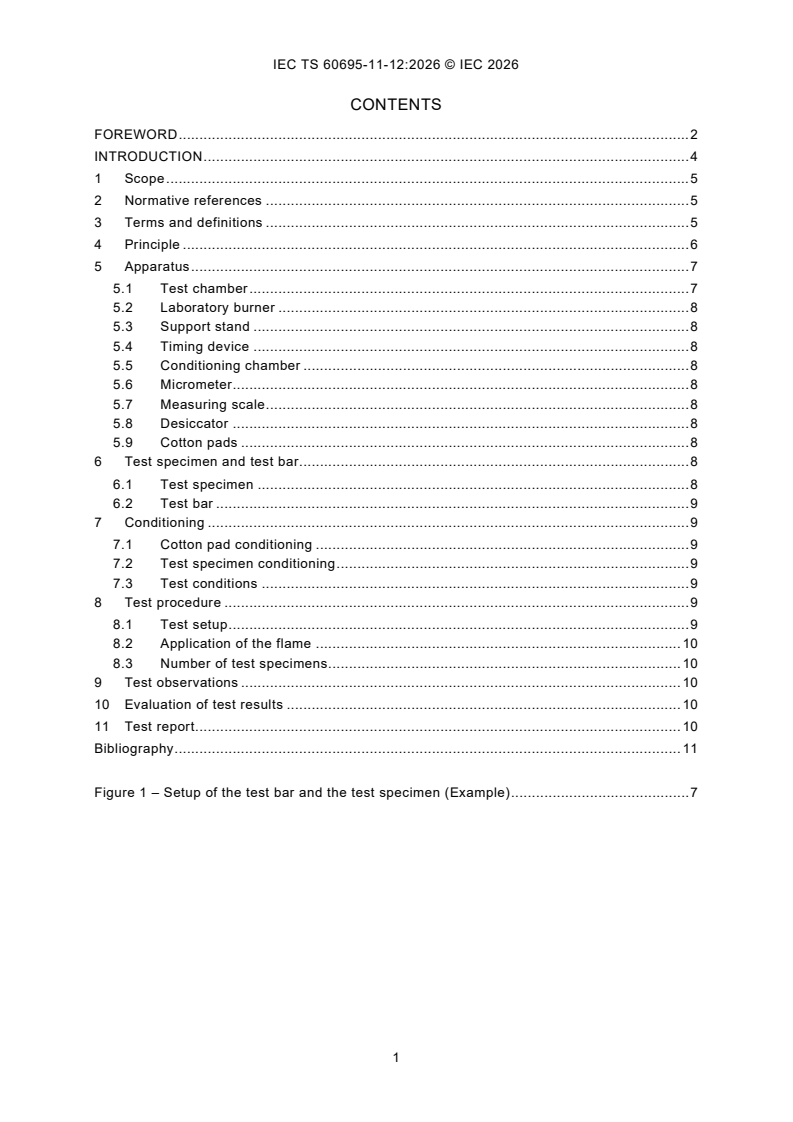
CONTENTS
FOREWORD . 2
INTRODUCTION . 4
1 Scope . 5
2 Normative references . 5
3 Terms and definitions . 5
4 Principle . 6
5 Apparatus . 7
5.1 Test chamber . 7
5.2 Laboratory burner . 8
5.3 Support stand . 8
5.4 Timing device . 8
5.5 Conditioning chamber . 8
5.6 Micrometer . 8
5.7 Measuring scale . 8
5.8 Desiccator . 8
5.9 Cotton pads . 8
6 Test specimen and test bar. 8
6.1 Test specimen . 8
6.2 Test bar . 9
7 Conditioning . 9
7.1 Cotton pad conditioning . 9
7.2 Test specimen conditioning . 9
7.3 Test conditions . 9
8 Test procedure . 9
8.1 Test setup . 9
8.2 Application of the flame . 10
8.3 Number of test specimens . 10
9 Test observations . 10
10 Evaluation of test results . 10
11 Test report . 10
Bibliography . 11
Figure 1 – Setup of the test bar and the test specimen (Example) . 7
INTERNATIONAL ELECTROTECHNICAL COMMISSION
____________
Fire hazard testing -
Part 11-12: Test flames - Burning droplets test for finished units
FOREWORD
1 The International Electrotechnical Commission (IEC) is a worldwide organization for standardization comprising
all national electrotechnical committees (IEC National Committees). The object of IEC is to promote international
co-operation on all questions concerning standardization in the electrical and electronic fields. To this end and
in addition to other activities, IEC publishes International Standards, Technical Specifications, Technical Reports,
Publicly Available Specifications (PAS) and Guides (hereafter referred to as "IEC Publication(s)"). Their
preparation is entrusted to technical committees; any IEC National Committee interested in the subject dealt with
may participate in this preparatory work. International, governmental and non-governmental organizations liaising
with the IEC also participate in this preparation. IEC collaborates closely with the International Organization for
Standardization (ISO) in accordance with conditions determined by agreement between the two organizations.
2 The formal decisions or agreements of IEC on technical matters express, as nearly as possible, an international
consensus of opinion on the relevant subjects since each technical committee has representation from all
interested IEC National Committees.
3 IEC Publications have the form of recommendations for international use and are accepted by IEC National
Committees in that sense. While all reasonable efforts are made to ensure that the technical content of IEC
Publications is accurate, IEC cannot be held responsible for the way in which they are used or for any
misinterpretation by any end user.
4 In order to promote international uniformity, IEC National Committees undertake to apply IEC Publications
transparently to the maximum extent possible in their national and regional publications. Any divergence between
any IEC Publication and the corresponding national or regional publication shall be clearly indicated in the latter.
5 IEC itself does not provide any attestation of conformity. Independent certification bodies provide conformity
assessment services and, in some areas, access to IEC marks of conformity. IEC is not responsible for any
services carried out by independent certification bodies.
6 All users should ensure that they have the latest edition of this publication.
7 No liability shall attach to IEC or its directors, employees, servants or agents including individual experts and
members of its technical committees and IEC National Committees for any personal injury, property damage or
other damage of any nature whatsoever, whether direct or indirect, or for costs (including legal fees) and
expenses arising out of the publication, use of, or reliance upon, this IEC Publication or any other IEC
Publications.
8 Attention is drawn to the Normative references cited in this publication. Use of the referenced publications is
indispensable for the correct application of this publication.
9 IEC draws attention to the possibility that the implementation of this document may involve the use of (a)
patent(s). IEC takes no position concerning the evidence, validity or applicability of any claimed patent rights in
respect thereof. As of the date of publication of this document, IEC had not notice of (a) patent(s), which may be
required to implement this document. However, implementers are cautioned that this may not represent the latest
information, which may be obtained from the patent database available at https://patents.iec.ch and
www.iso.org/patents . IEC shall not be held responsible for identifying any or all such patent rights.
IEC TS 60695-11-12 has been prepared by IEC technical committee 89: Fire Hazard Testing.
It is a Technical Specification.
The text of this Technical Specification is based on the following documents:
Draft Report on voting
89/1661/DTS 89/1677/RVDTS
Full information on the voting for its approval can be found in the report on voting indicated in
the above table.
The language used for the development of this Technical Specification is English.
This document was drafted in accordance with ISO/IEC Directives, Part 2, and developed in
accordance with ISO/IEC Directives, Part 1 and ISO/IEC Directives, IEC Supplement, available
at www.iec.ch/members_experts/refdocs. The main document types developed by IEC are
described in greater detail at www.iec.ch/publications.
A list of all parts in the IEC 60695 series, published under the general title Fire hazard testing,
can be found on the IEC website.
The committee has decided that the contents of this document will remain unchanged until the
stability date indicated on the IEC website under webstore.iec.ch in the data related to the
specific document. At this date, the document will be
– reconfirmed,
– withdrawn, or
– revised.
INTRODUCTION
In the design of any electrotechnical product, the risk of abnormal heat and the potential
hazards associated with abnormal heat need to be considered. In this respect the objective of
component, circuit, and product design, as well as the choice of materials, is to reduce to
acceptable levels the potential risks during normal operating conditions, reasonably foreseeable
abnormal use, malfunction and/or failure. IEC Technical Committee 89 has developed IEC
60695-1-10 [1], together with its companion IEC 60695-1-11 [2], to provide guidance on how
this is to be accomplished.
The primary aims of IEC 60695-1-10 [1] and IEC 60695-1-11 [2] are to provide guidance on
how:
a) to prevent ignition caused by an electrically energized component part, and
b) to confine any resulting fire within the bounds of the enclosure of the electrotechnical
product in the event of ignition.
Secondary aims of IEC 60695-1-10 [1] and IEC 60695-1-11 [2] include the minimization of any
flame spread beyond the product’s enclosure and the minimization of the harmful effects of fire
effluents such as heat, smoke, toxicity and/or corrosivity.
IEC TC 108 (Safety of electronic equipment within the field of audio/video, information
technology and communication technology) has used the hot flaming oil test in the past to test
the adequacy of the bottom of a fire enclosure (see IEC 60950-1:2005/AMD2:2013 [3], 4.6.2
and Clause A.3, Hot Flaming Oil Test). While this test was representative in times where oil
was used in components such as transformers, it was deemed too severe and not reflective of
the current materials used in electrotechnical products, where the majority of the burning
materials present inside the equipment are made of plastics. When a fire starts in modern
equipment, it is expected that the melting material will be a mixture of plastic, copper and other
materials. This mixture will have a much higher density compared to the hot flaming oil. This
test method replaces the oil with a sample of plastic material as expected in the application.
IEC TS 60695-11-12:2
...