

IEC 60695-2-10:2026
(Main)Fire hazard testing - Part 2-10: Glowing/Hot-wire based test methods - Glow-wire apparatus and common test procedure
General Information
- Abstract
IEC 60695-2-10:2026 specifies the glow-wire apparatus and common test procedure to simulate the effects of thermal stresses which may be produced by heat sources such as glowing elements or overloaded resistors, for short periods, in order to assess the fire hazard by a simulation technique. The test procedure described in this document is a common test procedure intended for the small-scale tests in which a standardized electrically heated wire is used as a source of ignition. It is a common part of the test procedures applied to end products and to solid electrical insulating materials or other solid combustible materials. A detailed description of each particular test procedure is given in IEC 60695-2-11, IEC 60695-2-12 and IEC 60695-2-13.
This fourth edition cancels and replaces the third edition published in 2021. This edition constitutes a technical revision.
This edition includes the following significant technical changes with respect to the previous edition:
a) revision of 4.3 to add reference to new Annex D;
b) addition of new normative Annex D on "Use of pyrometer for glow-wire test";
c) revision of Clause 3 references to align with ISO 13943:2017.
It has the status of a basic safety publication in accordance with IEC Guide 104. This International Standard is to be used in conjunction with IEC 60695-2-11, IEC 60695-2-12, and IEC 60695-2-13.
- Status
- Published
- Publication Date
- 07-May-2026
- Technical Committee
- TC 89 - Fire hazard testing
- Drafting Committee
- WG 12 - TC 89/WG 12
- Current Stage
- PPUB - Publication issued
- Start Date
- 08-May-2026
- Completion Date
- 15-May-2026
Buy Documents
REDLINE IEC 60695-2-10:2026 CMV - Fire hazard testing - Part 2-10: Glowing/Hot-wire based test methods - Glow-wire apparatus and common test procedure
iec60695-2-10{ed4.0}en - Fire hazard testing - Part 2-10: Glowing/Hot-wire based test methods - Glow-wire apparatus and common test procedure
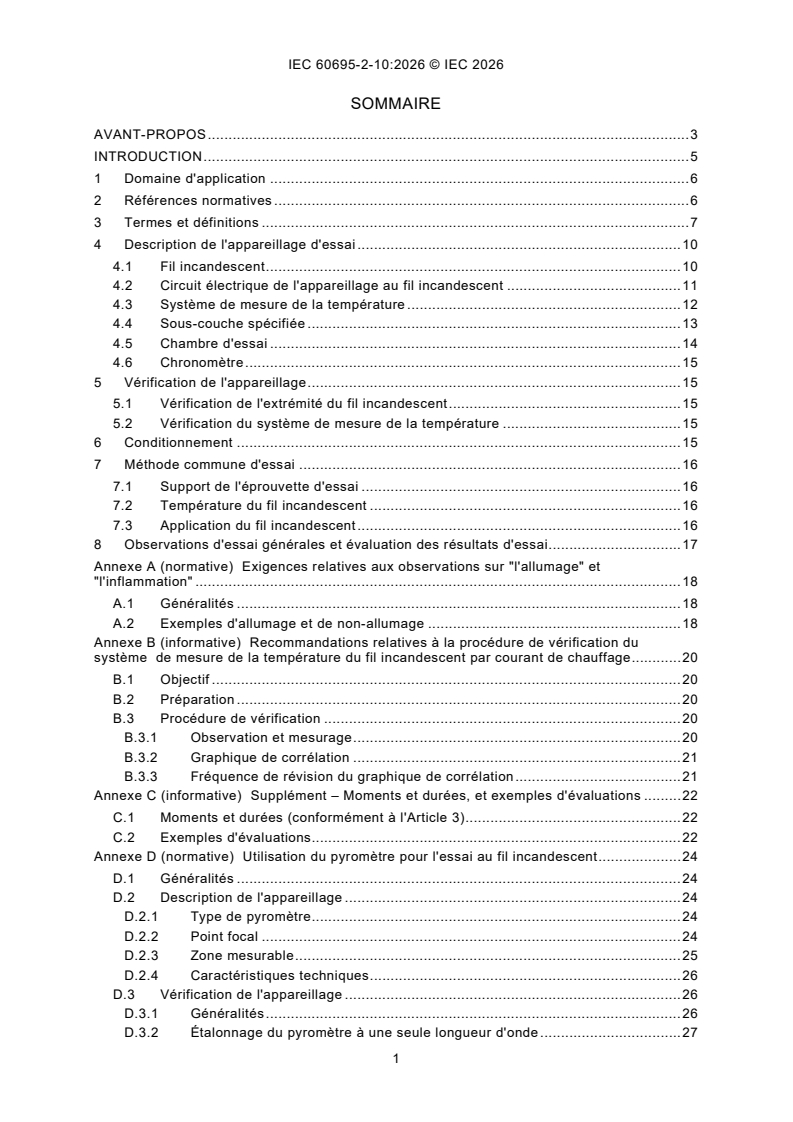
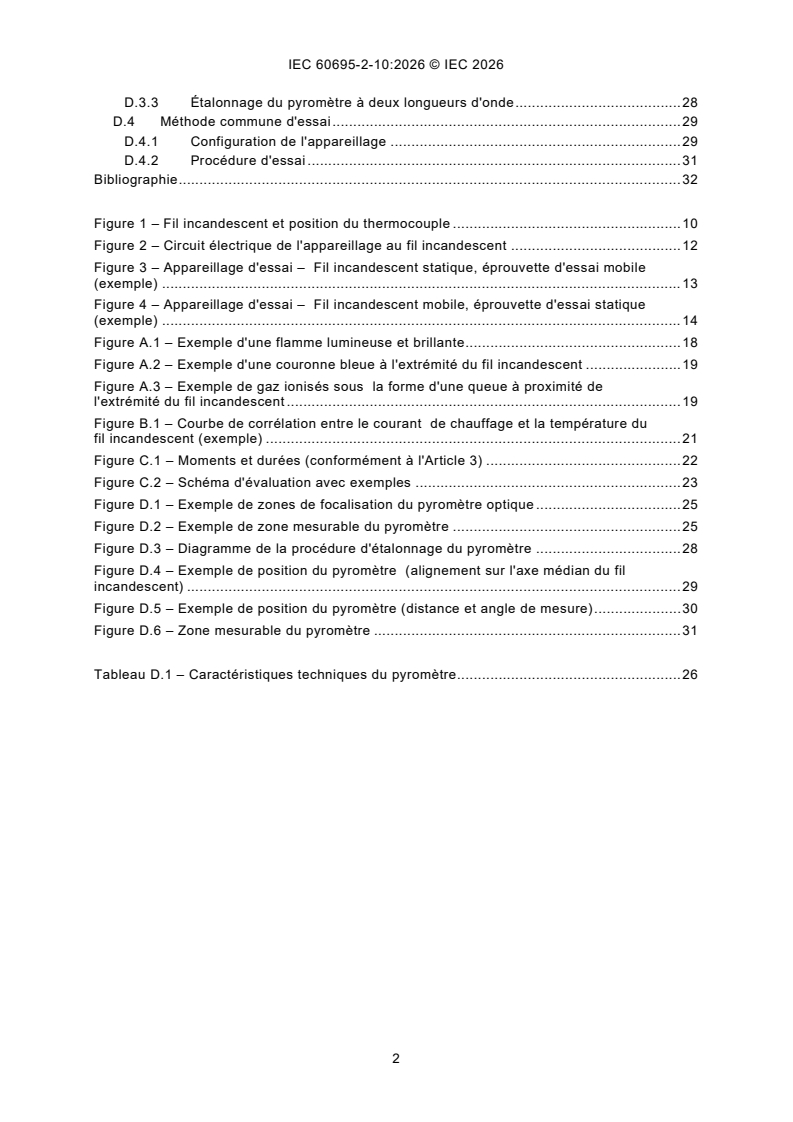
iec60695-2-10{ed4.0}fr - Essais relatifs aux risques du feu - Partie 2-10: Essais au fil incandescent/chauffant - Appareillage et méthode commune d'essai
Overview
IEC 60695-2-10:2026 outlines the requirements for glow-wire apparatus and the common test procedure used in fire hazard testing, specifically within the context of glowing/hot-wire based test methods. This international standard, developed by IEC Technical Committee 89, provides a simulation technique to assess fire risks by reproducing the thermal stresses caused by heat sources-such as glowing electrical elements or overloaded resistors-using a standardized electrically heated wire as an ignition source. The 2026 fourth edition reflects important technical revisions, including updates related to pyrometer use and harmonization of terminology.
As a foundational part of the IEC 60695-2 series, this standard forms the reference point for other related standardized fire hazard tests defined in IEC 60695-2-11, IEC 60695-2-12, and IEC 60695-2-13. IEC 60695-2-10 serves both as a basic safety publication and as a guide for developing fire safety testing protocols for electrotechnical products and materials.
Key Topics
- Glow-Wire Apparatus Requirements: Specifies design, material, and construction criteria for the glow-wire (e.g. nickel/chromium wire, diameter, annealing requirements) and related components to ensure consistent test conditions.
- Temperature Measurement: Details temperature control and measurement via thermocouple or, as specified in the new Annex D, pyrometer devices-ensuring accurate simulation of real-world ignition scenarios.
- Test Chamber Environment: Emphasizes operation in a draught-free chamber with adequate size and light control for consistent fire behavior data.
- Safety and Verification: Outlines methods for verifying apparatus integrity, including calibration of the glow-wire tip and temperature measurement system, to ensure precision and repeatability.
- Test Procedure: Provides step-by-step procedures for preparing specimens, achieving required test conditions, and recording results such as ignition, flaming, and fire propagation.
- Significant Updates in Edition 4.0:
- Addition of Annex D, specifying the use of pyrometers for glow-wire tests
- Alignment of terminology with ISO 13943:2017
- Expanded requirements and clarifications for apparatus verification and use
Applications
- Electrotechnical Product Safety: Used by manufacturers and testing labs to assess the fire hazard potential of finished electrical appliances and electronic products. The glow-wire test ensures products do not ignite or contribute significantly to fire under abnormal thermal stresses.
- Testing of Materials: Essential for evaluating the fire behavior of solid insulating and combustible materials (e.g. plastics, components housings) used in electrical and electronic assemblies.
- Regulatory Compliance: Supports regulatory and certification bodies in verifying compliance with international fire safety requirements, making it a critical tool for product approval processes worldwide.
- Quality Assurance and Product Development: Integral to R&D and QA teams focused on minimizing fire risk in design, material selection, and finished products.
Related Standards
- IEC 60695-2-11: Glow-wire flammability test method for end products (GWEPT)
- IEC 60695-2-12: Glow-wire flammability index (GWFI) test method for materials
- IEC 60695-2-13: Glow-wire ignition temperature (GWIT) test method for materials
- IEC 60584-1: EMF specifications and tolerances for thermocouples
- ISO 13943:2017: Vocabulary for fire safety
- ISO 4046-4:2016: Definitions related to paper and board products
IEC 60695-2-10:2026 is essential for organizations aiming to ensure product and material safety in line with international fire hazard testing standards, supporting both compliance and innovation in electrical and electronic industries.
Relations
- Effective Date
- 23-Aug-2024
- Effective Date
- 01-Mar-2024
Buy Documents
REDLINE IEC 60695-2-10:2026 CMV - Fire hazard testing - Part 2-10: Glowing/Hot-wire based test methods - Glow-wire apparatus and common test procedure
iec60695-2-10{ed4.0}en - Fire hazard testing - Part 2-10: Glowing/Hot-wire based test methods - Glow-wire apparatus and common test procedure
iec60695-2-10{ed4.0}fr - Essais relatifs aux risques du feu - Partie 2-10: Essais au fil incandescent/chauffant - Appareillage et méthode commune d'essai
Get Certified
Connect with accredited certification bodies for this standard

IMQ S.p.A. (Certification)
Italian electrical product certification.

SLG Prüf- und Zertifizierungs GmbH
German testing and certification body.

UL Solutions
Global safety science company with testing, inspection and certification.
Sponsored listings
Frequently Asked Questions
IEC 60695-2-10:2026 is a standard published by the International Electrotechnical Commission (IEC). Its full title is "Fire hazard testing - Part 2-10: Glowing/Hot-wire based test methods - Glow-wire apparatus and common test procedure". This standard covers: IEC 60695-2-10:2026 specifies the glow-wire apparatus and common test procedure to simulate the effects of thermal stresses which may be produced by heat sources such as glowing elements or overloaded resistors, for short periods, in order to assess the fire hazard by a simulation technique. The test procedure described in this document is a common test procedure intended for the small-scale tests in which a standardized electrically heated wire is used as a source of ignition. It is a common part of the test procedures applied to end products and to solid electrical insulating materials or other solid combustible materials. A detailed description of each particular test procedure is given in IEC 60695-2-11, IEC 60695-2-12 and IEC 60695-2-13. This fourth edition cancels and replaces the third edition published in 2021. This edition constitutes a technical revision. This edition includes the following significant technical changes with respect to the previous edition: a) revision of 4.3 to add reference to new Annex D; b) addition of new normative Annex D on "Use of pyrometer for glow-wire test"; c) revision of Clause 3 references to align with ISO 13943:2017. It has the status of a basic safety publication in accordance with IEC Guide 104. This International Standard is to be used in conjunction with IEC 60695-2-11, IEC 60695-2-12, and IEC 60695-2-13.
IEC 60695-2-10:2026 specifies the glow-wire apparatus and common test procedure to simulate the effects of thermal stresses which may be produced by heat sources such as glowing elements or overloaded resistors, for short periods, in order to assess the fire hazard by a simulation technique. The test procedure described in this document is a common test procedure intended for the small-scale tests in which a standardized electrically heated wire is used as a source of ignition. It is a common part of the test procedures applied to end products and to solid electrical insulating materials or other solid combustible materials. A detailed description of each particular test procedure is given in IEC 60695-2-11, IEC 60695-2-12 and IEC 60695-2-13. This fourth edition cancels and replaces the third edition published in 2021. This edition constitutes a technical revision. This edition includes the following significant technical changes with respect to the previous edition: a) revision of 4.3 to add reference to new Annex D; b) addition of new normative Annex D on "Use of pyrometer for glow-wire test"; c) revision of Clause 3 references to align with ISO 13943:2017. It has the status of a basic safety publication in accordance with IEC Guide 104. This International Standard is to be used in conjunction with IEC 60695-2-11, IEC 60695-2-12, and IEC 60695-2-13.
IEC 60695-2-10:2026 is classified under the following ICS (International Classification for Standards) categories: 13.220.40 - Ignitability and burning behaviour of materials and products; 29.020 - Electrical engineering in general. The ICS classification helps identify the subject area and facilitates finding related standards.
IEC 60695-2-10:2026 has the following relationships with other standards: It is inter standard links to IEC 60695-2-10:2021/COR1:2024, IEC 60695-2-10:2021. Understanding these relationships helps ensure you are using the most current and applicable version of the standard.
IEC 60695-2-10:2026 is available in PDF format for immediate download after purchase. The document can be added to your cart and obtained through the secure checkout process. Digital delivery ensures instant access to the complete standard document.
Standards Content (Sample)
IEC 60695-2-10 ®
Edition 4.0 2026-05
INTERNATIONAL
STANDARD
COMMENTED VERSION
HORIZONTAL PUBLICATION
Fire hazard testing -
Part 2-10: Glowing/Hot-wire based test methods - Glow-wire apparatus and
common test procedure
ICS 13.220.40; 29.020 ISBN 978-2-8327-1246-7
All rights reserved. Unless otherwise specified, no part of this publication may be reproduced or utilized in any form or
by any means, electronic or mechanical, including photocopying and microfilm, without permission in writing from either
IEC or IEC's member National Committee in the country of the requester. If you have any questions about IEC copyright
or have an enquiry about obtaining additional rights to this publication, please contact the address below or your local
IEC member National Committee for further information.
IEC Secretariat Tel.: +41 22 919 02 11
3, rue de Varembé info@iec.ch
CH-1211 Geneva 20 www.iec.ch
Switzerland
About the IEC
The International Electrotechnical Commission (IEC) is the leading global organization that prepares and publishes
International Standards for all electrical, electronic and related technologies.
About IEC publications
The technical content of IEC publications is kept under constant review by the IEC. Please make sure that you have the
latest edition, a corrigendum or an amendment might have been published.
IEC publications search - IEC Products & Services Portal - products.iec.ch
webstore.iec.ch/advsearchform Discover our powerful search engine and read freely all the
The advanced search enables to find IEC publications by a publications previews, graphical symbols and the glossary.
variety of criteria (reference number, text, technical With a subscription you will always have access to up to date
committee, …). It also gives information on projects, content tailored to your needs.
replaced and withdrawn publications.
Electropedia - www.electropedia.org
The world's leading online dictionary on electrotechnology,
IEC Just Published - webstore.iec.ch/justpublished
Stay up to date on all new IEC publications. Just Published containing more than 22 500 terminological entries in English
details all new publications released. Available online and and French, with equivalent terms in 25 additional languages.
once a month by email. Also known as the International Electrotechnical Vocabulary
(IEV) online.
IEC Customer Service Centre - webstore.iec.ch/csc
If you wish to give us your feedback on this publication or
need further assistance, please contact the Customer
Service Centre: sales@iec.ch.
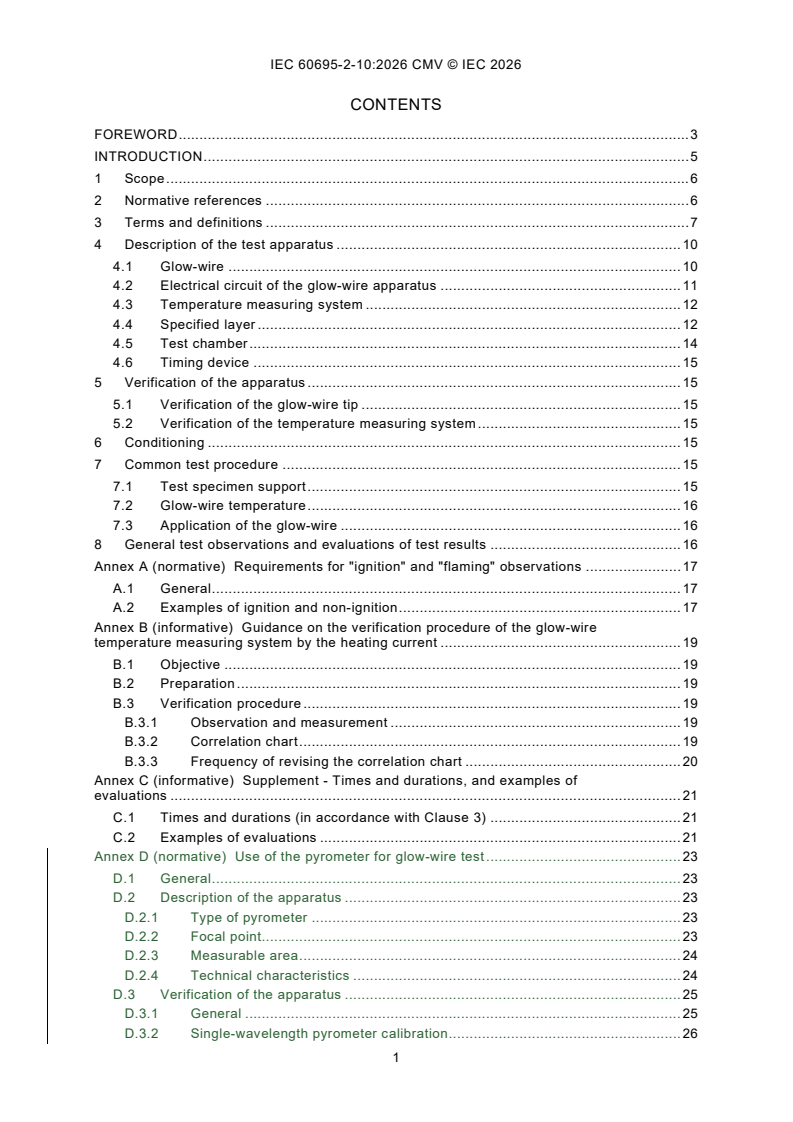
CONTENTS
FOREWORD . 3
INTRODUCTION . 5
1 Scope . 6
2 Normative references . 6
3 Terms and definitions . 7
4 Description of the test apparatus . 10
4.1 Glow-wire . 10
4.2 Electrical circuit of the glow-wire apparatus . 11
4.3 Temperature measuring system . 12
4.4 Specified layer . 12
4.5 Test chamber . 14
4.6 Timing device . 15
5 Verification of the apparatus . 15
5.1 Verification of the glow-wire tip . 15
5.2 Verification of the temperature measuring system . 15
6 Conditioning . 15
7 Common test procedure . 15
7.1 Test specimen support . 15
7.2 Glow-wire temperature . 16
7.3 Application of the glow-wire . 16
8 General test observations and evaluations of test results . 16
Annex A (normative) Requirements for "ignition" and "flaming" observations . 17
A.1 General . 17
A.2 Examples of ignition and non-ignition . 17
Annex B (informative) Guidance on the verification procedure of the glow-wire
temperature measuring system by the heating current . 19
B.1 Objective . 19
B.2 Preparation . 19
B.3 Verification procedure . 19
B.3.1 Observation and measurement . 19
B.3.2 Correlation chart . 19
B.3.3 Frequency of revising the correlation chart . 20
Annex C (informative) Supplement - Times and durations, and examples of
evaluations . 21
C.1 Times and durations (in accordance with Clause 3) . 21
C.2 Examples of evaluations . 21
Annex D (normative) Use of the pyrometer for glow-wire test . 23
D.1 General . 23
D.2 Description of the apparatus . 23
D.2.1 Type of pyrometer . 23
D.2.2 Focal point. 23
D.2.3 Measurable area . 24
D.2.4 Technical characteristics . 24
D.3 Verification of the apparatus . 25
D.3.1 General . 25
D.3.2 Single-wavelength pyrometer calibration . 26
D.3.3 Dual-wavelength pyrometer calibration . 27
D.4 Common test procedure . 27
D.4.1 Apparatus setup . 27
D.4.2 Test procedure . 29
Bibliography . 30
List of comments. 31
Figure 1 – Glow-wire and position of thermocouple . 10
Figure 2 – Electrical circuit of the glow-wire apparatus. 11
Figure 3 – Test apparatus - static glow-wire, moving test specimen (example) . 13
Figure 4 – Test apparatus - moving glow-wire, static test specimen (example) . 14
Figure A.1 – Example of a brightly shining flame . 17
Figure A.2 – Example of a blue corona at the glow-wire tip . 18
Figure A.3 – Example of ionized gases in the form of a tail near the glow-wire tip . 18
Figure B.1 – Correlation curve between the heating current and the glow-wire
temperature (example) . 20
Figure C.1 – Times and durations (in accordance with Clause 3) . 21
Figure C.2 – Evaluation scheme with examples . 22
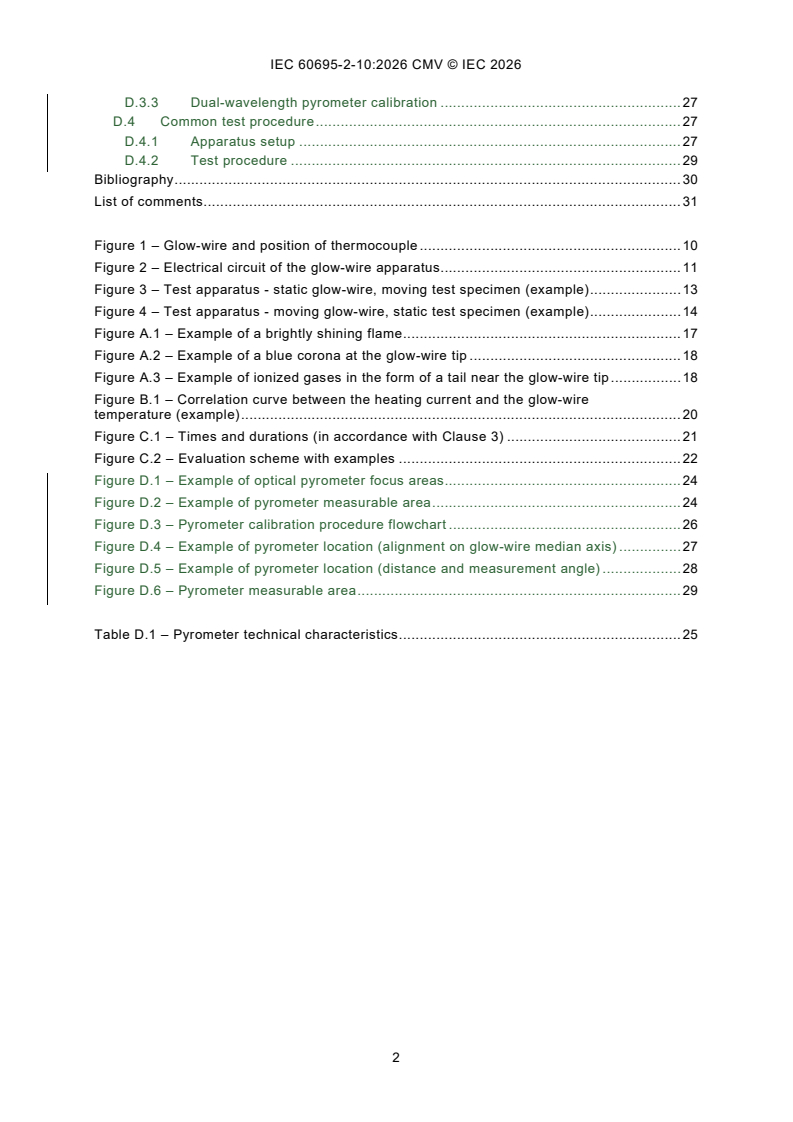
Figure D.1 – Example of optical pyrometer focus areas. 24
Figure D.2 – Example of pyrometer measurable area . 24
Figure D.3 – Pyrometer calibration procedure flowchart . 26
Figure D.4 – Example of pyrometer location (alignment on glow-wire median axis) . 27
Figure D.5 – Example of pyrometer location (distance and measurement angle) . 28
Figure D.6 – Pyrometer measurable area . 29
Table D.1 – Pyrometer technical characteristics . 25
INTERNATIONAL ELECTROTECHNICAL COMMISSION
____________
Fire hazard testing -
Part 2-10: Glowing/Hot-wire based test methods - Glow-wire apparatus
and common test procedure
FOREWORD
1) The International Electrotechnical Commission (IEC) is a worldwide organization for standardization comprising
all national electrotechnical committees (IEC National Committees). The object of IEC is to promote international
co-operation on all questions concerning standardization in the electrical and electronic fields. To this end and
in addition to other activities, IEC publishes International Standards, Technical Specifications, Technical Reports,
Publicly Available Specifications (PAS) and Guides (hereafter referred to as "IEC Publication(s)"). Their
preparation is entrusted to technical committees; any IEC National Committee interested in the subject dealt with
may participate in this preparatory work. International, governmental and non-governmental organizations liaising
with the IEC also participate in this preparation. IEC collaborates closely with the International Organization for
Standardization (ISO) in accordance with conditions determined by agreement between the two organizations.
2) The formal decisions or agreements of IEC on technical matters express, as nearly as possible, an international
consensus of opinion on the relevant subjects since each technical committee has representation from all
interested IEC National Committees.
3) IEC Publications have the form of recommendations for international use and are accepted by IEC National
Committees in that sense. While all reasonable efforts are made to ensure that the technical content of IEC
Publications is accurate, IEC cannot be held responsible for the way in which they are used or for any
misinterpretation by any end user.
4) In order to promote international uniformity, IEC National Committees undertake to apply IEC Publications
transparently to the maximum extent possible in their national and regional publications. Any divergence between
any IEC Publication and the corresponding national or regional publication shall be clearly indicated in the latter.
5) IEC itself does not provide any attestation of conformity. Independent certification bodies provide conformity
assessment services and, in some areas, access to IEC marks of conformity. IEC is not responsible for any
services carried out by independent certification bodies.
6) All users should ensure that they have the latest edition of this publication.
7) No liability shall attach to IEC or its directors, employees, servants or agents including individual experts and
members of its technical committees and IEC National Committees for any personal injury, property damage or
other damage of any nature whatsoever, whether direct or indirect, or for costs (including legal fees) and
expenses arising out of the publication, use of, or reliance upon, this IEC Publication or any other IEC
Publications.
8) Attention is drawn to the Normative references cited in this publication. Use of the referenced publications is
indispensable for the correct application of this publication.
9) IEC draws attention to the possibility that the implementation of this document may involve the use of (a)
patent(s). IEC takes no position concerning the evidence, validity or applicability of any claimed patent rights in
respect thereof. As of the date of publication of this document, IEC had not received notice of (a) patent(s), which
may be required to implement this document. However, implementers are cautioned that this may not represent
the latest information, which may be obtained from the patent database available at https://patents.iec.ch. IEC
shall not be held responsible for identifying any or all such patent rights.
This commented version (CMV) of the official standard IEC 60695-2-10:2026 edition 4.0 allows
the user to identify the changes made to the previous IEC 60695-2-10:2021 edition 3.0.
Furthermore, comments from IEC TC 89 experts are provided to explain the reasons of the most
relevant changes, or to clarify any part of the content.
A vertical bar appears in the margin wherever a change has been made. Additions are in green
text, deletions are in strikethrough red text. Experts' comments are identified by a blue-
background number. Mouse over a number to display a pop-up note with the comment.
This publication contains the CMV and the official standard. The full list of comments is available
at the end of the CMV.
IEC 60695-2-10 has been prepared by IEC technical committee 89: Fire hazard testing. It is an
International Standard.
This fourth edition cancels and replaces the third edition published in 2021. This edition
constitutes a technical revision.
This edition includes the following significant technical changes with respect to the previous
edition:
a) Revision of 4.3 to add reference to new Annex D;
b) Addition of new normative Annex D on "Use of pyrometer for glow-wire test";
c) Revision of Clause 3 references to align with ISO 13943:2017.
The text of this International Standard is based on the following documents:
FDIS Report on voting
89/1650/FDIS 89/1657/RVD
Full information on the voting for its approval can be found in the report on voting indicated in
the above table.
The language used for the development of this International Standard is English.
This document was drafted in accordance with ISO/IEC Directives, Part 2, and developed in
accordance with ISO/IEC Directives, Part 1 and ISO/IEC Directives, IEC Supplement, available
at www.iec.ch/members_experts/refdocs. The main document types developed by IEC are
described in greater detail at www.iec.ch/standardsdev/publications.
It has the status of a basic safety publication in accordance with IEC GUIDE 104:2019 [1].
This International Standard is to be used in conjunction with IEC 60695-2-11, IEC 60695-2-12,
and IEC 60695-2-13.
A list of all parts in the IEC 60695 series, published under the general title Fire hazard testing,
can be found on the IEC website.
The committee has decided that the contents of this document will remain unchanged until the
stability date indicated on the IEC website under webstore.iec.ch in the data related to the
specific document. At this date, the document will be
– reconfirmed,
– withdrawn, or
– revised.
INTRODUCTION
In the design of any electrotechnical product, the risk of fire and the potential hazards
associated with fire need to be considered. In this respect the objective of component, circuit,
and product design, as well as the choice of materials, is to reduce to acceptable levels the
potential risks of fire during normal operating conditions, reasonably foreseeable abnormal use,
malfunction, and/or failure. IEC 60695-1-10 [2] was developed, together with its companion,
IEC 60695-1-11 [3], to provide guidance on how this is accomplished.
The primary aims of IEC 60695-1-10 [2] and IEC 60695-1-11 [3] are to provide guidance on
how:
a) to prevent ignition caused by an electrically energized component part; and
b) to confine any resulting fire within the bounds of the enclosure of the electrotechnical
product in the event of ignition .
Secondary aims of these documents include the minimization of any flame spread beyond the
product’s enclosure and the minimization of harmful effects of fire effluents such as heat,
smoke, toxicity and/or corrosivity.
Fires involving electrotechnical products can also be initiated from external non-electrical
sources. Considerations of this nature should be dealt with in the overall fire risk assessment.
In electrotechnical equipment, overheated metal parts can act as ignition sources. In glow-wire
tests, a glowing wire is used to simulate such an ignition source.
This part of IEC 60695 gives recommendations with regard to the glow-wire test apparatus and
describes a common test procedure for tests applicable to end products and materials to be
used with IEC 60695-2-11 which describes a glow-wire flammability test for end products
(GWEPT), IEC 60695-2-12 which describes a glow-wire flammability index test for materials
(GWFI), and IEC 60695-2-13 which describes a glow-wire ignition temperature test method for
materials (GWIT).
1 Scope
This part of IEC 60695 specifies the glow-wire apparatus and common test procedure to
simulate the effects of thermal stresses which may be produced by heat sources such as
glowing elements or overloaded resistors, for short periods, in order to assess the fire hazard
by a simulation technique.
The test procedure described in this document is a common test procedure intended for the
small-scale tests in which a standardized electrically heated wire is used as a source of ignition.
It is a common part of the test procedures applied to end products and to solid electrical
insulating materials or other solid combustible materials.
A detailed description of each particular test procedure is given in IEC 60695-2-11, IEC 60695-
2-12 and IEC 60695-2-13.
This basic safety publication focusing on safety test method(s) is primarily intended for use by
technical committees in the preparation of safety publications in accordance with the principles
laid down in IEC GUIDE 104:2019 [1] and ISO/IEC Guide 51 [4].
One of the responsibilities of a technical committee is, wherever applicable, to make use of
basic safety publications in the preparation of its publications.
2 Normative references
The following documents are referred to in the text in such a way that some or all of their content
constitutes requirements of this document. For dated references, only the edition cited applies.
For undated references, the latest edition of the referenced document (including any
amendments) applies.
ISO 4046-4:2016, Paper, board, pulps and related terms - Vocabulary - Part 4: Paper and board
grades and converted products
ISO 13943:2017, Fire safety - Vocabulary
IEC 60584-1, Thermocouples - Part 1: EMF specifications and tolerances
IEC 60695-2-11, Fire hazard testing - Part 2-11: Glowing/hot-wire based test methods - Glow-
wire flammability test method for end products (GWEPT)
IEC 60695-2-12, Fire hazard testing - Part 2-12: Glowing/hot-wire based test methods - Glow-
wire flammability index (GWFI) test method for materials
IEC 60695-2-13, Fire hazard testing - Part 2-13: Glowing/hot-wire based test methods - Glow-
wire ignition temperature (GWIT) test method for materials
3 Terms and definitions
For the purposes of this document, the terms and definitions given in ISO 13943:2017, some of
which are reproduced below for the user’s convenience, and the following apply.
ISO and IEC maintain terminology databases for use in standardization at the following
addresses:
– IEC Electropedia: available at https://www.electropedia.org/
– ISO Online browsing platform: available at https://www.iso.org/obp
3.1
combustible
capable of being ignited and burned
[SOURCE: ISO 13943:2017, 3.52]
3.2
combustion
exothermic reaction of a substance with an oxidizing agent
Note 1 to entry: Combustion generally emits fire effluent accompanied by flame (3.6) and/or glowing.
[SOURCE: ISO 13943:2017, 3.55]
3.3
draught-free environment
space in which the results of experiments are not significantly affected by the local air speed
Note 1 to entry: A qualitative example is a space in which a wax candle flame (3.6) remains essentially undisturbed.
−1 −1
Quantitative examples are small-scale fire tests (3.5) in which a maximum air speed of 0,1 m × s or 0,2 m × s is
sometimes specified.
[SOURCE: ISO 13943:2017, 3.83]
3.4
fire hazard
potential for harm associated with fire
Note 1 to entry: Alternatively, fire hazard can be a physical object or condition with a potential for an undesirable
consequence from fire.
[SOURCE: ISO 13943:2017, 3.131]
3.5
fire test
test that measures fire behaviour or exposes an item to the effects of a fire
Note 1 to entry: The results of a fire test can be used to quantify fire severity or determine the fire resistance or
reaction to fire of the test specimen.
[SOURCE: ISO 13943:2017, 3.157]
3.6
flame
rapid, self-sustaining, sub-sonic propagation of combustion (3.2) in a gaseous medium, usually
with emission of light
[SOURCE: ISO 13943:2017, 3.159]
3.7
flame event
sustainedpersistent flaming and/or glowing combustion
3.7
flammability
ability of a material or product to burn with a flame under specified conditions
[SOURCE: ISO 13943:2017, 3.178]
3.8
ignition
DEPRECATED: sustained ignition
initiation of combustion (3.2)
[SOURCE: ISO 13943:2017, 3.217]
3.10
test temperature
temperature to which the tip of the glow-wire is heated and stabilized prior to any contact with
the test specimen
3.11
time of application
t
APP
application time of the glow-wire
Note 1 to entry: Time of application constitutes the first 30 s of the test.
Note 2 to entry: t was originally designated as t in Editions 1 and 2 of IEC 60695-2.
APP A
Note 32 to entry: See Annex C.
3.12
time of observation
t
OBS
observation time of the specimen and/or specified layer, starting immediately after t
APP
Note 1 to entry: Time of observation constitutes the second 30 s of the test.
Note 2 to entry: See Annex C.
3.13
time of ignition
t
I
time (to the nearest 0,5 s), from the start of test, at which the longest persisting flame event
(3.7) starts
Note 1 to entry: This is a measured value.
Note 2 to entry: See Annex C.
3.14
time of extinguishing
t
E
time (to the nearest 0,5 s), from the start of the test, at which the longest persisting flame event
(3.7) ends
Note 1 to entry: This is a measured value.
Note 2 to entry: See Annex C.
3.15
total flame event time
t
T
duration of the longest persisting flame event (3.7)
𝑡𝑡 =𝑡𝑡 −𝑡𝑡
T E I
Note 1 to entry: This is a calculated value.
Note 2 to entry: See Annex C.
3.16
flame time after removal
t
R
time elapsed after the removal of the glow-wire tip from the test specimen to the end of the
longest persisting flame event (3.7)
𝑡𝑡 =𝑡𝑡 −30s
R E
Note 1 to entry: If t is less than 30 s then t is zero.
E R
Note 2 to entry: This is a calculated value.
Note 3 to entry: See Annex C.
3.17
flame time during application
t
B
duration of the longest persisting flame event (3.7) whilst the glow-wire tip is in contact with the
test specimen
𝑡𝑡 =𝑡𝑡 −𝑡𝑡
B T R
Note 1 to entry: This is a calculated value.
Note 2 to entry: See Annex C.
3.18
emissivity
ratio of the radiation emitted by a radiant source to the ratio of radiation that would be emitted
by a black body radiant source at the same temperature
Note 1 to entry: Emissivity is dimensionless.
[SOURCE: ISO 13943:2017, 3.89]
3.19
focal length
distance between the centre of the pyrometer optic lens and its focal point (3.20)
3.20
focal point
point where light rays converge
Note 1 to entry: For lens application, the focal point is commonly known as the point where in a captured image,
the subject is clearly visible without blur.
4 Description of the test apparatus
4.1 Glow-wire
The glow-wire is formed from nickel/chromium > 77 % Ni/(20 ± 1) % Cr wire, having an overall
diameter of 4,00 mm ± 0,07 mm (before bending). The dimensions of the glow-wire loop are as
detailed in Figure 1. When forming the glow-wire, ensure that fine cracking at the tip is avoided.
NOTE 1 Annealing is a suitable process for prevention of fine cracking at the tip.
Dimensions in millimetres
1 Glow-wire
2 Thermocouple
3 Stud
Z Enlarged view of Z section
A Overall diameter of the wire after bending (see 5.1)
Figure 1 – Glow-wire and position of thermocouple
A new glow-wire shall be annealed for a total of at least 10 h by being subjected to a current of
at least 120 A before being used for a test run. The total annealing time may be achieved
cumulatively. To avoid damage, the thermocouple shall not be installed during annealing. At
the end of annealing, the depth of the thermocouple pocket hole shall be verified.
NOTE 2 The temperature of a new glow-wire which has not been annealed gradually lowers during the first few
hours when subjected to a flow of current. After a period of time the temperature then reaches equilibrium.
The test apparatus shall be designed so that the glow-wire is kept in a horizontal plane and
applies a force of 0,95 N ± 0,10 N to the test specimen during the application of the glow-wire.
The force shall be maintained at this value when the glow-wire or the test specimen is moved
horizontally one towards the other. The penetration of the tip of the glow-wire into and through
the test specimen shall be limited to 7,0 mm ± 0,5 mm.
The test apparatus shall be designed in such a way that burning or glowing particles falling from
the test specimen are able to fall without obstruction onto the layer as specified in 4.4.
Two typical examples of the test apparatus are shown in Figure 3 and Figure 4.
NOTE 23 The apparatus shown in Figure 4 has been found useful when testing heavy and/or awkwardly shaped
test specimens.
4.2 Electrical circuit of the glow-wire apparatus
The glow-wire shall be heated by an electric circuit. There shall be no feedback mechanism or
circuit to maintain the temperature. The input voltage supplying the glow-wire test apparatus
shall be stable (±2 %) during the test. A typical example of electric circuit is shown in Figure 2.
NOTE 1 The stable voltage can be supplied using an appropriate stabilized voltage source. As an alternative, it has
been found useful to monitor the input voltage supplied to the glow-wire test apparatus during the test.
The circuit shall contain a current measuring device which indicates a true RMS (root mean
square) value having an accuracy of ±2,5 % or more accurate.
Due to the high currents involved, it is essential that all electrical connections for the glow-wire
are capable of carrying the current without affecting the performance or long-term stability of
the circuit. For the glow-wire to stud connection, a sufficient contact area (typically at least
60 mm at each end) is necessary for the stable and loss-less current necessary for the test.
The glow-wire to stud connection shall be tightly screwed, soldered, or brazed between the
glow-wire and studs.
NOTE 2 The typical current necessary for heating the tip to a temperature of 960 °C is between 120 A and 150 A.
Key
1 Mains input voltage supply
2 Stabilized voltage source (alternative to Key 3)
3 Input voltage measuring device (alternative to Key 2)
4 Variable auto-transformer
5 Step down separating transformer
6 Current measuring device
Figure 2 – Electrical circuit of the glow-wire apparatus
4.3 Temperature measuring system
The temperature of the tip of the glow-wire shall be measured by a class 1 (see IEC 60584-1)
mineral-insulated metal-sheathed fine-wire thermocouple with an insulated junction. It shall
have an overall nominal diameter of 1,0 mm. The thermocouple wires shall be suitable for
continuous operation at temperatures up to 960 °C (e.g. chromel/alumel (Type K) or NiCrSi/NiSi
(Type N) - see IEC 60584-1). The welded point shall be located inside the sheath as close to
the tip as practicable. The sheath shall consist of a metal resistant to continuous operation at
a temperature of at least 1 050 °C.
NOTE 1 A sheath made from a nickel-based heat-resistant alloy satisfies the above requirements.
The glow-wire, with the thermocouple inserted, is shown in Figure 1, detail Z.
The thermocouple is arranged in a pocket hole, drilled in behind the tip of the glow-wire, and
maintained as a close fit as shown in detail Z of Figure 1. The pocket hole shall be the smallest
diameter that can accommodate the inserted thermocouple in order to reduce the occurrence
of contamination during testing. The thermal contact between the tip of the thermocouple and
the end of the drilled hole shall be maintained. Ensure that the thermocouple is able to follow
the dimensional changes of the tip of the glow-wire caused by heating.
NOTE 2 Slight bending of the thermocouple, in order to create a spring load force towards the pocket hole, is an
example of methodology that can be used to ensure that the thermocouple follows the dimensional changes of the
glow-wire. 1
The instrument for measuring the thermocouple voltages may consist of any commercial digital
thermometer with a built-in reference junction.
Other temperature measuring instrumentation may be used, but, in case of dispute, the
thermocouple method must be used.
An alternative temperature measurement instrumentation to the thermocouple, that has been
verified and found effective, is the pyrometer. If the pyrometer is used as an alternative to the
thermocouple, it shall meet the characteristics and usage conditions specified in Annex D. 2
In case of dispute, the thermocouple method shall be used.
4.4 Specified layer
To evaluate the possible spread of fire, for example by burning or glowing particles falling from
the test specimen, a specified layer is placed underneath the test specimen.
Unless otherwise specified, a single layer of wrapping tissue resting on, and in close contact
with, the upper surface of a piece of wooden board (flat and smooth and having a minimum
thickness of 10 mm) is positioned at a distance of 200 mm ± 5 mm below the place where the
glow-wire is applied to the test specimen. See Figure 3 and Figure 4. Wrapping tissue (as
defined in ISO 4046-4:2016, 4.215) is a soft and strong lightweight wrapping paper with a mass
2 2
per unit area of between 12 g/m and 30 g/m .
Key
1 Test specimen support
2 Carriage
3 Tensioning cord
4 Base plate
5 Weight
6 Adjustable stop
7 Scale to measure height of flame (optional)
8 Penetration adjustment
9 Glow-wire
10 Cut-out in base plate for falling particles
11 Glow-wire mounting stud
12 Low-friction rollers
13 Specified layer
Figure 3 – Test apparatus - static glow-wire, moving test specimen (example)
Key
1 Test specimen support
2 Height adjustment screw
3 Tensioning cord
4 Base plate
5 Weight
6 Adjustable stop
7 Scale to measure height of flame (optional)
8 Penetration adjustment
9 Glow-wire
10 Restraining pin
11 Glow-wire mounting stud
12 Low-friction rollers
13 Specified layer
Figure 4 – Test apparatus - moving glow-wire, static test specimen (example)
4.5 Test chamber
The apparatus shall be operated in a draught-free environment having sufficient volume such
that
a) oxygen depletion during the test does not significantly affect the result, and
b) the test specimen can be mounted at least 100 mm from any surface.
NOTE 1 A chamber having a volume of at least 0,5 m is considered to have sufficient volume for the test.
Within the test location chamber, the ambient light falling on the test specimen, not counting
that from the glow-wire, shall not exceed 20 lx. This shall be measured with a lux meter
positioned in place of the test specimen facing towards the rear part of the location test
chamber.
NOTE 2 Use of a dark background material will usually help in achieving the 20 lx limit.
After each test, the test location chamber shall be vented to replace any depleted oxygen.
4.6 Timing device
The timing device shall have a resolution of 0,1 s or less.
5 Verification of the apparatus
5.1 Verification of the glow-wire tip
Before each series of tests, the glow-wire tip shall be inspected by measuring and recording
dimension "A" as shown in detail Z of Figure 1. The glow-wire shall be replaced once this
measurement is reduced to 97,5 % or less of the measurement taken before its initial use.
On completion of each test, clean the tip, if necessary, to remove any residue of previously
tested material, for example by means of a wire brush (no copper or brass brush), and then
inspect the tip of the glow-wire for any cracks. If it is not possible to clean the tip without
damaging it (for example when there is molten glass fibre residue), then the glow-wire shall be
replaced.
5.2 Verification of the temperature measuring system
The temperature measuring system described in 4.3 shall be verified periodically using the
procedure described below.
A one-point verification of the temperature of the glow-wire shall be performed using a foil of
silver with a purity of at least 99,8 %, approximately 2 mm in area and approximately 0,06 mm
thick, placed upon the upper surface of the tip of the glow-wire. The glow-wire shall be initially
set at a temperature slightly lower than the melting point of the foil and allowed to stabilize. The
glow-wire temperature is then increased at a slow heating rate so that the melting point may be
accurately observed. When the silver starts to melt the thermometer shall indicate
960 °C ± 10 °C. The glow-wire, while still hot, shall be cleared of all traces of silver immediately
after this verification process to reduce the probability of alloying.
NOTE Annex B provides guidance to complement the one-point verification procedure of the glow-wire temperature
measuring system by defining the relationship between the heating current and the glow-wire temperature. In order
to assist in setting test temperatures, it has been found useful to develop a reference chart immediately after installing
a new glow-wire and thermocouple indicating the current for each temperature. This reference chart can be referred
to on each use to verify that the current-temperature relationship remains consistent. A variation to this relationship
of more than 2 % would suggest that something in the apparatus has changed. In this situation, a verification and
recalibration of the test apparatus are indicated.
6 Conditioning
Before testing, the wooden board and wrapping tissue shall be stored for a minimum of 24 h in
an atmosphere having a temperature between 15 °C and 35 °C and a relative humidity between
45 % and 75 %.
7 Common test procedure
7.1 Test specimen support
The test specimen shall be mounted or clamped so that:
a) the heat losses due to the supporting or fixing means are insignificant;
b) the planar area of the surface is vertical;
c) the tip of the glow-wire is applied to the centre of the planar area of the surface;
d) any dripping particles can flow freely without interference from the support.
Prior to each set of tests, the glow-wire application force shall be checked with a suitable device.
In addition, the free movement of the carriage along the full path shall be checked.
7.2 Glow-wire temperature
CAUTIONWARNING Precautions shall be taken to safeguard the health of personnel conducting tests against:
– the risks of explosion, burning or fire;
– the risk of burns and electric shock;
– the inhalation of smoke and/or toxic products; and
– the risks of toxic residues.
Before heating the glow-wire to the specified temperature, there shall be no contamination in
the thermocouple hole drilled in the glow-wire and there is shall be appropriate thermocouple
to glow-wire contact. Appropriate contact shall be accomplished by gently pushing the
thermocouple into the full depth of the drilled hole.
The glow-wire is heated to the specified temperature which is measured by means of the
calibrated temperature measurement system. Before bringing the tip of the glow-wire into
contact with the test specimen, ensure that:
a) this temperature is constant within 5 K for a period of at least 60 s;
b) heat radiation does not influence the test specimen during this period by providing an
adequate distance between the specimen and glow-wire, i.e. 5,0 cm minimum, or by using
an appropriate screen; and
c) no further adjustment to the heating current is to be made until after the test is completed.
7.3 Application of the glow-wire
The tip of the glow-wire is then brought smoothly into contact with the test specimen for a
duration of 30 s ± 1 s. An approximate rate of approach and withdrawal of 10 mm/s to 25 mm/s
has been found to be satisfactory. However, the rate of approach shall be reduced to near zero
upon contact to avoid impact forces exceeding 1,05 N. In those cases where the material melts
away from the glow-wire, the glow-wire shall not be kept in contact with the test specimen.
Following the application time, the glow-wire and the test specimen are slowly separated,
avoiding any further heating of the test specimen and any movement of air which might affect
the result of the test. The penetration of the tip of the glow-wire into and through the test
specimen shall be limited to 7,0 mm ± 0,5 mm.
8 General test observations and evaluations of test results
During the time of application of the glow-wire (t ), and during the time of observation (t ),
APP OBS
the test specimen, and the parts surrounding the test specimen (for tests according to IEC
60695-2-11 GWEPT), or the specified layer (for tests according to IEC 60695-2-12 GWFI)
placed below it, shall be observed, and t , t , t , t and t shall be recorded, if applicable (see
I E B R T
Annex C for times, durations, and examples of evaluations).
Details of observation and evaluation shall follow the relevant document: IEC 60695-2-11 for
the end product test and IEC 60695-2-12 and IEC 60695-2-13 for the material tests.
During the tests conducted in accordance with IEC 60695-2-11, IEC 60695-2-12 and IEC 60695-
2-13, requirements for the observation of ignition and flaming are to be found in Annex A.
Annex A
(normative)
Requirements for "ignition" and "flaming" observations
A.1 General
During the tests conducted in accordance with IEC 60695-2-11, IEC 60695-2-12 and IEC 60695-
2-13, the following determination shall apply for “ignition ” and “flaming” observations.
a) A flame observed directly at the test specimen (see Figure A.1) shall be judged as a clear
indication of ignition .
NOTE Some materials show a pale flame instead of a bright shiny flame .
b) Sometimes a circular corona can be observed around the tip of the glow-wire (see Figure
A.2). This corona consists of ionized gas, predominantly blue in colour and is located in the
immediate vicinity of the glow-wire. This phenomenon shall not be judged to be ignition of
the test specimen, as long as it does not lead to an ignition of the test specimen according
to Clause A.1, list item a).
c) Ionized gases can sometimes be noticed along the glow-wire (see Figure A.3). This
phenomenon shall not be judged to be ignition of the test specimen, as long as it does not
lead to an ignition of the test specimen according to Clause A.1, list item a).
A.2 Examples of ignition and non-ignition
Figure A.1 – Example of a brightly shining flame
This indicates that ignition has occurred.
Figure A.2 – Example of a blue corona at the glow-wire tip
This does not indicate that ignition has occurred.
Figure A.3 – Example of ionized gases in the form of a tail near the glow-wire tip
This does not indicate that ignition has occurred.
Annex B
(informative)
Guidance on the verification procedure of the glow-wire temperature
measuring system by the heating current
B.1 Objective
The verification of the glow-wire temperature measuring system described in this document
(see 5.2) uses a one-point measurement based on the melting temperature of silver foil.
However, it assumes that this result covers verification at all other relevant test temperatures.
Annex B provides guidance to complement the one-point verification procedure of the glow-wire
temperature measuring system by defining the relationship between the heating current and the
glow-wire temperature. It provides a practical verification procedure across the entire range of
test temperatures intended for use in IEC 60695-2-11, IEC 60695-2-12 and
...
IEC 60695-2-10 ®
Edition 4.0 2026-05
INTERNATIONAL
STANDARD
HORIZONTAL PUBLICATION
Fire hazard testing -
Part 2-10: Glowing/Hot-wire based test methods - Glow-wire apparatus and
common test procedure
ICS 13.220.40; 29.020 ISBN 978-2-8327-1236-8
All rights reserved. Unless otherwise specified, no part of this publication may be reproduced or utilized in any form or
by any means, electronic or mechanical, including photocopying and microfilm, without permission in writing from either
IEC or IEC's member National Committee in the country of the requester. If you have any questions about IEC copyright
or have an enquiry about obtaining additional rights to this publication, please contact the address below or your local
IEC member National Committee for further information.
IEC Secretariat Tel.: +41 22 919 02 11
3, rue de Varembé info@iec.ch
CH-1211 Geneva 20 www.iec.ch
Switzerland
About the IEC
The International Electrotechnical Commission (IEC) is the leading global organization that prepares and publishes
International Standards for all electrical, electronic and related technologies.
About IEC publications
The technical content of IEC publications is kept under constant review by the IEC. Please make sure that you have the
latest edition, a corrigendum or an amendment might have been published.
IEC publications search - IEC Products & Services Portal - products.iec.ch
webstore.iec.ch/advsearchform Discover our powerful search engine and read freely all the
The advanced search enables to find IEC publications by a publications previews, graphical symbols and the glossary.
variety of criteria (reference number, text, technical With a subscription you will always have access to up to date
committee, …). It also gives information on projects, content tailored to your needs.
replaced and withdrawn publications.
Electropedia - www.electropedia.org
The world's leading online dictionary on electrotechnology,
IEC Just Published - webstore.iec.ch/justpublished
Stay up to date on all new IEC publications. Just Published containing more than 22 500 terminological entries in English
details all new publications released. Available online and and French, with equivalent terms in 25 additional languages.
once a month by email. Also known as the International Electrotechnical Vocabulary
(IEV) online.
IEC Customer Service Centre - webstore.iec.ch/csc
If you wish to give us your feedback on this publication or
need further assistance, please contact the Customer
Service Centre: sales@iec.ch.
CONTENTS
FOREWORD . 3
INTRODUCTION . 5
1 Scope . 6
2 Normative references . 6
3 Terms and definitions . 7
4 Description of the test apparatus . 10
4.1 Glow-wire . 10
4.2 Electrical circuit of the glow-wire apparatus . 11
4.3 Temperature measuring system . 11
4.4 Specified layer . 12
4.5 Test chamber . 14
4.6 Timing device . 15
5 Verification of the apparatus . 15
5.1 Verification of the glow-wire tip . 15
5.2 Verification of the temperature measuring system . 15
6 Conditioning . 15
7 Common test procedure . 15
7.1 Test specimen support . 15
7.2 Glow-wire temperature . 16
7.3 Application of the glow-wire . 16
8 General test observations and evaluations of test results . 16
Annex A (normative) Requirements for "ignition" and "flaming" observations . 17
A.1 General . 17
A.2 Examples of ignition and non-ignition . 17
Annex B (informative) Guidance on the verification procedure of the glow-wire
temperature measuring system by the heating current . 19
B.1 Objective . 19
B.2 Preparation . 19
B.3 Verification procedure . 19
B.3.1 Observation and measurement . 19
B.3.2 Correlation chart . 19
B.3.3 Frequency of revising the correlation chart . 20
Annex C (informative) Supplement - Times and durations, and examples of
evaluations . 21
C.1 Times and durations (in accordance with Clause 3) . 21
C.2 Examples of evaluations . 21
Annex D (normative) Use of the pyrometer for glow-wire test . 23
D.1 General . 23
D.2 Description of the apparatus . 23
D.2.1 Type of pyrometer . 23
D.2.2 Focal point. 23
D.2.3 Measurable area . 24
D.2.4 Technical characteristics . 24
D.3 Verification of the apparatus . 25
D.3.1 General . 25
D.3.2 Single-wavelength pyrometer calibration . 26
D.3.3 Dual-wavelength pyrometer calibration . 27
D.4 Common test procedure . 27
D.4.1 Apparatus setup . 27
D.4.2 Test procedure . 29
Bibliography . 30
Figure 1 – Glow-wire and position of thermocouple . 10
Figure 2 – Electrical circuit of the glow-wire apparatus. 11
Figure 3 – Test apparatus - static glow-wire, moving test specimen (example) . 13
Figure 4 – Test apparatus - moving glow-wire, static test specimen (example) . 14
Figure A.1 – Example of a brightly shining flame . 17
Figure A.2 – Example of a blue corona at the glow-wire tip . 18
Figure A.3 – Example of ionized gases in the form of a tail near the glow-wire tip . 18
Figure B.1 – Correlation curve between the heating current and the glow-wire
temperature (example) . 20
Figure C.1 – Times and durations (in accordance with Clause 3) . 21
Figure C.2 – Evaluation scheme with examples . 22
Figure D.1 – Example of optical pyrometer focus areas. 24
Figure D.2 – Example of pyrometer measurable area . 24
Figure D.3 – Pyrometer calibration procedure flowchart . 26
Figure D.4 – Example of pyrometer location (alignment on glow-wire median axis) . 27
Figure D.5 – Example of pyrometer location (distance and measurement angle) . 28
Figure D.6 – Pyrometer measurable area . 29
Table D.1 – Pyrometer technical characteristics . 25
INTERNATIONAL ELECTROTECHNICAL COMMISSION
____________
Fire hazard testing -
Part 2-10: Glowing/Hot-wire based test methods - Glow-wire apparatus
and common test procedure
FOREWORD
1) The International Electrotechnical Commission (IEC) is a worldwide organization for standardization comprising
all national electrotechnical committees (IEC National Committees). The object of IEC is to promote international
co-operation on all questions concerning standardization in the electrical and electronic fields. To this end and
in addition to other activities, IEC publishes International Standards, Technical Specifications, Technical Reports,
Publicly Available Specifications (PAS) and Guides (hereafter referred to as "IEC Publication(s)"). Their
preparation is entrusted to technical committees; any IEC National Committee interested in the subject dealt with
may participate in this preparatory work. International, governmental and non-governmental organizations liaising
with the IEC also participate in this preparation. IEC collaborates closely with the International Organization for
Standardization (ISO) in accordance with conditions determined by agreement between the two organizations.
2) The formal decisions or agreements of IEC on technical matters express, as nearly as possible, an international
consensus of opinion on the relevant subjects since each technical committee has representation from all
interested IEC National Committees.
3) IEC Publications have the form of recommendations for international use and are accepted by IEC National
Committees in that sense. While all reasonable efforts are made to ensure that the technical content of IEC
Publications is accurate, IEC cannot be held responsible for the way in which they are used or for any
misinterpretation by any end user.
4) In order to promote international uniformity, IEC National Committees undertake to apply IEC Publications
transparently to the maximum extent possible in their national and regional publications. Any divergence between
any IEC Publication and the corresponding national or regional publication shall be clearly indicated in the latter.
5) IEC itself does not provide any attestation of conformity. Independent certification bodies provide conformity
assessment services and, in some areas, access to IEC marks of conformity. IEC is not responsible for any
services carried out by independent certification bodies.
6) All users should ensure that they have the latest edition of this publication.
7) No liability shall attach to IEC or its directors, employees, servants or agents including individual experts and
members of its technical committees and IEC National Committees for any personal injury, property damage or
other damage of any nature whatsoever, whether direct or indirect, or for costs (including legal fees) and
expenses arising out of the publication, use of, or reliance upon, this IEC Publication or any other IEC
Publications.
8) Attention is drawn to the Normative references cited in this publication. Use of the referenced publications is
indispensable for the correct application of this publication.
9) IEC draws attention to the possibility that the implementation of this document may involve the use of (a) patent(s).
IEC takes no position concerning the evidence, validity or applicability of any claimed patent rights in respect
thereof. As of the date of publication of this document, IEC had not received notice of (a) patent(s), which may
be required to implement this document. However, implementers are cautioned that this may not represent the
latest information, which may be obtained from the patent database available at https://patents.iec.ch. IEC shall
not be held responsible for identifying any or all such patent rights.
IEC 60695-2-10 has been prepared by IEC technical committee 89: Fire hazard testing. It is an
International Standard.
This fourth edition cancels and replaces the third edition published in 2021. This edition
constitutes a technical revision.
This edition includes the following significant technical changes with respect to the previous
edition:
a) Revision of 4.3 to add reference to new Annex D;
b) Addition of new normative Annex D on "Use of pyrometer for glow-wire test";
c) Revision of Clause 3 references to align with ISO 13943:2017.
The text of this International Standard is based on the following documents:
FDIS Report on voting
89/1650/FDIS 89/1657/RVD
Full information on the voting for its approval can be found in the report on voting indicated in
the above table.
The language used for the development of this International Standard is English.
This document was drafted in accordance with ISO/IEC Directives, Part 2, and developed in
accordance with ISO/IEC Directives, Part 1 and ISO/IEC Directives, IEC Supplement, available
at www.iec.ch/members_experts/refdocs. The main document types developed by IEC are
described in greater detail at www.iec.ch/standardsdev/publications.
It has the status of a basic safety publication in accordance with IEC GUIDE 104:2019 [1].
This International Standard is to be used in conjunction with IEC 60695-2-11, IEC 60695-2-12,
and IEC 60695-2-13.
A list of all parts in the IEC 60695 series, published under the general title Fire hazard testing,
can be found on the IEC website.
The committee has decided that the contents of this document will remain unchanged until the
stability date indicated on the IEC website under webstore.iec.ch in the data related to the
specific document. At this date, the document will be
– reconfirmed,
– withdrawn, or
– revised.
INTRODUCTION
In the design of any electrotechnical product, the risk of fire and the potential hazards
associated with fire need to be considered. In this respect the objective of component, circuit,
and product design, as well as the choice of materials, is to reduce to acceptable levels the
potential risks of fire during normal operating conditions, reasonably foreseeable abnormal use,
malfunction, and/or failure. IEC 60695-1-10 [2] was developed, together with its companion,
IEC 60695-1-11 [3], to provide guidance on how this is accomplished.
The primary aims of IEC 60695-1-10 [2] and IEC 60695-1-11 [3] are to provide guidance on
how:
a) to prevent ignition caused by an electrically energized component part; and
b) to confine any resulting fire within the bounds of the enclosure of the electrotechnical
product in the event of ignition .
Secondary aims of these documents include the minimization of any flame spread beyond the
product’s enclosure and the minimization of harmful effects of fire effluents such as heat,
smoke, toxicity and/or corrosivity.
Fires involving electrotechnical products can also be initiated from external non-electrical
sources. Considerations of this nature should be dealt with in the overall fire risk assessment.
In electrotechnical equipment, overheated metal parts can act as ignition sources. In glow-wire
tests, a glowing wire is used to simulate such an ignition source.
This part of IEC 60695 gives recommendations with regard to the glow-wire test apparatus and
describes a common test procedure for tests applicable to end products and materials to be
used with IEC 60695-2-11 which describes a glow-wire flammability test for end products
(GWEPT), IEC 60695-2-12 which describes a glow-wire flammability index test for materials
(GWFI), and IEC 60695-2-13 which describes a glow-wire ignition temperature test method for
materials (GWIT).
1 Scope
This part of IEC 60695 specifies the glow-wire apparatus and common test procedure to
simulate the effects of thermal stresses which may be produced by heat sources such as
glowing elements or overloaded resistors, for short periods, in order to assess the fire hazard
by a simulation technique.
The test procedure described in this document is a common test procedure intended for the
small-scale tests in which a standardized electrically heated wire is used as a source of ignition.
It is a common part of the test procedures applied to end products and to solid electrical
insulating materials or other solid combustible materials.
A detailed description of each particular test procedure is given in IEC 60695-2-11, IEC 60695-
2-12 and IEC 60695-2-13.
This basic safety publication focusing on safety test method(s) is primarily intended for use by
technical committees in the preparation of safety publications in accordance with the principles
laid down in IEC GUIDE 104:2019 [1] and ISO/IEC Guide 51 [4].
One of the responsibilities of a technical committee is, wherever applicable, to make use of
basic safety publications in the preparation of its publications.
2 Normative references
The following documents are referred to in the text in such a way that some or all of their content
constitutes requirements of this document. For dated references, only the edition cited applies.
For undated references, the latest edition of the referenced document (including any
amendments) applies.
ISO 4046-4:2016, Paper, board, pulps and related terms - Vocabulary - Part 4: Paper and board
grades and converted products
ISO 13943:2017, Fire safety - Vocabulary
IEC 60584-1, Thermocouples - Part 1: EMF specifications and tolerances
IEC 60695-2-11, Fire hazard testing - Part 2-11: Glowing/hot-wire based test methods - Glow-
wire flammability test method for end products (GWEPT)
IEC 60695-2-12, Fire hazard testing - Part 2-12: Glowing/hot-wire based test methods - Glow-
wire flammability index (GWFI) test method for materials
IEC 60695-2-13, Fire hazard testing - Part 2-13: Glowing/hot-wire based test methods - Glow-
wire ignition temperature (GWIT) test method for materials
3 Terms and definitions
For the purposes of this document, the terms and definitions given in ISO 13943:2017, some of
which are reproduced below for the user’s convenience, and the following apply.
ISO and IEC maintain terminology databases for use in standardization at the following
addresses:
– IEC Electropedia: available at https://www.electropedia.org/
– ISO Online browsing platform: available at https://www.iso.org/obp
3.1
combustible
capable of being ignited and burned
[SOURCE: ISO 13943:2017, 3.52]
3.2
combustion
exothermic reaction of a substance with an oxidizing agent
Note 1 to entry: Combustion generally emits fire effluent accompanied by flame (3.6) and/or glowing.
[SOURCE: ISO 13943:2017, 3.55]
3.3
draught-free environment
space in which the results of experiments are not significantly affected by the local air speed
Note 1 to entry: A qualitative example is a space in which a wax candle flame (3.6) remains essentially undisturbed.
−1 −1
Quantitative examples are small-scale fire tests (3.5) in which a maximum air speed of 0,1 m × s or 0,2 m × s is
sometimes specified.
[SOURCE: ISO 13943:2017, 3.83]
3.4
fire hazard
potential for harm associated with fire
Note 1 to entry: Alternatively, fire hazard can be a physical object or condition with a potential for an undesirable
consequence from fire.
[SOURCE: ISO 13943:2017, 3.131]
3.5
fire test
test that measures fire behaviour or exposes an item to the effects of a fire
Note 1 to entry: The results of a fire test can be used to quantify fire severity or determine the fire resistance or
reaction to fire of the test specimen.
[SOURCE: ISO 13943:2017, 3.157]
3.6
flame
rapid, self-sustaining, sub-sonic propagation of combustion (3.2) in a gaseous medium, usually
with emission of light
[SOURCE: ISO 13943:2017, 3.159]
3.7
flame event
persistent flaming and/or glowing combustion (3.2)
3.8
flammability
ability of a material or product to burn with a flame (3.6) under specified conditions
[SOURCE: ISO 13943:2017, 3.178]
3.9
ignition
DEPRECATED: sustained ignition
initiation of combustion (3.2)
[SOURCE: ISO 13943:2017, 3.217]
3.10
test temperature
temperature to which the tip of the glow-wire is heated and stabilized prior to any contact with
the test specimen
3.11
time of application
t
APP
application time of the glow-wire
Note 1 to entry: Time of application constitutes the first 30 s of the test.
Note 2 to entry: See Annex C.
3.12
time of observation
t
OBS
observation time of the specimen and/or specified layer, starting immediately after t
APP
Note 1 to entry: Time of observation constitutes the second 30 s of the test.
Note 2 to entry: See Annex C.
3.13
time of ignition
t
I
time (to the nearest 0,5 s), from the start of test, at which the longest persisting flame event
(3.7) starts
Note 1 to entry: This is a measured value.
Note 2 to entry: See Annex C.
3.14
time of extinguishing
t
E
time (to the nearest 0,5 s), from the start of the test, at which the longest persisting flame event
(3.7) ends
Note 1 to entry: This is a measured value.
Note 2 to entry: See Annex C.
3.15
total flame event time
t
T
duration of the longest persisting flame event (3.7)
𝑡𝑡 =𝑡𝑡 −𝑡𝑡
T E I
Note 1 to entry: This is a calculated value.
Note 2 to entry: See Annex C.
3.16
flame time after removal
t
R
time elapsed after the removal of the glow-wire tip from the test specimen to the end of the
longest persisting flame event (3.7)
𝑡𝑡 =𝑡𝑡 −30s
R E
Note 1 to entry: If t is less than 30 s then t is zero.
E R
Note 2 to entry: This is a calculated value.
Note 3 to entry: See Annex C.
3.17
flame time during application
t
B
duration of the longest persisting flame event (3.7) whilst the glow-wire tip is in contact with the
test specimen
𝑡𝑡 =𝑡𝑡 −𝑡𝑡
B T R
Note 1 to entry: This is a calculated value.
Note 2 to entry: See Annex C.
3.18
emissivity
ratio of the radiation emitted by a radiant source to the ratio of radiation that would be emitted
by a black body radiant source at the same temperature
Note 1 to entry: Emissivity is dimensionless.
[SOURCE: ISO 13943:2017, 3.89]
3.19
focal length
distance between the centre of the pyrometer optic lens and its focal point (3.20)
3.20
focal point
point where light rays converge
Note 1 to entry: For lens application, the focal point is commonly known as the point where in a captured image,
the subject is clearly visible without blur.
4 Description of the test apparatus
4.1 Glow-wire
The glow-wire is formed from nickel/chromium > 77 % Ni/(20 ± 1) % Cr wire, having an overall
diameter of 4,00 mm ± 0,07 mm (before bending). The dimensions of the glow-wire loop are as
detailed in Figure 1. When forming the glow-wire, ensure that fine cracking at the tip is avoided.
NOTE 1 Annealing is a suitable process for prevention of fine cracking at the tip.
Dimensions in millimetres
Key
1 Glow-wire
2 Thermocouple
3 Stud
Z Enlarged view of Z section
A Overall diameter of the wire after bending (see 5.1)
Figure 1 – Glow-wire and position of thermocouple
A new glow-wire shall be annealed for a total of at least 10 h by being subjected to a current of
at least 120 A before being used for a test run. The total annealing time may be achieved
cumulatively. To avoid damage, the thermocouple shall not be installed during annealing. At
the end of annealing, the depth of the thermocouple pocket hole shall be verified.
NOTE 2 The temperature of a new glow-wire which has not been annealed gradually lowers during the first few
hours when subjected to a flow of current. After a period of time the temperature then reaches equilibrium.
The test apparatus shall be designed so that the glow-wire is kept in a horizontal plane and
applies a force of 0,95 N ± 0,10 N to the test specimen during the application of the glow-wire.
The force shall be maintained at this value when the glow-wire or the test specimen is moved
horizontally one towards the other. The penetration of the tip of the glow-wire into and through
the test specimen shall be limited to 7,0 mm ± 0,5 mm.
The test apparatus shall be designed in such a way that burning or glowing particles falling from
the test specimen are able to fall without obstruction onto the layer as specified in 4.4.
Two typical examples of the test apparatus are shown in Figure 3 and Figure 4.
NOTE 3 The apparatus shown in Figure 4 has been found useful when testing heavy and/or awkwardly shaped test
specimens.
4.2 Electrical circuit of the glow-wire apparatus
The glow-wire shall be heated by an electric circuit. There shall be no feedback mechanism or
circuit to maintain the temperature. The input voltage supplying the glow-wire test apparatus
shall be stable (±2 %) during the test. A typical example of electric circuit is shown in Figure 2.
NOTE 1 The stable voltage can be supplied using an appropriate stabilized voltage source. As an alternative, it has
been found useful to monitor the input voltage supplied to the glow-wire test apparatus during the test.
The circuit shall contain a current measuring device which indicates a true RMS (root mean
square) value having an accuracy of ±2,5 % or more accurate.
Due to the high currents involved, it is essential that all electrical connections for the glow-wire
are capable of carrying the current without affecting the performance or long-term stability of
the circuit. For the glow-wire to stud connection, a sufficient contact area (typically at least
60 mm at each end) is necessary for the stable and loss-less current necessary for the test.
The glow-wire to stud connection shall be tightly screwed, soldered, or brazed between the
glow-wire and studs.
NOTE 2 The typical current necessary for heating the tip to a temperature of 960 °C is between 120 A and 150 A.
Key
1 Mains input voltage supply
2 Stabilized voltage source (alternative to Key 3)
3 Input voltage measuring device (alternative to Key 2)
4 Variable auto-transformer
5 Step down separating transformer
6 Current measuring device
Figure 2 – Electrical circuit of the glow-wire apparatus
4.3 Temperature measuring system
The tempera
...
IEC 60695-2-10 ®
Edition 4.0 2026-05
NORME
INTERNATIONALE
PUBLICATION HORIZONTALE
Essais relatifs aux risques du feu -
Partie 2-10: Essais au fil incandescent/chauffant - Appareillage et méthode
commune d'essai
ICS 13.220.40; 29.020 ISBN 978-2-8327-1236-8
Droits de reproduction réservés. Sauf indication contraire, aucune partie de cette publication ne peut être reproduite ni
utilisée sous quelque forme que ce soit et par aucun procédé, électronique ou mécanique, y compris la photocopie et
les microfilms, sans l'accord écrit de l'IEC ou du Comité national de l'IEC du pays du demandeur. Si vous avez des
questions sur le copyright de l'IEC ou si vous désirez obtenir des droits supplémentaires sur cette publication, utilisez
les coordonnées ci-après ou contactez le Comité national de l'IEC de votre pays de résidence.
IEC Secretariat Tel.: +41 22 919 02 11
3, rue de Varembé info@iec.ch
CH-1211 Geneva 20 www.iec.ch
Switzerland
A propos de l'IEC
La Commission Electrotechnique Internationale (IEC) est la première organisation mondiale qui élabore et publie des
Normes internationales pour tout ce qui a trait à l'électricité, à l'électronique et aux technologies apparentées.
A propos des publications IEC
Le contenu technique des publications IEC est constamment revu. Veuillez vous assurer que vous possédez l’édition la
plus récente, un corrigendum ou amendement peut avoir été publié.
Recherche de publications IEC - IEC Products & Services Portal - products.iec.ch
webstore.iec.ch/advsearchform Découvrez notre puissant moteur de recherche et consultez
La recherche avancée permet de trouver des publications gratuitement tous les aperçus des publications, symboles
IEC en utilisant différents critères (numéro de référence, graphiques et le glossaire. Avec un abonnement, vous aurez
texte, comité d’études, …). Elle donne aussi des toujours accès à un contenu à jour adapté à vos besoins.
informations sur les projets et les publications remplacées
ou retirées. Electropedia - www.electropedia.org
Le premier dictionnaire d'électrotechnologie en ligne au
IEC Just Published - webstore.iec.ch/justpublished monde, avec plus de 22 500 articles terminologiques en
Restez informé sur les nouvelles publications IEC. Just anglais et en français, ainsi que les termes équivalents
dans 25 langues additionnelles. Egalement appelé
Published détaille les nouvelles publications parues.
Disponible en ligne et une fois par mois par email. Vocabulaire Electrotechnique International (IEV) en ligne.
Service Clients - webstore.iec.ch/csc
Si vous désirez nous donner des commentaires sur cette
publication ou si vous avez des questions contactez-
nous: sales@iec.ch.
SOMMAIRE
AVANT-PROPOS . 3
INTRODUCTION . 5
1 Domaine d'application . 6
2 Références normatives . 6
3 Termes et définitions . 7
4 Description de l'appareillage d'essai . 10
4.1 Fil incandescent . 10
4.2 Circuit électrique de l'appareillage au fil incandescent . 11
4.3 Système de mesure de la température . 12
4.4 Sous-couche spécifiée . 13
4.5 Chambre d'essai . 14
4.6 Chronomètre . 15
5 Vérification de l'appareillage . 15
5.1 Vérification de l'extrémité du fil incandescent . 15
5.2 Vérification du système de mesure de la température . 15
6 Conditionnement . 15
7 Méthode commune d'essai . 16
7.1 Support de l'éprouvette d'essai . 16
7.2 Température du fil incandescent . 16
7.3 Application du fil incandescent . 16
8 Observations d'essai générales et évaluation des résultats d'essai . 17
Annexe A (normative) Exigences relatives aux observations sur "l'allumage" et
"l'inflammation" . 18
A.1 Généralités . 18
A.2 Exemples d'allumage et de non-allumage . 18
Annexe B (informative) Recommandations relatives à la procédure de vérification du
système de mesure de la température du fil incandescent par courant de chauffage . 20
B.1 Objectif . 20
B.2 Préparation . 20
B.3 Procédure de vérification . 20
B.3.1 Observation et mesurage . 20
B.3.2 Graphique de corrélation . 21
B.3.3 Fréquence de révision du graphique de corrélation . 21
Annexe C (informative) Supplément – Moments et durées, et exemples d'évaluations . 22
C.1 Moments et durées (conformément à l'Article 3) . 22
C.2 Exemples d'évaluations. 22
Annexe D (normative) Utilisation du pyromètre pour l'essai au fil incandescent . 24
D.1 Généralités . 24
D.2 Description de l'appareillage . 24
D.2.1 Type de pyromètre . 24
D.2.2 Point focal . 24
D.2.3 Zone mesurable . 25
D.2.4 Caractéristiques techniques . 26
D.3 Vérification de l'appareillage . 26
D.3.1 Généralités . 26
D.3.2 Étalonnage du pyromètre à une seule longueur d'onde . 27
D.3.3 Étalonnage du pyromètre à deux longueurs d'onde . 28
D.4 Méthode commune d'essai . 29
D.4.1 Configuration de l'appareillage . 29
D.4.2 Procédure d'essai . 31
Bibliographie . 32
Figure 1 – Fil incandescent et position du thermocouple . 10
Figure 2 – Circuit électrique de l'appareillage au fil incandescent . 12
Figure 3 – Appareillage d'essai – Fil incandescent statique, éprouvette d'essai mobile
(exemple) . 13
Figure 4 – Appareillage d'essai – Fil incandescent mobile, éprouvette d'essai statique
(exemple) . 14
Figure A.1 – Exemple d'une flamme lumineuse et brillante . 18
Figure A.2 – Exemple d'une couronne bleue à l'extrémité du fil incandescent . 19
Figure A.3 – Exemple de gaz ionisés sous la forme d'une queue à proximité de
l'extrémité du fil incandescent . 19
Figure B.1 – Courbe de corrélation entre le courant de chauffage et la température du
fil incandescent (exemple) . 21
Figure C.1 – Moments et durées (conformément à l'Article 3) . 22
Figure C.2 – Schéma d'évaluation avec exemples . 23
Figure D.1 – Exemple de zones de focalisation du pyromètre optique . 25
Figure D.2 – Exemple de zone mesurable du pyromètre . 25
Figure D.3 – Diagramme de la procédure d'étalonnage du pyromètre . 28
Figure D.4 – Exemple de position du pyromètre (alignement sur l'axe médian du fil
incandescent) . 29
Figure D.5 – Exemple de position du pyromètre (distance et angle de mesure) . 30
Figure D.6 – Zone mesurable du pyromètre . 31
Tableau D.1 – Caractéristiques techniques du pyromètre . 26
COMMISSION ÉLECTROTECHNIQUE INTERNATIONALE
____________
Essais relatifs aux risques du feu –
Partie 2-10: Essais au fil incandescent/chauffant –
Appareillage et méthode commune d'essai
AVANT-PROPOS
1) La Commission Électrotechnique Internationale (IEC) est une organisation mondiale de normalisation composée
de l'ensemble des comités électrotechniques nationaux (Comités nationaux de l'IEC). L'IEC a pour objet de
favoriser la coopération internationale pour toutes les questions de normalisation dans les domaines de
l'électricité et de l'électronique. À cet effet, l'IEC – entre autres activités – publie des Normes internationales,
des Spécifications techniques, des Rapports techniques, des Spécifications accessibles au public (PAS) et des
Guides (ci-après dénommés "Publication(s) de l'IEC"). Leur élaboration est confiée à des comités d'études, aux
travaux desquels tout Comité national intéressé par le sujet traité peut participer. Les organisations
internationales, gouvernementales et non gouvernementales, en liaison avec l'IEC, participent également aux
travaux. L'IEC collabore étroitement avec l'Organisation Internationale de Normalisation (ISO), selon des
conditions fixées par accord entre les deux organisations.
2) Les décisions ou accords officiels de l'IEC concernant les questions techniques représentent, dans la mesure du
possible, un accord international sur les sujets étudiés, étant donné que les Comités nationaux de l'IEC intéressés
sont représentés dans chaque comité d'études.
3) Les Publications de l'IEC se présentent sous la forme de recommandations internationales et sont agréées
comme telles par les Comités nationaux de l'IEC. Tous les efforts raisonnables sont entrepris afin que l'IEC
s'assure de l'exactitude du contenu technique de ses publications; l'IEC ne peut pas être tenue responsable de
l'éventuelle mauvaise utilisation ou interprétation qui en est faite par un quelconque utilisateur final.
4) Dans le but d'encourager l'uniformité internationale, les Comités nationaux de l'IEC s'engagent, dans toute la
mesure possible, à appliquer de façon transparente les Publications de l'IEC dans leurs publications nationales
et régionales. Toutes divergences entre toutes Publications de l'IEC et toutes publications nationales ou
régionales correspondantes doivent être indiquées en termes clairs dans ces dernières.
5) L'IEC elle-même ne fournit aucune attestation de conformité. Des organismes de certification indépendants
fournissent des services d'évaluation de conformité et, dans certains secteurs, accèdent aux marques de
conformité de l'IEC. L'IEC n'est responsable d'aucun des services effectués par les organismes de certification
indépendants.
6) Tous les utilisateurs doivent s'assurer qu'ils sont en possession de la dernière édition de cette publication.
7) Aucune responsabilité ne doit être imputée à l'IEC, à ses administrateurs, employés, auxiliaires ou mandataires,
y compris ses experts particuliers et les membres de ses comités d'études et des Comités nationaux de l'IEC,
pour tout préjudice causé en cas de dommages corporels et matériels, ou de tout autre dommage de quelque
nature que ce soit, directe ou indirecte, ou pour supporter les coûts (y compris les frais de justice) et les dépenses
découlant de la publication ou de l'utilisation de cette Publication de l'IEC ou de toute autre Publication de l'IEC,
ou au crédit qui lui est accordé.
8) L'attention est attirée sur les références normatives citées dans cette publication. L'utilisation de publications
référencées est obligatoire pour une application correcte de la présente publication.
9) L'IEC attire l'attention sur le fait que la mise en application du présent document peut entraîner l'utilisation d'un
ou de plusieurs brevets. L'IEC ne prend pas position quant à la preuve, à la validité et à l'applicabilité de tout
droit de brevet revendiqué à cet égard. À la date de publication du présent document, l'IEC n'avait pas reçu
notification qu'un ou plusieurs brevets pouvaient être nécessaires à sa mise en application. Toutefois, il y a lieu
d'avertir les responsables de la mise en application du présent document que des informations plus récentes
sont susceptibles de figurer dans la base de données de brevets, disponible à l'adresse https://patents.iec.ch.
L'IEC ne saurait être tenue pour responsable de ne pas avoir identifié de tels droits de brevets.
L'IEC 60695-2-10 a été établie par le comité d'études 89 de l'IEC: Essais relatifs aux risques
du feu. Il s'agit d'une Norme internationale.
Cette quatrième édition annule et remplace la troisième édition parue en 2021. Cette édition
constitue une révision technique.
Cette édition inclut les modifications techniques majeures suivantes par rapport à l'édition
précédente:
a) révision du 4.3 pour ajouter une référence à la nouvelle Annexe D;
b) ajout d'une nouvelle Annexe D normative relative à l'"utilisation du pyromètre pour l'essai
au fil incandescent";
c) révision des références de l'Article 3 pour s'aligner sur l'ISO 13943:2017.
Le texte de cette Norme internationale est issu des documents suivants:
FDIS Rapport de vote
89/1650/FDIS 89/1657/RVD
Le rapport de vote indiqué dans le tableau ci-dessus donne toute information sur le vote ayant
abouti à son approbation.
La langue employée pour l'élaboration de cette Norme internationale est l'anglais.
Ce document a été rédigé selon les Directives ISO/IEC, Partie 2, il a été développé selon les
Directives ISO/IEC, Partie 1 et les Directives ISO/IEC, Supplément IEC, disponibles sous
www.iec.ch/members_experts/refdocs. Les principaux types de documents développés par
l'IEC sont décrits plus en détail sous www.iec.ch/standardsdev/publications.
Il a le statut d'une publication fondamentale de sécurité conformément au Guide 104 de l’IEC [1].
La présente Norme internationale doit être utilisée conjointement avec l'IEC 60695-2-11,
l'IEC 60695-2-12 et l'IEC 60695-2-13.
Une liste de toutes les parties de la série IEC 60695, publiées sous le titre général Essais
relatifs aux risques du feu, se trouve sur le site web de l'IEC.
Le comité a décidé que le contenu de ce document ne sera pas modifié avant la date de stabilité
indiquée sur le site web de l'IEC sous webstore.iec.ch dans les données relatives au document
recherché. À cette date, le document sera
– reconduit,
– supprimé, ou
– révisé.
INTRODUCTION
Lors de la conception d'un quelconque produit électrotechnique, il est nécessaire de prendre
en considération le risque d'incendie et les dangers potentiels associés au feu. À cet égard, la
conception des composants, circuits et produits ainsi que le choix des matériaux ont pour
objectif de réduire à des niveaux acceptables les risques potentiels d'incendie dans les
conditions de fonctionnement normal, d'utilisation anormale raisonnablement prévisible, de
dysfonctionnement et/ou de défaillance. L'IEC 60695-1-10 [2] a été élaborée, avec sa norme
associée, l'IEC 60695-1-11 [3], afin de fournir des recommandations sur les méthodes de
réalisation correspondantes.
L'IEC 60695-1-10 [2] et l'IEC 60695-1-11 [3] ont pour principaux objectifs de fournir des
recommandations relatives aux éléments suivants:
a) éviter l'allumage provoqué par une partie de composant à alimentation électrique; et
b) confiner tout feu résultant dans les limites de l'enceinte du produit électrotechnique en cas
d'allumage.
Les objectifs secondaires de ces documents comprennent la réduction le plus possible de toute
propagation de la flamme en dehors de l'enceinte du produit et la réduction le plus possible des
effets nuisibles des effluents du feu tels que la chaleur, la fumée, la toxicité et/ou la corrosivité.
Les feux qui impliquent des produits électrotechniques peuvent également être déclenchés par
des sources externes non électriques. Il convient de prendre en considération ces éléments
dans le cadre de l'appréciation globale du risque d'incendie.
Dans l'appareillage électrotechnique, les parties métalliques surchauffées peuvent constituer
des sources d'allumage. Dans les essais au fil incandescent, un fil incandescent est utilisé pour
simuler la source d'allumage.
La présente partie de l'IEC 60695 donne des recommandations relatives à l'appareillage d'essai
au fil incandescent et décrit une méthode commune d'essai applicable aux essais de produits
finis et matériaux à utiliser avec l'IEC 60695-2-11 qui décrit une méthode d'essai
d'inflammabilité au fil incandescent pour produits finis (GWEPT), l'IEC 60695-2-12 qui décrit
une méthode d'essai d'indice d'inflammabilité au fil incandescent (GWFI) pour matériaux et
l'IEC 60695-2-13 qui décrit une méthode d'essai de température d'allumage au fil incandescent
(GWIT) pour matériaux.
1 Domaine d'application
La présente partie de l'IEC 60695 spécifie l'appareillage et la méthode commune d'essai au fil
incandescent pour simuler l'effet de contraintes thermiques qui peuvent être produites par des
sources de chaleur telles que des éléments incandescents ou des résistances surchargées, sur
de courtes durées, afin d'évaluer de façon simulée le danger d'incendie.
La méthode d'essai décrite dans le présent document représente une méthode commune
d'essai destinée aux essais à petite échelle qui utilisent un fil normalisé chauffé électriquement
comme source d'allumage.
Il s'agit d'une partie commune des méthodes d'essai appliquées aux produits finis et aux
matériaux isolants électriques solides ou à d'autres matériaux combustibles solides.
Une description détaillée de chaque méthode d'essai particulière est donnée dans
l'IEC 60695-2-11, l'IEC 60695-2-12 et l'IEC 60695-2-13.
La présente publication fondamentale de sécurité, fondée sur la ou les méthodes d'essai de
sécurité, est essentiellement destinée à être utilisée par les comités d'études dans le cadre de
l'élaboration de publications de sécurité conformément aux principes établis dans le Guide 104
de l’EC [1] et le Guide 51 de l'ISO/IEC [4].
L'une des responsabilités d'un comité d'études consiste, le cas échéant, à utiliser les
publications fondamentales de sécurité dans le cadre de l'élaboration de ses publications.
2 Références normatives
Les documents suivants sont cités dans le texte de sorte qu'ils constituent, pour tout ou partie
de leur contenu, des exigences du présent document. Pour les références datées, seule
l'édition citée s'applique. Pour les références non datées, la dernière édition du document de
référence s'applique (y compris les éventuels amendements).
ISO 4046-4:2016, Papier, carton, pâtes et termes connexes – Vocabulaire –
Partie 4: Catégories et produits transformés de papier et de carton
ISO 13943:2017, Sécurité au feu – Vocabulaire
IEC 60584-1, Couples thermoélectriques – Partie 1: Spécifications et tolérances en matière de
FEM
IEC 60695-2-11, Essais relatifs aux risques du feu – Partie 2-11: Essais au fil
incandescent/chauffant – Méthode d'essai d'inflammabilité pour produits finis (GWEPT)
IEC 60695-2-12, Essais relatifs aux risques du feu – Partie 2-12: Essais au fil
incandescent/chauffant – Méthode d'essai d'indice d'inflammabilité au fil incandescent (GWFI)
pour matériaux
IEC 60695-2-13, Essais relatifs aux risques du feu – Partie 2-13: Essais au fil
incandescent/chauffant – Méthode d'essai de température d'allumage au fil incandescent
(GWIT) pour matériaux
3 Termes et définitions
Pour les besoins du présent document, les termes et définitions de l'ISO 13943:2017, certains
étant repris ci-dessous pour des raisons de commodité de l'utilisateur, ainsi que les suivants
s'appliquent.
L'ISO et l'IEC tiennent à jour des bases de données terminologiques destinées à être utilisées
en normalisation, consultables aux adresses suivantes:
– IEC Electropedia: disponible à l'adresse https://www.electropedia.org/
– ISO Online browsing platform: disponible à l'adresse https://www.iso.org/obp
3.1
combustible
susceptible d'être allumé et brûlé
[SOURCE: ISO 13943:2017, 3.52]
3.2
combustion
réaction exothermique d'une substance avec un comburant
Note 1 à l'article: Cette combustion émet généralement des effluents du feu accompagnés de flammes (3.6) ou
d'une incandescence.
[SOURCE: ISO 13943:2017, 3.55]
3.3
environnement en air calme
environnement dans lequel les résultats des expériences ne sont pas affectés de manière
significative par la vitesse locale de l'air
Note 1 à l'article: Un exemple qualitatif est l'environnement dans lequel une flamme (3.6) de bougie de cire demeure
fondamentalement stable. Les exemples quantitatifs sont illustrés par des essais au feu (3.5) à petite échelle dans
−1 −1
lesquels une vitesse maximale de l'air de 0,1 m × s ou de 0,2 m × s est parfois spécifiée.
[SOURCE: ISO 13943:2017, 3.83]
3.4
danger d'incendie
dommage potentiel associé à un feu
Note 1 à l'article: Un danger d'incendie peut également être un objet physique ou une condition susceptible
d'entraîner des conséquences non souhaitables causées par un incendie.
[SOURCE: ISO 13943:2017, 3.131]
3.5
essai au feu
essai qui mesure le comportement au feu ou expose un objet aux effets d'un feu
Note 1 à l'article: Les résultats d'un essai au feu peuvent être utilisés pour quantifier la gravité d'un incendie ou
déterminer la résistance au feu ou la réaction au feu de l'éprouvette d'essai.
[SOURCE: ISO 13943:2017, 3.157]
3.6
flamme
propagation subsonique, auto-entretenue et rapide de la combustion (3.2) dans un milieu
gazeux, généralement accompagnée d'une émission de lumière
[SOURCE: ISO 13943:2017, 3.159]
3.7
événement d'inflammation
combustion (3.2) avec flamme (3.6) et/ou combustion incandescente persistantes
3.8
inflammabilité
aptitude d'un matériau ou d'un produit à brûler avec flamme (3.6) dans des conditions spécifiées
[SOURCE: ISO 13943:2017, 3.178]
3.9
allumage
DÉCONSEILLÉ: allumage persistant
amorçage de la combustion (3.2)
[SOURCE: ISO 13943:2017, 3.217]
3.10
température d'essai
température à laquelle l'extrémité du fil incandescent est chauffée et stabilisée avant tout
contact avec l'éprouvette d'essai
3.11
durée de l'application
t
APP
temps d'application du fil incandescent
Note 1 à l'article: La durée de l’application constitue les trente premières secondes de l'essai.
Note 2 à l'article: Voir l'Annexe C.
3.12
durée de l'observation
t
OBS
durée de l’observation de l'éprouvette et/ou de la couche spécifiée, qui commence
immédiatement après t
APP
Note 1 à l'article: La durée de l’observation constitue les 30 s qui suivent les trente premières secondes de l'essai.
Note 2 à l'article: Voir l'Annexe C.
3.13
moment de l'allumage
t
I
moment (à 0,5 s près), à partir du début de l'essai, auquel commence l'événement
d'inflammation (3.7) persistante le plus long
Note 1 à l'article: Il s'agit d'une valeur mesurée.
Note 2 à l'article: Voir l'Annexe C.
3.14
moment de l'extinction
t
E
moment (à 0,5 s près), à partir du début de l'essai, auquel se termine l'événement
d'inflammation (3.7) persistante le plus long
Note 1 à l'article: Il s'agit d'une valeur mesurée.
Note 2 à l'article: Voir l'Annexe C.
3.15
durée totale de l'événement d'inflammation
t
T
durée de l'événement d'inflammation (3.7) persistante le plus long
𝑡𝑡 =𝑡𝑡 −𝑡𝑡
T E I
Note 1 à l'article: Il s'agit d'une valeur calculée.
Note 2 à l'article: Voir l'Annexe C.
3.16
durée d'inflammation après le retrait
t
R
temps écoulé après le retrait de l'extrémité du fil incandescent de l'éprouvette d'essai jusqu'à
la fin de l'événement d'inflammation (3.7) persistante le plus long
𝑡𝑡 =𝑡𝑡 −30s
R E
Note 1 à l'article: Si t est inférieur à 30 s, alors t est égale à zéro.
E R
Note 2 à l'article: Il s'agit d'une valeur calculée.
Note 3 à l'article: Voir l'Annexe C.
3.17
durée d'inflammation pendant l'application
t
B
durée de l'événement d'inflammation (3.7) persistante le plus long lorsque l'extrémité du fil
incandescent est en contact avec l'éprouvette d'essai
𝑡𝑡 =𝑡𝑡 −𝑡𝑡
B T R
Note 1 à l'article: Il s'agit d'une valeur calculée.
Note 2 à l'article: Voir l'Annexe C.
3.18
émissivité
rapport du rayonnement émis par une source de rayonnement sur le rayonnement qui serait
émis par la source de rayonnement du corps noir à la même température
Note 1 à l'article: L'émissivité est une grandeur sans dimension.
[SOURCE: ISO 13943:2017, 3.89]
3.19
distance focale
distance entre le centre de la lentille optique du pyromètre et son point focal (3.20)
3.20
point focal
point où convergent les rayons lumineux
Note 1 à l'article: Pour l'application d'une lentille, le point focal est généralement désigné comme le point auquel,
dans une image capturée, le sujet est clairement visible sans flou.
4 Description de l'appareillage d'essai
4.1 Fil incandescent
Le fil incandescent est fabriqué à partir d'un fil de nickel/chrome (> 77 % Ni/(20 ± 1) % Cr) qui
a un diamètre extérieur de 4,00 mm ± 0,07 mm (avant pliage). Le fil incandescent est constitué
d'une boucle dont les dimensions sont précisées à la Figure 1. Lors de la formation du fil
incandescent, s'assurer que la présence de fines craquelures à l'extrémité du fil est évitée.
NOTE 1 Le recuit est un procédé adapté pour prévenir de fines craquelures à l'extrémité du fil.
Dimensions en millimètres
1 fil incandescent
2 thermocouple
3 plot
Z vue agrandie de la partie Z
A diamètre extérieur du fil après pliage (voir le 5.1)
Figure 1 – Fil incandescent et position du thermocouple
Un fil incandescent neuf doit être recuit pendant une durée totale d'au moins 10 h en lui
appliquant un courant d'au moins 120 A avant de l'utiliser pour réaliser un essai. Le temps de
recuit total peut être obtenu en cumulé. Pour éviter des dégâts, le thermocouple ne doit pas
être installé pendant le recuit. À la fin du traitement de recuit, la profondeur du puits du
thermocouple doit être vérifiée.
NOTE 2 La température d'un nouveau fil incandescent qui n'a pas été recuit de manière progressive diminue
pendant les toutes premières heures lorsqu'il est soumis à un flux de courant. Au bout d'un certain temps, la
température se stabilise.
L'appareillage d'essai doit être conçu de telle façon que le fil incandescent soit maintenu dans
un plan horizontal et qu'il exerce une force de 0,95 N ± 0,10 N sur l'éprouvette d'essai pendant
l'application du fil incandescent. Cette force doit être maintenue à cette valeur quand le fil
incandescent et l'éprouvette d'essai sont déplacés horizontalement, l'un vers l'autre. La
pénétration de l'extrémité du fil incandescent dans et à travers l'éprouvette d'essai doit être
limitée à 7,0 mm ± 0,5 mm.
L'appareillage d'essai doit être conçu de telle façon que des particules enflammées ou
incandescentes qui viennent de l'éprouvette d'essai puissent tomber librement sur la
sous-couche, comme cela est spécifié au 4.4.
Deux exemples types d'appareillages d'essai sont représentés à la Figure 3 et à la Figure 4.
NOTE 3 L'appareillage de la Figure 4 s'est avéré utile pour des éprouvettes d'essai lourdes et/ou encombrantes.
4.2 Circuit électrique de l'appareillage au fil incandescent
Le fil incandescent doit être chauffé par un circuit électrique. Il ne doit pas y avoir de mécanisme
de contre-réaction ou de circuit pour maintenir la température. La tension d'entrée qui alimente
l'appareillage d'essai au fil incandescent doit être stable (±2 %) pendant l'essai. La Figure 2
représente un exemple type de circuit électrique.
NOTE 1 La tension stable peut être fournie par une source de tension stabilisée appropriée. En variante, il a été
jugé utile de surveiller la tension d'entrée fournie à l'appareillage d'essai au fil incandescent pendant l'essai.
Le circuit doit comprendre un dispositif de mesure du courant qui indique une valeur efficace
vraie qui a une exactitude supérieure ou égale à ±2,5 %.
Du fait des forts courants impliqués, il est essentiel que toutes les connexions électriques du fil
incandescent soient capables de transporter le courant sans altérer les performances ou la
stabilité à long terme du circuit. Pour ce qui concerne la connexion du fil incandescent au plot,
il est nécessaire de disposer d'une surface de contact suffisante (généralement d'au moins
60 mm à chaque extrémité) pour assurer le courant établi et à faible perte pour l'essai. La
connexion du fil incandescent au plot doit être fermement vissée, soudée ou brasée entre le fil
incandescent et les plots.
NOTE 2 Le courant type nécessaire pour porter l'extrémité à une température de 960 °C se situe entre 120 A et
150 A.
1 tension d'alimentation réseau
2 source de tension stabilisée (alternative à la légende 3)
3 dispositif de mesure de la tension d'entrée (alternative à la légende 2)
4 autotransformateur variable
5 transformateur de séparation abaisseur
6 dispositif de mesure de courant
Figure 2 – Circuit électrique de l'appareillage au fil incandescent
4.3 Système de mesure de la température
La température de l'extrémité du fil incandescent doit être mesurée avec un thermocouple à fils
fins, isolé par un matériau minéral dans une gaine métallique, de classe 1 (voir l'IEC 60584-1)
avec une jonction isolée. Son diamètre extérieur nominal doit être de 1,0 mm. Les fils du
thermocouple doivent être appropriés pour fonctionner en continu jusqu'à une température de
960 °C (par exemple, chromel/alumel (type K) ou NiCrSi/NiSi (type N) – voir l'IEC 60584-1). Le
point de soudure doit être situé à l'intérieur de la gaine aussi près que possible de l'extrémité.
La gaine doit être constituée d'un métal résistant pour un fonctionnement continu à une
température d'au moins 1 050 °C.
NOTE 1 Une gaine fabriquée avec un alliage de nickel résistant à la chaleur satisfait aux exigences précédentes.
Le fil incandescent, avec son thermocouple, est représenté à la Figure 1, détail Z.
Le thermocouple est disposé dans un puits, foré dans l'extrémité du fil incandescent, et
maintenu dans l'ajustement comme cela est représenté pour le détail Z de la Figure 1. Le puits
doit avoir le plus petit diamètre que le thermocouple inséré peut accepter afin de réduire toute
contamination pendant les essais. Le contact thermique entre le sommet du thermocouple et le
fond du puits doit être maintenu. S'assurer que le thermocouple puisse suivre les variations
dimensionnelles de l'extrémité du fil incandescent causées par l'échauffement.
NOTE 2 Pour s'assurer que le thermocouple suive les variations dimensionnelles du fil incandescent, une méthode
peut consister par exemple à courber légèrement le thermocouple afin de créer une charge de ressort en direction
du puits.
Pour le mesurage des tensions du thermocouple, tout thermomètre digital du commerce avec
une jonction de référence intégrée peut être utilisé.
Un autre appareil de mesure de la température que le thermocouple qui a été vérifié et qui s'est
avéré efficace est le pyromètre. Si le pyromètre est utilisé comme alternative au thermocouple,
il doit satisfaire aux caractéristiques et aux conditions d'utilisation spécifiées à l'Annexe D.
En cas de litige, la méthode par thermocouple doit être utilisée.
4.4 Sous-couche spécifiée
Pour évaluer la possibilité de propagation du feu, par exemple par des particules enflammées
ou incandescentes qui tombent de l'éprouvette d'essai, une sous-couche spécifiée est disposée
sous l'éprouvette d'essai.
Sauf spécification contraire, une simple sous-couche de papier mousseline placée en contact
étroit avec la surface supérieure d'une planche de bois (plate et lisse, d'une épaisseur minimale
de 10 mm) est disposée à une distance de 200 mm ± 5 mm sous l'endroit où le fil incandescent
est appliqué contre l'éprouvette d'essai. Voir la Figure 3 et la Figure 4. Le papier mousseline
(comme cela est défini dans l'ISO 4046-4:2016, 4.215) est un papier d'emballage mince, souple
2 2
et résistant, de grammage compris entre 12 g/m et 30 g/m .
1 support de l'éprouvette d'essai
2 chariot
3 câble de tension
4 bâti
5 poids
6 butée réglable
7 échelle de mesure de la hauteur de la flamme (facultatif)
8 réglage de pénétration
9 fil incandescent
10 découpe dans le bâti pour les particules tombantes
11 plot pour fil incandescent
12 roulements à faible coefficient de friction
13 sous-couche spécifiée
Figure 3 – Appareillage d'essai –
Fil incandescent statique, éprouvette d'essai mobile (exemple)
1 support de l'éprouvette d'essai
2 vis de réglage en hauteur
3 câble de tension
4 bâti
5 poids
6 butée réglable
7 échelle de mesure de la hauteur de la flamme (facultatif)
8 réglage de pénétration
9 fil incandescent
10 cheville d'arrêt
11 plot pour fil incandescent
12 roulements à faible coefficient de friction
13 sous-couche spécifiée
Figure 4 – Appareillage d'essai –
Fil incandescent mobile, éprouvette d'essai statique (exemple)
4.5 Chambre d'essai
L'appareillage doit fonctionner dans un environnement en air calme et avoir un volume suffisant
tel que
a) la consommation d'oxygène pendant l'essai n'altère pas significativement le résultat, et
b) l'éprouvette d'essai puisse être montée à au moins 100 mm de n'importe quelle surface.
NOTE 1 Une chambre qui a un volume d'au moins 0,5 m est considérée comme suffisante pour cet essai.
Dans la chambre d'essai, la lumière ambiante sur l'éprouvette d'essai, sans prendre en compte
celle du fil incandescent, ne doit pas excéder 20 lx. Cela doit être mesuré avec un luxmètre
positionné à la place de l'éprouvette d'essai, face à la paroi arrière de la chambre d'essai.
NOTE 2 L'utilisation d'un arrière-plan noir aide à obtenir une limite à 20 lx.
Après chaque essai, la chambre d'essai doit être ventilée pour remplacer l'oxygène épuisé.
4.6 Chronomètre
Le chronomètre doit avoir une résolution de 0,1 s ou moins.
5 Vérification de l'appareillage
5.1 Vérification de l'extrémité du fil incandescent
Avant chaque série d'essais, l'extrémité du fil incandescent doit être examinée en mesurant et
en enregistrant la dimension "A" représentée à la Figure 1, détail Z. Dès lors que cette mesure
est réduite à 97,5 % ou moins par rapport à la mesure initiale, le fil incandescent doit être
remplacé.
À l'issue de chaque essai, nettoyer l'extrémité du fil, si nécessaire, afin d'éliminer tout résidu
du matériau déjà soumis à l'essai avec, par exemple, une brosse métallique (pas de brosse en
cuivre ou en laiton), puis vérifier l'absence de craquelure à l'extrémité du fil. S'il n'est pas
possible de nettoyer l'extrémité du fil sans l'endommager (par exemple, en présence de résidus
de fibre de verre en fusion), le fil incandescent doit être remplacé.
5.2 Vérification du système de mesure de la température
Le système de mesure de la température décrit au 4.3 doit être vérifié périodiquement en
appliquant la procédure décrite ci-après.
Une vérification de la température en un point du fil incandescent doit être effectuée en utilisant
une feuille d'argent, de pureté d'au moins 99,8 %, d'environ 2 mm et 0,06 mm d'épaisseur,
placée sur la surface supérieure de l'extrémité du fil incandescent. Le fil incandescent doit être
porté à une température initiale légèrement inférieure au point de fusion de la feuille, puis
stabilisé. Le fil incandescent est ensuite chauffé à une faible vitesse de manière à pouvoir
observer avec exactitude le point de fusion. Lorsque la feuille d'argent commence à fondre, le
thermomètre doit indiquer 960 °C ± 10 °C. Le fil incandescent, encore chaud, doit être nettoyé
de toute trace d'argent immédiatement après ce processus de vérification pour réduire la
probabilité d'alliage.
NOTE L'Annexe B fournit des recommandations qui complètent la procédure de vérification en un point du système
de mesure de la température du fil incandescent en définissant la relation qui existe entre le courant de chauffage
et la température du fil incandescent. Afin de faciliter l'établissement des températures d'essai (3.10), il a été jugé
utile d'élaborer un graphique de référence immédiatement après l'installation d'un thermocouple et d'un nouveau fil
incandescent, qui indique le courant pour chaque température. Ce graphique de référence peut être consulté à
chaque utilisation afin de vérifier que la relation courant – température reste cohérente. Une variation de cette
relation de plus de 2 % indique l'occurrence d'une modification d'un élément dans l'appareillage. Dans ce cas, la
vérification et le réétalonnage de l'appareillage d'essai sont indiqués.
6 Conditionnement
Avant l'essai, la planche en bois et le papier mousseline doivent être maintenus pendant au
moins 24 h dans une atmosphère avec une température comprise entre 15 °C et 35 °C et une
humidité relative comprise entre 45 % et 75 %.
7 Méthode commune d'essai
7.1 Support de l'éprouvette d'essai
L'éprouvette d'essai doit être montée ou fixée de telle sorte que:
a) les pertes de chaleur par le support ou le dispositif de fixation soient négligeables;
b) la surface plane soit verticale;
c) l'extrémité du fil incandescent soit appliquée au centre de la surface plane;
d) les particules qui s'égouttent puissent s'écouler librement sans interférence de la part du
support.
Préalablement à chaque série d'essais, la force d'application du fil incandescent doit être
vérifiée avec un dispositif approprié. De plus, le déplacement libre du chariot sur toute la course
doit être vérifié.
7.2 Température du fil incandescent
AVERTISSEMENT Des précautions doivent être prises afin de protéger le personnel qui réalise les essais contre:
– les risques d'explosion, de brûlures ou de feu;
– le risque de brûlures et de choc électrique;
– les inhalations de fumées et/ou de produits toxiques; et
– les risques des résidus toxiques.
Avant de chauffer le fil incandescent à la température spécifiée, il ne doit y avoir aucune
contamination dans le puits du thermocouple foré dans le fil incandescent et le contact entre le
thermocouple et le fil incandescent doit être approprié. Un bon contact doit être réalisé en
poussant doucement le thermocouple dans toute la profondeur du puits foré.
Le fil incandescent est chauffé à la température spécifiée, qui est mesurée au moyen du
système de mesure de la température étalonné. Avant d'amener l'extrémité du fil incandescent
en contact avec l'éprouvette d'essai, s'assurer:
a) que cette température est constante à 5 K près pendant une durée d'au moins 60 s;
b) que l'éprouvette d'essai ne subit aucun rayonnement thermique pendant cette période en
l'éloignant suffisamment du fil incandescent, c'est-à-dire d'au moins 5,0 cm, ou en la
protégeant par un écran approprié; et
c) qu'aucun ajustement du courant de chauffage n'est effectué avant la fin de l'essai.
7.3 Application du fil incandescent
L'extrémité du fil incandescent est alors amenée doucement en contact avec l'éprouvette
d'essai pendant une durée de 30 s ± 1 s. Une vitesse d'approche et de retrait appropriée de
10 mm/s à 25 mm/s s'est révélée satisfaisante. Toutefois, la vitesse d'approche doit être réduite
pratiquement à zéro lors du contact pour éviter des forces d'impact supérieures à 1,05 N. Dans
le cas où le matériau s'éloigne en fondant lors du contact, le fil incandescent ne doit pas rester
en contact avec l'éprouvette d'essai. À la fin du temps d'application, le fil incandescent et
l'éprouvette d'essai sont lentement séparés, évitant ainsi tout échauffement supplémentaire de
l'éprouvette d'essai et tout mouvement d'air susceptible d'altérer le résultat de l'essai. La
pénétration de l'extrémité du fil incandescent dans et à travers l'éprouvette d'essai doit être
limitée à 7,0 mm ± 0,5 mm.
8 Observations d'essai générales et évaluation des résultats d'essai
Pendant la durée de l'application du fil incandescent (t ), et pendant la durée de l'o
...