IEC 61643-312:2013/COR1:2013
(Corrigendum)Corrigendum 1 - Components for low-voltage surge protective devices - Part 312: Selection and application principles for gas discharge tubes
Corrigendum 1 - Components for low-voltage surge protective devices - Part 312: Selection and application principles for gas discharge tubes
Corrigendum 1 - Composants pour parafoudres basse tension - Partie 312: Principes de choix et d'application pour les tubes à décharge de gaz
General Information
Relations
Standards Content (Sample)
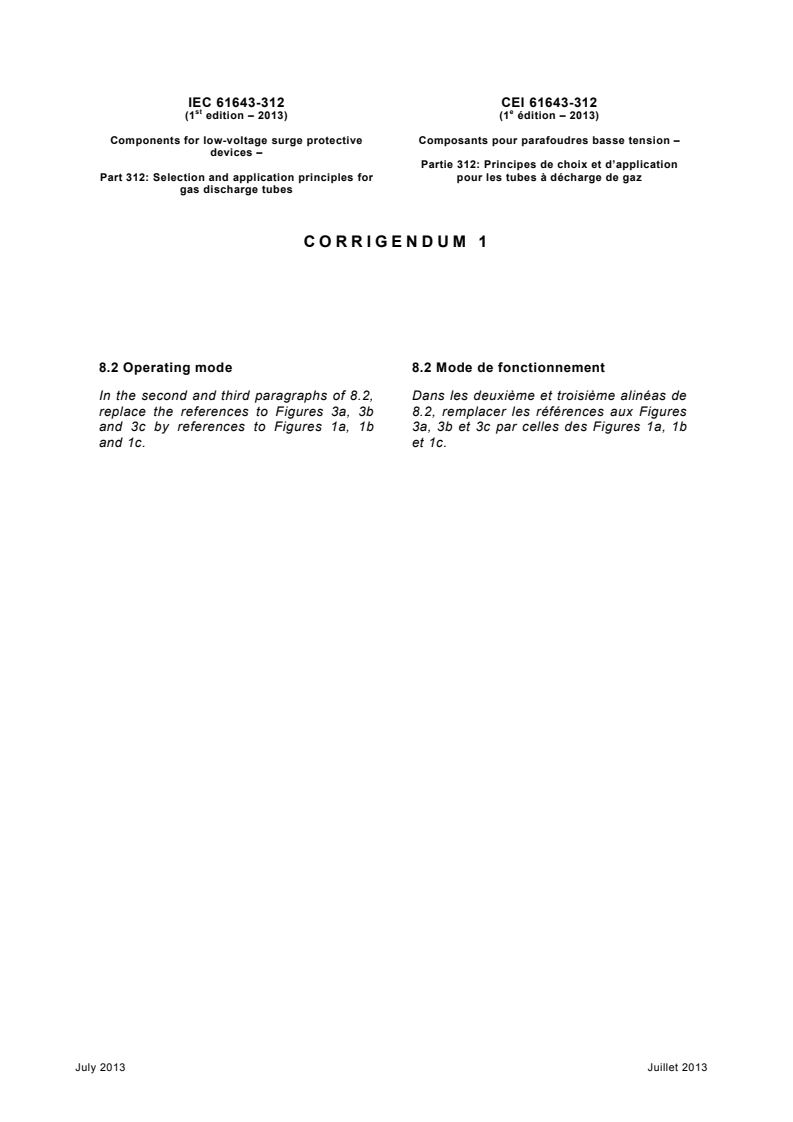
IEC 61643-312 CEI 61643-312
st e
(1 edition – 2013) (1 édition – 2013)
Components for low-voltage surge protective Composants pour parafoudres basse tension –
devices –
Partie 312: Principes de choix et d’application
Part 312: Selection and application principles for pour les tubes à décharge de gaz
gas discharge tubes
CO RRI G E NDUM 1
8.2 Operating mode
...
This May Also Interest You
IEC 61643-312:2013 is applicable to gas discharge tubes (GDT) used for overvoltage protection in telecommunications, signalling and low-voltage power distribution networks with nominal system voltages up to 1 000 V (r.m.s.) a.c. and 1 500 V d.c. They are defined as a gap, or several gaps with two or three metal electrodes hermetically sealed so that gas mixture and pressure are under control. They are designed to protect apparatus or personnel, or both, from high transient voltages. This standard provides information about the characteristics and circuit applications of GDTs having two or three electrodes. This standard does not specify requirements applicable to complete surge protective devices, nor does it specify total requirements for GDTs employed within electronic devices, where precise coordination between GDT performance and surge protective device withstand capability is highly critical. Keywords: gas discharge tubes (GDT), overvoltage protection in telecommunications, signalling and low-voltage power distribution networks, nominal system voltages up to 1 000 V (r.m.s.) a.c. and 1 500 V d.c. The contents of the corrigendum of July 2013 have been included in this copy.
- Standard43 pagesEnglish and French languagesale 15% off
IEC 61643-311:2013 is applicable to gas discharge tubes (GDT) used for overvoltage protection in telecommunications, signalling and low-voltage power distribution networks with nominal system voltages up to 1 000 V (r.m.s.) a.c. and 1 500 V d.c..They are defined as a gap, or several gaps with two or three metal electrodes hermetically sealed so that gas mixture and pressure are under control. They are designed to protect apparatus or personnel, or both, from high transient voltages. This standard contains a series of test criteria, test methods and test circuits for determining the electrical characteristics of GDTs having two or three electrodes. This standard does not specify requirements applicable to complete surge protective devices, nor does it specify total requirements for GDTs employed within electronic devices, where precise coordination between GDT performance and surge protective device withstand capability is highly critical. This second edition of IEC 61643-311 cancels and replaces the first edition published in 2001. It constitutes a technical revision. Specific changes with respect to the previous edition are: Addition of performance values. Key words: gas discharge tubes (GDT), overvoltage protection in telecommunications, signalling and low-voltage power distribution networks, nominal system voltages up to 1 000 V (r.m.s.) a.c. and 1 500 V d.c.
- Standard53 pagesEnglish and French languagesale 15% off
Gas discharge tubes (GDTs) are used for applications up to 1 000 V a.c. or 1 500 V d.c. in communication or signalling circuits. They are defined as a gap, or series of gaps, in an enclosed discharge medium other than air. They are designed to protect apparatus or personnel, or both, from high transient voltages. This standard does not specify requirements applicable to complete surge protective devices, nor does it specify total requirements for GDTs employed within electronic devices, where precise coordination between GDT performance and surge protective device withstand capability is highly critical.
- Standard41 pagesEnglish and French languagesale 15% off
IEC 62541-100:2025 defines the information model associated with Devices. This document describes three models which build upon each other as follows:
• The (base) Device Model is intended to provide a unified view of devices and their hardware and software parts irrespective of the underlying device protocols.
• The Device Communication Model adds Network and Connection information elements so that communication topologies can be created.
• The Device Integration Host Model finally adds additional elements and rules required for host systems to manage integration for a complete system. It enables reflecting the topology of the automation system with the devices as well as the connecting communication networks.
This document also defines AddIns that can be used for the models in this document but also for models in other information models. They are:
• Locking model – a generic AddIn to control concurrent access,
• Software update model – an AddIn to manage software in a Device.
This second edition cancels and replaces the first edition published in 2015. This edition constitutes a technical revision.
This edition includes the following significant technical changes with respect to the previous edition:
a a ComponentType that can be used to model any HW or SW element of a device has been defined and a SoftwareType has been added as subtype of ComponentType;
b the new OPC UA interface concept and defined interfaces for Nameplate, DeviceHealth, and SupportInfo has been added.
c) a new model for Software Update (Firmware Update) has been added;
d) a new entry point for documents where each document is represented by a FileType instance has been specified;
e) a model that provides information about the lifetime, related limits and semantic of the lifetime of things like tools, material or machines has been added.
- Standard152 pagesEnglish languagesale 15% off
- Standard158 pagesFrench languagesale 15% off
- Standard310 pagesEnglish and French languagesale 15% off
IEC TR 61169-1-8:2025 provides a test method for voltage standing wave ratio (VSWR, hereinafter) of single RF connector by double-connector method. This document is applicable to single RF cable connectors and single microstrip RF connectors as well as single adapters if an estimation of the VSWR of a single completely installed RF-connector is used and a time domain feature is not available on the vector network analyzer.
- Technical report18 pagesEnglish languagesale 15% off
IEC 62541-7: 2025 specifies value and structure of Profiles in the OPC Unified Architecture.
OPC UA Profiles are used to segregate features with regard to testing of OPC UA products and the nature of the testing. The scope of this document includes defining functionality that can only be tested. The definition of actual TestCases is not within the scope of this document, but the general categories of TestCases are covered by this document.
Most OPC UA applications will conform to several, but not all of the Profiles.
This fourth edition cancels and replaces the third edition published in 2020. This edition constitutes a technical revision.
This edition includes the following significant technical changes with respect to the previous edition:
a) Profiles and ConformanceUnits are not part of this document, but are solely managed in a public database as described in Clause 1.
- Standard160 pagesEnglish languagesale 15% off
- Standard173 pagesFrench languagesale 15% off
- Standard333 pagesEnglish and French languagesale 15% off
IEC 62541-10:2025 is available as IEC 62541-10:2025 RLV which contains the International Standard and its Redline version, showing all changes of the technical content compared to the previous edition.IEC 62541-10:2025 defines the Information Model associated with Programs in OPC Unified Architecture (OPC UA). This includes the description of the NodeClasses, standard Properties, Methods and Events and associated behaviour and information for Programs. The complete AddressSpace model including all NodeClasses and Attributes is specified in IEC 62541-3. The Services such as those used to invoke the Methods used to manage Programs are specified in IEC 62541-4. An example for a DomainDownload Program is defined in Annex A. This fourth edition cancels and replaces the third edition published in 2020. This edition constitutes a technical revision.
This edition includes the following significant technical changes with respect to the previous edition:
- StateMachine table format has been aligned.
- Standard42 pagesEnglish languagesale 15% off
- Standard45 pagesFrench languagesale 15% off
- Standard87 pagesEnglish and French languagesale 15% off
IEC 62541-4:2025 is available as IEC 62541-4:2025 RLV which contains the International Standard and its Redline version, showing all changes of the technical content compared to the previous edition.IEC 62541-4:2025 defines the OPC Unified Architecture (OPC UA) Services. The Services defined are the collection of abstract Remote Procedure Calls (RPC) that are implemented by OPC UA Servers and called by OPC UA Clients. All interactions between OPC UA Clients and Servers occur via these Services. The defined Services are considered abstract because no particular RPC mechanism for implementation is defined in this document. IEC 62541‑6 specifies one or more concrete mappings supported for implementation. For example, one mapping in IEC 62541‑6 is to UA-TCP UA-SC UA-Binary. In that case the Services described in this document appear as OPC UA Binary encoded payload, secured with OPC UA Secure Conversation and transported via OPC UA TCP. Not all OPC UA Servers implement all of the defined Services. IEC 62541‑7 defines the Profiles that dictate which Services must be implemented in order to be compliant with a particular Profile. A BNF (Backus-Naur form) for browse path names is described in Annex A. This fourth edition cancels and replaces the third edition published in 2020. This edition constitutes a technical revision.
This edition includes the following significant technical changes with respect to the previous edition:
a) addition of new definitions to Method Call Service to allow optional Method arguments;
b)addition of reference to SystemStatusChangeEventType for event monitored item error scenarios;
c) enhancement of the general description of how determining if a Certificate is trusted;
d) addition of support for ECC;
e) addition of revisedAggregateConfiguration to AggregateFilterResult structure;
f) addition of INVALID to the BrowseDirection enumeration data type;
g) addition of INVALID to the TimestampsToReturn enumeration data type;
h) addition of definitions that make sure the subscription functionality works if retransmission queues are optional;
i) addition of client checks has been added to be symmetric to the Server Certificate check has been added;
j) clarification that ‘local’ top level domain is not appended by server into certificate and not checked by client when returned from LDS-ME;
k) addition of a definition for expiration behaviour of IssuedIdentityTokens;
l) addition of status code Good_PasswordChangeRequired to ActivateSession;
m) restriction of AdditionalInfo to servers in debug mode;
n) addition of new status code Bad_ServerTooBusy;
o) addition of definition for cases where server certificate must be contained in GetEndpoints response.
- Standard245 pagesEnglish languagesale 15% off
- Standard257 pagesFrench languagesale 15% off
- Standard502 pagesEnglish and French languagesale 15% off
IEC TS 63414:2025 is applicable for the determination of the AC and DC pollution flashover and withstand voltage characteristics of insulators with polymeric housing, to be used outdoors in HV applications and exposed to polluted environments. This is also applicable for insulators with hydrophobic coatings. This document refers to AC systems with a rated voltage greater than 1 000 V and DC systems with a rated voltage greater than 1 500 V.
The object of this technical specification is to prescribe standardized test methods, requirements and procedures for artificial pollution tests applicable to polymeric insulators for overhead lines including traction lines, station post and hollow insulators of equipment. Available test experience with polymeric station post and hollow insulators, especially for DC applications, is limited.
The proposed tests are not applicable to ceramic and glass insulators without polymeric housing, to greased insulators or to special types of insulators (e.g., insulators with semiconducting glaze).
Differently to ceramic and glass insulators without polymeric housing:
- The pollution performance of insulators with polymeric housing varies with the hydrophobicity condition of the surface. The specific conditions simulated by standardized tests might not represent the actual dynamic field conditions.
- The determination of the flashover and/or withstand voltage under pollution conditions is not enough for dimensioning. Additional constraints related to possible ageing are also to be considered.
- If the Hydrophobicity Transfer Material (HTM) test according to IEC TR 62039 confirms that an insulator is non-HTM, it can be tested according to IEC 60507 or IEC TS 61245.
- Technical specification39 pagesEnglish languagesale 15% off
IEC TS 62876-3-4:2025, which is a Technical Specification, establishes a standardized guideline to assess
• reliability of metallic interfaces
of Ohmic-contacted field-effect transistors (FETs) using 2D nano-materials by quantifying
• linearity of current-voltage (I-V) output curves
for devices with various materials combinations of van der Waals (vdW) interfaces.
For metallic interfaces with 2D materials (eg. graphene, MoS2, MoTe2, WS2, WSe2, etc) and metals (eg. Ti, Cr, Au, Pd, In, Sb, etc), the reliability of Ohmic contact is quantified.
For FETs consisting of 2D materials-based channels (eg. MoS2, MoTe2, WS2, WSe2, etc), the reliability of Ohmic contact when varying contacting metal, channel length, channel thickness, applied voltage, and surface treatment condition is quantified.
The reliability of the metallic contacts is quantified from the linearity of I-V characteristics measured over extended time periods.
- Technical specification24 pagesEnglish languagesale 15% off


Questions, Comments and Discussion
Ask us and Technical Secretary will try to provide an answer. You can facilitate discussion about the standard in here.
Loading comments...