

IEC 63048-2:2026
(Main)Mobile remotely controlled systems (MRCSs) for nuclear and radiological applications - Part 2: Particular requirements for aerial surveillance
General Information
- Abstract
IEC 63048-2:2026 is applicable to MRCSs for ground surveillance of a nuclear facility or in a radiological environment. This document describes the mission, operating conditions, reliability requirements, functional requirements, operational requirements, and test requirements of MRCS for ground surveillance of nuclear facilities.
- Status
- Published
- Publication Date
- 15-Sep-2026
- Technical Committee
- TC 45 - Nuclear instrumentation
- Drafting Committee
- WG 18 - TC 45/WG 18
- Current Stage
- PPUB - Publication issued
- Start Date
- 16-Sep-2026
- Completion Date
- 25-Sep-2026
Overview
IEC 63048-2:2026 is an international standard developed by the International Electrotechnical Commission (IEC) specifying the particular requirements for mobile remotely controlled systems (MRCSs) used in aerial surveillance for nuclear and radiological applications. This document provides in-depth guidance for designing, deploying, and operating aerial MRCSs-such as drones-for tasks related to radiation mapping, facility monitoring, emergency response, and security in nuclear environments.
The standard addresses essential factors such as mission objectives, operating and environmental conditions, system reliability, functional requirements, operational protocols, and validation procedures-ensuring MRCSs meet the rigorous safety and performance demands found in nuclear and radiological settings.
Key Topics
- Aerial Surveillance Missions: Defines roles for MRCSs in monitoring radiation levels, assessing structural integrity, supporting emergency evacuation plans, and enhancing security at nuclear facilities.
- Operation Conditions: Outlines considerations for radiation, mobility, temperature, weather, and communication-each critical in determining equipment suitability and mission planning.
- Radiation: High, intermediate, and low exposure scenarios require different system tolerances and safety measures.
- Mobility: Addresses navigation challenges from obstacles like buildings, pipes, and confined spaces.
- Temperature and Weather: Specifies requirements for MRCS operability across extremes, including hot, cold, rain, snow, and wind.
- Communication: Discusses high-interference environments and the need for reliable wireless systems.
- System Structure: Details required subsystems, including the aerial “slave” (sensing, mobility, power, communication) and the “master” (control interface, status monitoring, remote operation).
- Risk and Safety Management: Emphasizes structured risk analysis (fault tolerance, risk minimization, probabilistic assessment) and safety design principles to mitigate potential hazards.
- Reliability and Functional Requirements: Establishes performance expectations, such as radiation resistance, mobile stability, weatherproofing, and fail-safe operations tailored to nuclear contexts.
- Operational and Test Requirements: Requires thorough pre-deployment testing, validation, and verification to assure compliance, safety, and reliability in real-world use.
Applications
IEC 63048-2:2026 supports broad deployment of aerial MRCSs in the nuclear and radiological industry, enabling:
- Routine Facility Monitoring: Automated aerial surveys for radiation dose mapping, supporting compliance with regulatory inspection requirements.
- Emergency Response: Rapid deployment during incidents to map radioactive plume dispersion, evaluate facility integrity, and guide emergency services or evacuation plans-reducing human exposure.
- Security Operations: Real-time detection of unauthorized intrusions and surveillance of perimeters and restricted zones, enhancing facility security and incident response capabilities.
- Environmental Assessment: Remote sensing of environmental parameters related to leaks, flooding, fire, or contamination at nuclear sites, minimizing personnel risk.
- Infrastructure Inspection: Scheduled and on-demand monitoring of critical assets, such as containers, pipelines, and storage areas, to detect structural anomalies or early signs of failure.
By ensuring MRCSs are designed, validated, and operated to meet the stringent requirements outlined in IEC 63048-2:2026, nuclear facility operators can leverage the latest in drone and robotics technology while maintaining the highest standards of safety, reliability, and regulatory compliance.
Related Standards
Professionals implementing IEC 63048-2:2026 should also consult these relevant standards:
- IEC 63048:2020 – General requirements for mobile remotely controlled systems for nuclear and radiological applications.
- IEC 60529 – Degrees of protection provided by enclosures (IP Code), useful for evaluating weather and dust resistance of MRCS enclosures.
- ISO/IEC Guidance – Terminology and framework support for robotics, electrotechnology, and risk management in complex environments.
By integrating IEC 63048-2:2026 with related international standards, stakeholders can develop comprehensive operational policies for deploying aerial robotics in nuclear contexts, ensuring both regulatory alignment and operational excellence.
Get Certified
Connect with accredited certification bodies for this standard

DNV
DNV is an independent assurance and risk management provider.

Lloyd's Register
Lloyd's Register is a global professional services organisation specialising in engineering and technology.
DNV Energy Systems
Energy and renewable energy certification.
Sponsored listings
Frequently Asked Questions
IEC 63048-2:2026 is a standard published by the International Electrotechnical Commission (IEC). Its full title is "Mobile remotely controlled systems (MRCSs) for nuclear and radiological applications - Part 2: Particular requirements for aerial surveillance". This standard covers: IEC 63048-2:2026 is applicable to MRCSs for ground surveillance of a nuclear facility or in a radiological environment. This document describes the mission, operating conditions, reliability requirements, functional requirements, operational requirements, and test requirements of MRCS for ground surveillance of nuclear facilities.
IEC 63048-2:2026 is applicable to MRCSs for ground surveillance of a nuclear facility or in a radiological environment. This document describes the mission, operating conditions, reliability requirements, functional requirements, operational requirements, and test requirements of MRCS for ground surveillance of nuclear facilities.
IEC 63048-2:2026 is classified under the following ICS (International Classification for Standards) categories: 25.040.01 - Industrial automation systems in general; 25.040.30 - Industrial robots. Manipulators; 27.120 - Nuclear energy engineering. The ICS classification helps identify the subject area and facilitates finding related standards.
IEC 63048-2:2026 is available in PDF format for immediate download after purchase. The document can be added to your cart and obtained through the secure checkout process. Digital delivery ensures instant access to the complete standard document.
Standards Content (Sample)
IEC 63048-2 ®
Edition 1.0 2026-09
INTERNATIONAL
STANDARD
Mobile remotely controlled systems (MRCSs) for nuclear and radiological
applications -
Part 2: Particular requirements for aerial surveillance
ICS 27.120; 25.040.30; 25.040.01 ISBN 978-2-8327-1456-0
All rights reserved. Unless otherwise specified, no part of this publication may be reproduced or utilized in any form or
by any means, electronic or mechanical, including photocopying and microfilm, without permission in writing from either
IEC or IEC's member National Committee in the country of the requester. If you have any questions about IEC copyright
or have an enquiry about obtaining additional rights to this publication, please contact the address below or your local
IEC member National Committee for further information.
IEC Secretariat Tel.: +41 22 919 02 11
3, rue de Varembé info@iec.ch
CH-1211 Geneva 20 www.iec.ch
Switzerland
About the IEC
The International Electrotechnical Commission (IEC) is the leading global organization that prepares and publishes
International Standards for all electrical, electronic and related technologies.
About IEC publications
The technical content of IEC publications is kept under constant review by the IEC. Please make sure that you have the
latest edition, a corrigendum or an amendment might have been published.
IEC publications search - IEC Products & Services Portal - products.iec.ch
webstore.iec.ch/advsearchform Discover our powerful search engine and read freely all the
publications previews, graphical symbols and the glossary.
The advanced search enables to find IEC publications by a
variety of criteria (reference number, text, technical With a subscription you will always have access to up to date
committee, …). It also gives information on projects, content tailored to your needs.
replaced and withdrawn publications.
Electropedia - www.electropedia.org
The world's leading online dictionary on electrotechnology,
IEC Just Published - webstore.iec.ch/justpublished
Stay up to date on all new IEC publications. Just Published containing more than 22 500 terminological entries in English
details all new publications released. Available online and and French, with equivalent terms in 25 additional languages.
once a month by email. Also known as the International Electrotechnical Vocabulary
(IEV) online.
IEC Customer Service Centre - webstore.iec.ch/csc
If you wish to give us your feedback on this publication or
need further assistance, please contact the Customer
Service Centre: sales@iec.ch.
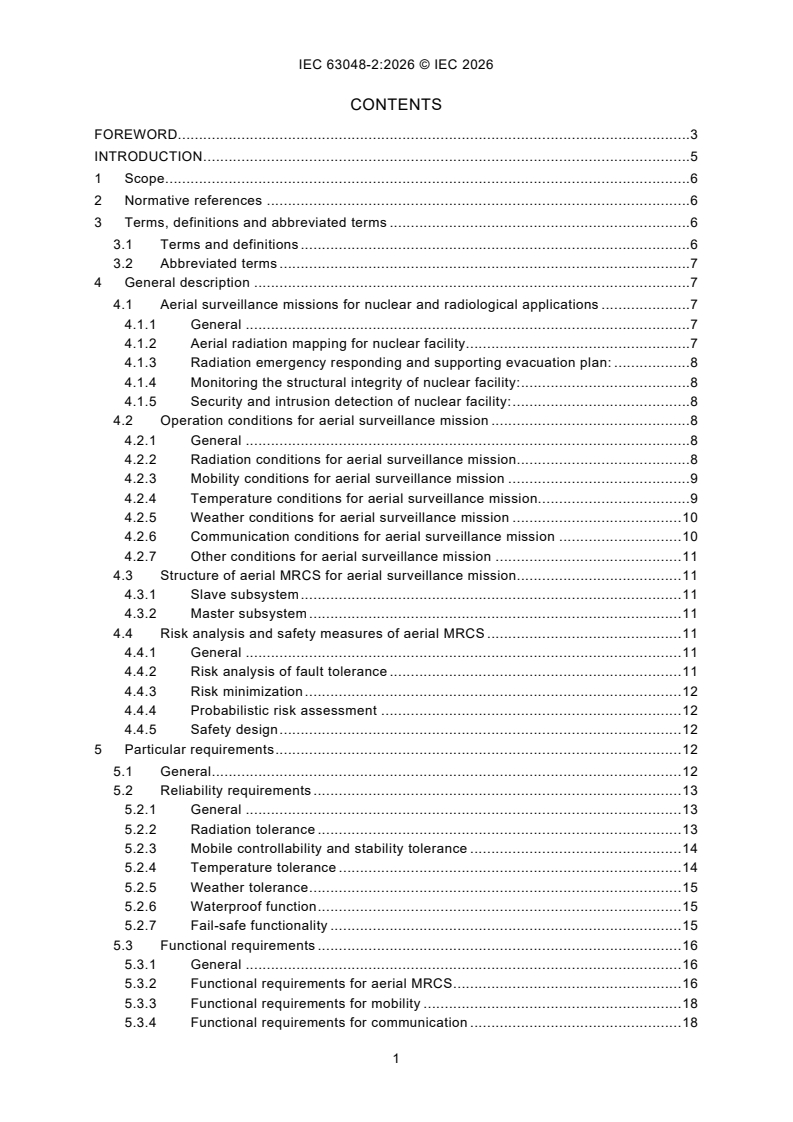
CONTENTS
FOREWORD. 3
INTRODUCTION . 5
1 Scope . 6
2 Normative references . 6
3 Terms, definitions and abbreviated terms . 6
3.1 Terms and definitions . 6
3.2 Abbreviated terms . 7
4 General description . 7
4.1 Aerial surveillance missions for nuclear and radiological applications . 7
4.1.1 General . 7
4.1.2 Aerial radiation mapping for nuclear facility . 7
4.1.3 Radiation emergency responding and supporting evacuation plan: . 8
4.1.4 Monitoring the structural integrity of nuclear facility: . 8
4.1.5 Security and intrusion detection of nuclear facility: . 8
4.2 Operation conditions for aerial surveillance mission . 8
4.2.1 General . 8
4.2.2 Radiation conditions for aerial surveillance mission. 8
4.2.3 Mobility conditions for aerial surveillance mission . 9
4.2.4 Temperature conditions for aerial surveillance mission . 9
4.2.5 Weather conditions for aerial surveillance mission . 10
4.2.6 Communication conditions for aerial surveillance mission . 10
4.2.7 Other conditions for aerial surveillance mission . 11
4.3 Structure of aerial MRCS for aerial surveillance mission. 11
4.3.1 Slave subsystem . 11
4.3.2 Master subsystem . 11
4.4 Risk analysis and safety measures of aerial MRCS . 11
4.4.1 General . 11
4.4.2 Risk analysis of fault tolerance . 11
4.4.3 Risk minimization . 12
4.4.4 Probabilistic risk assessment . 12
4.4.5 Safety design . 12
5 Particular requirements . 12
5.1 General . 12
5.2 Reliability requirements . 13
5.2.1 General . 13
5.2.2 Radiation tolerance . 13
5.2.3 Mobile controllability and stability tolerance . 14
5.2.4 Temperature tolerance . 14
5.2.5 Weather tolerance . 15
5.2.6 Waterproof function . 15
5.2.7 Fail-safe functionality . 15
5.3 Functional requirements . 16
5.3.1 General . 16
5.3.2 Functional requirements for aerial MRCS . 16
5.3.3 Functional requirements for mobility . 18
5.3.4 Functional requirements for communication . 18
5.4 Safety requirements . 19
5.5 Operational requirements . 19
5.6 Test requirements . 20
6 Verification and validation . 21
6.1 General . 21
6.2 Required verification and validation of the aerial MRCS . 21
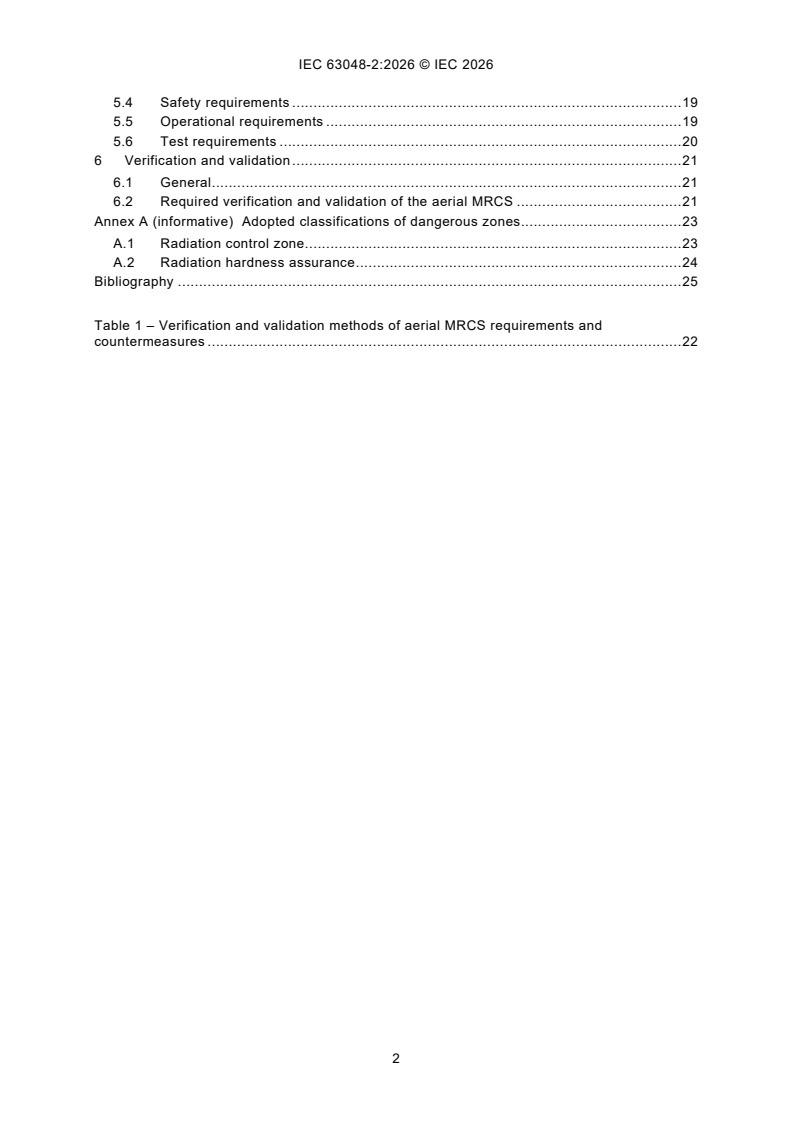
Annex A (informative) Adopted classifications of dangerous zones . 23
A.1 Radiation control zone . 23
A.2 Radiation hardness assurance . 24
Bibliography . 25
Table 1 – Verification and validation methods of aerial MRCS requirements and
countermeasures . 22
INTERNATIONAL ELECTROTECHNICAL COMMISSION
____________
Mobile remotely controlled systems (MRCSs)
for nuclear and radiological applications -
Part 2: Particular requirements for aerial surveillance
FOREWORD
1) The International Electrotechnical Commission (IEC) is a worldwide organization for standardization comprising
all national electrotechnical committees (IEC National Committees). The object of IEC is to promote international
co-operation on all questions concerning standardization in the electrical and electronic fields. To this end and
in addition to other activities, IEC publishes International Standards, Technical Specifications, Technical Reports,
Publicly Available Specifications (PAS) and Guides (hereafter referred to as "IEC Publication(s)"). Their
preparation is entrusted to technical committees; any IEC National Committee interested in the subject dealt with
may participate in this preparatory work. International, governmental and non-governmental organizations liaising
with the IEC also participate in this preparation. IEC collaborates closely with the International Organization for
Standardization (ISO) in accordance with conditions determined by agreement between the two organizations.
2) The formal decisions or agreements of IEC on technical matters express, as nearly as possible, an international
consensus of opinion on the relevant subjects since each technical committee has representation from all
interested IEC National Committees.
3) IEC Publications have the form of recommendations for international use and are accepted by IEC National
Committees in that sense. While all reasonable efforts are made to ensure that the technical content of IEC
Publications is accurate, IEC cannot be held responsible for the way in which they are used or for any
misinterpretation by any end user.
4) In order to promote international uniformity, IEC National Committees undertake to apply IEC Publications
transparently to the maximum extent possible in their national and regional publications. Any divergence between
any IEC Publication and the corresponding national or regional publication shall be clearly indicated in the latter.
5) IEC itself does not provide any attestation of conformity. Independent certification bodies provide conformity
assessment services and, in some areas, access to IEC marks of conformity. IEC is not responsible for any
services carried out by independent certification bodies.
6) All users should ensure that they have the latest edition of this publication.
7) No liability shall attach to IEC or its directors, employees, servants or agents including individual experts and
members of its technical committees and IEC National Committees for any personal injury, property damage or
other damage of any nature whatsoever, whether direct or indirect, or for costs (including legal fees) and
expenses arising out of the publication, use of, or reliance upon, this IEC Publication or any other IEC
Publications.
8) Attention is drawn to the Normative references cited in this publication. Use of the referenced publications is
indispensable for the correct application of this publication.
9) IEC draws attention to the possibility that the implementation of this document may involve the use of (a)
patent(s). IEC takes no position concerning the evidence, validity or applicability of any claimed patent rights in
respect thereof. As of the date of publication of this document, IEC had not received notice of (a) patent(s), which
may be required to implement this document. However, implementers are cautioned that this may not represent
the latest information, which may be obtained from the patent database available at https://patents.iec.ch. IEC
shall not be held responsible for identifying any or all such patent rights.
IEC 63048-2 has been prepared by IEC technical committee 45: Nuclear instrumentation. It is
an International Standard.
The text of this International Standard is based on the following documents:
Draft Report on voting
45/1056/FDIS 45/1066/RVD
Full information on the voting for its approval can be found in the report on voting indicated in
the above table.
The language used for the development of this International Standard is English.
This document was drafted in accordance with ISO/IEC Directives, Part 2, and developed in
accordance with ISO/IEC Directives, Part 1 and ISO/IEC Directives, IEC Supplement, available
at www.iec.ch/members_experts/refdocs. The main document types developed by IEC are
described in greater detail at www.iec.ch/publications.
A list of all parts of the IEC 63048 series of standards, published under the general title Mobile
remotely controlled systems (MRCSs) for nuclear and radiological applications, can be found
on the IEC website.
The committee has decided that the contents of this document will remain unchanged until the
stability date indicated on the IEC website under webstore.iec.ch in the data related to the
specific document. At this date, the document will be
– reconfirmed,
– withdrawn, or
– revised.
INTRODUCTION
IEC 63048 provides the general requirements for mobile remotely controlled systems (MRCS)
intended for various missions at nuclear facilities. Depending on the given missions, different
types of MRCSs can be used, and the requirements of the MRCSs are applied in different level.
Nuclear facilities are strictly regulated to prevent leakage of radioactive materials, and
surveillance is an important mission for all nuclear facilities. A nuclear power plant, which is a
representative nuclear facility, is operated in different situations, such as normal operation,
transient, accident conditions and decommission. Whereas various missions of MRCSs are
required in different situations, the surveillance mission of MRCSs is essential for all operation
situations.
All types of MRCSs (i.e. unmanned ground vehicles, remotely operated mobile manipulators,
aerial drones, underwater drones, etc.) are useful for surveillance of nuclear facilities. However,
aerial MRCSs are faster than other types of MRCS and are effective for surveillance of large
areas.
This document establishes the particular requirements for MRCSs used for aerial surveillance.
1 Scope
This part of IEC 63048 establishes the particular requirements of aerial MRCSs used for aerial
surveillance mission for nuclear and radiological applications, such as rapid radiation mapping,
structural damage monitoring, monitoring of radioactive plume transport, or finding a radioactive
material. It provides the functional and operational requirements of aerial MRCS.
2 Normative references
The following documents are referred to in the text in such a way that some or all of their content
constitutes requirements of this document. For dated references, only the edition cited applies.
For undated references, the latest edition of the referenced document (including any
amendments) applies.
IEC 60529, Degrees of protection provided by enclosures (IP Code)
IEC 63048:2020, Mobile remotely controlled systems for nuclear and radiological applications -
General requirements
3 Terms, definitions and abbreviated terms
3.1 Terms and definitions
For the purposes of this document, the following terms and definitions apply.
ISO and IEC maintain terminology databases for use in standardization at the following
addresses:
– IEC Electropedia: available at https://www.electropedia.org/
– ISO Online browsing platform: available at https://www.iso.org/obp
3.1.1
mission
objective description of the fundamental task performed by a system
[SOURCE: IEC 63048:2020, 3.3]
3.1.2
mobile remotely controlled system
MRCS
robotics in nuclear instrumentation that are mobile, remotely controlled by an operator, and
consisting of sub-systems, modules or assemblies
EXAMPLE Subsystems, modules or assemblies are, for example, mechanical and electrical/electronical controls,
communications (between the operator and the robotic, and some robotic subsystems, modules or assemblies),
lighting and possibly audio subsystems, modules or assemblies, sampling and monitoring subsystems, modules or
assemblies, used for photographing the environment with video or still photos, sampling or monitoring the contacted
air or surfaces for radioactive materials, noxious gases and particulates such as asbestos, and performing other
designed activities, all controlled by the operator.
[SOURCE: IEC 63048:2020, 3.4]
3.1.3
surveillance
continual checking, critically observing or determining the status in order to identify change
from the risk (3.1.4) level required or expected
[SOURCE: ISO Guide 73:2009 [5], 3.8.2.1, modified – "Monitoring" has been changed to
"surveillance"; "Supervising" has been deleted, and "performance level" has been changed to
"risk". In addition, Note 1 to entry has been deleted.]
3.1.4
risk
potential that a given threat will exploit vulnerabilities of an asset or group of assets and thereby
cause harm to the organization
Note 1 to entry: Risk is measured in terms of combination of the severity of impact from the environment, probability
of the exposure time to the radiation and the controllability for MRCS.
[SOURCE: IAEA Nuclear Security Series No. 17:2011 [7], modified. The second sentence in
the definition has been removed, and Note 1 to entry has been added.]
3.2 Abbreviated terms
CBRN Chemical, biological, radiological or nuclear
GPS Global positioning system
HMI Human-machine interface
HVAC Heat, ventilation, and air conditioning
IMU Inertial measurement unit
LTE Long-term evolution
MRCS Mobile remotely controlled system
MTBF Mean time between failures
SLAM Mimultaneous localization and mapping
4 General description
4.1 Aerial surveillance missions for nuclear and radiological applications
4.1.1 General
Aerial surveillance missions are conducted to enhance safety and security by providing real-
time, accurate, and comprehensive data for decision-making, risk mitigation, and response
coordination in the context of nuclear facility management or public safety.
Aerial surveillance is conducted to monitor radiation distributions in large areas, such as,
regular monitoring of a nuclear facility, regulatory monitoring or inspection of a nuclear facility,
the expected location of a lost radiation source, the area suspected of radioactive contamination,
the area of a chemical, biological, radiological or nuclear (CBRN) emergency, and the area
supposed to be affected by a nuclear security event (e.g. sabotage of a nuclear facility or
detonation of a radiological dispersal device).
4.1.2 Aerial radiation mapping for nuclear facility
The aerial surveillance is conducted to monitor the nuclear facility. The nuclear facility is
operated under strict regulation. Each zone of the nuclear facility has a limited level of radiation.
The aerial MRCS is commonly utilized for regular monitoring and legal regulatory investigation
of nuclear facility.
4.1.3 Radiation emergency responding and supporting evacuation plan:
The aerial surveillance is conducted for public safety in a radiation emergency situation. The
radiation distribution map resulting from the aerial surveillance should be provided to the people
in the radiation emergency area. The emergency responding strategy should be planned based
on the radiation zone. The headquarters make decision where to dispatch the first responding
workers or where to make an action by using un-maned system. The radiation mapping by the
aerial surveillance assists in planning the safe evacuation routes for the public.
4.1.4 Monitoring the structural integrity of nuclear facility:
The aerial surveillance is conducted to regularly survey the structural integrity of key
components in the nuclear facility. Any signs of damage or potential issues could be monitored
by aerial surveillance.
4.1.5 Security and intrusion detection of nuclear facility:
The aerial surveillance is conducted to integrate security features to detect and respond to any
unauthorized access or intrusion attempts to the nuclear facility.
4.2 Operation conditions for aerial surveillance mission
4.2.1 General
Aerial surveillance missions should be conducted for different purposes and target areas. The
operation conditions of the aerial surveillance mission should be considered with regard to the
targeted nuclear facility or the targeted area.
4.2.2 Radiation conditions for aerial surveillance mission
The radiation level of the target area shall be assessed for the aerial surveillance mission (see
Annex A). The procedures, operation time, or the types of aerial MRCS should be changed with
respect to the radiation condition.
The radiation conditions of the aerial surveillance mission should be considered as follows:
– High radiation condition: Access of human worker is not allowed in the target area due to
high radiation, and aerial MRCSs are utilized for safety. The aerial MRCS is exposed to high
level of radiation most of the time for the aerial surveillance mission. Such conditions occur,
for example, during monitoring of a nuclear facility in accident conditions, and during
radiation investigation of an area affected by a large radioactive leakage.
– Intermediate radiation condition: Access of human worker should be restricted depending
on radiation levels, and an aerial MRCS should be utilized for preventing possible exposure
of radiation. The aerial MRCS is exposed to intermediate level of radiation in partial time for
the aerial surveillance mission. Such conditions occur, for example, during monitoring of
overhaul operation, and during radiation mapping of a decommission site of a nuclear
facility.
– Low radiation condition: Access of human workers is allowed, and an aerial MRCS should
be utilized for preventing unexpected exposure of radiation. The aerial MRCS is exposed to
low level of radiation during the aerial surveillance mission. Such conditions occur, for
example, during regular monitoring of a normally operated nuclear facility, and during
scheduled radiation mapping of a radioactive waste storage site.
The classification of the radiation conditions can be adjusted to the applying country. The aerial
surveillance mission should be conducted to consider the permission of the target facility.
Regional regulations can apply.
4.2.3 Mobility conditions for aerial surveillance mission
Mobility conditions of the target area shall be assessed for the aerial surveillance mission,
because buildings, stacks, poles or trees hinder the flying path of the aerial MRCS. When the
aerial surveillance mission is targeted inside a nuclear facility, the more obstacles it is expected
to avoid, such as walls, ceilings, fences, or pipes.
The mobility conditions of the aerial surveillance mission should be considered as follows:
– High mobility constraints: The target area of the aerial surveillance mission includes
confined space, narrow passage, complex obstacles that are difficult to avoid, or a difficult
target to access. The aerial surveillance mission shall be prepared to adjust the flying path
due to the complex obstacles in the target area. The aerial MRCS is highly expected to be
controlled to avoid obstacles during the entire mission, and the flight path shall be carefully
monitored and frequently adjusted.
– Intermediate mobility constraints: The target area of the aerial surveillance mission includes
simple obstacles easy to avoid, such as, tree, stack, pole, or building. The aerial surveillance
mission should be prepared to adjust flying path due to the obstacles in the target area. The
aerial MRCS is expected to face obstacles in some part of the mission, and the flight path
should be monitored and adjusted.
– Low mobility constraints: The target area of the aerial surveillance mission is an open space
without obstacles on the flight path. The aerial surveillance mission should be prepared to
adjust the flying path due to the unexpected obstacles in the target area, and the flight path
should be monitored and adjusted.
4.2.4 Temperature conditions for aerial surveillance mission
The temperature of the target area shall be assessed for the aerial surveillance mission. If the
flying route of the aerial surveillance mission includes a high heat area, the aerial MRCS shall
be selected in consideration of the temperature.
Temperature conditions for the aerial surveillance mission should be considered as follows:
– Hot temperature conditions: The flying route of the aerial surveillance is exposed to high
heat. Examples of such conditions include disaster areas in fire, leakage of hot steam in a
facility, adjacent to overheated equipment. The components and materials of the aerial
MRCS shall be selected to endure the hot temperature condition due to the high heat.
– Moderate temperature conditions: The flying route of the aerial surveillance is exposed to
unexpected high heat or cold air. The components and materials of the aerial MRCS shall
be selected to endure a short duration of time in unexpected hot or cold temperature
condition.
– Cold temperature conditions: The flying route of the aerial surveillance is exposed to cold
air. Examples of such conditions include blizzards in the winter season, leakage of a
refrigerant in a facility, inside a large cold storage. The components and materials of the
aerial MRCS shall be selected to endure the cold temperature condition daue to the cold
air.
The classification of the temperature conditions can be adjusted to the applying country. The
aerial surveillance mission should be conducted to consider the climate and the characteristics
of the target facility.
4.2.5 Weather conditions for aerial surveillance mission
The weather conditions of the target area shall be assessed for aerial surveillance mission. The
weather, such as wind, rain, snow, fog, mist, or haze affects the operation of the aerial MRCS.
Weather conditions for the aerial surveillance mission should be considered as follows:
– High weather constraint condition: The aerial surveillance mission shall consider the severe
weather. The control of the aerial MRCS can become unstable in the high weather constraint
condition, making it difficult to hover over the same location or to follow along the predefined
flight path. The targeted area includes heavy rain, heavy snow, high wind, fog, mist, or haze.
For instance, if the land wind speed exceeds 20 m/s (Beaufort scale 9 to 12), or the rain
intensity is over 10 mm/h (heavy rain and violent rain), it is strongly advised against and
considered dangerous for flight.
– Intermediate weather constraint condition: The aerial surveillance mission should consider
the adverse weather. The control of aerial MRCS can be affected by the intermediate
weather constraint condition, making position error to hover over the same location or to
follow along the predefined flight path. The targeted area includes some region of rain,
snow, wind, fog, mist, or haze. For example, when the land wind speed is between 10 m/s
and 20,7 m/s (Beaufort scale 6 to 8), or the rain intensity ranges from 2,5 mm to 10 mm
(moderate rain), some grades of wind resistance allow for flight, but caution is
recommended.
– Low weather constraint condition: The aerial surveillance mission does not affected by the
weather. The control of the aerial MRCS is rarely affected by the low weather constraint
condition, making it easy to hover over the same location or to follow along the predefined
flight path. The targeted area is in mild weather, such as light rain, snow, and low wind. For
instance, when the land wind speed is less than 1 m/s (Beaufort scale 0 to 5), or the rain
intensity is less than 2,5 mm/h (light rain), normal flight operations are applicable.
The classification of the weather conditions should be adjusted to the applying country. The
aerial surveillance mission should be conducted to consider the regional weather pattern.
4.2.6 Communication conditions for aerial surveillance mission
The communication conditions of the target area shall be assessed for the aerial surveillance
mission. The communication can be limited by the high-rise obstacle, metal structures, or walls
inside of the building. The connection of the communication between the master subsystem and
aerial MRCS is affected by the characteristics of the target area or the target facility.
The communication conditions for aerial surveillance mission should be considered as follows:
– High constraint condition: The aerial surveillance mission shall be prepared for a high level
of electromagnetic interference in communication. The target area includes the inside of a
building or plant, and most parts of the surveillance course are divided or enclosed by thick
concrete walls or metal barriers. The aerial MRCS shall have reliable communication
methods for high level constraints of electromagnetic interference.
– Intermediate constraint condition: The aerial surveillance mission shall be prepared for an
intermediate level of electromagnetic interference in wireless communication. The target
area includes high rise buildings or metallic structures, and some parts of the surveillance
course are divided or enclosed by concrete walls or metal barriers. The aerial MRCS should
have reliable communication methods for intermediate level constraints of electromagnetic
interference.
– Low constraint condition: The aerial surveillance mission shall be prepared for a low level
of electromagnetic interference in communication. Most parts of the surveillance course are
connected space or open space. The aerial MRCS should have reliable communication
methods for low level constraints of electromagnetic interference.
The classification of the communication conditions should be adjusted to the applying country.
The aerial surveillance mission should be conducted to consider the regional regulation and the
permission of the target facility.
4.2.7 Other conditions for aerial surveillance mission
Other conditions in the target area should be considered for an aerial surveillance mission.
Humidity, pressure, vapour, the presence of people or animals, security remarks, and biohazard
characteristics, can affect the aerial surveillance mission.
4.3 Structure of aerial MRCS for aerial surveillance mission
4.3.1 Slave subsystem
a) Sensing: camera, altitude sensor, location sensor, obstacle sensor, gyro, barometer.
b) Measuring: radiation detection, visual survey camera, IR survey camera, acoustic detection,
wind speed sensing, temperature sensor, gas sensor.
c) Mobility: aerial vehicle platform, propulsion, landing, take off, autonomous path flight,
manual controlled flight, obstacle avoidance.
d) Control: flight control, pan and tilt control, path planning, stabilizer.
e) Communication: wireless.
f) Power: batteries, fuels, wired or wireless hybrid.
4.3.2 Master subsystem
a) HMI: video display, control status display, MRCS status, battery status.
b) Remote control: remote controller.
c) Communication: wireless.
d) Power supply: AC power line, uninterruptable power supply, diesel generator power supply.
4.4 Risk analysis and safety measures of aerial MRCS
4.4.1 General
To prevent or mitigate risks in the aerial surveillance mission in the targeted nuclear field or
nuclear facilities, necessary safety measures shall be taken for aerial MRCSs.
These risks can occur due to various factors, including but not limited to the following items.
– Radiation conditions for aerial surveillance mission, as mentioned in 4.2.2.
– Mobility conditions for aerial surveillance mission, as mentioned in 4.2.3.
– Environmental conditions for aerial surveillance mission, as mentioned in 4.2.4 and 4.2.5.
The conditions for aerial surveillance mission shall be assessed in the system design and
development phases of the aerial MRCS to mitigate the risks.
Appropriate safety measures shall be taken based on the results of risk assessment.
4.4.2 Risk analysis of fault tolerance
The manufacturer of the aerial MRCS shall provide the risk analysis of the fault tolerance.
a) The risk analysis of the fault tolerance of the aerial MRCS.
b) The hazard analysis that is to show the identified hazards controlled below acceptable
levels. In addition, the linkage to the operational plan shall be clarified with respect to flight
safety measures, and a detailed analysis of the failure tolerant design adequacy shall be
performed.
4.4.3 Risk minimization
The manufacturer of the aerial MRCS shall provide risk minimization design. The risk
minimization design is to control hazards by means other than failure tolerant design. When
failure tolerant design is not applicable, the aerial MRCS can be designed with a higher safety
factor or design margin to increase its reliability.
4.4.4 Probabilistic risk assessment
The manufacturer of the aerial MRCS shall provide verification and validation of probabilistic
risk assessment. In cases where risk minimization of the design is not feasible, it shall be
confirmed that probabilistic risk assessment is performed. Probabilistic risk assessment is a
method to quantitatively evaluate the frequency of occurrence and its effects for all possible
accidents and failures. It is determined whether the risk is small enough to be multiplied by both
of them. Examples include mean time between failures (MTBF) evaluation for components and
investigation of failure history.
4.4.5 Safety design
The manufacturer of the aerial MRCS shall provide the safety design.
a) The safe design of elimination or minimization hazards.
b) The safe design of hazards control.
c) The safe design of the application of hazard control methods that rely on special procedures
and training.
5 Particular requirements
5.1 General
The requirements of the aerial MRCS shall be assessed for the missions in 4.1 and the
conditions in 4.2.
The main tasks of the aerial surveillance mission are as follows:
– Aerial surveillance for radiation:
• radiation levels and spectrums;
• wide area geospatial radiation map ;
• radioactive material dispersion range;
• rinding a location of radioactive source.
– Aerial surveillance for structure:
• structural integrity of buildings and structures;
• structural integrity of equipment, component or container;
• leakage of liquid or gas at the nuclear facility.
– Aerial surveillance for environment and boundaries:
• measuring environmental parameters;
• surveillance of fire or flood;
• surveillance for boundary intrusion.
The aerial MRCS shall be designed and manufactured to meet the requirements for the aerial
surveillance missions and the listed main tasks.
The requirements established in 5.2 to 5.6 are not necessarily applicable to all types of MRCSs,
and each of the requirements can selectively apply to the corresponding type of MRCS. This
means that one may add phrases, such as "if applicable" or "if necessary" to each of the
requirements established in these subclauses.
These requirements include, but are not limited to, the following:
– reliability requirements;
– functional requirements;
– safety requirements;
– operational requirements;
– test requirements.
5.2 Reliability requirements
5.2.1 General
The aerial MRCS shall satisfy the safety requirements of IEC 63048 and the safety
requirements for the mission in 4.1 and the conditions in 4.2.
The aerial MRCS shall meet, but not be limited to, the following reliability requirements:
– radiation tolerance;
– mobile controllability and stability tolerance;
– temperature tolerance;
– weather tolerance;
– waterproof;function
– fail-safe.functionality
5.2.2 Radiation tolerance
The aerial MRCS shall comply with the safety requirements specified in IEC 63048:2020, 6.2,
and shall satisfy the reliability for the radiation conditions specified in 4.2.2.
The following reliability requirements for radiation tolerance shall be satisfied, if applicable:
– High radiation tolerance: The aerial MRCS shall endure a high level of radioactivity. The
flying route of the aerial MRCS is near a radioactive building or ground. The components of
the aerial MRCS shall be selected as high level grade radiation-resistant components
suitable for the applied condition. The total ionizing dose of the aerial MRCS shall be
guaranteed to at least 1 kGy.
– Intermediate radiation tolerance: The aerial MRCS shall endure an intermediate level of
radioactivity. The flying route of the aerial MRCS is at a distance from the radioactive
building or ground. Radiation tolerant components shall be preferred where operationally
appropriate and where such components are readily and commercially available. If
commercial grade components are used, verification of radiation resistance shall be
required. The total ionizing dose of the aerial MRCS shall be guaranteed to at least 100 Gy.
– Low radiation tolerance: The aerial MRCS should endure a low level of radioactivity (total
dose below 100 Gy). The flying route of the aerial MRCS is away from the radioactive
building or ground. The components of the aerial MRCS can be selected as low level grade
or commercial grade components.
Verification and validation of radiation tolerance shall be conducted to the aerial MRCS under
the proper level of radiation conditions in 4.2.2.
5.2.3 Mobile controllability and stability tolerance
The aerial MRCS shall comply with the safety requirements specified in IEC 63048:2020, 6.2,
and shall satisfy the reliability for the mobility conditions in 4.2.3.
The following reliability requirements for mobile controllability and stability tolerance shall be
satisfied, if applicable:
– High level of mobile controllability and stability tolerance: The aerial MRCS shall be
designed and manufactured to hover, fly, and avoid obstacles in the high mobility constraints
in 4.2.3. The aerial MRCS shall have a high grade mobility mechanism or stability method
to exceed the extreme conditions of wind and turbulence, with respect to the high weather
constraint conditions in 4.2.5.
– Intermediate level of mobile controllability and stability tolerance: The aerial MRCS shall be
designed and manufactured to hover, fly, and avoid obstacles for intermediate mobility
constraints in 4.2.3. The aerial MRCS shall have an intermediate grade mobility mechanism
or stability method to exceed the normal condition of wind and turbulence, with respect to
the intermediate weather constraint conditions in 4.2.5.
– Low level of mobile controllability and stability tolerance: The aerial MRCS shall be designed
and manufactured to hover, fly, and avoid obstacles for low mobility constraints in 4.2.3.
The aerial MRCS shall have a low grade mobility mechanism or stability method for general
purpose application, with respect to the low weather constraint conditions in 4.2.5.
Verification and validation of mobile controllability and stability tolerance shall be conducted to
the aerial MRCS under the proper mobile constraint conditions in 4.2.3.
5.2.4 Temperature tolerance
The aerial MRCS shall have reliable temperature tolerance capabilities. The aerial MRCS shall
be capable of operating under the temperature conditions specified in 4.2.4.
The target area includes some regions in severe temperature conditions, such as, disaster
areas in fire, hot steam leaks in facilities adjacent to overheated equipment, blizzards in winter
season, refrigerant leaked in facilites inside a large cold storage. Severe temperature conditions
in the flying route can cause degradation of performance or a direct disorder of the aerial MRCS.
The control board of the aerial MRCS can be turned off in high temperature conditions, or the
supplying power of battery can suddenly drop down in cold temperature conditions. The aerial
MRCS shall be equipped with thermal control parts, such as cooling fan, heat sink, insulation
material, or heater, to maintain normal performance in extreme temperature conditions.
The following reliability requirements for temperature tolerance shall be satisfied:
– Tolerance for high temperature: The aerial MRCS shall be integrated with heat-resistant
components suitable for the applied conditions. If general commercial components are used,
verification of temperature resistance shall be required. The maximum internal operating
temperature of the aerial MRCS shall be guaranteed to at least 125 °C. The aerial MRCS
shall be equipped with heat dissipation means, such as cooling fan, fin, or water spray. The
temperature of aerial MRCS shall be monitored by using temperature sensing means. The
overheating temperature of aerial MRCS shall be detected and alarmed to the master
subsystem.
– Tolerance for moderate temperature: The aerial MRCS is allowed to be integrated with
general commercial components. The internal operating temperature of the MRCS shall be
guaranteed between 0 °C and 70 °C. The temperature of aerial MRCS can be monitored by
using temperature sensing means. The abnormal temperature of the aerial MRCS can be
detected and alarmed to the master subsystem.
– Tolerance for low temperature: The aerial MRCS shall be integrated with cold-resistant
components suitable for the applied conditions. If general commercial components are used,
verification of temperature resistance shall be required. The minimum internal operating
temperature shall be guaranteed at the most at -40 °C. The aerial MRCS shall be equipped
with heat conservation means, such as insulation material or heater. The temperature of the
aerial MRCS shall be monitored by using temperature sensing means. The overcooling
temperature of the aerial MRCS shall be detected and alarmed to the master subsystem.
Verification and validation of the temperature toleran
...