

IEC 60728-10:2014
(Main)Cable networks for television signals, sound signals and interactive services - Part 10: System performance of return paths
General Information
- Abstract
IEC 60728-10:2014 specifies the transparent return path of cable networks operated in the frequency range between 5 MHz and 85 MHz or parts thereof. The upper frequency limit of the return path is reduced to 65 MHz where FM radio signals are transmitted in a cable network. Higher frequencies may be used in fibre based networks. This third edition cancels and replaces the second edition published in 2005 and constitutes a technical revision. It includes the following changes:
- update on the state-of-the-art of return path transmission in cable networks;
- provisions for DOCSIS 3.0 and EuroDOCSIS 3.0 transmission standards;
- revision of subclause 4.3 on measurement of channel level;
- new subclause 4.12 for method of measurement of noise power ratio (NPR) on return paths;
- new subclause 4.13 for 10-tone measurements;
- new subclause 4.14 for method of measurement of modulation error ratio (MER);
- revision of subclause 5.2 on analogue parameters influencing system performance.
- Status
- Published
- Publication Date
- 10-Mar-2014
- Technical Committee
- TC 100 - Audio, video and multimedia systems and equipment
- Drafting Committee
- WG 7 - TC 100/TA 5/WG 7
- Current Stage
- PPUB - Publication issued
- Start Date
- 11-Mar-2014
- Completion Date
- 15-Mar-2014
Overview
IEC 60728-10:2014 is an international standard developed by the International Electrotechnical Commission (IEC) specifying system performance requirements for the return paths in cable networks. These cable networks are designed for television signals, sound signals, and interactive services, operating within frequency ranges from 5 MHz up to 85 MHz. However, when FM radio signals are included, the upper frequency limit is reduced to 65 MHz for conventional cable networks, while fiber-based networks may support higher frequencies.
This third edition, published in 2014, replaces the previous 2005 edition and incorporates essential updates reflecting state-of-the-art return path transmission technologies, including compatibility with DOCSIS 3.0 and EuroDOCSIS 3.0 standards. It also introduces revised and new measurement techniques key to assessing system performance accurately.
Key Topics
- Return Path Frequency Range: Defines operation between 5 MHz and 85 MHz, with adjustments for FM radio signal transmission.
- Measurement Methods: Detailed methodologies covering:
- Channel level measurement for digitally modulated carriers.
- Amplitude response variation.
- Signal-to-noise ratio (S/N).
- Multiple interference and impulse noise.
- Echo ratio, group delay variation, frequency error.
- Bit error ratio (BER) measurement.
- New techniques for Noise Power Ratio (NPR), 10-tone measurement, and Modulation Error Ratio (MER).
- System Performance Requirements: Focusing on analogue parameters influencing performance such as impedance, maximum signal level, and specific system criteria.
- Technical Revisions: Updates for emerging technologies including DOCSIS 3.0 and EuroDOCSIS 3.0, reflecting modern cable network demands.
Applications
- Cable Television Networks: Ensures reliable and transparent return path communication supporting interactive services and enhanced user experience.
- Broadband Cable Networks: Helps network engineers optimize upstream paths critical for data services following DOCSIS standards.
- Network Performance Testing: Defines standardized measurement procedures to assess noise levels, error ratios, and signal distortions in return paths.
- Network Design & Optimization: Supports telecommunications and broadcast engineers in system planning by defining performance targets to maintain signal integrity.
- Fibre-based Networks: Extends applicability to fiber optic infrastructures supporting higher return path frequencies.
- Quality Assurance: Provides operators with a benchmark for compliance testing and maintaining high-quality interactive and broadcast services.
Related Standards
- IEC 60728-1: General cable network requirements and system architecture.
- DOCSIS 3.0 and EuroDOCSIS 3.0: Specifications referenced for compatibility with cable modem standards governing upstream data communication.
- IEC 60728-2: Distribution network design and operational guidelines supporting the system performance aspects defined in Part 10.
- IEC 60728-11: Focuses on optical components and system performance for cable networks employing fiber technology.
- Other IEC Standards: Related to electrical and electronic test methods that assist in precise measurement of signal quality and network parameters.
By adhering to IEC 60728-10:2014, cable operators and network designers can ensure robust, high-performance upstream channels essential for interactive television, sound, and data services. This standard’s comprehensive measurement procedures and updated system requirements assist in maintaining system transparency, reducing noise and interference, and achieving compliance with modern transmission protocols. The document is vital for professionals managing cable network return paths aiming to deliver superior service quality in a competitive telecommunications landscape.
Relations
- Effective Date
- 05-Sep-2023
Get Certified
Connect with accredited certification bodies for this standard

ANCE
Mexican certification and testing association.

Intertek Slovenia
Intertek testing, inspection, and certification services in Slovenia.

LNE (Laboratoire National de Métrologie et d'Essais)
French national laboratory for metrology and testing.
Sponsored listings
Frequently Asked Questions
IEC 60728-10:2014 is a standard published by the International Electrotechnical Commission (IEC). Its full title is "Cable networks for television signals, sound signals and interactive services - Part 10: System performance of return paths". This standard covers: IEC 60728-10:2014 specifies the transparent return path of cable networks operated in the frequency range between 5 MHz and 85 MHz or parts thereof. The upper frequency limit of the return path is reduced to 65 MHz where FM radio signals are transmitted in a cable network. Higher frequencies may be used in fibre based networks. This third edition cancels and replaces the second edition published in 2005 and constitutes a technical revision. It includes the following changes: - update on the state-of-the-art of return path transmission in cable networks; - provisions for DOCSIS 3.0 and EuroDOCSIS 3.0 transmission standards; - revision of subclause 4.3 on measurement of channel level; - new subclause 4.12 for method of measurement of noise power ratio (NPR) on return paths; - new subclause 4.13 for 10-tone measurements; - new subclause 4.14 for method of measurement of modulation error ratio (MER); - revision of subclause 5.2 on analogue parameters influencing system performance.
IEC 60728-10:2014 specifies the transparent return path of cable networks operated in the frequency range between 5 MHz and 85 MHz or parts thereof. The upper frequency limit of the return path is reduced to 65 MHz where FM radio signals are transmitted in a cable network. Higher frequencies may be used in fibre based networks. This third edition cancels and replaces the second edition published in 2005 and constitutes a technical revision. It includes the following changes: - update on the state-of-the-art of return path transmission in cable networks; - provisions for DOCSIS 3.0 and EuroDOCSIS 3.0 transmission standards; - revision of subclause 4.3 on measurement of channel level; - new subclause 4.12 for method of measurement of noise power ratio (NPR) on return paths; - new subclause 4.13 for 10-tone measurements; - new subclause 4.14 for method of measurement of modulation error ratio (MER); - revision of subclause 5.2 on analogue parameters influencing system performance.
IEC 60728-10:2014 is classified under the following ICS (International Classification for Standards) categories: 33.060.40 - Cabled distribution systems. The ICS classification helps identify the subject area and facilitates finding related standards.
IEC 60728-10:2014 has the following relationships with other standards: It is inter standard links to IEC 60728-10:2005. Understanding these relationships helps ensure you are using the most current and applicable version of the standard.
IEC 60728-10:2014 is available in PDF format for immediate download after purchase. The document can be added to your cart and obtained through the secure checkout process. Digital delivery ensures instant access to the complete standard document.
Standards Content (Sample)
IEC 60728-10 ®
Edition 3.0 2014-03
INTERNATIONAL
STANDARD
NORME
INTERNATIONALE
Cable networks for television signals, sound signals and interactive services –
Part 10: System performance for return paths
Réseaux de distribution par câbles pour signaux de télévision, signaux de
radiodiffusion sonore et services interactifs –
Partie 10: Performances des systèmes de voie de retour
All rights reserved. Unless otherwise specified, no part of this publication may be reproduced or utilized in any form
or by any means, electronic or mechanical, including photocopying and microfilm, without permission in writing from
either IEC or IEC's member National Committee in the country of the requester. If you have any questions about IEC
copyright or have an enquiry about obtaining additional rights to this publication, please contact the address below or
your local IEC member National Committee for further information.
Droits de reproduction réservés. Sauf indication contraire, aucune partie de cette publication ne peut être reproduite
ni utilisée sous quelque forme que ce soit et par aucun procédé, électronique ou mécanique, y compris la photocopie
et les microfilms, sans l'accord écrit de l'IEC ou du Comité national de l'IEC du pays du demandeur. Si vous avez des
questions sur le copyright de l'IEC ou si vous désirez obtenir des droits supplémentaires sur cette publication, utilisez
les coordonnées ci-après ou contactez le Comité national de l'IEC de votre pays de résidence.
IEC Central Office Tel.: +41 22 919 02 11
3, rue de Varembé Fax: +41 22 919 03 00
CH-1211 Geneva 20 info@iec.ch
Switzerland www.iec.ch
About the IEC
The International Electrotechnical Commission (IEC) is the leading global organization that prepares and publishes
International Standards for all electrical, electronic and related technologies.
About IEC publications
The technical content of IEC publications is kept under constant review by the IEC. Please make sure that you have the
latest edition, a corrigenda or an amendment might have been published.
IEC Catalogue - webstore.iec.ch/catalogue Electropedia - www.electropedia.org
The stand-alone application for consulting the entire The world's leading online dictionary of electronic and
bibliographical information on IEC International Standards, electrical terms containing more than 30 000 terms and
Technical Specifications, Technical Reports and other definitions in English and French, with equivalent terms in 14
documents. Available for PC, Mac OS, Android Tablets and additional languages. Also known as the International
iPad. Electrotechnical Vocabulary (IEV) online.
IEC publications search - www.iec.ch/searchpub IEC Glossary - std.iec.ch/glossary
The advanced search enables to find IEC publications by a More than 55 000 electrotechnical terminology entries in
variety of criteria (reference number, text, technical English and French extracted from the Terms and Definitions
committee,…). It also gives information on projects, replaced clause of IEC publications issued since 2002. Some entries
and withdrawn publications. have been collected from earlier publications of IEC TC 37,
77, 86 and CISPR.
IEC Just Published - webstore.iec.ch/justpublished
Stay up to date on all new IEC publications. Just Published IEC Customer Service Centre - webstore.iec.ch/csc
details all new publications released. Available online and If you wish to give us your feedback on this publication or
also once a month by email. need further assistance, please contact the Customer Service
Centre: csc@iec.ch.
A propos de l'IEC
La Commission Electrotechnique Internationale (IEC) est la première organisation mondiale qui élabore et publie des
Normes internationales pour tout ce qui a trait à l'électricité, à l'électronique et aux technologies apparentées.
A propos des publications IEC
Le contenu technique des publications IEC est constamment revu. Veuillez vous assurer que vous possédez l’édition la
plus récente, un corrigendum ou amendement peut avoir été publié.
Catalogue IEC - webstore.iec.ch/catalogue Electropedia - www.electropedia.org
Application autonome pour consulter tous les renseignements
Le premier dictionnaire en ligne de termes électroniques et
bibliographiques sur les Normes internationales,
électriques. Il contient plus de 30 000 termes et définitions en
Spécifications techniques, Rapports techniques et autres
anglais et en français, ainsi que les termes équivalents dans
documents de l'IEC. Disponible pour PC, Mac OS, tablettes
14 langues additionnelles. Egalement appelé Vocabulaire
Android et iPad.
Electrotechnique International (IEV) en ligne.
Recherche de publications IEC - www.iec.ch/searchpub
Glossaire IEC - std.iec.ch/glossary
Plus de 55 000 entrées terminologiques électrotechniques, en
La recherche avancée permet de trouver des publications IEC
en utilisant différents critères (numéro de référence, texte, anglais et en français, extraites des articles Termes et
comité d’études,…). Elle donne aussi des informations sur les Définitions des publications IEC parues depuis 2002. Plus
projets et les publications remplacées ou retirées. certaines entrées antérieures extraites des publications des
CE 37, 77, 86 et CISPR de l'IEC.
IEC Just Published - webstore.iec.ch/justpublished
Service Clients - webstore.iec.ch/csc
Restez informé sur les nouvelles publications IEC. Just
Published détaille les nouvelles publications parues. Si vous désirez nous donner des commentaires sur cette
Disponible en ligne et aussi une fois par mois par email. publication ou si vous avez des questions contactez-nous:
csc@iec.ch.
IEC 60728-10 ®
Edition 3.0 2014-03
INTERNATIONAL
STANDARD
NORME
INTERNATIONALE
Cable networks for television signals, sound signals and interactive services –
Part 10: System performance for return paths
Réseaux de distribution par câbles pour signaux de télévision, signaux de
radiodiffusion sonore et services interactifs –
Partie 10: Performances des systèmes de voie de retour
INTERNATIONAL
ELECTROTECHNICAL
COMMISSION
COMMISSION
ELECTROTECHNIQUE
PRICE CODE
INTERNATIONALE
CODE PRIX XA
ICS 33.060.40 ISBN 978-2-8322-1438-1
– 2 – IEC 60728-10:2014 © IEC 2014
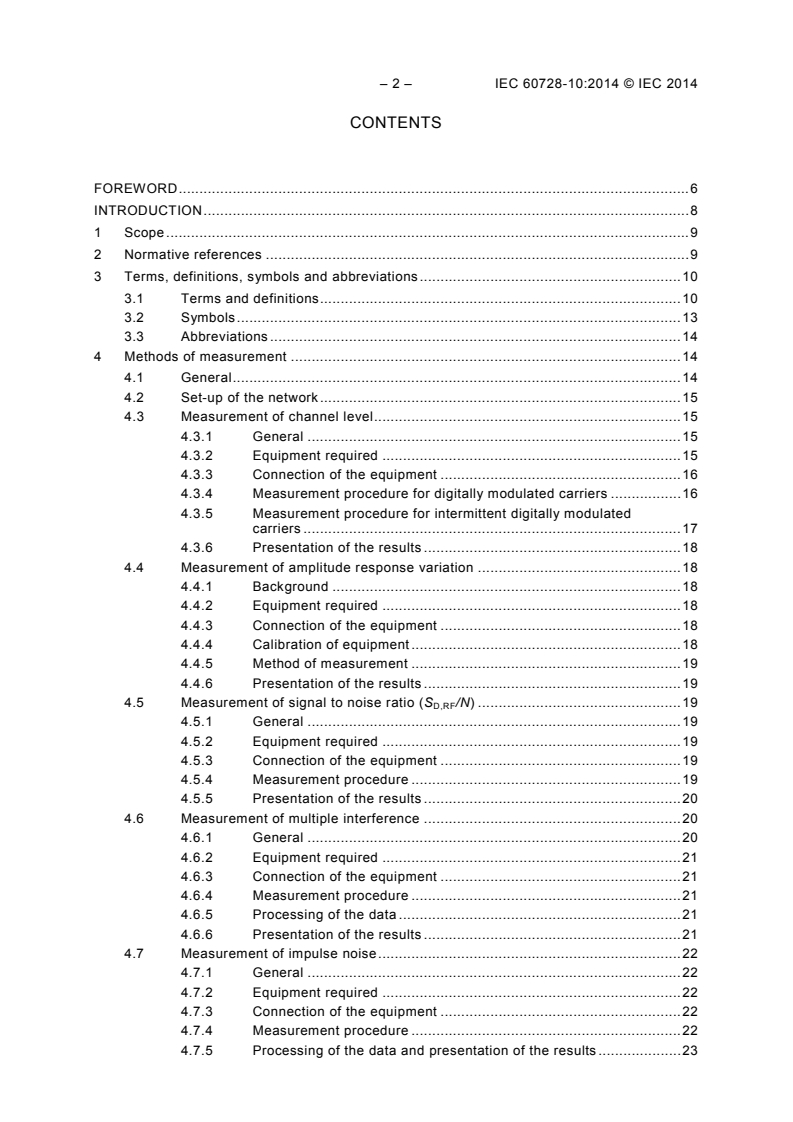
CONTENTS
FOREWORD . 6
INTRODUCTION . 8
1 Scope . 9
2 Normative references . 9
3 Terms, definitions, symbols and abbreviations . 10
3.1 Terms and definitions . 10
3.2 Symbols . 13
3.3 Abbreviations . 14
4 Methods of measurement . 14
4.1 General . 14
4.2 Set-up of the network . 15
4.3 Measurement of channel level . 15
4.3.1 General . 15
4.3.2 Equipment required . 15
4.3.3 Connection of the equipment . 16
4.3.4 Measurement procedure for digitally modulated carriers . 16
4.3.5 Measurement procedure for intermittent digitally modulated
carriers . 17
4.3.6 Presentation of the results . 18
4.4 Measurement of amplitude response variation . 18
4.4.1 Background . 18
4.4.2 Equipment required . 18
4.4.3 Connection of the equipment . 18
4.4.4 Calibration of equipment . 18
4.4.5 Method of measurement . 19
4.4.6 Presentation of the results . 19
4.5 Measurement of signal to noise ratio (S /N) . 19
D,RF
4.5.1 General . 19
4.5.2 Equipment required . 19
4.5.3 Connection of the equipment . 19
4.5.4 Measurement procedure . 19
4.5.5 Presentation of the results . 20
4.6 Measurement of multiple interference . 20
4.6.1 General . 20
4.6.2 Equipment required . 21
4.6.3 Connection of the equipment . 21
4.6.4 Measurement procedure . 21
4.6.5 Processing of the data . 21
4.6.6 Presentation of the results . 21
Measurement of impulse noise . 22
4.7
4.7.1 General . 22
4.7.2 Equipment required . 22
4.7.3 Connection of the equipment . 22
4.7.4 Measurement procedure . 22
4.7.5 Processing of the data and presentation of the results . 23
4.8 Measurement of echo ratio . 23
4.8.1 General . 23
4.8.2 Equipment required . 24
4.8.3 Connection of the equipment . 25
4.8.4 Measurement procedure . 25
4.8.5 Presentation of the results . 25
4.9 Measurement of group delay variation. 25
4.10 Measurement of frequency error . 26
4.10.1 General . 26
4.10.2 Equipment required . 26
4.10.3 Connection of the equipment . 26
4.10.4 Measurement procedure . 26
4.10.5 Presentation of the result . 27
4.11 Measurement of bit error ratio (BER) . 27
4.11.1 General . 27
4.11.2 Equipment required . 27
4.11.3 Connection of the equipment . 28
4.11.4 Measurement procedure . 28
4.11.5 Presentation of the results . 28
4.12 Noise power ratio (NPR) measurement on return path . 28
4.12.1 General . 28
4.12.2 Equipment required . 29
4.12.3 Connection of the equipment . 29
4.12.4 Measurement procedure . 30
4.12.5 Presentation of the results . 31
4.12.6 Recommended correction factors . 31
4.12.7 Precautions during measurement . 32
4.12.8 NPR dynamic range . 32
4.13 10-Tone measurement . 33
4.13.1 General . 33
4.13.2 Measurement principle . 34
4.13.3 Measurement procedure . 34
4.14 Modulation error ratio (MER) measurement on return path . 35
4.14.1 General . 35
4.14.2 Equipment required . 36
4.14.3 Connection of the equipment . 36
4.14.4 Measurement procedure . 36
4.14.5 Presentation of the results . 37
5 System performance requirements . 37
5.1 General . 37
5.2 Analogue parameters that influence the system performance . 40
5.3 General requirements . 42
5.3.1 Impedance . 42
5.3.2 Maximum signal level . 42
5.4 Specific system performance requirements . 42
6 System performance recommendations – Return path bandwidth . 45
6.1 Frequency allocation . 45
6.2 Transmission quality in the return path frequency ranges . 45
Annex A (normative) Correction factors for noise . 47
– 4 – IEC 60728-10:2014 © IEC 2014
A.1 Signal level measurement . 47
A.2 Noise level measurement . 47
Annex B (normative) Correction factor for a spectrum analyser . 49
Annex C (normative) Null packet and PRBS definitions . 50
C.1 Null packet definition . 50
C.2 PRBS definition . 51
Bibliography . 52
Figure 1 – Reference points of an active return path system (example) . 15
Figure 2 – Time domain representation of an upstream burst with marker on the
preamble of the DOCSIS signal . 17
Figure 3 – Arrangement of test equipment for measurement of amplitude response
variation . 18
Figure 4 − Echo rating graticule . 24
Figure 5 – Arrangement of test equipment for measurement of echo ratio . 25
Figure 6 – Test set-up for frequency stability measurement . 26
Figure 7 – Principle of BER measurement . 27
Figure 8 – Band-pass and band-stop filters response . 29
Figure 9 – NPR test set up . 30
Figure 10 – NPR versus RF power density applied at input of optical transmitter and
determination of OMI 100 % . 31
Figure 11 – Example of the frequency response of the optional band-pass filter . 31
Figure 12 – Example of NPR dynamic range . 33
Figure 13 – Dynamic range plotted versus NPR . 33
Figure 14 – Alternative NPR measurement principle . 34
Figure 15 – Relationship between classical NPR method and multi-tone method . 35
Figure 16 – Test set-up for modulation error ratio (MER) measurement . 36
Figure 17 – Example of constellation diagram for a 64QAM modulation format . 37
Figure 18 – Return path signals affecting forward path signals . 38
Figure 19 – Forward path signals affecting return path signals . 39
Figure 20 – Return path signals of service 1 affecting return path signals of a different
service (e.g. service 2). 39
Figure 21 – Return path signals of a specific service (e.g. service 2) affecting return
path signals of the same service . 39
Figure 22 – Identification of the most common sub-bands within the return path band
with limited transmission quality . 46
Figure A.1 – Noise correction factor CF versus measured level difference D . 48
Table 1 – Examples of the Nyquist bandwidth of digitally modulated carriers . 16
Table 2 – Band-stop filter notch frequencies . 29
Table 3 – Summary of the requirements for MER according to ETSI EN 302 878-2,
V.1.1.1 (2011-11), (clause 6.2.22.3.2) . 41
Table 4 – System performance requirements for different modulation techniques for
–4
BER = 10 . 43
Table 5 – Comparison of system performance parameters given in Table 4 with those
given in ETSI EN 302 878-2, V.1.1.1 (2011-11), specifications. 44
Table 6 – Return path frequency ranges . 45
Table 7 – Reasons for quality reduction in sub-bands of the return path . 45
Table A.1 – Noise correction factor . 47
Table C.1 – Null transport stream packet definition . 51
– 6 – IEC 60728-10:2014 © IEC 2014
INTERNATIONAL ELECTROTECHNICAL COMMISSION
____________
CABLE NETWORKS FOR TELEVISION SIGNALS,
SOUND SIGNALS AND INTERACTIVE SERVICES –
Part 10: System performance for return paths
FOREWORD
1) The International Electrotechnical Commission (IEC) is a worldwide organization for standardization comprising
all national electrotechnical committees (IEC National Committees). The object of IEC is to promote
international co-operation on all questions concerning standardization in the electrical and electronic fields. To
this end and in addition to other activities, IEC publishes International Standards, Technical Specifications,
Technical Reports, Publicly Available Specifications (PAS) and Guides (hereafter referred to as “IEC
Publication(s)”). Their preparation is entrusted to technical committees; any IEC National Committee interested
in the subject dealt with may participate in this preparatory work. International, governmental and non-
governmental organizations liaising with the IEC also participate in this preparation. IEC collaborates closely
with the International Organization for Standardization (ISO) in accordance with conditions determined by
agreement between the two organizations.
2) The formal decisions or agreements of IEC on technical matters express, as nearly as possible, an international
consensus of opinion on the relevant subjects since each technical committee has representation from all
interested IEC National Committees.
3) IEC Publications have the form of recommendations for international use and are accepted by IEC National
Committees in that sense. While all reasonable efforts are made to ensure that the technical content of IEC
Publications is accurate, IEC cannot be held responsible for the way in which they are used or for any
misinterpretation by any end user.
4) In order to promote international uniformity, IEC National Committees undertake to apply IEC Publications
transparently to the maximum extent possible in their national and regional publications. Any divergence
between any IEC Publication and the corresponding national or regional publication shall be clearly indicated in
the latter.
5) IEC itself does not provide any attestation of conformity. Independent certification bodies provide conformity
assessment services and, in some areas, access to IEC marks of conformity. IEC is not responsible for any
services carried out by independent certification bodies.
6) All users should ensure that they have the latest edition of this publication.
7) No liability shall attach to IEC or its directors, employees, servants or agents including individual experts and
members of its technical committees and IEC National Committees for any personal injury, property damage or
other damage of any nature whatsoever, whether direct or indirect, or for costs (including legal fees) and
expenses arising out of the publication, use of, or reliance upon, this IEC Publication or any other IEC
Publications.
8) Attention is drawn to the Normative references cited in this publication. Use of the referenced publications is
indispensable for the correct application of this publication.
9) Attention is drawn to the possibility that some of the elements of this IEC Publication may be the subject of
patent rights. IEC shall not be held responsible for identifying any or all such patent rights.
International Standard IEC 60728-10 has been prepared by technical area 5: Cable networks
for television signals, sound signals and interactive services of IEC technical committee 100:
Audio, video and multimedia systems and equipment.
This third edition cancels and replaces the second edition published in 2005 and constitutes a
technical revision.
This edition includes the following significant technical changes with respect to the previous
edition:
• update on the state-of-the-art of return path transmission in cable networks;
• provisions for DOCSIS 3.0 and EuroDOCSIS 3.0 transmission standards;
• revision of subclause 4.3 on measurement of channel level;
• new subclause 4.12 for method of measurement of noise power ratio (NPR) on return
paths;
• new subclause 4.13 for 10-tone measurements;
• new subclause 4.14 for method of measurement of modulation error ratio (MER);
• revision of subclause 5.2 on analogue parameters influencing system performance.
The text of this standard is based on the following documents:
FDIS Report on voting
100/2247/FDIS 100/2283/RVD
Full information on the voting for the approval of this standard can be found in the report on
voting indicated in the above table.
This publication has been drafted in accordance with the ISO/IEC Directives, Part 2.
The list of all the parts of the IEC 60728 series under the general title Cable networks for
television signals, sound signals and interactive services, can be found on the IEC website.
The committee has decided that the contents of this publication will remain unchanged until
the stability date indicated on the IEC web site under "http://webstore.iec.ch" in the data
related to the specific publication. At this date, the publication will be
• reconfirmed,
• withdrawn,
• replaced by a revised edition, or
• amended.
– 8 – IEC 60728-10:2014 © IEC 2014
INTRODUCTION
Standards and deliverables of IEC 60728 series deal with cable networks including equipment
and associated methods of measurement for headend reception, processing and distribution
of television and sound signals and for processing, interfacing and transmitting all kinds of
data signals for interactive services using all applicable transmission media. These signals
are typically transmitted in networks by frequency-multiplexing techniques.
This includes for instance
• regional and local broadband cable networks,
• extended satellite and terrestrial television distribution systems,
• individual satellite and terrestrial television receiving systems,
and all kinds of equipment, systems and installations used in such cable networks, distribution
and receiving systems.
The extent of this standardization work is from the antennas and/or special signal source
inputs to the headend or other interface points to the network up to the terminal input of the
customer premises equipment.
The standardization work will consider coexistence with users of the RF spectrum in wired
and wireless transmission systems.
The standardization of any user terminals (i.e. tuners, receivers, decoders, multimedia
terminals etc.) as well as of any coaxial, balanced and optical cables and accessories thereof
is excluded.
Specific equipment installed in cable networks for the operation of such return paths is
standardised in the relevant equipment standards. See IEC 60728-3, IEC 60728-4,
IEC 60728-5, IEC 60728-6.
CABLE NETWORKS FOR TELEVISION SIGNALS,
SOUND SIGNALS AND INTERACTIVE SERVICES –
Part 10: System performance for return paths
1 Scope
This part of IEC 60728 specifies the transparent return path of cable networks operated in the
frequency range between 5 MHz and 85 MHz or parts thereof. The upper frequency limit of
the return path is reduced to 65 MHz where FM radio signals are transmitted in a cable
network. Higher frequencies may be used in fibre based networks.
NOTE In addition, it is possible to use the frequency range from 0 MHz to 5 MHz for return path transmissions, for
example for NMS or other control, monitoring and signalling purposes. Applications below 5 MHz are not covered
by this standard.
Specifications of transmission systems (e.g. DOCSIS) are not within the scope of this
standard.
2 Normative references
The following documents, in whole or in part, are normatively referenced in this document and
are indispensable for its application. For dated references, only the edition cited applies. For
undated references, the latest edition of the referenced document (including any
amendments) applies.
IEC 60728 (all parts), Cable networks for television signals, sound signals and interactive
services
IEC 60728-1, Cable networks for television signals, sound signals and interactive services –
Part 1: System performance of forward paths
IEC 60728-2, Cable networks for television signals, sound signals and interactive services –
Part 2: Electromagnetic compatibility for equipment
IEC 60728-5, Cable networks for television signals, sound signals and interactive services –
Part 5: Headend equipment
IEC 60728-12, Cabled distribution systems for television and sound signals – Part 12:
Electromagnetic compatibility of systems
ISO/IEC 13818-1:2007, Information technology − Generic coding of moving pictures and
associated audio information − Part 1: Systems
ITU-R BT.470, Conventional analogue television systems
CLC/TR 50083-10-1:2009, Guidelines for the implementation of return paths in cable networks
ETSI ES 200 800, Digital Video Broadcasting (DVB); DVB interaction channel for Cable TV
distribution systems (CATV)
– 10 – IEC 60728-10:2014 © IEC 2014
ETSI EN 302 878-2, V.1.1.1 (2011-11), Access, Terminals, Transmission and Multiplexing
(ATTM); Third Generation Transmission Systems for Interactive Cable Television Services –
IP Cable Modems; Part 2: Physical Layer; DOCSIS 3.0
3 Terms, definitions, symbols and abbreviations
3.1 Terms and definitions
For the purposes of this document, the following terms and definitions apply.
3.1.1
amplitude response variation
peak-to-peak variation in frequency amplitude response of a specified signal path over a
specified frequency band
Note 1 to entry: The amplitude response variation is expressed in dB.
3.1.2
broadcast signal
signal comprising video and/or audio and/or data content distributed to several receivers
simultaneously
3.1.3
CATV network
regional and local broadband cable networks designed to provide sound and television signals
as well as signals for interactive services to a regional or local area
Note 1 to entry: Originally defined as Community Antenna Television network.
3.1.4
channel availability
percentage of the time during which the channel fulfils all performance requirements
Note 1 to entry: The duration of the observation time shall be published.
3.1.5
extended satellite television distribution network or system
distribution network or system designed to provide sound and television signals received by
satellite receiving antennas to households in one or more buildings
Note 1 to entry: This kind of network or system can possibly be combined with terrestrial antennas for the
additional reception of TV and/or radio signals via terrestrial networks.
Note 2 to entry: This kind of network or system can also carry control signals for satellite switched systems or
other signals for special transmission systems (e.g. MoCA or WiFi) in the return path direction.
3.1.6
extended terrestrial television distribution network or system
distribution network or system designed to provide sound and television signals received by
terrestrial receiving antennas to households in one or more buildings
Note 1 to entry: This kind of network or system can possibly be combined with a satellite antenna for the
additional reception of TV and/or radio signals via satellite networks.
Note 2 to entry: This kind of network or system can also carry other signals for special transmission systems (e.g.
MoCA or WiFi) in the return path direction.
3.1.7
forward path direction
direction of signal flow in a cable network from the headend or any other central point (node)
of a cable network to the subscribers' area
3.1.8
forward path
part of a cable network by which signals are distributed in the forward path direction from the
headend or any other central point (node) of a cable network to the subscribers' area
Note 1 to entry: The forward path was formerly referred to as downstream.
3.1.9
frequency error
quality of supply evaluated on the basis of the actual frequency of an electrical system
compared to its nominal value
Note 1 to entry: Frequency error consists of initial error, and short term and long term frequency stability.
3.1.10
headend
equipment connected between receiving antennas or other signal sources and the remainder
of the cable network, to process the signals to be distributed
Note 1 to entry: The headend may, for example, comprise antenna amplifiers, frequency converters, combiners,
separators and generators.
3.1.11
hybrid fibre coaxial network
HFC
cable network which is comprised of optical equipment and cables and coaxial equipment and
cables in different parts
3.1.12
impulse noise
noise caused by electromagnetic interference into cable networks
Note 1 to entry: Impulse noise is characterised by pulses with a duration of typically <10 µs.
3.1.13
individual satellite television receiving system
system designed to provide sound and television signals received from satellite(s) to an
individual household
Note 1 to entry: This kind of system can also carry control signals for satellite switched systems or other signals
for special transmission systems (e.g. MoCA or WiFi) in the return path direction.
3.1.14
individual terrestrial television receiving system
system designed to provide sound and television signals received via terrestrial broadcast
networks to an individual household
Note 1 to entry: This kind of system could also carry other signals for special transmission systems (e.g. MoCA or
WiFi) in the return path direction.
3.1.15
ingress noise
noise caused by electromagnetic interference into cable networks
Note 1 to entry: The power of the ingress noise decreases with increasing frequency. It is permanently present
but it varies slowly in its intensity as a function of time.
3.1.16
interaction path
part of a cable network by which interactive signals are transmitted in the forward path
direction (from the headend or node to the subscriber) and in the return path direction (from
the subscriber to the headend or node)
– 12 – IEC 60728-10:2014 © IEC 2014
3.1.17
local broadband cable network
network designed to provide sound and television signals as well as signals for interactive
services to a local area (e.g. one town or one village)
3.1.18
location specific noise
noise which occurs at a specific area of a cable network or which occurs in a cable network
located in a specific environment
3.1.19
MATV network
extended terrestrial television distribution networks or systems designed to provide sound and
television signals received by terrestrial receiving antennas to households in one or more
buildings
Note 1 to entry: Originally defined as master antenna television network.
Note 2 to entry: This kind of network or system can possibly be combined with a satellite antenna for the
additional reception of TV and/or radio signals via satellite networks.
Note 3 to entry: This kind of network or system can also carry other signals for special transmission systems (e.g.
MoCA or WiFi) in the return path direction.
3.1.20
multiple interference
interfering signal which consists of at least two signals that originated from at least two
different sources
Note 1 to entry: On return path the multiple interference consists of ingress noise and intermodulation distortion
products.
3.1.21
multimedia signal
signal comprising two or more different media contents, for example, video, audio, text, data,
etc.
3.1.22
network management system
NMS
software based system for controlling and supervising cable networks
3.1.23
network segment
part of a cable network comprising a set of functions and/or a specific extent of the complete
cable network
3.1.24
network termination
electrical termination of a cable network at any outlet on subscribers' side and headend or
node side
3.1.25
node
central point of a network segment at which signals can be fed into the forward path or can be
gathered from a number of subscribers out of the return path
3.1.26
regional broadband cable network
network designed to provide sound and television signals as well as signals for interactive
services to a regional area covering several towns and/or villages
3.1.27
return path
part of a cable network by which signals are transmitted in the return path direction from any
subscriber, connected to the network, to the headend or any other central point (node) of a
cable network
Note 1 to entry: The return path was referred to as upstream before.
3.1.28
return path direction
direction of signal flow in a cable network from a subscriber to the headend or any other
central point (node) of a cable network
3.1.29
SMATV network
extended distribution networks or systems designed to provide sound and television signals
received by satellite receiving antennas to households in one or more buildings
Note 1 to entry: Originally defined as satellite master antenna television network.
Note 2 to entry: This kind of network or system can possibly be combined with terrestrial antennas for the
additional reception of TV and/or radio signals via terrestrial networks.
Note 3 to entry: This kind of network or system can also carry control signals for satellite switched systems or
other signals for special transmission systems (e.g. MoCA or WiFi) in the return path direction.
3.2 Symbols
The following graphical symbols are used in the figures of this standard. These symbols are
either listed in IEC 60617, IEC 60417 or based on symbols defined in IEC 60617.
Symbols Terms Symbols Terms
Electrical spectrum analyzer
O
Optical receiver
[IEC 60617-S00910
P(f)
[IEC 60617-S00213 (2001-07)]
(2001-07)]
E
Passive distribution network
G
Test waveform generator
[IEC 60617-S00910
[IEC 60617-S01225 (2001-07)]
(2001-07)]
Variable signal generator
Oscilloscope
[IEC 60617-S00899 (2001-07),
[IEC 60617-S00059,
G
IEC 60617-S01403 (2001-09),
IEC 60617-S00922 (2001-07)]
IEC 60617-S00081 (2001-07)]
Low pass filter
Variable attenuator
[IEC 60617-S01248
A
[IEC 60617-S01245 (2001-07)]
(2001-07)]
System under test/
High pass filter Network under test
SUT/NUT
[IEC 60617-S01247 (2001-07)] [IEC 60617-S00060
(2007-07)]
Modulator
Demodulator
[IEC 60417-5261
[IEC 60417-5260 (2002-10)]
(2002-10)]
Bit error rate detector
Amplifier with return path amplifier [IEC 60617-S00059,
BER
[IEC 60617-S00433 (2001-07)] IEC 60617-S00910
(2001-07)]
– 14 – IEC 60728-10:2014 © IEC 2014
3.3 Abbreviations
The following abbreviations are used in this standard:
BER bit error ratio BW bandwidth, equivalent noise
bandwidth
CATV community antenna television CB citizen band
CIN composite intermodulation noise CM cable modem
C/MI carrier-to-multiple interference CMTS cable modem termination system
ratio
C/N carrier-to-noise ratio DVB digital video broadcasting
EMC electromagnetic compatibility FM frequency modulation
FSK frequency shift keying HFC hybrid fibre coaxial
HNI home network interface IF intermediate frequency
ISM industrial, scientific, medical LPF low-pass filter
MATV master antenna television MER modulation error ratio
(network)
MoCA multimedia over cable alliance NMS network management system
NPR noise power ratio NUT network under test
OFDM orthogonal frequency division OMI optical modulation index
multiplexing
PRBS pseudo random binary sequence QAM quadrature amplitude modulation
QPSK quaternary phase shift keying RF radio frequency
RMS root mean square RBW resolution bandwidth
S signal level, before corrections SCDMA synchronous code division
multiple access
SL signal level (corrected) SMATV satellite master antenna television
(network)
S/N signal-to-noise ratio S /N signal-to-noise ratio
D,RF
(RF digital signal)
SUT system under test TDMA time division multiple access
TV television WiFi wireless fidelity
4 Methods of measurement
4.1 General
An active return path carries typically only return signals. A passive return path can be used
for both return and forward signals.
This standard lays down the basic methods of measurement for signals typically used in the
return path of cable networks in order to assess the performance of those signals and their
performance limits.
All requirements refer to the performance limits, which shall be obtained between the
reference points (Figure 1) of the return path system.
One reference point is the network termination unit (NTU) close to the home network interface
HNI or to the subscriber system outlet (SO). It is the last point where all forward and return
signals are present and carried on the same cable. If no network termination unit exists, the
reference point is the HNI or the system outlet.
The other reference point is the input of the return signal receiver (or transceiver) in the
CMTS. At this point, the transparent signal path ends and beyond this point, the signal is
treated in a non-transparent way. The return signal receiver can be situated at the headend
but can also be at the node of the coaxial cell or at any other point of the network (where the
CMTS is located).
NTU
Optical node
Wireless
Headend/Hub
Video
E O O
O E
Voice
Data
E O
O
O E
CMTS
HNI
O
Reference point
IEC 0737/14
Figure 1 – Reference points of an active return path system (example)
In addition to the system performance requirements for the transparent return path, system
performance recommendations were
...