

IEC 62271-111:2019
(Main)High-voltage switchgear and controlgear - Part 111: Automatic circuit reclosers for alternating current systems up to and including 38 kV
General Information
- Abstract
IEC 62271-111:2019 applies to all overhead, pad-mounted, dry vault and submersible single or multi-pole alternating current automatic circuit reclosers for rated maximum voltages above 1 000 V and up to and including 38 kV.
Devices that require a dependent manual operation are not covered by this document.
In order to simplify this document where possible, the term recloser (or reclosers) has been substituted for automatic circuit recloser(s) or cutout mounted recloser(s) or both.
This third edition cancels and replaces the second edition, published in 2012, and constitutes a technical revision. The main changes with respect to the previous edition are as follows:
a) Deletion of the fault interrupter from the title, scope and body of the standard including the original Annex G. IEEE will develop a separate standard for this type of equipment used primarily in North America to be designated as IEEE C37.62;
b) Adoption of IEC 62271-1:2017 as a normative reference replacing both IEEE C37.100.1-2007 and IEC 62271-1:2007;
c) Adoption of the “standard test method” for the conduction of wet tests for both IEEE and IEC voltage ratings, reference 7.2.7.2 and Tables 2 and 3;
d) Line and cable charging tests in 7.101.6: added test voltage level requirements;
e) Added test specifications in 7.103.3 and 7.103.5 for effectively earthed neutral systems (first-pole-to-clear factor kpp = 1,3) making this an optional rating. The kpp parameters are used in lieu of the system terms;
f) Added low current tests in 7.104 as a replacement of the critical current tests;
g) Adopted the revised allowable temperature rise table of IEC 62271-1:2017 with an increase in the allowable temperature rise for certain points in non-oxidizing gases (NOG);
h) Time-current test requirements in 7.108: several changes including increased number of test current levels and tests at each level. Specified minimum number of curves to be tested;
i) Mechanical duty tests in 7.109: added requirements for testing at high and low temperature;
j) Replaced normative references IEC 60255-22-1 and IEC 60255-22-4 with IEC 60255-26 in 7.111.1;
k) Added pass/fail criteria for fault interruption tests with restrikes in 7.112.1;
l) Added Clauses 9, 10, 11, 12 and 13 similar to those in IEC 62271-1 but tailored to the recloser;
m) Deleted Annex A: Information and technical requirements to be given with enquiries, tenders and orders.
International Standard IEC 62271-111/IEEE Std C37.60 has been jointly revised by the Switchgear Committee of the IEEE Power and Energy Society, in cooperation with subcommittee 17A: Switching devices, of IEC technical committee 17: High-voltage switchgear and controlgear, under the IEC/IEEE Dual Logo Agreement.
- Status
- Published
- Publication Date
- 11-Feb-2019
- Technical Committee
- SC 17A - Switching devices
- Drafting Committee
- MT 47 - TC 17/SC 17A/MT 47
- Current Stage
- PPUB - Publication issued
- Start Date
- 12-Feb-2019
- Completion Date
- 11-Jan-2019
Overview
IEC 62271-111:2019 is the international standard for high-voltage switchgear and controlgear, specifically addressing automatic circuit reclosers for alternating current (AC) systems up to and including 38 kV. Issued by the International Electrotechnical Commission (IEC), in collaboration with IEEE, this standard supersedes previous editions and provides harmonized requirements for multiple installation types, including overhead, pad-mounted, dry vault, and submersible applications. Dependently operated manual devices are not covered by this standard.
Automatic circuit reclosers (commonly referred to as reclosers) are essential for enhancing system reliability, as they automatically interrupt and restore power in the event of transient faults. IEC 62271-111:2019 details the performance, test methods, construction, and safety requirements for reclosers, facilitating their safe integration in medium-voltage distribution networks.
Key Topics
Scope and Terminology
- Applies to single or multi-pole reclosers with rated maximum voltages above 1,000 V up to 38 kV.
- Covers reclosers intended for use in a variety of environments (outdoor, indoor, vault, submersible).
Normative References
- Replaces previous references with IEC 62271-1:2017 as the principal normative standard.
Design and Construction
- Specifies material requirements, earthing, protection against electric shock, enclosure protection levels (IP and IK ratings), and mechanical robustness.
- Addresses gas and liquid system tightness, corrosion resistance, and EMC compliance.
Types of Tests
- Type Tests: Dielectric, mechanical, environmental, and performance tests (including wet tests, withstand voltage, and low current tests).
- Routine Tests: Factory-based verifications such as dielectric, resistance, and operation checks.
Ratings and Parameters
- Establishes requirements for rated voltage, insulation levels, continuous and short-circuit currents, operating sequence, and environmental performance factors.
- Includes special considerations for systems with effectively earthed neutrals.
Maintenance & Safety
- Details guidelines on transport, storage, installation, and regular maintenance practices.
- Addresses failure reporting and safety measures for operators and equipment.
Applications
IEC 62271-111:2019 plays a critical role in the design, specification, procurement, and operation of:
- Medium-Voltage Distribution Networks
- Protects against transient faults and improves system uptime through automatic recloser intervention.
- Urban, Rural, and Industrial Installations
- Suitable for a wide range of deployment scenarios including distribution substations and overhead feeders.
- Renewable Energy Systems
- Facilitates integration into grids with distributed energy resources where fault isolation and quick restoration are essential.
- Utilities and Industrial Power Systems
- Ensures standardized, reliable performance for both public utilities and private industrial networks.
Implementing compliance with this standard improves the reliability, safety, and maintainability of electrical distribution assets.
Related Standards
- IEC 62271-1:2017 - Common specifications for high-voltage switchgear and controlgear
- IEC 60255-26 - EMC requirements for measuring relays and protection equipment
- IEEE Std C37.60 - North American counterpart (as aligned with IEC 62271-111)
- IEC 62271-100 - Requirements for high-voltage AC circuit breakers
For equipment previously classified as "fault interrupters," refer to the upcoming IEEE C37.62 standard, as these devices are no longer covered by IEC 62271-111:2019.
Adopting IEC 62271-111:2019 ensures that automatic circuit reclosers meet international performance and safety benchmarks, providing reliable protection and modernization for medium-voltage AC power systems worldwide. For further updates or purchasing information, visit the IEC Webstore.
Relations
- Effective Date
- 05-Sep-2023
Get Certified
Connect with accredited certification bodies for this standard

IMQ S.p.A. (Certification)
Italian electrical product certification.

SLG Prüf- und Zertifizierungs GmbH
German testing and certification body.

UL Solutions
Global safety science company with testing, inspection and certification.
Sponsored listings
Frequently Asked Questions
IEC 62271-111:2019 is a standard published by the International Electrotechnical Commission (IEC). Its full title is "High-voltage switchgear and controlgear - Part 111: Automatic circuit reclosers for alternating current systems up to and including 38 kV". This standard covers: IEC 62271-111:2019 applies to all overhead, pad-mounted, dry vault and submersible single or multi-pole alternating current automatic circuit reclosers for rated maximum voltages above 1 000 V and up to and including 38 kV. Devices that require a dependent manual operation are not covered by this document. In order to simplify this document where possible, the term recloser (or reclosers) has been substituted for automatic circuit recloser(s) or cutout mounted recloser(s) or both. This third edition cancels and replaces the second edition, published in 2012, and constitutes a technical revision. The main changes with respect to the previous edition are as follows: a) Deletion of the fault interrupter from the title, scope and body of the standard including the original Annex G. IEEE will develop a separate standard for this type of equipment used primarily in North America to be designated as IEEE C37.62; b) Adoption of IEC 62271-1:2017 as a normative reference replacing both IEEE C37.100.1-2007 and IEC 62271-1:2007; c) Adoption of the “standard test method” for the conduction of wet tests for both IEEE and IEC voltage ratings, reference 7.2.7.2 and Tables 2 and 3; d) Line and cable charging tests in 7.101.6: added test voltage level requirements; e) Added test specifications in 7.103.3 and 7.103.5 for effectively earthed neutral systems (first-pole-to-clear factor kpp = 1,3) making this an optional rating. The kpp parameters are used in lieu of the system terms; f) Added low current tests in 7.104 as a replacement of the critical current tests; g) Adopted the revised allowable temperature rise table of IEC 62271-1:2017 with an increase in the allowable temperature rise for certain points in non-oxidizing gases (NOG); h) Time-current test requirements in 7.108: several changes including increased number of test current levels and tests at each level. Specified minimum number of curves to be tested; i) Mechanical duty tests in 7.109: added requirements for testing at high and low temperature; j) Replaced normative references IEC 60255-22-1 and IEC 60255-22-4 with IEC 60255-26 in 7.111.1; k) Added pass/fail criteria for fault interruption tests with restrikes in 7.112.1; l) Added Clauses 9, 10, 11, 12 and 13 similar to those in IEC 62271-1 but tailored to the recloser; m) Deleted Annex A: Information and technical requirements to be given with enquiries, tenders and orders. International Standard IEC 62271-111/IEEE Std C37.60 has been jointly revised by the Switchgear Committee of the IEEE Power and Energy Society, in cooperation with subcommittee 17A: Switching devices, of IEC technical committee 17: High-voltage switchgear and controlgear, under the IEC/IEEE Dual Logo Agreement.
IEC 62271-111:2019 applies to all overhead, pad-mounted, dry vault and submersible single or multi-pole alternating current automatic circuit reclosers for rated maximum voltages above 1 000 V and up to and including 38 kV. Devices that require a dependent manual operation are not covered by this document. In order to simplify this document where possible, the term recloser (or reclosers) has been substituted for automatic circuit recloser(s) or cutout mounted recloser(s) or both. This third edition cancels and replaces the second edition, published in 2012, and constitutes a technical revision. The main changes with respect to the previous edition are as follows: a) Deletion of the fault interrupter from the title, scope and body of the standard including the original Annex G. IEEE will develop a separate standard for this type of equipment used primarily in North America to be designated as IEEE C37.62; b) Adoption of IEC 62271-1:2017 as a normative reference replacing both IEEE C37.100.1-2007 and IEC 62271-1:2007; c) Adoption of the “standard test method” for the conduction of wet tests for both IEEE and IEC voltage ratings, reference 7.2.7.2 and Tables 2 and 3; d) Line and cable charging tests in 7.101.6: added test voltage level requirements; e) Added test specifications in 7.103.3 and 7.103.5 for effectively earthed neutral systems (first-pole-to-clear factor kpp = 1,3) making this an optional rating. The kpp parameters are used in lieu of the system terms; f) Added low current tests in 7.104 as a replacement of the critical current tests; g) Adopted the revised allowable temperature rise table of IEC 62271-1:2017 with an increase in the allowable temperature rise for certain points in non-oxidizing gases (NOG); h) Time-current test requirements in 7.108: several changes including increased number of test current levels and tests at each level. Specified minimum number of curves to be tested; i) Mechanical duty tests in 7.109: added requirements for testing at high and low temperature; j) Replaced normative references IEC 60255-22-1 and IEC 60255-22-4 with IEC 60255-26 in 7.111.1; k) Added pass/fail criteria for fault interruption tests with restrikes in 7.112.1; l) Added Clauses 9, 10, 11, 12 and 13 similar to those in IEC 62271-1 but tailored to the recloser; m) Deleted Annex A: Information and technical requirements to be given with enquiries, tenders and orders. International Standard IEC 62271-111/IEEE Std C37.60 has been jointly revised by the Switchgear Committee of the IEEE Power and Energy Society, in cooperation with subcommittee 17A: Switching devices, of IEC technical committee 17: High-voltage switchgear and controlgear, under the IEC/IEEE Dual Logo Agreement.
IEC 62271-111:2019 is classified under the following ICS (International Classification for Standards) categories: 01 - GENERALITIES. TERMINOLOGY. STANDARDIZATION. DOCUMENTATION; 29.130.10 - High voltage switchgear and controlgear. The ICS classification helps identify the subject area and facilitates finding related standards.
IEC 62271-111:2019 has the following relationships with other standards: It is inter standard links to IEC 62271-111:2012. Understanding these relationships helps ensure you are using the most current and applicable version of the standard.
IEC 62271-111:2019 is available in PDF format for immediate download after purchase. The document can be added to your cart and obtained through the secure checkout process. Digital delivery ensures instant access to the complete standard document.
Standards Content (Sample)
IEC 62271-111 ®
Edition 3.0 2019-02
™
INTERNATIONAL IEEE Std C37.60
STANDARD
NORME
INTERNATIONALE
colour
inside
High-voltage switchgear and controlgear –
Part 111: Automatic circuit reclosers for alternating current systems up to and
including 38 kV
Appareillage à haute tension –
Partie 111: Disjoncteurs à réenclenchement de circuit automatique pour
systèmes en courant alternatif jusqu'à 38 kV compris
All rights reserved. IEEE is a registered trademark in the U.S. Patent & Trademark Office, owned by the Institute of
Electrical and Electronics Engineers, Inc. Unless otherwise specified, no part of this publication may be reproduced
or utilized in any form or by any means, electronic or mechanical, including photocopying and microfilm, without
permission in writing from the IEC Central Office. Any questions about IEEE copyright should be addressed to the
IEEE. Enquiries about obtaining additional rights to this publication and other information requests should be
addressed to the IEC or your local IEC member National Committee.
IEC Central Office Institute of Electrical and Electronics Engineers, Inc.
3, rue de Varembé 3 Park Avenue
CH-1211 Geneva 20 New York, NY 10016-5997
Switzerland United States of America
Tel.: +41 22 919 02 11 stds.info@ieee.org
info@iec.ch www.ieee.org
www.iec.ch
About the IEC
The International Electrotechnical Commission (IEC) is the leading global organization that prepares and publishes
International Standards for all electrical, electronic and related technologies.
About IEC publications
The technical content of IEC publications is kept under constant review by the IEC. Please make sure that you have the
latest edition, a corrigendum or an amendment might have been published.
IEC publications search - webstore.iec.ch/advsearchform Electropedia - www.electropedia.org
The advanced search enables to find IEC publications by a The world's leading online dictionary on electrotechnology,
variety of criteria (reference number, text, technical containing more than 22 000 terminological entries in English
committee,…). It also gives information on projects, replaced and French, with equivalent terms in 16 additional languages.
and withdrawn publications. Also known as the International Electrotechnical Vocabulary
(IEV) online.
IEC Just Published - webstore.iec.ch/justpublished
Stay up to date on all new IEC publications. Just Published IEC Glossary - std.iec.ch/glossary
details all new publications released. Available online and 67 000 electrotechnical terminology entries in English and
once a month by email. French extracted from the Terms and Definitions clause of
IEC publications issued since 2002. Some entries have been
IEC Customer Service Centre - webstore.iec.ch/csc collected from earlier publications of IEC TC 37, 77, 86 and
If you wish to give us your feedback on this publication or CISPR.
need further assistance, please contact the Customer Service
Centre: sales@iec.ch.
IEC 62271-111 ®
Edition 3.0 2019-02
IEEE Std C37.60™
INTERNATIONAL
STANDARD
NORME
INTERNATIONALE
colour
inside
High-voltage switchgear and controlgear –
Part 111: Automatic circuit reclosers for alternating current systems up to and
including 38 kV
Appareillage à haute tension –
Partie 111: Disjoncteurs à réenclenchement de circuit automatique pour
systèmes en courant alternatif jusqu'à 38 kV compris
INTERNATIONAL
ELECTROTECHNICAL
COMMISSION
COMMISSION
ELECTROTECHNIQUE
INTERNATIONALE
ICS 29.130.10 ISBN 978-2-8322-4991-8
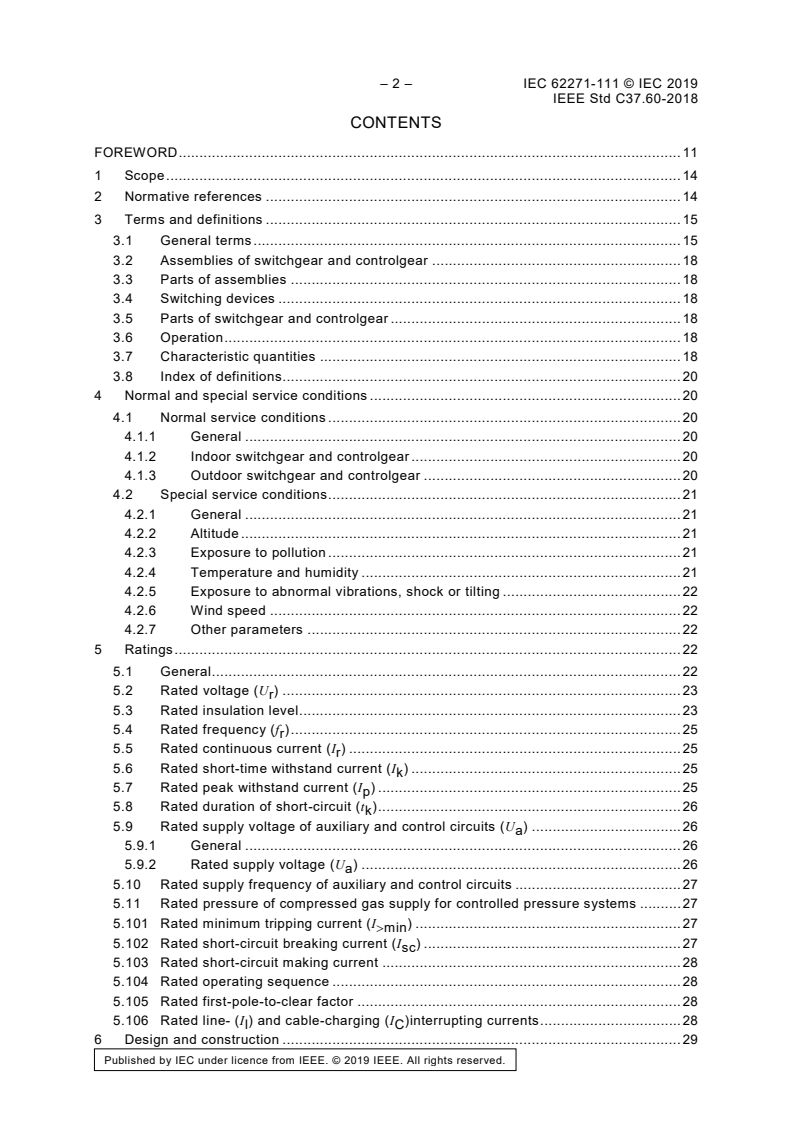
– 2 – IEC 62271-111 © IEC 2019
IEEE Std C37.60-2018
CONTENTS
FOREWORD . 11
1 Scope . 14
2 Normative references . 14
3 Terms and definitions . 15
3.1 General terms . 15
3.2 Assemblies of switchgear and controlgear . 18
3.3 Parts of assemblies . 18
3.4 Switching devices . 18
3.5 Parts of switchgear and controlgear . 18
3.6 Operation . 18
3.7 Characteristic quantities . 18
3.8 Index of definitions . 20
4 Normal and special service conditions . 20
4.1 Normal service conditions . 20
4.1.1 General . 20
4.1.2 Indoor switchgear and controlgear . 20
4.1.3 Outdoor switchgear and controlgear . 20
4.2 Special service conditions . 21
4.2.1 General . 21
4.2.2 Altitude . 21
4.2.3 Exposure to pollution . 21
4.2.4 Temperature and humidity . 21
4.2.5 Exposure to abnormal vibrations, shock or tilting . 22
4.2.6 Wind speed . 22
4.2.7 Other parameters . 22
5 Ratings . 22
5.1 General . 22
5.2 Rated voltage (U ) . 23
r
5.3 Rated insulation level . 23
5.4 Rated frequency (f ) . 25
r
5.5 Rated continuous current (I ) . 25
r
5.6 Rated short-time withstand current (I ) . 25
k
5.7 Rated peak withstand current (I ) . 25
p
5.8 Rated duration of short-circuit (t ) . 26
k
5.9 Rated supply voltage of auxiliary and control circuits (U ) . 26
a
5.9.1 General . 26
5.9.2 Rated supply voltage (U ) . 26
a
5.10 Rated supply frequency of auxiliary and control circuits . 27
5.11 Rated pressure of compressed gas supply for controlled pressure systems . 27
5.101 Rated minimum tripping current (I ) . 27
>min
5.102 Rated short-circuit breaking current (I ) . 27
sc
5.103 Rated short-circuit making current . 28
5.104 Rated operating sequence . 28
5.105 Rated first-pole-to-clear factor . 28
5.106 Rated line- (I ) and cable-charging (I )interrupting currents . 28
l C
6 Design and construction . 29
Published by IEC under licence from IEEE. © 2019 IEEE. All rights reserved.
IEC 62271-111 © IEC 2019 – 3 –
IEEE Std C37.60-2018
6.1 Requirements for liquids in switchgear and controlgear . 29
6.2 Requirements for gases in switchgear and controlgear . 29
6.3 Earthing of switchgear and controlgear . 29
6.4 Auxiliary and control equipment . 30
6.4.1 General . 30
6.4.2 Protection against electric shock . 30
6.4.3 Components installed in enclosures . 30
6.5 Dependent power operation . 31
6.6 Stored energy operation. 31
6.6.1 General . 31
6.6.2 Energy storage in gas receivers or hydraulic accumulators . 32
6.6.3 Energy stored in springs (or weights) . 32
6.6.4 Manual charging . 32
6.6.5 Motor charging . 32
6.6.6 Energy storage in capacitors . 32
6.7 Independent unlatched operation (independent manual or power operation) . 32
6.8 Manually operated actuators . 33
6.9 Operation of releases. 33
6.9.1 General . 33
6.9.2 Shunt closing release . 33
6.9.3 Shunt opening release . 33
6.9.4 Capacitor operation of shunt releases . 33
6.9.5 Under-voltage release . 33
6.10 Pressure/level indication . 33
6.11 Nameplates . 33
6.12 Locking devices . 35
6.13 Position indication . 35
6.14 Degrees of protection provided by enclosures . 35
6.14.1 General . 35
6.14.2 Protection of persons against access to hazardous parts and protection
of the equipment against ingress of solid foreign objects (IP coding) . 35
6.14.3 Protection against ingress of water (IP coding) . 36
6.14.4 Protection of equipment against mechanical impact under normal
service conditions (IK coding) . 36
6.15 Creepage distances for outdoor insulators . 36
6.16 Gas and vacuum tightness . 36
6.17 Tightness for liquid systems . 36
6.18 Fire hazard (flammability) . 36
6.19 Electromagnetic compatibility (EMC) . 36
6.20 X-ray emission . 36
6.21 Corrosion . 36
6.22 Filling levels for insulation, switching and/or operation . 36
6.101 Tank construction: submersible or dry vault reclosers . 37
6.101.1 Tank material and finish . 37
6.101.2 Water entrapment . 37
6.101.3 Tank support . 37
6.101.4 Lifting lugs . 37
6.102 Counters . 37
6.103 Conductor terminal sizes. 37
Published by IEC under licence from IEEE. © 2019 IEEE. All rights reserved.
– 4 – IEC 62271-111 © IEC 2019
IEEE Std C37.60-2018
7 Type tests . 37
7.1 General . 37
7.1.1 Overview . 37
7.1.2 Information for identification of test objects . 38
7.1.3 Information to be included in type-test reports . 38
7.1.101 Test conditions . 38
7.2 Dielectric tests . 39
7.2.1 General . 39
7.2.2 Ambient air conditions during tests . 39
7.2.3 Wet test procedure . 39
7.2.4 Arrangement of the equipment . 40
7.2.5 Criteria to pass the test . 40
7.2.6 Application of the test voltage and test conditions . 40
7.2.7 Tests of switchgear and controlgear of U ≤ 245 kV . 40
r
7.2.8 Test of switchgear and controlgear of U > 245 kV . 41
r
7.2.9 Artificial pollution tests for outdoor insulators . 41
7.3 Radio interference voltage (RIV) test . 41
7.4 Resistance measurement . 41
7.4.1 Measurement of the resistance of auxiliary contacts class 1 and class 2 . 41
7.4.2 Measurement of the resistance of auxiliary contacts class 3 . 42
7.4.3 Electrical continuity of earthed metallic parts test . 42
7.4.4 Resistance measurement of contacts and conections in the main circuit
as a condition check . 42
7.5 Continuous current tests . 42
7.5.1 Condition of the test object . 42
7.5.2 Arrangement of the equipment . 42
7.5.3 Test current and duration . 42
7.5.4 Temperature measurement during test . 42
7.5.5 Resistance of the main circuit . 43
7.5.6 Criteria to pass test . 43
7.6 Short-time withstand current and peak withstand current tests . 43
7.7 Verification of the protection . 44
7.8 Tightness tests . 44
7.9 Electromagnetic compatibility tests (EMC) . 44
7.10 Additional tests on auxiliary and control circuits . 44
7.11 X-radiation test procedure for vacuum interrupters . 44
7.101 Line-charging current and cable-charging current interruption tests . 44
7.101.1 General . 44
7.101.2 Characteristics of supply circuits . 44
7.101.3 Earthing (grounding) of the supply circuit . 45
7.101.4 Characteristics of the capacitive circuit to be switched. 45
7.101.5 Waveform of the current . 46
7.101.6 Test voltage . 46
7.101.7 Test current . 46
7.101.8 Test-duties . 46
7.101.9 Criteria to pass the test . 48
7.102 Making current capability . 48
7.102.1 Test procedure . 48
Published by IEC under licence from IEEE. © 2019 IEEE. All rights reserved.
IEC 62271-111 © IEC 2019 – 5 –
IEEE Std C37.60-2018
7.102.2 Criteria for passing making current tests . 49
7.103 Rated short-circuit breaking current tests . 49
7.103.1 General . 49
7.103.2 Interrupting performance . 50
7.103.3 Verification of short-circuit breaking current . 51
7.103.4 Standard operating duty test with rated k = 1,5; automatic operation . 52
pp
7.103.5 Tests for rated k = 1,3 (effectively earthed neutral systems) . 55
pp
7.103.6 Transient recovery voltage (TRV) related to rated short-circuit breaking
current . 56
7.103.7 Criteria to pass the operating duty test . 65
7.104 Low current tests . 65
7.104.1 Applicability . 65
7.104.2 Test current . 66
7.104.3 Test circuit . 66
7.104.4 Low current test-duty . 66
7.104.5 Criteria to pass the low current tests . 66
7.105 Minimum tripping current tests . 66
7.105.1 General . 66
7.105.2 Test circuit . 66
7.105.3 Test procedures. 66
7.106 Partial discharge (corona) tests . 66
7.106.1 General . 66
7.106.2 Test voltages and limits . 67
7.106.3 Conditioning of test object . 67
7.106.4 Test equipment and procedure . 67
7.106.5 Partial discharge test report . 68
7.107 Surge current test; series-trip reclosers . 68
7.107.1 General . 68
7.107.2 Test conditions . 68
7.107.3 Test procedure . 68
7.107.4 Condition after test . 68
7.108 Time-current tests . 68
7.108.1 General test conditions . 68
7.108.2 Test procedure . 69
7.108.3 Clearing time-current curve test results . 69
7.109 Mechanical duty test . 70
7.109.1 General . 70
7.109.2 Common provisions for each mechanical test series . 70
7.109.3 Mechanical test at ambient temperature . 71
7.109.4 Mechanical tests at low and high temperature . 71
7.110 Ice loading test . 72
7.110.1 General . 72
7.110.2 Applicability . 73
7.110.3 Ice formations . 73
7.110.4 Test program . 73
7.110.5 Acceptance criteria . 74
7.111 Control electronic elements surge withstand capability (SWC) tests . 75
7.111.1 Oscillatory and fast transient surge tests . 75
Published by IEC under licence from IEEE. © 2019 IEEE. All rights reserved.
– 6 – IEC 62271-111 © IEC 2019
IEEE Std C37.60-2018
7.111.2 Simulated surge arrester operation test . 75
7.112 Condition of recloser after each test of 7.101, 7.103 and 7.104 . 77
7.112.1 General requirements . 77
7.112.2 Specific requirement for vacuum interrupters in SF insulated
equipment . 78
7.113 Thermal runaway test . 79
8 Routine tests . 79
8.1 General . 79
8.2 Dielectric test on the main circuit . 80
8.3 Tests on auxiliary and control circuits . 80
8.4 Measurement of the resistance of the main circuit . 80
8.5 Tightness test . 80
8.101 Reclosing and overcurrent trip calibration . 80
8.102 Partial discharge test . 81
8.103 Mechanical operations tests . 81
9 Guide to the selection of reclosers . 81
9.1 General . 81
9.2 Selection of rated values . 81
9.3 Cable-interface considerations . 81
9.4 Continuous or temporary overload due to changed service conditions . 81
9.5 Environmental aspects . 82
9.5.1 Clearances affected by service conditions . 82
9.5.2 High humidity. 82
9.5.3 Solar radiation . 82
10 Information to be given with enquiries, tenders and orders . 82
10.1 General . 82
10.2 Information with enquiries and orders . 82
10.3 Information with tenders . 83
11 Transport, storage, installation, operating instructions and maintenance . 83
11.1 General . 83
11.2 Conditions during transport, storage and installation . 84
11.3 Installation . 84
11.3.1 General . 84
11.3.2 Unpacking and lifting . 84
11.3.3 Assembly . 84
11.3.4 Mounting . 84
11.3.5 Connections . 84
11.3.6 Information about gas systems for controlled and closed pressure
systems . 85
11.3.7 Final installation inspection . 85
11.4 Operating instructions . 85
11.5 Maintenance . 85
11.5.1 General . 85
11.5.2 Information about fluids to be included in maintenance manual . 85
11.5.3 Recommendations for the manufacturer. 86
11.5.4 Recommendations for the user . 87
11.5.5 Failure report . 87
11.101 Field tests on units in-service, including DC withstand tests on cables . 88
Published by IEC under licence from IEEE. © 2019 IEEE. All rights reserved.
IEC 62271-111 © IEC 2019 – 7 –
IEEE Std C37.60-2018
12 Safety . 89
13 Influence of the product on the environment . 90
101 Internal arc fault classification . 90
Annex A (informative) X/R ratios . 91
A.1 General . 91
A.2 Time constant τ and X/R ratio . 91
A.3 Asymmetrical fault current. 91
Annex B (informative) Simulated surge arrester operation test . 93
B.1 General . 93
B.2 Simulated surge arrester operation testing . 93
Annex C (normative) Method of drawing the envelope of the prospective transient
recovery voltage of a circuit and determining the representative parameters . 97
C.1 General . 97
C.2 Drawing the envelope . 97
C.3 Determination of parameters . 97
Annex D (informative) Background basis of recloser transient recovery voltage (TRV)
values . 99
D.1 General . 99
D.2 Two parameter TRV . 99
D.3 u (TRV peak) . 100
c
D.4 Rate of rise of recovery voltage (RRRV) . 101
D.5 t (time to reach u at the specified RRRV) . 102
3 c
D.6 Multipliers for TRV values at currents less than the rated short-circuit current . 102
Annex E (normative) Tolerances for test values . 104
E.1 General . 104
E.2 Type test tolerances . 104
Annex F (informative) Definition for the automatic circuit recloser . 107
F.1 Definition of a recloser . 107
F.2 Background . 107
F.3 Recloser classifications . 108
F.4 Recloser operating characteristics . 108
F.5 TRV considerations . 108
F.5.1 General . 108
F.5.2 First-pole-to-clear factor (k ) . 109
pp
F.5.3 Rate of rise of recovery voltage (RRRV) . 110
Annex G (informative) Basis of derivation of duty factors and standard operating
duties . 111
G.1 General . 111
G.2 Standard operating duty . 111
Annex H (normative) Ratings for oil interrupting reclosers and hydraulically controlled
reclosers . 114
H.1 General . 114
H.2 Rating structure for hydraulically controlled series-trip and oil interrupting
reclosers . 114
H.2.1 General . 114
H.2.2 Rated maximum voltage . 114
H.2.3 Rated continuous (normal) current (I ) . 114
r
Published by IEC under licence from IEEE. © 2019 IEEE. All rights reserved.
– 8 – IEC 62271-111 © IEC 2019
IEEE Std C37.60-2018
H.2.4 Rated minimum tripping current for hydraulically controlled series-trip
reclosers . 115
H.2.5 Rated short-circuit breaking current for hydraulically controlled series-
trip reclosers and oil interrupting reclosers . 115
H.2.6 Rated symmetrical making current . 115
H.2.7 Rated operating sequence . 115
H.3 Special test considerations for hydraulically controlled series-trip reclosers –
Measurement of resistance of main circuit . 116
Annex I (informative) Standard methods for determining the values of a sinusoidal
current wave and a power-frequency recovery voltage . 120
I.1 General . 120
I.2 Currents . 120
I.2.1 Significance of r.m.s. values used in the standards on AC high-voltage
reclosers . 120
I.2.2 Classification of current wave . 120
I.2.3 RMS value of a symmetrical sinusoidal wave at a particular instant . 120
I.2.4 Measurement of the r.m.s. value of a current during a short circuit of
several cycles duration . 121
I.3 Power-frequency recovery voltage . 121
Annex J (normative) Altitude correction factors . 123
J.1 General . 123
J.2 Altitude correction factors . 123
Annex K (informative) Comparison of definitions related to the unit operation . 125
K.1 General . 125
K.2 Broader reclose operation . 125
Annex L (informative) Corrosion protection . 128
L.1 General . 128
L.2 Reference documents . 128
L.3 Other considerations . 128
Bibliography . 129
Figure 1 – Unit operation . 17
Figure 2 – Test circuits for cable-charging or line-charging switching tests (see 7.101.5) . 48
Figure 3 – Three-phase short-circuit representation . 50
Figure 4 – Representation of the specified TRV as a two-parameter line and a delay line . 57
Figure 5 – Surge test circuit . 77
Figure B.1 – Surge test circuit . 95
Figure B.2 – Typical surge voltage and current waves . 96
Figure C.1 – Representation by two parameters of a prospective transient recovery
voltage of a test circuit . 98
Figure D.1 – A TRV waveform as a 1-cosine function of time . 99
Figure D.2 – Representation of the specified TRV as a two-parameter line and a delay line 100
Figure D.3 – Representation of the specified TRV as a two-parameter line and a delay
line compared to a 1-cosine TRV waveform . 100
Figure G.1 – Recloser duty factors . 113
Figure I.1 – Measurement of the r.m.s. value of a symmetrical wave . 121
Figure I.2 – Determination of the power-frequency pole unit recovery voltage . 122
Published by IEC under licence from IEEE. © 2019 IEEE. All rights reserved.
IEC 62271-111 © IEC 2019 – 9 –
IEEE Std C37.60-2018
Figure J.1 – Altitude correction factors . 124
Figure K.1 – Illustration of auto-reclose operation . 127
Table 1 – Ratings for automatic circuit reclosers and cutout mounted reclosers . 23
Table 2 – Rated maximum voltages and rated voltage withstand values for reclosers
applied on overhead line distribution circuits . 24
Table 3 – Rated maximum voltages and rated voltage withstand values for reclosers
applied on cable connected distribution circuits . 25
Table
...