

IEC 61000-2-9:2025
(Main)Electromagnetic compatibility (EMC) - Part 2-9: Environment - Description of HEMP environment - Radiated disturbance
General Information
- Abstract
IEC 61000-2-9: 2025 defines the high-altitude electromagnetic pulse (HEMP) environment that is one of the consequences of a high-altitude nuclear explosion. There are two cases of nuclear detonations:
- high-altitude nuclear explosions;
- low-altitude nuclear explosions.
For civil systems, the most important case is the high-altitude nuclear explosion. In this case, the other effects of the nuclear explosion such as blast, ground shock, thermal and nuclear ionizing radiation are not present at the ground level. However, the electromagnetic pulse associated with the explosion can cause disruption of, and damage to, communications, electronic systems, electric power systems and other portions of the commercial critical infrastructures, thereby upsetting the stability of modern society. The object of this document is to establish a common reference for the HEMP environment in order to select realistic stresses to apply to victim equipment for evaluating their performance and in order to develop protection methods to minimize the impacts of the HEMP. This second edition cancels and replaces the first edition published in 1996. This edition constitutes a technical revision. This edition includes the following significant technical changes with respect to the previous edition:
a) updating the document to provide new information on the variation of the early-time HEMP on the earth's surface and to provide new information on the late-time HEMP;
b) adding a new informative Annex A which provides details concerning the development of the early- and late-time standard waveforms in the main body, an explanation of the advantages and disadvantages for the use of the double exponential waveform, and an explanation of the far field region for the early-time HEMP.
IEC 61000-2-9: 2025 has the status of a basic EMC publication in accordance with IEC Guide 107.
- Status
- Published
- Publication Date
- 13-May-2025
- Technical Committee
- SC 77C - High power transient phenomena
- Drafting Committee
- MT 61000-2-9 - TC 77/SC 77C/MT 61000-2-9
- Current Stage
- PPUB - Publication issued
- Start Date
- 14-May-2025
- Completion Date
- 23-May-2025
Overview
IEC 61000-2-9:2025 - Electromagnetic compatibility (EMC) - Part 2-9: Environment - Description of HEMP environment - Radiated disturbance - defines a standardized description of the high-altitude electromagnetic pulse (HEMP) radiated environment resulting from nuclear detonations. This edition (2025) replaces the 1996 version and provides updated information on spatial variation of the early-time HEMP, new material on late-time HEMP, and an informative Annex A that details waveform development and far-field considerations. The document is a basic EMC publication (IEC Guide 107) intended as a common reference for selecting realistic HEMP stresses for testing and protection design.
Key topics
- HEMP scenarios: differentiation of high-altitude vs. low-altitude nuclear bursts and emphasis on high-altitude effects relevant to civil systems (radiated disturbance only; no blast/thermal/ground shock at surface).
- Time-domain waveforms: standardized descriptions of early-time, intermediate-time and late-time HEMP components and the complete composite time waveform.
- Standard waveforms and analytic forms: development and comparison of waveform representations including double-exponential and alternate analytic forms (DEXP, QEXP) discussed in Annex A.
- Field components: characterization of both electric (E) and magnetic (H) field components, including spatial variation on the Earth’s surface and geomagnetic dip-angle dependence.
- Spectral/energy metrics: amplitude spectra and energy fluence distributions across frequency bands.
- Radiation interaction with environment: reflection, transmission and far-field region analysis for early-time HEMP at surface interfaces.
- Guidance for test stress selection: use as a reference to derive realistic radiated stresses for immunity testing and vulnerability assessment.
Applications
- Developing and validating EMC immunity tests and laboratory HEMP simulation waveforms.
- Designing hardening and protection measures for communications, electronic equipment, power systems and critical infrastructure.
- Performing risk and vulnerability assessments for utilities, transportation, telecommunications and emergency systems.
- Informing procurement, certification and regulatory requirements for equipment that must withstand HEMP radiated disturbances.
Who should use this standard
- EMC engineers and test laboratories
- Power system and utility planners
- Telecommunications and data-center designers
- Critical infrastructure protection specialists
- National regulators, defence and standards organizations
- Manufacturers of electronic and control systems
Related standards
- Other parts of the IEC 61000 series (Environment - Part 2; Limits - Part 3; Testing & measurement - Part 4; Installation & mitigation - Part 5)
- IEC Guide 107 (status as a basic EMC publication)
Keywords: IEC 61000-2-9:2025, HEMP, electromagnetic compatibility, radiated disturbance, high-altitude electromagnetic pulse, HEMP waveforms, EMC testing, critical infrastructure protection.
Get Certified
Connect with accredited certification bodies for this standard

ANCE
Mexican certification and testing association.

Intertek Slovenia
Intertek testing, inspection, and certification services in Slovenia.

LNE (Laboratoire National de Métrologie et d'Essais)
French national laboratory for metrology and testing.
Sponsored listings
Frequently Asked Questions
IEC 61000-2-9:2025 is a standard published by the International Electrotechnical Commission (IEC). Its full title is "Electromagnetic compatibility (EMC) - Part 2-9: Environment - Description of HEMP environment - Radiated disturbance". This standard covers: IEC 61000-2-9: 2025 defines the high-altitude electromagnetic pulse (HEMP) environment that is one of the consequences of a high-altitude nuclear explosion. There are two cases of nuclear detonations: - high-altitude nuclear explosions; - low-altitude nuclear explosions. For civil systems, the most important case is the high-altitude nuclear explosion. In this case, the other effects of the nuclear explosion such as blast, ground shock, thermal and nuclear ionizing radiation are not present at the ground level. However, the electromagnetic pulse associated with the explosion can cause disruption of, and damage to, communications, electronic systems, electric power systems and other portions of the commercial critical infrastructures, thereby upsetting the stability of modern society. The object of this document is to establish a common reference for the HEMP environment in order to select realistic stresses to apply to victim equipment for evaluating their performance and in order to develop protection methods to minimize the impacts of the HEMP. This second edition cancels and replaces the first edition published in 1996. This edition constitutes a technical revision. This edition includes the following significant technical changes with respect to the previous edition: a) updating the document to provide new information on the variation of the early-time HEMP on the earth's surface and to provide new information on the late-time HEMP; b) adding a new informative Annex A which provides details concerning the development of the early- and late-time standard waveforms in the main body, an explanation of the advantages and disadvantages for the use of the double exponential waveform, and an explanation of the far field region for the early-time HEMP. IEC 61000-2-9: 2025 has the status of a basic EMC publication in accordance with IEC Guide 107.
IEC 61000-2-9: 2025 defines the high-altitude electromagnetic pulse (HEMP) environment that is one of the consequences of a high-altitude nuclear explosion. There are two cases of nuclear detonations: - high-altitude nuclear explosions; - low-altitude nuclear explosions. For civil systems, the most important case is the high-altitude nuclear explosion. In this case, the other effects of the nuclear explosion such as blast, ground shock, thermal and nuclear ionizing radiation are not present at the ground level. However, the electromagnetic pulse associated with the explosion can cause disruption of, and damage to, communications, electronic systems, electric power systems and other portions of the commercial critical infrastructures, thereby upsetting the stability of modern society. The object of this document is to establish a common reference for the HEMP environment in order to select realistic stresses to apply to victim equipment for evaluating their performance and in order to develop protection methods to minimize the impacts of the HEMP. This second edition cancels and replaces the first edition published in 1996. This edition constitutes a technical revision. This edition includes the following significant technical changes with respect to the previous edition: a) updating the document to provide new information on the variation of the early-time HEMP on the earth's surface and to provide new information on the late-time HEMP; b) adding a new informative Annex A which provides details concerning the development of the early- and late-time standard waveforms in the main body, an explanation of the advantages and disadvantages for the use of the double exponential waveform, and an explanation of the far field region for the early-time HEMP. IEC 61000-2-9: 2025 has the status of a basic EMC publication in accordance with IEC Guide 107.
IEC 61000-2-9:2025 is classified under the following ICS (International Classification for Standards) categories: 33.100.01 - Electromagnetic compatibility in general. The ICS classification helps identify the subject area and facilitates finding related standards.
IEC 61000-2-9:2025 is available in PDF format for immediate download after purchase. The document can be added to your cart and obtained through the secure checkout process. Digital delivery ensures instant access to the complete standard document.
Standards Content (Sample)
IEC 61000-2-9 ®
Edition 2.0 2025-05
INTERNATIONAL
STANDARD
Electromagnetic compatibility (EMC) –
Part 2-9: Environment – Description of HEMP environment – Radiated
disturbance
ICS 33.100.01 ISBN 978-2-8327-0393-9
All rights reserved. Unless otherwise specified, no part of this publication may be reproduced or utilized in any form or
by any means, electronic or mechanical, including photocopying and microfilm, without permission in writing from either
IEC or IEC's member National Committee in the country of the requester. If you have any questions about IEC copyright
or have an enquiry about obtaining additional rights to this publication, please contact the address below or your local
IEC member National Committee for further information.
IEC Secretariat Tel.: +41 22 919 02 11
3, rue de Varembé info@iec.ch
CH-1211 Geneva 20 www.iec.ch
Switzerland
About the IEC
The International Electrotechnical Commission (IEC) is the leading global organization that prepares and publishes
International Standards for all electrical, electronic and related technologies.
About IEC publications
The technical content of IEC publications is kept under constant review by the IEC. Please make sure that you have the
latest edition, a corrigendum or an amendment might have been published.
IEC publications search - IEC Products & Services Portal - products.iec.ch
webstore.iec.ch/advsearchform Discover our powerful search engine and read freely all the
The advanced search enables to find IEC publications by a
publications previews, graphical symbols and the glossary.
variety of criteria (reference number, text, technical With a subscription you will always have access to up to date
committee, …). It also gives information on projects, content tailored to your needs.
replaced and withdrawn publications.
Electropedia - www.electropedia.org
IEC Just Published - webstore.iec.ch/justpublished The world's leading online dictionary on electrotechnology,
Stay up to date on all new IEC publications. Just Published containing more than 22 500 terminological entries in English
details all new publications released. Available online and and French, with equivalent terms in 25 additional languages.
once a month by email. Also known as the International Electrotechnical Vocabulary
(IEV) online.
IEC Customer Service Centre - webstore.iec.ch/csc
If you wish to give us your feedback on this publication or
need further assistance, please contact the Customer
Service Centre: sales@iec.ch.
– 2 – IEC 61000-2-9:2025 © IEC 2025
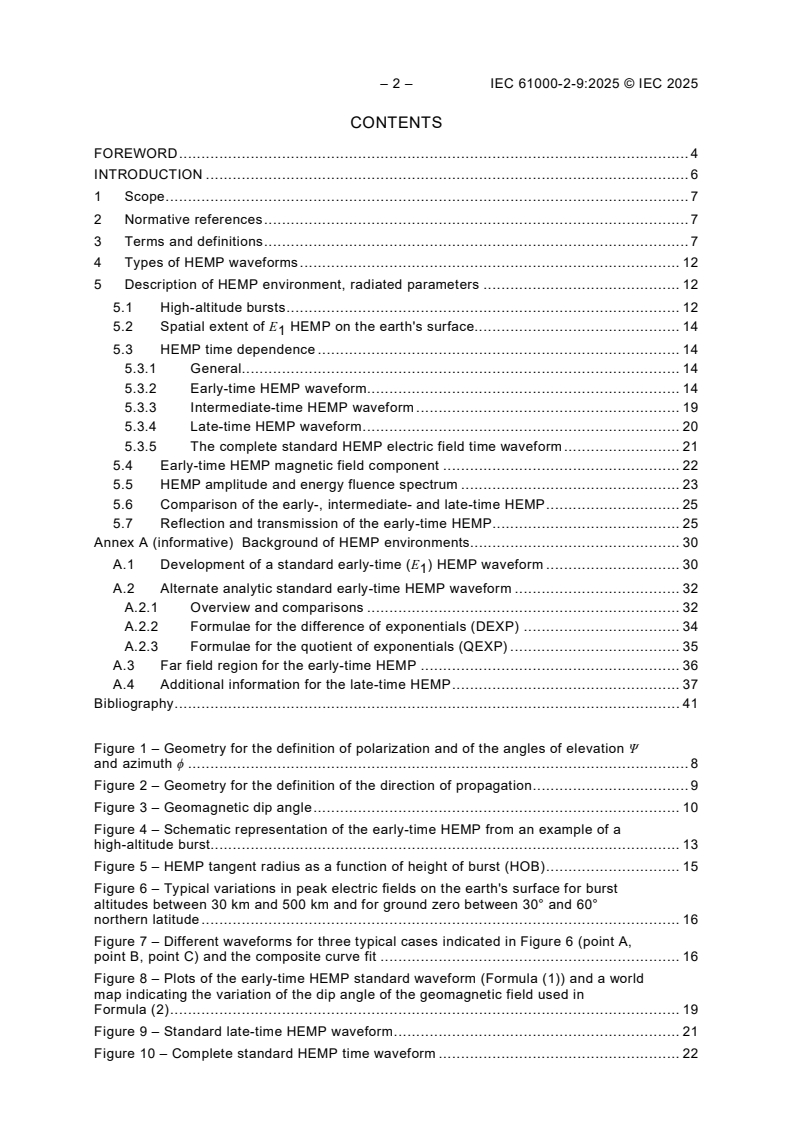
CONTENTS
FOREWORD . 4
INTRODUCTION . 6
1 Scope . 7
2 Normative references . 7
3 Terms and definitions . 7
4 Types of HEMP waveforms . 12
5 Description of HEMP environment, radiated parameters . 12
5.1 High-altitude bursts . 12
5.2 Spatial extent of E HEMP on the earth's surface. 14
5.3 HEMP time dependence . 14
5.3.1 General. 14
5.3.2 Early-time HEMP waveform. 14
5.3.3 Intermediate-time HEMP waveform . 19
5.3.4 Late-time HEMP waveform . 20
5.3.5 The complete standard HEMP electric field time waveform . 21
5.4 Early-time HEMP magnetic field component . 22
5.5 HEMP amplitude and energy fluence spectrum . 23
5.6 Comparison of the early-, intermediate- and late-time HEMP . 25
5.7 Reflection and transmission of the early-time HEMP . 25
Annex A (informative) Background of HEMP environments. 30
A.1 Development of a standard early-time (E ) HEMP waveform . 30
A.2 Alternate analytic standard early-time HEMP waveform . 32
A.2.1 Overview and comparisons . 32
A.2.2 Formulae for the difference of exponentials (DEXP) . 34
A.2.3 Formulae for the quotient of exponentials (QEXP) . 35
A.3 Far field region for the early-time HEMP . 36
A.4 Additional information for the late-time HEMP . 37
Bibliography . 41
Figure 1 – Geometry for the definition of polarization and of the angles of elevation Ψ
and azimuth ϕ . 8
Figure 2 – Geometry for the definition of the direction of propagation . 9
Figure 3 – Geomagnetic dip angle . 10
Figure 4 – Schematic representation of the early-time HEMP from an example of a
high-altitude burst. 13
Figure 5 – HEMP tangent radius as a function of height of burst (HOB) . 15
Figure 6 – Typical variations in peak electric fields on the earth's surface for burst
altitudes between 30 km and 500 km and for ground zero between 30° and 60°
northern latitude . 16
Figure 7 – Different waveforms for three typical cases indicated in Figure 6 (point A,
point B, point C) and the composite curve fit . 16
Figure 8 – Plots of the early-time HEMP standard waveform (Formula (1)) and a world
map indicating the variation of the dip angle of the geomagnetic field used in
Formula (2) . 19
Figure 9 – Standard late-time HEMP waveform . 21
Figure 10 – Complete standard HEMP time waveform . 22
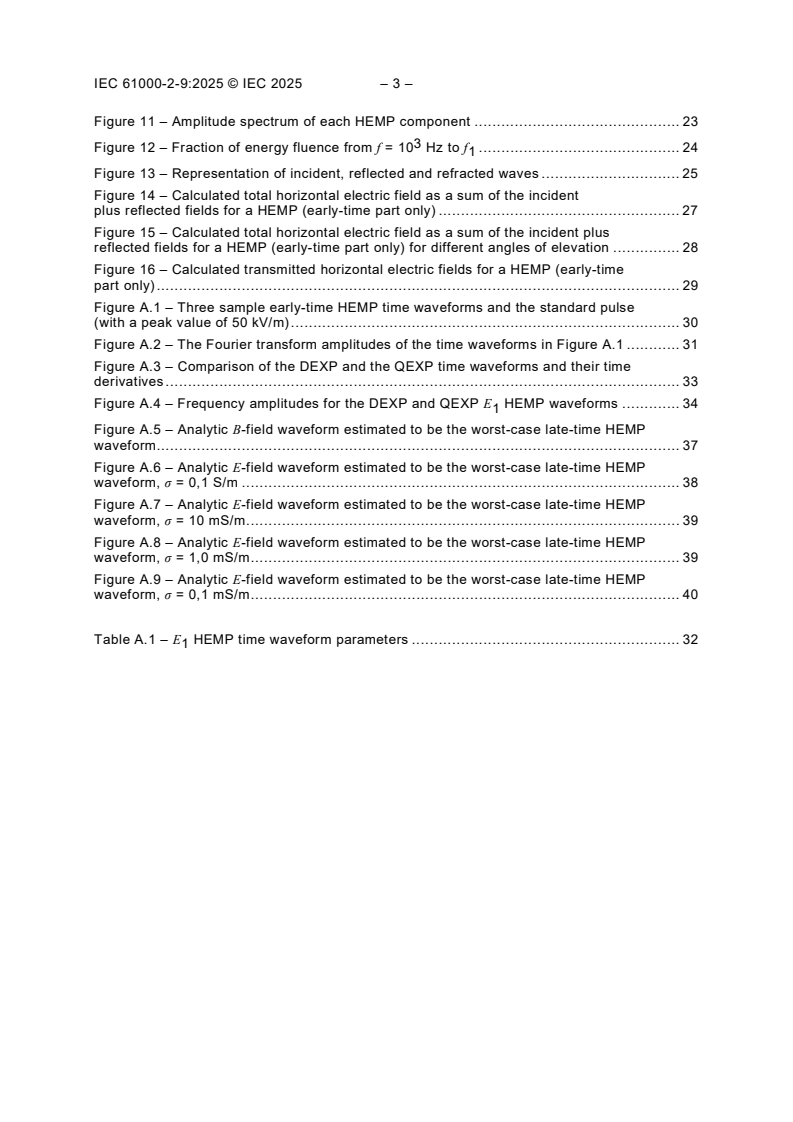
Figure 11 – Amplitude spectrum of each HEMP component . 23
Figure 12 – Fraction of energy fluence from f = 10 Hz to f . 24
Figure 13 – Representation of incident, reflected and refracted waves . 25
Figure 14 – Calculated total horizontal electric field as a sum of the incident
plus reflected fields for a HEMP (early-time part only) . 27
Figure 15 – Calculated total horizontal electric field as a sum of the incident plus
reflected fields for a HEMP (early-time part only) for different angles of elevation . 28
Figure 16 – Calculated transmitted horizontal electric fields for a HEMP (early-time
part only) . 29
Figure A.1 – Three sample early-time HEMP time waveforms and the standard pulse
(with a peak value of 50 kV/m) . 30
Figure A.2 – The Fourier transform amplitudes of the time waveforms in Figure A.1 . 31
Figure A.3 – Comparison of the DEXP and the QEXP time waveforms and their time
derivatives . 33
Figure A.4 – Frequency amplitudes for the DEXP and QEXP E HEMP waveforms . 34
Figure A.5 – Analytic B-field waveform estimated to be the worst-case late-time HEMP
waveform . 37
Figure A.6 – Analytic E-field waveform estimated to be the worst-case late-time HEMP
waveform, σ = 0,1 S/m . 38
Figure A.7 – Analytic E-field waveform estimated to be the worst-case late-time HEMP
waveform, σ = 10 mS/m . 39
Figure A.8 – Analytic E-field waveform estimated to be the worst-case late-time HEMP
waveform, σ = 1,0 mS/m . 39
Figure A.9 – Analytic E-field waveform estimated to be the worst-case late-time HEMP
waveform, σ = 0,1 mS/m . 40
Table A.1 – E HEMP time waveform parameters . 32
– 4 – IEC 61000-2-9:2025 © IEC 2025
INTERNATIONAL ELECTROTECHNICAL COMMISSION
____________
ELECTROMAGNETIC COMPATIBILITY (EMC) –
Part 2-9: Environment –
Description of HEMP environment – Radiated disturbance
FOREWORD
1) The International Electrotechnical Commission (IEC) is a worldwide organization for standardization comprising
all national electrotechnical committees (IEC National Committees). The object of IEC is to promote international
co-operation on all questions concerning standardization in the electrical and electronic fields. To this end and
in addition to other activities, IEC publishes International Standards, Technical Specifications, Technical Reports,
Publicly Available Specifications (PAS) and Guides (hereafter referred to as "IEC Publication(s)"). Their
preparation is entrusted to technical committees; any IEC National Committee interested in the subject dealt with
may participate in this preparatory work. International, governmental and non-governmental organizations liaising
with the IEC also participate in this preparation. IEC collaborates closely with the International Organization for
Standardization (ISO) in accordance with conditions determined by agreement between the two organizations.
2) The formal decisions or agreements of IEC on technical matters express, as nearly as possible, an international
consensus of opinion on the relevant subjects since each technical committee has representation from all
interested IEC National Committees.
3) IEC Publications have the form of recommendations for international use and are accepted by IEC National
Committees in that sense. While all reasonable efforts are made to ensure that the technical content of IEC
Publications is accurate, IEC cannot be held responsible for the way in which they are used or for any
misinterpretation by any end user.
4) In order to promote international uniformity, IEC National Committees undertake to apply IEC Publications
transparently to the maximum extent possible in their national and regional publications. Any divergence between
any IEC Publication and the corresponding national or regional publication shall be clearly indicated in the latter.
5) IEC itself does not provide any attestation of conformity. Independent certification bodies provide conformity
assessment services and, in some areas, access to IEC marks of conformity. IEC is not responsible for any
services carried out by independent certification bodies.
6) All users should ensure that they have the latest edition of this publication.
7) No liability shall attach to IEC or its directors, employees, servants or agents including individual experts and
members of its technical committees and IEC National Committees for any personal injury, property damage or
other damage of any nature whatsoever, whether direct or indirect, or for costs (including legal fees) and
expenses arising out of the publication, use of, or reliance upon, this IEC Publication or any other IEC
Publications.
8) Attention is drawn to the Normative references cited in this publication. Use of the referenced publications is
indispensable for the correct application of this publication.
9) IEC draws attention to the possibility that the implementation of this document may involve the use of (a)
patent(s). IEC takes no position concerning the evidence, validity or applicability of any claimed patent rights in
respect thereof. As of the date of publication of this document, IEC had not received notice of (a) patent(s), which
may be required to implement this document. However, implementers are cautioned that this may not represent
the latest information, which may be obtained from the patent database available at https://patents.iec.ch. IEC
shall not be held responsible for identifying any or all such patent rights.
IEC 61000-2-9 has been prepared by subcommittee 77C: High power transient phenomena, of
IEC technical committee 77: Electromagnetic compatibility. It is an International Standard.
It forms Part 2-9 of IEC 61000. It has the status of a horizontal basic EMC publication in
accordance with IEC Guide 107.
This second edition cancels and replaces the first edition published in 1996. This edition
constitutes a technical revision.
This edition includes the following significant technical changes with respect to the previous
edition:
a) updating the document to provide new information on the variation of the early-time HEMP
on the earth's surface and to provide new information on the late-time HEMP;
b) adding a new informative Annex A which provides details concerning the development of
the early- and late-time standard waveforms in the main body, an explanation of the
advantages and disadvantages for the use of the double exponential waveform, and an
explanation of the far field region for the early-time HEMP.
The text of this International Standard is based on the following documents:
Draft Report on voting
77C/347/FDIS 77C/350/RVD
Full information on the voting for its approval can be found in the report on voting indicated in
the above table.
The language used for the development of this International Standard is English.
This document was drafted in accordance with ISO/IEC Directives, Part 2, and developed in
accordance with ISO/IEC Directives, Part 1 and ISO/IEC Directives, IEC Supplement, available
at www.iec.ch/members_experts/refdocs. The main document types developed by IEC are
described in greater detail at www.iec.ch/publications.
A list of all parts in the IEC 61000 series, published under the general title Electromagnetic
compatibility (EMC), can be found on the IEC website.
The committee has decided that the contents of this document will remain unchanged until the
stability date indicated on the IEC website under webstore.iec.ch in the data related to the
specific document. At this date, the document will be
• reconfirmed,
• withdrawn, or
• revised.
– 6 – IEC 61000-2-9:2025 © IEC 2025
INTRODUCTION
IEC 61000 is published in separate parts according to the following structure:
Part 1: General
General considerations (introduction, fundamental principles)
Definitions, terminology
Part 2: Environment
Description of the environment
Classification of the environment
Compatibility levels
Part 3: Limits
Emission limits
Immunity limits (in so far as they do not fall under the responsibility of product committees)
Part 4: Testing and measurement techniques
Measurement techniques
Testing techniques
Part 5: Installation and mitigation guidelines
Installation guidelines
Mitigation methods and devices
Part 6: Generic standards
Part 9: Miscellaneous
Each part is further subdivided into several sections, published either as International
Standards or as technical specifications or technical reports, some of which have already been
published as sections. Others will be published with the part number followed by a dash and a
second number identifying the subdivision (example: IEC 61000-6-1).
ELECTROMAGNETIC COMPATIBILITY (EMC) –
Part 2-9: Environment –
Description of HEMP environment – Radiated disturbance
1 Scope
This part of IEC 61000 defines the high-altitude electromagnetic pulse (HEMP) environment
that is one of the consequences of a high-altitude nuclear explosion.
There are two cases of nuclear detonations:
– high-altitude nuclear explosions;
– low-altitude nuclear explosions.
For civil systems, the most important case is the high-altitude nuclear explosion. In this case,
the other effects of the nuclear explosion such as blast, ground shock, thermal and nuclear
ionizing radiation are not present at the ground level. However, the electromagnetic pulse
associated with the explosion can cause disruption of, and damage to, communications,
electronic systems, electric power systems and other portions of the commercial critical
infrastructures, thereby upsetting the stability of modern society.
The object of this document is to establish a common reference for the HEMP environment in
order to select realistic stresses to apply to victim equipment for evaluating their performance
and in order to develop protection methods to minimize the impacts of the HEMP.
2 Normative references
There are no normative references in this document.
3 Terms and definitions
For the purposes of this document, the following terms and definitions apply.
ISO and IEC maintain terminology databases for use in standardization at the following
addresses:
• IEC Electropedia: available at https://www.electropedia.org/
• ISO Online browsing platform: available at https://www.iso.org/obp
3.1
angle of elevation in the vertical plane
Ψ
angle Ψ measured in the vertical plane between a flat horizontal surface such as the ground
and the propagation vector
SEE: Figure 1.
– 8 – IEC 61000-2-9:2025 © IEC 2025
Figure 1 – Geometry for the definition of polarization and
of the angles of elevation Ψ and azimuth ϕ
3.2
azimuth angle
ϕ
angle between the projection of the propagation vector on the ground plane and the principal
axis of the victim object
Note 1 to entry: The azimuth angle is measured from the z axis for the transmission line in Figure 1.
3.3
composite waveform
waveform which maximizes the important features of a group of waveforms
3.4
coupling
interaction of the HEMP field with a system to produce currents and voltages on system surfaces
and cables
Note 1 to entry: Voltages result from the induced charges and currents result from the flow of charges.
3.5
direction of propagation
direction of the propagation vector , perpendicular to the plane
k
containing the vectors of the electric and the magnetic fields
SEE: Figure 2.
Figure 2 – Geometry for the definition of the direction of propagation
3.6
E
early-time HEMP electric field
[SOURCE: IEC 61000-2-10:2021, 3.6]
3.7
E
intermediate-time HEMP electric field
[SOURCE: IEC 61000-2-10:2021,3.7]
3.8
E
late-time HEMP electric field
[SOURCE: IEC 61000-2-10:2021,3.8]
3.9
electromagnetic pulse
EMP
any transient electromagnetic time domain waveform
3.10
energy fluence
integral of the Poynting vector over time
Note 1 to entry: Energy fluence is expressed in units of J/m .
– 10 – IEC 61000-2-9:2025 © IEC 2025
3.11
geomagnetic dip angle
θ
dip
dip angle of the geomagnetic flux density vector , measured from the local horizontal in the
B
e
magnetic north-south plane
Note 1 to entry: θ = 90° at the magnetic north pole and –90° at the magnetic south pole.
dip
SEE: Figure 3.
Figure 3 – Geomagnetic dip angle
3.12
ground zero
point on the earth's surface directly below the burst, sometimes called surface zero
3.13
high-altitude electromagnetic pulse
HEMP
high-altitude electromagnetic pulse created by a high-altitude nuclear explosion
[SOURCE: IEC 61000-2-10:2022, 3.11]
3.14
high-altitude nuclear explosion
height of burst above 30 km altitude
[SOURCE: IEC 61000-2-10:2022, 3.12]
3.15
height of burst
HOB
height of burst above the surface of the earth, usually in kilometres
3.16
horizontal polarization
orientation of the electromagnetic wave when the magnetic field vector is in the incidence plane
and the electric field vector is perpendicular to the incidence plane and thus parallel to the
ground plane
Note 1 to entry: This type of polarization is also called perpendicular or transverse electric (TE).
SEE: Figure 1.
3.17
incidence plane
plane formed by the propagation vector and the normal to the ground plane
3.18
low-altitude nuclear explosion
height of burst below 1 km altitude
[SOURCE: IEC 61000-2-10:2022, 3.15]
3.19
nuclear electromagnetic pulse
NEMP
all types of EMP produced by a nuclear explosion
[SOURCE: IEC 61000-2-10:2022, 3.16]
3.20
polarization
orientation of the electric field vector
3.21
prompt radiation
nuclear energy which leaves an explosion within 1 µs
3.22
system generated EMP
SGEMP
NEMP produced on a satellite or other vehicle in space due to photons ejecting electrons from
the metallic surface and causing high surface currents to flow, which produce high levels of
transient electromagnetic fields, and which in turn can create electromagnetic interference in
the vehicle's electronics
3.23
source region EMP
SREMP
NEMP produced in any region where prompt radiation is also present producing currents
(sources) in the air
3.24
tangent point
any point on the earth's surface where a line drawn from the burst is tangent to the surface of
the earth
3.25
tangent radius
distance measured along the earth's surface between ground zero and any tangent point
– 12 – IEC 61000-2-9:2025 © IEC 2025
3.26
vertical polarization
position of the electromagnetic wave when the electric field vector is in the incidence plane and
the magnetic field vector is perpendicular to the incidence plane and thus parallel to the ground
plane
Note 1 to entry: This type of polarization is also called parallel or transverse magnetic (TM).
SEE: Figure 1.
4 Types of HEMP waveforms
A high altitude (above 30 km) nuclear burst produces three types of electromagnetic pulses
which are observed on the earth's surface:
* early-time (E ) HEMP (fast)
* intermediate-time (E ) HEMP (medium)
* late-time (E ) HEMP (slow)
As described in IEC TR 61000-1-3, the earliest efforts dealing with HEMP focused on the early-
time HEMP, which was previously referred to as simply "HEMP" in the past due to an initial lack
of understanding of the later time portions of HEMP. Here the term "high-altitude EMP" or
"HEMP" is used to include all time portions. The term NEMP covers many categories of nuclear
EMPs including those produced by surface bursts, air bursts and high-altitude bursts and also
close to the bursts (SREMP) or created on space systems (SGEMP). The term HEMP is more
specific than the term NEMP, as it defines a type of NEMP. Therefore, the term NEMP shall not
be used as a replacement for HEMP.
Because the HEMP is produced by a high-altitude detonation, one does not observe other
nuclear weapon environments such as prompt radiation, heat, blast and shock waves at the
earth's surface. The occurrence of HEMP was reported from high altitude U.S. nuclear tests in
the South Pacific and from high-altitude tests in the Soviet Union in 1962, producing effects on
electronic equipment far from the burst location (see IEC TR 61000-1-3).
5 Description of HEMP environment, radiated parameters
5.1 High-altitude bursts
When a nuclear weapon detonates at high altitudes, the prompt radiations (x-rays, gamma rays
and neutrons) deposit their energy in the dense air below the burst. In this deposition (source)
region, the gamma rays of the nuclear explosion produce Compton electrons by interactions
with the molecules of the air. These electrons are deflected in a coherent manner by the earth's
magnetic field. These transverse electron currents produce transverse electric fields which
propagate down to the earth's surface. This mechanism describes the generation of the early-
time HEMP (see Figure 4) which is characterized by a large peak electric field (tens of kilovolts
per meter), a fast rise time (nanoseconds), a short pulse duration (up to about 100 ns) and a
wave impedance (at the peak of the pulse) of approximately 377 Ω. The early-time HEMP
exposes the earth's surface within line-of-sight of the burst and is polarized transverse to the
direction of propagation and to the local geomagnetic field within the deposition region. In the
northern and southern latitudes (i.e., far from the Equator) this means that the electric field is
predominantly oriented horizontally (horizontal polarization). Near the Equator, the electric field
is predominantly oriented vertically (vertical polarization).
NOTE 1 Only one line of sight ray is shown.
NOTE 2 While HEMP is defined for HOB ≥ 30 km, only burst heights above 50 km produce a source region below
the burst.
Figure 4 – Schematic representation of the early-time HEMP from
an example of a high-altitude burst
Immediately following the initial fast HEMP transient, scattered gamma rays and inelastic
gammas from weapon neutrons create additional currents and ionization resulting in the second
part (intermediate time) of the HEMP signal. This second signal is on the order of 10 V/m to
100 V/m and occurs in a time interval from 100 ns to tens of milliseconds after the arrival of the
early-time HEMP.
The last type of HEMP, the late-time HEMP, also designated magnetohydrodynamic EMP (MHD
EMP) is generated from the same nuclear burst. Late-time HEMP is characterized by a low
amplitude electric field (up to approximately 100 mV/m), a slow rise time (seconds), and a long
pulse duration (hundreds of seconds after the arrival of the early-time HEMP). These fields will
induce similar currents in power lines and telephone networks as those associated with
geomagnetic storms often observed in the Northern U.S., Canada and in Northern Europe. Late-
time HEMP can interact with long transmission and distribution lines to induce currents that
result in half-cycle saturation of transformers, severe harmonics, voltage imbalances and the
generation of hot spots in large transformers that potentially could create damage.
In this document the maximum levels of early-, intermediate- and late-time HEMP will be
presented, and while each portion of the HEMP is typically generated by a high-altitude nuclear
burst, the burst altitudes that maximize each of these waveforms are not the same. The different
pulses also couple to electronic systems in different ways, and therefore for example, the early-
time HEMP is most important to relatively small equipment and its connected cables, while the
late-time HEMP is most important to very long lines and the equipment connected to them.
Since critical equipment and systems to be protected cannot know the burst locations (height,
latitude and longitude), they should consider the maximum fields for each HEMP portion to
design protection, although information is provided concerning the variability of the fields, so
systems with less criticality could consider lower field levels if recovery can be accomplished in
a reasonable time.
– 14 – IEC 61000-2-9:2025 © IEC 2025
5.2 Spatial extent of E HEMP on the earth's surface
The strength of the electric field observed at the earth's surface from a high-altitude explosion
can vary significantly (in peak amplitude, rise time, duration and polarization) over the large
area exposed by the HEMP depending on burst height and yield (see Figure 4). For example,
in the northern hemisphere, the maximum peak electric field identified as E occurs south of
max
ground zero and can be as high as 50 kV/m, depending upon the height of burst and the weapon
yield (in the southern hemisphere the maximum region is found to the north of ground zero).
Figure 5 shows the early-time HEMP tangent radius as a function of the height of burst (HOB).
For an explosion at an altitude of 50 km, for example, the affected area on the ground would
have a radius of 800 km and for an altitude of 500 km, the tangent radius would be about
2 500 km. Figure 6 describes the general variation of the peak HEMP fields over the exposed
area of the earth.
5.3 HEMP time dependence
5.3.1 General
In 5.3, electric field time waveforms are identified to represent the early-time, intermediate-time,
and late-time HEMP environments, with the maximum levels identified with some information
given concerning variability.
5.3.2 Early-time HEMP waveform
Examples of the general variation of early-time HEMP waveforms with location are shown by
the three waveforms A, B and C in Figure 7 with the curves referenced to the positions noted
in Figure 6. With respect to Figure 6, point A is located just north of ground zero. In addition,
the value of the peak electric field at the earth's tangent (shown as 0,5 E ) can be less than
max
this value depending on the combination of burst height and yield. For bursts in the southern
latitudes (between 30° and 60° south latitude) the figure is reflected such that the maximum
peak field region is north of the burst and the minimum field region is south of the burst.
Since the incident waveshapes in Figure 7 vary greatly, and there is no way to predict the burst
location in advance, a generalized standard time waveform is constructed for the early-time
HEMP that maintains the short rise time of the near-ground-zero location and the large
amplitude of the HEMP in the region of maximum peak amplitude. An envelope of all pulses in
the time domain, including the long fall time in the tangent region, would provide an extreme
case, however, it is understood that the widest pulses do not occur when the peak value is the
highest. A more realistic composite waveform, constructed from the envelope of the Fourier
transforms (amplitude spectra in the frequency domain) of all of them, results in a standard
waveform recommended for use (see Formula (1) and Figure 8 a) and b). More details of the
process used to develop this standard waveform are found in Annex A.
NOTE , where H is HOB in km for values equal to or less than 500 km.
RH≈ 110
TB B
Figure 5 – HEMP tangent radius as a function of height of burst (HOB)
– 16 – IEC 61000-2-9:2025 © IEC 2025
Figure 6 – Typical variations in peak electric fields on the earth's surface
for burst altitudes between 30 km and 500 km and for ground zero
between 30° and 60° northern latitude
Figure 7 – Different waveforms for three typical cases indicated in Figure 6
(point A, point B, point C) and the composite curve fit
For these cases, the standard electric field early-time behaviour in free space of this wave is
given by:
0 when t ≤ 0
Et =
( )
-at -bt
E ⋅−ke e when t>0
01 1
E = 50 000 V/m
(1)
7 -1
a = 4 × 10 s
8 -1
b = 6 × 10 s
k = 1,3
where
E is given in volts per meter;
t is in seconds.
Two plots of Formula (1) are given in Figure 8 a) and Figure 8 b). Figure 8 a) shows the pulse
rise characteristics. The pulse decay behaviour is given in Figure 8 b). Because this waveform
attempts to bound features of any early-time HEMP waveform, it is considered a standard
waveform and shall be used for performing coupling studies and testing. The pulse has a peak
amplitude of 50 kV/m, a 10 % to 90 % rise time of 2,6 ns – 0,1 ns = 2,5 ns, a time to peak of
4,8 ns, and a pulse width at half maximum of 23 ns. The energy fluence of the early-time
waveform is 0,114 J/m .
It should be emphasized that the early-time HEMP is an incident field, and reflections from the
ground shall be treated separately (see 5.7). The incident electric field is polarized
perpendicular to the direction of propagation and the earth's magnetic field. Because of this
relationship, the local vertical component of the incident early-time HEMP electric field is
maximum to the magnetic east and west of the burst at the earth’s tangent point. Toward the
magnetic north and south, the local vertical electric field component is zero. Since it is not
known where the burst will be located relative to a given observer, the range of vertical and
horizontal electric field component fractions can be defined as:
f ≤ cos θ
v dip
f ≥ sin θ
(2)
h dip
2 2
ff+=1
vh
Figure 8 c) provides information to establish θ .
dip
– 18 – IEC 61000-2-9:2025 © IEC 2025
a) 0 ns to 10 ns (pulse rise characteristic)
b) 0 ns to 50 ns (pulse decay behaviour)
c) Dip angle, θ , of the earth's magnetic field
dip
[SOURCE: US/UK World Magnetic Model, Epoch 2020.0, accessed from https://www.ngdc.noaa.gov/geomag/.]
Figure 8 – Plots of the early-time HEMP standard waveform (Formula (1))
and a world map indicating the variation of the dip angle of
the geomagnetic field used in Formula (2)
5.3.3 Intermediate-time HEMP waveform
The intermediate-time HEMP is characterized by an amplitude of 10 V/m to 100 V/m for times
between approximately 0,1 µs and 0,001 s. The field has similarity to the early-time HEMP in
terms of being defined as an incident radiation field with the same polarization as the early-time
HEMP. After earth reflection, the electric field will be oriented mainly vertically with a small
horizontal component.
___________
Reproduced with permission of the U.S. Government.
– 20 – IEC 61000-2-9:2025 © IEC 2025
The standard electric field intermediate-time behaviour in free space of this wave is given by:
0 when t ≤ 0
Et( ) =
-a t -b t
E ⋅− k e e when t>0
02 2 )
(
E = 100 V/m
(3)
-1
a = 1 000 s
8 -1
b = 6 × 10 s
k = 1
where
E is given in volts per meter;
t is in seconds.
A plot of this waveform is shown later in Figure 10. This waveform has a peak amplitude of
100 V/m and a pulse width at half maximum of 693 µs. The energy fluence of the wave is
approximately 0,0133 J/m . This waveform shall be used for coupling studies to long lines but
is not well suited for equipment radiated field testing due to its low frequency content. The
wavelengths of the E HEMP field are much longer than typical equipment with short cables,
and therefore direct field coupling is very inefficient.
5.3.4 Late-time HEMP waveform
The most important late-time portion of the HEMP waveform is produced by the heave
magnetohydrodynamic (MHD) effect and produces electric fields in the earth up to
approximately 100 mV/m (or 100 V/km) for times between 1 s and 1 000 s. The peak electric
field varies based on the local deep earth conductivity (to depths of 700 km). The induced
electric field is oriented horizontally (to the earth's surface).
There is another mechanism involved in the late-time HEMP known as the blast wave effect,
and it produces fields from 1 s to 10 s, but at distances far away from the surface zero position
(thousands of kilometers). See [7] for more details.
The standard time waveform for the heave process is defined here for a uniform deep ground
conductivity of 1 mS/m and is intended to provide the highest level of field within the exposed
area of the earth for those cases where this level of conductivity is appropriate.
The time behaviour for the standard late-time HEMP electric field waveform is given as:
1,5 5,2
2,5 tt75 − 1,2 75
( ) ( )
3,284
V/km, when t ≥ 0,
Et() =
2 (4)
σ
3,7
G
1+ (t 75)
___________
Numbers in square brackets refer to the Bibliography.
where t is the time in seconds and is the ground conductivity in S/m. This waveform is shown
σ
G
in Figure 9. This waveform with the appropriate ground conductivity shall be used for coupling
studies.
The basis for this waveform is discussed in Clause A.4 [8].
Figure 9 – Standard late-time HEMP waveform
5.3.5 The complete standard HEMP electric field time waveform
The late-time portion of the HEMP waveform is produced by the heave magnetohydrodynamic
(MHD). Figure 10 shows the time behaviour of all three contributions to the HEMP. It is
emphasized that E (t) and E (t) are incident waves with identical polarizations (depending on
1 2
the local earth's magnetic field vector and the line-of-sight direction from the burst to the
observer) while E (t) is an induced electric field in the earth with horizontal orientation (to the
earth's surface).
– 22 – IEC 61000-2-9:2025 © IEC 2025
Figure 10 – Complete standard HEMP time waveform
5.4 Early-time HEMP magnetic field component
The early-time HEMP electric field waveforms as indicated in Figure 8 a) and Figure 8 b) are
created from transverse currents along a radial path from the burst through the source region;
it then propagates to the earth’s surface along the radial path from the burst. The lengths of
these current paths are on the order of 30 km to several hundred kilometres, depending on the
angle of the line of sight through the atmosphere. Therefore, the ground observer location is
not in the far field of the source "antenna" for all frequencies of interest. See Annex A for more
details.
It is important to recognize that the early-time HEMP waveform contains many frequencies with
the highest frequencies contained in the rise of the pulse up to the peak value, and the lowest
frequencies represented by the fall of the pulse. It can be approximated that for the rise of the
pulse and the peak value, the magnetic field can be computed by dividing the electric field
= 120 π = 377 Ω. At later times, the use of this value is not precise but could
waveform by Z
be used approximately for the entire early-time waveform out to a time of 1 µs.
In order to calculate the peak incident magnetic field for the early-time HEMP:
E 50000
H = = =132,6 A/m
(5)
Z 120π
where
E is given in volts/meter;
Z is given in ohms;
is given in amperes/meter.
H
5.5 HEMP amplitude and energy fluence spectrum
Many of the significant HEMP energy collectors are particularly frequency selective during the
coupling process. It is thus important to establish the HEMP energy distribution in the frequency
domain. The Fourier transform of the generalized HEMP electric field time waveform is used to
find the relative contribution of the constituent frequencies:
+∞
− j2πft
E f E()f⋅ e dt
( ) (6)
∫
−∞
For the difference of exponential analytic time waveform used in Formula (1) and Formula (3),
the Fourier transform is analytic and is given by:
E ⋅−k b a
( )
om m m m
− jφ
Ef = e
( ) (7)
m
j 22πf ++a j πf b
( )( )
mm
where
m can be 1, 2, i or j;
φ is a phase shift (φ = 0 for E and E , φ = 2πf for E and E ).
1 2 i j
For the late-time HEMP waveform, the electric field time waveform has been numerically Fourier
transformed, and its amplitude is shown in Figure 11. Figure 11 shows the amplitude density
spectrum of the complete high altitude EMP electric field. Each of the components is shown
separately. It is noted that all three portions of the HEMP waveform cannot attain their worst-
case values at a single location on the ground, so this graph is shown only for information about
the frequency content of each of the three portions.
Figure 11 – Amplitude spectrum of each HEMP component
=
– 24 – IEC 61000-2-9:2025 © IEC 2025
The power spectrum S(f) describes the energy density as a function of frequency (i.e., with the
far field assumption for frequencies above 10 MHz):
2 | Ef( )|
S f = (8)
( )
Z
where
Z = 120 π Ω.
The energy fluence of the early-time E waveform can be found by integrating Formula (8) in
the frequency domain giving:
f
+∞
(9)
W=S ( f )•=df W S ( f )• df
Tf
∫∫
10 10
Figure 12 shows the cumulative amount of energy fluence of the early-time HEMP as a function
of frequency using the analytic waveform described in Formula (1).
Figure 12 – Fraction of energy fluence from f = 10 Hz to f
5 8
EXAMPLE The energy fluence below 10 Hz is 2 %. Below 10 Hz it is about 98 %. Therefore 96 % of the energy
5 8
fluence is between 10 Hz and 10 Hz.
This example indicates that the important part of the early-time HEMP pulse (from an energy fluence point of view)
is in the 0,1 MHz to 100 MHz frequency range.
As shown earlier in Figure 11, the amplitude spectra for E and E are higher than E for
2 3 1
frequencies below 10 Hz and 1 Hz, respectively. In spite of this situation, E and E have a
2 3
total energy fluence much less than that of E , due to the lower frequencies involved. The
energy fluence of the intermediate-time and late-time HEMP is negligible compared to the early-
time HEMP.
However, it is emphasized that the energy which is picked up from an electromagnetic field by
an "antenna" and then conducted to a "victim" does not only depend upon the total incident
energy fluence W of the field. This is because the voltages and currents that are induced at
T
the electronics level in a system are also functions of the coupling mechanisms, the system
topology, the impedance matching, and in power grids, the follow on currents after a dielectric
breakdown.
5.6 Comparison of the early-, intermediate- and late-time HEMP
Intermediate-time and late-time HEMP effects are often neglected in the open literature,
because only their small amplitudes are considered. One might believe that 100 V/m
(intermediate time) and 85 mV/m (late-time) peak values may be neglected compared to the
50 000 V/m of t
...